Introduction
Palms (Arecaceae) and weevils of the tribe Derelomini (Coleoptera, Curculionidae) have developed a series of close host–pollinator interactions, showing a striking example of mutualistic systems (Franz and Valente, Reference Franz and Valente2006). Palm inflorescences or leaves produce attractive odours for their specific pollinators (Dufay et al., Reference Dufay, Hossaert-McKey and Anstett2003; Auffray et al., Reference Auffray, Frérot, Poveda, Louise and Beaudoin-Ollivier2017) and inflorescences provide shelter and food substrate for adults and larvae. In return, weevils provide efficient pollination by flying between male and female inflorescences of their specific host. As for all closely co-evolved relationships, both partners have mutual dependence to ensure their survival, and detailed studies of these associations are essential for a better understanding of the adaptation and maintaining of these interactions to changing environments (Franz and Valente, Reference Franz and Valente2006).
Elaeis guineensis Jacquin, 1763, the oil palm, is native to humid tropical Africa (Zeven, Reference Zeven1964; Ergo, Reference Ergo1997). The red oil produced by its fruits is traditionally used by local populations for subsistence and trade and has played a fundamental role in the nutrition and social development of many African forest peoples (Rival and Levang, Reference Rival and Levang2013; Cochard and Durand-Gasselin, Reference Cochard, Durand-Gasselin and Rival2018). Due to its more substantial oil production per hectare than any other crop (only 150 oil palms/ha are needed to produce an average of 5 tonnes of oil per year) (Launois et al., Reference Launois, Chirara, Durand-Gasselin and Rival2016), this species and its hybrids have been introduced into many parts of the tropics (Central and South America, India, South East Asia) where they are currently a major component of oil production, and of associated controversial impacts (Hartley, Reference Hartley1967; Piggott, Reference Piggott1990; Jacquemard, Reference Jacquemard1995; Cochard et al., Reference Cochard, Adon, Rekima, Billotte, Desmier de Chenon, Koutou, Nouy, Omoré, Razak, Glaszmann and Noyer2009; Rival and Levang, Reference Rival and Levang2013; Potter, Reference Potter2015; Corley and Tinker, Reference Corley and Tinker2016; Savi, Reference Savi and Rival2018).
In its native range, the inflorescences of the oil palm are mainly pollinated by seven Derelomine weevils of the genus Elaeidobius Kuschel, namely the species E. bilineatus (Hustache), E. kamerunicus (Faust), E. pilimargo Haran & Kuschel, 2020, E. piliventris Haran & Kuschel, 2020, E. plagiatus (Fahraeus), E. singularis (Faust) and E. subvittatus (Faust) (Haran et al., Reference Haran, Beaudoin-Ollivier, Benoit and Kuschel2020). All these species are sympatric over the entire native distribution range of the oil palm and they may be found together on a single inflorescence (Haran et al., Reference Haran, Beaudoin-Ollivier, Benoit and Kuschel2020), usually giving rise to large population densities (Mariau et al., Reference Mariau, Houssou, Lecoustre and Ndigui1991). The exact role of each of these species in pollinating the host is not clear, but some species seem to have divergent oviposition preferences on anthesis (Syed, Reference Syed, Pusharajah and PS1982). Pollination efficiency also appears to vary between some species and E. kamerunicus was identified as the most efficient because it exhibits the highest pollen carrying capacity (Syed et al., Reference Syed, Law and Corley1982). Indeed, male specimens of E. kamerunicus possess a large body surface and long setae that allow a high pollen load (Dhileepan, Reference Dhileepan1992). Due to this apparent pollinating efficiency, and to its adaptation to long rainy seasons, E. kamerunicus was introduced and successfully established during the second half of the 20th century in various tropical regions growing oil palms (Corley and Tinker, Reference Corley and Tinker2016). Following this introduction, a substantial increase in yield was observed in various South American and Asian countries (Syed et al., Reference Syed, Law and Corley1982; Li et al., Reference Li, Tscharntke, Saintes, Buchori and Grass2019). However, the increase was not observed over the long term in some particular Malaysian populations (Corley and Tinker, Reference Corley and Tinker2016). In addition, after a period of yield improvement, a decrease in fruit set and oil extraction rates was documented in Malaysia and Indonesia (Donough et al., Reference Donough, Chew and Law1996; Rao and Law, Reference Rao and Law1998). Several hypotheses have been suggested to explain this trend, such as poor adaptation of populations to the local climate and the impact of parasitic nematodes (Li et al., Reference Li, Tscharntke, Saintes, Buchori and Grass2019). In order to gain a clearer understanding of this decline in pollination efficacy, there is a need to explore the biology, ecology, but also the genetic diversity of this species in its native range (Li et al., Reference Li, Tscharntke, Saintes, Buchori and Grass2019).
In this study, we reconstructed the phylogeography of E. kamerunicus in its native and introduced areas with both mitochondrial and nuclear genes. We then attempted to relate the genetic patterns observed to potential driving parameters.
Material and methods
Sampling
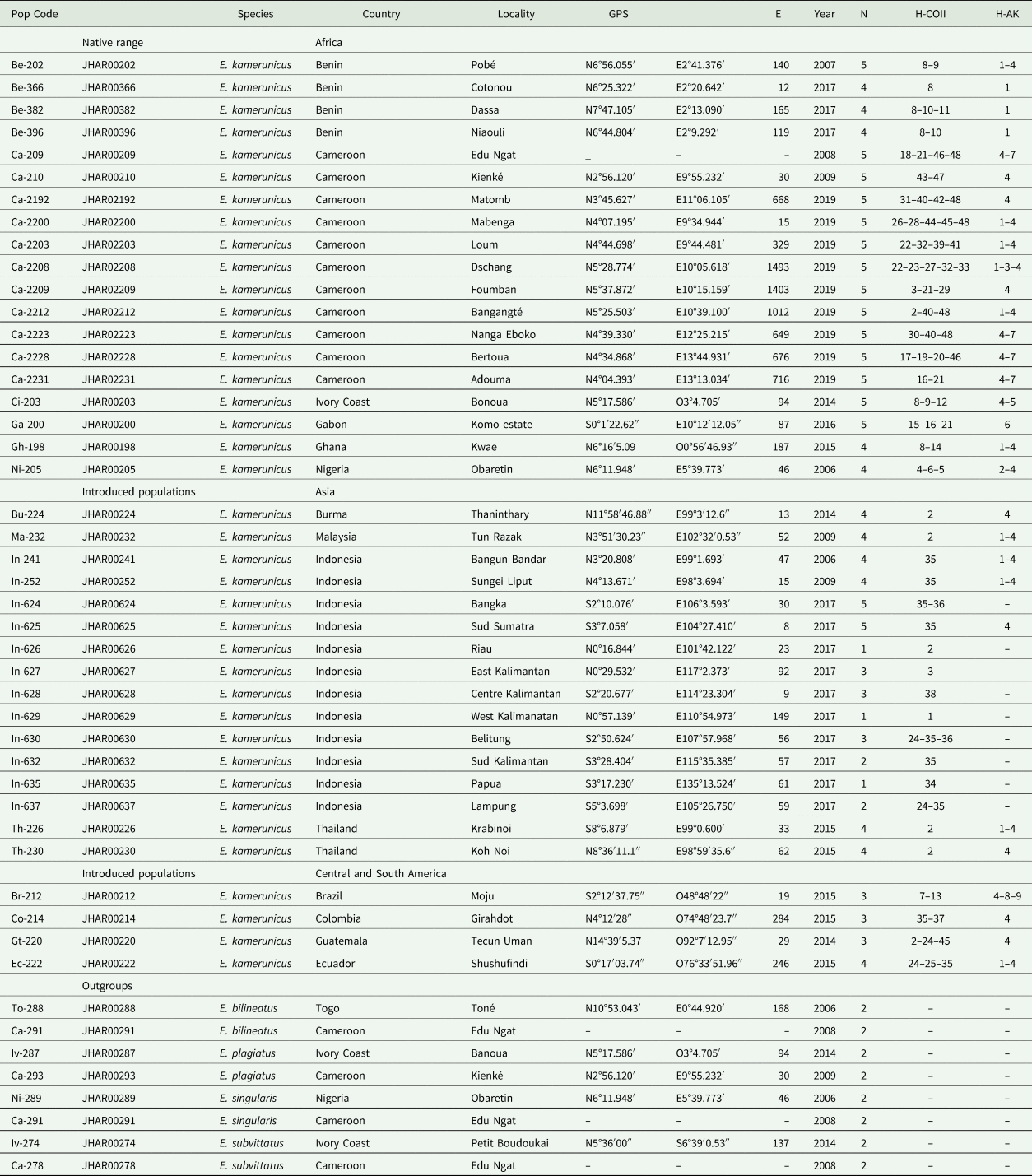
Specimens of Elaeidobius kamerunicus were collected on male inflorescences of Elaeis guineensis at the full anthesis stage. In total, 39 localities were sampled worldwide, with a focus on the native range of this weevil where 19 populations were sampled (Table 1). In Asia and South America, 16 and 4 populations were sampled, respectively. Population sizes ranged from 1 to 5, for a mean value of 3.9 specimens per site. Adults were collected from cultivated spots of E. guineensis, both in smallholdings in village areas or in large plantations. The collection years ranged from 2006 to 2019. After collection, E. kamerunicus specimens were sorted from co-occurring species of Elaeidobius and stored in 96% ethanol at 4°C pending DNA extraction.
Details of the samples of Elaeidobius species and specimens of E. kamerunicus included in the study

E, elevation (metres); N, number of individuals in the population; H-COII, number of COII haplotypes found in the population; H-AK, number of AK haplotypes found in the population.
DNA extraction and amplification
One to five individuals were processed per collection site, for a total of 153 specimens. Non-destructive DNA extraction was carried out on full specimens using a Qiagen DNeasy® 96 Blood and Tissue Kit (Qiagen, Germany). The extraction steps followed the manufacturer's instructions, with a lysis step extended to 12 hours in a thermomixer at 56°C in order to maximize the digestion of DNA-rich tissues. After extraction, specimens were washed in H2O, re-mounted on cards, dried and deposited in the Centre de Biologie pour la Gestion des Populations, Montpellier, France (CBGP) collection as vouchers (CIRAD collection), in Montpellier, France.
Two genes were sequenced for each specimen: the cytochrome c oxidase subunit II (COII) and the nuclear gene fragment of arginine kinase (AK). The primers used were as follows: TL2-J-3038 5′-TAATATGGCAGATTAGTGCATTGGA and TK-N-3782 5′-GAGACCATTACTTGCTTTCAGTCATCT for COII (727 bp) and ArgKforB2 5′-GAYTCCGGWATYGGWATCTAYGCTCC and ArgKrevB1 5′-TCNGTRAGRCCCATWCGTCTC for AK (757 bp; Hernández-Vera et al., Reference Hernández-Vera, Caldara, Toševski and Emerson2013). The polymerase chain reactions (PCR) were carried out in a final volume of 10 μl of PCR mix containing 5 μl of Multiplex Master Mix (Qiagen, Hilden, Germany), 0.2 μM of each primer and 2 μl of DNA template. The PCR conditions were as follows: initial DNA denaturation at 94°C for 15 min, followed by 37 cycles of 1 min at 95°C, 1 min at 52°C, and 1 min at 72°C, with a final extension of 5 min at 72°C. The PCR products were sequenced from both strands at Eurofins Genomics (Ebersberg, Germany).
Sequence analysis
The Sanger sequences were aligned with CodonCode Aligner v. 10.5.8 software (CodonCode Corporation, Dedham, Massachusetts, USA) and checked for the presence of pseudogenes using standard detection methods (Haran et al., Reference Haran, Koutroumpa, Magnoux, Roques and Roux2015). The genus Elaeidobius comprises a number of species, several of which are morphologically closely related (Haran et al., Reference Haran, Beaudoin-Ollivier, Benoit and Kuschel2020). In order to ensure the correct assignation of all specimens to E. kamerunicus, a phylogenetic tree was first reconstructed for each gene with the sequence of four congeneric species (E. bilineatus, E. plagiatus, E. singularis and E. subvittatus). Phylogenetic analyses were carried out using PhyML (Guindon and Gascuel, Reference Guindon and Gascuel2003) following the automatic model selection implemented in the software. COII and AK trees were inferred with 1000 bootstrap replicates and then annotated using FigTree v. 1.4.2 (Rambaut, Reference Rambaut2010). Uncorrected p-distances were computed using Mega 7 (Kumar et al., Reference Kumar, Stecher and Tamura2016).
A haplotype network was built for COII and AK using the software TCS 1.21 (Clement et al., Reference Clement, Posada and Crandall2000). In AK, variable sites with more than two ambiguous sites were removed from the analysis, as they corresponded to artificial diversity due to amplification of closely related paralogs. Nucleotide diversity (average over loci) and п (mean number of pairwise differences) were estimated for each haplogroup, in the native areas and in areas of introduction using DnaSP v. 6 (Librado and Rozas, Reference Librado and Rozas2009). The geographic origin of introduced populations was determined using phylogenetic relatedness of populations. Haplotypes of COII and AK were displayed in a geographic context using QGIS (3.4.12-Madeira).
Results
Nucleotide sequences were obtained for 157 and 115 specimens of E. kamerunicus for the COII and AK genes, respectively. Sequences of AK were not obtained for several Asian populations due to poor specimen storage conditions and resulting poor DNA quality. Sequences of COII showed no traces of ambiguous sites, stop codons or insertions that could be assigned to pseudogenes or heteroplasmy. Sequences with 3′ or 5′ missing parts were removed from the analysis. Two ambiguous sites on AK on positions 355 and 491 were also removed from the rest of the analysis.
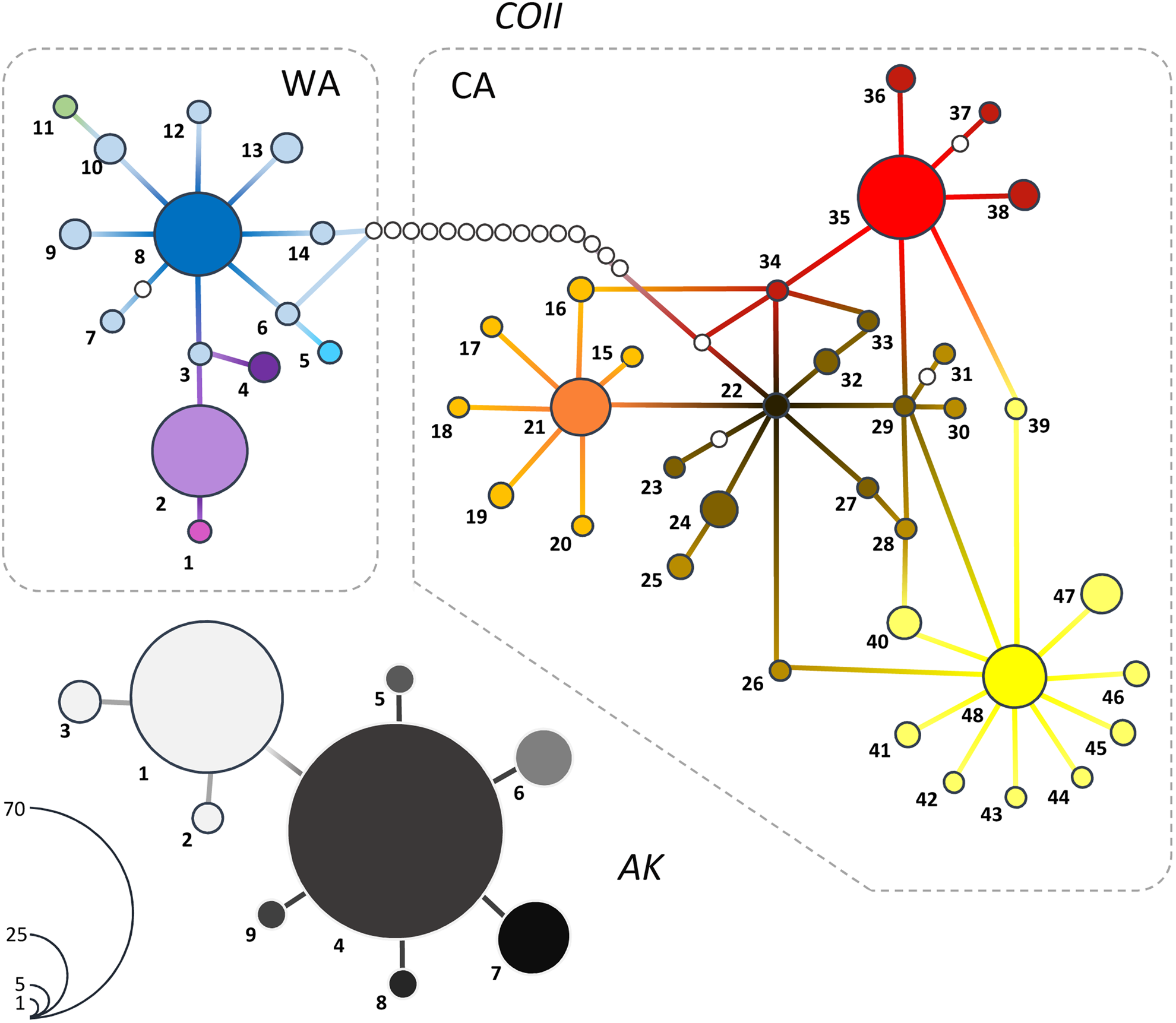
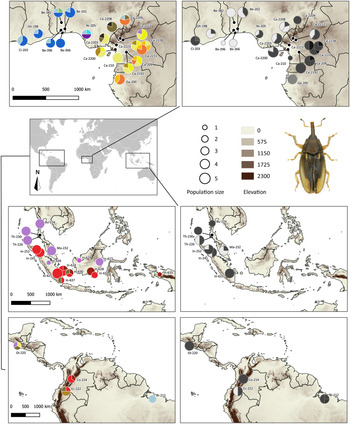
A phylogenetic analysis of the COII and AK genes (best model selected TN93 + G for COII and TN93 for AK) showed that all specimens were correctly identified as E. kamerunicus, which formed a cluster distinct from all the other Elaeidobius species included in the analysis (bootstrap value = 100, Appendix 1). The COII sequences of E. kamerunicus formed two well supported clusters in its native area: the first comprising the West African populations including Ivory Coast, Ghana, Benin, Nigeria, and two specimens in western Cameroon (hereafter called the WA cluster) (fig. 1), and the second with all central African populations, including Cameroon and Gabon (hereafter called the CA cluster). Uncorrected p-distances between these two clusters ranged from 2.2 to 2.9%. Intra-cluster distances reached 0.55 and 0.69% for the WA and CA clusters, respectively. The two clusters formed a rather sharp contact zone located along the Cameroon Volcanic Line (CVL). Only two specimens belonging to the WA cluster were found to the southeast of this mountain range (Ca-2209-1 and Ca-2212-1). The distribution of AK haplotypes roughly followed an East-West distribution, but the geographic distribution of these haplotypes on both sides of the CVL was not as sharp as observed for COII (fig. 2). The maximum p-distance within AK haplotypes reached 0.66%.
TCS networks of the mitochondrial Cytochrome oxidase 2 gene (COII) and the Arginine kinase nuclear gene (AK) for all the specimens of Elaeidobius kamerunicus included in the study (native area and regions of introduction). Disc diameters refer to the relative abundance of the particular haplotype among all sequences. White circles represent missing haplotypes and lines between them the mutation steps.

Geographical distribution of haplotypes of populations of Elaeidobius kamerunicus for the mitochondrial Cytochrome oxidase 2 gene (COII) and the Arginine kinase nuclear gene (AK) in the native area (Tropical Africa, middle) and areas of introduction (Central and South America, left; Southeast Asia, right). Pie diameters refer to the size of populations from each site. The colour and pattern of pies refer to the haplotypes displayed in fig. 1.

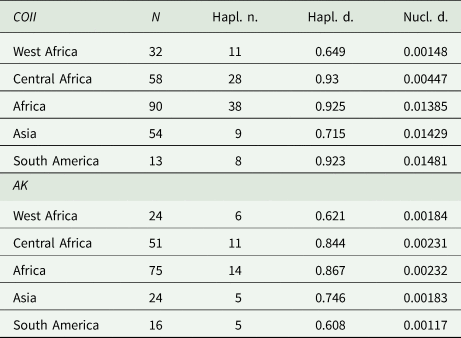
The TCS haplotype network based on COII sequences showed that the WA and CA clusters formed two haplogroups separated from each other by 16 mutation steps. The haplotype number, haplotype diversity and nucleotide diversity was higher in the CA haplogroup (Table 2), which displayed a more complex and interconnected structure (fig. 1). The haplotype network based on AK formed a single haplogroup, with the majority of specimens belonging to two main haplotypes separated by one mutation step (1–4, fig. 1).
Statistical analysis of the haplogroups identified based on COII sequences

N, number of individuals in the group; Hapl. n., haplotype number; Hapl. d., haplotype diversity; Nucl. d., nucleotide diversity.
The populations introduced into Asia and South America both included the WA and CA clusters identified in Africa for COII (fig. 2). Asian populations displayed two major haplotypes (no. 2 and no. 35) and an overall low haplotype number compared with African populations. The two major haplotypes found in Asian populations were not encountered in Africa, although they are close to some haplotypes encountered there (1 mutation step). South American populations were less densely sampled but displayed a relatively large number of haplotypes. Of all the introduced populations, the two WA and CA clusters were not encountered together in the localities sampled (apart from Guatemala: Gt-220).
Discussion
Two main genetic clusters in the native area
Our results showed that E. kamerunicus is forming two divergent mitochondrial clades in its native area, one in West Africa and the second in central Africa. Such a pattern is commonly observed in the interspecific and intraspecific splits of Afrotropical forest insect species (Le Gall et al., Reference Le Gall, Silvain, Nel and Lachaise2010), as well as in plants (Duminil et al., Reference Duminil, Brown, Ewédjè, Mardulyn, Doucet and Hardy2013; Demenou et al., Reference Demenou, Doucet and Hardy2017) and vertebrates (Leaché and Fujita Reference Leaché and Fujita2010; Hassanin et al., Reference Hassanin, Khouider, Gembu, Goodman, Kadjo, Nesi, Pourrut, Nakouné and Bonillo2015). Indeed, the climatic oscillations which occurred during the Pleistocene have caused cycles of fragmentation-expansion of tropical forests around the Gulf of Guinea (Dupont et al., Reference Dupont, Donner, Schneider and Gerold2001; Miller and Gosling, Reference Miller and Gosling2014) successively connecting or splitting populations between the Upper Guinean (West Africa) and Lower Guinean (Western Central Africa) rain forest blocks (Demenou et al., Reference Demenou, Doucet and Hardy2017). Elaeis guineensis is a pioneer species of African forests, and the genetic structure of its wild populations revealed by microsatellites also showed such West – Western Central differentiation (Cochard et al., Reference Cochard, Adon, Rekima, Billotte, Desmier de Chenon, Koutou, Nouy, Omoré, Razak, Glaszmann and Noyer2009). Therefore, our results suggested that this species and its specific pollinator E. kamerunicus have both experienced such fragmentation of populations during their shared evolutionary history.
However, the genetic patterns of the nuclear and mitochondrial genes used showed clear incongruence. The maternally inherited mitochondrial COII displayed a much stronger genetic structure than the nuclear AK, especially where the two clusters were forming a contact zone. Such patterns show, primarily, that E. kamerunicus is a single panmictic species, as it is a signature of maintained gene flow of the nuclear genome between populations of the two mitochondrial clusters. This genetic pattern is also usually considered as a consequence of sex-biased dispersal, with the females dispersing less than the males. In E. kamerunicus, this hypothesis is relevant because males exhibit morphological adaptations for pollen transport (long setae on the body) and ensure most of the pollination. However, the dispersal ability of E. kamerunicus has not been tested formally yet (Syed, Reference Syed, Pusharajah and PS1982), and neither have potential differences between males and females (Li et al., Reference Li, Tscharntke, Saintes, Buchori and Grass2019).
The contact zone between the WA and CA mitochondrial clusters was observed along the CVL, contrasting with the splits usually observed at the Dahomey gap, the current gap between the two forest blocks (Le Gall et al., Reference Le Gall, Goergen and Neuenschwander2002, Reference Le Gall, Silvain, Nel and Lachaise2010). The CVL is located about 800 km east of that gap. It comprises a 1600 km long volcano chain running from Northeast to Southwest, including the islands of the Guinean Gulf. In its continental section, this chain is a moderate altitudinal barrier 100 km in width, culminating at 4095 m (Mount Cameroon). However, in several parts, especially along the coast and 50 km inland near the region of Kumba, the elevation is only 100–200 m above sea level. The sharp contact zone between the two mitochondrial clusters along the CVL tends to show that it acts at least partly as a physical barrier to the dispersal of E. kamerunicus females. However, a strong effect of this moderate barrier is not expected, because the host plant of this weevil is found on either side of the mountain and rain forests have formed a single block there for the last 9000–4500 years (Demenou et al., Reference Demenou, Doucet and Hardy2017). In addition, E. kamerunicus does not seem to be limited in its dispersal by intermediate elevations, as some populations were collected up to 1500 m above sea level (Dschang, Cameroon). It is suggested that other parameters, such as climate, might explain the genetic patterns observed. The CVL also coincides with a transition zone for monthly rainfall distribution. On the southern side of this mountain range, rains are permanent and abundant, from 2000 to 11,000 mm on the flank of Mount Cameroon (Etia, Reference Etia, Laclavere and Loung1980). Conversely, on the Nigerian side of this chain, rains occur from March to October, with the winter months in this case being dry. Rains and associated moisture are critical for insect survival, dispersal, and distribution. Such parameters can determine the distribution of species or populations in beetles, and explain the maintenance of sharp contact zones between genetically distinct populations (Kutywayo et al., Reference Kutywayo, Chemura, Kusena, Chidoko and Mahoya2013; Haran et al., Reference Haran, Rousselet, Tellez, Roques and Roux2018). In E. kamerunicus, climatic parameters are thought to impact population density and pollination efficacy (Appiah & Agyei-Dwarko, Reference Appiah and Agyei-Dwarko2013; Li et al., Reference Li, Tscharntke, Saintes, Buchori and Grass2019, Nurul Fatihah et al., Reference Nurul Fatihah, Muhamad, Luqman, Syarifah Nadiah, Teo, Izfa Riza and Idris2019). For example, several studies have reported a decline in the pollinating activity of the Asian populations during heavy rainy seasons (Syed et al., Reference Syed, Law and Corley1982; Mariau & Genty, Reference Mariau and Genty1988; Sambathkumar and Ranjith, Reference Sambathkumar and Ranjith2011; Nurul Fatihah et al., Reference Nurul Fatihah, Muhamad, Luqman, Syarifah Nadiah, Teo, Izfa Riza and Idris2019). Conversely, dry seasons can negatively affect population densities (Chinchilla and Richardson, Reference Chinchilla and Richardson1989; Dhileepan, Reference Dhileepan1994; Labarca and Narvaez, Reference Labarca and Narvaez2009; Sambathkumar and Ranjith, Reference Sambathkumar and Ranjith2011; Montes Bazurto et al., Reference Montes Bazurto, Sanchez, Prada, Daza, Bustillo and Romero2018). All together these studies and our results suggest that E. kamerunicus only tolerates a specific moisture range and can be limited in its dispersal by unfavourable climatic environments.
Introduction pathways
The contrasting genetic structure observed for COII in the native range of E. kamerunicus, together with historical records, support the hypothesis regarding its effective introduction pathways worldwide. In Asia, records indicate that Malaysian populations were introduced from the Lobe estate in Cameroon, a place located northwest of the CVL (Syed, Reference Syed, Pusharajah and PS1982). Although this locality was not sampled, the Malaysian populations indeed belonged to the WA cluster, and the particular haplotype introduced (H2) was recovered in an individual of a population collected in Bangangté (Ca-2212-1), located south of, but very close to, the CVL boundary. This haplotype was also introduced into Thailand, Burma, and Indonesia and a closely related one (H1) was introduced into West Kalimantan (Indonesia). Our results suggested that the other Asian populations (islands of Indonesia) resulted from one or more introductions from distinct populations located south of the CVL. As none of the haplotypes on those islands were found in the native African populations sampled, it is impossible to determine exactly from where these population were collected. However, some closely related haplotypes were found in two populations located a few kilometres south of the CVL (Loum, Dschang, 2192, 2212–2223). The low haplotype number found across all Asian populations suggests that these introductions were made from a very limited number of individuals, or that only a few survived and spread after introduction.
In South and Central America, E. kamerunicus was introduced intentionally into Brazil (Corrado, Reference Corrado1985), Columbia, Ecuador, Costa Rica and Honduras in 1986 (Chinchilla and Richardson, Reference Chinchilla and Richardson1989). Although our sampling was limited in this area, the genetic structure observed suggested a more complex scenario of introduction. The Guatemalan populations probably resulted from the introduction of populations of the two WA and CA clusters, and the Brazilian populations from the WA cluster only. Populations from Columbia and Ecuador belong to the CA cluster and may result from introductions from either the Cameroon or Asian populations. As for the Asian populations, none of the haplotypes found in the Americas was identified among the native populations, though being closely related to the haplotypes found there. This suggests that the diversity and ‘endemicity’ of haplotypes in the native area are very high and that our sample size was not enough to uncover all of the diversity.
Conclusion
This study showed that the African populations of E. kamerunicus are structured into two differentiated mitochondrial haplogroups in West and central Africa, forming a contact zone along the CVL. The existence of this sharp contact zone along this weak altitudinal barrier suggests that other parameters, such as climate, may be driving the distribution of these haplotypes. The differential genetic structure between mitochondrial and nuclear genes and the strong level of genetic structure of the mitochondrial gene also suggest sex-biased dispersal in this species, with the males dispersing more than the females. Lastly, the genetic structure inferred from the Asian and South American populations suggests that they probably originate from populations of both western and central tropical Africa and that a bottleneck has been experienced by these populations. The tolerance and dispersal behaviour of E. kamerunicus in reaction to humidity should be tested in the future, to gain a better understanding of the genetic patterns observed and potentially to obtain insights into the decline in pollination observed in its areas of introduction.
Supplementary material
The supplementary material for this article can be found at https://doi.org/10.1017/S0007485320000218.
Acknowledgements
The authors like to acknowledge Dr Madeleine Tchuinte from the Ministry of Scientific Research and Innovation of the Republic of Cameroon for the sampling permit (No. 2040) and phytosanitary certificate (No. 90499) and Mr Denis Depommier, the CIRAD Regional Director for Central Africa, for their support during the field trip in Cameroon. They also thank all those who contributed to sampling the specimens and all the research teams who sent the specimens for identification assessment and allowed us to keep the specimens. They thank Peter Biggins (Cirad) for proof-reading the text. This research was partly funded by a grant from PalmElit SAS.