Introduction
Sensorineural deafness is a well recognised manifestation of early acquired syphilis and was frequently seen in the nineteenth century.Reference Feldman1 With the recent dramatic rise in the incidence of syphilis in the UK, there has been a re-emergence of presenting manifestations that had previously become rare.2 The presented case serves as a reminder that, with the re-emergence of syphilis, clinicians are likely to come across manifestations of syphilis in day to day ENT practice.
Case report
A 24-year-old, Caucasian woman was seen in the ENT emergency clinic with a two-day history of sudden onset, bilateral, profound hearing loss. This was preceded by a one-week history of severe headache, dizziness and loss of balance, but no tinnitus.
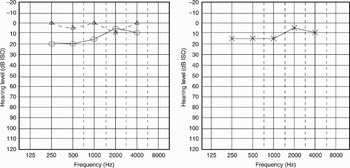
The patient's past medical history included migraine, anxiety and depression. She gave a history of a failed hearing test at school at the age of 11 years, but was subsequently found to have normal otoscopy and audiometry results (Figure 1). She denied using recreational drugs, took no regular medication and had no known allergies.
Pure tone audiogram taken at age 11 years, showing normal hearing. Air conduction: ○ = right; ×= left. Bone conduction: Δ = unmasked (right or left).

On examination, the patient was found to have profound hearing loss in both ears. As a result, the Weber and Rinne tests could not be analysed. Otoscopic and neurological examinations were otherwise normal. The patient was treated for migraine with associated hearing loss, and arrangements made for pure tone audiometry (PTA).
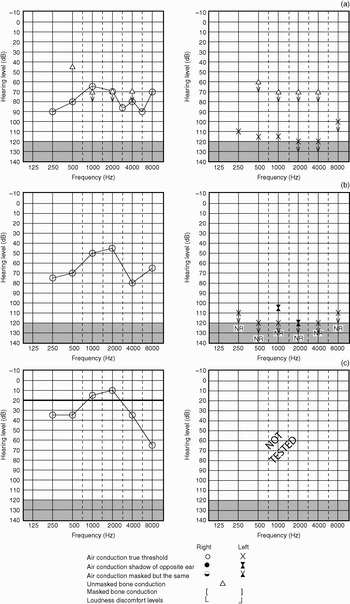
Audiometry on day two showed profound left-sided and moderately severe right-sided sensorineural hearing loss (Figure 2a).
Pure tone audiograms taken on (a) day two, (b) day nine and (c) after completion of treatment. V = Vibrotactile; NR = Not Recorded.

On day nine, the patient was reviewed in the ENT clinic and complained of persistent hearing loss and headaches. She had also developed aphthous ulcers in her mouth and blisters on her palms. Pure tone audiometry at this stage now showed a ‘dead’ left ear and slight improvement on the right (Figure 2b).
The patient was admitted, and rheumatology and dermatology opinions were sought. Her full blood count, urea and electrolytes, and liver function test results were normal, although her C-reactive protein result was slightly elevated at 25. Autoantibody screening and serology for human immunodeficiency virus (HIV), hepatitis B, hepatitis C and Coxsackie virus were negative. Culture and Gram staining for gonococcus from a skin scrape were also negative. Magnetic resonance imaging of the brain was normal.
An underlying vasculitic process was suspected, and a punch biopsy was taken from a blister on the patient's left palm. The histopathological appearance was reported as showing psoriasiform hyperplasia, focal lichenoid damage and a heavy chronic inflammatory infiltrate, raising the possibility of syphilis in view of the presence of a plasma cell rich inflammatory response. There was no evidence of vasculitis.
Syphilis serology was performed on day 11, and a diagnosis of secondary syphilis was made based on positive results for treponemal enzyme immunoassay, Treponema Pallidum Particle Agglutination (TPPA) and treponemal immunoglobulin M, and a reactive venereal disease research laboratory test (with a 1 in 32 titre).
The patient was transferred to the infectious diseases unit for a lumbar puncture. Cerebrospinal fluid (CSF) examination was unremarkable, with a clear fluid with 940 red blood cells, two white cells, and a normal protein level of 0.34 g/l. No organisms were seen on microscopy and there was no growth on culture. Microbiological analysis of CSF showed a negative result for treponemal antibody enzyme immunoassay, an indeterminate TPPA test and a non-reactive venereal disease research laboratory test. Polymerase chain reaction analysis for herpes simplex virus, varicella zoster virus and enterococcus was negative.
The patient was treated with oral doxycycline 100 mg twice daily for 14 days on an out-patient basis. However, she defaulted on her follow-up appointment with the infectious diseases unit and presented to the genitourinary medicine clinic 20 days after her discharge. She reported persistent hearing loss and it emerged that, having lost her supply of antibiotics, she could not complete the prescribed course. In view of inadequate treatment for secondary syphilis with central nervous system (CNS) involvement, she was administered three doses of benzathine benzylpenicillin intramuscularly at weekly intervals. Contact tracing was undertaken.
Pure tone audiometry repeated after completion of treatment showed near-normal hearing on the right side and a dead left ear (Figure 2c).
At follow up six months later, there was no change in audiometry results. The patient was referred to a hearing therapist for further advice and management.
Discussion
Syphilis is a multi-system infection and may affect the inner ear in both secondary and late stages. Late syphilis is defined as untreated syphilis of more than two years' duration; its ear involvement is classically referred to as otosyphilis. Our patient had symptoms, signs and serology suggestive of secondary syphilis. The ENT manifestations of syphilis, irrespective of stage, may include impairment of hearing, tinnitus and nystagmus.Reference Klemm and Wollina3 Hearing impairment is reversible in the secondary stage, and prompt diagnosis and treatment are important for maximum hearing recovery.Reference Balkany and Dans4, Reference Saltiel, Melmed and Portnoy5 When an ENT presentation is suspected to be due to secondary syphilis, it is advisable to inform the laboratory when sending a blood sample for syphilis serology, in order to prevent any delay between diagnosis and treatment.
It is recommended that patients with ear manifestations of syphilis should have a lumbar puncture. Cerebrospinal fluid abnormalities, in the form of pleocytosis and elevated protein level, in conjunction with venereal disease research laboratory test reactivity and identification of Treponema pallidum in CSF by polymerase chain reaction, are highly suggestive of CNS involvement by syphilis. These changes can be seen in both secondary and late syphilis, but may not always be present. In our patient, venereal disease research laboratory test reactivity was completely absent in the CSF, despite marked reactivity in the serum.
Differentiation of the stage of syphilis, whether secondary or late, is important in terms of length of treatment, prognosis and contact tracing, and is often based on a combination of symptoms, signs and syphilis serology pattern. The presence of a skin rash and high serum venereal disease research laboratory test reactivity pointed to secondary syphilis in our patient.
Current guidelines on syphilis management recommend a single dose of benzathine penicillin for early syphilis (primary, secondary and early latent syphilis), while three weekly injections are recommended for syphilis in the late stage.
Neurosyphilis and otosyphilis refer to CNS and ear involvement in late syphilis, and sometimes may coexist (as oto-neurosyphilis). They may present as meningitis with or without cranial nerve involvement, meningovascular disease, or stroke. The treatment of otosyphilis is as for neurosyphilis, with high dose intravenous benzylpenicillin, intramuscular procaine penicillin or intramuscular benzathine penicillin with steroid cover. Desensitisation should be considered in patients who are allergic to penicillin. Patients are followed up serologically until they are serofast. It is recommended that those found to have CSF changes should have repeated CSF examinations six-monthly until the cell count is normal.
Doxycycline is an alternative in patients with a penicillin allergy or those who decline parenteral treatment.
It is mandatory that all patients with syphilis are screened for HIV as the two infections often coexist. Human immunodeficiency virus infected patients with early syphilis may have an increased risk of neurological involvement and unusual neurological manifestations. Human immunodeficiency virus infected patients may respond less well to treatment and may be more likely to relapse serologically following treatment, compared with HIV-negative individuals.Reference Johns, Tierney and Felsenstein6–Reference Malone, Wallace, Hendrick, LaRocco, Tonon and Brodine8
While syphilis had previously been considered as a differential diagnosis for many conditions within several different specialties, it is now often overlooked, leading to a delay in diagnosis and appropriate treatment. Our case provides a good example of this – syphilis was not considered even when the patient developed fairly classical signs.
• With the exponential rise in syphilis cases in the UK, there has been a re-emergence of presenting manifestations which had previously become rare
• Early syphilis should be considered in all sexually active adults who present with deafness, as prompt diagnosis and treatment are crucial for maximum recovery
• This paper describes the case of a 24-year-old woman who presented with sudden hearing loss and who subsequently developed clinical features suggestive of secondary syphilis
Early acquired syphilis should be considered in all sexually active adults who present with sudden deafness. The importance of cooperation between different specialities in managing patients with syphilis cannot be over-emphasised.
Acknowledgements
We are grateful to Michelle Robson at the Department of Audiology, Leicester Royal Infirmary, University Hospitals of Leicester NHS Trust.