Is the United Nations Security Council (UNSC) a legitimate organization? Constructivists argue that legitimacy is central to world politics by providing the authoritative rules necessary to establish social order (Onuf Reference Onuf1989). Hurd (Reference Hurd1999) argued that there are three possible reasons to obey rules and, therefore, three potential sources of order: coercion, self-interest, and legitimacy. Agents comply with rules through either a fear of retribution, calculation of self-interest, or moral obligation. Legitimate authority is constituted by social acceptance of the rules, not by coercion or self-interest. Lake (Reference Lake2007) argued that a legitimate social order often is based on a social contract between the ruler and the ruled: the ruler provides a stable social order, and the ruled accept a certain loss of freedom.
The UN Charter attempts to establish a social contract and a legitimate social order: it obligates the five permanent UNSC members to maintain international peace and security, and it obligates the other member states to comply with UNSC resolutions. Is this a legitimate arrangement? Do the permanent veto powers perform the UNSC role from self-interest or moral obligation to legitimately pursue international peace and security? Lake (Reference Lake2007) argued that if powerful countries uphold their end of the social contract, then others will acknowledge their leadership as legitimate and comply with the rules establishing order. If, however, powerful countries do not uphold their part of the bargain, then they reduce the legitimacy of the international order and undermine their own authority within that order. The ruled will not long comply with the rules of an illegitimate ruler.
Hurd (Reference Hurd2002) applied this argument to the UNSC: if the veto powers act according to their immediate interests and do not legitimately pursue international security, they risk losing legitimacy for an institution that supports their long-term interests. Thus, an important question is whether the UNSC pursues international security in a way that upholds the social contract established by the UN Charter or in a way that protects the narrow national interests of the veto powers. One way to evaluate the legitimacy of the UNSC is through its agenda. Does it reflect the UN Charter goal of international peace and security? Does the UNSC address the most significant conflicts in world politics? Or is the agenda influenced by the national interests of the veto powers?
We address these questions with a dataset that includes the number of UNSC meetings held and resolutions passed on 40 conflicts from 1991 to 2013. This analysis provides evidence for the legitimacy of the UNSC: conflicts with more refugees and more deaths are significantly more likely to be on the agenda. The analysis does not support critics of the UNSC—the national interests of the veto powers, measured as arms sales to and trade with the conflict participants, do not significantly alter the UNSC agenda.
THE LEGITIMACY OF THE UN SECURITY COUNCIL
There are many ways to evaluate the legitimacy of an international organization (Buchanan and Keohane Reference Buchanan and Keohane2006). Many who argue that the UNSC is not legitimate rely on a procedural notion of legitimacy, arguing that the UNSC is dominated by a few powerful states and does not have fair decision-making procedures. First, the UNSC is not a representative organization; the rules are not mutually negotiated by all member states. Second, the veto shields the permanent members or others whom they protect from collective security enforcement. The rules are not binding to all. Third, the UNSC is not accountable to other actors such as the International Court of Justice or the General Assembly. A recent study found that states often criticize the UNSC for its procedural shortcomings during UN General Assembly debates (Binder and Heupel Reference Binder and Heupel2015). It is difficult to defend the UNSC on procedural grounds; indeed, most reform proposals for the UNSC are intended to address procedural issues of representation, transparency, accountability, and use of the veto.
It is difficult to defend the UNSC on procedural grounds; indeed, most reform proposals for the UNSC are intended to address procedural issues of representation, transparency, accountability, and use of the veto.
Another way to analyze legitimacy, however, is to evaluate performance. Does the institution fulfill its mandate? Does it effectively solve common problems? In the case of the UNSC, does it provide international peace and security? Does it restrain powerful countries? Does it consistently apply its principles? Many scholars also criticize the legitimacy of the UNSC on these grounds, arguing that it selectively pursues its agenda according to the interests of the veto powers (Thakur Reference Thakur2010). For example, Morris and Wheeler (Reference Morris and Wheeler2007) argued that the UNSC cannot constrain the use of force by great powers, particularly the United States. Boulden (Reference Boulden2006) argued that the veto powers control the UNSC agenda and often will be “distant” and “disengaged” regarding conflicts that do not influence their interests.
Realist approaches to world politics are generally skeptical of the legitimacy of international organizations (Mearsheimer Reference Mearsheimer1994). Realists argue that the UN Charter requires the veto powers to believe that an attack on anyone is an attack on all, or that a civil war halfway across the world threatens their interests. Why would great powers become involved in local wars in areas with no strategic interest? Doing so would reduce their ability to protect their real national interests. The UN Charter also may require the veto powers to punish friends as well as enemies and powerful as well as weak countries. Realists argue that this is unlikely. Will states condemn a friend that pursues aggressive policies toward another? Or agree to economic sanctions with a major trading partner? Or send troops to punish a regional power? These political calculations inevitably lead to no—or at least selective—enforcement. Some empirical research supports these realist conclusions. Wallensteen and Johansson (Reference Wallensteen, Johansson and Malone2004) found that the UN is less likely to send peacekeepers into conflicts involving powerful states. Fortna (Reference Fortna2008) found that the UN is less likely to send peacekeepers into conflicts involving the former colonies of the five veto powers. Binder (Reference Binder2009) argued that the UNSC has responded selectively to major humanitarian crises after the Cold War.
Despite these criticisms, there also are theoretical and empirical arguments supporting the legitimacy of the UNSC. At a basic level of legality, the UN Charter gives the UNSC its authority, and all UN member states have consented to that authority. At a minimum, member states have not explicitly withdrawn their consent from the global social contract and left the UN. Most states, most of the time, prefer to resolve conflict and use force under the auspices of the UN. Claude (Reference Claude1966) provided the classic argument that the UNSC provides legitimacy to state actions. Hurd (Reference Hurd2002) provided a more contemporary argument about the symbolic power of the UNSC. Finnemore (Reference Finnemore2003) argued that an emerging norm of world politics is that humanitarian interventions require UNSC approval.
A growing body of research suggests that the UNSC does pursue international security in legitimate ways (Doyle and Sambanis Reference Doyle and Sambanis2006; Mullenbach Reference Mullenbach2005; Neack Reference Neack1995). Beardsley and Schmidt (Reference Beardsley and Schmidt2012) argued that the UN acts consistently with its humanitarian and security mission because “the need to provide public goods and maintain legitimacy in the eyes of smaller member states substantially influences how the UN responds to threats to international peace and security.” Gilligan and Stedman (Reference Gilligan and Stedman2003) found that the UN tends to intervene in the most violent conflicts; Fortna (Reference Fortna2008) found that the UN tends to intervene in difficult conflicts in which the government is weak and the rebels are relatively strong; Hultman (Reference Hultman2013) found that the UN tends to intervene in conflicts in which the parties target the civilian population; and Melander (Reference Melander2009) concluded that the UN tends to intervene in conflicts in which the risk of genocide is higher.
Constructivists argue that there are efficiency advantages to legitimate authority, and powerful states try to legitimate their power (Hurd Reference Hurd1999). The permanent members cannot cross a line and violate the social contract. An illegitimate UNSC would fail to obtain the necessary compliance to implement resolutions. Basic notions of fairness, good faith, and justice influence the legitimate authority of the UNSC. If a veto power suggests an illegitimate action, then the UNSC will refuse and fail to provide legitimacy for that action (Mor Reference Mor2007). Whether the UNSC agenda reflects the material interests of the veto powers or the intrinsic nature of the conflicts involved is another indicator of legitimacy—UN members are more likely to comply with UNSC resolutions if they consider them legitimate. Furthermore, because the UNSC cannot claim procedural legitimacy, it must compensate and maintain its legitimacy through its performance.
ANALYZING THE UNSC AGENDA
One way to evaluate the performance legitimacy of the UNSC is through its agenda. If the UNSC legitimately pursues international peace and security, then the most devastating conflicts should dominate its agenda. If the UNSC is legitimate, then the veto powers should uphold their end of the global social contract established by the UN Charter and determine its agenda by the intrinsic nature of the conflicts. If the UNSC is not legitimate, then the narrow national interests of the veto powers should determine the extent to which that conflict is on the UNSC agenda. To test these arguments, we evaluated whether the UNSC agenda is indeed dominated by “the most devastating conflicts” or conflicts associated with the narrow national interests of the veto powers. Our analysis asserts the following four hypotheses: two that assert the legitimacy of the UNSC and two that do not. Footnote 1
-
H1: Conflicts with a large number of deaths are more likely to be on the UNSC agenda.
-
H2: Conflicts with a large number of refugees are more likely to be on the UNSC agenda.
-
H3: Conflicts in which the veto powers sell a large number of weapons to the participants are less likely to be on the UNSC agenda.
-
H4: Conflicts in which the veto powers have significant trade with the participants are less likely to be on the UNSC agenda.
If the UNSC legitimately pursues international peace and security, then the most devastating conflicts should dominate its agenda. If the UNSC is legitimate, then the veto powers should uphold their end of the global social contract established by the UN Charter and determine its agenda by the intrinsic nature of the conflicts.
Our analysis attempts to capture the intrinsic nature of the conflict—and therefore the potential legitimacy of the UNSC agenda—by including the number of deaths (H1) and the number of refugees (H2) associated with each conflict. Hypotheses 1 and 2 both address the normative dimensions of constructivist arguments that connect legitimacy to human-security concerns. The refugee variable also includes an interdependent element to the analysis. Large numbers of refugees will influence the interests of other states, thereby directly threatening international peace and security. For the veto powers to uphold their end of the global social contract and maintain the legitimacy of the UNSC, they must address the conflicts that generate the most refugees.
Our analysis attempts to capture realist arguments about the material interests of the veto powers by including weapons sales to and trade with conflict participants (H3 and H4, respectively). If the realist critique is correct, then the material interests of the veto powers should skew the UNSC agenda. It is possible that these material interests could make it more likely for such conflicts to be on the agenda—the veto powers may want to use the UNSC to end conflicts in areas where it has direct material interests. However, our hypotheses rely on the realist critique of collective security and assert that direct material interests will reduce the likelihood that such conflicts will be on the UNSC agenda. Within a collective-security framework, the UNSC often punishes states for violating international peace and security. If veto powers have direct material interests with conflict participants, they may be more hesitant to subject those actors to collective security enforcement. We assume this dynamic and assert H4. Ultimately, however, the direction of the relationship is not crucial to the argument. If the material interests of the veto powers skew the agenda in either direction, this would undermine the argument that the UNSC is a legitimate organization.
To test these hypotheses, we combined data measuring the expected predictors of UNSC behavior with data on 40 post–Cold War conflicts. These observations included all conflicts from 1992 to 2013 that experienced at least 1,000 battle deaths, according to the Uppsala Conflict Data Program/Peace Research Institute Oslo (UCDP/PRIO) Armed Conflict Dataset (Gleditsch et al. Reference Gleditsch, Wallensteen, Eriksson, Sollenberg and Strand2002; Themnér and Wallensteen Reference Themnér and Wallensteen2014). Our dependent variables contained yearly counts of UNSC meetings (Model 1) and UNSC resolutions (Model 2) regarding each conflict. Because our interest is in the general decision of the UNSC to meet and pass a resolution given the overall intensity of a conflict, the data were kept at the conflict-year level. In total, there are 511 conflict-years included in the data. Footnote 2
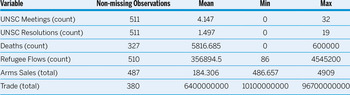
We used four independent variables to test the legitimacy of the UNSC agenda: (1) the total number of deaths caused within each conflict-year according to the UCDP/PRIO Battle Deaths Dataset (Sundberg Reference Sundberg, Harbom and Sundberg2008); (2) the yearly count of refugee flows generated by the conflict according to the International Institute for Strategic Studies’ Armed Conflict Database; (3) the total level of arms sales between UNSC veto members and the conflict participants in the conflict-year as measured by the Stockholm International Peace Research Institute; and (4) the yearly aggregate level of trade between UNSC veto members and conflict participants, derived from the International Monetary Fund’s Direction of Trade Statistics. Footnote 3 Our two dependent variables were (1) yearly counts for a specific conflict of the number of UNSC meetings held, and (2) the number of resolutions passed. Table 1 summarizes the statistics for these variables. Footnote 4
Summary Statistics for Included Variables

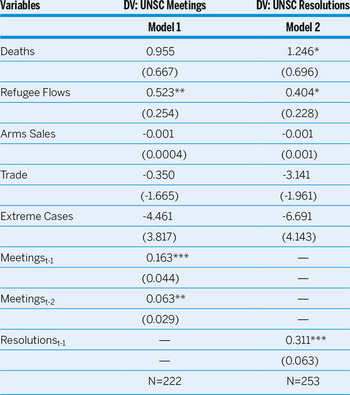
Given the count nature of the two dependent variables, the tests of the UNSC behavior require the use of negative binomial models at the conflict-year unit of analysis. Because the data are not strictly continuous, ordinary least squares (OLS) is not an appropriate model choice—however, the results of time-series cross-sectional OLS models match the negative binomial results displayed below in table 2. Footnote 5
Negative Binomial Models of UNSC Behavior During Conflict (1991–2013)

Clustered standard errors in parentheses. *p < 0.1, **p < 0.05, ***p < 0.01
Because the data are structured by the conflict-year, temporal dependence may affect the estimation results. Regressing the dependent variables against their respective lags, UNSC meetings two years in the past significantly affected present-period meetings, whereas the previous year’s resolutions influenced present passage of resolutions. As a result, a two-year lagged dependent variable is included in the model estimating effects on UNSC meetings and a single-year lag is included for the model of UNSC resolutions. Within-panel heteroskedasticity is addressed by clustering the models’ standard errors by conflict. Footnote 6
Table 2 presents results from the UNSC meeting and resolution models. UNSC meetings have a significant relationship with the number of refugees, and UNSC resolutions are driven by both the number of refugees and the number of deaths in the conflict-year. The coefficients are positive, which indicates that increases in the number of refugees and deaths increase the UNSC discussion of the conflict and passage of resolutions. Although they are in the expected negative direction, in neither model are the coefficients for the arms and trade variables statistically significant. These models support hypotheses (H1) and (H2): the UNSC agenda reacts to the severity of conflicts. Conversely, there is little evidence to support hypotheses (H3) and (H4) that the UNSC agenda is influenced by the material interests of the veto powers. These models, however, do not indicate how intense a particular conflict needs to become for the UNSC to act.
To measure the change in the count of UNSC meetings and resolutions as conflict intensity increases, we used Clarify to calculate the change in expected count (Tomz, Wittenberg, and King Reference Tomz, Wittenberg and King2003). Expected counts for UNSC meetings and resolutions were calculated with 95% confidence intervals for all significant independent variables in Models 1 and 2. Given the large upper bounds of most of the independent variables, the graphs of the expected count tend to compress the scale to accommodate these outliers. Because this suppressed the display of significant effects in the middle ranges and had such wide confidence intervals that the expected count is unclear, these graphs were truncated at lower and upper bounds to show the largest range where a significant effect is present. Outside of these limits, where refugee flows and deaths are either small or uniquely large, there is no significant effect on UNSC behavior. Footnote 7
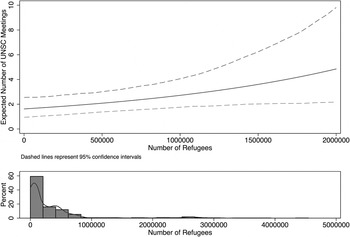
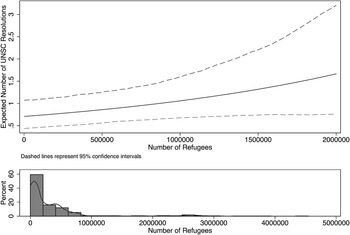
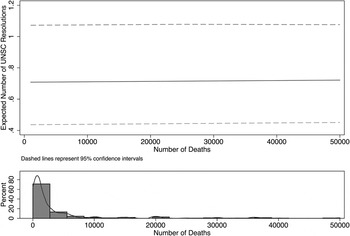
Figure 1 displays the change in the expected number of UNSC meetings as refugee flows increase, estimated from Model 1. A given conflict can be expected to generate at least one meeting when there are relatively few refugees. However, the increase in meetings is gradual—it takes approximately 1.5 million refugees to guarantee an additional UNSC meeting. Figure 2 presents the expected count estimates of UNSC resolutions as refugee flows increase. The UNSC is slower to respond to a conflict with a resolution because it requires approximately 500,000 refugees before a resolution is expected. It also appears that it is possible for the UNSC to pass more than one resolution on a particular conflict because the expected count does not reliably predict a second resolution, even at high levels of refugee flow. Figure 3 illustrates a similar general effect for the increase in conflict deaths and the number of UNSC resolutions. Although the expected count is significant and positive for the entire range of conflict deaths, it never crosses the level required to be certain that the UNSC will pass a resolution on the conflict. These results indicate that whereas the UNSC is likely to meet and pass a resolution about a conflict as refugee flows increase, a high level of conflict-related deaths does not guarantee a resolution. The UNSC may not be responsive to a conflict unless it is particularly significant.
These results indicate that whereas the UNSC is likely to meet and pass a resolution about a conflict as refugee flows increase, a high level of conflict-related deaths does not guarantee a resolution. The UNSC may not be responsive to a conflict unless it is particularly significant.
Expected Number of Meetings as Refugees Increase

Expected Number of Resolutions as Refugees Increase

Expected Number of Resolutions as Deaths Increase

CONCLUSIONS
Our results show that conflicts with more deaths and refugees are more likely to be on the UNSC agenda. The variables measuring conflict intensity are better predictors of the observed counts of UNSC meetings and resolutions than both veto-power trade and arms sales. This analysis suggests that constructivist arguments about legitimacy are better explanations of UNSC action than rationalist accounts focusing on material indicators of national interest. The UNSC is influenced more by the intensity of a conflict than the veto members’ strategic links to the states involved in the conflict. Our analysis does not support more skeptical, realist accounts of the UNSC.
However, the analysis also suggests two caveats regarding the legitimacy of the UNSC. First, refugees are a better predictor than conflict deaths. Rationalists could account for this in this way: refugees spur the UNSC to act because they influence the interests of other member states beyond the conflict participants. Perhaps a more appropriate measure of the intrinsic nature of the conflict is conflict deaths, thereby capturing the constructivist notion of legitimacy to a greater degree than refugees. The number of refugees influencing the UNSC agenda more than the number of deaths may not endorse unequivocally the legitimacy of the UNSC.
Second, the results also indicate that a conflict must be relatively intense for the UNSC to act, particularly for the passage of a resolution. At least a few thousand refugees or deaths need to occur to initiate a UNSC response. Perhaps smaller conflicts are less likely to cause concern that the consequences of war will spill into neighboring states—or perhaps this threshold simply reflects an organizational inertia that is inevitable given the veto power of permanent members. Additional UNSC action also requires large increases in conflict intensity over time—again, particularly for the passage of a resolution. Meetings increase more often and at lower levels of conflict escalation, but only when refugee flows increase.
Despite these caveats, the results of the analysis show that the UNSC agenda is generally consistent with the ideals of the UN Charter. For the veto powers to uphold their end of the global social contract, they must pursue international peace and security in a way that other member states view as legitimate. The UNSC agenda suggests that the veto powers attempt to maintain legitimacy by addressing the most pressing conflicts. Strategic concerns of the veto powers have not significantly influenced the agenda. Instead, those conflicts with the most deaths and refugees are more likely to be on the UNSC agenda.
SUPPLEMENTARY MATERIAL
To view supplementary material for this article, please visit https://doi.org/10.1017/S104909651600278X.
ACKNOWLEDGMENTS
The authors thank Cooper Drury, Amanda Murdie, and the anonymous reviewers for their helpful comments and contributions to this article. Any omissions or errors are the sole responsibility of the authors.