Translational research on trauma has grown rapidly over the last several decades. Stimulated by growing concerns both about the high rates of children's exposure to trauma-inducing violence, loss, and stress and about the developmental consequences of trauma, researchers have begun joining with practitioners in designing and rigorously evaluating both treatment and prevention programs addressing these interrelated phenomena. What have we learned from these efforts? Is the science adequate to guide the design of effective programs and policies? Are programs and policies open to and really prepared to use developmental and prevention sciences to improve their effectiveness and their scale? What challenges remain to fulfill the promise of translational research so that outstanding developmental and prevention science can be used to actually make a real difference in children's lives? These are the general questions and concerns that motivate this paper. As active collaborators in translational research on violence, trauma, and psychopathology for many years, we have come to both appreciate how far such research has come but how far it still needs to go if as a nation (and a global society) we are to develop and validate population-scalable preventive interventions based on translational research.
Consequently, we have three main objectives for this paper: (a) to explore school-based universal preventive interventions as a frontier in translational research on trauma and trauma-related problems in development (the theme of this Special Issue); (b) to report on progress to date on one example of translational research we have conducted on a school-based preventive intervention entitled Reading, Writing, Respect, and Resolution (4Rs); and (c) based on the current state of the field and our own experience, to identify major challenges in effectively crossing this frontier in translational research and propose a new approach to address those challenges.
To meet these objectives, we structure this article in four parts. First, we describe the broader context in which contemporary translational research on school-based preventive interventions is being conducted. We describe the context as mental health prevention and promotion meets education reform. Second, we describe the specifics of working at the frontier by reviewing the history, design, and evaluation of the 4Rs Program. We emphasize how our work aspired both to translate research into practice and to translate practice into research. Third, we briefly describe the 4Rs intervention and what we have learned to date about its impact on children's school settings and their social–emotional development, mental health, and academic achievement. We also forecast the next steps in both research on 4Rs and program redesign for a next generation of social and emotional learning (SEL) initiatives. Fourth and finally, we identify a series of challenges the field of school-based preventive interventions must address to cross some of the next great frontiers in translational research on violence, trauma, and psychopathology and go to scale with school-based preventive interventions.
The Broader Context: Mental Health Prevention and Promotion Meets School Reform
Translational research on violence, trauma, and psychopathology is currently being conducted in the context of both mental health prevention and school reform. To understand both the opportunities for and challenges to translational research on school-based preventive interventions, a clear understanding of these two critical contexts is needed.
Preventive mental health
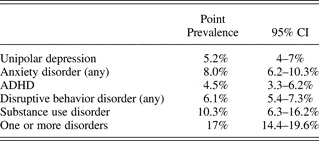
Rates of mental, emotional, and behavioral (MEB) disorders among children are alarmingly high in both the United States and in the city in which we conducted the translational research we describe in this article. A major report on Preventing Mental, Emotional and Behavioral Disorders among Young People was published in 2009 by the National Research Council and Institute of Medicine (NRC/IOM, 2009). The best epidemiologic data assembled for this report suggest very high rates of forms of psychopathology, including depression (5.2%), disruptive behavior disorder (6.1%), and anxiety (8.0%). Fully 17% of US children are estimated to suffer from one or more MEB disorders (see Table 1).
Prevalence estimates of mental, emotional, and behavioral disorders among young people

Note: Data according to NRC/IOM (2009). CI, confidence interval; ADHD, attention-deficit/hyperactivity disorder.
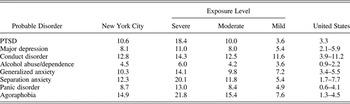
Elevated rates of child psychopathology are commonly associated with exposure to violence and trauma. For example, in response to the events of 9/11/01, Christina Hoven and colleagues (2005) conducted rigorous epidemiologic studies of the prevalence of MEB disorders in New York City (NYC) and compared NYC rates to US rates. It was not surprising that 6 months after the events of 9/11 the NYC rates were higher than national rates. In addition, prevalence rates in NYC were associated with the level of exposure to the traumatic events of 9/11 (see Table 2). Rates for types of psychopathology thought to be most responsive to traumatic events (e.g., posttraumatic stress disorder, separation anxiety, agoraphobia) were 300% to 400% higher for children with severe exposure (vs. mild exposure) to the events of 9/11. However, even forms of psychopathology not as responsive to traumatic events per se (e.g., depression, conduct disorder, alcohol abuse) showed prevalence rates 50% to 200% higher for the severely (vs. mildly) exposed children in NYC.
Prevalence of probable mental disorders for New York City public school children (Grades 4–12) at 6 months post-9/11 versus US community sample pre-9/11

Note: Children were 9–17 years of age. Data according to Hoven et al. (Reference Hoven, Duarte, Lucas, Wu, Mandell and Goodwin2005). PTSD, posttraumatic stress disorder.
The NRC report emphasizes that services to treat children's MEB disorders are scarce and underfunded. Consequently, the report emphasizes the need for effective prevention strategies as a critical component to a national strategy to promote children's mental health. The data from Hoven et al. (Reference Hoven, Duarte, Lucas, Wu, Mandell and Goodwin2005) support the same conclusion as less than a quarter of NYC children who suffer from diagnosable MEB disorders are receiving any form of formal or informal mental health treatment. A focus on prevention strategies requires a shift from investing in inpatient and outpatient clinical settings to investing in neighborhood agencies, primary care settings, homes, and of course, schools. Why focus on schools as the setting of preference to mount preventive mental health efforts? Because that's where the children are. These facts concerning the epidemiology and economics of children's mental health have led us as translational researchers to decide to work with and in school settings.
School reform
Unfortunately, as the mental health field's interest in working on prevention strategies through and with schools has grown, mainstream school reform initiatives have been moving in the opposite direction. Since the publication of “A Nation at Risk” (National Commission on Excellence in Education, 1983), school reform has focused primarily on improving academic outcomes via accountability systems designed to hold schools to high standards, instructional improvement, and high stakes testing. The emphasis on improving achievement test scores has crowded out interest in and efforts on behalf of the whole child, including their mental health and psychosocial well-being (Broader, Bolder Approach to Education, 2010). There are, of course, impressive exceptions. At the policy level, for example, the states of Illinois and New York have written and promulgated “social–emotional learning” standards. Professional organizations are mobilizing to promote social–emotional learning in schools (see the Collaborative for Academic, Social and Emotional Learning, http://www.casel.org). This collaborative and others have worked with members of Congress to introduce the Academic Social and Emotional Learning Act of 2009, a bill that would provide a federal structure and resources to assist states and local education agencies to implement best SEL practices. At the research and practice levels there are also numerous exceptions. For example, a recent meta-analysis (Durlak et al., in press) of over 200 rigorous (experimental or quasi-experimental) studies of social–emotional learning initiatives has been conducted. It concludes that SEL interventions have important effects on social–emotional competence (average ds ≈ 0.60), mental health and behavioral outcomes (average ds ≈ 0.25), and academic outcomes (average ds ≈ 0.30). This evidence, mounting over the last two decades, suggests that it is possible to design school-based interventions that promote social–emotional learning, mental health, and academic learning. Yet despite this evidence, the culture and politics of school reform has resisted implementing preventive mental health and SEL strategies as part of school reform at scale.
So we paint a somewhat unhappy picture of the broader context in which we have undertaken our translational research. Children's trauma-related mental health problems are widespread, largely untreated, and constitute significant barriers to academic achievement and attainment. Preventive mental health services are the stepchildren of the children's mental health field that remains focused, professionally and economically, on clinical and medical treatment of children's mental health problems (NRC/IOM, 2009). The whole school reform movement has been focused narrowly on academic instructional practices, high-stakes testing, and accountability systems to raise children's achievement levels. The school-based promotion of the social–emotional bases of both learning and well-being is the neglected child of the whole school reform movement, born of the movement but neither acknowledged for its value nor integrated into the family of school reform strategies.
Despite the marginalization of school-based preventive interventions in mental health and school reform, we and many others have persisted in our translational research on school-based preventive interventions. We next describe the design and evaluation of SEL practice and research in NYC. (We will return to the broader issues of context in the last section of the paper because so many of the challenges to the work involve the larger context.)
Working at the Frontier: Design and Evaluation of SEL Initiatives in NYC
In addition to being embedded in larger national contexts such as the preventive mental health and whole school reform movements, translational research on trauma, violence, and psychopathology is nearly always also embedded in local contexts and personal/professional histories. We recently wrote a very brief history of a research–practice partnership in social–emotional learning (Aber, Brown, Jones, & Roderick, Reference Aber, Brown, Jones and Roderick2010) that led to the creation of the 4Rs Program and to the rigorous school-randomized trial testing the efficacy and effectiveness of 4Rs. We will not recount the history here. However, we do wish to highlight three specific dimensions of working at the frontier that were highly influential to the evolution of the work on the 4Rs that we report in the next section.
1. Starting with practice: One of the relatively unique features of how we conduct translational research is that we did not begin with theory or research. We began with practice. In the early 1990s, we were asked by an independent nonprofit organization based in NYC (Educators for Social Responsibility [ESR]) and a funder of evaluations of innovative social programs for children and youth (the William T. Grant Foundation) to design and conduct an evaluation of the Resolving Conflict Creatively Program (RCCP), a programmatic predecessor to the 4Rs Program. In order to do so, we spent nearly a year working with ESR, the developers of RCCP, to make their implicit theory of change for RCCP explicit and to develop, select, and/or adapt measures that allowed us to empirically operationalize ESR's theory of change (see Aber, Brown, Chundry, Jones, & Samples, Reference Aber, Brown, Chaudry, Jones and Samples1996).
2. Querying practice with scientific theory and prior empirical research: Although we start with an intervention's own theory of change and attempt to make it as explicit and testable as possible, we do not rest there in our partnership with practitioners. We draw on both theory and prior empirical research in the developmental and prevention sciences to query the intervention's theory of change. For example, we asked ESR if a critical feature of what they meant by changing how children understand their relations with peers and teachers was captured in part by reducing children's hostile attribution bias, by reducing children's disposition to interpret ambiguous social cues from teachers and peers as hostile in intent. When ESR decided that this is partially what they meant, then they were able to bring the extant theory about causal influences on the development and prevention of hostile attribution bias to ESR's further articulation of their theory of change (see Aber, Brown, & Jones, Reference Aber, Brown and Jones2003; Aber, Jones, Brown, Chaudry, & Samples, Reference Aber, Jones, Brown, Chaudry and Samples1998).
3. Mutually fitting program intervention theory and developmental/contextual theory: What began as a two-step sequence in our work with ESR on RCCP has now evolved into more of a periodic two-way iterative process in our work on the 4Rs Program. Translating practice into research (starting with practice) and translating research into practice (querying practice with scientific theory and prior empirical research) no longer occurs just at the design phase of a project, but continues into the analysis, interpretation, and write-up phases. Mutually fitting program intervention theory and developmental/contextual theory is usually a necessity at various points throughout such a project because: the program evolves (e.g., the program was delivered somewhat differently than how it was designed); the social conditions the intervention is meant to address change (e.g., children's exposure to trauma and violence increases due to neighborhood or societal changes); and theory and empirical research in the developmental and prevention sciences evolve (e.g., advances in the study of what were informally referred to as spillover effects via evolution in developmental cascades theory).
The implications of this view of two-way, iterative processes as fundamental to translational research on trauma, violence, and psychopathology are profound. The original vision of translational research in medicine as solely “from bench to bed” is one-sided, overly simplistic, and therefore limiting. Scientific research is not just “translated” into practice. Practice, what interventionists are trying to do and their implicit theories of change, should also be “translated” into research. Whether initiated by practitioners or researchers, the translational process must quickly become iterative between the two parties. The new vision, closer to our lived reality, is nonetheless complex and fraught with challenges and perhaps even some dangers. We elaborate on this new vision and the challenges we must address to realize this vision in the last section of this article.
The 4Rs Program: Reading, Writing, Respect, and Resolution
The 4Rs Program is a universal, school-based intervention that integrates SEL into the language arts curriculum for kindergarten through Grade 5. Evolving from the previous stand-alone conflict resolution program that was RCCP, the 4Rs uses high-quality children's literature as a springboard for helping students gain skills and understanding in several areas including handling anger, listening, cooperation, assertiveness, and negotiation. The 4Rs represents the most recent stage in the evolution of work promoting SEL in NYC public schools by ESR, now called the Morningside Center for Teaching Social Responsibility (MCTSR). The 4Rs program has two primary components: (a) a comprehensive seven-unit, 21-lesson, literacy-based curriculum in conflict resolution and social–emotional learning for K to Grade 5; and (b) intensive professional development and training in 4Rs for teachers. Each unit is organized around a specific grade-appropriate children's book and begins with a comprehensive book reading and discussion, ensuring students understand the primary themes of the story and allowing them to connect the themes to their own lives. This is followed by three to five social–emotional learning lessons. The curriculum provided to teachers includes a standardized, grade-specific teaching guide. Intensive professional development for teachers in the 4Rs curriculum consists of a 25-hr introductory training course, followed by ongoing classroom coaching throughout the year by a 4Rs staff developer (an experienced teacher coach, master facilitator of social and emotional learning activities in the classroom, and expert in the 4Rs curriculum) to support teachers in teaching the 4Rs curriculum.
Our approach to the evaluation of the 4Rs Program has been guided both by a multilevel program theory (Jones, Brown, & Aber, Reference Jones, Brown, Aber, Shinn and Yoshikawa2008) and by developmental cascades theory (Masten & Cicchetti, Reference Masten and Cicchetti2010; Masten, Long, Kuo, McCormick, & Desjardins, Reference Masten, Long, Kuo, McCormick and Desjardins2009). With regard to its multilevel program theory, three major sets of premises guided the design of 4Rs and have direct implications for the design and conduct of its evaluation. First, 4Rs promotes change processes at multiple levels (e.g., individuals, their interactions, and proximal settings including their classroom and school environments; Tseng & Seidman, Reference Tseng and Seidman2007). Second, 4Rs was designed based on the idea that improving functioning in one domain (e.g., interpersonal interactions) influences functioning in other domains (e.g., academic engagement and attention; Domitrovitch et al., in press; Guerra & Bradshaw, Reference Guerra and Bradshaw2008). Third, 4Rs is designed to promote change at multiple levels in multiple domains over time as dynamic systems (e.g., Cox, Mills-Koonce, Propper, & Gariepy, Reference Cox, Mills-Koonce, Propper and Gariepy2010; Jones et al., Reference Jones, Brown, Aber, Shinn and Yoshikawa2008). With regard to the theory of developmental cascades, impacts associated with exposure to the 4Rs Program were expected to be cumulative, resulting initially in small to modest changes in domains of functioning most proximal to the intervention and within some levels but with longer and sustained program exposure, expanding to more distal domains of functioning and outcomes (e.g., from reductions in hostile attribution bias to reductions in aggression and increases in social competence) across multiple levels (e.g., from changes in children's skills to changes in the structure of their peer networks).
Consistent with these theoretical principles and programmatic expectations, we conducted a longitudinal, school-randomized trial to test the impacts of the 4Rs program on classroom and teacher processes and outcomes as well as on children's social–emotional and academic development. Eighteen NYC public schools were pairwise matched on key school-level demographic characteristics. One school from each pair was randomly assigned to receive schoolwide intervention in 4Rs over three consecutive school years and the other school to a “business as usual” control group.Footnote 1 The parents of a cohort of third-grade students across these 18 schools were consented; and the children were assented and assessed in the fall and spring of each of three consecutive school years as they advanced from third to fifth grade. At each wave, teachers were consented and completed questionnaires rating the language and literacy skills, as well as social competence and externalizing problems, of each consented child in their class. Teachers also completed questions rating the climate of their school and their own social and emotional skills and behaviors, including their professional background and development, their beliefs about the importance of social–emotional learning in school, their classroom management strategies and styles, and their experiences of stress and burnout. Consented children also completed questionnaires rating their aggressive and pro-social cognitions, and their internalizing symptoms. Children's yearly scaled scores on the New York State standardized assessments of math and reading achievement and attendance rates were obtained from the NYC Department of Education. In addition, with the exception of the first wave, trained observers blind to intervention status of the schools conducted structured observations and ratings of the quality of classroom interactions indicative of instructional and emotional supports and classroom organization. Finally, fidelity of implementation was monitored via both administrative and teacher survey data.
Findings to Date
Our findings to date support the programmatic expectations described above: impacts at multiple levels (child, classroom) and in expanded domains of functioning over time with greater program exposure. First, at the classroom level, after 1 year of exposure to the program, 4Rs school classrooms were rated by trained, independent observers as having higher quality interactions on average compared to control school classrooms, suggesting that 4Rs can improve the quality of both classroom instructional and emotional support provided by teachers (Brown, Jones, LaRusso, & Aber, Reference Brown, Jones, LaRusso and Aber2010).
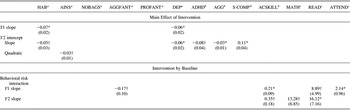
Second, at the child level, as shown in Table 3, initial findings after 1 year of exposure to the 4Rs Program were modest, indicating that children in 4Rs schools had lower average levels of self-reported hostile attributional biases and depression compared to children in control schools. In addition, for those children identified by teachers at baseline at highest behavioral risk, there were positive intervention impacts on children's self-reports of aggressive fantasies, teacher reports of academic skills, attendance records, and standardized reading achievement (Jones, Brown, Hoglund, & Aber, Reference Jones, Brown, Hoglund and Aber2010).
Unstandardized estimates (standard errors) of 4Rs intervention main effects and selected interaction effects on children's social emotional, behavioral, and academic outcomes after 1 and 2 years in the study

Note: Summarized from Jones, Brown, Hoglund, and Aber (Reference Jones, Brown, Hoglund and Aber2010) and Jones, Brown, and Aber (2011).
aChild reported.
bTeacher reported.
cSchool records.
†p < .10. *p < .05.
After 2 years of exposure to 4Rs, in addition to continued positive changes in children's self-reported hostile attributional biases and depression, positive changes were also found in children's reports of aggressive interpersonal negotiation strategies (i.e., their tendency to select aggressive responses in conflict situations), and teacher reports of children's attention-deficit/hyperactivity disorder (ADHD), social competence, and aggressive behavior (see Table 3). Similarly, there were both continued and expanded positive impacts of the program for children rated by their classroom teacher as highest in initial behavioral risk. Specifically, compared to similarly identified children in control schools, children in 4Rs schools at highest initial behavioral risk continued to show the most substantial gains in teacher reports of academic skills, but also in both standardized reading and math achievement test scores (Jones, Brown, & Aber, in press).
Taken together, these findings indicate both short-term and longer term impacts of the 4Rs program both for the general population of students as well as for those students at highest behavioral risk as perceived by their teachers. Among the general student population we see short-term impacts on features of children's social–cognitive processes associated with aggressive behavior (e.g., their bias toward hostile attributions in ambiguous social situations). Prior theory and research suggest these processes are (a) affected by certain types of violent and/or trauma-related experiences (e.g., a history of harsh, punitive, or abusive parenting; or exposure to community violence, Coie & Dodge, Reference Coie, Dodge and Eisenberg1998; peer environments in which violence is normative, Tremblay, Mase, Vitaro, & Dobkin, Reference Tremblay, Masse, Vitaro and Dobkin1995) and in turn (b) increase the probability of aggression and violence by children and youth (e.g., Dodge, Laird, Lochman, Zelli, & Conduct Problems Prevtion Research Group, Reference Dodge, Laird, Lochman and Zelli2002) and are linked to a broader set of MEB problems (e.g., Domitrovitch et al., in press). Although we have not formally tested the link between these social–cognitive processes and aggressive or violent behavior (see Forecast of Next Steps in Research Section), after 2 years of intervention we find positive changes in both domains, including teacher reports of aggressive behavior and social competence. Similarly, initial impacts on children's depression may forecast the positive impacts we see after 2 years in children's attention skills, and together, with additional exposure to intervention, these may “cascade” further into other developmental domains including lowered risk of academic disengagement/failure and delayed onset of substance use (e.g., Eddy, Reid, Stoolmiller, & Fetrow, Reference Eddy, Reid, Stoolmiller and Fetrow2003; Lochman & Wells, Reference Lochman and Wells2004).
Among the most aggressive children, we find that this integrated social–emotional learning and literacy intervention produces the greatest benefit in the academic domain, specifically children's scores on standardized tests of math and reading skills and teacher reports of their academic skills. The processes by which these benefits are conferred on high-risk students based on their cumulative exposure to the 4Rs program are key questions not only for our research and program team collaboration but for the broader field of school-based social–emotional learning and school reform as well.
Our findings to date contribute to the growing evidence that primary prevention strategies designed to address children's social–emotional as well as academic learning can be effectively integrated and become part of standard practice in classrooms and schools. Further, our findings suggest that doing so can significantly improve the quality of key aspects of children's social settings such as the quality of their classroom interactions with teachers and peers, and reduce the risk of aggressive behavior, depression, and ADHD, three of the most ubiquitous forms of psychopathology associated with exposure to trauma and violence. However, although these findings from the first 2 years of our evaluation are encouraging, there remain many unanswered questions, and so we now turn to describing our next set of research plans.
Forecast of next steps in research
Consistent with the 4Rs multilevel program theory and, and in order to effectively assess the theory of developmental cascades underlying the 4Rs Program and its evaluation design (Masten & Cicchetti, Reference Masten and Cicchetti2010), we planned to report the results of the 4Rs study in a staged manner over time. Accordingly, we plan to report (a) effects separately by years of intervention (Years 1, 2, and 3), (b) effects separately by level (child, classroom, school), and (c) effects simultaneously across domains (social–emotional and academic learning). Our first set of reports focused on findings after 1 year of intervention at the individual child level and the classroom-level (Brown et al., Reference Brown, Jones, LaRusso and Aber2010; Jones et al., Reference Jones, Brown, Hoglund and Aber2010). Our next report focused on impacts after 2 years of intervention at the child level (Jones et al., in press) and we are planning reports at the teacher and classroom levels after 2 years. Additional reports will follow this strategy through the full 3 years of the intervention.
Building upon our prior work evaluating the programmatic predecessor to the 4Rs Program, the RCCP (e.g., Aber et al., Reference Aber, Brown and Jones2003), we also are committed to better understanding the role of implementation dosage in the impact of the 4Rs intervention. Consistent with other programs (and studies) of this type (e.g., Kam, Greenberg, & Walls, Reference Kam, Greenberg and Walls2003), there was variability in teacher's fidelity of implementation of the 4Rs curriculum.Footnote 2 To better understand the role of this variability in implementation, we will model a benchmark criterion representing either low- or high-quantity or quality implementation by 4Rs teachers as a function of classroom composition, teacher demographic, and experiential background characteristics (e.g., Lochman, Boxmeyer, Powell, Roth, & Windle, Reference Lochman, Boxmeyer, Powell, Roth and Windle2006). We will then use these propensity profiles to draw a comparable group of teachers from the control condition with the goal of producing an unbiased, experimental assessment of the treatment impact on children for high or low implementers. We will use this same strategy to test the sensitivity of the results after accounting for takeup of the intervention in the control schools.
Directly addressing the 4Rs program multilevel program theory, we will examine both individual-level and classroom-level microcontext mediators of 4Rs' 3-year impact including the peer ecology and classroom climate. For example, at the individual level we will examine the degree to which intervention-induced changes in children's social cognitions (e.g., in their hostile attributional biases) underlie intervention-induced changes in their aggressive and socially competent behavior, and whether intervention-induced changes in children's social–emotional skills (e.g., in their attention and socially competent behavior) underlie intervention-induced changes in their achievement.
Focusing on the classroom level, we will generate a descriptive portrait of how classrooms are nested in schools, and how dyadic relationships and peer networks are nested in classrooms. We then plan to empirically describe dynamic shifts in classroom and peer microcontexts over time, and to take these real multilevel dynamics into consideration when estimating the impact of 4Rs on children's developmental outcomes. For example, we will address the degree to which intervention-induced changes in the emotional and instructional climate of the classroom underlie intervention-induced changes in children's socially competent and aggressive behavior, and their attendance and achievement, and whether intervention-induced changes in the classroom-level saturation of children with prosocial cognitions and normative beliefs about aggression underlie intervention-induced changes in children's behavior and academic achievement.
Finally, additional funding from National Institutes of Mental Health has supported a longitudinal follow-up of the 4Rs elementary school sample into middle school (in 2008–2009 and 2009–2010) and finally into the ninth grade (in 2010–2011). We expect to examine the direct effects of exposure to 4Rs in elementary school on four domains of children's health risk behaviors in seventh to ninth grades. Two outcome domains represent explicit targets of the intervention (aggression/violence and school disengagement and failure), and two are theoretically and empirically related health risk behaviors that are not explicitly targeted by the intervention (depression and the onset and course of substance use). With regard to the causal processes by which the 4Rs Program may impact the four domains of children's health risk behaviors in middle school, we expect that the positive changes we are currently seeing in children's social cognitions and their aggressive behavior will offset problematic delinquent behaviors in later elementary and middle school when these more serious behaviors begin to increase. We also expect some of the early positive effects we are observing in depressive and ADHD symptoms will translate into universal benefits in other developmental domains later in elementary school and in middle school (e.g., reduced academic disengagement/failure and delayed onset of substance use; e.g., Eddy et al., Reference Eddy, Reid, Stoolmiller and Fetrow2003; Lochman & Wells, Reference Lochman and Wells2004). Finally we will test a set of hypotheses about the differential impact of the 4Rs Program on the four domains of health risk behaviors for subgroups of “developmentally vulnerable” and “ecologically vulnerable” children identified at the outset of the elementary school study, and for girls and boys.
Forecast of next steps in program redesign and extension
Even before the final results of the elementary school trial are published, the practitioners who designed 4Rs are beginning to innovate and adapt based on what has been learned to date. Two sets of innovations in particular are important to note. First, with support from the Institute of Education Sciences, the developers of 4Rs, the MCTSR, are partnering with the developers of a validated approach to supporting high-quality, effective implementation of curricula (My Teaching Partner; Pianta, Mashburn, Hamre, Downer, & Justice, Reference Pianta, Mashburn, Downer, Hamre and Justice2008). This partnership is designed to develop and test a set of teacher-focused supports that enhance implementation of the 4Rs curriculum with the ultimate goal of improving its impact on students' social and academic performance. Second, MCTSR has partnered with The After-School Corporation to integrate the 4Rs program with the The After-School Corporation Model After-School, an expanded learning time strategy that extends the school day to 6 p.m. every day that school is in session and includes more time for core academic instruction and experiential learning opportunities (e.g., robotics, fencing, astronomy, music). This integration, called the Turnaround Zone is designed to reach students who need more time to learn and provides additional supports to address nonacademic barriers to student achievement. These two innovations address the challenges of enhancing fidelity of implementation and scalability, which we discuss in more detail in the next section.
The Next Frontiers in Translational Research on the School-Based Prevention of Children's MEB Disorders
The story of our collaboration with MCTSR as an example of translational research is not an isolated one. Research teams are increasingly collaborating with practitioners throughout the country (and the world) in designing and evaluating evidence-based approaches to addressing trauma, loss, and psychopathology (for school-based interventions, see Durlak et al., in press; for interventions based in the child welfare system, see Toth, Manly, & Nilsen, Reference Toth, Manley and Nilsen2008). Like ours, the other collaborations are played out in larger contexts, through personal and professional histories, that lead to specific, often very local, intervention strategies that are studied using various experimental and quasiexperimental research designs. Each effort must struggle with similar questions. How are our research findings translated most effectively into practice/policy in our field? As important, how is practice “back” translated into our research? Perhaps most important, how can the products (and processes) of our translational research help lead not only to better science on but also to truly significant changes in children's MEB health?
Both the broader literatures on school-based preventive interventions and our intensive experiences in collaborating with MCTSR has led us to identify a number of challenges the field must address if such translational research is going to lead to the strength and scale of improvements in the MEB health of children they need and deserve. Here we focus on five critical and interrelated challenges.
Challenge 1: From faith-based to evidence-based training and development
To scale school-based approaches, they must become integral to the daily lives of children. This requires that teachers be the front lines of intervention. At the level of teacher practice, a shift is beginning to occur that is critical to future success. Historically, frontline practitioners of preventive interventions took on faith that their efforts had a positive impact on children. However, both in prevention and in education, the standard of evidence for effectiveness of practices is increasingly becoming the same standard employed in clinical medicine: cumulative evidence from a series of well-designed studies that permit strong causal inferences about the efficacy of a practice or intervention. Typically, these are randomized control trials, and when the unit of intervention is supraindividual, for example, classrooms or schools, the preferred methods are cluster-randomized trials (where children are clustered in school settings). However, most teachers (and frontline practitioners of other types of preventive interventions) do not enter the field with a background in science. They are usually motivated by more humanistic concerns, fundamentally the desire to help children, and professional concerns, usually the preference for autonomous action. Although these motives are noble, they can sometimes run counter to a culture of proof and the requirements of fidelity of implementation to the specified model. Thus, the beliefs and attitudes of practitioners and their relation to well-established preferences for forms of helping behaviors are often obstacles to the adoption and scale-up of evidence-based approaches. A major challenge in translational research is to address the attitudes, beliefs, and preferences for helping behaviors that constrain practitioners from embracing evidence-based approaches.
Challenge 2: From brands to essential ingredients
Like other forms of preventive and remedial interventions that focus on children's MEB health, the school-based preventive intervention field has developed and tested what we will call in this paper brands, such as 4Rs, the RCCP (Aber et al., Reference Aber, Brown and Jones2003), Providing Alternative Thinking Strategies (Greenberg & Kusché, Reference Greenberg, Kusché, Jimerson and Furlong2006), Positive Action (Flay & Allred, Reference Flay and Allred2003), and Fast Track (CPPRG, 2007), to name a few. We will call them brands (analogous to food brands) because they are smartly packaged, have a unique identity, often are associated with a special taste, develop a customer following, and perhaps have a method to market the brand (read, be replicated and scaled) elsewhere. Brands, however, do not directly communicate the essential ingredients in the brand that are “good for you,” the vitamins, minerals, proteins of the intervention. Thus, a key challenge facing our field is moving from understanding and testing interventions as brands to understanding, testing, and replicating/scaling-up essential ingredients. What do our interventions do that is essential to preventing MEB problems among children? Different food combinations deliver various essential ingredients that provide input into critical biological processes of health. What are the essential ingredients of school-based preventive interventions that target which critical social, emotional, cognitive, and behavioral processes that help prevent MEB problems? What experiences or interventions reduce hostile attribution bias and promote maturation of interpersonal negotiation strategies and thus reduce aggression and conduct disorder? What ingredients enhance children's working memory and flexible attention deployment and thereby help reduce ADHD? Of course, we do not assume simple one-to-one correspondence between essential ingredients of interventions and critical processes, or between critical mediating processes and MEB outcomes. We already know that many processes can lead to the same outcome (equifinality) and the same process can lead to many outcomes (multifinality; Cicchetti & Rogosh, Reference Cicchetti and Rogosch1996). However, this complexity should not obscure the point we are emphasizing here: our intervention theories need to solve the problem of identifying and reliably measuring the essential ingredients, the causal agents that lead to positive change, rather than the brands that package the causal agents. Identifying and reliably measuring the causal agents that often lay obscured within the brand are key paths to enhancing successful replication and scale-up of evidence-based approaches.
Challenge 3: From efficacy trials to effectiveness, scale-up, and sustainability trials
The traditional sequence of preventive intervention research starts with conducting efficacy trials under controlled, favorable conditions and proceeds through effectiveness trials under typical, less favorable conditions, and then on to scale-up and sustainability. This careful, cautious approach fits well with the intellectually conservative values of most of the prevention science community. In addition, because efficacy trials, as hard as they may be, are the easiest to conduct, efficacy trials do a good job advancing prevention science careers, but are not sufficient alone to impact on children's mental health at the population level. Consequently, one of the greatest challenges facing our field is how infrequently school-based preventive interventions have advanced beyond the efficacy stage (Toth, Pianta, & Erikson, in press). (In the broader field of education reform, this problem has begun to be addressed through the validation and scale-up projects to be funded by the US Department of Education through its i3 [Investing in Innovation] mechanism; Granger, Reference Granger2011.)
We believe that a new frontier in our domain of translational research is beginning to generate and test hypotheses about how to deliver essential ingredients under typical conditions (not just hot-house conditions) and at scale (not just in a few places). The traditional prevention science perspective is that these are engineering and economic challenges, and we agree, they are, but only in part. They are also deeply conceptual. We believe that in order to move from efficacy to scalability, the field must more rigorously address the context issue. Adapting an intervention that works under controlled, favorable conditions to work in typical, less favorable conditions means having a theory about how causal intervention agents affect critical processes that affect MEB outcomes differentially by context. To use Bronfenbrenner's terms, the change in conditions involves a change in context at the micro- or mesolevels of children's ecologies (Bronfenbrenner & Morris, Reference Bronfenbrenner, Morris, Damon and Lerner2006). Similarly, going to scale involves changes in conditions, in context, at the exo- and macrolevels of children's ecologies. Theory and measures that enable the field to pose and test differentiated hypotheses about Condition (Context) × Intervention (Essential Ingredients) × Process and Outcome interactions is the conceptual and scientific work needed to move from efficacy to scalability. Fortunately, some leaders in the field and (funding sources) are beginning to advance and promote this perspective (see Granger, Reference Granger2011) by advocating for a new learning agenda for the i3 grants noted above. They will ask, “What organizational, community, and policy factors influence the impact of efficacious interventions when brought to scale”?
Challenge 4: From programs to systems and policies
The move from efficacy to effectiveness to scale of school-based preventive interventions involves an expansion of partners, from program providers to include systems managers and policymakers. One cannot move to testing interventions under typical conditions without active engagement and partnership with educational systems managers (e.g., district office officials and superintendents). In addition, the field cannot move to scale and sustainability without engagement with policymakers (e.g., district school boards, state commissioners) and the public. The creation of such partnerships involves much more than the engineering, economic, theoretical, and measurement challenges cited above. It involves understanding how different policymaking audiences define evidence-based practice and what they consider credible and relevant research (Tseng, Reference Tseng2010). It also involves addressing competing values and politics. School-based preventive interventions can be designed and tested for efficacy under favorable conditions at the program level and fly below the radar of cultural values and political preferences. However, to test them under normal conditions and then to take them to scale requires sufficient public and political support for such expansion. This often leads school-based preventive interventions to run headlong into contentious debates about what schools are for and how they should be reformed (to promote academic achievement or to educate the whole child?). The field of school-based interventions to prevent MEB disorders must develop approaches to tap existing core values of communities and societies if it ever hopes to garner the support necessary to move from programs to systems to policies. In short, for translational research in this area to fulfill its potential, the values and political conflicts of mental health promotion and social–emotional learning must be effectively addressed.
Challenge 5: From a narrow, timid approach to a broader, bolder approach
These are the pressing challenges to translational research in our field: understanding and changing faith-based attitudes and behavioral dispositions toward practice to those that embrace evidence-based approaches; shifting the goal of translational research from testing brands to identifying, testing, and replicating essential ingredients, under various conditions; moving from efficacy to effectiveness to scale-up efforts by expanding partnerships beyond programs to include systems managers and policymakers; challenging and changing values and politics required to move from programs to systems to policies. If these challenges are to be met, translational research needs to redefine its scope and aspirations. We need to shift from reflexively adopting the relatively narrow, timid approach that currently prevails in prevention science to promoting a broader, bolder approach.Footnote 3 Translating research findings into real changes for children can be done on such a small scale that it will not have the impact required. From a public health and human rights perspective, it is irresponsible to leave 75% of our country's children who suffer from MEB disorders untreated. Effective school-based prevention at scale (universal, like access to basic education) is the right aspiration for our field. However, this requires the broader, bolder approach to translational work that we sketch above. It actually requires a paradigm shift. Those of us working at the frontier of translational research on the prevention of MEB disorders need to understand and frame our work differently.
From Translational to Transformational Research
In our opinion, translational research turns out to be the wrong metaphor for our time and challenges. As mentioned earlier, translational research has always implied a one-way street: for example, in the clinical sciences, from bench to bed. From the inception of our work, we followed a different vision: to start with practice, to strive to understand the theories of change implicit in our current best practices, and to question and query those theories using the best scientific theory and research methodology—in short, from practice to research. Over time and through sustained collaboration with practitioners, we moved from a two-step process to an ongoing, iterative process in which practice and research influence each other dynamically in real time.
Now as we step back and consider the challenges we faced (and those the field faces) if we are to realize the potential of translational research, we believe it is time to organize our work around a new metaphor: transformational research. Transformational research is two-way (transactional) and is more rapidly mutually influential (dynamic). Research informs practice and practice informs research, often nonlinearly (Cicchetti & Toth, Reference Cicchetti, Toth, Damon, Sigel and Renninger1998). Such a metaphor for our work will, we believe, facilitate the more rapid progress of school-based preventive interventions moving from isolated programs or a few city/state systems to broadly enacted, evidence-based policies. Transformational research strives to employ the best of developmental and prevention science to transform not only practice but also the attitudes, beliefs, values, and policies that constrain the use of science to transform the lives of vulnerable children.