Introduction
Schizophrenia (SZ) and bipolar disorder (BPD) are complex mental disorders, that ascribe to several genetic and environmental factors. The latest epidemiological survey in China shows that the lifetime prevalence of SZ and the BPD are 0.5% and 0.6%, respectively (Huang et al., Reference Huang, Wang, Wang, Liu, Yu, Yan and Wu2019). While each disorder manifests distinct clinical symptomatology, they also share overlapping pathophysiological features and clinical manifestations (Pearlson, Reference Pearlson2015). The hypothesis of a continuum between SZ and BPD has been proposed postulating a common pathophysiologic mechanism. For example, a series of large-scale genome-wide association studies have identified overlapping genetic variations between SZ and BPD (Andreassen et al., Reference Andreassen, Thompson, Schork, Ripke, Mattingsdal, Kelsoe and Werge2013). The overlapping neurobiological, neuropsychological features (Goodkind et al., Reference Goodkind, Eickhoff, Oathes, Jiang, Chang, Jones-Hagata and Korgaonkar2015) and shared symptoms suggest that SZ and BPD may not be two separate disorders as indicated by today's diagnostic criteria, but rather exist within a continuous spectrum of mental illness (Pearlson, Reference Pearlson2015). However, to what extent the underlying etiology and pathophysiology differ, or overlap remains to be clarified.
Neurocognitive dysfunction is one of the core features in both SZ and BPD and is among the strongest predictors of disability and poor quality of life (Barch, Reference Barch2009; Barch & Sheffield, Reference Barch and Sheffield2014; Caspi & Moffitt, Reference Caspi and Moffitt2018). Studies have found that chronic SZ and BPD (particularly with psychotic features) patients exhibit similar cognitive patterns (Kuswanto et al., Reference Kuswanto, Chin, Sum, Sengupta, Fagiolini, McIntyre and Sim2016; Lee et al., Reference Lee, Rizzo, Altshuler, Glahn, Miklowitz, Sugar and Green2017), which contribute to high rates of disability of functioning (Halverson et al., Reference Halverson, Orleans-Pobee, Merritt, Sheeran, Fett and Penn2019). In patients with first episode psychosis (FEP), significant impairments [0.64–1.20 s.d.s below healthy controls (HCs)] are present across all neurocognitive domains (Mesholam-Gately, Giuliano, Goff, Faraone, & Seidman, Reference Mesholam-Gately, Giuliano, Goff, Faraone and Seidman2009). As the disease becomes chronic, patients' overall brain function, including neurocognitive function, declines significantly and becomes less likely to recover fully, thus early detection and treatment contribute to favorable long-term clinical and cognitive outcomes (Correll, Detraux, De Lepeleire, & De Hert, Reference Correll, Detraux, De Lepeleire and De Hert2015).
Auditory event-related potential (ERP) provides a non-invasive method of measuring brain activity during cognitive processing. Because of the high temporal resolution, ERP provides an insight into very early stages of information processing, as well as to illuminate how and why these cognitive processes are altered in psychiatric disorders. The auditory mismatch negativity (MMN) is a frontal negativity ERP occurring at around 100–250 ms. It is generated by an automatic cortical change-detection process to discriminate changes in a stream of auditory stimulation, and is largest at central-midline of the front of the scalp (Naatanen, Gaillard, & Mantysalo, Reference Naatanen, Gaillard and Mantysalo1978; Nagai et al., Reference Nagai, Tada, Kirihara, Araki, Jinde and Kasai2013). MMN is a potentially useful tool for understanding the neurobiological links between sensory processing and cognition in psychiatric disorders (Näätänen, Sussman, Salisbury, & Shafer, Reference Näätänen, Sussman, Salisbury and Shafer2014). Studies in mice (Featherstone et al., Reference Featherstone, Shin, Kogan, Liang, Matsumoto and Siegel2015), monkeys (Camalier, Scarim, Mishkin, & Averbeck, Reference Camalier, Scarim, Mishkin and Averbeck2019) and human subjects (de la Salle et al., Reference de la Salle, Shah, Choueiry, Bowers, McIntosh, Ilivitsky and Knott2019) suggest that MMN may be a particularly good indicator and biomarker of underlying cortical pathophysiology in SZ and BPD (Erickson, Ruffle, & Gold, Reference Erickson, Ruffle and Gold2016; Hermens, Chitty, & Kaur, Reference Hermens, Chitty and Kaur2018; Koshiyama et al., Reference Koshiyama, Thomas, Miyakoshi, Joshi, Molina, Tanaka-Koshiyama and Light2020; Light & Näätänen, Reference Light and Näätänen2013). For example, in chronic SZ, the attenuation of MMN amplitude is a robust finding (Erickson et al., Reference Erickson, Ruffle and Gold2016; Kim et al., Reference Kim, Jeon, Jang, Kim, Im and Lee2019; Umbricht and Krljes, Reference Umbricht and Krljes2005). In chronic BPD, while early studies reported preserved MMN amplitude (Catts et al., Reference Catts, Shelley, Ward, Liebert, McConaghy, Andrews and Michie1995; Hall et al., Reference Hall, Rijsdijk, Picchioni, Schulze, Ettinger, Toulopoulou and Sham2007, Reference Hall, Schulze, Rijsdijk, Kalidindi, McDonald, Bramon and Sham2009; Umbricht et al., Reference Umbricht, Koller, Schmid, Skrabo, Grübel, Huber and Stassen2003), results of meta-analyses indicate a reduction of MMN amplitude, albeit to a lesser degree than in SZ (Chitty, Lagopoulos, Lee, Hickie, & Hermens, Reference Chitty, Lagopoulos, Lee, Hickie and Hermens2013; Erickson et al., Reference Erickson, Ruffle and Gold2016). Together, MMN deficit in chronic patients may be better conceptualized within the Research Domain Criteria (RDoC) framework as a shared psychopathological phenotype, rather than being a diagnosis-specific biomarker.
In patients with FEP, MMN deficits are also present, with smaller effect sizes (Haigh, Coffman, & Salisbury, Reference Haigh, Coffman and Salisbury2017; Hsieh et al., Reference Hsieh, Lin, Chien, Hwang, Hwu, Liu and Liu2019; Koshiyama et al., Reference Koshiyama, Miyakoshi, Thomas, Joshi, Molina, Tanaka-Koshiyama and Light2021) than chronic patients, indicating deficits being present early in the disease course. Although literature indicates MMN impairment in FEP, a number of issues have yet to be resolved. One relates to whether MMN (and concomitant P3a ERP described below) impairments reflect a common pathophysiology in first episode SZ and BPD. Very few studies have investigated MMN (and concomitant P3a) in patients with first episode BPD. Kaur and colleague reported that patients with early stage of SZ and BPD disorders had reduced frontocentral MMN amplitudes (Kaur et al., Reference Kaur, Battisti, Lagopoulos, Ward, Hickie and Hermens2012). In contrast, Higgins and colleagues in a recent longitudinal study of early course SZ and psychotic BPD patients found that MMN abnormalities were evident in patients with SZ-spectrum disorders at baseline and 1-year follow-up timepoints, but not in BPD at either timepoint (Higgins, Lewandowski, Liukasemsarn, & Hall, Reference Higgins, Lewandowski, Liukasemsarn and Hall2021). Another issue concerns the medication effect. Patients in these studies were medicated. Thus, it is unknown to what extent medication may have impacted the results. Given inconsistent results, there is a need to further examine MMN biomarker in unmedicated first-episode patients with SZ and BPD.
Another ERP, the P3a component, is often followed after MMN wave occurring around 250–300 ms at fronto-central electrodes, and is elicited by novel or unexpected stimuli (Light, Swerdlow, and Braff, Reference Light, Swerdlow and Braff2007). P3a ERP is thought to represent an involuntary capture of attention (Dien, Spencer, & Donchin, Reference Dien, Spencer and Donchin2003). Most studies reported reduced P3a amplitude in chronic SZ (Jeon & Polich, Reference Jeon and Polich2003; Mathalon, Ford, & Pfefferbaum, Reference Mathalon, Ford and Pfefferbaum2000; Turetsky, Bilker, Siegel, Kohler, & Gur, Reference Turetsky, Bilker, Siegel, Kohler and Gur2009). Limited research on P3a in first episode SZ has been conducted. Some studies reported a reduction in P3a amplitude (Kruiper et al., Reference Kruiper, Fagerlund, Nielsen, Düring, Jensen, Ebdrup and Oranje2019; Mondragón-Maya et al., Reference Mondragón-Maya, Solís-Vivanco, León-Ortiz, Rodríguez-Agudelo, Yáñez-Téllez, Bernal-Hernández and de la Fuente-Sandoval2013; Morales-Muñoz et al., Reference Morales-Muñoz, Jurado-Barba, Fernández-Guinea, Álvarez-Alonso, Rodríguez-Jiménez, Jiménez-Arriero and Rubio2017; Valkonen-Korhonen et al., Reference Valkonen-Korhonen, Purhonen, Tarkka, Sipilä, Partanen, Karhu and Lehtonen2003), whereas others found intact P3a amplitudes (Atkinson, Michie, & Schall, Reference Atkinson, Michie and Schall2012; Devrim-Üçok, Keskin-Ergen, & Üçok, Reference Devrim-Üçok, Keskin-Ergen and Üçok2006). In a longitudinal study Monaghan et al. found that deficit of P3a was already present in FEP patients at study entry and this deficit was stable over time over 1 year follow-up (Monaghan, Brickman, Huynh, Ongur, & Hall, Reference Monaghan, Brickman, Huynh, Ongur and Hall2019). To our knowledge, there are only two studies in first episode BPD. Kaur et al. (Reference Kaur, Battisti, Ward, Ahmed, Hickie and Hermens2011, Reference Kaur, Battisti, Lagopoulos, Ward, Hickie and Hermens2012) found MMN/P3a deficits in both first episode SZ-spectrum and affective-spectrum patients as well as in patients with early stage of SZ and BPD. These available findings suggest that medicated patients with both affective and SZ spectrum diagnoses share neurophysiological disturbances in attention orienting (P3a) processing in the early phase of illness.
The relationships between MMN and P3a ERPs and the relationships of MMN or P3a with high-order cognitive measures and psychosocial functioning in the same first-episode patients are of great interests but few studies have specifically examined them. Higgins et al., investigated the relationships among MMN, neuro- and social-cognition, and functional measures in a cohort of transdiagnostic early psychosis patients over a 1-year follow-up period. They found that across the patient groups, MMN was associated with symptom severity and real-life functioning at baseline, and with social cognition and real-life functioning at follow up (Higgins et al., Reference Higgins, Lewandowski, Liukasemsarn and Hall2021). Hermens and colleagues reported that FEP patients showed impairments in attention and verbal learning/memory performances and that quality of life and verbal learning measures were associated with P3a, whereas processing speed was associated with MMN (Hermens et al., Reference Hermens, Ward, Hodge, Kaur, Naismith and Hickie2010). In a subsequent study using a larger but overlapping sample, these authors reported that reduced MMN amplitude of the entire FEP cohort was associated with poorer mental control (r = −0.33) and verbal learning (r = −0.34) cognitive performance. There were no significant associations between P3a amplitude, clinical, cognitive or psychosocial variables (Kaur et al., Reference Kaur, Battisti, Ward, Ahmed, Hickie and Hermens2011). Patients in these studies were medicated. The effect of medication on MMN or P3a is still a debated issue. To our knowledge, no study of MMN/P3a and their associations with cognition and functioning has been reported in drug-naïve first-episode patients, because such samples are difficult to recruit. Furthermore, studies of first-episode patients typically focus on SZ diagnosis or on psychotic features with mixed diagnoses including both SZ spectrum and affective psychosis diagnoses. Comparing first episode SZ with BPD (with or without psychotic feature) is rare. In the search for stable and reliable biological markers of SZ and/or BPD, an optimal design might be to study first-episode unmedicated patients with SZ and BPD separately (Menezes, Arenovich, & Zipursky, Reference Menezes, Arenovich and Zipursky2006).
In this study, we assembled a unique cohort of drug naïve first-episode patients with diagnosis of SZ -spectrum or BPD, and age, sex-matched HCs. We collected neurocognition, functioning, MMN and P3a measures to (i) examine diagnosis specific neurophysiological (MMN and P3a), neurocognitive, and functioning impairments in drug naïve first-episode patients; and (ii) explore the relationships of MMN or P3a with neurocognition and functioning in each diagnostic group. We hypothesized that MMN, P3a ERPs and neurocognition would be impaired in SZ patients and to a less degree also in bipolar patients. In addition, we hypothesized that the deficits of MMN and P3a would correlate with the impairment of neurocognition and the disability of global functioning.
Methods
Participants
Twenty first-episode drug-naïve SZ (female/male: 6/14; mean age: 20.95 ± 8.34 years) and 24 first-episode drug-naïve BPD (female/male: 11/13; mean age: 22.21 ± 5.78 years) patients from the West China Hospital Mental Health Center were enrolled in this study. Recruiting drug-naïve patients are possible in China because a majority of first-episode patients are brought to the hospital clinics by their parents and after a clear diagnosis has been reached, patients and families are given a grace period (about 2 months) to make their own decision whether to use medications or not. Patients were interviewed and assessed by two consistent, experienced psychiatrists according to the Structured Clinical Interview for the DSM-IV (Diagnostic and Statistical Manual of Mental Disorders, fourth edition) (SCID-I/P) (First, Reference First1997), and fulfilled diagnostic criteria for either DSM-IV SZ -spectrum disorder or BPD. In this study, patients in the SZ group included those with SZ, schizoaffective disorder (depressed or bipolar subtype), and psychosis not otherwise specified (NOS) diagnoses. Patients in the BPD group were individuals with diagnoses of BPD-I with or without psychotic features. The participants with evidence of organic brain disorders, alcohol or operationally defined ‘drug abuse’, or any other severe physical illness such as brain tumor or epilepsy were excluded. The ‘drug abuse’ definition was based on the drug list in SCID-I including sedative, cannabis, stimulant, opioid, cocaine, hallucinogen, phencyclidine and others (e.g. steroid medicines, diet pills). Forty-nine age and sex-matched drug free HC (female/male: 11/38; mean age: 23.71 ± 3.44 years) were also recruited. All participants were Han Chinese and right-handed. The handedness of the participants was assessed with Annett Handedness Scale (Annett, Reference Annett1970). This study was carried out in accordance with the Declaration of Helsinki and was approved by the Institutional Review Board of West China Hospital, Sichuan University. After a complete description of the study to each participant, a written informed consent was obtained.
Clinical, neurocognition and functioning assessments
Symptom severities and functioning were evaluated by two experienced psychiatrists using the positive and negative symptoms scale (PANSS) (Kay, Fiszbein, & Opler, Reference Kay, Fiszbein and Opler1987), Hamilton Depression Rating Scale (HAMD) (Hamilton, Reference Hamilton1960), Young Manic Rating Scale (YMRS) (Wu, Angst, Ou, Chen, & Lu, Reference Wu, Angst, Ou, Chen and Lu2008) and Functioning Assessment Short Test (FAST) (Rosa et al., Reference Rosa, Sanchez-Moreno, Martinez-Aran, Salamero, Torrent, Reinares and Vieta2007) (overall inter-rater reliability: ICC = 0.91). A total HAMD score above 7 and a total YMRS score above 5 are considered endorsements of current depressive and manic symptoms, respectively (Lukasiewicz et al., Reference Lukasiewicz, Gerard, Besnard, Falissard, Perrin, Sapin and Azorin2013; Zimmerman, Martinez, Young, Chelminski, & Dalrymple, Reference Zimmerman, Martinez, Young, Chelminski and Dalrymple2013). A total PANSS score above 57 is considered an endorsement of current psychiatric symptoms (Leucht et al., Reference Leucht, Kane, Kissling, Hamann, Etschel and Engel2005). FAST is a short simple interview-administered instrument for use in patients with psychiatric disorders. There are a total of 24 individual items grouped into four domains: autonomy (four items), occupational functioning (five items), cognitive functioning (five items), financial issues (two items), interpersonal relationships (six items) and leisure time (two items). The total score (range 0–72) is the sum of each of the 24 item scores, with higher scores representing worse function.
Intelligence quotient (IQ) was measured by the Wechsler Adult Intelligence Scale (WAIS) and the Cattell' Culture Fair Intelligence Test (CCFT). In the current study, we calculated the total scores of full scale IQ by means of the following formula (Gong & Dai, Reference Gong and Dai1984). Total score of CCFT was used to measure fluid intelligence level of the individual (Cattell, Reference Cattell1963). The score of block design scale was corrected to the age related score based on the norm:
-
Verbal IQ = 2 × (score of knowledge + score of similarity) + score of arithmetic + score of digit span
-
Performance IQ = 2 × (score of picture completion + score of block design) + score of digit span
-
Full scale IQ = verbal IQ + performance IQ
Neurocognitive function was measured by the Rapid Visual Information Processing (RVP) and the Delay Matching to Sample (DMS) tasks in the Cambridge Neuropsychological Tests Automated Battery (CANTAB) (Sahakian & Owen, Reference Sahakian and Owen1992). The probability of hit of RVP task and the percent of correct of DMS task assess sustained attention and working memory capacity, respectively.
Electrophysiological recordings and processing
The electroencephalogram (EEG) was collected continuously from the BrainVision Recorder system 1.21 (Brain Products GmbH, Munich, Germany) at a digitization rate of 512 Hz, with a bandpass of 0.01–100 Hz, and AFz site as the reference, using a 64-channel electrode cap. Electrooculographic (EOG) electrode was placed below the left eye. The MMN and P3a were elicited by a passive auditory duration oddball task. Stimuli were consisted of 1200 trials presented to the subjects through foam insert earphones. Eighty-five percent of the stimuli were standard tones (1000 Hz, 100 ms), and 15% were duration deviant tones (1000 Hz, 150 ms), with an inter-stimulus interval of 200 ms. Participants were instructed to watch a silence video. No response was needed during EEG recording.
The data were processed using BrainVision Analyzer 2.0 (Brain Products GmbH, Munich, Germany). Signals were re-referenced to an average of the mastoids and filtered between 0.01 and 20 Hz using a zero phase shift Butterworth filter. Data were segmented by stimulus marker from −100 to 400 ms. Segments were baseline corrected using −100 to 0 ms pre-stimulus period and eye-blink corrected using established measures (Gratton, Coles, & Donchin, Reference Gratton, Coles and Donchin1983). Artifact rejection for individual channels was performed and a given segment was rejected if the voltage gradient exceeded 50 μV/ms, amplitude was ±100 μV, or the signal was flat (<0.5 μV for >100 ms). MMN waveforms were generated by subtracting ERP waveforms in response to standard tones from the ERPs generated in response to the deviant tones. The MMN amplitude was measured as the peak amplitude between the time window of 120 to 250 ms and P3a amplitude time window between 250 and 360 ms. ERP amplitudes at maximal leads (i.e. Fz for MMN, Cz for P3a) were used in statistical analyses.
Statistical analysis
Prior to conducting analyses, all outcome measures were examined for normality. Analysis of variance (ANOVA) and χ2 test were used to compare the demographics, functioning and cognition scores among SZ, BPD and HC. Two sample t test was applied for comparing clinic variables between SZ and bipolar. Analysis of covariance (ANCOVA) was used for comparing latency and amplitude of MMN or P3a, including age, gender and education years as covariates. Post-hoc comparisons were Bonferroni corrected (McHugh, Reference McHugh2011). p ⩽ 0.017 was set as statistical significance level corrected for multiple comparisons when comparing SZ, BPD and HC. Two sets of stepwise regression models were used to assess the relationships among ERPs, functioning and cognition, one for SZ and one for BPD. In the model, MMN or P3a amplitude was the outcome variable, and the functioning (FAST, CCFT), symptom severity (PANSS, YMRS, HAMD), cognition variables (DMS, RVP) were included as predictors. Partial correlation analyses and the scatter plots were generated to quantify the strength of associations. These models were adjusted for age, gender and education years. The statistical significance level for the stepwise regression and partial correlation was set at p < 0.05.
Statistical analyses were carried out by SPSS 25.0 (SPSS, Inc., Chicago, IL, USA); figures were drawn with Brainvision Analyzer 2.0 (Brain Products GmbH, Munich, Germany) and GraphPad Prism 8 (GraphPad Software, LLC, San Diego, CA, USA).
Results
Demographic and clinical characteristics
There were no significant group differences in age (F = 1.99, p = 0.143), sex (χ2 = 2.12, p = 0.126) and self-reported smoking (χ2 = 0.56, p = 0.575) between SZ, BPD and HC groups. All participants denied drinking history. The education years was significantly different between groups (F = 17.18, p < 0.001), with the highest in the HC group, BPD in the middle, and the lowest in the SZ group (Table 1). Patients with SZ showed significantly higher PANSS positive, negative and general scores than BPD patients (Table 1). The two patient groups did not differ in duration of untreated time, age of onset, YMRS, and HAMD (Table 1). Current depressive symptoms were reported by five patients (25.00%) with SZ and 15 patients (62.50%) with BPD (χ2 = 6.19, p = 0.013). Current manic symptoms were reported by two schizophrenic patients (10.00%) and 15 bipolar patients (45.83%) (χ2 = 6.73, p = 0.009). All SZ-spectrum patients reported current psychotic symptoms, while six BP patients (25.00%) reported current psychotic symptoms (χ2 = 19.12, p < 0.001).
Comparison of general information, general function and cognition among different groups

HC, health control; BPD, bipolar disorder; SZ, schizophrenia; FAST, Functioning Assessment Short Test (the better the functioning, the lower the FAST score); WAIS, Wechsler Adult Intelligence Scale; CCFT, Cattell' Culture Fair Intelligence Test; DMS, Delay Matching to Sample task in the Cambridge Neuropsychological Tests Automated Battery; RVP, Rapid Visual Information Processing task in the Cambridge Neuropsychological Tests Automated Battery; HAMD, Hamilton Depression Rating Scale; YMRS, Young Manic Rating Scale; and PANSS, Positive And Negative Symptoms Scale.
Note: **p < 0.005; ***p < 0.001; the post-hoc analysis was Bonferroni corrected.
Comparisons of neurocognition and functioning between groups
Significant group differences were found in IQ, CCFT, cognitive measures (DMS, RVP), and FAST functioning (Table 1). Patients with SZ and BPD, who didn't differ from each other, had a significant lower WAIS-IQ than HC (F = 10.95, p < 0.001). Patients with SZ had significantly lower CCFT score (F = 7.99, p = 0.001) and less percent correct in the DMS task (F = 9.43, p < 0.001) than BPD patients and HC. Patients with SZ and BPD, who didn't differ from each other, performed significant worse in the RVP task than HC (F = 9.21, p < 0.001). HC had significantly better FAST functioning than BPD, who had also significantly better functioning than SZ (F = 16.11, p < 0.001) (Table 1).
Comparisons of MMN between groups
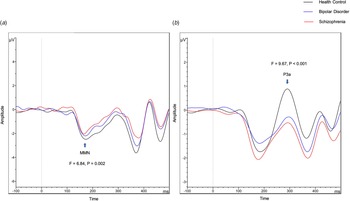
There were no significant group differences in MMN latency (F = 2.18, p = 0.12). MMN amplitude was significantly different among groups (F = 6.84, p = 0.002). ANCOVA and Post-hoc test showed that MMN amplitude of HC (amplitude = −3.05, s.d. = 1.12) was larger than that of SZ (amplitude = −1.86, s.d. = 1.18) and BPD (amplitude = −2.15, s.d. = 1.06) (F = 6.84, p = 0.002) (Table 2, Figs 1 and 2). Patients with SZ and BPD didn't differ from each other.
Comparison of MMN (Fz) and P3a (Cz) among three group.

Averaged ERP wave of MMN (a) and P3a (b) among three group.

Comparison of MMN (Fz) and P3A (Cz) among three group

HC, health control; BPD, bipolar disorder; SZ, schizophrenia.
a Adjusted for age, gender and education. The Post-hoc analysis was Bonferroni corrected.
Note: **P < 0.005; ***P < 0.001.
Comparisons of P3a between groups
There were no significant group differences in P3a latency (F = 0.74, p = 0.485). P3a amplitude of HC (Amplitude = 1.64, s.d. = 0.94) was significantly larger than that of SZ (Amplitude = 0.29, s.d. = 1.02) and BPD (Amplitude = 0.07, s.d. = 1.27) (F = 9.67, p < 0.001) (Table 2, Figs 1 and 2). Patients with SZ and BPD didn't differ from each other.
MMN in relationships with neurocognition and functioning
Results of the stepwise regression showed that in SZ, FAST score and CCFT were significant predictors and in BPD, DMS was a significant predictor (Table 3 and online Supplementary Fig. S2). In SZ, MMN was significant correlated with FAST (partial correlation = 0.48) and CCFT (partial correlation = −0.31) (online Supplementary Fig. S2A and S2B). Table 3 shows that the FAST score (B = 0.16, s.e. = 0.01, adjusted p = 0.032) and the CCFT score (B = −0.06, s.e. = 0.04, Adjusted p = 0.027) could predict 85% of the amplitude of MMN in SZ. In BPD, MMN was significant correlated with DMS (partial correlation = −0.54) (online Supplementary Fig. S2E). The DMS scores of BPD (B = −0.08, s.e. = 0.03, Adjusted p = 0.021) were significant predictors of 15% of the amplitude of MMN. P3a was not a significant predictor of MMN in either patient group.
Relationship among ERPs, general function and cognition in different groups

Note: p-values were adjusted for age, gender and education; *p < 0.05.
P3a in relationships with neurocognition and functioning
Results of the stepwise regression showed that in SZ, RVP and FAST scores were significant predictors. In BPD, RVP, WAIS and FAST were significant predictors (Table 3 and online Supplementary Fig. S2). In SZ, P3a was significantly correlated with RVP (partial correlation = 0.26) and FAST (partial correlation = −0.24) (online Supplementary Figs S2C and S2D). The RVP scores (B = 2.44, s.e. = 2.01, Adjusted p = 0.024) and the FAST score (B = −0.08, s.e. = 0.02, Adjusted p = 0.023) can predict 56% of the amplitude of P3a in SZ. In BPD, P3a was significantly correlated with RVP (partial correlation = 0.33), FAST (partial correlation = −0.11) and WAIS (partial correlation = 0.25) (online Supplementary Figs S2F, S2G and S2H). The RVP scores (B = 3.05, s.e. = 1.27, Adjusted p = 0.028), the WAIS score (B = 1.35, s.e. = 0.59, Adjusted p = 0.047) and the FAST score (B = −0.05, s.e. = 0.06, Adjusted p = 0.046) were significant predictors of 71% of the amplitude of P3a in BPD (Table 3). MMN was not a significant predictor of P3a in either patient group.
Discussion
In this study, we examined the aspects of MMN and P3a ERPs in drug naïve first episode SZ and BPD patients. Although a few prior studies exist, diagnosis specificity is rarely compared, and all are based on medicated patient cohorts. Therefore, it is important to study drug naïve first-episode patients to validate the notion of using MMN /P3a ERP as biological markers for SZ and/or BPD. Our results suggested that antipsychotics do not seem to have an effect on MMN in first episode SZ, as drug naïve patients in this study showed a reduction in MMN comparable with medicated patients. However, effects of antipsychotic medications on BPD were less clear. The observed P3a amplitude reduction in drug naïve patients is inconsistent with the study of Monaghan et al. (Reference Monaghan, Brickman, Huynh, Ongur and Hall2019) who reported a preserved P3a in FEP at study entry (baseline) but impaired P3a at 12- and 24-month follow-up timepoints. Similarly, the observed MMN impairment in this study is inconsistent with Higgins et al. (Reference Higgins, Lewandowski, Liukasemsarn and Hall2021) who found patients in the early-stage BPD had an intact MMN throughout a 24-month follow-up period. One possible explanation may be that P3a and MMN track illness duration longitudinally or across different stages of illnesses. An alternative explanation may be that medication may have a short-term effect in normalizing ERPs in BPD patients.
We found significant group differences in the WAIS-IQ (Richards et al., Reference Richards, Pardiñas, Frizzati, Tansey, Lynham, Holmans and Walters2020) and cognitive processing related to visual information processing (RVP) (Kanchanatawan, Thika, Anderson, Galecki, & Maes, Reference Kanchanatawan, Thika, Anderson, Galecki and Maes2018), showing lower WAIS-IQ and impaired RVP in SZ and BPD groups than that of HC, but similar between patient groups, suggesting shared etiology. Also, we observed that deficits of ERPs were more severe in SZ patients while BPD patients were intermediate between SZ and controls (Fig. 2). This result is consistent with the continuous spectrum of mental illness hypothesis (Pearlson, Reference Pearlson2015) and the report of a difference in neuropsychological profile across SZ and BPD groups (Barch & Sheffield, Reference Barch and Sheffield2014). On the other hand, in tasks relevant to working memory and CCFT functioning, patients with SZ were specifically impaired compared to BPD or HC, who did not differ from each other. This observation is consistent with the notion that patients with SZ have a higher vulnerability than BPD individuals. It is worthwhile noting that the SZ group and the BPD group did not differ in untreated time, onset of age and clinic scales. Lewandowski et al. has suggested that patterns of neuropsychological deficits seem to be similar across SZ and BPD groups, the pathways by which patient groups arrive at these points differ – the evolution of neurocognitive dysfunction seems to follow distinct courses in SZ and BPD (Lewandowski, Cohen, & Ongur, Reference Lewandowski, Cohen and Ongur2011).
Both SZ and BPD drug naïve patients showed MMN deficits (Table 2 and Fig. 1) and that the amplitude of MMN in BPD group was intermediate between that of the SZ and HC. These results are consistent with prior findings of a moderate impairment in BPD and a larger effect in SZ (Erickson et al., Reference Erickson, Ruffle and Gold2016; Hermens et al., Reference Hermens, Chitty and Kaur2018). Our results suggest that SZ and BPD share a common pathophysiologic mechanism underlying MMN reduction, in line with recent reports of MMN alteration being associated with frontotemporal cortical thickness changes in patients with SZ and BPD (Kim et al., Reference Kim, Jeon, Jang, Kim, Im and Lee2019), as well as support the notion of a continuous spectrum of mental illness (Pearlson, Reference Pearlson2015) and a shared genetic/molecular risk (Bhat et al., Reference Bhat, Irizar, Thygesen, Kuchenbaecker, Pain, Adams and Bramon2021).
After an adjustment of age, gender and education, this study found that MMN amplitude was related to functioning disability as measured by FAST, specific in SZ, suggesting that MMN is a stable factor to predict real-world functioning consistent with prior studies (Hamilton et al., Reference Hamilton, Perez, Ford, Roach, Jaeger and Mathalon2018; Light and Braff, Reference Light and Braff2005). However, such a relationship between MMN and functioning was not observed in BPD. The intermediate or weaker effect size of MMN impairment in BPD might contribute to the observed diagnosis specificity. On the other hand, MMN was associated with working memory deficits in BPD but not in SZ. As working memory deficits have been reported in both SZ and BPD, this result is somewhat unexpected. We assessed working memory using a visual working memory task (i.e. the Delay Matching to Sample task) (Rodriguez, Zürcher, Bartlett, Nathanielsz, & Nijland, Reference Rodriguez, Zürcher, Bartlett, Nathanielsz and Nijland2011), which may not comprehensively assess across the working memory domain. Nonetheless, results revealed a partial deficit in working memory in patients with BPD and are consistent with previous results (Sweeney, Kmiec, & Kupfer, Reference Sweeney, Kmiec and Kupfer2000).
In addition, MMN appears to be related to intelligence, particularly fluid intelligence level, at least in SZ patients. Compared to WAIS, CCFT test is designed to overcome the influences of verbal fluency, cultural background, and educational level (Furlow, Armijo-Prewitt, Gangestad, & Thornhill, Reference Furlow, Armijo-Prewitt, Gangestad and Thornhill1997). Näätänen et al. (Reference Näätänen, Sussman, Salisbury and Shafer2014) pointed out that MMN is highly reflected by the education level (Näätänen et al., Reference Näätänen, Sussman, Salisbury and Shafer2014). Umbricht et al. (Reference Umbricht, Bates, Lieberman, Kane and Javitt2006) found that first-episode psychosis patients who had received some college education showed normal MMN while those who had not reached college showed MMN ERP as impaired as in chronic patients. We therefore included education as a covariate in statistical analysis and found a significant relationship between CCFT intelligence and MMN independent of education and WAIS. Further exploration of this link is warrant in the future.
Consistent with Kaur et al. (Reference Kaur, Battisti, Ward, Ahmed, Hickie and Hermens2011) and Kruiper et al. (Reference Kruiper, Fagerlund, Nielsen, Düring, Jensen, Ebdrup and Oranje2019) but contrary to Wada et al. (Reference Wada, Kurose, Miyazaki, Nakajima, Masuda, Mimura and Noda2019) and Andersen et al. (Reference Andersen, Campbell, Schipul, Bellion, Donkers, Evans and Belger2016), we observed reduced P3a amplitudes in SZ and in BPD (Table 2 and Fig. 1). Until now, limited research has examined BPD. P3a deficits in our sample did not differ between diagnoses, although the averaged P3a amplitude was poorer in BPD than in SZ in our sample. Jahshan et al. (Reference Jahshan, Wynn, Mathis, Altshuler, Glahn and Green2012) also reported that BPD patients had more P3a amplitude reduction than the SZ group. Our funding indicated that a compromised automatic sensory discrimination processing already exists during the first episode across SZ and BPD and perhaps has occurred prior to illness onset. The observed relationship between P3a and sustained attention across SZ and BPD groups (Table 3) suggested that patient' difficulties in shifting attention to target auditory stimuli are linked to an impaired orientation to salient auditory stimuli reflection (Hamilton et al., Reference Hamilton, Roach, Bachman, Belger, Carrion, Duncan and Addington2019). Attention deficits have been robustly reported in chronic patients, findings of this study are consistent with those reported in chronic SZ and BPD patients.
Greater P3a abnormalities were associated with greater functional impairment, consistent with prior reports in healthy individuals (Light et al., Reference Light, Swerdlow and Braff2007) and in patients (Hermens et al. Reference Hermens, Ward, Hodge, Kaur, Naismith and Hickie2010). Hermens et al. (Reference Hermens, Ward, Hodge, Kaur, Naismith and Hickie2010) found a significant correlation between MMN/P3a complex and quality of life in FEP. We were able to extend the literature by demonstrating that P3a impairment in first episode SZ and BPD patients was associated with functioning disability across several functioning domains independent of symptom severity and intelligence.
The major strengths of this study are that the study cohort included both first episode drug naïve SZ and BPD patients and that we fully considered the influence of education on the results during the analyses. Although studies suggest that antipsychotic medication may not significantly affect P3a and MMN (Korostenskaja et al., Reference Korostenskaja, Dapsys, Siurkute, Maciulis, Ruksenas and Kahkonen2005; Leung, Croft, Baldeweg, & Nathan, Reference Leung, Croft, Baldeweg and Nathan2007; Pekkonen et al., Reference Pekkonen, Katila, Ahveninen, Karhu, Huotilainen and Tiihonen2002; Umbricht et al., Reference Umbricht, Javitt, Novak, Bates, Pollack, Lieberman and Kane1998). It should be noted that these studies are likely underpowered or unable to examine potential effects of other medication classes on ERPs. Findings from the present study are valuable to validate prior reports and provide insights into the disease brain during an early stage of illness. There are several limitations. First, influenced by sample size and individual heterogeneity of the sample, the results of this study may not be generalizable to all SZ and BPD. Lacking an auditory cognitive task also limits our ability to study the influence of a cognitive task on pathophysiological processes. Studies with larger samples and multidimensional cognitive-behavioral and longitudinal design are needed to explore further the differences between SZ and BPD. In addition, all BPD patients were stable during testing. Whether MMN and P3a deficits are more pronounced during depressive, manic and hypomanic period remained to be explored.
In conclusion, the present study found that deficits in MMN, P3a, neurocognition in drug naïve SZ and BPD patients. Such deficits appear to link with levels of higher-order cognition and functioning.
Supplementary material
The supplementary material for this article can be found at https://doi.org/10.1017/S0033291721002130
Financial support
This work was supported by the National Natural Science Foundation of China Key Project (81630030 and 81920108018 to T.L.); the National Natural Science Foundation of China (82001440 to X.L.); 1.3.5 Project for disciplines of excellence, West China Hospital of Sichuan University (ZY2016103, ZY2016203 and ZYGD20004 to T.L.); Project for Hangzhou Medical Disciplines of Excellence & Key Project for Hangzhou Medical Disciplines (202004A11 to T.L.); Introduction Project of Suzhou Clinical Expert Team (SZYJTD201715 to X.D. and T.L.); McLean Foundation Award (401343 to M.H.) and Post-Doctor Research Project, West China Hospital, Sichuan University (2020HXBH042 to X.L.).
Conflict of interest
The authors declare that they have no competing interests.