Introduction
On January 13, 2018 at 08:10 in the morning, an emergency alert was broadcast to cell phones across Hawaii (USA) that a “ballistic missile threat” was inbound and to “seek immediate shelter” leading residents to panic.Reference Nagourney, Sanger and Hohanna 1 For almost 40 minutes, many Hawaiians believed they were about to face a catastrophic event: that of a nuclear explosion. Among the factors that contributed to the panic was the realization that many did not know what to do with the few minutes of warning the alert system gave them. Thankfully, in this case, it was a false alarm.
Multiple organizations and government agencies, some of them tasked with the safety of civilians, have put out guides on how to prepare for a nuclear blast. 2 – 4 Some military organizations have also published publicly available guidelines for preparation. 5 , Reference Goans 6 A common element of these guidelines is a recommendation to prepare an emergency kit, commonly referred to as a Bug-Out Bag, as well as a list of items to consider including.
One pitfall of such guidelines is that by their nature, they attempt to encapsulate a wide-range of risks, and thereby can suffer from a “mission creep” by recommending so many items as to become impractical.
The goal of this report is to discuss the rationale for various components of emergency kits in order to make sensible recommendations and advise the community to the fullest extent possible.
Report
General Principles
The purpose of the emergency kit is to facilitate evacuation and sustain evacuees in the lag time between an emergent event and when relief efforts can be established by the authorities. Although lag time can vary based on circumstances, three days is a commonly accepted time period for planning of emergency kits. Planning for a shorter period is likely to be insufficient in a major disaster. Planning for longer would be impractical.
It is impossible to prepare for every eventuality in every circumstance. No matter how complete an equipment list is, a case can always be made for an additional or back-up item. In fact, a common adage in Expedition Medicine is “Two is One and One is None,” which is to say, always pack a back-up for critical equipment. However, this runs counter to the preparation of emergency kits given the nature of the event being prepared for, namely a large-scale disaster rather than a carefully planned travel expedition. First and foremost, emergency kits need to be light and compact in order to be practical, and the impulse must be avoided to make the kit “complete.” It is crucial to consider that the individuals intended to implement these emergency kits are untrained, average civilians. The entire contents should fit into a backpack no larger than 40 liters in volume.
Specific Recommendations
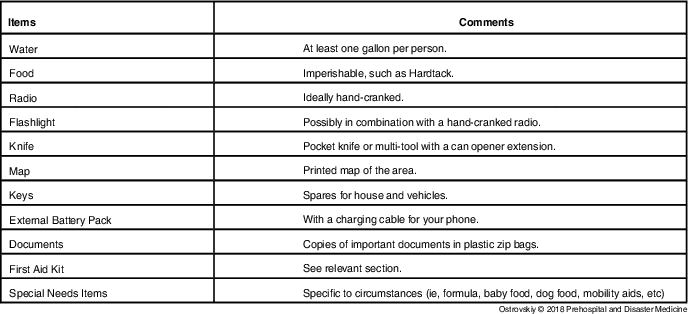
Specific recommendations are summarized in Table 1.
Recommendations for Emergency Kit Contents

Water
Typical recommendations for water content in an emergency kit suggest preparing at least one gallon of water per person per day. 3 For example, the Federal Emergency Management Agency (FEMA; Washington, DC USA) recommends preparing one gallon of water per person per day, for a minimum of three days. 3 For a small family of three, that would give the water content of the kit alone a weight of 74 lbs (34 kg). This is likely impractical if the situation arises requiring one to leave shelter. A more practical recommendation would be to prepare one gallon per person in total and plan to ration that quantity strictly.
Food
For an extended expedition, one would typically look for food items that meet the caloric and nutritional needs of the team. This is impractical in the setting being considered. Dehydrated foods require much needed water that is going to be scarce, and many non-dehydrated food items are going to be heavy or bulky and could impact mobility. Like with water, the aim would be to prepare not for the optimal caloric and nutritional requirements, but for the absolute minimum requirements for three days. The ideal food items are individually packaged, do not require can openers, utensils, heat, or water to consume. One possibility is Hardtack, an inexpensive, virtually imperishable, light, compact biscuit as a food source.
Communication Device
As the recent experience with the false alarm in Hawaii makes clear, it is important to be able to receive follow-up communication from authorities. In the event of a nuclear blast, cell phone communication and access to social media may not be available. The best tool to receive updates in the event of a disaster remains a hand-cranked radio. There are many commercially available options, many of which can also serve as a light source.
Flashlight
A light source is critical to navigate in the dark and potentially signal your whereabouts. These are also available in hand-cranked versions, which are ideal for the home kit as the charge status of batteries may go unchecked for an extended period of time. If a standard battery-operated flashlight is used, it is strongly recommended to store batteries outside of the device.
Knife
A pocketknife or a multi-tool is an essential piece of equipment. In a disaster scenario, it is unlikely to have access to tools normally available, particularly if leaving one’s home. Many easily solvable problems under normal circumstances, such as opening a container, can become extremely difficult or impossible in the absence of a sharp edge. The knife should be sturdy, reliable, and compact. Ideally, it should come with a can opener.
First Aid Kit
As with the emergency kit at large, the primary goal of the first aid kit in this scenario is to facilitate evacuation. The following recommendations are based on this assumption and are directed at items that may be needed to allow an individual to continue moving away from danger.
Other “Recommend to Include”
Other recommendations include the following.
∙ Acetaminophen or Ibuprofen: Over-the-counter pain medication may be necessary to treat pain from injuries sustained during the incident or evacuation. Acetaminophen may be the preferred choice, as Ibuprofen may exacerbate acute kidney injury in the setting of dehydration.
∙ Blister Care Supplies: Few things can impact ability to continue moving as painful blisters. There are multiple commercially available products, which can be selected based on personal preference.
∙ Duct Tape: Multi-purpose tape can be used for a variety of situations, from directly closing a laceration, to securing a dressing, to improvising a splint when combined with an available rigid object such as a stick or a rolled-up magazine.
∙ Ace Bandage: Bandages are essential for treating sprains or for securing wound dressings.
∙ Gauze: Cuts and scrapes may be treated on the move with the direct application of gauze and secured by ace bandage and duct tape.
∙ Personal Medications: A three-day supply of any individual necessary medication needs should be set aside.
Other “Consider Including”
Another item to consider including is below.
∙ Iodine Tablets: Potassium iodine (KI) tablets may be used in the event of a nuclear blast to shield the thyroid from absorption of radioactive iodine, and they can be protective from the risk of thyroid cancer. It has been shown to be generally safe, 7 with the best evidence for efficacy in children, who are particularly susceptible. It would be prudent to recommend the inclusion of potassium iodine (KI) tablets in kits, particularly for families with children, but to await recommendations on administration from authorities. It would not be unreasonable to exclude this item.
Not Recommended to Include
Items not recommended include the following.
∙ Water Purification Tablets and Filtering Systems: This may seem counter-intuitive given that clean drinking water is essential to survival. Moreover, in the case of a nuclear blast, radioactive fallout may make water dangerous to drink despite filtration or purification with tablets.
Miscellaneous Items
Other miscellaneous items are included here. Map of the area: a printed map of the area can serve as a useful evacuation guide. Extra house and car keys: copies of keys prevent the need to hunt for lost keys in a crisis. External phone battery and charging cable: although cellular communication may be down, in the event it is not, it may be the most useful form of communication.
Documents
It would be prudent to include photocopies of key documents placed into a gallon-sized plastic zip bag, including:
∙ ID;
∙ Health insurance cards;
∙ Immunization records;
∙ Notable past medical history with medication list;
∙ Home ownership and insurance documents;
∙ Vehicle registration and insurance documents; and
∙ Family and emergency contact information.
Special Needs
Depending on family and living situation, there may be additional personalized needs:
∙ Baby supplies (bottles, formula, baby food, and reusable diapers for three days);
∙ Pet supplies (food for three days, and additional water up to one gallon);
∙ Walking cane or other mobility aid; and
∙ Hearing aids.
Discussion
The current recommendation from the Hawaii Emergency Management Agency (Honolulu, Hawaii USA) is to “immediately seek shelter in a building or other substantial structure.” 2 The recommendation to have an emergency kit is not contradictory to that. Depending on circumstances, rapid evacuation may in fact become necessary immediately after a potential impact, either as instructed by local authorities to facilitate extraction, or to escape immediate danger, such as a building collapse. It is worthwhile to have emergency kits in the home, place of work, and a vehicle in preparation for such events.
Civilians without relevant experience attempting to follow the available guidelines to the letter are likely to assemble unwieldy kits. Emergency Physicians, together with Emergency Medical Services and Disaster Medicine specialist colleagues, are by definition a cohort of frontline providers who provide care that is often unanticipated and emergent.
Limitations
The above recommendations come with a number of limitations:
1) Lack of Evidence. Upon literature review, there are no rigorous trials assessing the optimal content of civilian emergency kits. Given the lack of more rigorous scientific evidence, this report is limited to the opinions of the authors.
2) Focus on Mobility. The above recommendations are focused on preparing an emergency kit for a three-day period. Following these recommendations may in fact be counter-productive in settings where relief or evacuation is likely to be more than 72 hours away.
3) Unpredictability of Circumstances. The nature of Disaster Medicine is such that it may be impossible to prepare for every eventuality. Individual circumstances, locales, and types of disaster may have specific or nuanced needs not addressed by the above recommendations.
Conclusion
Recommendations for personal and family emergency kits should be based on the goal of sheltering safely and subsequently facilitating evacuation if sheltering in place becomes unsustainable or is directed by authorities. Emergency kits should therefore be light and compact. The recommendations above will assist individuals to prepare accordingly.