Introduction
Cochlear implantation has become the standard treatment of choice for children and adults with severe to profound sensorineural hearing loss. The referral guidelines for cochlear implantation assessment have changed over time and currently apply to patients even with some residual hearing. Doctors play a vital role in dispersing information that is necessary for an adequate and timely referral, especially in a country such as India where a formal referral system does not exist. Appropriate referral of a patient with hearing loss therefore depends on the primary physician that the patient consults. This may be for symptoms and disorders other than hearing loss. These physicians can provide appropriate information to patients and their families and facilitate an early referral process for cochlear implantation. The efficiency with which a medical professional refers a potential candidate for cochlear implantation assessment depends on whether he or she is sufficiently knowledgeable about how and when a referral should be made. Some of the other factors that can influence the referral decision include previous experience with cochlear implantation users, adequate levels of training, presence of established professional relationships with cochlear implantation clinics and confidence in the effectiveness of cochlear implantation.Reference Hogan, Taylor and Westcott1
The main objective of our study was to assess the knowledge, attitude and practices regarding cochlear implantation among doctors other than otolaryngologists in a tertiary care referral institution.
Materials and methods
A cross-sectional study was conducted using a validated questionnaire in our tertiary care referral centre in South India to evaluate knowledge, attitude and practices regarding cochlear implantation among non-otolaryngologists working in clinical departments from June 2019 to April 2020. The study was approved by the institutional review board and ethical committee (number: 12043). Doctors who were above the level of interns after completion of a basic medical degree or its equivalent in various clinical departments with different levels of experience and who consented to take part in the survey were included in the study. Doctors who had personal knowledge of cochlear implantation (i.e. those who had close relatives or friends who had undergone cochlear implantation) and those unwilling to give consent were excluded from the study.
Assuming 40 per cent to be an adequate knowledge of cochlear implantation among the doctors, with 7 per cent precision and 95 per cent confidence interval, a sample size of 100 doctors was calculated. The overall score of 40 per cent was taken as adequate knowledge among non-otolaryngologists, based on a cross-sectional study in 2015 by Guerra et al. of 73 audiologists, pathologists and otolaryngologists.Reference Guerra, Sampaio, Oliveira and Serra2 This showed 31 per cent knowledge among audiologists and 59.4 per cent knowledge among otolaryngologists regarding cochlear implantation.
Questionnaire development and data collection
The study group was divided into smaller sub-categories that included doctors of various departments, such as general medicine, general surgery, orthopaedics, paediatrics, dermatology, cardiology, developmental paediatrics, obstetrics and gynaecology, cardiothoracic surgery, neurology, psychiatry, urology and nephrology.
For the analysis, doctors were grouped based on years of professional experience, medical or surgical field, and broad specialty or higher specialty training. The knowledge, attitude and practices questionnaire was developed with inputs from an experienced epidemiologist and senior otolaryngologists. The overall content validity index was calculated among six expert otolaryngologists for the entire questionnaire. The average item content validity was 0.97, and the average rater content validity was 0.97. The scale-content validity item based on the universal agreement method was 0.875. A range between 0.70 to 0.90 is considered a measure of good internal consistency.Reference Nunnally3
A 24-item questionnaire (the initial 4 questions were related to demographic data and the rest were on hearing loss and cochlear implantation) was developed, which required around 15 minutes for completion. There were 8 questions (8, 10, 13, 14, 17, 21, 22 and 23), including sub-questions that were for assessing ‘knowledge’ regarding cochlear implantation and hearing loss, 7 questions (7, 13, 15, 16, 18, 20 and 24) that assessed ‘attitude’ and 4 questions (5, 6, 9 and 11) that assessed the ‘practice’ category (Appendix 1).
Statistical methods
Data were summarised as mean ± standard deviation or median (range) for continuous variables and frequency along with percentage for categorical variables. The internal consistency of the tool was calculated using Cronbach's alpha. The knowledge, attitude and practice scores were presented with a 95 per cent confidence interval. The correlation between knowledge, attitude and practice was assessed using Pearson's correlation co-efficient. The knowledge, attitude and practices among the specialties were compared using analysis of variance, and the correlation between knowledge, attitude and practice with years of experience was analysed using Pearson's correlation coefficient and depicted on a scatter plot. The knowledge, attitude and practice score was calculated for a total score of 36 (including sub-questions), based on how many were answered appropriately as judged by 6 expert otolaryngologists.
Results
Demographics
Among the 100 doctors who participated in the study, 61 per cent were male and 39 per cent were female. The age of the participants ranged from 25 to 61 years. Out of 100 doctors, 89 had completed a broad specialty training (3 additional years after a basic medical degree or its equivalent) and had a degree of Master of Surgery or Master of Medicine, and 46 of the 89 doctors had undergone a higher specialty training (additional 3-year training; degree awarded being Master of Chirurgical or Surgery or Doctorate of Medicine as outlined in Table 1.
Years of experience among doctors after basic medical degree or its equivalent, broad specialty and higher specialty

*n = 100; †n = 89; ‡n = 46
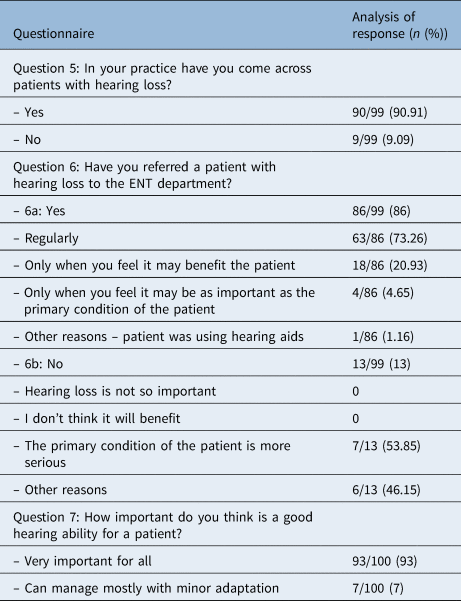
Table 2 summarises the analysis and results of questions 5, 6a, 6b and 7 based on the awareness of hearing loss and referral of patients to the ENT department. Among the 100 doctors surveyed, questions 5, 6a and 6b were attempted only by 99 doctors.
Analysis and results of questions 5, 6a, 6b and 7

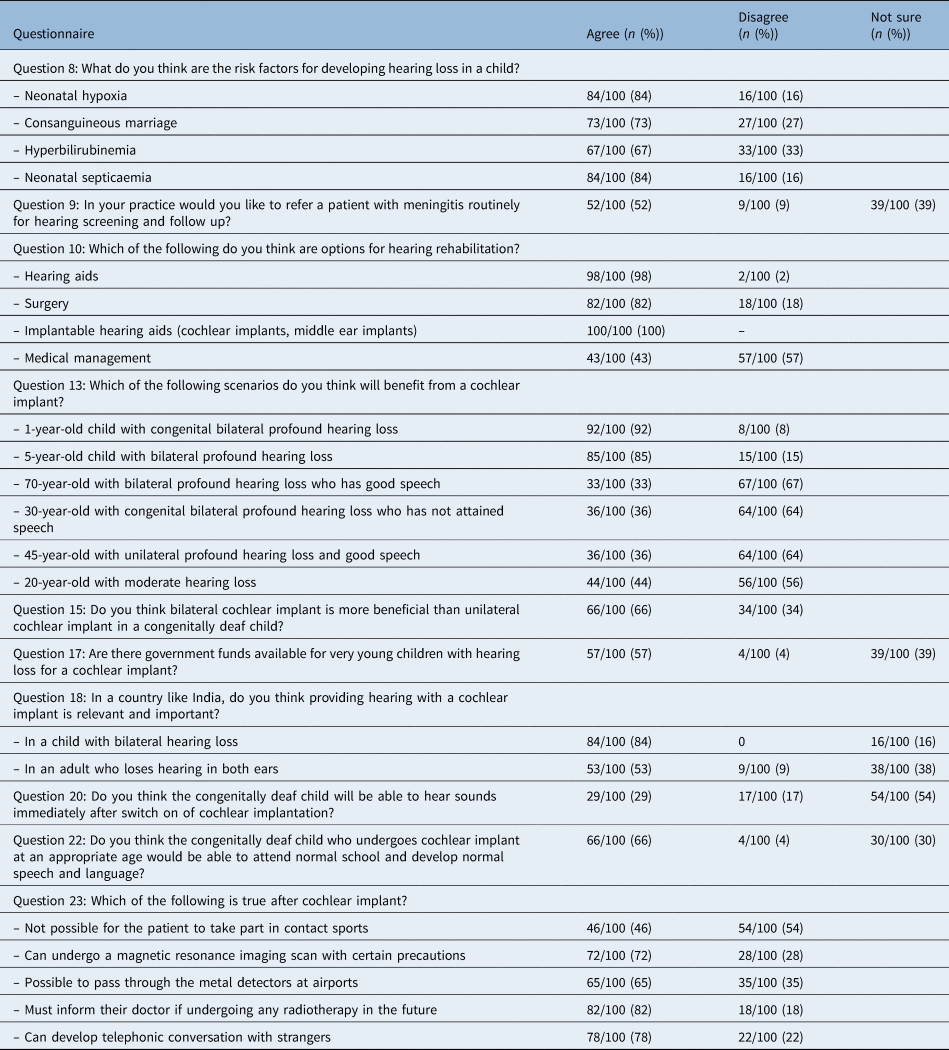
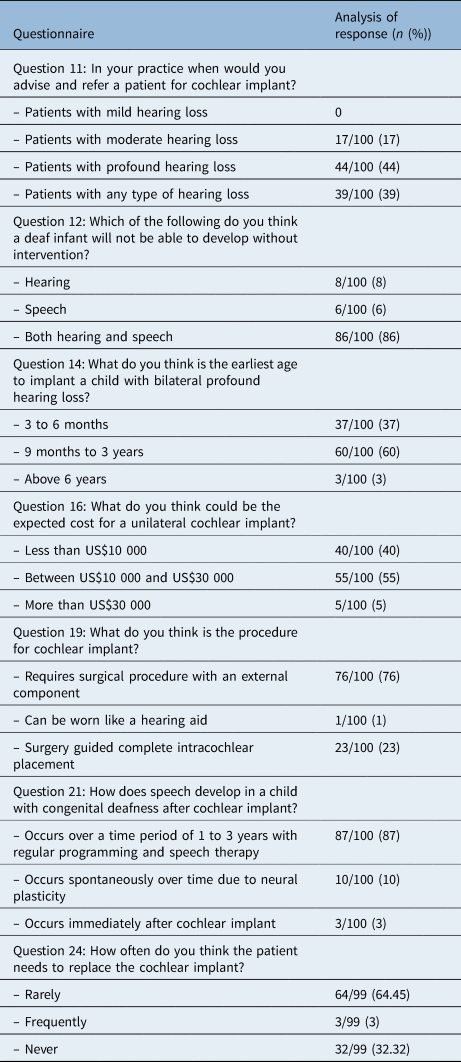
Table 3 and 4 summarise the analysis and results of questions 8, 9, 10, 11, 12, 13, 14 and 15 based on risk factors, candidacy and management of hearing loss, questions 16, 17, 19, 23 and 24 based on the availability of government funds, procedure for cochlear implantation, precautions to be taken by a cochlear implantee and replacement of cochlear implantation in the future, and questions 20, 21 and 22 based on the development of speech and language following cochlear implantation.
Analysis and results of questions 8, 9, 10, 13, 15, 17, 18, 20, 22 and 23 in the study population

Analysis and results of questions 11, 12, 14, 16, 19, 21 and 24 in the study population

Descriptive analysis
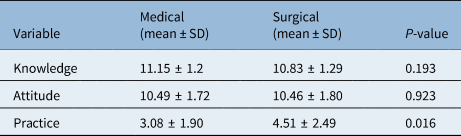
Out of a maximum appropriate answer score of 36, including sub-questions, an average score of 24.27 (67.4 per cent) was obtained overall among the 100 doctors in the knowledge, attitude and practices questionnaire. Descriptive analysis and association correlation among 65 doctors in the medical specialties and 35 doctors in the surgical specialties is outlined in Table 5. In practice related to hearing loss and cochlear implantation, the surgical group scored significantly better than the medical group with a p-value of 0.016. However, there was no statistically significant difference between the ‘knowledge’ and ‘attitude’ scores among the medical and surgical specialty groups.
Association correlation between medical and surgical groups

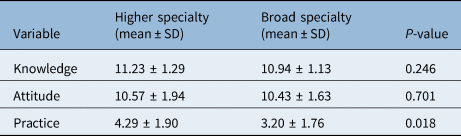
Descriptive analysis and association correlation among 35 doctors in higher specialties and 65 doctors in the broad specialties is outlined in Table 6. In the ‘practice’ domain, the higher specialties had better scores than the broad specialties with a statistically significant p-value of 0.018. However, there was no statistically significant difference in the ‘knowledge’ and ‘attitude’ domain between the broad and higher specialties. Analysis also showed a statistically significant correlation between age and knowledge (r = 0.213) and age and practice (r = 0.636) among doctors with a p-value of 0.0327 and 0.000, respectively. This meant that with the increasing age and experience of doctors, their knowledge and practice regarding cochlear implantation also improved (Figure 1a and 1b). There was a statistically significant correlation between knowledge and attitude (r = 0.313 and p = 0.001; Figure 1c). The correlation between age and attitude (r = 0.107) was not statistically significant, with a p-value of 0.288. The correlation between knowledge with practice and practice with attitude was also not statistically significant (p = 0.5371 and p = 0.278, respectively).
(a) A scatter plot depicting a correlation between age and knowledge. (b) A scatter plot depicting a correlation between age and practice. (c) A scatter plot depicting a correlation between knowledge and attitude.

Association correlation between broad specialty and higher specialty groups

Discussion
A significant number of doctors of other clinical specialties may encounter patients eligible for a cochlear implant. The enthusiasm with which a physician appropriately refers a patient with hearing loss for further evaluation and a possible cochlear implantation appears to be influenced by several factors.
Potential barriers for a patient in obtaining a referral to the implant centre include a lack of knowledge regarding the cost of implantation, outcomes of cochlear implantation, referral guidelines and candidature of cochlear implantation.Reference Hogan, Taylor and Westcott1 Knowledge and awareness regarding the candidacy criteria, government funding options and safety precautions following cochlear implantation are instrumental in helping a physician counsel a patient and make a suitable referral. Other factors that may be associated with referral behaviours include their experience in the medical profession, knowledge about recent advances in medical science, interaction with colleagues from other specialties in a multispecialty centre and the level of training received. According to Ben-Itzhak,Reference Ben-Itzhak, Most and Weisel4,Reference Damen, Beynon, Krabbe, Mulder and Mylanus5 the main reason for a professional's lack of knowledge may be because of the absence of the subject in the formal education of the professionals because implant otology is a relatively new field. Not all healthcare professionals are comfortable explaining to patients about cochlear implantation when they do not benefit from hearing aids.
• Surveys have shown underutilisation of cochlear implant services in both developed and developing nations, pointing to gaps in referral patterns
• This study aimed to understand the knowledge and attitude of non-otolaryngologists who identify and refer patients for implants
• Awareness regarding cochlear implantation for adults, elderly and unilateral deafness among non-otolaryngologists is sub-optimal
• Surgeons and those in higher specialties did better when it came to practice related to cochlear implantation
• Increasing age and experience of doctors also improved knowledge and practice with regards to cochlear implantation
In this study, 100 medical doctors other than otolaryngologists completed the survey concerning knowledge, attitude and practices towards hearing loss, cochlear implants and associated referral behaviour. Among the 100 doctors, 90 of them had come across patients with hearing loss in their practice. Regarding practice related to referral of patients with hearing loss, 86 per cent routinely referred patients to the otolaryngologist. Among the doctors who did not routinely refer patients with hearing loss to the otolaryngologist, 7 (53.85 per cent) considered the primary condition of the patient to be more serious, and 6 (46.15 per cent) did not assign any reason for this. A study by D'Haese et al. Reference D'Haese, Van Rompaey, De Bodt and Van de Heyning6 was conducted among 240 otolaryngologists in a secondary setting in Germany, England, France, Austria and Sweden. A custom-made questionnaire was used to understand their knowledge and beliefs regarding hearing loss and its treatment, and the findings showed that otolaryngologists shared many common beliefs about hearing loss, hearing aids and cochlear implantation. In our study, we found that overall, non-otolaryngologists support cochlear implantation, but because of a lack of familiarity, not all were confident in discussing cochlear implantation with patients and making a referral.
Questions related to knowledge, practice and attitude regarding risk factors for hearing loss and options for management of hearing loss, candidacy for cochlear implantation, earliest age of implantation, availability of government funds, the procedure for cochlear implantation, attainment of speech and language development following cochlear implantation, and safety precautions necessary to be taken for a cochlear implantee were included in the study. Most of the doctors were aware of the well-known risk factors for congenital hearing loss. However, 39 per cent of the doctors were unsure and 9 per cent disagreed that referral for hearing assessment was necessary following meningitis. Non-otolaryngologists knew that hearing aids, surgery and implantable hearing aids were all options available for management of hearing loss; however, only 43 per cent of the doctors felt that medical management could be an option for hearing loss.
Regarding the candidacy for cochlear implantation, 44 doctors (44 per cent) said they would refer a patient with profound hearing loss for cochlear implantation; however, 17 (17 per cent) of the doctors said they would also refer a patient with moderate hearing loss, and 39 (39 per cent) said they would refer patients with any type of hearing loss for cochlear implantation. The knowledge regarding the type of hearing loss that warrants a cochlear implantation was inadequate among the surveyed doctors. In our study, 84 per cent of the doctors agreed that cochlear implantation was important in providing hearing in a child with bilateral profound hearing loss, but 34 per cent of them disagreed that bilateral cochlear implantation was more beneficial than unilateral cochlear implantation in such a child.
Regarding the age of patients that could be implanted, most doctors were aware of the option for cochlear implants in children; however, 67 per cent of doctors did not agree that cochlear implantation was indicated in bilateral profound hearing loss in the elderly, and 64 per cent of doctors disagreed that cochlear implantation was an option for unilateral profound hearing loss. Therefore, knowledge regarding adult cochlear implants and cochlear implantation in patients with unilateral hearing loss was inadequate.
A similar study performed by Blanchfield et al. Reference Blanchfield, Feldman, Dunbar and Gardner7 mentioned that despite the ready availability of cochlear implant technology, relatively few potentially eligible adults have been implanted. According to the Australian Bureau of statistics 2018, the number of adults in Australia with severe hearing loss was projected to be 573 000 by 2020, and it is estimated that less than 10 per cent of such adults utilise cochlear implantation in Australia.8,Reference Bierbaum, McMahon, Hughes, Boisvert, Lau and Braithwaite9 Similar studies also mention use of cochlear implantation technology among adults to be less than 5 per cent in the UKReference Raine10 and approximately 8 per cent in the USA,Reference Holder, Reynolds, Sunderhaus and Gifford11 indicating cochlear implantation is being underutilised for adults globally.Reference Sorkin and Buchman12 The low take-up rate suggested that several barriers exist, which prevent deafened adults from accessing the implant programme. One of these could be a lack of knowledge among primary physicians about candidacy for cochlear implantation in adult patients.
In the present study, 60 per cent of doctors felt that the earliest age of implantation in a baby with profound hearing loss was between 9 months to 3 years; however, 40 per cent did not agree. A similar study by Hayman et al. Reference Hayman, Marsh and Potsic13 on 222 paediatric audiologists regarding their views on cochlear implantation showed that 68 per cent indicated that they would consider referring a child by 18 months, and 92 per cent of the respondents recommended that families consider cochlear implantation as an option.
When attitude-related questions were analysed, it was found that doctors consistently agreed that good hearing ability was important for all, and both hearing and speech can be affected without early intervention in a deaf infant. Regarding the cost of the implant, 40 per cent assumed the expected cost for unilateral cochlear implantation to be less than US$10 000, 55 per cent said it was between US$10 000 and 30 000, and 5 per cent said that the cost was more than US$30 000. Therefore only 55 per cent of the surveyed doctors gave a correct estimate of the cost of a unilateral cochlear implantation. Regarding the availability of government funds for cochlear implantation procedure, 57 doctors (57 per cent) agreed that funds were available for cochlear implantation in very young children with hearing loss. A lack of knowledge regarding the actual cost of a cochlear implant in the country could be another deterrent to appropriate referral and advice. At present, there are no private insurance agencies in India that cover a cochlear implant.
Of the 100 doctors, 76 (76 per cent) agreed that cochlear implantation required a surgical procedure and had an internal as well as an external component. A survey undertaken by Guerra et al. Reference Guerra, Sampaio, Oliveira and Serra2 in 2015 of 73 audiologists, pathologists and otolaryngologists who answered 33 questions on knowledge of cochlear implantations in a federal district showed that 31 per cent of interviewees believed that they had sufficient knowledge regarding the surgical procedure, whereas among the otolaryngologists it was around 59.4 per cent.
More than half the doctors surveyed were not sure whether the child would be able to hear immediately after ‘switching on’ the implant. The majority of doctors (87) agreed that speech development in a child with congenital deafness occurred over a time period of 1 to 3 years after cochlear implantation with regular implant programming and speech therapy. More than half the number of doctors (66 per cent) were aware and agreed that if cochlear implantation was performed at an appropriate age, the child with congenital deafness would be able to attend a regular school and develop normal speech and language. According to a study of audiologists by Chundu and BuhagiarReference Chundu and Buhagiar14 using a 31-item questionnaire regarding knowledge on cochlear implantation, 97 per cent of the respondents agreed that cochlear implantation provided more than just environmental awareness, and most audiologists supported cochlear implantation. This high score could be because they had included audiology specialists.
Our study, which was based on a 24-item validated questionnaire showed an overall knowledge, attitude and practice score among doctors in the study population to be 67.4 per cent. We found no difference between knowledge and attitude among doctors in both the medical and surgical groups. However, with regards to practice, surgical specialty doctors scored better (p = 0.016) when it came to referral of patients with hearing loss and need for hearing rehabilitation. When results were compared between sub-groups of broad specialty and higher specialty, there was no difference with regards to knowledge and attitude between these groups. There was a significantly higher score among the higher specialty group when it came to practice (p = 0.018). Doctors in higher specialties scored higher in the practice of referral of patients with hearing loss and need for hearing rehabilitation when compared with the doctors in broad specialty.
A medical professional's lack of experience may also be a barrier to referral. As age increases, the knowledge and practice with regards to hearing loss and cochlear implantation increases (correlation between knowledge with age had an r-value of 0.213 and p-value of 0.0327, and the correlation between practice with age had an r-value of 0.636 and p-value of 0.000). There was also a significant correlation between knowledge and attitude, with an r-value of 0.313 and a p-value of 0.001, which meant that with increasing knowledge, the attitude towards hearing loss and cochlear implantation also improved. There was no correlation between knowledge with practice and practice with attitude.
There are currently no studies based on the knowledge, attitude and practices among non-otolaryngologists regarding cochlear implants in the English medical literature. When surveys have shown underutilisation of cochlear implant services in both developed and developing nations, it is important to attempt to understand the gaps in our referral patterns. In such a scenario, this study strives to understand the knowledge and attitude of specialists who may play a great role in advising potential recipients of cochlear implants.
Improving awareness about cochlear implantation and its benefits among non-otolaryngology colleagues can ensure that more people who could potentially benefit from cochlear implantation will receive appropriate counselling and referral. Non-otolaryngologists who refer patients for hearing screening and rehabilitative procedures may be encouraged if they receive a personal note or feedback regarding details of the cochlear implant procedure carried out and subsequent outcome of referred patients. Another way of spreading awareness among non-otolaryngologists would be by conducting ‘continuing medical education’ seminars on a regular basis on related topics. Celebrating international days of cochlear implant and hearing on a large scale endorsed by relevant professional bodies can help to bring focus to this subject. The curriculum for basic medical degrees needs to be restructured with emphasis laid on recent advances in cochlear implantation.
One of the limitations of our study was that because the questionnaire was self-administered, there was a possibility of over-reporting of more acceptable or desirable answers and under-reporting of less desirable ones. Additionally, the study group consisted of highly accomplished and busy professionals, and they may have filled out the questionnaire in haste. For the same reason, we could not recruit a larger number of doctors of higher specialties.
Conclusion
The overall knowledge among non-otolaryngologists regarding risk factors, treatment options for hearing loss, indications for cochlear implants in children, rehabilitation and replacement following implant was adequate; however, awareness regarding cochlear implantation for adults, elderly patients and for unilateral deafness was deficient. Surgeons and doctors in higher specialties did better when it came to practice related to cochlear implantation. The age and experience of doctors also improved knowledge and practice with regards to cochlear implantation.
Acknowledgements
The authors would like to gratefully acknowledge the contributions of Mrs Mahasampath Gowri in the statistical analysis of this article. We are also grateful to all the doctors who volunteered to participate in this study. This study was supported by funding from the Fluid Research Grants, Christian Medical College, Vellore, India.
Competing interests
None declared
Appendix 1. Questionnaire proforma
Knowledge, attitude and practices (KAP) among doctors regarding cochlear implant
Serial no.
Please read each question and circle/mark the answer that you think is correct.
1. Name Sex – M/F
2. Age
3. Department Qualification
4. Duration of experience after

5. In your practice have you come across patients with hearing loss? YES/NO
6. Have you referred a patient with hearing loss to the ENT Department?
YES/NO
IF YES
i. Regularly
ii. Only when you feel it may benefit the patient
iii. Only when you feel it may be as important as the primary condition of the patient
iv. Other reasons
IF NO
i. Hearing loss is not so important
ii. I don't think it will benefit
iii. The primary condition of the patient is more serious
iv. Other reasons
7. How important do you think is a good hearing ability for a patient?
i. Very important for all
ii. Can manage mostly with minor adaptation
iii. Not relevant much in our scenario as other diseases take precedence.
8. What do you think are the risk factors for developing hearing loss in a child?
i. Neonatal Hypoxia AGREE/DISAGREE
ii. Consanguineous marriage AGREE/DISAGREE
iii. Hyperbilirubinemia AGREE/DISAGREE
iv. Neonatal Septicaemia AGREE/DISAGREE
9. In your practice would you like to refer a patient with meningitis routinely for hearing screening and follow up
i. YES ii. NO iii. NOT SURE
10. Which of the following do you think are options for hearing rehabilitation?
i. Hearing aids AGREE/DISAGREE
ii. Surgery AGREE/DISAGREE
iii. Implantable hearing aids (cochlear implants, middle ear implants) AGREE/DISAGREE
iv. Medical management AGREE/DISAGREE
11. In your practice when would you advise and refer a patient for a cochlear implant?
i. Patients with mild hearing loss
ii. Patients with moderate hearing loss
iii. Patients with profound hearing loss
iv. Any type of hearing loss
12. Which of the following do you think a deaf infant will not be able to develop without intervention?
i. Hearing
ii. Speech
iii. Speech and Hearing
13. Which of the following scenarios do you think will benefit from a cochlear implant?
i. 1-year old child with congenital bilateral profound hearing loss AGREE/DISAGREE
ii. 5-year-old child with bilateral profound hearing loss AGREE/DISAGREE
iii. 70-year-old with bilateral profound hearing loss who has good speech AGREE/DISAGREE
iv. 30-year-old with congenital bilateral profound hearing loss who has not attained speech AGREE/DISAGREE
v. 45-year-old with unilateral profound hearing loss and good speech AGREE/DISAGREE
vi. 20-year-old with moderate hearing loss AGREE/DISAGREE
14. What do you think is the earliest age to implant a child with bilateral profound hearing loss?
i. 3 to 6 months
ii. 9 months to 3 years
iii. Above 6 years
15. Do you think bilateral cochlear implant is more beneficial than unilateral cochlear implant in a congenital deaf child?
i. Agree ii. Disagree
16. What do you think could be the expected cost for a unilateral Cochlear Implant?
i. <US$10 000
ii. US$10 000 – 30 000
iii. >US$30 000
17. Are there government funds available for very young children with hearing loss for a cochlear implant?
i. Yes ii. No iii. Not sure
18. In a country like India, do you think providing hearing with cochlear implant is relevant and important?
i. In a child with bilateral hearing loss: YES/NO/ NOT SURE
ii. In an adult who loses hearing in both ears: YES/NO/ NOT SURE
19. What do you think is the procedure for cochlear implant?
i. Surgery guided complete intracochlear placement
ii. Can be worn like a hearing aid
iii. Requires surgical procedure with an external and internal component
20. Do you think the congenitally deaf child will be able to hear sounds immediately after switch on of cochlear implantation?
i. YES ii. No iii. NOT SURE
21. How does speech develop in a child with congenital deafness after cochlear implant?
i. Occurs immediately after cochlear implant
ii. Occurs spontaneously over time due to neural plasticity
iii. Occurs over a time period of 1 to 3 years with regular implant programming and speech therapy
22. Do you think the congenitally deaf child who undergoes cochlear implant at an appropriate age would be able to attend normal school and develop normal speech and language?
i. AGREE ii. DISAGREE iii. NOT SURE
23. Which of the following is true after cochlear implant?
i. Not possible for the patient to take part in contact sports AGREE/DISAGREE
ii. Can undergo an MRI scan with certain precautions AGREE/DISAGREE
iii. Possible to pass through the metal detectors at airports AGREE/DISAGREE
iv. Must inform their doctor if undergoing any radiotherapy in future AGREE/DISAGREE
v. Can develop telephonic conversation with strangers AGREE/DISAGREE
24. How often do you think the patient needs to replace the cochlear implant?
i. Rarely
ii. Frequently
iii. Never
25. Any comment you would like to make regarding cochlear implant