


We don't turn a matter over to a judge because we want his view about what the best idea is, what the best solution is. It is because we want him or her to apply the law. . . . They are constrained when they do that. . . . They need to be bound down by rules and precedents: . . . the rules, the laws that you [Congress] pass, the precedents that judges before them have shaped.
—John Roberts (U.S. Congress, 2005). . . Legal rules governing decision making (e.g. precedent, plain meaning) in the cases that come to the Court do not limit discretion . . . because the Supreme Court is the court of last resort, the justices . . . may freely implement their personal policy preferences.
—Jeffrey A. Segal and Harold J. Spaeth (Reference Segal and Spaeth2002, 111)To what extent does law matter on the U.S. Supreme Court? Some, like Chief Justice Roberts, argue that the law is key to understanding judicial outcomes because justices operate within the bounds of legal constraints such as precedent and appropriate deference to legislative authority (see, inter alia, Clayton Reference Clayton, Clayton and Gillman1999; Richards and Kritzer Reference Richards and Kritzer2002). Others like Segal and Spaeth (Reference Segal and Spaeth2002) disagree. They argue that there is no systematic evidence that legal factors influence the decisions justices make (351). Instead, they believe that justices base their decisions on their personal policy preferences.
A definitive answer to this question has been elusive because of the difficulty in disentangling the legal and policy motivations of justices. Qualitatively, one can explain most Court decisions in terms of either policy or legal motivations. Statistically, this muddle of policy preferences and law creates an identification problem.
We use a spatial model to devise a new test for measuring the effect on justices' decision of three prominent legal doctrines: stare decisis, judicial restraint, and protection of speech. Key to the approach is the use of positions of elected officials on Supreme Court cases. Because elected officials are less likely to be influenced by legal doctrines than justices, their behavior helps us pin down the policy implications of each case. This, in turn, enables us to statistically identify the effects of the legal doctrines on which we focus.
We make two contributions. Theoretically, we show that even if the justices place great weight on legal doctrines, the Court may divide consistently along policy lines, creating a misleading impression of a completely politicized court. Empirically, we find that nonpolicy factors influence Supreme Court justices and that the extent of such influence varies across individual justices in interesting ways. These factors do not replace policy preferences, but they do lead us to challenge the stark view that the Court is a small legislature of nine unelected politicians.
DISENTANGLING THE LAW AND POLICY PREFERENCES
Scholars typically gravitate toward one of two opposing views about how justices make their decisions. On one side, attitudinalists argue that “institutional features designed to secure judicial independence . . . insure that the Justices can give their ideological preferences ‘free play’ and ‘base their decisions solely upon personal policy preferences’” (Whittington Reference Whittington2001, 482, quoting Rohde and Spaeth Reference Rohde and Spaeth1976, 72). In this view, “legal considerations—efforts to interpret the law accurately and well—play essentially no role in the Court's decisions” (Baum Reference Baum1994, 3). Numerous quantitative studies support this view (Hagle and Spaeth Reference Hagle and Spaeth1993; Howard and Segal Reference Howard and Segal2002; Rohde and Spaeth Reference Rohde and Spaeth1976; Segal and Cover Reference Segal and Cover1989; Segal and Spaeth Reference Segal and Spaeth1993; Segal et al. Reference Segal, Epstein, Cameron and Spaeth1995).
On the other side are scholars who emphasize the limits that legal doctrines impose on judicial discretion. In this view, justices are heavily influenced by legal norms and principles that arise from justices' socialization in law schools and the legal community (Baum Reference Baum1997; Kahn Reference Kahn, Clayton and Gillman1999). Justices may also internalize a sense of obligation from their institutional position that leads them to base their decisions on the law (Gilman Reference Gilman, Clayton and Gillman1999, 4). Even Walter Murphy, a scholar strongly associated with the view that justices strategically pursue their policy preferences, admits that “much of the force of self-restraint can be traced to individual Justices' concepts of their proper role in American government . . .” (Reference Murphy1964, 29).
Both views suggest that the decisions justices make are shaped by a set of underlying values. They differ on which values drive decision making. Are justices' decisions simply about policy, as Segal and Spaeth (Reference Segal and Spaeth2002, 111) suggest? Or, do the relevant values include notions that decisions should be guided by legal doctrines and views about the legal process? (Baum Reference Baum1997, 61; Ferejohn and Weingast Reference Ferejohn and Weingast1992, 5). These are, of course, empirical questions that scholars continue to ask (e.g., Lindquist and Klein Reference Lindquist and Klein2006).
The challenge for empirical scholars trying to test these two views is that one can usually explain a decision by a justice in either policy or legal terms. A case in point is Justice Thomas' dissent in Lawrence v. Texas (2003). In the case, the Court struck down a Texas antisodomy law. On the one hand, one could interpret Thomas' behavior in the legal terms he provided in his dissenting opinion. He wrote that even though on policy grounds he found Texas' law “uncommonly silly,” he believed that the choice to change the law should be left in the hands of the democratically elected state legislature. On the other hand, it is possible to interpret Thomas' behavior in terms of policy preferences. Indeed, Thomas was a regular opponent of the gay rights advocates who were fighting to strike the Texas law (Pinello Reference Pinello2003, 100).
Figures 1 and 2 translate this general problem into spatial terms. In the underlying spatial model for Figure 1, each justice has an ideal point at θi. The utility of justice i of voting for the petitioner on case v is a quadratic loss function:  , where γP is the spatial location of the outcome associated with voting for the petitioner. The utility of voting for the respondent is analogous:
 , where γvR is the spatial location of the outcome associated with voting for the respondent. Following standard spatial theory, a justice will vote for the petitioner if his or her ideal point is on the same side of the midway point (often referred to as a cut point) between the outcomes associated with voting for the petitioner and respondent.
Decision Making by Policy Motivated Justices

Decision Making When Law and Policy Matter

In Figure 1, justices with ideal points at θ1, θ2, θ3, θ4, and θ5 support the petitioner, and justices with ideal points at θ6 through θ9 support the respondent. This pattern suggests a cut point between θ5 and θ6. Behavior here is completely consistent with the attitudinalist approach in which “Rehnquist votes the way he does because he is extremely conservative; Marshall voted the way he did because he is extremely liberal” (Segal and Spaeth Reference Segal and Spaeth1993, 65).
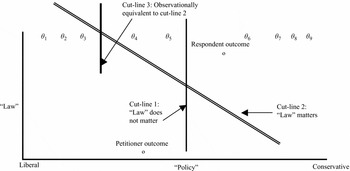
But what happens when we add a legal dimension? Justices' decisions now depend on both their policy preferences (x-axis) and legal doctrines such as stare decisis, judicial restraint, and a literal reading of the First Amendment. To capture this spatially, we add a second axis in Figure 2 that, for simplicity, we refer to as “Law.” For illustrative purposes, the figure assumes that all justices weight law equally; our empirical analysis allows legal concepts to affect different justices differently.Footnote 1 The policy implications of the respondent and petitioner outcomes are also the same as in Figure 1, but the two sides' legal implications are now different. In the two-dimensional figure, the respondent's outcome is more legally sound than the petitioner's outcome, pushing it higher on the Y dimension. Mathematically, the utility of justice i in voting for the petitioner is

where δi is the weight justice i places on the value of Law for case v. The utility of voting for the respondent is analogous.
How justices will vote in Figure 2 depends on which model is correct. If a justice's decisions reflect only his or her policy preferences, the line that divides liberals and conservatives (labeled cut-line 1) is the vertical line between θ 5 and θ 6, just as in Figure 1. If both policy and legal factors matter, though, the cutting line is a line whose angle depends on the relative weight of “the Law” (labeled cut-line 2). In the example in Figure 2, a majority (θ 4–θ 9) votes in favor of the respondent when law matters.
This situation creates an identification problem: even when law matters, we get a division of liberals and conservatives that can be explained by another vertical line, marked as cut-line 3, or the “observationally equivalent” cut-line. Observing a 6 to 3 conservative vote in favor of the respondent on a case in which (say) the respondent had precedent on his side does not necessarily mean that the justices were moved by the law; it could be simply that the policy implications of the case were such that purely policy-driven justices would divide in that manner. In the Appendix, we demonstrate this point mathematically.
Frequently, court observers note that the votes cast by a justice are consistent with the prenomination portraits of their policy preferences. These voting patterns are seen as evidence that the bench has become politicized. But, as we see in Figure 2, it is entirely conceivable to observe ideologically predictable voting patterns, even when justices are actually quite influenced by law. In the case of cut-line 2, the division is consistent with policy preferences, even though law has changed several votes (and the outcome of the case).
THREE LEGAL DOCTRINES
To move from the abstract notion of “the law” in the spatial model to empirical assessment of legal factors, we need to identify legal concepts that may influence justices and that can be coded in a reasonably straightforward way. To be sure, numerous legal doctrines may shape judicial decision making. We concentrate on three doctrines: stare decisis, judicial restraint, and strict interpretation of the First Amendment. We selected these doctrines because of their salience in American jurisprudence and because we can identify the cases where these factors are particularly likely to be considered by a justice.
Stare Decisis
The most widely celebrated legal influence is stare decisis, the notion that Court precedents should guide judges' decisions. Public law scholars and Supreme Court justices routinely argue that precedent shapes the decisions of the Court (Clayton Reference Clayton, Clayton and Gillman1999; Dworkin Reference Dworkin1978; Gilman Reference Gilman, Clayton and Gillman1999; Kahn Reference Kahn, Clayton and Gillman1999; Levi Reference Levi1949). Judges themselves emphasize precedent more frequently than any other legal factor (Knight and Epstein Reference Knight and Epstein1996).
Quantitative evidence in support of stare decisis has been mixed. Richards and Kritzer (Reference Richards and Kritzer2002) found evidence that doctrinal changes in First Amendment case law led to measurable changes in the determinants of case outcomes, and George and Epstein (Reference George and Epstein1992) concluded that both law and ideology affected death penalty cases. In contrast, Segal and Spaeth (Reference Segal and Spaeth1996a) and Spaeth and Segal (Reference Spaeth and Segal1999) focused on whether individual justices who dissented on landmark cases subsequently supported the precedent in future progeny cases. They found that justices' votes generally—but not always—do not change on progeny cases, implying that precedent exerts little or no effect.
Segal and Spaeth's (Reference Segal and Spaeth1996a) evidence is not definitive, however. First, Segal and Spaeth themselves found Justices Powell and Stewart to have been moved by precedent in a nontrivial number of cases. Second, it is possible that their coding of cases masks precedential behavior in instances where precedent becomes embedded in the law (Songer and Lindquist Reference Songer and Lindquist1996).Footnote 2 Finally, the Segal and Spaeth (Reference Segal and Spaeth1996a) standard for evidence might be too restrictive. According to Friedman (Reference Friedman2006), adherence to precedent does not require an individual justice in the minority to bow to the will of the majority. Furthermore, narrowing a precedent is not necessarily a demonstration that one is unfaithful to stare decisis (Friedman Reference Friedman2006). Hence, the 1980 decision in Rhode Island v. Innis that defined the scope of questions that required a Miranda warning was not inconsistent with the Court's 1966 Miranda ruling because this question was not raised when Miranda was decided.
Justices may employ a stare decisis constraint for several different reasons. First, they may have been socialized to accept a norm of deference (Knight and Epstein Reference Knight and Epstein1996). Second, the Court's ability to entice other actors to comply with Court decisions may depend on clarity, for which adherence to stare decisis may be useful (Bueno de Mesquita and Stephenson Reference de Mesquita, Ethan and Stephenson2002; Hansford and Spriggs Reference Hansford and Spriggs2006, 19–20). Third, the legitimacy of the Court (and, indirectly, its policy effectiveness) may depend on reliance on legal principles such as precedent (Hansford and Spriggs Reference Hansford and Spriggs2006, 20; Kahn Reference Kahn, Clayton and Gillman1999, 189).
Judicial Restraint
Another legal doctrine that may shape judicial decision making is judicial deference to legislatures. This factor comes into play when justices argue, as in Thomas' previous comment, that although they do not agree with a given case outcome, it is the task of duly elected legislators, not judges, to change policy. As Anthony Kronman, the former dean of the Yale Law School, explained to the Senate Judiciary Committee during the Supreme Court confirmation hearings for Samuel Alito, “The temperament of the judge, as I see it, is marked by modesty, by caution, by deference to others in different roles with different responsibilities” (U.S. Congress, Senate, Committee on the Judiciary, 2006, 711). Kronman's views reflect Wechsler's (Reference Wechsler1959) argument that justices should refrain from infringing on legislative authority except when neutral principles can be employed to provide clear guidance.
Justices can be among the most forceful advocates for judicial restraint. Justice John Marshall Harlan II wrote: “This Court, limited in function . . ., does not serve its high purpose when it exceeds its authority, even to satisfy justified impatience with the slow workings of the political process” (Reynolds v. Sims 1964, 624–25). More recently, Chief Justice Roberts elaborated on his belief in judicial restraint:
Members of Congress have been chosen by hundreds of thousands of people, millions of people. Not a single person has voted for me. . . . And that is, to me, an important constraint. It means that I'm not there to make a judgment based on my personal policy preferences or my political preferences. (Barnes Reference Barnes2006)
Deference may also be practically useful for justices. Rosen, for example, maintained “history suggests that courts can best maintain their democratic legitimacy . . . by practicing judicial restraint” (Reference Rosen2006, 13). In this view, the political system works best when judges “defer to the view of the political branches” (13). As Ferejohn and Kramer (Reference Ferejohn, Kramer and Drobak2006, 163) observed, “The judiciary is a self-regulator: it has created a system of self-imposed institutional and doctrinal constraints that keep judges within the bounds required by institutional vulnerability.”
Strict Interpretation of the First Amendment
Another legal value that could lead justices to vote against their policy preferences is the protection of speech. The concept of strictly interpreting the Constitution has a storied history in American jurisprudence. The First Amendment's “Congress shall make no law . . .” prohibition on restricting free speech has frequently been invoked by those who believe in a strict interpretation. For example, Justice Hugo Black—stating that “no law means no law”—would vote to strike laws that he may have agreed with but for his interpretation of the Constitution.
The contemporary justice who is most frequently associated with the view that the Constitution should be interpreted literally is Scalia (Tushnet Reference Tushnet2005). This view has led Scalia to cast a number of votes that have resulted in alliances that span the ideological spectrum. Perhaps the most prominent examples are Scalia's decision to join Justice William Brennan in striking down state (Texas v. Johnson [1989]) and federal (United States v. Eichman [1990]) laws prohibiting flag burning. Scalia later explained that he cast the deciding vote for Gregory Lee Johnson in the Texas, case even though “I would have been delighted to throw Mr. Johnson in jail. . . . Unfortunately, as I understand the First Amendment, I couldn't do it” (University of Mississippi 2003).
IDENTIFYING THE EFFECT OF JURISPRUDENCE
To measure the effect of these three legal concepts, we need to net out the effect of ideology. Our statistical model pins down a policy based cut-line for each case and thus enables us to identify the extent that the decisions of each justice are constrained by the three legal doctrines we have just discussed. Central to our approach are three factors. These factors will enable us to isolate the effect that the law has on the decisions justices make.
First, members of Congress and the president routinely take positions on Supreme Court cases and are less likely than Supreme Court justices to be influenced by the legal doctrines on which we focus. Second, a precedent can influence judicial decision making only after it has been established. Thus, we have a second “control” group available to us when testing for the effect of precedent: justices who ruled on an earlier case in which precedent did not have the same implication. For example, the principle of stare decisis did not have the same implications for the justices initially ruling on Roe v. Wade (1973) as it did for post-Roe justices ruling on Planned Parenthood v. Casey (1992).
Third, the importance of stare decisis, judicial restraint, and strict construction of the First Amendment varies from case to case. For example, even though the importance of stare decisis was central to the decision Dickerson v. U.S. (1999) (in which the court upheld Miranda), stare decisis was not a central question in Rostker v. Goldberg (1980) (in which the Court addressed the constitutionality of requiring only men to register for the draft). When stare decisis, restraint, and First Amendment scrutiny are central to a case, support for the legal doctrine normally has clear ideological implications. For example, in Dickerson, support for stare decisis (upholding Miranda) had clear liberal implications (requiring the delivery of a “Miranda warning” prior to securing the statement of a criminal suspect).
In terms of Figure 2, the elected officials serve as the control actors who allow us to pin down the policy implications of votes on Supreme Court cases, in turn enabling us to identify whether legal concepts matter. Without the control actors, the estimated vote cut point would capture both the policy cut point and the effect of law, if any. If justices exhibit the same behavior conditional on policy preferences as do elected officials on cases in which legal concepts are clearly implicated, we can infer that these legal concepts do not explain behavior once the preferences of each justice are accounted for. However, if—conditional on policy preferences—our control group is less likely to allow the relevant legal doctrines to influence its positions, we can infer that law matters.
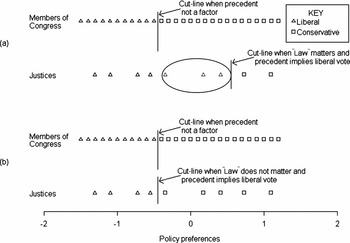
Figures 3a and 3b illustrate our identification strategy via an illustrative case in which precedent has been coded as implying a liberal vote. We assume for simplicity that all justices weight law equally (even as our empirical approach allows justices to vary).Footnote 3 In this case, law mattering on the court will cause the cut point to shift on the court relative to the cut point among elected officials. In the figures, various elected officials are arrayed according to their policy preferences and their position on a particular case. The positions taken by members of Congress imply some cut-line, one that we can infer is policy based relative to Supreme Court justices because members of Congress are less likely to be affected by stare decisis and other legal considerations.
Hypothetical Positions on a Supreme Court Case

In Figure 3a, the three circled justices in the bottom row vote liberally and consistent with precedent, even though they are to the right of the policy-only cut-line. This is the behavior we would expect if law is influential. However, in Figure 3b, the cut-line is the same for the control group and the Supreme Court justices subject to the legal principle. This implies that law does not matter to the justices. In this case, the justices vote in complete accord with the members of Congress who share their policy preferences. Our estimation strategy isolates policy preferences using members of Congress and then identifies whether justices systematically differ from members of Congress in the directions predicted by the legal implications of cases.
We note that our approach depends on the validity of our assumption that the positions articulated by members of Congress and presidents are more likely than justices to be influenced by policy preferences than by the sorts of legal doctrines we are investigating. Although it is possible that members of Congress and presidents also care about the three legal doctrines we assess, such concerns are unlikely to dominate congressional decision making. It seems reasonable to characterization of the legal model that justices on the Supreme Court should care more about the law than do elected officials—a conclusion we draw from evidence that members of Congress are primarily motivated by ideology (Poole and Rosenthal Reference Poole and Rosenthal1997), party needs (Cox and McCubbins Reference Cox and McCubbins1993), and constituencies (Arnold Reference Arnold1990).
Our approach only requires justices to care more about legal doctrines than elected officials. Nevertheless, we suspect that the positions of elected officials are not completely independent of their view regarding the law. This seems particularly likely when the elected official has a legal background or when freedom of speech is at stake. In other words, it is conceivable that a legislator's policy goal is the maintenance of a legal doctrine such as protecting the First Amendment. To the extent that legal influence shapes congressional and presidential positions, our estimated policy cut-line will not be completely purged of legal effects. In this case, we would be estimating the differential effect that the legal doctrines have on justices relative to members of Congress and the president.
Modeling and Estimating the Role of Law
To ascertain whether our three legal doctrines influence decision making on the Supreme Court, we model the positions taken by justices, presidents, and members of Congress on Supreme Court cases and congressional roll calls. The model is derived in the Appendix from Equation (1), using the standard techniques of random utility models and ideal point preferences estimation (see Bailey Reference Bailey2007). The dependent variable indicates whether an individual voted conservatively. Our interest in the effect of law leads us to add three specific legal variables to a standard voting model. The model estimated is

where yitv is 1 if individual i takes a conservative position at time t on vote v; αv is the vote discrimination parameterFootnote 4; θit is the policy preference of individual i at time t (the higher the value, the more conservative); κv is the vote cut point; πi, δi, and σi are the weights justice i places on precedent, legislative deference, and protection of speech, respectively; and PREC v, DEF v, and SPEECH v are the precedent, deference, and speech variables, coded as described later. Policy preferences are permitted to vary over the course of an individual's career.Footnote 5 This leaves us with a probit-like data structure in which there is a dichotomous dependent variable and a series of parameters that allow us to estimate ideal points (θ), vote parameters (α and κ), and the law variables (π, δ, and σ) identified in Equation (2).
We estimate the parameters of the model for all justices, presidents, and members of Congress in the data set. The identification assumption is δi = πi = σi = 0 for all nonjustices, which means that we are identifying the effect of these factors on justices relative to any effect they may have on nonjustices. Finding δi > 0 or πi > 0 or σi > 0 for some justices would be consistent with the idea that legal factors exert a real effect independent of judicial policy preferences.
The model is estimated via a Bayesian Markov Chain Monte Carlo algorithm that simultaneously estimates the parameters in Equation (2) (see, e.g., Clinton, Jackman, and Rivers Reference Clinton, Jackman and Rivers2004; Martin and Quinn Reference Martin and Quinn2002). The online appendix provides additional details.
DATA
The dependent variable denotes the position—conservative or not—taken by justices, members of Congress, and presidents on 842 Supreme Court cases and 761 congressional votes that arose between 1977 and 2003. We limit Supreme Court cases to those that involved criminal procedure, civil rights, First Amendment, due process, privacy, and federalism. We limit congressional and presidential roll calls to those centering around similar issues.Footnote 6 No observation exists for those who did not take a position on a given case or roll-call vote.
Each case and roll call is coded for ideological direction. For the 842 Supreme Court cases, the coding is based on Spaeth's (Reference Spaeth2006) dir variable that indicates the ideological direction of an opinion.Footnote 7 Decisions are coded liberal if they are prosuspect, procivil rights claimant, antibusiness, and so forth. The coding for ideological direction of the 761 congressional votes was done manually by the authors following the Spaeth coding scheme.
Identifying Policy Implications of Supreme Court Cases
We have gathered 8,286 interinstitutional bridge observations that consist of members of Congress and presidents taking positions on Supreme Court cases via amicus filings, public statements, bill sponsorship, or roll-call votes directly related to a particular court case.Footnote 8 For example, President George W. Bush's (Reference Bush2002) declaration that “The Supreme Court of the United States gave a great victory to parents and students throughout the nation by upholding the decisions made by local folks here in the city of Cleveland, Ohio” constitutes a presidential bridge observation for Zelman v. Simmons-Harris (2002), in which the Court upheld the right of parochial schools to receive school vouchers. Representative Tom Osborne's (R-NE) statement in regard to Lee v. Weisman (1992) that “In 1992, the Supreme Court declared an invocation and benediction at a graduation ceremony unconstitutional . . . this seems to fly in the face of the way our country was founded” (U.S. House of Representatives, 1993) is a typical congressional bridge observation. Although roll-call votes that were directly relevant to Supreme Court cases were rather rare, an example is a July 28, 1982 roll call on the Solomon amendment that was later upheld in Selective Service v. Minnesota Public Interest Research Group (1984).
In addition to votes and statements, we create more robust estimates by including 17,662 implicit observations. These implicit observations help us pin down preferences across institutions and time, and, in particular, aid our ability to establish a member of Congress' preferences on a Supreme Court case, even when they do not explicitly mention the case. For example, we have identified every member of Congress who cosponsored a constitutional amendment to prohibit abortions as taking a conservative position on both Planned Parenthood v. Casey (1992) and Webster v. Reproductive Health Services (1989). Likewise, based on the fact that Senator Robert Byrd (Reference Byrd1996; D-WV) proposed to amend the U.S. Constitution so that “Nothing in this Constitution . . . shall be construed to prohibit voluntary prayer . . . or to prohibit voluntary prayer . . . at a public school extracurricular activity,” we treat Senator Byrd as supporting the school district's position in Santa Fe Independent School District v. Doe (2000), in which the Supreme Court banned public school districts from allowing students to lead pregame prayers at football games. Although these observations provide more information, they do not drive the results; we show in the online appendix that results without these implicit observations are quite similar.
Use of bridging data raises issues that do not arise with conventional roll-call data. One issue is that our observations are from a self-selected sample that may not be representative of Congress. As discussed in the online appendix, there is a slight skew to the right in the ideology of those making bridge observations. For example, we have 68 bridge observations for Senator Orin Hatch (R-UT) and only 20 for Senator Barbara Mikulski (D-MD), even though both were first elected to Congress in 1976. However, this is not sufficient to cause bias because we are conditioning on policy preferences in the outcome equation. Selection bias occurs only if error in the selection equation is correlated with error in the outcome equation (Greene Reference Greene2000, 976). In our model, this would occur if an individual were more likely to express an opinion on an issue when he or she is idiosyncratically more liberal or conservative than his or her ideal point. Having a sample skewed to one direction or another will not cause bias (nor, by the way, is a nonskewed sample sufficient to show that selection bias is not occurring).Footnote 9
In addition to interinstitutional bridge observations, we also employ 416 intertemporal observations to help us isolate the effects of stare decisis. These are comments by justices that express support or opposition to a prior ruling of the Court. Usually, they were made by a justice about a case decided before the justice served on the bench. For example, Justices Breyer and Ginsburg noted in Lawrence (2003) that they would have voted with the minority in Bowers v. Hardwick (1986). Another example is Stevens' assertion that “I would have joined Rehnquist's dissent in Weber [United Steel Workers v. Weber (1979)]” (2005, 14).Footnote 10 Thus, we created a Bowers observation for Breyer and Ginsburg and a Weber observation for Stevens. These observations were made after 1978 by justices who were on the Court at the time of the comment. When these observations refer to a case for which a precedent had not previously existed, they are useful for assessing the impact of precedent, as previously discussed. Results without these observations are reported in the online appendix and are substantively similar to those with the observations.
Although our interest centers on the behavior of Supreme Court justices, we include congressional votes because they are useful in estimating preferences of members of Congress relative to one another. This helps us pin down the policy implications of votes and, in turn, helps us use elected officials' positions to isolate the effect of the law on Supreme Court justices.
Coding Cases
In addition to creating interinstitutional and intertemporal bridge observations, we also code cases with respect to the three legal concepts: precedent, deference to Congress, and the sanctity of the First Amendment's free speech clause. This is no simple task. As Friedman (Reference Friedman2006, 267) explained, “Law may seem frustrating to political scientists in that, because of the way it works, the actions of legal actors are not so easily coded as they may like.” However, we believe that it is possible to identify in an objective manner a set of cases in which each of the three legal doctrines we explore is particularly relevant.
Although every case could theoretically be used to overturn a precedent, precedent is a prominent issue in only a subset of cases. For example, an important question in Webster was whether the Roe precedent should remain standing. Indeed, the petitioner's brief asked the Court to use the case as a vehicle for overturning Roe (Segal and Howard Reference Segal and Howard2001, 435). In contrast, in Texas v. Johnson, there was no serious question of overturning the precedent that established that the Constitution protected symbolic speech; in this case, none of the parties or justices involved in the case argued that precedent needed to be reversed.
To identify cases in which precedent was particularly likely to be relevant, we relied on the actions of justices, plaintiffs, and respondents. Precedent was coded as in play if (1) any of the parties or justices expressly supported overturning a specific precedent and (2) the votes divided justices into proprecedent and antiprecedent camps; that is, we would not code precedent as being in play if some, but not all, of the majority expressed an interest in overturning precedent.Footnote 11 The value of the precedent variable depends on whether supporting the precedent in question implied a liberal or conservative vote. If a liberal decision would overturn precedent, conservatives were voting to uphold the precedent, and the precedent variable would be coded as 1. If a conservative decision would strike down precedent, the liberals were voting in favor of precedent, and the precedent variable would be coded as −1. A good way to understand the logic is to refer to Equation (2): a positive weight on precedent (π) coupled with a positive value of the precedent variable would increase the probability of a conservative vote. Precedent was implicated in 158 cases.Footnote 12
Our deference variable indicates cases that involved the court upholding or overturning the constitutionality of a law passed by Congress.Footnote 13 For example, a case involving a federal statute banning flag burning implicates legislative deference, whereas a case involving the constitutionality of a shopping center ban on leafleting does not. A case involving a National Park Service ban against oversized placards on a national monument would implicate deference to a legislative body only if the question before the Court clearly involved a policy adopted by Congress, rather than an administrative decision of the National Park Service.
The value of the deference variable depends on whether deference implied a liberal or conservative vote. For example, if an act of Congress authorized the attorney general to expel foreigners without a hearing and was challenged, a vote for deference (accepting an act's constitutionality) would imply a conservative outcome; the deference variable in this case would be coded as 1. Likewise, if an act of Congress mandated minority set asides in contracting, a vote for deference (accepting an act's constitutionality) would imply a liberal outcome; the deference variable in this case would be coded as −1. Deference was implicated in 111 cases. These cases are relatively contested, as individual justices voted 39% of the time to overturn statutes.
Our coding with regard to freedom of speech proceeded in a similar fashion. To ascertain whether each justice allowed a strict interpretation of the First Amendment's free speech protections to drive their decision making, we relied on Spaeth (Reference Spaeth2006) to identify cases in which freedom of speech questions were particularly prominent. The value of the speech variable depends on whether protection of free speech implied a liberal or conservative vote. For example, in the Texas flag burning case, a vote to protect speech would imply a liberal outcome; the speech variable in this case would be coded as −1. Likewise, if a free speech vote implied a conservative outcome, the speech variable would be coded as 1. For example, in Airport Commissioners v. Jews for Jesus (1987), the Supreme Court overturned a Los Angeles Airport Commission ban on the distribution of religious pamphlets. Speech is implicated in 158 cases.
RESULTS
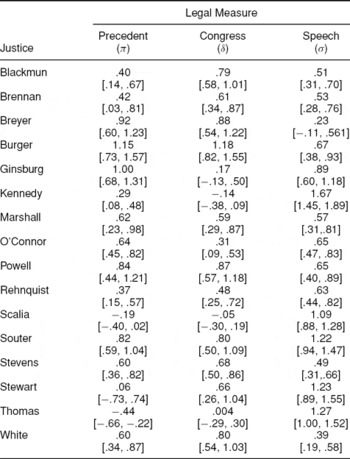
Table 1 reports the estimated precedent (π), congressional deference (δ), and speech (σ) parameters for the justices in the sample. The first notable finding is that the parameters are statistically significant for most justices.Footnote 14 The estimated precedent parameters (π) are significant for 13 of 16 justices (all except Stewart, Scalia, and Thomas). The congressional deference parameters (δ) are statistically significant for 12 of the 16 justices (all justices except Scalia, Kennedy, Thomas, and Ginsburg). The protection of speech parameters (σ) are significant for 15 of 16 justices (all except Breyer).
Raw Estimates of Effect of Legal Variables

Note: 95% Bayesian confidence intervals are in brackets.
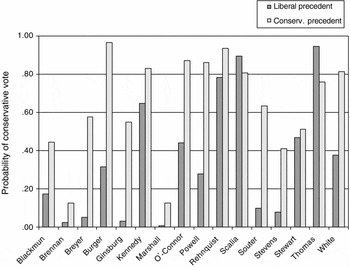
Because of the nonlinear probit-like structure of the model, the parameters are not directly interpretable. Therefore, we used the estimated parameters to simulate justices' probabilities of voting conservatively. Figure 4 shows one set of simulation results for the precedent parameter. For each justice, we calculated his or her average policy preference over the time period in the sample and calculated the probability of voting conservatively given that the precedent either was implicated and implied a liberal vote (the blue bar in the figure) or was implicated and implied a conservative vote (the yellow bar).Footnote 15 If after controlling for policy preferences a justice's votes were swayed by precedent, his or her yellow bar would be higher than his or her blue bar. For example, with precedent implicated and suggesting a conservative outcome, Stevens is simulated to vote in a conservative direction with 41% probability; however, with precedent implicated and suggesting a liberal outcome, Stevens is simulated to have an 8% probability of voting conservatively. Although Stevens clearly prefers liberal outcomes, if stare decisis suggests a conservative outcome, Stevens is more likely to embrace such a position. In contrast, Scalia's yellow and blue bars are relatively the same height and thus suggest that stare decisis plays a relatively small role in his jurisprudence.
Simulated Effect of Precedent: Probability of a Conservative Vote for Cut Point (K) = 0

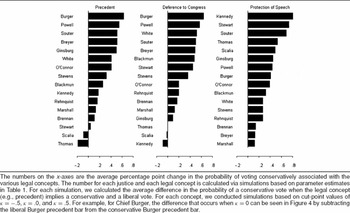
Figure 5 aggregates a series of simulations in order to compare effects across justices. Because the magnitude of the nonlinear effect varies for each justice and with the simulated cut point, we used the parameter estimates to simulate effects for three different policy cut points (κ).Footnote 16 One simulated cut point is 0, meaning that a justice with a policy ideal point of 0 would have a 50% chance of voting conservatively (for reference, Justice Stewart has an average estimated ideal point of −.03). This is the same cut point used in Figure 4. The two other simulated policy cut points are −.5 and .5. For each of these three cut-point values, we calculate the difference in the probability that a justice would vote conservatively if the legal concept in question implied a conservative or a liberal vote.
Effect of Legal Variables on Individual Justices

The results for precedent are in the leftmost column of Figure 5. Chief Justice Warren Burger and Justices Lewis Powell and David Souter are portrayed as the most influenced by precedent. In contrast, the stare decisis parameters for Scalia and Thomas suggest that their interpretations of the Constitution are not significantly influenced by precedent. That Justice Scalia is unconstrained by stare decisis is not particularly surprising; as he himself has noted, “I do not myself believe in rigid adherence to stare decisis in constitutional cases” (Lawrence v. Texas 2003). Thomas, too, has a reputation for not valuing precedent; Goldstein (Reference Goldstein2007) wrote that Thomas “believes that precedent qua precedent concerning constitutional law has no value at all; he does not give stare decisis any weight. Justice Thomas' view is, at bottom, a doctrine of stare indecisis.”Footnote 17
The rankings on the deference to Congress variable are in the middle panel of Figure 5. Justices Burger, Powell, and White rank highest, and Justice Kennedy ranks the lowest. These results also accord well with judicial reputations. Kennedy frequently maintains that the role of judges is to promote broad values such as “liberty” and “human dignity.” Breyer's (Reference Breyer2005) relatively large weight on congressional deference is consistent with his concept of active liberty, which looks to the Court to ensure that citizens can effectively govern themselves. It is also what one might expect given his experience as a congressional staffer. External sources provide additional validity for our measure. A New York Times op-ed by Yale Constitutional law professor Paul Gerwirtz and former Justice Stevens clerk Chad Golder (Reference Gewirtz and Golder2005) characterized Breyer as the most deferential to Congress and Thomas, Kennedy and Scalia as the least likely to uphold the constitutionality of congressional acts. Howard and Segal (Reference Howard and Segal2004) found White and Powell to be the most deferential to Congress. Finally, our findings are consistent with Lindquist and Solberg's (Reference Lindquist and Solberg2007) finding that even though conservatives such as the Chief Justice were less likely to strike federal statutes during the Burger Court, during the Rehnquist Court conservatives were more likely to strike federal laws than their liberal counterparts.
In the panel on the right-hand side of Figure 5, we rank the justices with regard to the weight they place on free speech doctrine. Kennedy, Thomas, and Scalia—the three justices who placed the least weight on congressional deference—placed a great deal of weight on a strict interpretation of the First Amendment's speech clause. Scalia has been a vocal and articulate defender of the First Amendment (Abrams Reference Abrams1997). The justice who appears to place the greatest weight on the protection of speech guarantees is Stewart, who believed that “censorship reflects a society's lack of confidence in itself. It is a hallmark of an authoritarian regime” (Ginzburg v. United States 1966, 498). Meanwhile, Justices Brennan, Breyer, and Marshall placed relatively little emphasis on this value. This does not mean that they were conservative on free speech issues; rather, they were not distinctively liberal on cases in which protection of speech implied a liberal vote. Likewise, the fact that they placed relatively little weight on a strict interpretation of the First Amendment suggests that in cases where support of the First Amendment produces a conservative outcome, Brennan, Breyer, and Marshall were unlikely to feel doctrinally constrained by arguments regarding the importance of the First Amendment. Thus, Brennan and Marshall voted in Buckley v. Valeo (1976) to uphold the spending (and, arguably, speech) limits contained in the Federal Election Campaign Act of 1971. Similarly, Breyer (Reference Breyer2005, 40–1) believes that
. . . to limit the distinctions to the point at which First Amendment law embodies the slogan “speech is speech” cannot work . . . if strong First Amendment standards were to apply across the board, they would prevent a democratically elected government from creating necessary regulation.
JUDICIAL RESTRAINT AND PARTISANSHIP
So far, we have presented evidence on the extent to which the legal doctrines of restraint, stare decisis, and a strict reading of the First Amendment influence the decisions of justices. There are, however, two possible nonlegal explanations for our judicial restraint findings. One possible explanation is that justices may defer to Congress when Congress is most likely to overrule the Court (Bawn and Shipan Reference Bawn and Shipan1997; Ferejohn and Shipan Reference Ferejohn and Shipan1990; Harvey and Friedman Reference Harvey and Friedman2006; Sala and Spriggs Reference Sala and Spriggs2004; Segal Reference Segal1997). Our finding that some justices are more likely to defer to Congress than others also suggests another explanation for what we portrayed as a norm of restraint: some justices might practice deference due to a strategic calculation that Congress is more likely to produce policy outcomes consistent with their views than the Court is.
To test these alternative explanations, we expand our main model in two ways. First, we control for general strategic effects. If the elected branches are all controlled by the Democrats, justices who are fearful of contradicting the preferences of those who control the government should be more likely to embrace liberal outcomes; if the Republicans control the government, we would expect the opposite. Therefore, we include a unified government variable that denotes whether the House, Senate, and the White House are controlled by Republicans (+1) or Democrats (−1), or are split across the parties.
Second, we control for the possibility that justices are more inclined to defer to a Congress controlled by a particular party and that control of Congress matters only when the Court is reviewing the constitutionality of congressional acts. Therefore, we also created a variable to denote whether the Republicans (+1) or the Democrats (−1), controlled both the House and Senate. If control across the two chambers is split, the party control variable is set to zero. We then interacted this variable with the deference variable used in the main specification. This variable was a 1 if a case pertained to the constitutionality of an act of Congress and if deference to Congress implied a conservative vote, or a −1 if deference implied a liberal vote. Thus, for example, the interaction variable is −1 in the Harris v. McRae (1980) review of the constitutionality of the Hyde amendment's restriction on funding for abortions. If the estimated coefficient on this variable is positive, a justice is more deferential to Congress when the Republicans control Congress; if the estimated coefficient is negative, a justice is more deferential to Congress when the Democrats are in control. We do not estimate this parameter for Stewart or Breyer due to the very small number of observations for them in which there was unified control and deference to Congress was implicated.
The results in Table 2 establish, most importantly, that the inclusion of separation-of-powers–related variables does not change our conclusions about the effect of law. First, the pattern of statistical significance for the precedent and speech variables is unchanged; in fact, the correlations between these π and σ parameter estimates and those in Table 1 are .997 and .995, respectively. For the deference to Congress variable, the correlation is .91. Likewise, the Table 2 restraint coefficients for the individual justices are similar to the coefficients in Table 1.
Raw Estimates of Effect of Legal Variables When Controlling for Party Control

Note: 95% Bayesian confidence intervals are in brackets.
Second, the effect of the unified government variable is positive and significant for 11 of 16 justices (all but Burger, Rehnquist, Scalia, Ginsburg, and Breyer). This pattern provides weak empirical support for the separation-of-powers model, but it does not change our conclusion that legal doctrine matters.
Third, the interaction variable is significant for only a small number of justices. The results imply that O'Connor and Blackmun were more deferential when reviewing the constitutionality of acts of Congress when Democrats control the House and Senate, and that Powell was more likely to accept the constitutionality of an act of Congress when Republicans controlled the Capitol. Because all three justices were appointed by Republican presidents, none of them are generally regarded as ideological extremists, and only three justices had a deference to Congress parameter that is distinct when either Republicans or Democrats controlled the institution, we are reluctant to accept the claim that deference reflects a strategic calculation regarding how to best achieve one's policy objectives.
CONCLUSION
Few questions are more important to scholars of the Court than understanding the factors that shape justices' decisions. Unfortunately, those with opposing viewpoints have often talked past one another. Those in the “law” camp have frequently eschewed systematic quantitative tests, whereas those in the “attitudes” camp “have limited sharply the promise and utility of their own work by not looking beyond their own discipline to the one place most apt: the law” (Friedman Reference Friedman2006, 262).
We have tried to build on the strengths of both positions. We provide a statistical analysis of Supreme Court behavior of a type that should be very familiar to those steeped in the attitudinal model. At the same time, we take seriously the theoretical and empirical implications of legally motivated judicial behavior. We use models to show that legal factors can easily get hidden or, in statistical terms, be hard to identify. We then use the positions taken by members of Congress, presidents, and previous Supreme Court justices to separate policy and legal elements. In contrast to the pure forms of the attitudinal model, we find strong evidence that legal principles are influential. We also find variation in the importance of legal doctrines across justices. Taken as a whole, these findings differ dramatically from the judges-as-policy makers view that is prominent among judicial process scholars.
We do not claim to have identified all nonattitudinal forces that may shape justices' decisions. Our claim is that legal forces can matter significantly when justices write opinions and reach decisions, and we marshal specific evidence with regard to stare decisis, congressional deference, and protection of speech to support this claim. There are many aspects of the law, ranging from the doctrine of original intent to respecting the “plain meaning” of legislative statutes, which we have not examined and which may well have influenced justices.
There are also other ways in which legal doctrine could matter. A justice who acts inconsistently with a legal doctrine is not necessarily allowing their policy preferences to trump the law (Lindquist and Solberg Reference Lindquist and Solberg2007). In some cases, it may be that adherence to one legal concept may override adherence to another. For example, a justice who values a narrow reading of the Commerce Clause may be less likely to defer to Congress when it inserts itself into a gray area of federalism. In addition, our measured policy “conservatism” may include the effects of nonmeasured legal concepts that are correlated with conservative outcomes.
Our results should not be construed to imply that policy preferences are unimportant. Even though one could, in light of the coarseness of our legal measures, consider our findings of legal effects as a lower bound on the influence of law, our estimated policy preferences indicate that models of Supreme Court decision making should include the policy preferences of justices. Second, policy preferences may operate at a metalevel, whereby justices choose judicial values in a manner to advance broad policy goals. We cannot rule out, for example, that justices use adherence to precedent as a tool to achieve certain long-term policy goals, even as this tool forces them to sacrifice policy goals in some instances (Bueno de Mesquita and Stephenson Reference de Mesquita, Ethan and Stephenson2002; Hansford and Spriggs Reference Hansford and Spriggs2006).
These possibilities should not obscure the central finding: the attitudinal model is too restrictive. Justices are not simply life-tenured policy maximizers. They operate in an environment in which the freedom to pursue their personal values leads many justices to follow legal values about the proper role of deference to elected officials and the proper treatment of precedents. Justices vary in the weights they place on the legal values measured here, and, presumably, in the weights they place on values we have not been able to measure. But the influence of legal forces is clear. There is a long tradition among court watchers of skepticism about a completely political view of the court. Our findings, we believe, should reinforce that skepticism and continue to push the conversation toward understanding how politics and the law interact on the U.S. Supreme Court.
APPENDIX
Valence Model Derivation

where  is the location of conservative outcome and Law Cv is the position of conservative outcome on the valence dimension. Then,
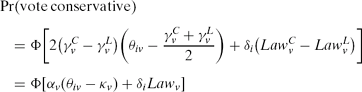
We can derive the same model if we allow utility to be quadratic in distance on valence dimension as long as Law is a dichotomous variable.
Identification of Model
First, we show that the weight on law is not identified, even with discrimination parameters and heterogeneous weights on law by justices.

Add and subtract  and regroup:
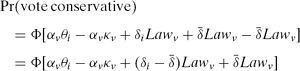
Let  and
 , then

Because we can get the same likelihood with these two different formulations, the model is unidentified. In Equation (A1), the cutpoint contains no legal elements, and the estimated δ is the weight on the law variable; in Equation (A2), the cutpoint contains the average weight on the law, and the estimated δ is deviated from the mean weight on law.
Second, the weight on law is identified by setting δ = 0 for some observations within the sample (in our case, the members of Congress and presidents). To see this, note that the only way to recover the same contribution to the likelihood for all observations with the reparameterized coefficients is for the coefficient on Lawv to be the true coefficient minus  . However, if we impose δi = 0 on the estimation, then this reparameterization is not available and only the first works, which is the parameterization consistent with our model.
 , where T it measures years served as of time t. As noted on page 5 of the online appendix, the number of γ parameters we estimate depends on the length of time an individual served on the bench or in Congress.





Comments
No Comments have been published for this article.