Introduction
Post-intensive care syndrome (PICS) has increasingly been recognized as a source of morbidity in patients and their family members after intensive care unit (ICU) hospitalization (Azoulay et al., Reference Azoulay, Pochard and Kentish-Barnes2005; Desai et al., Reference Desai, Law and Needham2011; McAdam et al., Reference McAdam, Fontaine and White2012; Needham et al., Reference Needham, Davidson and Cohen2012; Siegel et al., Reference Siegel, Hayes and Vanderwerker2008). The Society of Critical Care Medicine has proposed the designation “post-intensive care syndrome-family” (PICS-F) to identify psychological distress experienced by ICU family members during the post-ICU period, including symptoms of anxiety, depression, and posttraumatic stress disorder (PTSD) (Davidson et al., Reference Davidson, Jones and Bienvenu2012; Desai et al., Reference Desai, Law and Needham2011; Needham et al., Reference Needham, Davidson and Cohen2012; Schmidt & Azoulay, Reference Schmidt and Azoulay2012). Although there is significant variability reported, prevalence of PICS-F symptoms can range from 6% to 69% in the first six months following an ICU illness (Anderson et al., Reference Anderson, Arnold and Angus2008; Azoulay et al., Reference Azoulay, Pochard and Kentish-Barnes2005; Desai et al., Reference Desai, Law and Needham2011; Garrouste-Orgeas et al., Reference Garrouste-Orgeas, Coquet and Périer2012; Jones et al., Reference Jones, Skirrow and Griffiths2004; Lautrette et al., Reference Lautrette, Darmon and Megarbane2007; McAdam et al., Reference McAdam, Fontaine and White2012; Petrinec et al., Reference Petrinec, Mazanec and Burant2015; Pillai et al., Reference Pillai, Aigalikar and Vishwasrao2010). Factors associated with a higher severity and prevalence of PICS-F symptoms include patient severity of illness, patient death, family member gender, family member/patient relationship, family member decision-making, and family member psychological history (Azoulay et al., Reference Azoulay, Pochard and Kentish-Barnes2005; Gries et al., Reference Gries, Engelberg and Kross2010; Kross et al., Reference Kross, Engelberg and Gries2011; Pillai et al., Reference Pillai, Aigalikar and Vishwasrao2010). Some researchers have reported PICS-F symptoms up to four years after the ICU illness with a diminished quality of life (Gries et al., Reference Gries, Engelberg and Kross2010; Siegel et al., Reference Siegel, Hayes and Vanderwerker2008).
Coping in response to stressful life events has been shown to have a relationship to psychological and physical health outcomes (Penley et al., Reference Penley, Tomaka and Wiebe2002). Researchers often describe three broad categories of coping behavior: problem-focused, emotion-focused, and avoidant (Ben-Zur, Reference Ben-Zur2005; Carver et al., Reference Carver, Scheier and Weintraub1989). Avoidant coping strategy use has been associated with PTSD symptoms following a traumatic event and decreased psychological adjustment in the face of acute and chronic health problems (Glass et al. , Reference Glass, Flory and Hankin2009; Krause et al., Reference Krause, Kaltman and Goodman2008; Smith et al., Reference Smith, Tarakeshwar and Hansen2009; Stanton et al., Reference Stanton, Danoff-burg and Huggins2002; Ullman et al., Reference Ullman, Townsend and Filipas2007). Furthermore, the use of avoidant coping has been associated with emotional distress of neuroscience ICU family members, prediction of later PTSD symptoms in neonatal ICU parents, and mediation of the relationship between patient death and later PTSD symptoms in ICU family decision-makers (FDMs) (Petrinec et al., Reference Petrinec, Mazanec and Burant2015; Shaw et al., Reference Shaw, Bernard and Storfer-Isser2013; Wartella et al., Reference Wartella, Auerbach and Ward2009).
There have been few data examining coping strategies used by FDMs of adult ICU patients and the relationship between coping strategies, PICS symptoms, and health-related quality of life (HRQOL). Therefore, the purpose of this study was to determine: (1) the relationship between coping strategies used by FDMs of ICU patients and the prevalence and severity of PICS-F symptoms; (2) the relationship between FDM PICS-F symptoms and HRQOL; and (3) risk factors for PICS-F symptoms and diminished HRQOL.
Methods
Sample and setting
The research setting included two mixed adult ICUs with medical and surgical patients at a large tertiary care hospital. The institutional review board of the hospital approved this study. Study inclusion criteria for ICU patients were (1) mechanical ventilation or predicted ICU stay of greater than five days; (2) lack of cognitive decisional capacity; (3) >18 years of age; and 4) had an identified FDM. Study inclusion criteria for FDMs of ICU patients were (1) >18 years of age; (2) identification as the primary decision-maker for the ICU patient; and (3) ability to speak English.
The study used a descriptive, longitudinal design to examine the relationships among coping strategies, PICS symptoms, and HRQOL in ICU FDMs. An FDM was defined as (1) a family member previously designated by the patient as the legal durable power of attorney; (2) a family member who was verbally chosen by the patient, but without legal documentation; (3) a relative or friend who is available and assumes the role of decision maker; or (4) a legal guardian.
The study had three data collection points: time 1 (T1) = days 3–5 after ICU admission; time 2 (T2) = 30 days after discharge from the hospital or death of the patient; and time 3 (T3) = 60 days after discharge or death of the patient. PICS-F symptoms (anxiety, depression, PTSD) were measured using the Hospital Anxiety and Depression Scale (HADS) and the PTSD Checklist for DSM-5 (PCL-5). Coping strategy use was measured using the Brief COPE instrument. HRQOL was measured using the Medical Outcomes Study 36-item Short-Form General Health Survey version 2 (SF-36v2). The Brief COPE instrument, the HADS, and the PCL-5 were administered at all three time points. The SF-36v2 was administered at T1 and T3. Bereaved family members contacted at T2 and T3 were encouraged to pursue local bereavement support groups. A $10.00 gift card was offered upon completion of each study time point to compensate FDMs for participating in the study.
Study instruments
HADS
Symptoms of anxiety and depression were assessed using the HADS instrument (Zigmond & Snaith, Reference Zigmond and Snaith1983). The HADS is a 14-item scale with seven items forming an anxiety subscale (HADS-A) and seven items forming a depression subscale (HADS-D). Individual item scores are added together to obtain the subscale score. A cutoff score of ≥11 is consistent with moderate-to-severe symptoms of anxiety or depression, respectively.
PCL-5
Symptoms of PTSD were measured using the PCL-5 instrument (Weathers et al., Reference Weathers, Litz and Keane2013). The PCL-5 is a 20-item self-report measure. A total symptom severity score (0–80) can be obtained by summing all of the items with higher scores indicating higher severity of PTSD symptoms. A cutoff score of 38 or higher is recommended as indicative of a provisional diagnosis of PTSD.
Brief COPE instrument
Coping strategies were measured by the Brief COPE instrument, which is a 28-item measure of coping strategies (Carver, Reference Carver1997). Items are scored using a 4-point Likert scale. Each of the items can be grouped into three coping categories or strategies: (1) problem-focused coping; (2) emotion-focused coping; and (3) avoidant coping (Coolidge et al., Reference Coolidge, Segal and Hook2000; Cooper et al., Reference Cooper, Katona and Livingston2008; Schnider et al., Reference Schnider, Elhai and Gray2007). Each category score is reported as a mean score ranging from 1 to 4 (Supplementary Digital Content A1 and A2). Higher scores indicate higher use of the coping strategy.
SF-36v2
The SF-36v2 is a 36-item self-report scale measuring HRQOL (Ware et al., Reference Ware, Kosinski and Keller1994). Each item on the scale is scored using a Likert-type scale with raw scores transformed to a 0 (worst) to100 (best) scale. Two aggregate summary measures of physical and mental components of HRQOL are calculated using scoring algorithms. The US norms for each scale and summary score are a mean of 50 with a standard deviation of 10.
Data analysis
Descriptive statistics were used to assess frequencies and variability of the data. Nominal or ordinal variables were described using absolute N and proportions. Interval/ratio variables were described using means and standard deviations. Bivariate associations were examined using Pearson correlations and chi-square analysis. Differences between variable subgroups were examined using dependent samples t tests, two sample t tests, and one-way analysis of variance. Regression analysis was used to model the relationship between study variables. Significance was set at p < 0.05. Data were analyzed using the Statistics Package for the Social Sciences (SPSS, IBM Corp., Armonk, NY), version 22, software.
Results
FDM characteristics
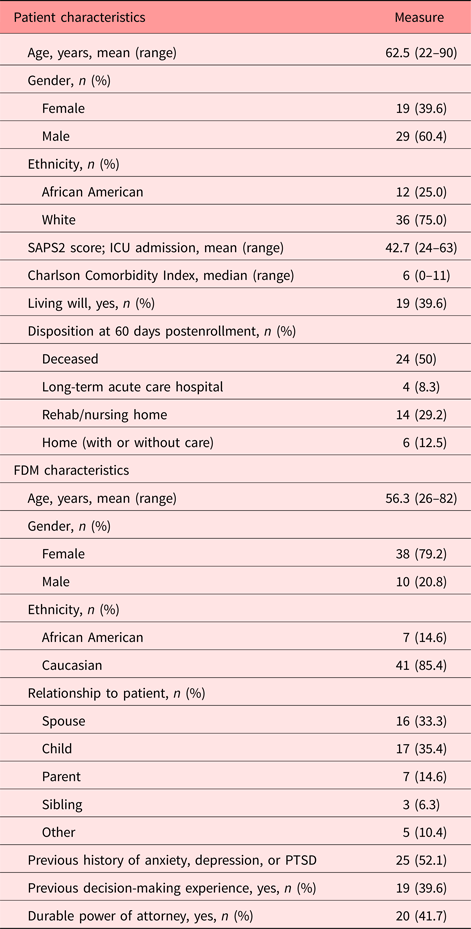
Sixty-eight FDM/patient dyads met the inclusion criteria for the study. Twenty FDMs refused to participate (29.4% refusal rate), yielding the study sample of 48 FDMs. Demographic characteristics of the patients and FDMs are summarized in Table 1. Approximately half of the FDMs (n = 25) had a previous self-reported psychiatric history of anxiety, depression, or PTSD. Two-thirds of the FDMs (n = 32) were employed, with 23 (47.9%) stating that they had to decrease their work hours because of the family member's illness.
Patient and FDM characteristics

FDM, family decision-maker; ICU, intensive care unit; PTSD, posttraumatic stress disorder; SAPS2, Simplified Acute Physiology Score 2.
PICS symptoms
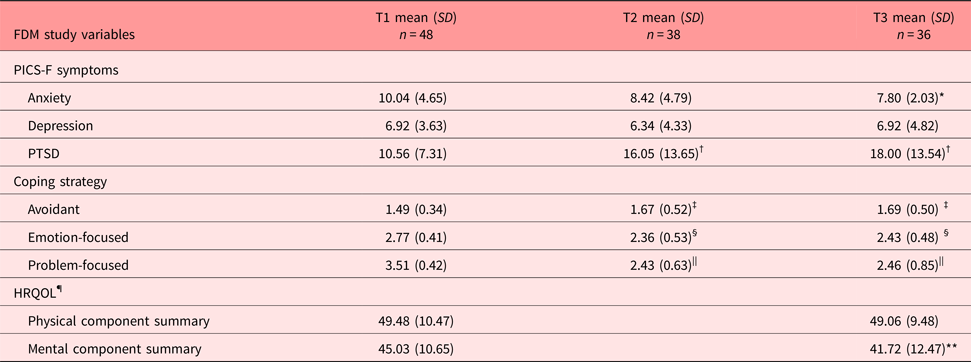
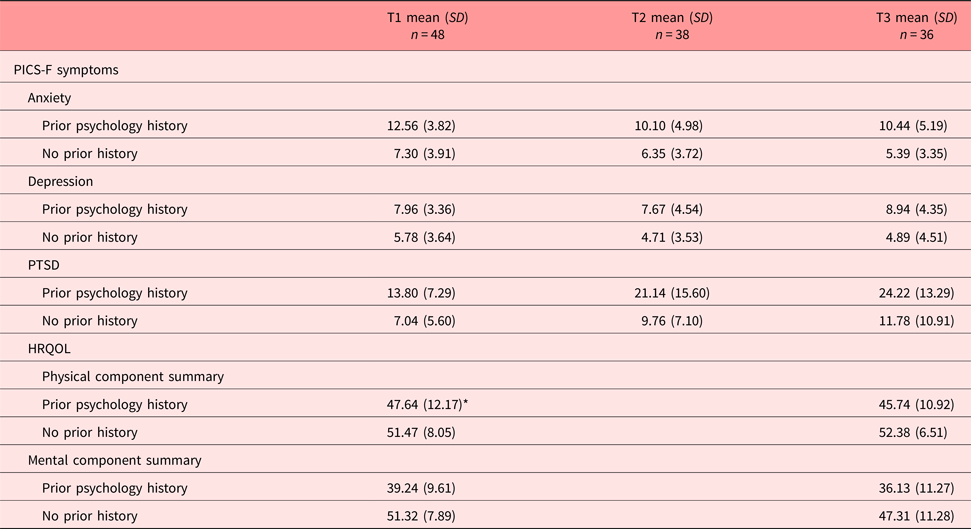
PICS symptoms, coping strategy use, and HRQOL are summarized in Table 2. Previous psychiatric history of anxiety, depression, or PTSD was the only FDM or patient demographic variable demonstrating a significant relationship to PICS symptoms and HRQOL. At each time point, PICS symptom severity was higher in FDMs with a previous psychiatric history compared with FDMs with no previous history (Table 3). The prevalence of FDMs with HADS scores suggestive of moderate or severe symptoms of anxiety (HADS-A ≥11) was highest at T1 (n = 22; 45.8%) and decreased over the course of the study (T2: n = 13, 34.2%; T3: n = 11, 30.6%). Conversely, the prevalence of FDMs with moderate to severe symptoms of depression (HADS-D ≥11) increased over time (T1: n = 7, 14.6%; T2: n = 8, 21.1%; T3: n = 9, 25.0%). No FDMs had PCL-5 scores suggestive of a PTSD diagnosis (PCL-5 ≥ 38) at T1. Over the course of the study, three (7.9%) FDMs at T2 and four (11.1%) at T3 met the criteria for a provisional diagnosis of PTSD. The majority of the patients with moderate or severe PICS-F symptoms (81%) indicated a previous history of anxiety, depression, or PTSD. There were no differences in PICS symptom severity among bereaved compared with nonbereaved FDMs: T3 anxiety t(34) = 0.32, p = 0.75; T3 depression t(34) = −0.82, p = 0.42; T3 PTSD t(34) = 0.30, p = 0.77.
PICS symptoms, coping strategy, and HRQOL

FDM, family decision-maker; HRQOL, health-related quality of life; PICS, post-intensive care syndrome; PTSD, posttraumatic stress disorder; SD, standard deviation; T1, time 1; T2, time 2; T3, time 3.
*Significant decrease from T1, F(2,68) = 3.94, p < .05; †significant increase from T1, F(1.51,51.26) = 14.05, p < .05; ‡significant increase from T1, F(2,64) = 4.91, p < .05; §significant decrease from T1, F(2,64) = 9.40, p < .05; ||significant decrease from T1, F(2,64) = 32.54, p < .05; ¶2009 US norms for each scale component are mean = 50, SD = 10; **significant decrease from T1, t(35) = 2.35, p < .05.
Influence of previous FDM history of anxiety, depression, or PTSD

FDM, family decision-maker; HRQOL, health-related quality of life; PICS, post-intensive care syndrome; PTSD, posttraumatic stress disorder; SD, standard deviation; T1, time 1; T2, time 2; T3, time 3.
*All time points significant (p < .05) except T1 HRQOL physical component score.
Coping
Problem-focused coping was the most widely used coping strategy at all three time points followed by emotion-focused coping. The use of these coping strategies decreased over time. FDM avoidant coping use was lowest at each time point, but its use increased from T1 to T2 and T3 (Table 2). FDMs with a previous psychiatric history used higher amounts of avoidant coping at T1 than FDMs with no previous psychiatric history [t (46) = 3.48; p = 0.001], but this difference was no longer evident at T2. No other relationships between FDM or patient demographic variables and coping strategy use were noted.
HRQOL
FDMs demonstrated a decrease in the HRQOL mental summary score over time (Table 2). Avoidant coping demonstrated moderate direct associations at T3 with symptoms of anxiety (r = 0.39, p = 0.02) and PTSD (r = 0.45, p = 0.01) and a moderate inverse relationship with the HRQOL mental summary score (r = −0.41, p = 0.01). Relationships between the FDM study variables at T3 are summarized in Supplementary Digital Content A3.
Prediction of PICS symptom severity and HRQOL
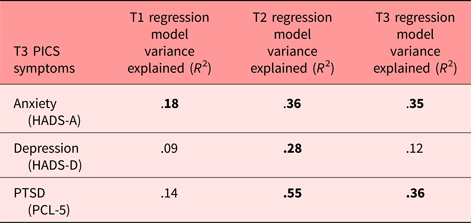
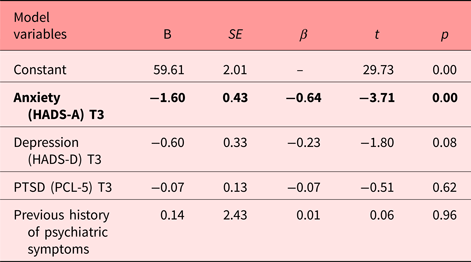
Linear regression models using previous history of psychological symptoms and coping strategy use at each time point were performed to determine the extent to which these variables predicted T3 FDM PICS symptom severity (Table 4). The models using T2 coping strategies were most predictive of T3 PICS symptom severity. Previous history of psychological symptoms was the only variable found to be an independent predictor of T3 PICS symptom severity in all statistically significant regression models (Supplementary Digital Content A4–A9). Avoidant coping was found to be a significant independent predictor of anxiety and PTSD in the T2 and T3 models. PICS symptoms severity at T3 explained 75% of the variance in T3 HRQOL mental summary score with T3 anxiety being the only significant independent predictor (Table 5).
Variance of T3 PICS symptom severity explained by coping strategy use

HADS-A, Hospital Anxiety and Depression Scale-Anxiety; HADS-D, Hospital Anxiety and Depression Scale-Depression; PCL-5 = PTSD checklist for DSM-5; PICS = post-intensive care syndrome; PTSD, posttraumatic stress disorder; T1 = time 1; T2 = time 2; T3 = time 3. Regression model independent variables include previous history of psychiatric symptoms and the coping strategies of each time point respectively (Supplemental Digital Content Table A5–A10). Bold type indicates p < 0.05.
T3 PICS symptom regression model of FDM T3 HRQOL mental summary score

FDM, family decision-maker; HADS-A, Hospital Anxiety and Depression Scale-Anxiety; HADS-D, Hospital Anxiety and Depression Scale-Depression; HRQOL, health-related quality of life; PTSD, posttraumatic stress disorder; SE, standard error; SF-36v2, Medical Outcomes Study 36-item Short-Form General Health Survey, version 2; T3, time 3. Dependent variable = T3 SF-36v2 Mental Summary Score; model summary: R 2 = .75; F (4,31) = 27.56, p = .00. Bold type indicates p < 0.05.
Discussion
We describe a significant prevalence of FDM PICS-F symptoms up to 60 days after a family member's ICU illness. Our findings in regard to the prevalence of anxiety and depression are in line with reports by other authors (McAdam et al., Reference McAdam, Fontaine and White2012; Schmidt & Azoulay, Reference Schmidt and Azoulay2012). However, the prevalence of PTSD symptoms in our study was lower than the reported prevalence in most previous studies, but similar to the prevalence reported by Gries and colleagues (Anderson et al., Reference Anderson, Arnold and Angus2008; Azoulay et al., Reference Azoulay, Pochard and Kentish-Barnes2005; Gries et al., Reference Gries, Engelberg and Kross2010; McAdam et al., Reference McAdam, Fontaine and White2012; Petrinec et al., Reference Petrinec, Mazanec and Burant2015). Comparisons of PICS-F symptom severity and prevalence is difficult because of differences in methodology, timing of symptom measurement, choice of measurement tool, and cutoff score used (Petrinec & Daly, Reference Petrinec and Daly2014). Gries and colleagues (Reference Gries, Engelberg and Kross2010) used a previous version of the PCL instrument that may be a more conservative estimate of PTSD symptom severity and partially explain the relatively low prevalence of clinically significant PTSD symptoms in their study and our findings.
FDM anxiety symptom severity and prevalence steadily decreased over the course of the study, which suggests that these symptoms may reflect acute rather than a chronic anxiety response. We noted an increase in the prevalence of FDM PTSD symptoms and a stable prevalence of depression symptoms over the course of our study. Some authors have reported a decrease in the severity and prevalence of PICS-F symptoms among family members over the first three months following an ICU illness, whereas others have reported a stable prevalence of depression and PTSD symptoms in family members up to four years after an ICU illness (Gries et al., Reference Gries, Engelberg and Kross2010; McAdam et al., Reference McAdam, Fontaine and White2012). The relative stability of depression and PTSD symptoms suggests a more inelastic and chronic nature of those symptoms when compared with anxiety. Our study did not demonstrate a difference in PICS-F symptoms among bereaved compared with nonbereaved FDMs, and the literature is inconclusive in regard to the influence of patient death on family member PICS symptoms (Anderson et al., Reference Anderson, Arnold and Angus2008; Azoulay et al., Reference Azoulay, Pochard and Kentish-Barnes2005; Kross et al., Reference Kross, Engelberg and Gries2011; McAdam et al., Reference McAdam, Fontaine and White2012). However, the prevalence of a history of psychological symptoms among FDMs was high and appeared to have a significant influence on the risk of developing PICS-F symptoms. Gries et al. (Reference Gries, Engelberg and Kross2010) reported a relationship between family members’ prior history of taking prescription medications for mood or seeing an outpatient psychiatrist and PTSD symptoms.
Problem-focused coping was highest among FDMs at all three time points, whereas avoidant coping was the least used coping strategy, which echoes previous findings (Petrinec et al., Reference Petrinec, Mazanec and Burant2015). The use of problem- and emotion-focused coping decreased over time, whereas the use of avoidant coping increased by T2 and remained higher than T1. By T3, avoidant coping was the only coping strategy with significant direct associations with severity of anxiety and PTSD symptoms. Avoidant coping has been linked to negative psychological outcomes, particularly PTSD, following a stressful event (Penley et al., Reference Penley, Tomaka and Wiebe2002; Petrinec et al., Reference Petrinec, Mazanec and Burant2015; Shaw et al., Reference Shaw, Bernard and Storfer-Isser2013; Wartella et al., Reference Wartella, Auerbach and Ward2009). The precise relationship between avoidant coping and later PTSD is unclear, with some authors suggesting avoidant coping as a response to PTSD symptoms, with others demonstrating early avoidant coping as a predictor of later PTSD symptoms (Coyne & Racioppo, Reference Coyne and Racioppo2000; Petrinec et al., Reference Petrinec, Mazanec and Burant2015; Schnider et al., Reference Schnider, Elhai and Gray2007; Shaw et al., Reference Shaw, Bernard and Storfer-Isser2013; Wartella et al., Reference Wartella, Auerbach and Ward2009). Petrinec et al. (Reference Petrinec, Mazanec and Burant2015) demonstrated a mediating effect between patient death and later PTSD symptoms among ICU FDMs.
FDM physical HRQOL remained stable throughout the study. However, the mental HRQOL was lower than US population norms and decreased by T3, suggesting that the role of ICU FDM takes a mental toll. These findings corroborate the findings of Lemiale et al. (Reference Lemiale, Kentish-Barnes and Chaize2010). As expected, mental HRQOL scores were inversely associated with all of the symptoms of PICS-F. Furthermore, the mental HRQOL score was inversely associated with avoidant coping. This association may be reflective of the relationship between avoidant coping and PICS-F symptoms at T3, but may also suggest that avoidant coping may have a relationship with decreased mental HRQOL apart from the relationship with PICS-F symptoms. Coping strategy use 30 days after ICU admission was the strongest predictor of PICS symptoms severity at 60 days, whereas PICS symptoms severity explained the majority of variance in the HRQOL mental summary score.
Early recognition of PICS in family members may allow for early intervention and prevention of the sequelae of ICU hospitalization. Intervention studies using ICU diaries or tailored communication strategies have shown some promise in diminishing the burden of PTSD symptoms, although the mechanism accounting for the reduction is unknown (Garrouste-Orgeas et al., Reference Garrouste-Orgeas, Coquet and Périer2012; Jones et al., Reference Jones, Bäckman and Griffiths2012; Lautrette et al., Reference Lautrette, Darmon and Megarbane2007). Additionally, avoidant coping has been shown to be amenable to cognitive behavioral therapy interventions with positive psychological outcomes (Butler et al., Reference Butler, Chapman and Forman2006; Sikkema et al., Reference Sikkema, Ranby and Meade2013). Our study suggests that screening for a previous history of PICS-like symptoms may be of benefit in identifying ICU family members at risk for PICS-F.
There are several limitations to our study. The overall sample size is small, which limits generalizability of our findings and detection of subtle changes in study variables over time. Our sample may be biased because of significant refusal and attrition rates, particularly because individuals who use high levels of avoidant coping may be less likely to participate in a study. The study used self-report instruments to measure PICS symptoms. These instruments cannot make the diagnosis of anxiety, depression, or PTSD but rather give an assessment of the severity of symptoms and a cutoff score that correlates with a provisional diagnosis of the respective disorder. Complicated grief is also a component of PICS-F and is potentially a confounding variable we did not measure in this study.
Our study reports a significant prevalence of PICS-F symptoms among post-ICU FDMs with a concomitant decreased mental HRQOL. This potentially represents a significant cost to society from psychological morbidity and loss of productivity, particularly when the FDM is a spouse and possibly the only remaining means of financial support during the time of the ICU illness and post-ICU recovery. Additionally, these FDMs are often grieving after their loved one's death or may be called upon during the recovery phase to provide informal caregiving at a time when they themselves are suffering from the ICU experience. Increasingly, palliative care services are being integrated into ICU care to facilitate a holistic approach to the care of the complex ICU patient and their family unit. Larger sample longitudinal studies are needed to better understand the dynamics of PICS, the relationships between antecedent risk factors, the utilization and significance of coping strategies, the role of complicated grief, and the long-term effects on HRQOL.
Acknowledgments
This study was funded by grants from the Sigma Theta Tau International Honor Society of Nursing Alpha Mu Chapter and Frances Payne Bolton School of Nursing Alumni Association.
Supplementary material
The supplementary material for this article can be found at https://doi.org/10.1017/S1478951517001043.
Author disclosure
Neither author has any conflicts of interest to disclose.