Introduction
Antipsychotic medications play an essential role in the treatment of psychosis (Sendt et al. Reference Sendt, Tracy and Bhattacharyya2014), but their effectiveness is often hindered by poor adherence (Keith & Kane, Reference Keith and Kane2003). Reviews report mean non-adherence rates between 27% and 49.5% among patients with psychosis (Cramer & Rosenheck, Reference Cramer and Rosenheck1988; Lacro et al. Reference Lacro, Dunn, Dolder, Leckband and Jeste2002; Nosè et al. Reference Nosè, Barbui and Tansella2003), while they may be up to 63% in first-episode psychosis (FEP) samples (Mojtabai et al. Reference Mojtabai, Lavelle, Gibson, Sohler, Craig and Carlson2002; Mutsatsa et al. Reference Mutsatsa, Joyce, Hutton, Webb, Gibbins, Paul and Barnes2003). Non-adherence is associated with negative outcomes such as greater risk of relapse, hospitalization and suicide (Higashi et al. Reference Higashi, Medic, Littlewood, Diez, Granström and De Hert2013). Although predictors of non-adherence have been identified (Sendt et al. Reference Sendt, Tracy and Bhattacharyya2014), they are not always easily amenable to intervention. For instance, illness-related factors such as cognitive deficit or lack of insight (Reed et al. Reference Reed, Harrow, Herbener and Martin2002; Sharma & Antonova, Reference Sharma and Antonova2003; Buckley et al. Reference Buckley, Wirshing, Bhushan, Pierre, Resnick and Wirshing2007) represent a feature rather than a co-morbidity of psychosis (Buckley et al. Reference Buckley, Wirshing, Bhushan, Pierre, Resnick and Wirshing2007) and may be inextricably and circularly linked to non-adherence. Similarly, reduction of side-effects may enhance adherence (Colom et al. Reference Colom, Vieta, Tacchi, Sanchez-Moreno and Scott2005), but this may often be reached through a trade-off between the desired level of response and a tolerable level of side-effects to ensure the most optimal adherence in a given individual.
By contrast, one of the most consistently reported risk-factors for non-adherence (Fenton et al. Reference Fenton, Blyler and Heinsse1997; Kampman & Lehtinen, Reference Kampman and Lehtinen1999; Green, Reference Green2006; Buckley, Reference Buckley2007), which may also potentially be amenable to intervention (Grech et al. Reference Grech, Van Os, Jones, Lewis and Murray2005; Addington & Addington, Reference Addington and Addington2007; Conrod et al. Reference Conrod, Castellanos-Ryan and Strang2010), is drug use. Cannabis is the most frequently used illicit drug worldwide (Global Drug Survey, 2014), especially in those with psychosis (Green et al. Reference Green, Young and Kavanagh2005; Addington & Addington, Reference Addington and Addington2007), with prevalence estimates of 16–23% for current and 27–42.1% for lifetime use (Koskinen et al. Reference Koskinen, Lohonen, Koponen, Isohanni and Miettunen2010). These may be as high as 10–18% for current and 46.9–66% for lifetime use in FEP patients (Foti et al. Reference Foti, Kotov, Guey and Bromet2010; Van Dijk et al. Reference Van Dijk, Koeter, Hijman, Kahn and van den Brink2012). Cannabis use is also associated with increased risk of psychosis, increased symptom severity (Moore et al. Reference Moore, Zammit, Lingford-Hughes, Barnes, Jones, Burke and Lewis2007), earlier onset (Large et al. Reference Large, Sharma, Compton, Slade and Nielssen2011) and more relapses and hospitalizations (Zammit et al. Reference Zammit, Moore, Lingford-Hughes, Barnes, Jones and Burke2008; Schoeler et al. Reference Schoeler, Monk, Sami, Klamerus, Foglia, Brown, Murray, Camuri, Altamura, Murray and Bhattacharyya2016a ), suggesting the importance of this predictor of non-adherence in those with psychosis.
Despite the prevalence and impact of cannabis use, to our knowledge no meta-analysis has as yet estimated the magnitude of its effect on medication non-adherence. Only one systematic review (Zammit et al. Reference Zammit, Moore, Lingford-Hughes, Barnes, Jones and Burke2008) has been published on the topic, but it included only three studies providing inconsistent evidence (Zammit et al. Reference Zammit, Moore, Lingford-Hughes, Barnes, Jones and Burke2008). Herein, we attempt to estimate the magnitude of the association between cannabis use and medication non-adherence in those with psychosis, and we assess the reporting strength of the available evidence on the topic. In line with previous studies, we control for duration of follow-up (Cramer & Rosenheck, Reference Cramer and Rosenheck1988; Lacro et al. Reference Lacro, Dunn, Dolder, Leckband and Jeste2002; Miller et al. Reference Miller, Ream, McCormack, Gunduz-Bruce, Sevy and Robinson2009), age (Gonzalez-Pinto et al. Reference Gonzalez-Pinto, Mosquera, Alonso, Lòpez, Ramìrez, Vieta and Baldessarini2006; Addington & Addington, Reference Addington and Addington2007; Castberg et al. Reference Castberg, Andreas and Olav2009), gender (Castberg et al. Reference Castberg, Andreas and Olav2009) and baseline illness severity (Zammit et al. Reference Zammit, Moore, Lingford-Hughes, Barnes, Jones and Burke2008). We compare the differential effects of cannabis use on adherence between: (1) FEP and non-FEP patients, that show higher rates of cannabis use (Foti et al. Reference Foti, Kotov, Guey and Bromet2010; Van Dijk et al. Reference Van Dijk, Koeter, Hijman, Kahn and van den Brink2012) and non-adherence (Mojtabai et al. Reference Mojtabai, Lavelle, Gibson, Sohler, Craig and Carlson2002; Mutsatsa et al. Reference Mutsatsa, Joyce, Hutton, Webb, Gibbins, Paul and Barnes2003); and (2) affective and non-affective patients, in order to obtain data relative to more homogeneous diagnostic groups.
Method
Literature search and selection procedures
We applied the Meta-analysis of Observational Studies in Epidemiology (MOOSE) guidelines for systematic reviews and meta-analyses of observational studies (Stroup et al. Reference Stroup, Berlin, Morton, Olkin, Williamson, Rennie, Moher, Becker, Sipe and Thacker2000). The final systematic search was performed on 27 April 2015 through OVID in four databases: EMBASE (1974–2015, week 17); Ovid MEDLINE In-Process and Other Non-Indexed Citations (1946 to Present); Journals@Ovid; PsycINFO (1806–February 2015). The search, limited to human studies, was run through titles (ti) and abstracts (ab). Search terms were grouped in three categories: (1) DIAGNOSIS: psychosis; psychot*; schizophren*; schizoaff*; (2) ILLICIT SUBSTANCES: cannabi*; drug-use; drug-abuse; drug-misuse; substance-use; substance-abuse; substance-misuse; (3) ADHERENCE: adheren*; complian*. The Boolean Operator ‘OR’ was adopted to separate within-category terms, while ‘AND’ was used to combine the three categories.
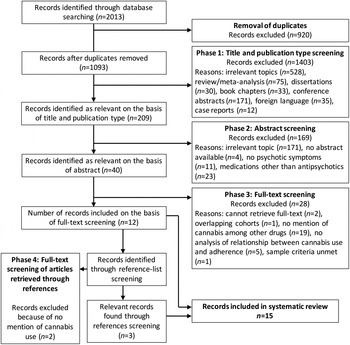
To find further relevant publications, reference lists were screened from included papers and other reviews on drug use and adherence. Authors were contacted for clarifications and unpublished data. The PRISMA flowchart presented in Fig. 1 shows the selection procedure followed to identify relevant studies, with numbers and reasons for exclusion. Data extraction followed a systematic process consisting in compiling a database (Supplementary Methods 1) with the variables of interest retrieved from the included studies. Study selection and data extraction were performed by two authors (E.F. and E.K.) and disagreement was resolved by consensus.
Literature search and selection of the studies, adapted from the PRISMA (Preferred Reporting Items for Systematic Reviews and Meta-Analyses) flowchart (http://www.prisma-statement.org).

Selection criteria and outcome measure
Only published peer-reviewed papers in English reporting original studies satisfying the following criteria were considered: (1) studies had to investigate the relationship between cannabis use and medication adherence; (2) the majority of the sample had to be on antipsychotic medication; (3) participants had to be patients diagnosed with schizophrenia or any psychotic disorder using standardized criteria. If cannabis was not the only substance considered, studies were included only when they specified that cannabis was the most frequently used illicit substance, or when analysis was done for each substance separately, or when other substance use was controlled for. If the presence of psychotic symptoms was unclear, papers were included only when the majority of the sample was on antipsychotics. Similarly, if treatment was referred to simply as ‘drug treatment’ or ‘medication’, with no specific reference to antipsychotic treatment, studies were included only when the sample comprised patients with a diagnosis of schizophrenia, other psychotic disorders or bipolar disorder with psychotic symptoms, as such patients are most likely to be treated with antipsychotics. Overlapping cohorts were excluded.
The outcome of interest was non-adherence to antipsychotics, with exclusion of studies that did not distinguish between adherence to pharmacological and other forms of treatment.
Data analysis
Studies that provided enough data to estimate odds ratio (OR) for risk of non-adherence were pooled in a meta-analysis. For the rest, a narrative synthesis of the findings will be presented. Statistical analyses were conducted with Review Manager 5.3 (http://tech.cochrane.org/revman) and with R for meta-regression and Egger's test. DerSimonian & Laird (Reference DerSimonian and Laird1986) random-effects models (REM) were adopted, assuming variations in true effect sizes across studies (Borenstein et al. Reference Borenstein, Hedges, Higgins and Rothstein2011). The outcome was dichotomized into two categories: good v. poor/non-adherence. OR of non-adherence and 95% confidence intervals (CIs) were used as a measure of effect size due to the categorical nature of the outcome. Except where already reported (Coldham et al. Reference Coldham, Addington and Addington2002), ORs were calculated employing an online software (http://www.campbellcollaboration.org/resources/effect_size_input.php) using frequency distributions (Linszen et al. Reference Linszen, Dingemans and Lenior1994; Martinez-Arevalo et al. Reference Martinez-Arevalo, Calcedo-Ordonez and Varo-Prieto1994; Kovasznay et al. Reference Kovasznay, Fleischer, Tanenberg-Karant, Jandorf, Miller and Bromet1997; Rehman & Farooq, Reference Rehman and Farooq2007; Barbeito et al. Reference Barbeito, Vega, Ruiz de Azua, Saenz, Martinez-Cengotitabengoa, Gonzalez-Ortega, Bermudez, Hernanz, Corres and Gonzalez-Pinto2013; Jónsdóttir et al. Reference Jónsdóttir, Opjordsmoen, Birkenaes, Simonsen, Engh, Ringen, Vaskinn, Friis, Sundet and Andreassen2013). Where frequencies were not available, χ2 value (Pogge et al. Reference Pogge, Singer and Harvey2005) or mean difference and s.d. (Strakowski et al. Reference Strakowski, DelBello, Fleck, Adler, Anthenelli, Keck, Arnold and Amicone2007; Schimmelmann et al. Reference Schimmelmann, Conus, Cotton, Kupferschmid, McGorry and Lambert2012) were used to calculate Cohen's d and its variance, from which ORs were estimated. We compared adherence outcomes between cannabis users and non-users groups. For studies that reported data on course of cannabis use (Martinez-Arevalo et al. Reference Martinez-Arevalo, Calcedo-Ordonez and Varo-Prieto1994; Faridi et al. Reference Faridi, Joober and Malla2012; Schimmelmann et al. Reference Schimmelmann, Conus, Cotton, Kupferschmid, McGorry and Lambert2012; Barbeito et al. Reference Barbeito, Vega, Ruiz de Azua, Saenz, Martinez-Cengotitabengoa, Gonzalez-Ortega, Bermudez, Hernanz, Corres and Gonzalez-Pinto2013) adherence outcomes were also compared between the following groups: non-users (i.e. those who were not using cannabis both at baseline and at follow-up) v. continued cannabis users at follow-up (i.e. those who were smoking cannabis both at baseline and follow-up); non-users v. former users at follow-up (i.e. those who were smoking cannabis at baseline but quit at follow-up); and former users v. current users.
Further details about analysis are reported in Supplementary Methods 2.
Heterogeneity was estimated through the I 2 statistic (Higgins et al. Reference Higgins, Thompson, Deeks and Altman2003) and publication bias through funnel plots and the Egger's test (Egger et al. Reference Egger, Davey Smith, Schneider and Minder1997).
Possible confounding variables identified a priori based on the rationale presented earlier were controlled for through further statistical analysis. For continuous variables, the following confounders were entered in meta-regression: (1) duration of follow-up; (2) mean age; (3) gender distribution; (4) age difference between cannabis users and non-users; (5) time difference between measurement of cannabis use and adherence.
For categorical variables, subgroup analyses were performed for: (1) ‘FEP’ only samples and ‘Non-FEP/mixed’ samples; (2) ‘Affective’ v. ‘Non-affective’ psychosis samples; (3) studies that controlled for baseline illness severity v. those that did not. Due to the heterogeneity of diagnostic groups reported in different studies, those that included at least 50% patients with affective psychosis were included within the ‘Affective’ group for the purpose of ‘Affective’ v. ‘Non-affective’ psychosis subgroup analysis and vice versa.
Post-hoc sensitivity analysis was also performed excluding two studies (Linszen et al. Reference Linszen, Dingemans and Lenior1994; Coldham et al. Reference Coldham, Addington and Addington2002) that, unlike the others, assessed both cannabis use and adherence at follow-up. Two prospective studies (Martinez-Arevalo et al. Reference Martinez-Arevalo, Calcedo-Ordonez and Varo-Prieto1994; Barbeito et al. Reference Barbeito, Vega, Ruiz de Azua, Saenz, Martinez-Cengotitabengoa, Gonzalez-Ortega, Bermudez, Hernanz, Corres and Gonzalez-Pinto2013) reported only data on course of cannabis use (i.e. how many participants at follow-up had never used cannabis, were currently using cannabis or had quit cannabis since baseline) but how many of these participants were using at baseline was not reported. For these studies, we inferred that all those who were currently using cannabis at follow-up were also users at baseline, as research shows that rates of initiation of cannabis use after onset of psychosis are generally very low (Miller et al. Reference Miller, Ream, McCormack, Gunduz-Bruce, Sevy and Robinson2009). In order to rule out possible confounding effects of such an approximation, we performed further sensitivity analyses excluding these two studies. Additionally, we restricted the analysis to only samples for which antipsychotics represented >50% of the total psychopharmacological treatment; the focus of the present review being on antipsychotic medication, this allowed to account for the fact that pharmacological treatment was mixed in several studies. Finally, we performed sensitivity analysis on a restricted sample of studies rated at least 8 in reporting strength.
Assessment of reporting strength
In keeping with previous systematic reviews (McGrath et al. Reference McGrath, Saha, Welham, El Saadi, MacCauley and Chant2004) and meta-analyses (Penttila et al. Reference Penttila, Jaaskelainen, Hirvonen, Isohanni and Miettunen2014) of psychosis epidemiology, we evaluated the reporting strength and characteristics of the included studies with an assessment tool (Supplementary Methods 3) employed in a previous related review by Beards et al. (Reference Beards, Gayer-Anderson, Borges, Dewey, Fisher and Morgan2013). We adapted this tool to suit the specific focus of the present meta-analysis in the absence of a standard tool that was fit for purpose (see Supplementary Methods 3). Ratings were obtained by adding scores on a 3-point scale (0–2) on each item, and a final score (0–4, poor; 5–9, moderate; 10–14, good) was assigned to each study.
Results
Results of search
A final list of 15 manuscripts (Linszen et al. Reference Linszen, Dingemans and Lenior1994; Martinez-Arevalo et al. Reference Martinez-Arevalo, Calcedo-Ordonez and Varo-Prieto1994; Kovasznay et al. Reference Kovasznay, Fleischer, Tanenberg-Karant, Jandorf, Miller and Bromet1997; Coldham et al. Reference Coldham, Addington and Addington2002; Pogge et al. Reference Pogge, Singer and Harvey2005; Perkins et al. Reference Perkins, Johnson, Hamer, Zipursky, Keefe, Centorrhino, Green, Glick, Kahn and Sharma2006; de Haan et al. Reference de Haan, van Amelsvoort, Dingemans and Linszen2007; Rehman & Farooq, Reference Rehman and Farooq2007; Strakowski et al. Reference Strakowski, DelBello, Fleck, Adler, Anthenelli, Keck, Arnold and Amicone2007; Miller et al. Reference Miller, Ream, McCormack, Gunduz-Bruce, Sevy and Robinson2009; Gonzalez-Pinto et al. Reference Gonzalez-Pinto, Reed, Novick, Bertsch and Haro2010; Faridi et al. Reference Faridi, Joober and Malla2012; Schimmelmann et al. Reference Schimmelmann, Conus, Cotton, Kupferschmid, McGorry and Lambert2012; Barbeito et al. Reference Barbeito, Vega, Ruiz de Azua, Saenz, Martinez-Cengotitabengoa, Gonzalez-Ortega, Bermudez, Hernanz, Corres and Gonzalez-Pinto2013; Jónsdóttir et al. Reference Jónsdóttir, Opjordsmoen, Birkenaes, Simonsen, Engh, Ringen, Vaskinn, Friis, Sundet and Andreassen2013) reporting on 3678 patients, were considered for the systematic-review. Of these, those that provided sufficient data for effect-size estimation were (Linszen et al. Reference Linszen, Dingemans and Lenior1994; Martinez-Arevalo et al. Reference Martinez-Arevalo, Calcedo-Ordonez and Varo-Prieto1994; Kovasznay et al. Reference Kovasznay, Fleischer, Tanenberg-Karant, Jandorf, Miller and Bromet1997; Coldham et al. Reference Coldham, Addington and Addington2002; Pogge et al. Reference Pogge, Singer and Harvey2005; Rehman & Farooq, Reference Rehman and Farooq2007; Strakowski et al. Reference Strakowski, DelBello, Fleck, Adler, Anthenelli, Keck, Arnold and Amicone2007; Gonzalez-Pinto et al. Reference Gonzalez-Pinto, Reed, Novick, Bertsch and Haro2010; Schimmelmann et al. Reference Schimmelmann, Conus, Cotton, Kupferschmid, McGorry and Lambert2012; Barbeito et al. Reference Barbeito, Vega, Ruiz de Azua, Saenz, Martinez-Cengotitabengoa, Gonzalez-Ortega, Bermudez, Hernanz, Corres and Gonzalez-Pinto2013; Jónsdóttir et al. Reference Jónsdóttir, Opjordsmoen, Birkenaes, Simonsen, Engh, Ringen, Vaskinn, Friis, Sundet and Andreassen2013) for cannabis users v. non-users (n = 3055 patients); three (Martinez-Arevalo et al. Reference Martinez-Arevalo, Calcedo-Ordonez and Varo-Prieto1994; Schimmelmann et al. Reference Schimmelmann, Conus, Cotton, Kupferschmid, McGorry and Lambert2012; Barbeito et al. Reference Barbeito, Vega, Ruiz de Azua, Saenz, Martinez-Cengotitabengoa, Gonzalez-Ortega, Bermudez, Hernanz, Corres and Gonzalez-Pinto2013) each for non-users v. current users (n = 175) and non-users v. former users (n = 187) and four (Martinez-Arevalo et al. Reference Martinez-Arevalo, Calcedo-Ordonez and Varo-Prieto1994; Faridi et al. Reference Faridi, Joober and Malla2012; Schimmelmann et al. Reference Schimmelmann, Conus, Cotton, Kupferschmid, McGorry and Lambert2012; Barbeito et al. Reference Barbeito, Vega, Ruiz de Azua, Saenz, Martinez-Cengotitabengoa, Gonzalez-Ortega, Bermudez, Hernanz, Corres and Gonzalez-Pinto2013) for former users v. current users (n = 192). Further details are presented in Supplementary Results 1.
Study characteristics
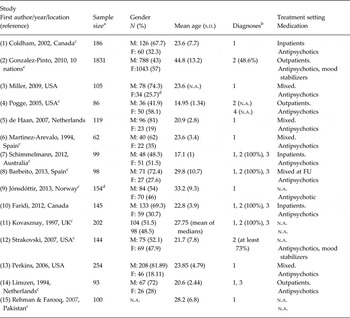
Table 1 shows the main characteristics of all of the 15 studies identified through systematic search. The following section presents summary characteristics for the 11 studies included in the meta-analysis (cannabis users v. non users), while data referring to the whole sample of 15 studies is reported as part of Supplementary Results 2. The included 11 studies reported data from 11 different cohorts from across the world. Males represented 48.7% of the sample with a mean age of 36.8 years. This was significantly influenced by data from a single study reporting on the largest sample (Gonzalez-Pinto et al. Reference Gonzalez-Pinto, Reed, Novick, Bertsch and Haro2010) (n = 1831, mean age = 45 years), while the remaining studies included patients with age ranging from 15 to 30 years. As for diagnoses, four studies included only schizophrenia spectrum diagnoses, two only bipolar I diagnoses, while the others were mixed. The schizophrenia spectrum disorder group included 25.7% of the pooled sample, while 2.1% fell into the Other psychosis group, and 72.2% into the Bipolar and other affective disorders group. Within the latter category, 48.5% had psychotic symptoms, while for the rest, the presence of psychotic symptoms was not specified. Five studies included only FEP patients early in the course of their illness, while samples were mixed in the other studies. The majority of the studies were observational (k = 11), longitudinal (k = 11) and prospective (k = 6), with follow-up periods ranging from 6 months to 8 years (mean = 2.3 years).
Characteristics of the samples of the included studies

a Sample size for which analysis on the relationship between cannabis use and adherence was done.
b 1 = schizophrenia spectrum disorder (number specified when applicable); 2 = bipolar affective disorder (% with psychosis); 3 = other psychosis, including affective; 4 = other psychiatric diagnoses (% with psychosis).
c Study included in the meta-analysis.
d The study reported data for patients diagnosed with schizophrenia and bipolar disorder separately. Here only the schizophrenia sample is considered, as presence of psychotic symptoms for the bipolar sample was not specified, and only 20% of the bipolar sample was on antipsychotics, thus not meeting the inclusion criteria.
Study reporting strength and assessment methods
No study was excluded on the basis of the assessment of reporting strength though separate analysis was carried out for studies having a reporting strength rating of at least 8, as part of sensitivity analyses. The following section reports data referred to the 11 studies included in the quantitative analysis, while those for the whole sample of 15 studies are reported in online Supplementary Results 3. Reporting strength (Supplementary Results 3) was on average moderate (mean = 8) A summary description of the assessment methods used in the included study, with a strength score, is presented in Supplementary Results 4. Five studies for cannabis and Five for adherence gathered data through either only self-reports or only clinical ratings, and only one study for cannabis and none for adherence used objective measures. Only two and three studies adopted a combination of sources to assess cannabis use and adherence respectively. However, it is important to note that most studies (six for adherence and six for cannabis) assessed variables at multiple time-points.
Effect of cannabis use on adherence to antipsychotics
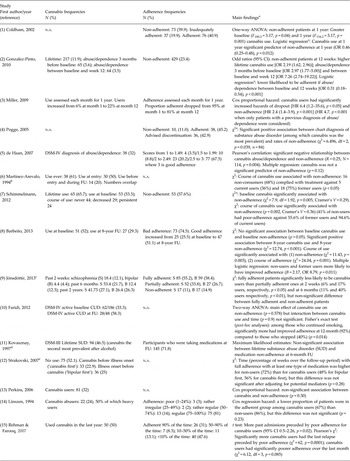
Summary results from each study are summarized in Table 2, together with the frequencies for cannabis use and non-adherence data, where available.
Cannabis frequencies, adherence frequencies and main findings

a Outcomes included in the meta-analysis. Where no outcome is indicated by a, OR was calculated through frequency distributions.
b Current users and former users grouped into one category and compared with non-users.
c Non-adherent patients and partially-adherent patients were grouped into the poor/non-adherence group. The outcome for 6 months adherence was considered for OR calculation.
d Schizophrenia and affective psychosis samples were grouped into one and comparisons were made between lifetime SUD and no-SUD (schizophrenia + schizoaffective).
e Bipolar-first and cannabis-first groups were grouped into the cannabis users group and compared with the non-users group. Mean % of weeks with adherence to medication was adopted to calculate Cohen's d from which OR was estimated.
Outcome measures varied according to the different definitions and cut-off points for non-adherence (Supplementary Results 4). Nine studies (Martinez-Arevalo et al. Reference Martinez-Arevalo, Calcedo-Ordonez and Varo-Prieto1994; Kovasznay et al. Reference Kovasznay, Fleischer, Tanenberg-Karant, Jandorf, Miller and Bromet1997; Pogge et al. Reference Pogge, Singer and Harvey2005; Perkins et al. Reference Perkins, Johnson, Hamer, Zipursky, Keefe, Centorrhino, Green, Glick, Kahn and Sharma2006; Miller et al. Reference Miller, Ream, McCormack, Gunduz-Bruce, Sevy and Robinson2009; Gonzalez-Pinto et al. Reference Gonzalez-Pinto, Reed, Novick, Bertsch and Haro2010; Faridi et al. Reference Faridi, Joober and Malla2012; Schimmelmann et al. Reference Schimmelmann, Conus, Cotton, Kupferschmid, McGorry and Lambert2012; Barbeito et al. Reference Barbeito, Vega, Ruiz de Azua, Saenz, Martinez-Cengotitabengoa, Gonzalez-Ortega, Bermudez, Hernanz, Corres and Gonzalez-Pinto2013) dichotomized the outcome into good v. poor/non-adherence. Six studies (Linszen et al. Reference Linszen, Dingemans and Lenior1994; Coldham et al. Reference Coldham, Addington and Addington2002; de Haan et al. Reference de Haan, van Amelsvoort, Dingemans and Linszen2007; Rehman & Farooq, Reference Rehman and Farooq2007; Strakowski et al. Reference Strakowski, DelBello, Fleck, Adler, Anthenelli, Keck, Arnold and Amicone2007; Jónsdóttir et al. Reference Jónsdóttir, Opjordsmoen, Birkenaes, Simonsen, Engh, Ringen, Vaskinn, Friis, Sundet and Andreassen2013) included additional categories to reflect intermediate levels of adherence, but three of them (Linszen et al. Reference Linszen, Dingemans and Lenior1994; Coldham et al. Reference Coldham, Addington and Addington2002; Strakowski et al. Reference Strakowski, DelBello, Fleck, Adler, Anthenelli, Keck, Arnold and Amicone2007) performed comparisons only between the two extreme categories. Two studies (Faridi et al. Reference Faridi, Joober and Malla2012; Barbeito et al. Reference Barbeito, Vega, Ruiz de Azua, Saenz, Martinez-Cengotitabengoa, Gonzalez-Ortega, Bermudez, Hernanz, Corres and Gonzalez-Pinto2013) also assessed course of adherence, and one study (Rehman & Farooq, Reference Rehman and Farooq2007) assessed the number of relapses preceded by poor adherence. In terms of definitions, nine studies (Linszen et al. Reference Linszen, Dingemans and Lenior1994; Martinez-Arevalo et al. Reference Martinez-Arevalo, Calcedo-Ordonez and Varo-Prieto1994; de Haan et al. Reference de Haan, van Amelsvoort, Dingemans and Linszen2007; Rehman & Farooq, Reference Rehman and Farooq2007; Strakowski et al. Reference Strakowski, DelBello, Fleck, Adler, Anthenelli, Keck, Arnold and Amicone2007; Miller et al. Reference Miller, Ream, McCormack, Gunduz-Bruce, Sevy and Robinson2009; Gonzalez-Pinto et al. Reference Gonzalez-Pinto, Reed, Novick, Bertsch and Haro2010; Faridi et al. Reference Faridi, Joober and Malla2012; Jónsdóttir et al. Reference Jónsdóttir, Opjordsmoen, Birkenaes, Simonsen, Engh, Ringen, Vaskinn, Friis, Sundet and Andreassen2013) defined non-adherence as ‘taking medications as prescribed less than x% of the time’ (usually 75–80%); three studies (Coldham et al. Reference Coldham, Addington and Addington2002; Perkins et al. Reference Perkins, Johnson, Hamer, Zipursky, Keefe, Centorrhino, Green, Glick, Kahn and Sharma2006; Schimmelmann et al. Reference Schimmelmann, Conus, Cotton, Kupferschmid, McGorry and Lambert2012) defined non-adherence as ‘failing to take medications for longer than 1 week’; two studies (Kovasznay et al. Reference Kovasznay, Fleischer, Tanenberg-Karant, Jandorf, Miller and Bromet1997; Pogge et al. Reference Pogge, Singer and Harvey2005) adopted simple yes/no criteria (e.g. participant had/did not have adequate adherence during follow up) and one study (Schimmelmann et al. Reference Schimmelmann, Conus, Cotton, Kupferschmid, McGorry and Lambert2012) based its ratings on yes/no questions (e.g. ‘Do you sometimes forget to take your medicines?’).
With reference to the 11 studies included in the meta-analysis, prevalence of cannabis use was calculated on the sample of studies that reported it. Prevalence of lifetime cannabis use was 18.9% as reported by four studies; prevalence of baseline cannabis use was 13.9% as reported by eight studies; and prevalence of current or follow-up cannabis use was 6.2% as reported by four studies. However, prevalence was higher (54.3%, 39.1%, 25.1% for lifetime, baseline and follow-up use, respectively) on excluding the study by Gonzalez-Pinto et al. (Reference Gonzalez-Pinto, Reed, Novick, Bertsch and Haro2010) which reported very low rates of co-morbid cannabis use, and also when only FEP samples were considered (52.8%, 44.9%, 25.8% for lifetime, baseline and follow-up use, respectively). Prevalence rates of non-adherence at follow-up were 28.9% for the whole sample and 34.3% for the FEP sample. Cannabis use and non-adherence data for the larger sample of 15 studies included in the systematic review are presented in Supplementary Results 2.
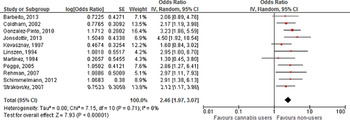
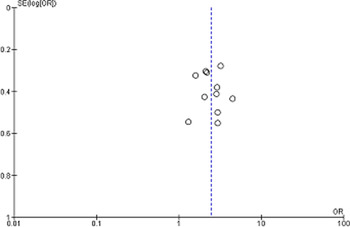
Results of the meta-analysis of 11 studies (Fig. 2) suggest that cannabis use is associated with a nearly 150% increase in the risk of non-adherence: a highly significant increase in the risk of non-adherence was observed at follow-up for cannabis users as compared to non-users (OR 2.46, CI 1.97–3.07, p < 0.00001).There was no evidence of heterogeneity (I 2 = 0%, p = 0.71) and funnel plots and Egger's test (Fig. 3) showed no evidence of publication bias (p = 0.93).
Forest plot of studies comparing non users v. cannabis users (REM 1).

Regression test for funnel plot asymmetry and Egger's test model: weighted regression with multiplicative dispersion predictor: standard error test for funnel plot asymmetry: t = 0.0862, df = 9, p = 0.9332.

Findings remained robust after controlling for confounding through sub-group analyses (Supplementary Results 5) and meta-regression (Supplementary Results 6). No significant subgroup differences were found (p > 0.05) and the effect-size estimate remained highly significant (p < 0.00001) in each of the considered sub-groups: (1) FEP (OR 2.22) v. non-FEP (OR 3.01); (2) samples comprised of at least 50% patients with non-affective psychosis (OR 2.38) v. <50% (OR 2.51); (3) studies that controlled for baseline illness severity (OR 2.97) v. those that did not (OR 2.16).
None of the following moderators entered in meta-regression (Supplementary Results 6) had a significant impact on the model (p > 0.05): (1) duration of follow-up; (2) mean age; (3) gender distribution; (4) age difference between cannabis users and non-users; (5) time difference between measurement of cannabis use and adherence.
When sensitivity analysis was performed, considering only studies that reported the effect of cannabis as measured before adherence (baseline or lifetime cannabis) rather than at follow-up, the effect remained robust (OR 2.49, CI 1.95–3.18, p < 0.00001, n = 9). No changes were detected also when considering only studies rated at least 8 in reporting strength (OR 2.24, CI 1.70–2.97, p < 0.00001, n = 5) or only those in which antipsychotics represented at least 50% of the pharmacological treatment (OR 2.55, CI 1.88–3.47, p < 0.00001).
The 11 included studies also reported nine additional outcomes that mostly corroborated those considered for quantitative analysis: positive associations were reported between non-adherence and baseline (Coldham et al. Reference Coldham, Addington and Addington2002; Gonzalez-Pinto et al. Reference Gonzalez-Pinto, Reed, Novick, Bertsch and Haro2010; Barbeito et al. Reference Barbeito, Vega, Ruiz de Azua, Saenz, Martinez-Cengotitabengoa, Gonzalez-Ortega, Bermudez, Hernanz, Corres and Gonzalez-Pinto2013), follow-up (Linszen et al. Reference Linszen, Dingemans and Lenior1994; Coldham et al. Reference Coldham, Addington and Addington2002; Gonzalez-Pinto et al. Reference Gonzalez-Pinto, Reed, Novick, Bertsch and Haro2010; Barbeito et al. Reference Barbeito, Vega, Ruiz de Azua, Saenz, Martinez-Cengotitabengoa, Gonzalez-Ortega, Bermudez, Hernanz, Corres and Gonzalez-Pinto2013) and lifetime (Kovasznay et al. Reference Kovasznay, Fleischer, Tanenberg-Karant, Jandorf, Miller and Bromet1997; Gonzalez-Pinto et al. Reference Gonzalez-Pinto, Reed, Novick, Bertsch and Haro2010) cannabis use, six of which reached statistical significance (p < 0.05).
As for the four studies that were excluded from the quantitative analysis, one (de Haan et al. Reference de Haan, van Amelsvoort, Dingemans and Linszen2007) also reported a significant positive association between baseline cannabis use and non-adherence, although cannabis use did not reach significance as a predictor of adherence after adjusting for confounders. Two studies (Perkins et al. Reference Perkins, Johnson, Hamer, Zipursky, Keefe, Centorrhino, Green, Glick, Kahn and Sharma2006; Miller et al. Reference Miller, Ream, McCormack, Gunduz-Bruce, Sevy and Robinson2009) adopted Cox Proportional Hazards considering cannabis as a covariate varying over time, and found increased hazards of non-adherence for cannabis users, although this relationship was significant in only (Miller et al. Reference Miller, Ream, McCormack, Gunduz-Bruce, Sevy and Robinson2009) of the two studies. Results for the fourth study (Faridi et al. Reference Faridi, Joober and Malla2012) will be reported in another section as it is pertinent to course of cannabis use.
Further outcomes of interest included positive association of cannabis use with service disengagement (Miller et al. Reference Miller, Ream, McCormack, Gunduz-Bruce, Sevy and Robinson2009), study-dropout (Pogge et al. Reference Pogge, Singer and Harvey2005) and number of past relapses preceded by poor adherence (Rehman & Farooq, Reference Rehman and Farooq2007).
Effect of course of cannabis use on adherence to antipsychotics
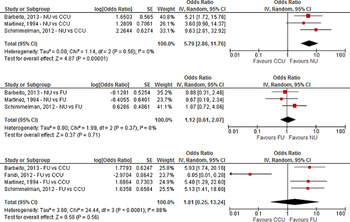
Results for effect of course of cannabis use are presented in Fig. 4. When current cannabis users were compared to non-users, an almost 480% increase in the risk of non-adherence was observed, which was highly significant between current users and non-users (OR 5.79, CI 2.86–11.76, p < 0.00001, I 2 = 0%, p for heterogeneity = 0.56, n = 175), while comparisons between non-users and former users (OR 1.12, CI 1.12–2.07, p = 0.71, I 2 = 0%, p for heterogeneity = 0.37, n = 187) and between current users and former users (OR 1.81, CI 0.25–13.24, p = 0.56, I 2 = 88%, p for heterogeneity < 0.0001, n = 192) were not significant. However, the latter became significant (OR 5.5, CI 2.58–11.69, p < 0.00001, I 2 = 0%, p for heterogeneity = 0.99, n = 144) suggesting increased risk of non-adherence for current users after exclusion of a study (Faridi et al. Reference Faridi, Joober and Malla2012) with data missing for close to a quarter of the participants and only reported this as part of a subgroup analysis, suggesting a 450% increase in the risk of non-adherence for current users compared to former users. Sensitivity analyses detected no relevant changes after excluding the two studies (Martinez-Arevalo et al. Reference Martinez-Arevalo, Calcedo-Ordonez and Varo-Prieto1994; Barbeito et al. Reference Barbeito, Vega, Ruiz de Azua, Saenz, Martinez-Cengotitabengoa, Gonzalez-Ortega, Bermudez, Hernanz, Corres and Gonzalez-Pinto2013) for which current users at follow-up were all assumed to have been also cannabis users at baseline (OR 2.57, CI 2.03–3.26, p < 0.00001).
Forest plots of studies comparing non-users (NU) v. current cannabis users (CCU), non-users v. former users (FU) and former users v. current users at follow-up.

Additional analyses are available as Supplementary Results 7.
One study (Barbeito et al. Reference Barbeito, Vega, Ruiz de Azua, Saenz, Martinez-Cengotitabengoa, Gonzalez-Ortega, Bermudez, Hernanz, Corres and Gonzalez-Pinto2013) also directly examined the relationship between course of cannabis use and course of adherence: those in whom adherence improved during follow-up were more likely to have been a former or never user compared to those who were cannabis users.
Discussion
Summary of findings
To our knowledge, this is the first meta-analysis to estimate the magnitude of the effect of cannabis use on adherence to antipsychotics. Results suggest that cannabis use increases the risk of non-adherence and that quitting cannabis may reduce the risk of non-adherence to antipsychotic medication in patients with psychosis (for possible underlying mechanisms see online Supplementary Discussion). Cannabis being the most used illicit drug among patients with psychosis (Addington & Addington, Reference Addington and Addington2007), these results are consistent with previous evidence on the association between drug use and poor adherence (Sendt et al. Reference Sendt, Tracy and Bhattacharyya2014).
Given the longitudinal design of the included samples and the results of sensitivity analyses considering only baseline/lifetime cannabis use, cannabis use may be regarded as a risk factor that predicts future non-adherence. However, this may also reflect the effect of continued cannabis use rather than some long-lasting effect of the substance over time. In fact, when current users at follow-up were compared to former users (excluding one outlier) an increase in the risk of non-adherence was observed while there was no significant difference between former users and non-users at follow-up, suggesting that quitting cannabis may help improving adherence. While results for the comparison between baseline cannabis users and non-users appear robust, those on the effect of course of cannabis use are far from definitive. Not only did the comparisons non-users v. current users, non-users v. former users and former users v. current users at follow-up include only a modest number of studies, but they were also quite heterogeneous. For instance, Faridi et al. (Reference Faridi, Joober and Malla2012) found that current users were actually more compliant than former users, in contrast with the other three studies (Martinez-Arevalo et al. Reference Martinez-Arevalo, Calcedo-Ordonez and Varo-Prieto1994; Schimmelmann et al. Reference Schimmelmann, Conus, Cotton, Kupferschmid, McGorry and Lambert2012; Barbeito et al. Reference Barbeito, Vega, Ruiz de Azua, Saenz, Martinez-Cengotitabengoa, Gonzalez-Ortega, Bermudez, Hernanz, Corres and Gonzalez-Pinto2013) that performed the same comparison. However, in this study data were missing for close to a quarter of the participants and these results were only reported as part of a subgroup analysis. Although the comparison non-users v. former users suggested a non-significant increase in non-adherence risk for former users (OR 1.12), 2 (Martinez-Arevalo et al. Reference Martinez-Arevalo, Calcedo-Ordonez and Varo-Prieto1994; Barbeito et al. Reference Barbeito, Vega, Ruiz de Azua, Saenz, Martinez-Cengotitabengoa, Gonzalez-Ortega, Bermudez, Hernanz, Corres and Gonzalez-Pinto2013) out of the three studies considered found the opposite effect, i.e. that former users were more compliant than non-users. One interpretation is that quitting cannabis may imply high levels of commitment and insight and an active approach to managing one's illness that may also lead to enhanced adherence. Further research focusing directly on the course of cannabis use and adherence is needed to disentangle the true nature of a relationship that appears complex and multifaceted.
Meta-regression and subgroup analyses suggest that the effect of cannabis use on non-adherence was not explained by differences across studies in medication type (i.e. proportion on antipsychotics), diagnosis, illness severity at baseline, reporting strength, follow-up duration, age, gender distribution and time-lag between measurements of cannabis use and adherence. However, the lack of effect of potential confounders on meta-regression and sub-group analyses may reflect the fact that these tests did not have enough power to detect small differences across fairly homogeneous samples (I 2 = 0%).
Methodological issues
Observational designs are most suited to investigating the association between cannabis use and poor adherence as enrollment in a clinical trial may indirectly improve adherence and hinder generalization to real-life setting by differing from routine care (Perkins et al. Reference Perkins, Johnson, Hamer, Zipursky, Keefe, Centorrhino, Green, Glick, Kahn and Sharma2006). However, inclusion of incident cases without randomization in observational studies leave open the possibility of confounding effect of other predictors of non-adherence: age (Gonzalez-Pinto et al. Reference Gonzalez-Pinto, Mosquera, Alonso, Lòpez, Ramìrez, Vieta and Baldessarini2006), gender, illness severity (Zammit et al. Reference Zammit, Moore, Lingford-Hughes, Barnes, Jones and Burke2008), insight (Reed et al. Reference Reed, Harrow, Herbener and Martin2002), other drugs/alcohol use (Sendt et al. Reference Sendt, Tracy and Bhattacharyya2014), time on antipsychotics, previous non-adherence and number of relapses (Martinez-Ortega et al. Reference Martinez-Ortega, Gutierrez-Rojas, Jurado, Higueras, Diaz and Gurpegui2012).
Furthermore, correlational studies do not allow causal inference to be drawn, as it is also possible that non-adherence may in turn increase cannabis use. Nonetheless, several factors make this less likely. Longitudinal designs adopted by the studies included here ensured that the assessment of cannabis use preceded that of adherence. Moreover, it can be assumed that, in FEP samples, which were the majority, onset of cannabis use preceded the onset of psychopharmacological treatment. Finally, since cannabis use tends to decrease rather than commence after illness-onset (Miller et al. Reference Miller, Ream, McCormack, Gunduz-Bruce, Sevy and Robinson2009), non-adherence is less likely to have resulted in a large proportion of patients who had never used cannabis to start using it (Miller et al. Reference Miller, Ream, McCormack, Gunduz-Bruce, Sevy and Robinson2009). Another methodological issue was sample-size: only three studies included a sample of at least 250 participants, which has been estimated (Zammit et al. Reference Zammit, Moore, Lingford-Hughes, Barnes, Jones and Burke2008) to be desirable to obtain 80% power to detect an effect of cannabis use on psychotic outcome.
While methodological issues may also have led to errors in the detection of non-adherence across the sample, this is most likely to have resulted in under- rather than over-estimation. It is worth noting that, although selection bias and attrition remain an inherent problem with observational, longitudinal, prospective designs, as those who refuse to participate or those who drop out are more likely to have been non-adherent (Pogge et al. Reference Pogge, Singer and Harvey2005; de Haan et al. Reference de Haan, van Amelsvoort, Dingemans and Linszen2007; Jónsdóttir et al. Reference Jónsdóttir, Opjordsmoen, Birkenaes, Simonsen, Engh, Ringen, Vaskinn, Friis, Sundet and Andreassen2013) studies included here had generally low levels of refusal and attrition. The outcome variable was generally dichotomized into adherence/non-adherence in a simplistic manner, less reflective of the complexity of the phenomenon in real-life (Julius et al. Reference Julius, Novitsky and Dubin2009), compared to when considered as a continuum. Finally, although misrepresentations of complex phenomena such as non-adherence are inevitable as no assessment methodology is free from limitations only three (Martinez-Arevalo et al. Reference Martinez-Arevalo, Calcedo-Ordonez and Varo-Prieto1994; Miller et al. Reference Miller, Ream, McCormack, Gunduz-Bruce, Sevy and Robinson2009; Jónsdóttir et al. Reference Jónsdóttir, Opjordsmoen, Birkenaes, Simonsen, Engh, Ringen, Vaskinn, Friis, Sundet and Andreassen2013) studies gathered data on adherence from at least two sources of a different nature, as recommended in a recent review (Velligan et al. Reference Velligan, Lam, Glahn, Barrett, Maples, Ereshefsky and Miller2006). Similarly, only two (Miller et al. Reference Miller, Ream, McCormack, Gunduz-Bruce, Sevy and Robinson2009; Barbeito et al. Reference Barbeito, Vega, Ruiz de Azua, Saenz, Martinez-Cengotitabengoa, Gonzalez-Ortega, Bermudez, Hernanz, Corres and Gonzalez-Pinto2013) studies did so when assessing cannabis use. Overall, rates and patterns of cannabis use and non-adherence, including their greater prevalence in FEP samples, were consistent with previous reports (Lacro et al. Reference Lacro, Dunn, Dolder, Leckband and Jeste2002; Koskinen et al. Reference Koskinen, Lohonen, Koponen, Isohanni and Miettunen2010), suggesting that cannabis use and non-adherence were nonetheless fairly-well represented.
Limitations
One limitation of the present meta-analysis was that it was not possible to quantitatively pool data from all 15 studies that were identified by the systematic search. However, the outcomes reported in these studies were generally in line with the pooled results from 11 studies that were included in the meta-analysis.
The present review aimed at gathering the most extensive evidence for the effect of cannabis use on medication non-adherence. Therefore, reporting strength was not used as exclusion criteria, but rather to identify issues to be addressed by future research. However, sensitivity analyses including only studies rated at least 8 in reporting strength did not detect significant changes in the overall effect-size. Several confounders could not be accounted for due to missing data and heterogeneity, including differences in assessment methodologies. While this hinders coherent interpretation of findings, it also shows that similar results were obtained through different methods, decreasing the likelihood of bias inherent to one particular methodology. Similarly, the role of further factors associated with both cannabis use and non-adherence could not be assessed in the present paper. For instance, personality traits as sensation seeking, boredom-susceptibility, disinhibition (Liraud & Verdoux, Reference Liraud and Verdoux2001) and impulsivity (Swann et al. Reference Swann, Dougherty, Pazzaglia, Pham and Moeller2004) may be at the basis of both cannabis use and non-adherence. Baseline illness severity was accounted for only by comparing studies that controlled for it with those that did not. Given the heterogeneity of scales adopted to assess it, it was not possible to explore whether illness severity as a continuum had an effect on the model, or whether it differed significantly between cannabis users and non-users. A further limitation relates to the presence of a substantial proportion (31.73%) of patients for whom the presence or absence of psychotic symptoms was not specified. However, such patients were distributed across studies in a way that never represented a significant majority, except for one study (Gonzalez-Pinto et al. Reference Gonzalez-Pinto, Reed, Novick, Bertsch and Haro2010).
Our focus on adherence to antipsychotic treatment did not allow us to investigate other aspects of pharmacological treatment other than adherence (e.g. medication resistance, responsiveness and side-effects) and different aspects of adherence (e.g. service-disengagement and drop-out) that may also be affected by cannabis use. Future research should explore the interaction between cannabis use, service disengagement and medication adherence in determining illness outcome, which may be complex and multidirectional. Finally, since cannabis use was always dichotomized into use v. non-use, investigating the existence of a dose-response effect on adherence was not possible with the present data.
Implications for future research and clinical practice
The number of studies included in the present meta-analysis is relatively limited considering the prevalence of cannabis use in psychosis and the impact of non-adherence in clinical practice. Therefore, there is an urgent need for further research in the area. Bearing in mind the methodological issues highlighted, future research needs to adopt longitudinal, prospective designs, possibly including antipsychotic-naive participants and randomized controls; consider better adjustment for relevant confounders, longer follow-up duration and larger samples, multiple means of assessment of variables, including objective ones; and employ definitions of non-adherence that better reflect its complexity, selection procedures and designs that minimize bias and attrition and assessments at multiple time-points to better pin-point changes in cannabis use and adherence. Furthermore, as mentioned before, further research is needed to directly investigate the effect of course of cannabis use on adherence.
Finally, studies should investigate how cannabis use and non-adherence interact in influencing psychosis outcome. In fact, although previous research has suggested that cannabis use has a negative effect on psychosis outcome (Zammit et al. Reference Zammit, Moore, Lingford-Hughes, Barnes, Jones and Burke2008; Schoeler et al. Reference Schoeler, Monk, Sami, Klamerus, Foglia, Brown, Murray, Camuri, Altamura, Murray and Bhattacharyya2016a , Reference Schoeler, Petros, Di Forti, Pingault, Klamerus, Foglia, Small, Murray and Bhattacharyya b ), it is not clear to what extent this effect may be mediated by non-adherence. This could not be systematically assessed in the present meta-analysis as most studies adopted non-adherence as the only outcome measure. Only two studies among those included (Faridi et al. Reference Faridi, Joober and Malla2012; Schimmelmann et al. Reference Schimmelmann, Conus, Cotton, Kupferschmid, McGorry and Lambert2012) directly assessed the interaction between non-adherence and cannabis use on clinical outcomes, with opposite findings. Faridi et al. (Reference Faridi, Joober and Malla2012) found that, while follow-up symptom severity was not affected by cannabis use, continued cannabis users had increased level of symptoms after controlling for medication adherence. On the contrary, Schimmelmann et al. (Reference Schimmelmann, Conus, Cotton, Kupferschmid, McGorry and Lambert2012), reported that medication non-adherence did not explain the relationship between continued cannabis use and worse clinical outcome. Four other studies (Linszen et al. Reference Linszen, Dingemans and Lenior1994; Martinez-Arevalo et al. Reference Martinez-Arevalo, Calcedo-Ordonez and Varo-Prieto1994; Kovasznay et al. Reference Kovasznay, Fleischer, Tanenberg-Karant, Jandorf, Miller and Bromet1997; Rehman & Farooq, Reference Rehman and Farooq2007) adopted non-adherence and cannabis use as predictors of clinical outcomes, and found that both variables were associated with each other and independently associated with worse outcome. For instance, Rehman & Farooq (Reference Rehman and Farooq2007) reported that cannabis users had increased number of relapses and that these were more often preceded by poor drug compliance, suggesting that non-adherence may play a role in precipitating relapse in cannabis users. However, such correlational findings do not allow us to reach conclusion on whether non-adherence is the main reason for the observed differences in outcome according to cannabis use. Perhaps the relationship between cannabis use, non-adherence and outcome of psychotic illness may be multi-directional, with symptoms, cannabis use and non-adherence being part of a self-reinforcing cycle of reciprocal exacerbation (Miller et al. Reference Miller, Ream, McCormack, Gunduz-Bruce, Sevy and Robinson2009). Nevertheless, this is an area that needs systematic investigation in future studies.
Our findings have important clinical implications. The magnitude of the pooled effect suggests that discouraging cannabis use in those with psychosis may result in fairly large improvement in adherence and thus better prognosis. This is particularly because available evidence suggests that antipsychotic medications have limited efficacy at best on psychosis parameters as well as cannabis use parameters in those patients with psychosis and co-morbid cannabis use (Wilson & Bhattacharyya, Reference Wilson and Bhattacharyya2016).
Non-adherence is not only difficult to solve (Sendt et al. Reference Sendt, Tracy and Bhattacharyya2014) but also to detect in clinical practice. It is generally identified only after multiple relapses, or misinterpreted for lack of medication-efficacy, resulting in continuous and ineffective changes in prescriptions (Cramer & Rosenheck, Reference Cramer and Rosenheck1998). Results presented here suggest that co-morbid cannabis use may act as an early warning sign of future non-adherence and perhaps indicate to clinicians the need to intervene before relapse occurs. This may involve appropriate strategies, including for instance an early switch to depot medication to prevent the emergence of non-adherence in those at risk (Keith & Kane, Reference Keith and Kane2003) as a result of co-morbid cannabis use.
Supplementary material
The supplementary material for this article can be found at https://doi.org/10.1017/S0033291717000046.
Acknowledgements
This work was funded by a Clinician Scientist Award (NIHR-CS-11-001) from the National Institute for Health Research, UK to Dr Bhattacharyya. The funder had no role in the design and conduct of the study; collection, management, analysis, and interpretation of the data; preparation, review, or approval of the manuscript; and the decision to submit the manuscript for publication. The views expressed here are those of the authors and not necessarily those of the National Health Service, National Institute for Health Research, or UK Department of Health. We thank all the authors of the included studies, as well as Dr John Hodsoll (King's College London, Institute of Psychiatry, Psychology & Neuroscience), who provided statistical advice for the meta-analysis.
Declaration of Interest
None.