

INTRODUCTION
The present paper investigates a group of figures which stand out in the schematic style of the Mycenaean pictorial painting owing to their accurate, detailed execution and their very particular attributes: the figures bear a long, tasselled sword across their chest and wear an elaborate long robe; moreover, they mostly have long hair. They occur on several kraters or krater fragments, all dated within a very limited time span from Late Helladic (LH) IIIA2 to LH IIIB1, which further stresses their homogeneous character.
Due to the presence of the swords, these figures are generally interpreted as men or warriors although the scenes in which they occur do not show any martial element (Pottier Reference Pottier1907, 232; Furumark Reference Furumark1941, 444–5; Karageorghis Reference Karageorghis1958, 387; Vermeule and Karageorghis Reference Vermeule and Karageorghis1982, 32, 152; Hiller Reference Hiller and Kyriatsoulis2001, 70; Vonhoff Reference Vonhoff2008, 233–5, 245–6; Papadopoulos Reference Papadopoulos, Nosch and Laffineur2012, 451–2). The only exception is the approach of Recht and Morris (Reference Recht and Morris2021, 121). They acknowledge the female nature of the figures, adding, however, that the figures ‘are not unequivocally rendered as such’. More recently, a chariot krater with these figures has been discovered at Hala Sultan Tekke by the New Swedish Cyprus Expedition, and the excavators call them, more cautiously, swordbearers, avoiding an identification with a sex and a role (Fischer and Bürge Reference Fischer and Bürge2019, 312, fig. 27, 314 n. 42).
Despite their particular features, the intriguing Sword Bearers (henceforth SB) have, so far, not been the object of close study. This paper offers a systemic investigation and proposes identifying the figures as women on grounds of gender specific attributes as can be recognised on pictorial vessels and, more generally, in Aegean art. A summary of certain, though not numerous, female representations on Mycenaean vases provides a basis for the present study.
As will be stressed, the male reading of the SB is exclusively based on the presence of the sword, which is, usually, associated with males. Nevertheless, this automatic identification is a typical case of gender bias, weapons being implicitly assumed to be related only to the realm of war and, consequently, to the male sphere, although several studies have already demonstrated the opposite. The interpretation of the SB as women is, therefore, important not only for increasing the scanty number of female images on pictorial vessels, but also for questioning the gender-based equation sword = man, and thus recognising a so far unknown female iconography in Aegean imagery.
CERTAIN REPRESENTATIONS OF WOMEN ON PICTORIAL STYLE VESSELS
As is well known, identifying gender on Mycenaean vessels is problematic.Footnote 1 The corpus of pictorial pottery provides a large number of human figures, but most of them have a standardised and rather stylised appearance lacking in distinctive features: the hair is, with a few exceptions, always short, and clothing is generally restricted to a plain spotted robe which conceals the arms; other figures are simply rendered in silhouette. If the latter are invariably male (Rehak Reference Rehak1996, 39; Steel Reference Steel, Rystedt and Wells2006, 149), the gender of the robed ones is more difficult to determine since the standard indicator, skin colour, is absent. Certain representations of women are recognisable by elaborate clothing and/or the presence of breasts and long hair. In a pioneering study, Steel (Reference Steel, Rystedt and Wells2006) investigated such figures and recognised further gender indicators thanks to two important vessels, the so-called Shrine Krater and Procession Krater (see below), and further comparisons with female representations on other media.
The starting point of our investigation is offered by these, not numerous, representations of certain female figures as presented in Steel's study, which also investigates an apparent absence of women in this ceramic class – an absence that is all the more inexplicable if one considers the prevalence of female figures in Aegean iconography. As Steel (Reference Steel, Rystedt and Wells2006, 147) points out, the lack of women's images is due to a ‘heavy gender bias’ that ‘has crept into the reading of pictorial style’. Steel has consequently examined the few certain female representations and verified whether precise details appear on other figures considered to be male or of ambiguous sex; at the same time, she discusses attributes which are indeed invariably male, also by the comparison with figures on seals and frescoes. Steel's investigation provides the basis for the identification of the SB as women, thanks to those identified distinctive features. Her corpus of female figures, with the addition of the two most important krater fragments discovered at Hala Sultan Tekke, is listed in Table 1.
The corpus of female figures in Mycenaean pictorial pottery. Women's representations are presented in chronological order; a point of particular interest is the fact that they are attested, with few exceptions, between LH IIIA1 and LH IIIA2–B1, i.e. in the same limited time span as the SB.

General remarks
As previously noted, women are usually clearly recognisable by distinctive attributes: elaborate clothing and the presence of breasts and long hair; sometimes, they are adorned with jewellery. W1 (Fig. 1) and W3 (Fig. 2) are very accurate figures with long and curly locks and recall representations on wall-paintings like La Parisienne from Knossos (Vermeule and Karageorghis Reference Vermeule and Karageorghis1982, 17–18; Immerwahr Reference Immerwahr1990, Kn cat. no. 26; Crouwel Reference Crouwel and Vlachopoulos2018, 93–4). The sumptuous Minoan attire on the new fragment W4 (Fig. 3) is unique, while a characteristic female headdress consisting of a fillet around the head, W5, W6, W7 (Figs 4, 5, 6), is often attested. Usually, the costume, if entirely preserved, is formed by two distinct parts, a bodice and a skirt: W2, W3, W4 (Figs 2, 3), W7 (Fig. 6), W8 (Fig. 7), W9 (Fig. 8), W10 (Fig. 9), W12.
W1: Krater fragment from Kition (Cyprus Museum, inv. no. Kition 2512). After Vermeule and Karageorghis Reference Vermeule and Karageorghis1982, cat. no. III.10. Redrawn by the author.

W3: Side view of the Window Krater from Kourion (British Museum inv. no. 1896,0201.26; on loan to the Cyprus Museum inv. no. 1971/XII-6/1). © The Trustees of the British Museum.

W4: Lower part of a krater from Hala Sultan Tekke, Area A, Pit V (L46-36). Fischer and Bürge Reference Fischer and Bürge2017, 66, fig. 15:4. Courtesy of Peter M. Fischer and Teresa Bürge.

W5: Detail of the Pyla-Verghi Krater, side B. Cyprus Museum, inv. no. CM 1952/IV-12/1. After Vermeule and Karageorghis Reference Vermeule and Karageorghis1982, cat. no. III.13. Redrawn by the author.
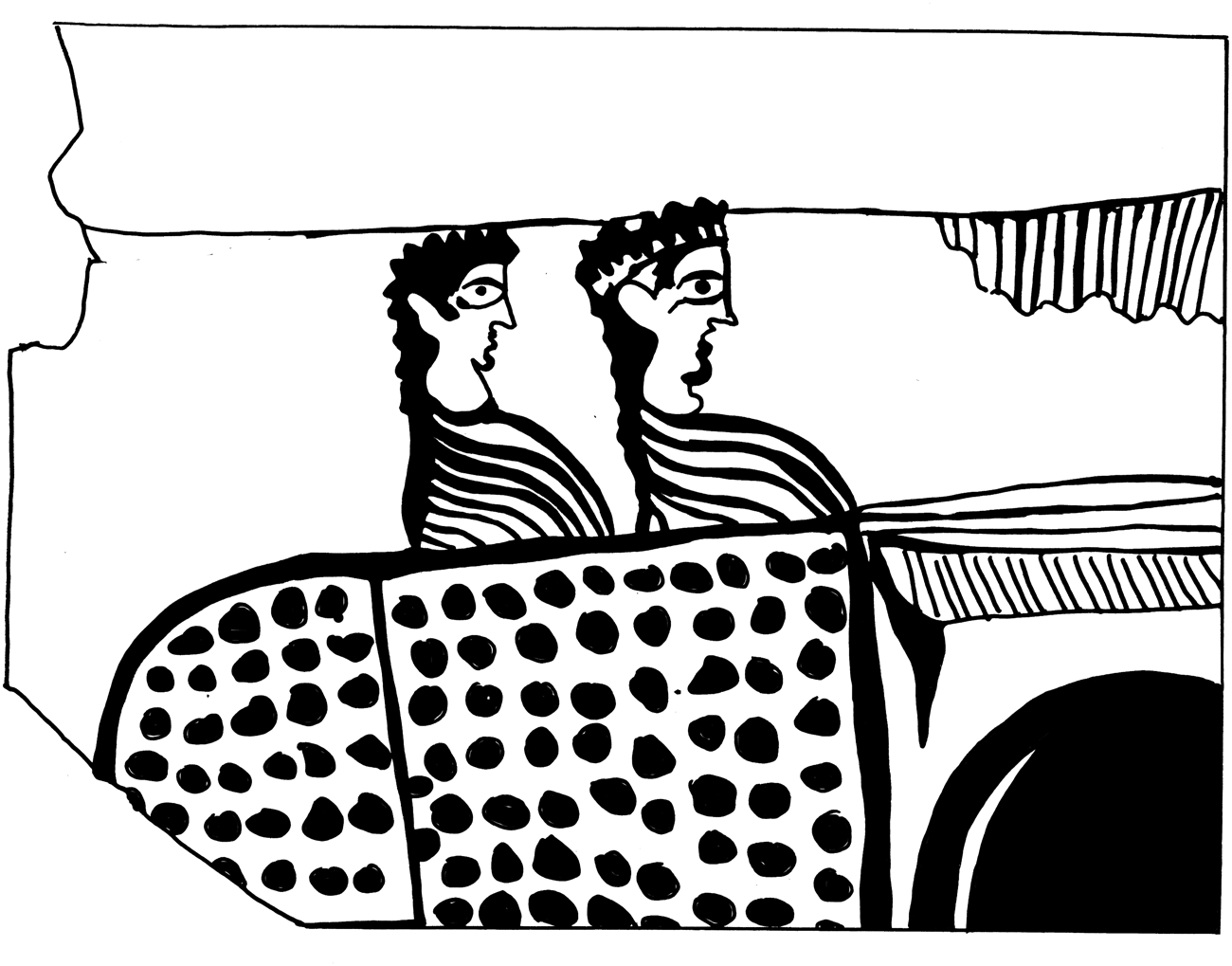
W6: Drawing of a krater fragment from Alalakh. Wooley Reference Wooley1955, pl. CXXIX:ATP/37/285. Reproduced by permission of the Society of Antiquaries of London.

W7: Detail of side A of the Procession Krater from Kalavassos-Hagios Dimitrios, Tomb 21. After Steel Reference Steel, Rystedt and Wells2006, 153, fig. 7. Redrawn by the author.

W8: Rim fragment of a krater from Hala Sultan Tekke, Area A, Well Y1 (L63-3). Fischer and Bürge Reference Fischer and Bürge2018, 46, fig. 14:1. Courtesy of Peter M. Fischer and Teresa Bürge.

W9: Reconstruction drawing of the Shrine Krater from Kalavassos-Hagios Dimitrios, Tomb 13. Steel Reference Steel1994, 206, fig. 4. Courtesy of Louise Steel.

W10: Krater from Hagia Paraskevi. The Metropolitan Museum of Art, New York, inv. no. MMA 74.51.966, The Cesnola Collection, purchased by subscription, 1874–6.

The new fragments from Hala Sultan Tekke W4, 8
The female representations found at Hala Sultan Tekke by the New Swedish Cyprus Expedition need a brief description.Footnote 2
The large fragment W4 (Fig. 3) belongs to the lower part of an amphoroid krater dated to LH IIIA2; it preserves a standing female figure facing to the right from the neck to the feet with a frontally rendered torso (Fischer and Bürge Reference Fischer and Bürge2017, 64). She wears the typical Minoan dress: a tight-fitting bodice filled with a lozenge-motif, probably a heanos, and a flounced kilt above it;Footnote 6 the short sleeves are indicated by three lines just above her left elbow.Footnote 7 This arm is bent and raised upwards, while her right seems to be bent across her breast.Footnote 8 The five lines at the forearm probably indicate bracelets. Her neck is adorned with a triple, elaborate necklace and the breasts seem to be naked, but this is difficult to determine. The kilt's flounces alternate between solid colour and a lozenge-motif, and the feet, rendered in profile, are depicted in dark like the arms. As the excavators point out, this representation is quite exceptional: such an accurately depicted Minoan dress is unparalleled in the ceramic repertoire.
To the right of the woman, another figure of minor dimension was represented, since at the level of the flounced kilt, the bent arm of a figure, clearly facing to the left, is still preserved. The only possible comparison is offered by the male figures, almost always rendered in silhouette, who sometimes appear in chariot scenes following or preceding the chariot and are generally called grooms or attendants. These figures can have their arms bent carrying an object, which is almost always a staff/spear. More rarely, they carry a camp-stool. The small figures on the Pyla-Verghi Krater W5 and, especially, that on the LH IIIA1 Zeus Krater (Vermeule and Karageorghis Reference Vermeule and Karageorghis1982, cat. no. III.2)Footnote 9 offer the best parallels for the bent arm on the fragment. In front of the woman, whose feet rest on the upper edge of the lower set of encircling bands, immediately above the krater's foot, the rear part of a chariot box facing to the right is still preserved. This is depicted above the higher decorative encircling bands. As the excavators note, the lower part of the vessel is usually not decorated with pictorial motifs (Fischer and Bürge Reference Fischer and Bürge2017, 64); however, the same arrangement is adopted on the Zeus Krater and on a contemporary krater with the large figure of an attendant (Vermeule and Karageorghis Reference Vermeule and Karageorghis1982, cat. no. IV.16). Finally, it is worth noting that the only parallel for the scheme of a woman with upraised forearms standing behind a chariot is preserved on the krater W10 (Fig. 9).Footnote 10
The small rim fragment W8 (Fig. 7) of an open krater dated to LH IIIA2–B preserves the upper part of a chariot box facing to the right with two female figures with clearly depicted breasts (Fischer and Bürge Reference Fischer and Bürge2018, 45). Beginning with the hairstyle, which consists in a curly ponytail along the shoulders, both are identically rendered. The flat upper part of their heads suggests that they wear a headgear, probably a flat cap, a typical female adornment.Footnote 11 They wear a dress which, uniquely for charioteers, is formed from two parts: a bodice with an elaborate neckline and, probably, a flounced kilt, as the Chevron Motif preserved on the left figure indicates.Footnote 12 The women are the only passengers of the chariot; the figure on the right is also the driver as the reins close to her breast indicate.
This small fragment is of great importance for the corpus of women's images on pictorial vessels as it doubtless shows female charioteers; this supports Steel's identification of the charioteers on the Pyla-Verghi Krater W5 (Fig. 4) and the Shrine Krater W9 (Fig. 8) as women:Footnote 13 as she has already noted, female figures appear more often than male ones on chariot scenes, as the wall-paintings of Knossos, Tiryns and Mycenae – and more recently Orchomenos – attest.Footnote 14
Distinguishing female attributes: dress, jewellery, hairstyle, headdress
Dress
With the exception of the robe of W13 and W14, almost all women wear a costume which is clearly divided in two parts: a bodice (probably indicating a heanos) and a skirt, mostly covering the feet, variously decorated with horizontal lines,Footnote 15 chevrons or, in one case, dots; the belt is visible on W2, W3 and W7 (Figs 2, 6).Footnote 16 Only the new fragment W4 (Fig. 3) doubtless shows a flounced kilt. Finally, the woman on the Warrior Vase W14 wears a long, undecorated tunic (Jones Reference Jones2015, 146) which corresponds to her mourning gesture;Footnote 17 the quite schematic figure W13 seems to wear the same plain dress.
Since the women are mostly represented in profile, it is not possible to determine if their breasts are uncovered; the frontal rendered figures W1, W8, W10, W11 and W12 (Figs 1, 7, 9) have the breast marked with circles or dots, but this is not necessarily an indication of nudity. The large breasts of the Mykenaia (Fig. 10; Immerwahr Reference Immerwahr1990, My cat. no. 3), for example, are covered by a closed version of the heanos.Footnote 18
Wall-painting of the Mykenaia from the Cult Centre at Mycenae. Courtesy of the Hellenic National Archaeological Museum, inv. no. P 11670; © Hellenic Ministry of Culture / Hellenic Organization of Cultural Resources Development (H.O.C.RE.D.).

All these dresses are widely attested in Mycenaean art, especially the heanos. The Minoan flounced skirt is also present in the Mycenaean area, but occurs most rarely and never in LH III; conversely, the flounced kilt is widely depicted until this time. One of the best examples is preserved on the LH IIIB fresco from Tiryns (Fig. 11):Footnote 19 a group of fragments show two processional, Minoan-fashioned women facing right, and the best-preserved figure on the left has a great similarity with the woman on the new fragment W4 (Fig. 3) in the heanos (here open at the breasts), the triple necklace, the four wristlets on her right arm and, especially, the lozenge-motif of the flounces.Footnote 20 Clearly, this particular Minoan costume continues to play an important role in Mycenaean cult iconography.Footnote 21
Wall-painting with processional women from the Western Staircase at Tiryns. Maran, Papadimitriou and Thaler Reference Maran, Papadimitriou, Thaler, Schallin and Tournavitou2015, 106, fig. 4. Drawing and graphics by Birgit Konnemann and Ulrich Thaler; courtesy of the Ephorate of Antiquities of Argolida, reproduced with kind permission of Joseph Maran, Alkistis Papadimitriou and Ulrich Thaler.

The long tunic with horizontal neckline, generally known as the robe and clearly shown on W14, often occurs on Mycenaean art and is worn by both men and women; it is often adorned with bands on the shoulders and along the hem and seems to be a genuine Mycenaean costume.Footnote 22 Interestingly, the very plain version shown on the krater W14 is also worn by several mourning women on contemporary larnakes (see Aravantinos et al. Reference Aravantinos, Fappas, Angelidis, Louka, Sepetzoglou and Vlachopoulos2018, 443, fig. 11ab, 448, fig. 14).
Finally, it is worth noting that the characteristic division of the costume into two parts is typical for Mycenaean figurines, and also attested on the wheel-made ones, since the upper part is usually rendered with wavy lines exactly like the women W3,Footnote 23 W5 and W9 (Figs 2, 4, 8; Pliatsika Reference Pliatsika, Nosch and Laffineur2012, 614; Steel Reference Steel2020, 3, fig. 3, 10, 12, fig. 15). As will be noted for the jewellery and the headdress, figurines show close stylistic similarities to the figures on pictorial vessels, supporting the argument that both are a product of the same workshops (Vetters Reference Vetters2019, 132–8).
Jewellery
Exceptionally for Pictorial Style figures, three women are adorned with jewellery. Around the neck of the woman W4 (Fig. 3) there is surely the most elaborate necklace, and this has a close parallel with the triple necklace of the Mykenaia (Fig. 10); both figures show, moreover, bracelets and/or wristlets. The parure on the fragment W1 (Fig. 1), composed also of a triple necklace, one of which has circular pendants, and one wristlet, is very similar. Finally, several women W7 (Fig 6) have a triple necklace which is depicted as multiple stripes on the neck (South Reference South, Rystedt and Wells2006, 140; Steel Reference Steel, Rystedt and Wells2006, 152). Therefore, necklaces seem to have a special significance in the characterisation of female figures.
In Minoan and Cycladic art, both women and men wear jewellery, but, in Mycenaean times, it is only typical for the former, being an ‘important means to perform gender identity’ (Steel Reference Steel2020, 10–11 with further references). Some representations on frescoes have already been mentioned, but particularly interesting are, again, clay figurines, for which jewellery is the most distinctive feature. Among the many ornaments, necklaces have a special significance: they occur on almost all exemplars and are rendered as dots or multiple stripes around the neck, as well as on the chest (Pliatsika Reference Pliatsika, Nosch and Laffineur2012, 615–16, cat. nos 30, 47, 73, 86, 89, pl. CLa; Palaiologou Reference Papadimitriou, Thaler, Maran, Brecoulaki, Davis and Stocker2015, 115, figs 9, 11; Vetters Reference Vetters2019, DB-nos 262, 416, 1394, 1537, 2401, 2404, 2406; Steel Reference Steel2020, 10). The presence of a fine necklace of red and blue beads on a red thread on the plastered head from the Cult Centre at Mycenae is also of particular interest since it is supposed to belong to a cult statue (Rehak Reference Rehak, Dakouri-Hild and Sherratt2005, 272; Boloti Reference Boloti, Harlow, Michel and Nosch2014, 257–8; Palaiologou Reference Palaiologou, Brecoulaki, Davis and Stocker2015, 99–100, 106–7, fig. 6). Finally, the rendering of necklaces in the form of multiple stripes around the neck is attested on mourning women on two larnakes from Tanagra dated to LH IIIB–C and LH IIIC (Aravantinos et al. Reference Aravantinos, Fappas, Angelidis, Louka, Sepetzoglou and Vlachopoulos2018, 447, fig. 13b; Steinmann Reference Steinmann2018, 201, 348, cat. no. 262).
Regarding jewellery on men, only four male figures with a necklace and six with wristlets are known, and all are attested on LH III wall-paintings.Footnote 24 Noteworthily, men wear the necklace only on the bared torso, but never when they wear the short or long tunic.Footnote 25
Hairstyle and headgear
Hairstyle and headgear are important gender indications, although such details can be difficult to identify on pictorial vases. In Aegean art, both men and women could have long hair. Women could, furthermore, have it tied in a net or headgear, but then it can appear to be short.Footnote 26
Men
As for jewellery, there is a substantial difference between Minoan and Mycenaean representations of male hairstyles. In Mycenaean art, men mostly have short hair,Footnote 27 reserving the typical Minoan long locks, down the back, for bull-leapers (not by chance a Minoan theme) who consequently wear a codpiece, which is otherwise not attested in LH III iconography.Footnote 28 Men with hair down to the neck, though not common, are, however, attested on wall-paintings;Footnote 29 sometimes the hair terminates in a curl, as shown on two young men from Orchomenos.Footnote 30 This particular curly lock on the neck also appears on pictorial vases on two attendants, one of which is holding the parasol on the Sunshade Krater (see below).Footnote 31
Women
Long and curly hair down the back, like the women W1, W3 and W5 (Figs 1, 2, 4), is common in Aegean iconography, and is attested, as previously noted, on frescoes, seal images and figurines.Footnote 32 On the fragment W8 (Fig. 7), the hair is indeed shorter: these women have a ponytail since the locks do not cover the shoulder. An interesting comparison is offered by a woman's long lock on a fresco fragment from Pylos, which probably originates from a bun on the back of the head.Footnote 33 The women on the fragment have, additionally, a flat upper part of the head, probably indicating the flat cap.
The figures on the Procession Krater W7 (Fig. 6) are depicted with great attention to detail, evident in the rendering of the headdress and hairstyle. All women wear headgear formed from a fillet around the head, filled with vertical lines; above it, curly hair is visible and, on some of the figures, a long, wavy lock ending in a curl hangs down their back (Steel Reference Steel, Rystedt and Wells2006, 152–4). Other women, on the contrary, show no locks, indicating they have their hair tied or even short.Footnote 34 The woman W10 (Fig. 9) whose upper head is flat and with a wavy profile is rendered in a more stylised manner, but seems to have the same coiffure.
Tied-up hair must be assumed for the two female figures staying in (or in front of) the sacred buildings on the Shrine Krater W9 (Fig. 8), although no hairstyle or headgear can be identified due to the rather inaccurate rendering of the figures. Tied-up hair is less common, but still well attested in Aegean iconography and also Mycenaean art: some of the women on the frescoes of Xeste 3 (Doumas Reference Doumas1992, 154, fig. 118, 156, fig. 120, 162, fig. 125), several female ivory reliefs and statuettes and clay figurines show bounded hair in a net or in a flat cap (Poursat Reference Poursat1977, 109, cat. no. 335, 121, cat. no. 375, pls XXXVI:335, XXXIX:375; Konstantinidi-Syvridi Reference Konstantinidi-Syvridi, Nosch and Laffineur2012, pl. LXIIIa; Pliatsika Reference Pliatsika, Nosch and Laffineur2012, 614; Konstantinidi-Syvridi Reference Konstantinidi-Syvridi and Logogianni-Georgakarakos2018, 293).
The fillet tied around the head on W5, W6Footnote 35 and W7 (Figs 4, 5, 6) is also a frequently attested female headdress, especially in Mycenaean art.Footnote 36 It is worn by the women of the procession fresco from Thebes as well by the venerating woman (upper register) of the painting from the tomb of Megalo Kastelli (Aravantinos et al. Reference Aravantinos, Fappas, Angelidis, Louka, Sepetzoglou and Vlachopoulos2018, 432, fig. 3, 439, 441, fig. 9). The best-preserved examples are, however, the Mykenaia (Fig. 10), the woman under the parasol on the procession fresco from Tiryns (Fig. 12; Papadimitriou, Thaler and Maran Reference Papadimitriou, Thaler, Maran, Brecoulaki, Davis and Stocker2015, 180, fig. 3) and the female plastered head from the Mycenae acropolis. The head is very interesting since it was at first considered to be male, but the headband, the long ponytail and the ears outlined in red are distinctive female traits (Palaiologou Reference Palaiologou, Brecoulaki, Davis and Stocker2015, 100–1, 108, fig. 7a–d). Mycenaean wheel-made figurines provide further and detailed representations of the fillet around the head (Pliatsika Reference Pliatsika, Nosch and Laffineur2012, 614, cat. nos 31–2, 34, 53, 67; Vetters Reference Vetters2019, DB-nos 1689, 2400–1). Finally, the very stylised figure on the small oinochoe W13 can be interpreted as a woman thanks to the flat cap with plume.Footnote 37
Detail of the wall-painting with processional women under the parasol from Western Staircase at Tiryns. Papadimitriou, Thaler and Maran Reference Papadimitriou, Thaler, Maran, Brecoulaki, Davis and Stocker2015, 180, fig. 3. Drawing and graphics by Birgit Konnemann and Ulrich Thaler; courtesy of the Ephorate of Antiquities of Argolida, reproduced with kind permission of Joseph Maran, Alkistis Papadimitriou and Ulrich Thaler.

INVESTIGATING THE SWORD BEARERS
The distinctive female features analysed above – hairstyle, headgear, jewellery – also occur in the SB listed in Table 2, allowing us to identify these figures as women.
The corpus of the Sword Bearers: classification and variants.

General remarks: robe, sword, hairstyles
The SB are always represented as standing and clothed in long, spotted robes, the profile of which is marked by a double line; on some robes, the double profile continues under the hem and reaches the ground, forming a kind of fringe. In this case, the hem consists of a double line filled with vertical strokes; otherwise, broad horizontal bands appear. This particular clothing clearly differs from the typical female costume formed by two pieces as previously investigated; similarly, it is neither the tunic with horizontal neckline nor the heanos, lacking their distinctive elements like the decorative bands on the shoulders and in the centre front.
The feet are almost always visible. The long sword is depicted across the chest, and four figures bear it on a baldric over the shoulder;Footnote 38 additionally, the scabbard is in all but one case adorned with tassels. With only one exception, the figures have long hair, but their hairstyles are different; on the base of the coiffure, five different variants, to which correspond also different actions, can be distinguished.
Variant 1: SB with long tresses and fillet in front of and behind a chariot (SB1, SB2, SB3; Figs 13, 14, 15)
The three kraters show very similar chariot scenes, which, on the latter two vases, are almost identical.Footnote 39 The in essence identical replication of such a singular scene on several vessels is, indeed, unique in the Pictorial Style, which could be an indication of its significance;Footnote 40 the new discovered krater SB3 (Fig. 15) is particularly important since it is the only one which preserves the scene completely.Footnote 41
SB1: Reconstruction drawing of a krater from Rhodos. Maiuri Reference Maiuri1923–4, 234, fig. 150. © Archivi SAIA.

SB2: Reconstruction drawing of a krater from Ugarit. After Vermeule and Karageorghis Reference Vermeule and Karageorghis1982, cat. no. IV.50. Redrawn by the author.

SB3: Krater from Hala Sultan Tekke, Area A, Tomb RR (N157). Fischer and Bürge Reference Fischer and Bürge2019, 312, fig. 27. Courtesy of Peter M. Fischer and Teresa Bürge.

Surrounded by Mycenaean Flowers (Furumark Motif [FM] 18:19,76) or palm trees, a group of two or three SB is depicted in front of the chariot, while another one is behind it; the two or three charioteers have the same clothing and hairstyles, but have no swords. The elaborate hairstyle is very interesting, consisting on SB2 and SB3 (Figs 14, 15) of a fillet decorated with vertical strokes like the women W5, W6 and W7 (Figs 4, 5, 6); the wavy hair is visible above the headdress and appears also as a long tress along the shoulders. This clearly female hairstyle has a striking parallel in the women on the Procession Krater W7 (Fig. 6).Footnote 42
Variant 2: SB with long, wavy hair following a chariot (SB4, SB5; Figs 16, 17)
The first krater SB4, the Sunshade Krater, is very special: it shows the rare motif of the parasol. On the small second fragment SB5, instead, only the upper part of a standing figure with a baldric over the right shoulder and two floating vessels are preserved. Based on the striking, even stylistic, similarities, this fragment has been supposed to belong to the former krater (Vermeule and Karageorghis Reference Vermeule and Karageorghis1982, 22; Morris Reference Morris1989, 1.235, 357); however, as has just been observed for the kraters of the previous variant, identical figures and scenes could appear on several vessels, making the existence of a further krater of the same painter with the same subject quite probable.
SB4: The Sunshade Krater from Enkomi, Tomb 67 (British Museum inv. no. 1897,0401.1076). © The Trustees of the British Museum.

SB5: Krater fragment from Enkomi. CVA: Cyprus 1, pl. 3:4 (inv. no. A2024). Courtesy of Giorgos Georgiou, Director of the Department of Antiquities, Republic of Cyprus.

None of the the robed figures from either fragment wear any headgear, but have long and wavy hair down the back like W1, W3 and W5 (Figs 1, 2, 4).Footnote 43 In contrast to the clothes of the previous variant, the spotted robe has neither the double profile nor the fringe under the hem which instead consists of three broad horizontal bands.
This scene shows several original details, like the floating vesselsFootnote 44 and, especially, the silhouette figure holding the parasol behind the SB. This motif occurs generally very rarely in Aegean art and only twice on chariot krater fragments.Footnote 45 Having its origin in Near Eastern iconography, it always emphasizes the high status of the figure and is attested even on wall-paintings, on the fresco from Tiryns (Fig. 12) which preserves three parasols – also in a procession of women of religious character.Footnote 46 The fresco provides, therefore, strong evidence for the identification of SB4 as a woman; notably, also the women under the parasols on the fresco are of larger dimension than the parasols’ holders.Footnote 47
Variant 3: SB with long ponytail and fillet together with a quadruped (SB6; Fig. 18)
The fragment SB6 (Fig. 18) also preserves unexpected elements: the rear part of a standing quadruped facing the opposite direction appears behind the two SB facing left, on the fragment's right edge. The hairstyle of these figures strongly differs from those observed above, consisting of a long ponytail down the back which ends in a curl like the women on W8 (Fig. 7). Additionally, they wear a dotted fillet around the head, whereas further white dots are carefully depicted along the tress indicating hair adornments which are largely attested on wall-paintings, but so far never observed on pictorial vessels.Footnote 48
SB6: Krater fragment from Ugarit (Musée du Louvre inv. no. AO 13143). © GrandPalaisRmn (Musée du Louvre) / Hervé Lewandowski.

Variant 4: SB with short (tied-up?) hair in front of an enthroned woman (SB7; Fig. 19a)
The fourth variant of SB is depicted on the Homage Krater SB7 (Fig. 19a). These are the only SB with short hair, which is rendered identically to the men in silhouette appearing on the same scene. An interesting aspect of this krater is the depiction of different scenes on the two faces, which is so far unparalleled among the pictorial vessels. Side A (Fig. 19a) shows two scenes almost identical to each other. In the first scene, two SB follow a man armed with a long spear in his right hand, while he holds a thin staff in his left; it seems he would offer it to the enthroned woman, towards whom they advance.Footnote 49 This robed female figure seats on a throne, on the back of which a bird is perching. To the right there are only three men, each with a spear, in front of a second enthroned figure, but there is no bird. On the opposite, fragmentary, side of the krater (Fig. 19b), four standing men facing to the right move towards a robed figure standing and facing left; they are unarmed and separated from each other by three stylised papyrus-flowers (FM 11:41); the third man touches the flower behind him. Interestingly, in front of the first two men thin staffs are fixed in the ground, recalling the offered staff on side A. The incompletely preserved robed figure wears a more elaborate clothing than the SB on the other side, recalling the robe of the previous variants, and there is no sword.Footnote 50 An interesting particular of this scene is, therefore, the absence of weapons.Footnote 51
a) SB7: Reconstruction drawing of the Homage Krater, side A. Pottier Reference Pottier1907, 232, fig. 11. b) Reconstruction drawing of the Homage Krater, side B. Pottier Reference Pottier1907, 232, fig. 12.

Although the SB have short hair, they wear four necklaces like the women on the Procession Krater W7 (Fig. 6), identifying them as female; additionally, they are identically rendered to the enthroned woman who also wears three necklaces.Footnote 52 Based on comparison with numerous processional scenes towards seated women known in Aegean art, the enthroned figures are surely female.Footnote 53 Additionally, the very rare motif of the bird perching on the seat's back supports this identification (see also Karageorghis Reference Karageorghis1958, 386), since it has only two further representations, both with enthroned women, probably goddesses, who receive offerings from processional figures. The same can be said for the also rare motif of the footstool on which the woman is putting her feet. Perching birds on the throne's back are attested on the signet-ring from Tiryns CMS I, 179 and on the signet-ring SN24-736 from the grave of the Griffin Warrior at Pylos (Davis and Stocker Reference Davis and Stocker2016, 646, fig. 12). Interestingly, all these birds face in the opposite direction to the enthroned women. Both women on the rings, dated to Late Minoan/Helladic (LM/H) II, also have the footstool like the enthroned woman on the krater. The footstool is, as Rehak has already noted, a female attribute in Aegean iconography (Rehak Reference Rehak and Rehak1995, 103); to the examples listed by Rehak, the new signet-ring from Pylos and a fresco fragment from Tiryns can be added (Maran, Papadimitriou and Thaler Reference Maran, Papadimitriou, Thaler, Schallin and Tournavitou2015, 107, fig. 5). Finally, it is important to stress that among the three unquestionable known footstool models, the most sumptuously decorated exemplar (with boar's tusk helmets and figure-of-eight shields, i.e. with weapons) was found in the female grave of tholos tomb A at Archanes, dated to LM IIIA.Footnote 54 Finally, a very singular element of this scene additionally supports the identification of the SB and of the standing figure as women, namely the puzzling ‘tongue’ motif which occurs on both of the krater's sides just in front of each of the SB and behind the standing robed figure (also clearly related only to the female figures). Pottier's (Reference Pottier1907, 233) interpretation of this motif as a bull's horn is confirmed by several representations of bull's heads on contemporary Mycenaean vessels (Vermeule and Karageorghis Reference Vermeule and Karageorghis1982, cat. nos IV.23–4), but a unique and intriguing parallel can now be found on the aforementioned signet-ring from Pylos: the offering woman in front of the enthroned goddess (with perching bird and footstool) holds an identical object in her hands, which the excavators interpret as a bull's horn on the basis of archaeological evidence from Minoan and Mycenaean cult and burial places (Davis and Stocker Reference Davis and Stocker2016, 645 n. 58). Thus, there seems to be a special relation between this peculiar iconography of the enthroned goddess, the presentation of the offering and the bull's horn.
Since the SB on the Homage Krater are generally argued to be male, it has been noted that this processional scene is unparalleled in Aegean art as the participants moving to a seated figure are always female;Footnote 55 however, a similar processional scene with both male and female participants decorates an ivory LM I pyxis from Mochlos.Footnote 56 A further interesting comparison is offered by the scene of the upper register of the famous limestone LH IIIC1 stele with pictorial decoration from Mycenae; although very fragmentarily preserved, an enthroned female figure wearing a long, blue robe on the left, to whom a male figure is approaching, is still visible.Footnote 57 Finally, a man in front of an enthroned woman appears also on the two LM/H I/II golden signet-rings CMS I, 101 and V, 199, clearly indicating that this scheme was known in palatial repertoire.
The scene on the opposite side of the krater shows, on the contrary, only men approaching the robed woman, and its compositional scheme recalls the well-known representations of processional figures with alternating plant motifs like lily-flowers, papyrus plants and palm trees attested on several media since LM/H II/III.Footnote 58
Variant 5: SB with long tresses and helmet flanking a ship (SB8; Fig. 20)
The last variant of SB, SB8 (Fig. 20), who additionally wear a helmet on their long hair, is depicted on the Ship Krater. The two almost identical scenes on the krater are so far unparalleled in Aegean art, and they show, moreover, the only representation of the ship motif on pictorial pottery up to LH IIIC.
SB8: The Ship Krater from Enkomi (Världskulturmuseerna, Medelhavsmuseet, inv. no. E. 003:262). Courtesy of the Världskulturmuseerna, Medelhavsmuseet.

In the middle of the scene a ship in section is depicted, the bow and stern of which are decorated, respectively, with a stylised flower motif and a bird with spread wings. On the lower deck, two pairs of men in silhouette flank the mast, which continues on the upper deck; here there are, instead, two larger SB at the sides of the mast. Finally, the ship is flanked, on Fig. 20a, by two further and larger SB who wear a conical helmet;Footnote 59 the almost identical other side (Fig. 20b) differs only with the large figure to the left of the ship being a man in silhouette who is wearing the same helmet, but bearing no sword.Footnote 60
Although the robed figures have long hair, the identification with women is more problematic due to the presence of the helmet, although women wearing a helmet are attested in Mycenaean iconography (see below); consequently, they have been interpreted as warriors departing with the ship (Karageorghis Reference Karageorghis1958, 387; Vermeule and Karageorghis Reference Vermeule and Karageorghis1982, 45). However, no elements refer to a hostile or military action. Warriors on ships are actually attested on pictorial vessels almost only in LH IIIC, and the ship motif is virtually absent until this period (Vermeule and Karageorghis Reference Vermeule and Karageorghis1982, 144–5, cat. nos XI.92–6, XI.160, XII.33). These later scenes show armed warriors, always rendered in silhouette, by sea-battles;Footnote 61 notably, in the same period, warriors also appear on chariots.
The profound difference between the representations of these warships and the scene on the Enkomi krater is indisputable: the latter shows no martial elements since the figures are not involved in any hostile actions, not even using their weapons or sailing the ship. The peaceful characterFootnote 62 is, furthermore, stressed by the accurate bow and stern decoration, which has a long tradition in ceremonial ship imagery.Footnote 63 Significantly, the only other decorated ship on pictorial pottery also has a bird on the bow and is preserved on a LH IIIC alabastron from Tragana which is decorated with other cult motifs like a palm tree and two incurved altars (Vermeule and Karageorghis Reference Vermeule and Karageorghis1982, cat. no. XI.92), confirming the relation of the decorated ship to the ritual sphere.Footnote 64
Searching for parallels: the woman of the Shrine Fresco at Mycenae
Besides their female attributes, the SB show two distinctive traits: the long, elaborate robe and the sword. Both have a unique parallel in the woman holding a sword on the Shrine Fresco of Room 31 in the Cult Centre at Mycenae (Fig. 21; Immerwahr Reference Immerwahr1990, My cat. no. 6), which is contemporary or slightly later than the ceramic representations considered here.Footnote 65 The construction of this room is namely dated to LH IIIB1 (Phase VIB), but the wall-paintings themselves could belong to a later stage, at the middle of LH IIIB1 (Phase VII), as the room's structure was partially modified with the addition of the Ivory Deposit (Room 32) to the east of the fresco wall.Footnote 66 A point of interest is the fact that these paintings had a short life: at the end of LH IIIB1, Room 31, like all rooms of this area, was destroyed by an earthquake and in LH IIIB2 was no longer in use.Footnote 67
a) Wall-painting from Room 31, east wall, of the Cult Centre at Mycenae (Archaeological Museum of Mycenae, inv. no. MM 385). Papadimitriou Reference Papadimitriou2015, 187. Courtesy of the Ephorate of Antiquities of Argolida; © Hellenic Ministry of Culture / Hellenic Organization of Cultural Resources Development (H.O.C.RE.D.). b) Reconstruction drawing of the wall-painting from Room 31, east wall, of the Cult Centre at Mycenae. Marinatos Reference Marinatos, French and Wardle1988, 251, fig. 3. Courtesy of Nanno Marinatos; drawing by Lilly Papageorgiou.

The three women of the fresco
The fresco on the east wall of Room 31, which is unfortunately only partially preserved, extends on two levels around a platform in the south-east corner of the room.Footnote 68 At the lower level, a standing female figure accompanied by a lion or a griffin faces to the right with raised arms holding plants in her hands (sheaves of grain?). She is wearing a tunic with short sleeves and, above it, a long garment knotted over her right shoulder and adorned with weights on the lower hem, forming an outfit which is unparalleled in Aegean art.Footnote 69 Additionally, she wears a large plumed flat cap on her long hair and several bracelets including a seal.
On the fresco's upper level, two standing female figures of major dimension, framed by two columns, are depicted with one facing the other; their heads are unfortunately not preserved, but the long locks are still visible. The woman on the right wears the typical Minoan dress, consisting of a heanos and flounced kilt (Jones Reference Jones2015, 274), and holds a spear or a staff in her right hand, which is always a gesture of authority.Footnote 70 The other woman is wearing, instead, a very special robe (see below) and holds a long sword pointing down. Finally, floating in the space between the women, there are two tiny figures in silhouette facing left, most probably male, who stretch out their hands towards the sword.Footnote 71
The unique composition has led to different interpretations of the role of each woman and the relationship between the figures and their actions, but most scholars now agree about the divine character of at least the two figures on the upper level.Footnote 72 Rehak proposes recognising in the woman with the sword a manifestation of a Mycenaean ‘warrior goddess’ who has her origin already in Minoan culture (Rehak Reference Rehak1984, 539–41; Reference Rehak and Laffineur1999, 236).
Comparing the woman with the sword with the SB
The close relation between the woman and her sword, as well as her very particular, carefully depicted garment and long hair, inevitably recalls the contemporary ceramic representations of the SB. The long, blue robe has red vertical stripes alternating between white and red strokes; additionally, a broad edge filled with white dots borders the robe, the lower hem of which is decorated with red conuli. Long, red fringes finally embellish the front side of the garment (Iakovidis Reference Iakovidis1977, 118–19; Rehak Reference Rehak1984, 540; Marinatos Reference Marinatos, French and Wardle1988, 247; Jones Reference Jones2015, 263). It is evident that this long robe is not the usual one with a vertical, central border attested already in LM II–III cult scenes and in Mycenaean art.Footnote 73 Based on precise details, Jones identifies this garment as a long cloak, wrapped around the right side and tied with strings, which are still partly preserved, on her left shoulder; this cloak's model, thus, conceals the arms which emerge from the opening on the side. A point of interest is the fact that it is a male garment: it is otherwise attested only on male figures from the miniature frieze of the West House (Doumas Reference Doumas1992, 71, fig. 36, 77, fig. 37; Jones Reference Jones2015, 271–4). A similar fringed cloak, which is also attested on male figures, is worn by the priestess of the West House at Thera, but this model is wrapped over one shoulder, leaving an arm uncovered.Footnote 74
The garment of the woman with the sword is, like that of the woman with the lion/griffin, unparalleled – even in the rich inventory of Minoan and Mycenaean fashion; similarly, the whole scene, in which each figure wears a different garment, is unique.Footnote 75 The distinctive elements of this particular clothing can be summarised as follows: a thick, male cloak, but of elaborate fabric which is decorated with fringes, borders and conuli on the hem. Comparing it with the long robe of the SB, precise correspondences can be noted. If the spotted fabric is the standard one for robed figures in chariot scenes, both the border (rendered with the double line) all around the profile and the hem's decoration with strokes or dots are unique elements. There is, however, an important difference between the SB and the woman on the fresco, since the former always carry the sword across the body and are, furthermore, shown in a group and/or in procession; a scene on a pictorial krater fragment could help to bridge this gap.
A further Sword Bearer on a pictorial krater?
Only very few standing figures on pictorial vases wear long garments, and these are always schematically rendered.Footnote 76 The elaborate robe of the SB has a unique parallel in the clothing of five figures, whose heads are unfortunately not preserved, as shown on three fragments of a LH IIIA1 krater probably from Enkomi (Fig. 22; Vermeule and Karageorghis Reference Vermeule and Karageorghis1982, 21, cat. no. III.20). The spotted robe has the same double profile, which continues under the broad hem to form a fringe; the hem is accurately rendered with a decorated band, and a similar band adorns the waist like the robe of SB1 (Fig. 13).Footnote 77 Two partially preserved motifs, though difficult to interpret, are very interesting. One of these (visible on the fragment Fig. 22b) is most probably an animal's head with opened muzzle, lying on the ground close to the feet of one figure: a diagnostic element which clearly indicates a sacrificial ritual (Vermeule and Karageorghis Reference Vermeule and Karageorghis1982, 21). It is worth noting that only this fragment and that of SB6 (Fig. 18) attest an animal in a procession or ceremonial scene on pictorial pottery.
Fragments of a LH IIIA1 krater, probably from Enkomi. CVA: Cyprus 1, pl. 3:1–3 (inv. no. 1958/VI-20/1). Courtesy of Giorgos Georgiou, Director of the Department of Antiquities, Republic of Cyprus.

Despite these great similarities, the absence of swords is a significant difference from the SB, since at least three of these sumptuously clothed figures carry no swords. However, a point of interest is the long vertical element in front of one figure on the third fragment, Fig. 22c, which has been interpreted as a staff (Vermeule and Karageorghis Reference Vermeule and Karageorghis1982, 21). This could be, instead, a sword blade, as its tapered end suggests. The shaft of a staff or a spear is always rendered as a thin line. If this identification is correct, the figure is facing left and holds a long sword pointing down in its hands and not hanging at the chest. This representation would show, therefore, a striking similarity with the woman on the fresco from Mycenae. Unfortunately, it is impossible to make further comments, since the very enigmatic and badly preserved motif in front of this figure cannot be identified. To conclude, the fine clothes of the SB must have had a particular significance which is clearly related to the sword and its bearer – as with the case of the woman with the sword from the Shrine Fresco: a unique garment for a unique figure.
The ritual character of the Sword Bearers
The women with swords doubtless show very interesting ritual scenes owing to the particular association between the female sphere and the sword. At the same time, however, these figures are difficult to interpret as they appear in different situations: in a procession with chariots, in a procession with an animal, in a presentation scene in front of an enthroned figure, and even with a ship. The common element is the ritual and doubtless peaceful character of each representation despite the presence of the sword.Footnote 78
The kraters SB1, SB2 and SB3 (Figs 13, 14, 15), as well as the Sunshade Krater SB4 and the fragment SB5 (Figs 16, 17), show similar scenes: the figures proceed or follow the chariot and, moreover, all wear the same garment and have the same hairstyle. The scenes of the former group apparently recall the scheme of the chariot proceeded or followed by the attendants in silhouette; actually, these male figures are never so numerous and also never surround the chariot in this manner, but simply escort it.Footnote 79
The processional theme is also present on the Homage Krater SB7 (Fig. 19a), but here all the figures proceed by foot and the men raise their left arms, giving the krater its name. The role of the men is, in fact, significant: they are more numerous than the women. Furthermore, they are not merely attendants carrying parasols or camp-stools, but play an active role in the ritual action, offering the staff, proceeding with their spears and making the ritual gesture. Moreover, on the scene of the opposite side (Fig. 19b), they are the sole participants in the procession.
It has already been stressed that this vessel is unparalleled, as the two sides depict three different scenes. Forming a tentative interpretation, the scenes can be read following the direction of the figures (i.e. from left to right) and their importance. Consequently, we start with the SB and the offering man in front of the enthroned woman, doubtless the most significant group of the vase. The second male group, armed with spears, is approaching a further enthroned woman, who is important, but probably not a goddess, as the absence of the bird and of the footstool indicate; she could be a priestess, as suggested by her identical robe and pose. The other side of the krater shows, instead, a more numerous group of unarmed men among papyrus plants approaching a standing woman, who actually does not show any particular attribute (but the figure is not entirely preserved). She is surely an important figure, as the bull's horn behind her confirms; moreover, this object directly connects her to the SB on the other side, stressing the narrative character of the vessel's composition, which should be read as a whole.
Also on the enigmatic Ship Krater SB8 (Fig. 20), men participate in the action, but the singularity of the composition makes it difficult to attempt an interpretation. Only the solemn character of the scene can be stressed.
Sword Bearers as warriors? The gender bias issue in interpreting attributes: the case of weapons and kraters
As previously mentioned, the current identification of the SB as warriors is exclusively based on the presence of the sword, since weapons are a male attribute in Aegean art and, moreover, the standard indicator for identifying male burials (Papadopoulos Reference Papadopoulos, Nosch and Laffineur2012; Steinmann Reference Steinmann2012, 13; see also Steinmann's complete catalogue of the tombs). The occurrence of the SB on kraters strengthens this identification, as it is implicitly assumed that this type of vessel refers to the male sphere and that banquets are a male affair (Rutter Reference Rutter, Phelps, Lolos and Vichos1999, 183; Steinmann Reference Steinmann2012, 325; Kramer-Hajos Reference Kramer-Hajos2015, 649). The only three representations of men toasting their cups in Aegean art seem to support this idea: the sitting robed men on the Campstool Fresco from Knossos and on the Megaron Fresco from Pylos and the standing men on a krater from Enkomi (Evans Reference Evans1935, 379–90; Lang Reference Lang1969, 80–1, cat. nos 44H6, 45H6; Immerwahr Reference Immerwahr1990, cat. nos Kn 26, Py 14; Karageorghis Reference Karageorghis1983, 165, fig. 2). Consequently, it is not surprising that all female elements of the SB like long hair (SB1, SB2, SB3, SB4, SB5, SB6, SB8), necklaces (SB7) and headdresses (SB1, SB2, SB3, SB6) have not been considered.
This typical case of gender bias is part of a more general problem in the study of prehistoric art: scholars of the past century have tended to separate sexes into opposing categories and make a clear distinction between male and female attributes, following a conception nearer to their own culture than to that of Aegean society. In particular, a scholar's cultural background has had a massive influence on reading attributes in a certain way, and there has been a lack of consideration of the notion that prehistoric civilisations may have had a different conception of gender (Goodison Reference Goodison and Kopaka2009, 233; Harrell Reference Harrell, Galanakis, Wilkinson and Bennet2014, 100–1; Goodison and Morris Reference Goodison, Morris and Bolger2013, 271–2; all authors with further references). At the same time, projections from classical antiquity have also affected the interpretation of sex roles in Aegean society (Rehak Reference Rehak, Younger and Kopaka2009, 14).
However, numerous recent studies have been dedicated to the problem of gender categories, questioning past readings and preconceptions.Footnote 80 Regarding the case of the krater as a male object, Steel (Reference Steel1998, 290–1; Reference Steel2004, 293–4) has already pointed out that kraters appear in both male and female burials: this Mycenaean import, as well as drinking-sets, was an indicator of the wealthy status of the deceased and also related to ceremonial feasts in which the elite took part.Footnote 81 More recently, Crouwel and Morris (Reference Crouwel and Morris2015, 172) have stressed that, at the present, ‘contextual evidence does not support the idea that kraters were used in a wholly male context’. Furthermore, women holding stemmed cups are attested exactly as men: the enthroned goddess in front of the processional genii on the golden signet-ring CMS I, 179, the woman officiating a funerary ritual on a Tanagra larnax (Kramer-Hajos Reference Kramer-Hajos2015, 647, fig. 12, 649) and the enthroned figure on a LH IIIC krater fragment from Tiryns (Kilian Reference Kilian1980, 28, figs 1–2; Vetters Reference Vetters, Gauß, Lindblom, Smith and Wright2011, 319).
Regarding weapons as an exclusive male attribute and their presence in burials as a diagnostic element for the male sex of the deceased, several scholars have pointed out that in most cases no osteological analysis of the Warrior Graves was published.Footnote 82 Concerning this point, the cultural context of the archaeologist played, as already mentioned, an important role in interpreting the finds; the problem of the reluctance to attribute arms to deceased females, since it was considered impossible, has already been noted and criticized by Rehak who drew attention to the emblematic case of Grave Θ from Circle B: the badly damaged bronze sword (lost shortly after its uncovering) found together with the remains of a wide-shouldered body with good muscularity became a ‘pen knife’ once the skeleton was recognised as female (Rehak Reference Rehak and Laffineur1999, 230 n. 31; Reference Rehak, Younger and Kopaka2009, 14–15; Mylonas Reference Mylonas1966, 98; Angel Reference Angel and Mylonas1973, 382; Mylonas Reference Mylonas1973, 109). As a result, it is not possible now to determine how many female burials might have contained arms (see also below). In other words, if it is indisputable that female and male individuals were buried with different grave goods, and weapons are the standard indicator for identifying male burials, this does not exclude the possibility of women being provided with a sword which indicates their high-ranking status. It must, however, be stressed that currently no skeleton inhumed with such a long sword has been decisively identified as female. On the other hand, several studies have pointed out that the presence of weapons in the Warrior Graves does not necessarily indicate the military status of the deceased, and that it could also show an expression of his (her?) social position and could even have had a religious and/or ceremonial connotation (Konstantinidi Reference Konstantinidi2001, 491–2; Whitley Reference Whitley2002, 220, 226–7; Georganas Reference Georganas, Horn and Kristiansen2018, 191–2, 195; Verduci Reference Verduci, Davis and Laffineur2020, 199–200, 202–3).
This ritual aspect is of great importance for attributing weapons to the female sphere since, as certain scholars have stressed (Hitchcock and Nikolaidou Reference Hitchcock, Nikolaidou and Bolger2013, 518), the fluidity of male/female categories occurs in the liminal zone of ritual, and in fact, several cases of this gender-cross are well known. Perhaps the best example concerns what is often considered the clearest indicator for distinguishing between the sex, namely that white skin represents women. Yet such white skin colour could also be used for men of outstanding status, like bull-leapers, the strong muscularity of the depictions clearly denoting male bodies.Footnote 83 A further example is the gesture of the outstretched arm holding a staff, which is attested for both sexes, referring to an expression of authority and the elite status of that person (Rehak Reference Rehak, Laffineur and Crowley1992a, 49–50; Hitchcock and Nikolaidou Reference Hitchcock, Nikolaidou and Bolger2013, 513).
Clothes are of great significance for the present investigation, since the SB and the woman with a sword from Mycenae wear a very particular garment. If certain attires like the flounced kilt and the codpiece are clearly associated with gender identity (Lee Reference Lee and Rautman2000, 115–21; Hitchcock and Nikolaidou Reference Hitchcock, Nikolaidou and Bolger2013, 511), three particular costumes are both male and female in Aegean art: the ankle-length hide skirt, worn only for specific rituals and moreover attested just in the Minoan area,Footnote 84 the aforementioned Mycenaean long tunic worn during solemn ceremoniesFootnote 85 and the long robe with diagonal bands which seems to have been a priestly garment.Footnote 86 They confirm that clothing can be related to a specific ceremonial function and/or the role of the person who is wearing it and not to their gender (Chapin Reference Chapin, Nosch and Laffineur2012, 303).
Regarding this point, a prestige object, which has so far been assumed to be typical for male individuals, has been more recently considered in a new light, namely the exceptional burial gift of the golden mask. The re-examination of Grave Circle A has suggested that at least one female skull from Grave IV was covered with a gold mask; furthermore, it is possible that a second mask from Grave Γ of Circle B belonged to a woman and not to the man buried in the same tomb, as has otherwise been argued. This would mean that burial masks were related to high social position rather than to the gender of the deceased (Dickinson et al. Reference Dickinson, Papazoglou-Manioudaki, Nafplioti and Prag2012, 177). Returning to the focus of the present investigation: weapons, despite their close relation the male sphere of war, could be associated with ritual and ceremonial activities and also to female figures, as the following examples also show.
The weapons’ connection with the female and cult sphere
Representations of armed women
As several scholars have already noted, if the sword is a male attribute, female figures carrying or even using weapons are attested in Aegean repertoire (Rehak Reference Rehak1984; Reference Rehak, Laffineur and Crowley1992a; Reference Rehak and Laffineur1999; Kilian-Dirlmeier Reference Kilian-Dirlmeier, Hägg and Nordquist1990, 158; Morgan Reference Morgan and Morgan2005, 169–71; Steel Reference Steel, Rystedt and Wells2006, 151; Alberti Reference Alberti, D'Agata and Van de Moortel2009, 105; Harrell Reference Harrell, Galanakis, Wilkinson and Bennet2014, 101; Recht and Morris Reference Recht and Morris2021, 108). However, unlike armed men, women with weapons occur, with only one exception, in cult scenes. Consequently, the question about their human or divine nature is difficult to answer. Nevertheless, these representations prove that weapons do not, in fact, refer exclusively to martial activity, but also have a deep symbolic value (Kilian-Dirlmeier Reference Kilian-Dirlmeier, Hägg and Nordquist1990; Morris Reference Morris, Hägg and Nordquist1990, 149, 155; Alberti Reference Alberti, D'Agata and Van de Moortel2009, 106; Steinmann Reference Steinmann2012, 39–40).
Three representations of women armed with a bow are currently known. Two LM/H I–II seals CMS XI, 26, 29, both unfortunately of unknown provenance, show the archers drawing the bow. On the latter scene, the numerous male and female figures, as well as the motif of the woman kneeling over the baetyl, refer without doubt to the cultic or even mythic sphere, excluding a war or hunting representation. The third female archer was discovered among the old fresco fragments from the palace of Pylos, but the general context of this figure remains obscure.Footnote 87
The Neopalatial seal CMS II3, 16 from Knossos shows a woman holding a sword in one hand and its tasselled scabbard in the other.Footnote 88 The sword is also present on the most enigmatic armed woman in Aegean art. She has been interpreted by several scholars as a manifestation of a Mycenaean ‘Warrior Goddess’; she appears on the damaged pinax from the Tsountas House at Mycenae, which is probably contemporary to or slightly older than the paintings of Room 31.Footnote 89 The middle of the composition is dominated by a figure almost completely covered by a big figure-of-eight shield; the feet are not preserved, but the white skin of the outstretched arms indicates a woman.Footnote 90 The figure is flanked by two women who are sufficiently preserved to make a flat cap and a Minoan dress recognisable.Footnote 91 Both stretch out their arms towards the central figure who holds a sword in her right hand;Footnote 92 finally, to the left of her feet an incurved altar is depicted, stressing the connection to the cult sphere. The outstretched arms of the flanking women exclude the idea that they are making a gesture of adoration or respect (as several scholars have already argued, e.g. Rehak Reference Rehak1984, 538), but rather suggest that they are offering or receiving something from the central figure. Although the gender of the latter cannot be identified with certainty,Footnote 93 it is clear that women are associated with arms in this image. Relating to this point, it is worth noting that Morgan (Reference Morgan and Morgan2005, 170–1) has already stressed the particularly striking association between women and the accoutrements of war in the Cult Centre. The same association between two women (with arms raised in adoration) and a (female?) figure hidden behind a shield and armed with a spear is also attested on a so far unparalleled LM IIIA larnax decoration from Knossos, confirming the presence of arms in a ritual context with women.Footnote 94
Particularly significant is the deep relation of the figure-of-eight shield to the female sex and the cult sphere. This is the most represented weapon in cult scenes, having a profoundly symbolic meaning besides its military use. As is well know, it is related to men as well as women on seal images and in burial and cult contexts, including the Throne Room at Knossos, since Middle Minoan (MM) II (Marinatos Reference Marinatos1986, 52–8; Rehak Reference Rehak1992b; Reference Rehak and Laffineur1999, 232–6; Nikolaidou Reference Nikolaidou, Davis and Laffineur2020, 182–4, 187–90). The shield also occurs as body adornment in the form of beads, and, interestingly, only female figures are actually attested with such pendants on their body: the MM IIIB faience plaques from the cist-deposit underneath the South Propylon at Knossos and the LH IIIB2 cult figurine of the Lady of Midea provide evidence for the connection between the figure-of-eight shield and women in ritual contexts over a long time span (Evans Reference Evans1928, 702, fig. 440; Rehak Reference Rehak1992b, 116–17; Pliatsika Reference Pliatsika, Nosch and Laffineur2012, 616, cat. no. 47; Nikolaidou Reference Nikolaidou, Davis and Laffineur2020, 187–8). Finally, it is worth noting that a figure-of-eight pendent of rock crystal adorned the necklace of gold beads found, together with further jewellery and dress accessories, in the LM IIIA2 tholos Δ of Archanes in which a woman of outstanding status was buried (Sakellarakis and Sapouna-Sakellaraki Reference Sakellarakis and Sapouna-Sakellaraki1997, 1.185–6, 2.611, fig. 644; Nikolaidou Reference Nikolaidou, Davis and Laffineur2020, 189, pl. XXXIIIc). For the female burial of tholos A, see below.
A further image of an armed woman comes from the Cult Centre, on the wall-painting fragment from the South House on which a white-skinned head wearing a boar's tusk helmet and holding a small griffin is preserved.Footnote 95 A second fragment from Thebes shows an identical head attesting the motif in the LH IIIB iconographic repertoire.Footnote 96
A fragment from the boar hunt fresco of Tiryns, preserving a white (left) hand, deserves a special mention, since it is adorned with a U-shaped wristlet and holds a spear (Rodenwaldt Reference Rodenwaldt1912, 121, cat. no. 157, pl. XIV:1; Rehak Reference Rehak and Laffineur1999, 229). This is the only representation of an armed woman in a non-cultic context. A further fragment displays part of the shoulder and the outstretched arm of a white figure as well as a long spear shaft just above it (Rodenwaldt Reference Rodenwaldt1912, 120, cat. no. 156, pl. XVII:1). However, the motifs on this second fragment and their correlation to each other are not easy to recognise, making it difficult to propose a convincing interpretation of the original scene.Footnote 97
Weapons and other male elements in elite female burials
The scenes examined above prove that male attributes like shields, helmets and swords are related to the female sphere in ritual contexts from the Neopalatial period onwards. Additionally, some exceptional tombs reveal that ceremonial arms or their representations could appear among the grave goods of outstanding women. The case of the female body with the (lost) sword of Grave Θ from Circle B has already been discussed. A further early Mycenaean example is the rich burial of a high status woman in pit 2 of tholos 2 at Routsi/Myrsinochori, which contained, among other objects, two golden daggers with silver and niello inlays.Footnote 98 Much more impressive is the ‘royal’ burial accoutrement in the side chamber from the LM IIIA1 tholos A at Archanes (Sakellarakis and Sapouna-Sakellaraki Reference Sakellarakis and Sapouna-Sakellaraki1997, 1.165–8, 2.589, fig. 603, 620, 649, 654, fig. 721, 721–9), in which, as others have pointed out (Rehak Reference Rehak and Laffineur1999, 236; D'Agata Reference D'Agata and Murphy2020, 305–6; Nikolaidou Reference Nikolaidou, Davis and Laffineur2020, 184), the boar's tusk helmet and the figure-of-eight shield are the main decorative motifs – although arms themselves are absent.Footnote 99 The outstanding status of the deceased is clearly indicated by the remains of the horse's and bull's sacrifices found, respectively, in front of and among the stones blocking the stomion (Sakellarakis and Sapouna-Sakellaraki Reference Sakellarakis and Sapouna-Sakellaraki1997, 1.263–5). Of great interest are further ‘male’ elements of the grave goods, such as the five golden signet-rings and the banquet bronze service of 10 vessels: a similar group of signet-rings only has a parallel in the tomb of the Griffin Warrior at Pylos, whereas a broader vessel set is only attested, on Crete, in the Tomb of the Tripod Hearth at Knossos. Thus, the grave goods of Tomb A are comparable only to those found in exceptional male graves.Footnote 100 However, other examples of similar vessel sets from the mainland cannot be ascribed with certainty to male individuals.Footnote 101 This is not surprising considering that, during the Shaft Graves period, both men and women were buried with bronze banquet vessels (Steinmann Reference Steinmann2012, 272).
Weapons in cult contexts
As previously noted, weapons have a symbolic value in Aegean culture that goes beyond their military use. One of the most significant examples is offered by the wall-painting decoration programme of Xeste 4 at Thera, in which a frieze of boar's tusk helmets, a procession of men bearing cult offerings and a sword with a plumed scabbard are attested.Footnote 102 Most representations of arms in a ritual context, however, come from the Mycenaean age; numerous ceremonial daggers and decorated swords are attested during the Shaft Grave period (Steinmann Reference Steinmann2012, 37–8, 56). Moreover, the two LM/H IIIA seal images CMS V, 608 and XI, 52 confirm their use in ritual practices as they belong, respectively, to an offering set and to a sacrificial ritual.Footnote 103 Finally, the scene on a fragmentary LH IIIB–C pictorial krater from Ugarit (Vermeule and Karageorghis Reference Vermeule and Karageorghis1982, cat. no. XIII.29), on which a warrior armed with a sword stands in front of an altar offering a fish, proves that such cult representations continue to be attested until the end of the Mycenaean palatial period.Footnote 104
Archaeological evidence of swords/daggers in ritual contexts is, on the contrary, scanty although significant and attested both on Crete and the mainland since LM/H I.Footnote 105 Of particular interest are the sword uncovered in Room 7 of the Pylos palace close to a sacrificial depositFootnote 106 and the deposit of three sword pommels of ivory and semi-precious stone of ‘early Mycenaean’ type found in the LH IIIC megaron at Midea.Footnote 107 Most recently, a magnificent short sword with ivory pommel was uncovered in the foundation deposit under the Fetish Shrine of the Religious Centre of Knossos, which is dated to LM II–IIIA1. Both sides of the blade are decorated with a couchant griffin rendered with inlays of gold and silver, a technique so far only attested in Mycenaean Greece. Both the technique and the griffin motif strengthen the connection to the contemporary renovation of the Palace, especially of the Throne Room-complex (Giumlia-Mair and Kanta Reference Giumlia-Mair, Kanta, Török and Giumlia-Mair2021).
The most significant find for our investigation is, however, the sword pommel of white stone found together with many precious objects on the north side of the Mycenae acropolis, which is argued to have been a shrine deposit (Wace Reference Wace1957, 197; Rehak Reference Rehak, Laffineur and Crowley1992a, 48). Among the discoveries, there were numerous female images which clearly refer to the cult sphere: the Ivory Triad, the plastered head, probably of a goddess, and 13 clay figurines.Footnote 108 This finding corresponds to the ivory pommel found, together with several cult artefacts of high quality, on the bench of Room 31 at the Cult Centre,Footnote 109 closing the circle about the ritual significance of the sword in relation to female figures.Footnote 110
CONCLUSIONS
The scenes examined here lead us to conclude that the SB belong to LH IIIA–B ritual imagery and play an important role in the iconography of this period, occurring on an elite product like the pictorial krater and having a parallel in the woman with the sword from the Cult Centre of Mycenae. However, the latter is supposed to be a goddess while the SB are definitely mortal: they always appear in a group and perform earthly activities like processions or chariot scenes. The distinguishing features of the figures, i.e. the long, elaborate cloak and the sword, strongly suggest that these are attributes which define a particular role, an activity or even a social position, as Recht and Morris (Reference Recht and Morris2021, 121) have already proposed. It could be argued they are high-ranking women performing a special ritual in which they assume the appearance of a particular goddess.
The presence of the sword is surely an exceptional element, but not an incongruous one, as the connection between the female sphere and weapons is well-attested in Aegean culture and especially in Mycenaean imagery, where arms, particularly swords, are also strictly related to the realm of cult and rituals. This is confirmed by the fact that all scenes in which the SB occur refer to ceremonies and the atmosphere is clearly peaceful.
Although armed women are attested in Neopalatial art, the particular iconography of the SB seems not to be of Minoan heritage, but specifically a Mycenaean one, as they are attested in a very limited period between LH IIIA1–2 and LH IIIB1. The ‘short life’ of the SB is a feature of interest: it is impossible to find out why they are no more attested after LH IIIB1, but this is a clear sign that they lose their importance. It seems not a chance that at the same time Room 31 was partially destroyed and the paintings were not restored although the area remained in use.
Significantly, female figures are also generally not attested on pictorial vessels after LH IIIB1: in the Ripe Pictorial Style the representations, especially the chariot scenes, become more standardised and, in accordance with this, the gender of the human figures portrayed loses its importance.
ACKNOWLEDGEMENTS
Firstly, I am deeply grateful to the anonymous BSA reviewers, whose precious advice improved an earlier version of the paper, enabling it to be published. I also warmly thank Professor Jean-Claude Poursat, who read the previous version too and encouraged me to carry on the peculiar topic of the women with the swords. I would like to thank Dr Birgitta Eder (Österreichisches Archäologisches Institut Athen), whose help was substantial for writing the part concerning the issue of gender in Aegean archaeology. I am also grateful to Professor Louise Steel (University of Wales, Trinity Saint David), not only for her helpful suggestions, but also for having given encouragement just when it was needed.
I am much indebted to Professor Peter Fischer (University of Gothenburg) and to Dr Teresa Bürge (University of Bern) for allowing me to use the original photographs of their exceptional finds from Hala Sultan Tekke, which have not yet been published as a complete collection.
Original photographs have also been very kindly provided by Dr Ulrich Thaler and the Ephorate of Antiquties of Argolida, the National Museum at Athens, the Världskulturmuseerna, Medelhavsmuseet and the Louvre Museum. For the permission to reproduce images, I am most grateful to the following people and institutions: Dr Giorgos Georgiou (Department of Antiquities, Republic of Cyprus), Dr Eleni Konstantinidi-Syvridi (National Archaeological Museum at Athens), Professor Joseph Maran (University of Heidelberg), Professor Nanno Marinatos (University of Illinois, Chicago), Dr Alkistis Papadimitriou (Ephorate of Antiquities of Argolida), Dr Ulrich Thaler (Landesamt für Archäologie Sachsen), the British Museum, the Cyprus Museum, the Ephorate of Antiquities of Argolida, the Louvre Museum, the National Archaeological Museum at Athens, the Scuola Archeologica Italiana di Atene, the École Française d'Athènes, the Society of Antiquaries of London and the Världskulturmuseerna, Medelhavsmuseet. Finally, I have to express my gratitude to Mr Christopher O'Reilly, who, once again, patiently corrected the English version of the paper, and to my friend Ms Eleni Kalogeroudi for the Greek translation of the abstract. Needless to say, I am solely responsible for the opinions expressed here, and any errors remain my own.



