





1. Introduction
As systems of fish, habitats, and people (Krueger & Decker, Reference Krueger, Decker, Kohler and Hubert1999; Scalet et al., Reference Scalet, Flake and Willis1996), fisheries are coupled human and natural systems (Liu et al., Reference Liu, Dietz, Carpenter, Alberti, Folke, Moran, Pell, Deadman, Kratz, Lubchenco, Ostrom, Ouyang, Provencher, Redman, Schneider and Taylor2007). Indeed, modern fisheries research stems from human and natural disciplines such as economics, human dimensions, ichthyology, ecology, and quantitative fisheries science (Hunt et al., Reference Hunt, Sutton and Arlinghaus2013; Magnuson, Reference Magnuson1991). Although many aspects of fish, habitats, and people are investigated by fisheries scientists – with research published in journals spanning the spectrum from human to natural systems – the simultaneous local, regional, and global dimensions and dynamics of fisheries have scarcely been investigated. For example, the Peruvian anchoveta Engraulis ringens fishery has been locally to globally important to humans for decades, yet only recently has harvest of anchoveta been examined in terms of simultaneous local effects on artisanal fishers, regional effects on fisheries managers and policymakers, and global effects on consumers of fish oil, soybeans, and wheat (A.K. Carlson et al., Reference Carlson, Taylor, Liu and Orlic2018).
Effects of distant phenomena on local conditions can be studied using various frameworks. For instance, the concept of teleconnections encompasses climatic connections among distant regions of the world, and the telecoupling framework captures economic, political, social, cultural, and ecological interactions among coupled human and natural systems over distances (A.K. Carlson et al., Reference Carlson, Taylor, Liu and Orlic2018; Liu et al., Reference Liu, Hull, Batistella, DeFries, Dietz, Fu, Hertel, Izaurralde, Lambin, Li, Martinelli, McConnell, Moran, Naylor, Ouyang, Polenske, Reenberg, de Miranda Rocha, Simmons and Zhu2013). The telecoupling framework allows users to systematically analyze the systems, flows, agents, causes, and effects associated with long-distance human–nature interactions, particularly in terrestrial ecosystems (Hulina et al., Reference Hulina, Bocetti, Campa III, Hull, Yang and Liu2017; Liu et al., Reference Liu, Hull, Luo, Yang, Liu, Vi˜na, Vogt, Xu, Yang, Zhang, An, Chen, Li, Ouyang, Xu and Zhang2015). However, there are important knowledge gaps concerning the structure, function, and dynamics of local, regional, and global social–ecological linkages in terrestrial and aquatic environments. For example, inland fisheries support livelihoods, food supply, and nutrition for hundreds of millions of people worldwide, but they were not mentioned in the United Nations Sustainable Development Goals despite their sustainability significance (Cooke et al., Reference Cooke, Allison, Beard, Arlinghaus, Arthington, Bartley, Cowx, Fuentevilla, Leonard, Lorenzen, Lynch, Nguyen, Youn, Taylor and Welcomme2016). Even marine fisheries, which are comparatively well researched and receive primary attention in global sustainability dialogues concerning aquatic resources, have scarcely been investigated from a simultaneous local–regional–global perspective (Carlson et al., Reference Carlson, Rubenstein and Levin2020). These knowledge gaps are problematic because they mask the multiscalar importance of fisheries and induce management and governance decision-making with incomplete information about how fisheries influence, and are influenced by, a constellation of social–ecological linkages.
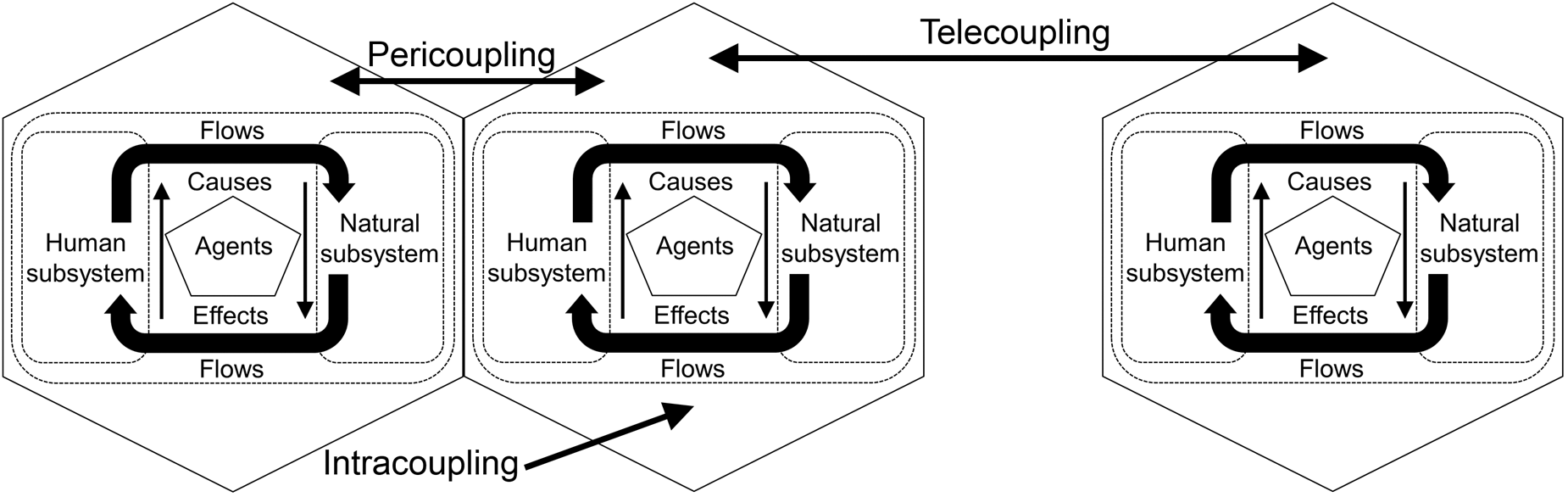
A paucity of research on multiscalar human–nature interactions, their causes, and their effects prompted the development of an integrated local–regional–global approach, the metacoupling framework (Liu, Reference Liu2017). Allowing researchers to study social–ecological linkages at multiple scales across the world, the metacoupling framework illuminates human–nature interactions that occur within a specific coupled human and natural system (intracouplings) and between adjacent systems (pericouplings) and distant systems (telecouplings). Collectively, these interactions are termed metacouplings (Figure 1). The metacoupling framework is useful and advances related frameworks (e.g., teleconnections, telecouplings) because it provides a flexible, adaptable approach that researchers and managers can use to quantify and compare social–ecological linkages not only over long distances (i.e., telecouplings), but also at local and regional levels. Such a framework may be helpful for understanding connections between humans and nature in fisheries and other systems involving biota, habitats, and humans that have traditionally been studied in a monothematic (i.e., human- or nature-focused) manner. Although it was originally used to investigate human–nature interactions in terrestrial systems (e.g., giant pandas Ailuropoda melanoleuca within and beyond Wolong Nature Reserve, China), the metacoupling framework has shown promise as an aquatic approach (Carlson et al., Reference Carlson, Boonstra, Joosse, Rubenstein and Levin2022, Reference Carlson, Rubenstein and Levin2020, Reference Carlson, Rubenstein and Levin2021).
Illustration of metacoupling: human–nature interactions within a coupled human and natural system (intracoupling) and between adjacent (pericoupling) and distant (telecoupling) systems.

Figure 1 Long description
The concept of metacoupling, depicting interactions within and between coupled human and natural systems. Three hexagonal sections are shown, each representing a system. The leftmost section is labeled ′Intracoupling′ and contains a pentagon with arrows connecting ′Causes′, ′Agents′, ′Effects′, ′Human subsystem′ and ′Natural subsystem′. Arrows labeled ′Flows′ encircle the pentagon, indicating movement within the system. The middle section, labeled ′Pericoupling′, is similar in structure, showing interactions between adjacent systems. The rightmost section, labeled ′Telecoupling′, represents interactions between distant systems, with arrows labeled ′Flows′ connecting it to the other sections. Arrows between the sections indicate the direction of interaction, with ′Pericoupling′ pointing from the left section to the middle and ′Telecoupling′ pointing from the middle to the right section.
Common dolphinfish (Coryphaena hippurus) are migratory marine predators that have a broad, circumtropical and circumsubtropical distribution (Fishbase, 2024). As prized sport fish that support high-value industrial and artisanal fisheries (Merten et al., Reference Merten, Appeldoorn, Grove, Aguilar-Perera, Arocha and Rivera2022a), dolphinfish are recreationally, economically, culturally, and nutritionally important. Characterized by rapid maturation, short generation time, fast growth, and large size (Fishbase, 2024), dolphinfish life history is believed to impart relatively high biological resilience to exploitation. However, there has been a documented decrease in dolphinfish abundance in the western Atlantic Ocean (Damiano et al., Reference Damiano, Karnauskas, Merten and Cao2024; Lynch et al., Reference Lynch, Shertzer, Cortés and Latour2018), and there is a shortage of information on the species and its fisheries (e.g., ecology, stock assessment, governance; Merten et al., Reference Merten, Appeldoorn, Latour, Glaser, Becker and Hammond2022b; Moltó et al., Reference Moltó, Hernández, Sinopoli, Besbes-Benseddik, Besbes, Mariani, Gambin, Alemany, Morales-Nin, Grau, Camiñas, Báez, Vasconcellos, Ceriola and Catalán2020). Given these basic knowledge gaps, it is not surprising that broader investigations of multiscalar social–ecological linkages are scarce for dolphinfish (Carlson et al., Reference Carlson, Rubenstein and Levin2020). For instance, there is little information on interactions, synergies, and tradeoffs between and among industrial, artisanal, subsistence, and recreational dolphinfish fisheries at local, regional, and global scales. Likewise, although dolphinfish are important for human nutrition and livelihoods, particularly in smaller, less developed countries (e.g., Cape Verde, Niue, and St. Vincent & the Grenadines; Pauly et al., Reference Pauly, Zeller and Palomares2020), little is known about the nutritional and livelihood effects of local to global human–nature interactions involving dolphinfish fisheries. Such knowledge gaps hinder the development of multiscalar management and governance approaches that encompass the full recreational, cultural, and nutritional value of dolphinfish, not to mention their economic importance in trade markets (Fishbase, 2024; NOAA, 2024).
The purpose of this study is to use the metacoupling framework to explore multiscalar human–nature interactions in – and inform management and governance of – dolphinfish fisheries across the world. My first objective is to quantify and compare dolphinfish catches as metacouplings (i.e., intracouplings, pericouplings, telecouplings) over 70 years (1950–2019). My second objective is to use time-series analysis to model different fishing sectors (i.e., industrial, artisanal, subsistence, recreational), characterize their multiscalar interactions, and predict future catches. Finally, my third objective is to evaluate the dynamics and variability of dolphinfish metacouplings across different parts of the world to yield insights for multiscalar management and governance of dolphinfish fisheries in coupled human and natural systems.
2. Methods
2.1. Metacoupling framework
I defined metacouplings as multiscalar human–nature interactions that occur within a particular exclusive economic zone (EEZ), between adjacent EEZs, and between distant EEZs or in the high seas (Figure 1). In practice, metacouplings can be quantitatively represented as total dolphinfish catches, which can be subdivided into intracouplings (fish caught within a nation’s own EEZ), pericouplings (fish caught in adjacent EEZs), and telecouplings (fish caught in distant EEZs or the high seas).
2.2. Data
The United Nations Food and Agriculture Organization (FAO) collects fish catch data that can provide insights into fisheries metacouplings worldwide. However, FAO data are known to underreport actual fish catches in particular places and times (Pauly & Zeller, Reference Pauly and Zeller2016). Reconstructing catches using both FAO data and non-FAO information from sources such as peer-reviewed journal articles, research reports, and fisheries agency documents is one way to reduce underreporting bias. Hence, fish catch data (metric tons [MT]) were obtained from the Sea Around Us database (Pauly et al., Reference Pauly, Zeller and Palomares2020), which integrates FAO data with reliable non-FAO information to reconstruct legal and illegal catches and quantify discards (bycatch) of numerous fish species in the world’s 280 EEZs in 1950–2019. Despite the potential shortcomings of building catch models with reconstructed data (e.g., slight to substantial differences in model parameters relative to reported data), it is important for fisheries scientists, managers, and policymakers to account for fishing that is known to occur but is not captured by FAO data. Rather than treat these fishing activities as ‘zeroes’, the Sea Around Us integrates FAO and non-FAO data to holistically reconstruct catches using 35 publications per reconstruction, on average (Pauly & Zeller, Reference Pauly and Zeller2016). In reconstructing fish catches, experts consider data quality by rating the certainty of industrial, artisanal, subsistence, and recreational time series as very high (±10% uncertainty), high (±20%), low (±30%), or very low (±50%). Overall, reconstructions are useful because they allow researchers to account for known unreported and underreported catches and thereby better represent fisheries for science, management, and policy evaluations.
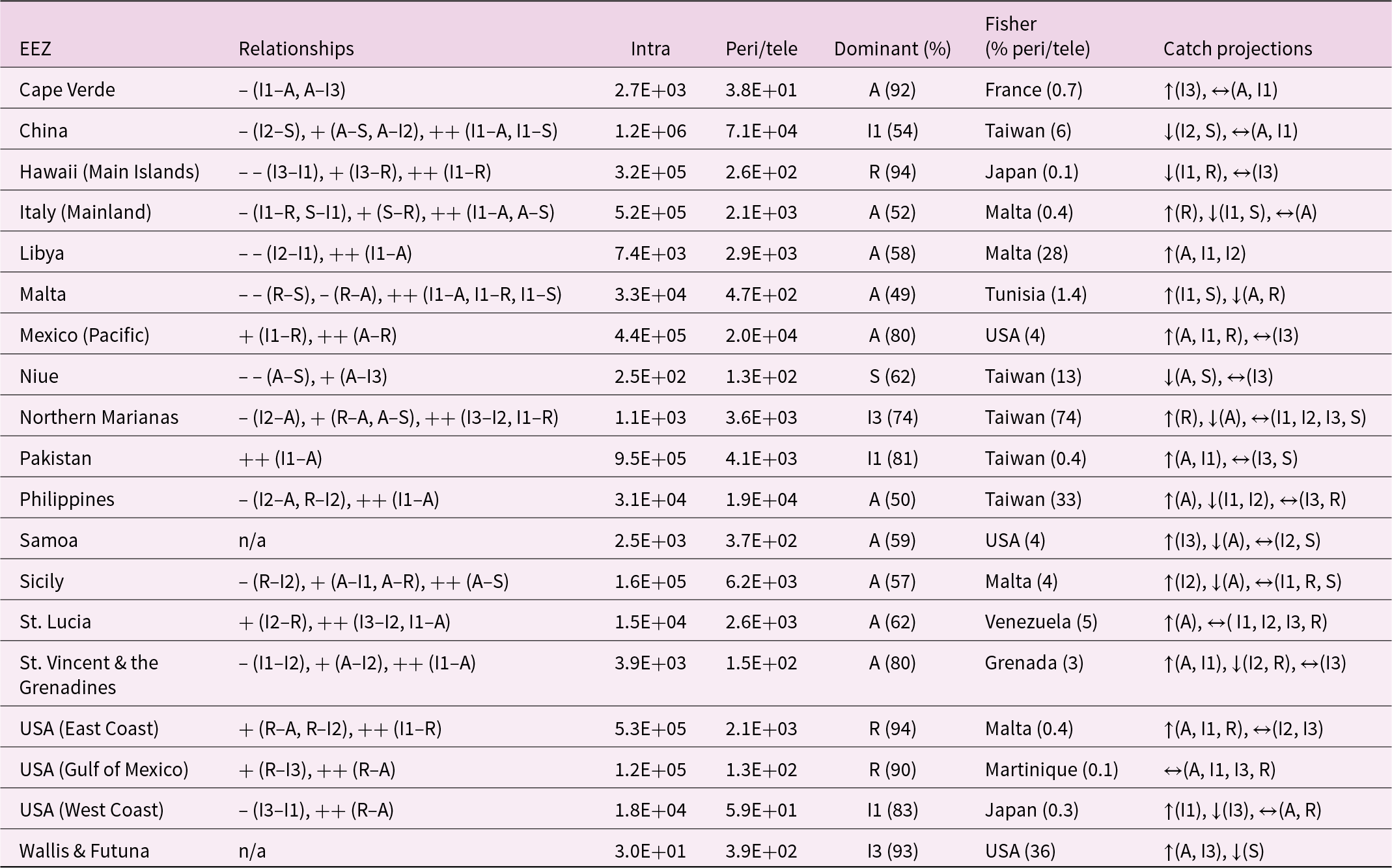
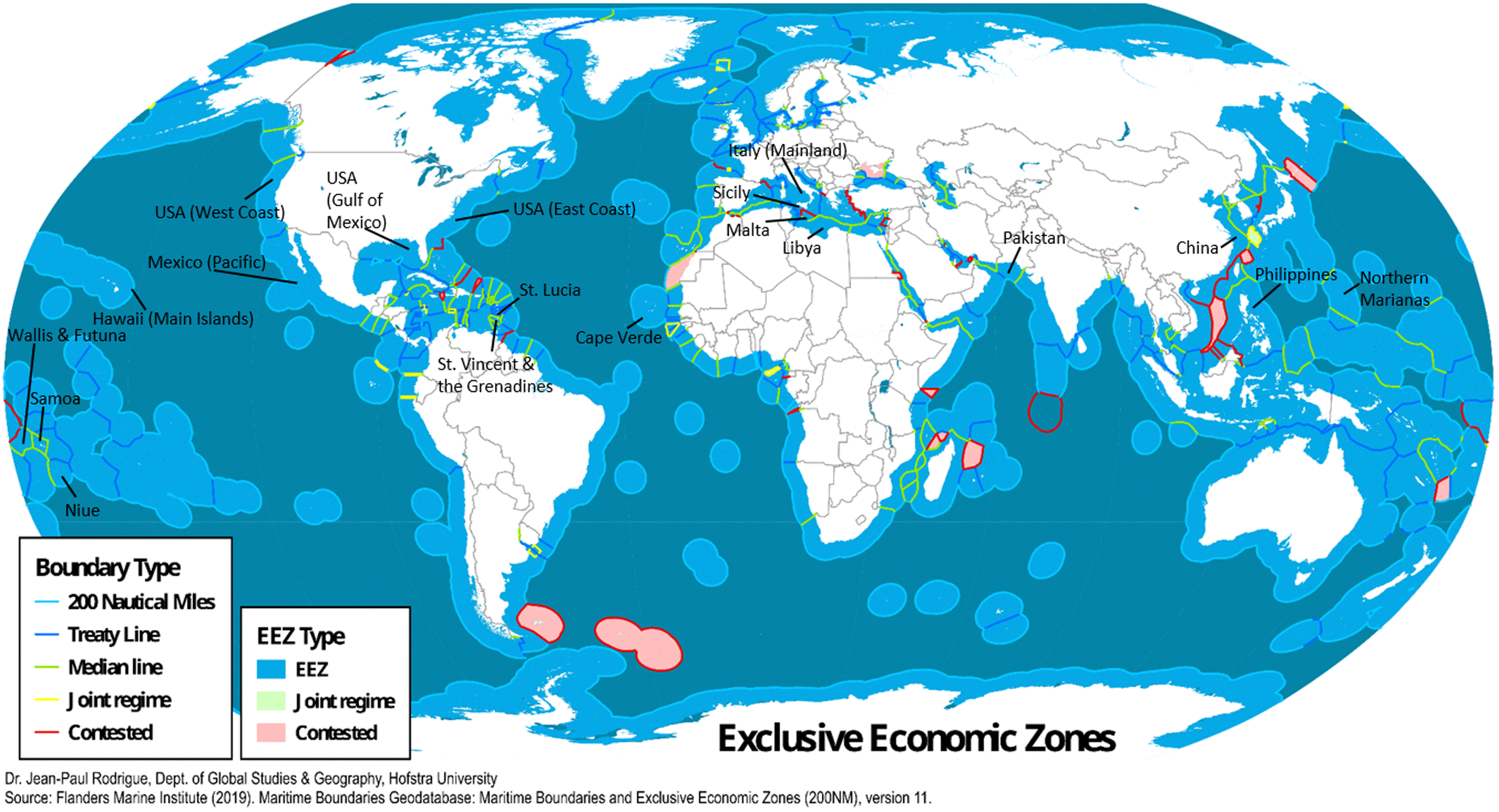
Dolphinfish data were obtained from the Sea Around Us and organized to identify fish catches, fishing nations, scales (intracoupling, pericoupling, telecoupling), and sectors (industrial, artisanal, subsistence, recreational) in 19 EEZs (Table 1, Figure 2) and the high seas in 1950–2019. These 19 EEZs were selected because they encompassed relatively large catches from three or more fishing sectors, a requirement for representing the various types of dolphinfish metacoupling interactions across the world. The high seas were included because they inherently involve distant-water fishing (i.e., telecouplings), an important component of the analysis.
Summary of dolphinfish fishing-type relationships, catches in 1950–2019, and catch predictions in 2020–2035. Relationships are the bidirectional positive (++), unidirectional positive (+), bidirectional negative (– –), and unidirectional negative (–) relationships between fishing types (artisanal [A], intracoupled industrial [I1], pericoupled industrial [I2], recreational [R], subsistence [S], telecoupled industrial [I3]). ++ and – – indicate a positive or negative effect of the first fishing type on the second, and vice versa, whereas + and – indicate a positive or negative effect of the first type on the second (not the opposite). “Intra” and “Peri/tele” are total tonnage (metric tons) of dolphinfish intracouplings, and pericouplings plus telecouplings, in 1950–2019. Dominant (%) is the largest-tonnage fishing type and its percentage of metacouplings in 1950–2019. Fisher (% peri/tele) is the largest-tonnage pericoupling or telecoupling fishing nation and its percentage of metacouplings in 1950–2019. Catch projections are forecasted changes in dolphinfish catches in 2020–2035 (increase ↑, decrease ↓, stable ↔) as predicted by autoregressive integrated moving average models. EEZ = exclusive economic zone, n/a = not applicable

Table 1 Long description
Rows list 19 EEZs and columns report Relationships, Intra and Peri or tele tonnage, Dominant fishing type with percent, Fisher nation with percent peri or tele, and Catch projections for 2020 to 2035 by fishing type. Intra tonnage ranges from 3.0E+01 in Wallis and Futuna to 1.2E+06 in China, with other high values including Pakistan at 9.5E+05, Italy Mainland at 5.2E+05, USA East Coast at 5.3E+05, Mexico Pacific at 4.4E+05, and Hawaii Main Islands at 3.2E+05. Peri or tele tonnage is highest for China at 7.1E+04, followed by Mexico Pacific at 2.0E+04 and Philippines at 1.9E+04, and is lowest for Cape Verde at 3.8E+01 and USA West Coast at 5.9E+01. Dominant percent is highest for Hawaii Main Islands and USA East Coast at 94 percent recreational, and for Wallis and Futuna at 93 percent telecoupled industrial; China lists intracoupled industrial at 54 percent, and several EEZs list artisanal as dominant including Cape Verde at 92 percent and Mexico Pacific and St. Vincent and the Grenadines at 80 percent. Fisher percent peri or tele is highest for Northern Marianas with Taiwan at 74 percent, then Libya with Malta at 28 percent, Wallis and Futuna with USA at 36 percent, and Philippines with Taiwan at 33 percent; several others are small, including Japan at 0.1 in Hawaii Main Islands and Martinique at 0.1 in USA Gulf of Mexico. Relationships entries use minus, plus, and double plus groupings with fishing type pairs, and Samoa and Wallis and Futuna list Relationships as not applicable. Catch projections include increases for Libya in artisanal, intracoupled industrial, and pericoupled industrial, decreases for China in pericoupled industrial and subsistence, and mixed directions in several EEZs such as Italy Mainland with increase in recreational, decreases in intracoupled industrial and subsistence, and stable in artisanal.
Map of the world’s exclusive economic zones (EEZs). The 19 EEZs included in this dolphinfish study are labeled. The map was created by Dr Jean-Paul Rodrigue and is freely available at https://transportgeography.org/wp-content/uploads/Map_Exclusive-Economic-Zones.pdf.

Figure 2 Long description
The map illustrates the world′s exclusive economic zones (EEZs) with various boundary and EEZ types. Boundary types include 200 nautical miles, treaty line, median line, joint regime and contested areas. EEZ types are marked as EEZ, joint regime and contested. Labeled regions include USA (West Coast, East Coast, Gulf of Mexico), Mexico (Pacific), Canada (Pacific), Malta, Cyprus, St. Vincent & the Grenadines, Cape Verde, Pakistan, India (West Coast), Philippines and China. The map highlights areas with joint regimes and contested zones, particularly around the Caribbean, Mediterranean and parts of Asia. The map provides a visual representation of maritime boundaries and economic zones globally.
2.3. Analysis
Dolphinfish data were first evaluated by plotting total and sector-specific catches in each EEZ in 1950–2019 and visualizing local, regional, and global flows of fish using Sankey diagrams. Then, dolphinfish catches and fishing-sector interactions were modeled using autoregressive integrated moving average (ARIMA) models. From fish populations to climate patterns and electricity demand to large-scale human health interventions (Lai & Dzombak, Reference Lai and Dzombak2020; Luzia et al., Reference Luzia, Rubio and Velasquez2023; Schaffer et al., Reference Schaffer, Dobbins and Pearson2021; Yesuf et al., Reference Yesuf, Getahun, Mengistou, Wilson, Anteneh and Abera2023), ARIMA models are used to investigate time-series trends and predict future outcomes. Moreover, ARIMA models are increasingly used in metacoupling research because they are helpful for analyzing time series and metacoupling interactions in various natural and human systems (e.g., crop trade, species invasion, animal and human migration, tourism; Herzberger et al., Reference Herzberger, Chung, Kapsar, Frank and Liu2019).
Time series have underlying properties such as lagged values and prediction errors that can be used to understand and project how dependent variables may behave in the future. Mathematically, ARIMA models employ this logic through a series of autoregressive parameters (AR(p)), moving averages (MA(q)), and integrated, stationarizing terms (I(d)) that generally improve model accuracy relative to autoregressive or moving-average approaches alone (Hamilton, Reference Hamilton1994; Hyndman & Athanasopoulos, Reference Hyndman and Athanasopoulos2018). These models also accommodate external regressors of interest to metacoupling researchers (e.g., effects of telecoupled industrial fishing on intracoupled artisanal fishing). Hence, ARIMA models were informative for the purposes of this study.
ARIMA models were used to assess past, present, and future trends in all six dolphinfish fishing types represented in the Sea Around Us: intracoupled artisanal, intracoupled industrial, intracoupled subsistence, intracoupled recreational, pericoupled industrial, and telecoupled industrial. Models were developed to represent catches of each fishing type in each of 19 EEZs in 1950–2019. Model equations provided information for addressing study objectives such as quantifying interactions between fishing types and predicting future dolphinfish catches. First, ARIMA models required dolphinfish catches to be natural-log transformed and modeled as a function of lagged catch values (i.e., AR(p) terms):
 \begin{equation}{Y_{tzf}}\left( 1 \right) = { }\delta + \mathop \sum \limits_{i = 1}^p {\phi _i}{y_{\left( {t - i} \right)zf}} + {\varepsilon _{tzf}}\end{equation}
In this equation, Ytzf(1) is catch at time t for EEZ z and fishing type f, δ is a constant, p is the AR polynomial order, ϕi terms are AR parameters, y (t−i)zf terms are lagged values of catch for EEZ z and fishing type f, and εtzf is an error term for EEZ z and fishing type f. Adding the I(d) term served to stationarize the time series:
 \begin{equation}{y_{d,tzf}} = {Y_{tzf}} - { }{Y_{\left( {t - 1} \right)zf}}\end{equation}
 \begin{equation}{Y_{tzf}}\left( 2 \right) = { }\delta + \mathop \sum \limits_{i = 1}^p {\phi _i}{y_{d,\left( {t - i} \right)zf}} + {\varepsilon _{tzf}}\end{equation}
where yd ,tzf is catch at time t for EEZ z and fishing type f differenced d times, and other terms are defined above. The MA(q) represents errors between predicted and observed dolphinfish catches:
 \begin{equation}{Y_{tzf}}\left( 3 \right) = { }\delta + \mathop \sum \limits_{i = 1}^q {\theta _i}{\varepsilon _{\left( {t - i} \right)zf}} + {\varepsilon _{tzf}}\end{equation}
where δ is a constant, q is the MA polynomial order, θi terms are MA parameters, ε (t−i)zf terms are prediction errors for EEZ z and fishing type f, and εtzf is an error term for EEZ z and fishing type f, and other terms are defined above. Combining information from Equations (1) through (4), ARIMA models included AR(p), I(d), and MA(q) terms:
 \begin{equation}{Y_{tzf}}\left( 4 \right) = { }\delta + \mathop \sum \limits_{i = 1}^p {\phi _i}{y_{d,\left( {t - i} \right)zf}} + \mathop \sum \limits_{i = 1}^q {\theta _i}{\varepsilon _{\left( {t - i} \right)zf}} + {\varepsilon _{tzf}}\end{equation}
Final ARIMA models incorporated interactions among fishing types:
 \begin{equation}{Y_{tzf}}\left( 5 \right) = { }{\mathbf{A}} + \mathop \sum \limits_{i = 1}^p {\phi _i}{y_{d,\left( {t - i} \right)zf}} + \mathop \sum \limits_{i = 1}^q {\theta _i}{\varepsilon _{\left( {t - i} \right)zf}} + {\varepsilon _{tzf}}\end{equation}
where A is a matrix of external regressors containing catch data for fishing types other than f within EEZ z, and other terms are defined above.
Various approaches were used to evaluate model quality. For example, augmented Dickey–Fuller tests were used to evaluate the ARIMA assumption of stationarity, and Box–Ljung tests were used to assess the assumption of lack of autocorrelation. Autocorrelation and partial autocorrelation functions were also useful in verifying the accuracy of parameter estimates using maximum-likelihood methods and information-theoretic model selection. Different combinations of ARIMA parameters and external regressors were compared using Akaike Information Criterion (AIC); models with the lowest AIC scores and random, independent residuals were considered the most parsimonious for evaluating interactions among fishing types and forecasting future catches. Standard ARIMA assessment methods (i.e., normalized root mean square error, mean absolute scaled error) were used to validate models by comparing model-projected and observed dolphinfish catches. Values of these metrics between 0 and 1 indicate great to good performance, whereas values >1 indicate poor performance (Hyndman & Athanasopoulos, Reference Hyndman and Athanasopoulos2018). The most parsimonious models for all EEZ–fishing type combinations were used to assess interactions among fishing types and predict future dolphinfish catches in 2020–2035. Fishing-type interactions were quantified by evaluating external regressor (i.e., Equation [6]) coefficients for significant (P ≤ 0.05) regressors and visualized using arrow diagrams. Arrows indicate a significant effect of one fishing type on another, with arrow width and color representing the magnitude and direction of the effect, respectively. Analyses were performed in RStudio version 3.6.1 (R Development Core Team, 2019).
3. Results
3.1. Dolphinfish catches: a metacoupling perspective
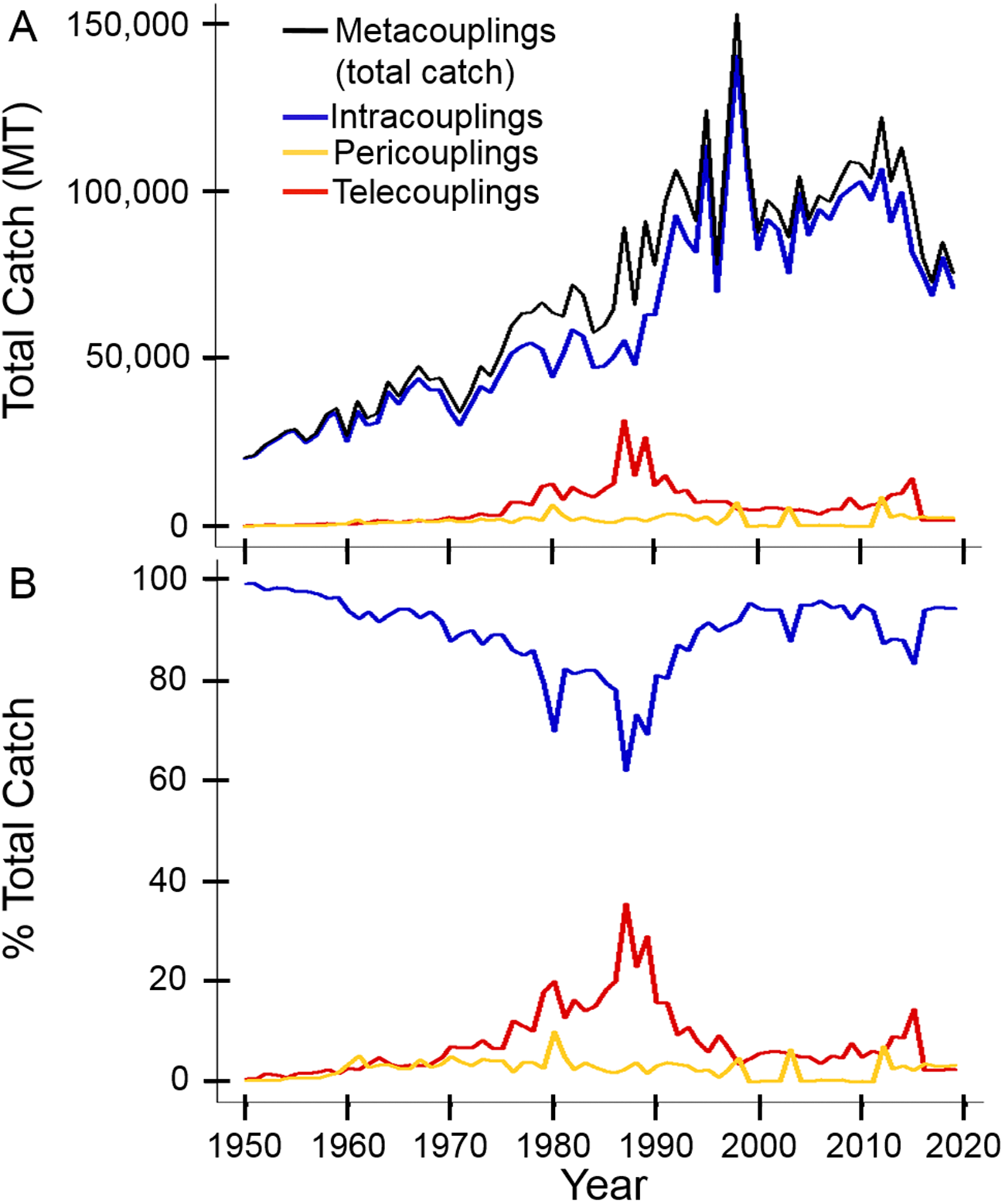
Dolphinfish metacouplings totaled 4.86 × 10⁶ MT in 1950–2019, including 4.45 × 10⁶ MT in EEZs and 4.05 × 10⁵ MT in the high seas. Metacouplings increased from 1950 to 1998, decreased from 1998 to 2000, and again increased in 2000–2012 before declining in more recent years (2012–2019; Figure 3A). Intracouplings in 1950–2019 (4.32 × 10⁶ MT) exhibited the same general trend as metacouplings, whereas pericouplings (1.22 × 10⁵ MT) were relatively small and stable in 1950–2019. Telecouplings (4.18 × 10⁵ MT) peaked in 1987 before declining in more recent years (Figure 3A). Intracouplings represented the largest percentage of metacouplings overall (mean: 89.6% in 1950–2019), although their contribution reached a low point in 1987, when telecouplings accounted for 35.5% of metacouplings (Figure 3B). Pericouplings averaged 2.5% of metacouplings in 1950–2019.
Temporal trends in dolphinfish metacouplings (total catch), intracouplings (catch within a nation’s own exclusive economic zone [EEZ]), pericouplings (catch in adjacent EEZs), and telecouplings (catch in distant, non-adjacent EEZs). Panel A depicts catches in metric tons, whereas panel B depicts intracouplings, pericouplings, and telecouplings as a percentage of metacouplings.

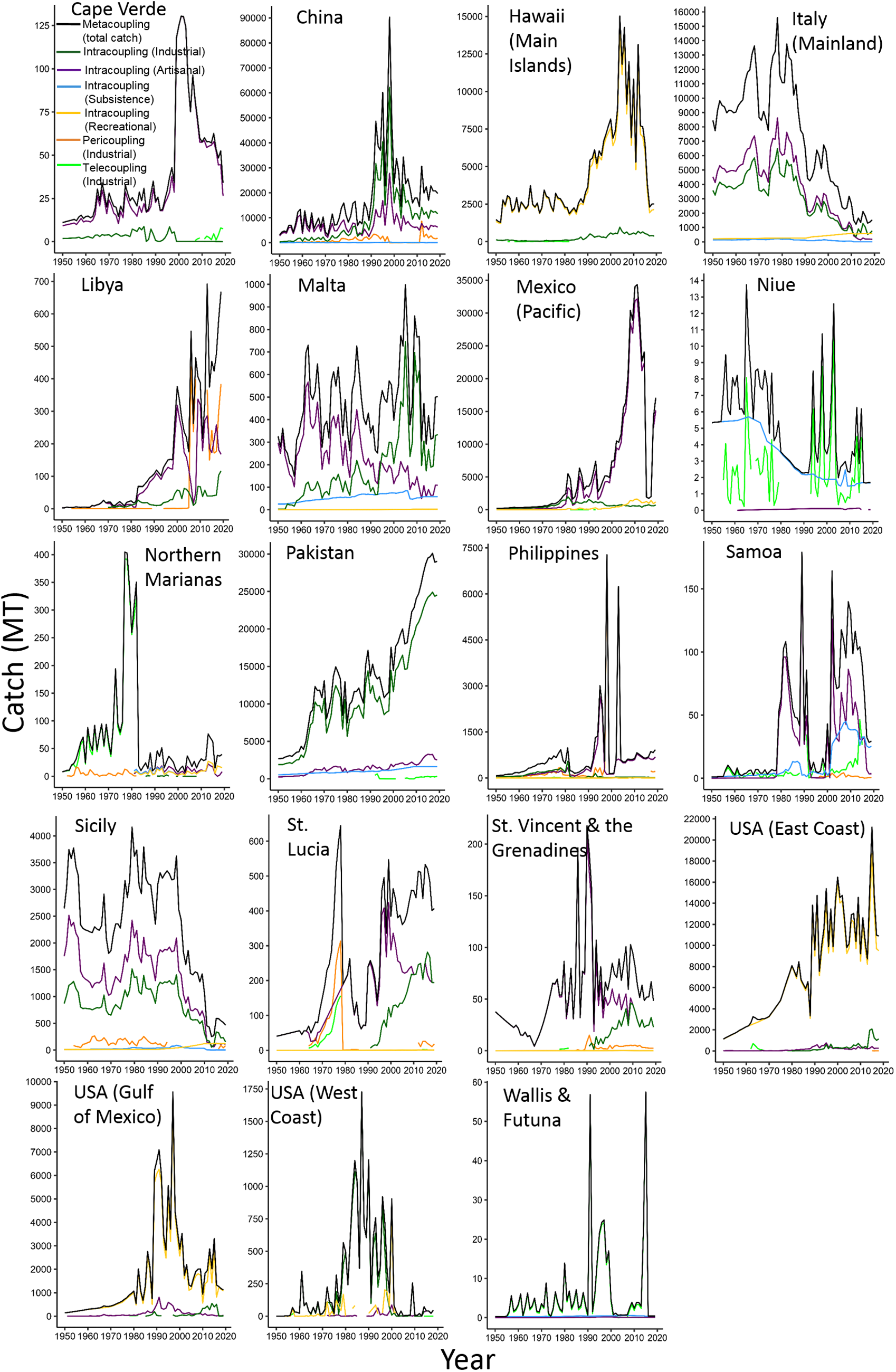
The majority of EEZs (73.7%, N = 14) exhibited an increase in dolphinfish metacouplings in 1950–2019, although 15.8% of EEZs (N = 3) showed a decrease, and 10.5% (N = 2) had stable dolphinfish catches (Figure 4). Intracoupled artisanal fishing was the largest-tonnage fishing type in 52.6% of EEZs (N = 10; Table 1). Other fishing types predominated in fewer EEZs: intracoupled industrial (15.8% of EEZs, N = 3), recreational (15.8%, N = 3), telecoupled industrial (10.5%, N = 2), and subsistence (5.3%, N = 1). Overall, industrial fishing accounted for 49.0% of metacouplings (2.38 × 10⁶ MT) across EEZs in 1950–2019, followed by artisanal (29.2%, 1.42 × 10⁶ MT), recreational (19.8%, 9.64 × 10⁵ MT), and subsistence (1.9%, 9.28 × 10⁴ MT) fishing.
Dolphinfish catch (metric tons, MT) in 1950–2019 within 19 exclusive economic zones (EEZs). Catch types include metacouplings (total catch), intracouplings (catch within a nation’s own EEZ), pericouplings (catch in adjacent EEZs), and telecouplings (catch in distant, non-adjacent EEZs) across artisanal, industrial, recreational, and subsistence sectors.

Figure 4 Long description
Multiple line graphs depicting dolphinfish catch in metric tons from 1950 to 2019 across different regions. The horizontal axis is labeled ′Year′ and spans from 1950 to 2020. The vertical axis is labeled ′Catch (MT)′ and varies in scale for each graph. Regions include Cape Verde, China, Hawaii (Main Islands), Italy (Mainland), Libya, Malta, Mexico (Pacific), Niue, Northern Marianas, Pakistan, Philippines, Samoa, Sicily, St. Lucia, St. Vincent and the Grenadines, USA (East Coast), USA (Gulf of Mexico), USA (West Coast) and Wallis and Futuna. Each graph features multiple lines representing different catch types: metacouplings (total catch), intracouplings (catch within a nations own EEZ), pericouplings (catch in adjacent EEZs) and telecouplings (catch in distant, non-adjacent EEZs). These are further divided into artisanal, industrial, recreational and subsistence sectors. The lines are visually distinguished by different styles or patterns. Key trends include increases in catch in most regions, with notable peaks in regions like China and Mexico (Pacific) around the 2000s. Some regions, such as Libya and Samoa, show more stable or fluctuating trends. The graphs highlight the dominance of certain regions and sectors in dolphinfish catch over time, with industrial and artisanal sectors often leading. Peaks and troughs vary, with some regions experiencing significant increases in specific decades. The purpose of the graphs is to illustrate the changes in dolphinfish catch across different regions and sectors over time.
3.2. Dolphinfish flows: local, adjacent, and distant
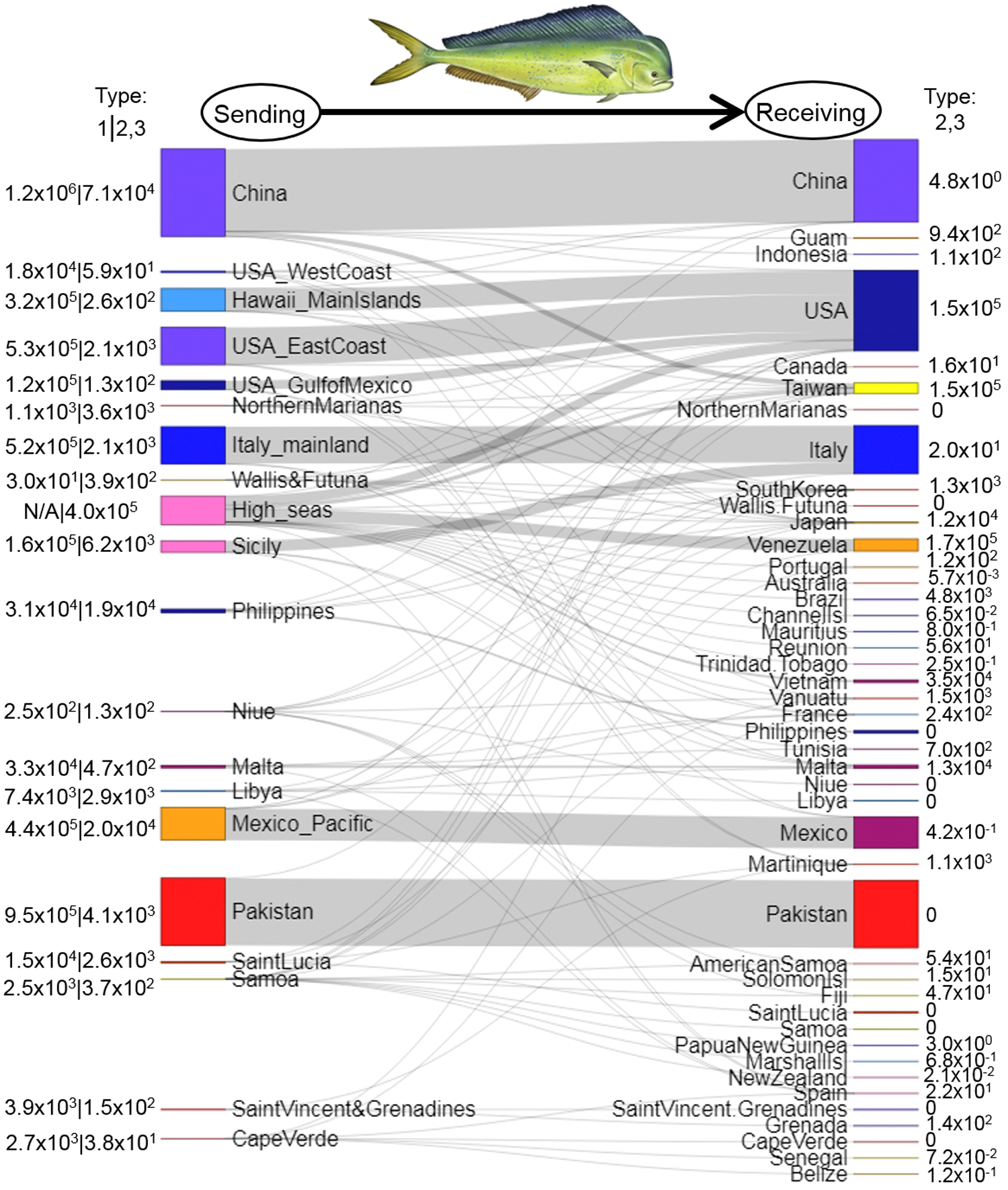
Dolphinfish intracouplings were largest by tonnage in China (94.3% of metacouplings, 1.16 × 10⁶ MT), Pakistan (99.6%, 9.49 × 10⁵ MT), and the USA (East Coast, 99.6%, 5.26 × 10⁵ MT; Table 1, Figures 4 and 5). In contrast, the smallest intracouplings occurred in island EEZs: Wallis & Futuna (7.1% of metacouplings, 3.02 × 101 MT), Niue (65.0%, 2.50 × 10² MT), and Northern Marianas (23.2%, 1.10 × 10³ MT).
Dolphinfish pericouplings were largest in China (5.7% of metacouplings, 7.00 × 10⁴ MT), Mexico (4.3%, 1.98 × 10⁴ MT), and the Philippines (37.1%, 1.84 × 10⁴ MT), and second largest by percentage in Libya (28.0%, 2.88 × 10³ MT; Figures 4 and 5). By comparison, pericouplings were smallest in an island EEZ (Cape Verde, 0.002% of metacouplings, 7.15 × 10⁻² MT), USA Gulf of Mexico (0.0001%, 1.58 × 10⁻¹ MT), and USA West Coast (0.001%, 2.60 × 10⁻¹ MT), and absent in four EEZs (Hawaii Main Islands, Malta, Pakistan, and Wallis & Futuna).
Sankey diagram depicting flows of dolphinfish (metric tons) from sending to receiving systems across the world in 1950–2019. Numbers to the left of the divider in the left margin are intracouplings (catch within a nation’s own exclusive economic zone [EEZ]); numbers to the right of the divider represent pericouplings and telecouplings (catch by nations that are adjacent to or distant from the labeled EEZ). Numbers in the right margin are pericouplings and telecouplings by the labeled nation in other EEZs.

Figure 5 Long description
A Sankey diagram presents dolphinfish flows in metric tons from sending systems to receiving systems across the world. A fish illustration appears at the top of the diagram. The diagram reads from left to right, with sending systems listed on the left margin and receiving systems listed on the right margin. Band width encodes flow volume, where wider bands represent larger quantities. Two type labels appear in the diagram: Type 1 2 3 on the sending side and Type 2 3 on the receiving side. Each sending node displays two numeric values separated by a divider. The value to the left of the divider represents catch within a nation′s own exclusive economic zone and the value to the right represents catch by adjacent or distant nations. Numeric values in the right margin represent flows by the labeled nation into other exclusive economic zones. The sending systems listed from top to bottom are: China with values 1.2 times 10 superscript 6 and 7.1 times 10 superscript 4, USA West Coast with values 1.8 times 10 superscript 5 and 1.9 times 10 superscript 5, Hawaii Mainlands with values 5.3 times 10 superscript 3 and 1.2 times 10 superscript 1, USA East Coast with values 5.2 times 10 superscript 5 and 1.3 times 10 superscript 4, USA Gulf of Mexico with values 5.2 times 10 superscript 4 and 1.3 times 10 superscript 3, Northern Marianas, Italy mainland, Wallis and Futuna, High seas labeled as N/A, Sicily, Philippines, Niue with value 2.5 times 10 superscript 2 and 1.3 times 10 superscript 2, Malta with value 3.3 times 10 superscript 4 and 1.4 times 10 superscript 4, Libya with values 7.4 times 10 superscript 4 and 1.2 times 10 superscript 1, Mexico Pacific with value 7.4 times 10 superscript 2 and 1.0 times 10 superscript 1, Pakistan with value 9.5 times 10 superscript 5 and 4.1 times 10 superscript 1, Saint Lucia with value 1.5 times 10 superscript 5 and 1.2 times 10 superscript 6, Samoa with value 2.5 times 10 superscript 3 and 3.7 times 10 superscript 2, Saint Vincent and Grenadines with value 3.9 times 10 superscript 3 and 1.5 times 10 superscript 2 and Cape Verde with value 2.3 times 10 superscript 3 and 1.8 times 10 superscript 1. The receiving systems listed include China with value 4.8 times 10 superscript 5, Guam, Indonesia, USA with value 1.1 times 10 superscript 2, Canada, Taiwan, Northern Marianas, Italy with value 2.0 times 10 superscript 1, South Korea, Wallis and Futuna, Japan, Venezuela, Portugal, Australia, Brazil, Mauritius, Channel Islands, Trinidad, Vietnam, France, Philippines, Tunisia, Malta, Libya, Mexico with value 4.2 times 10 superscript 1, Martinique with value 1.1 times 10 superscript 1, Pakistan with value 0, American Samoa, Samoa, Papua New Guinea, Saint Vincent and Grenadines, Solomon Islands, Cape Verde and Belize. China and Pakistan show the largest sending band widths. Pakistan shows a receiving value of 0 on the right margin.
Dolphinfish telecouplings were largest in Pakistan (0.4% of metacouplings, 4.09 × 10³ MT), Northern Marianas (73.8%, 3.50 × 10³ MT), and USA East Coast (0.39%, 2.05 × 10³ MT), and largest by percentage in an island EEZ, Wallis & Futuna (92.9%, 3.95 × 10² MT; Figures 4 and 5). In contrast, telecouplings were smallest in Sicily (<0.0001% of metacouplings, 5.62 × 10⁻³ MT), Libya (0.006%, 6.51 × 10⁻¹ MT), and St. Vincent & the Grenadines (0.3%, 1.03 × 101 MT), and absent in two EEZs (Italy [mainland], Malta).
Across EEZs in 1950–2019, the largest-tonnage fishing nations were China (1.16 × 10⁶ MT) and the USA (1.01 × 10⁶ MT; Figures 4 and 5). The smallest-tonnage nations were Portugal (6.97 × 10⁻³ MT) and New Zealand (2.08 × 10⁻² MT). By comparison, in the high seas, the largest-tonnage fishing nations were Venezuela (1.71 × 10⁵ MT) and the USA (1.30 × 10⁵ MT); the smallest-tonnage nations were Australia (5.72 × 10⁻³ MT) and Canada (9.99 × 10⁻³ MT).
3.3. Metacoupling interactions and projections
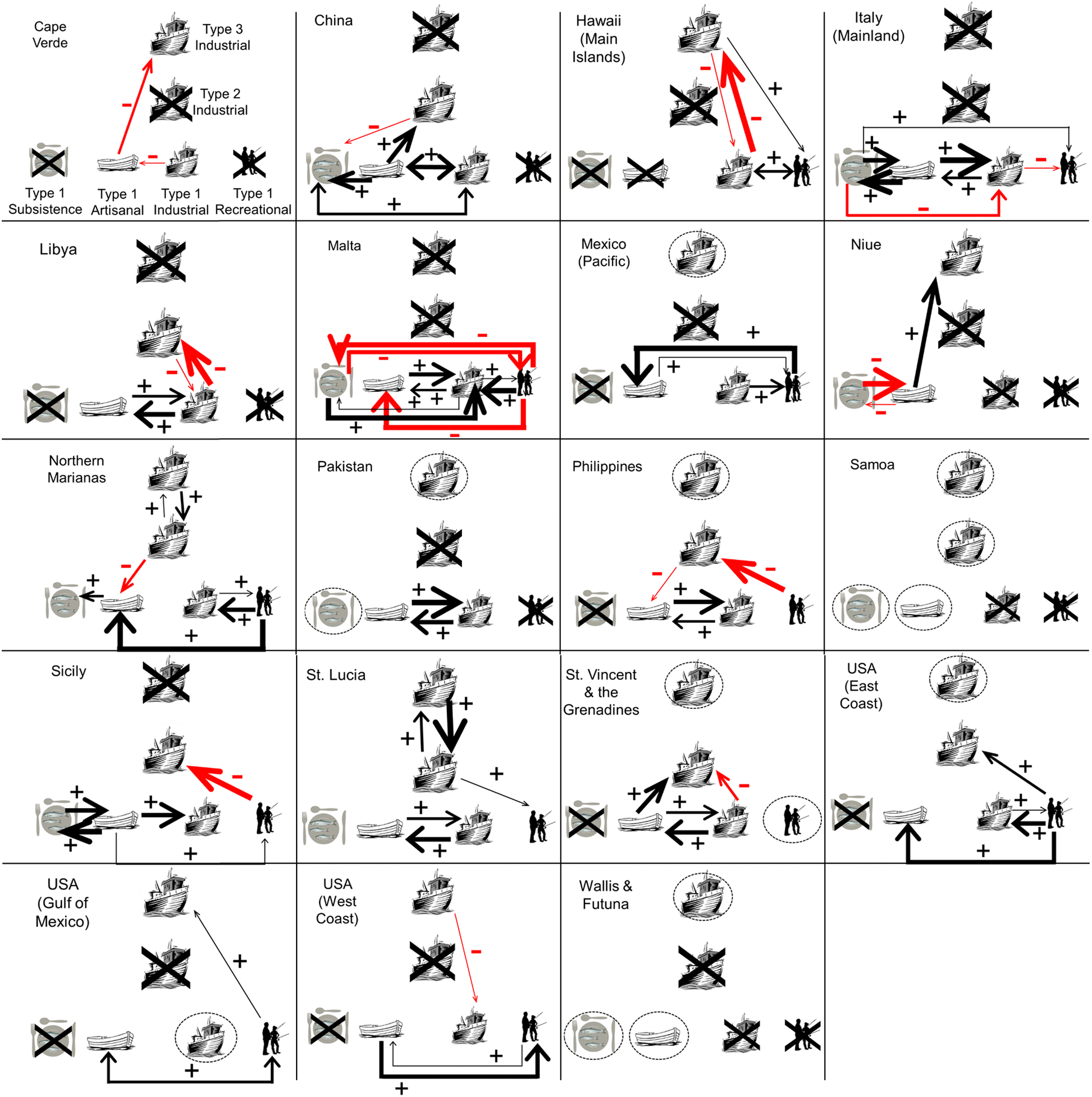
The most common fishing-sector interactions were bidirectional positive relationships between artisanal and intracoupled industrial fishing (42.1% of EEZs, N = 8), and between recreational and intracoupled industrial fishing (21.1%, N = 4; Table 1, Supplementary Tables S1–S20, Figure 6). The most common unidirectional relationships – each occurring in 10.5% of EEZs (N = 2) – were negative effects of pericoupled industrial on artisanal fishing, negative effects of recreational on pericoupled industrial fishing, positive effects of artisanal on pericoupled industrial fishing, positive effects of artisanal on subsistence fishing, and positive effects of recreational on artisanal fishing.
Metacoupling interactions among fishing types in 19 exclusive economic zones in 1950–2019. Arrow width is proportional to interaction strength. Arrow color corresponds with interaction direction: black (positive) and red (negative). ‘X’ symbols represent fishing types that were absent or did not meet criteria for inclusion in modeling, whereas dotted circles depict fishing types that were unaffected by, and did not affect, other fishing types.

Figure 6 Long description
Fishing interactions across 19 exclusive economic zones, each represented by a separate section. Each section includes symbols for different fishing types: subsistence, artisanal, industrial and recreational. Arrows indicate interaction directions and strengths, with positive interactions marked by plus signs and negative interactions by red arrows. Some sections have ′X′ symbols indicating absent fishing types, while dotted circles represent unaffected types. Notable interactions include bidirectional positive relationships between artisanal and intracoupled industrial fishing and between recreational and intracoupled industrial fishing. Unidirectional relationships include negative effects of pericoupled industrial on artisanal fishing, negative effects of recreational on pericoupled industrial fishing, positive effects of artisanal on pericoupled industrial fishing, positive effects of artisanal on subsistence fishing and positive effects of recreational on artisanal fishing. Each section is labeled with a geographic location, such as China, Hawaii, Italy, Libya, Malta, Mexico and others, showing specific interaction patterns within those zones.
Catch projections in the 19 EEZs encompassed 78 unique EEZ–fishing type combinations, of which 32.1% (N = 25) were projected to increase, 24.4% (N = 19) were predicted to decrease, and 43.6% (N = 34) were projected to remain stable in 2020–2035 (Table 1, Supplementary Figures S1–S19). Fishing types with the largest percentage of EEZs having projected increases in 2020–2035 were artisanal (44.4%, N = 8) and intracoupled industrial (43.8%, N = 7). By comparison, predicted decreases were most common for subsistence (44.4%, N = 4) and pericoupled industrial (33.3%, N = 3) fishing (Table 1, Supplementary Figures S1–S19). Stable catches were most commonly predicted for telecoupled industrial (71.4%, N = 10) and pericoupled industrial (44.4%, N = 4) fishing in 2020–2035.
4. Discussion
The long-term up-and-down pattern of dolphinfish metacouplings indicates changes in fish abundance or availability in 1950–2019. Indeed, the decline in dolphinfish metacouplings, intracouplings, and telecouplings in recent years is particularly noteworthy for a species with ‘common’ in its name. Although this may be an appropriate adjective in some circumstances, recent declines in dolphinfish catches are consistent with a documented decrease in dolphinfish abundance and individual size in the western Atlantic Ocean (Damiano et al., Reference Damiano, Karnauskas, Merten and Cao2024; Rudershausen et al., Reference Rudershausen, Buckel, Gregory, Stilson, Dukes, Gooding and Runde2024). Decreases in global dolphinfish catches may reflect overexploitation by recreational and commercial fishing or changes in ocean environmental conditions (e.g., warming, upwelling) that affect fish productivity (Damiano et al., Reference Damiano, Karnauskas, Merten and Cao2024; Rudershausen et al., Reference Rudershausen, Buckel, Gregory, Stilson, Dukes, Gooding and Runde2024). They may also reflect management failures or lack of sufficient management attention (e.g., no stock assessments; Lynch et al., Reference Lynch, Shertzer, Cortés and Latour2018; Rudershausen et al., Reference Rudershausen, Buckel, Gregory, Stilson, Dukes, Gooding and Runde2024). Despite these declines, dolphinfish have been the subject of comparatively limited research and fisheries governance measures in the western Atlantic and other regions (Merten et al., Reference Merten, Appeldoorn, Latour, Glaser, Becker and Hammond2022b; Moltó et al., Reference Moltó, Hernández, Sinopoli, Besbes-Benseddik, Besbes, Mariani, Gambin, Alemany, Morales-Nin, Grau, Camiñas, Báez, Vasconcellos, Ceriola and Catalán2020). Add to this information gap the paucity of knowledge on human–nature interactions in dolphinfish fisheries, and it becomes clear that more ecological and social–ecological research is important for informing management and conservation of this species.
This study provided novel information that expands the knowledge base on dolphinfish fisheries, building on previous research (Carlson et al., Reference Carlson, Rubenstein and Levin2020, Reference Carlson, Rubenstein and Levin2021) but containing distinct objectives, a new species, new EEZs and associated fish-catch datasets, new models, and novel implications for fisheries management and governance. For instance, I found that dolphinfish catches are often intracoupled, occurring by nations within their own EEZs, unlike Atlantic herring Clupea harengus, for which pericouplings prevail (Carlson et al., Reference Carlson, Rubenstein and Levin2021). Despite their prevalence, dolphinfish intracouplings are not uniform, spanning diverse industrial, artisanal, subsistence, and recreational sectors. Likewise, dolphinfish telecouplings and pericouplings accounted for a not-insignificant 10.4% of catches 1950–2019, on average. In other words, a moderate but important portion of dolphinfish were caught by nations fishing beyond their own EEZs, as exemplified by the 4.05 × 10⁵ MT of dolphinfish caught in the high seas where national ownership is nonexistent and telecouplings are inherent. The peak in dolphinfish telecouplings in 1987, followed by a decline in recent years, may reflect a shift in fishing effort toward other species, changes in fishing regulations and governance approaches, shortcomings of historical or current management approaches, increasing popularity of intracoupled recreational fisheries in nations like the USA, or alterations in ocean environmental conditions. For example, the decline in western-Atlantic dolphinfish abundance and size is believed to have resulted from high fishing pressure from industrial, recreational, and artisanal sectors and environmental changes (e.g., warming sea surface temperatures; Damiano et al., Reference Damiano, Karnauskas, Merten and Cao2024; Lynch et al., Reference Lynch, Shertzer, Cortés and Latour2018; Rudershausen et al., Reference Rudershausen, Buckel, Gregory, Stilson, Dukes, Gooding and Runde2024). The decline has not gone unnoticed, with hundreds of anglers from Florida, USA, expressing concern about decreased dolphinfish abundance as a result of what they believe are ‘domestic and international issues’ (Merten et al., Reference Merten, Appeldoorn, Grove, Aguilar-Perera, Arocha and Rivera2022a) – in other words, intracouplings, pericouplings, and telecouplings have contributed to angler dissatisfaction. Several US state fisheries management agencies have met with dolphinfish stakeholders and implemented stricter harvest regulations (Merten et al., Reference Merten, Appeldoorn, Grove, Aguilar-Perera, Arocha and Rivera2022a) to protect dolphinfish stocks. Clearly, there is a social layer in the landscape of dolphinfish management, highlighting the importance of novel research on human–nature interactions, particularly metacouplings, in dolphinfish fisheries.
This innovative research helps address the shortage of multiscalar social–ecological information on dolphinfish fisheries. For example, despite the widely recognized importance of dolphinfish as a sport fish, I found that intracoupled recreational fishing was the largest-tonnage fishing type in only 15.8% of EEZs (N = 3). In contrast, intracoupled artisanal fishing predominated in more than half of EEZs (N = 10). This novel finding reinforces the importance of viewing dolphinfish from a global perspective as a species that supports high-value commercial and artisanal fisheries (Damiano et al., Reference Damiano, Karnauskas, Merten and Cao2024) and enriches human livelihoods and cultures throughout its range (Carlson et al., Reference Carlson, Rubenstein and Levin2020), in addition to its recreational value. Although subsistence fishing for dolphinfish predominated in only one EEZ studied (Niue), subsistence fishing was documented in 47.4% of EEZs and is often numerically smaller than other fishing types despite rising to nutritionally and gastronomically important levels (Carlson et al., Reference Carlson, Rubenstein and Levin2020; Moltó et al., Reference Moltó, Hernández, Sinopoli, Besbes-Benseddik, Besbes, Mariani, Gambin, Alemany, Morales-Nin, Grau, Camiñas, Báez, Vasconcellos, Ceriola and Catalán2020). Certainly, the recreational, economic, cultural, and nutritional importance of dolphinfish was well established before the present study (Merten et al., Reference Merten, Appeldoorn, Grove, Aguilar-Perera, Arocha and Rivera2022a, Reference Merten, Appeldoorn, Latour, Glaser, Becker and Hammond2022b; Moltó et al., Reference Moltó, Hernández, Sinopoli, Besbes-Benseddik, Besbes, Mariani, Gambin, Alemany, Morales-Nin, Grau, Camiñas, Báez, Vasconcellos, Ceriola and Catalán2020), but this research makes an original contribution: comparing the relative importance of these dolphinfish values in particular places and times across the world from the perspective of multiscalar social–ecological linkages. Indeed, the metacoupling framework is an innovative tool for understanding how dolphinfish and humans are connected over space and time.
This study also facilitated the development of new, original knowledge regarding the types of nations where intracoupled, pericoupled, and telecoupled fishing predominated in 1950–2019. Dolphinfish intracouplings were largest by tonnage in large, populous nations (e.g., China, Pakistan, the USA) and smallest by tonnage in island EEZs with small human populations and comparatively limited fishing capacity (e.g., Wallis & Futuna, Niue, and Northern Marianas). Interestingly, pericouplings predominated in geographically and demographically diverse nations (e.g., China, Mexico, Philippines), whereas pericouplings were smallest in lightly populated island nations (e.g., Cape Verde) and large, populous mainland countries such as the USA. Similarly, telecouplings predominated in countries large and small (e.g., Pakistan, Northern Marianas, the USA), reached their largest percentage of metacouplings in an island EEZ (Wallis & Futuna), and were smallest in EEZs as diverse as Sicily, Libya, and St. Vincent & the Grenadines. Hence, compared to intracouplings, dolphinfish pericouplings and telecouplings are relatively unpredictable by land area or human population size, depending more on the proximity of, and pathways connecting, EEZs to particular fishing nations. This novel finding is consistent with previous research demonstrating the complexity of metacouplings within and among fisheries (Carlson et al., Reference Carlson, Rubenstein and Levin2020, Reference Carlson, Rubenstein and Levin2021).
Another innovative contribution of this research – metacoupling interactions between different fishing types – has important ramifications for dolphinfish management and governance. The most common metacoupling interactions were bidirectional positive relationships between artisanal and intracoupled industrial fishing. In the eight EEZs that exhibited this interaction, intracoupled industrial fishing did not impair catches of intranational artisanal fishers, likely reflecting fisheries management and governance approaches that encourage synergy or prevent discord between these sectors. At the same time, policy and environmental conditions that promote artisanal catches may also support industrial catches in these EEZs. For unidirectional fishing-type interactions, the most common relationships included negative effects of pericoupled industrial on artisanal fishing, an interplay that has been observed in other fisheries (e.g., Atlantic bluefin tuna Thunnus thynnus; Carlson et al., Reference Carlson, Rubenstein and Levin2020) and often arises in cases where neighboring fishing nations have fishing policies that are not aligned with those of ‘donor’ EEZs. Negative relationships between industrial pericouplings and artisanal intracouplings could induce consequences for artisanal fishers’ livelihoods, well-being, and, in cases where they consume their catch, food supply or nutrition. It is important to use this novel information to create fisheries governance strategies that, through synthesis of social–ecological information across scales, are effectively ‘metacoupled’. Incorporating metacouplings into management is important not only for the tradeoffs associated with negative fishing-type interactions. For instance, positive effects of artisanal on subsistence fishing, and recreational on artisanal fishing, observed herein are important for managers and policymakers to consider because they signal areas of synergy that can help streamline achievement of multiple management goals simultaneously, a metacoupling insight that represents an original contribution to the dolphinfish literature.
The metacoupling framework emphasizes that each EEZ is a unique entity. An EEZ’s environmental and social conditions, fisheries management–agency structure and function, and extant policy and governance approaches affect the relative influence of local versus distant fisheries. For instance, management strategies in the USA (Gulf of Mexico) are scaled to local and distant fisheries, promoting a harmonious, bidirectional positive interaction between local artisanal and recreational fishing as well as recreational and distant-water industrial fishing (Figure 6). In contrast, the management environment in Malta is more locally focused and promotes negative interactions between local artisanal, recreational, and subsistence fishing and few interactions with fisheries in other countries (Figure 6). These and all EEZs, with their different environmental and social conditions, and distinct management and policy environments, can be better understood through continued qualitative and quantitative application of the metacoupling framework.
Much like fishing-type interactions, novel metacoupling predictions derived from ARIMA models are relevant for dolphinfish management and governance. For example, artisanal and intracoupled industrial catches were commonly projected to increase in 2020–2035, which is consistent with their mutual positive interaction in many EEZs and indicates that artisanal and small-scale industrial fishing may be viable areas for growth in dolphinfish fisheries. However, subsistence and pericoupled industrial catches were projected to decline in 2020–2035. This prediction is unfavorable for fishers who rely on dolphinfish for food supply or nutrition, although subsistence fisheries are inherently small-scale and may be sustainable with concerted management and governance activities, along with continued positive relationships between artisanal and subsistence fishing. Moreover, if projected decreases in pericoupled industrial catches are manifested, these declines could amplify artisanal catches given that artisanal intracouplings were negatively associated with industrial pericouplings in some EEZs.
Despite possessing life history traits that are believed to make them resilient to exploitation (e.g., rapid maturation, short generation time, fast growth, large size), dolphinfish have declined in abundance and size in some areas (Damiano et al., Reference Damiano, Karnauskas, Merten and Cao2024; Rudershausen et al., Reference Rudershausen, Buckel, Gregory, Stilson, Dukes, Gooding and Runde2024) and exhibited decreases in metacouplings, intracouplings, and telecouplings herein. Indeed, resilience may require precautionary management approaches (Merten et al., Reference Merten, Appeldoorn, Grove, Aguilar-Perera, Arocha and Rivera2022a) and other strategies for sustainable management not commonly associated with such a prolific species. For example, the innovative concept of ‘metacoupling-informed management’ refers to fisheries management that explicitly considers and incorporates multiscalar human–nature interactions, including metacoupling synergies and tradeoffs that may affect sustainability, into management processes and decisions (Carlson et al., Reference Carlson, Rubenstein and Levin2021). This strategy for sustainable management can be operationalized in numerous ways, including directly using the metacoupling framework when setting safe harvest levels; developing gear, season, and harvest regulations; evaluating synergies and tradeoffs between different fisheries; structuring value chains; designing data collection systems; and communicating science and management information to diverse audiences. The common theme connecting these diverse activities is that the metacoupling framework is a novel, central element of planning, implementation, and monitoring, and an instrument for balancing positive and negative interactions among different types of fisheries. Before it is feasible to apply metacoupling-informed management at a large scale, it is important to address innovative questions that were beyond the scope of this study. There is a need to fill ecological and social–ecological data gaps on dolphinfish. For instance, the human and natural components of dolphinfish fisheries are embedded in social and ecological networks that can be better described using formal network analyses and agent-based models (Dou et al., Reference Dou, Millington, Silva, McCord, Viña, Song, Yu, Wu, Batistella, Moran and Liu2019; Schaffer-Smith et al., Reference Schaffer-Smith, Tomscha, Jarvis, Maguire, Treglia and Liu2018). Fisheries researchers would also benefit from conducting additional time-series analyses and implementing other advanced modeling techniques (e.g., state space models) to examine the plethora of fisheries data – on dolphinfish and many other species – that are publicly and privately available. Filling data gaps regarding dolphinfish ecology and population declines would increase understanding of the drivers of dolphinfish fisheries (Damiano et al., Reference Damiano, Karnauskas, Merten and Cao2024) and their structure as coupled human and natural systems. Likewise, it is important to apply the metacoupling framework to inland and freshwater fisheries, which have received less attention in global sustainability dialogues and social–ecological research but benefit many millions of people globally (Cooke et al., Reference Cooke, Allison, Beard, Arlinghaus, Arthington, Bartley, Cowx, Fuentevilla, Leonard, Lorenzen, Lynch, Nguyen, Youn, Taylor and Welcomme2016). The metacoupling framework also has promise as a tool for novel social–ecological integration in a variety of other disciplines – including wildlife management, agriculture, land change science, and epidemiology – and for a number of other species, both aquatic and terrestrial. Applying the metacoupling framework in these new contexts will first involve qualitative investigation of social–ecological components (i.e., systems, flows, agents, causes, and effects) followed by use of quantitative tools (e.g., time-series models, agent-based models, and network analyses), as in the present study.
5. Conclusion
Metacouplings are abundant and diverse in dolphinfish fisheries across the world. Despite the well-recognized importance of dolphinfish for recreational, industrial, and artisanal fisheries, the species has key information gaps (e.g., ecology, stock assessment, governance; Merten et al., Reference Merten, Appeldoorn, Latour, Glaser, Becker and Hammond2022b; Moltó et al., Reference Moltó, Hernández, Sinopoli, Besbes-Benseddik, Besbes, Mariani, Gambin, Alemany, Morales-Nin, Grau, Camiñas, Báez, Vasconcellos, Ceriola and Catalán2020) and a shortage of social–ecological research, hindering the development of robust management approaches that fully account for human–nature linkages across scales. I helped fill these knowledge gaps by applying the metacoupling framework to develop a modeling approach for understanding multiscalar human–nature interactions in dolphinfish fisheries. This novel research illustrated the utility of the metacoupling framework for systematically understanding reciprocal interactions between humans and fish. The innovative methods are broadly applicable to other aquatic and terrestrial systems at this important moment in the science and management of coupled human and natural systems.
Supplementary material
The supplementary material for this article can be found at https://doi.org/10.1017/sus.2025.3.
Acknowledgements
I thank J. Liu and W. Taylor for helpful conversations about the telecoupling and metacoupling frameworks that continue to inform research on fisheries as coupled human and natural systems. I thank the journal’s reviewers and editors for helpful comments that improved the manuscript. Any use of trade, firm, or product names is for descriptive purposes only and does not imply endorsement by the US Government.
Author contributions
A.K.C. conceived and designed the study, collected the data, performed statistical analyses, and wrote the manuscript.
Funding statement
This research received no specific grant from any funding agency, commercial or not-for-profit sectors.
Competing interests
A.K.C. declares none.
Research transparency and reproducibility
All data used in this research are openly available at the Sea Around Us (https://www.seaaroundus.org/).


 Open access

