Introduction
Clinical research studies of bvFTD often use participants with AD, the prototypical dementia, as a comparison group, generally relying on tests of cognitive function to match the groups. The use of an AD control group is intended for control for those variables common to dementias, such as the effects of having multiple cognitive impairments, a decline from a prior higher level of performance, evidence of daily functional impairment, and the psychosocial consequences of these conditions. These two dementia syndromes, however, are very different in clinical manifestations. People with bvFTD are most markedly impaired in behavior, personality, and in executive functions, in contrast to people with AD who are generally most impaired in memory, language, and visuospatial functions (Rascovsky et al., Reference Rascovsky2011). Therefore, the common practice of using cognitive scales to compare these different dementias is problematic, because the most affected domains differ, and the severity of the illness is not fully captured by cognitive assessment alone. For example, since the MMSE emphasizes testing of orientation and language, and in smaller part memory, persons affected by AD would be expected to perform worse than those with bvFTD at a similar stage of disease.
Despite these limitations, bvFTD and AD participants in research studies are commonly matched by MMSE or other cognitive scale scores (Gregory et al., Reference Gregory2002; Kertesz et al., Reference Kertesz, Davidson, McCabe and Munoz2003; Rascovsky et al., Reference Rascovsky2005), as well as age, years of education, and disease duration: As an example, Gregory et al. (Reference Gregory2002) compared bvFTD and AD participants on their performance on theory of mind tests, and matched the groups by MMSE as a marker for dementia severity.
When matching by MMSE, people with bvFTD may still demonstrate more global impairment than their matched AD controls. For example, Rosen et al. (Reference Rosen2004) reported that dementia stage, as measured by the CDRs sum of boxes, was significantly worse among bvFTD participants who had been matched to AD participants by age and MMSE score. Investigators have introduced a new form of the CDR, the FTLD-CDR Scale (Knopman et al., Reference Knopman2008; Reference Knopman, Weintraub and Pankratz2011), which has additional items for behavior and language, and which may prove a better instrument for matching dementia groups than the typical cognitive scales.
We aimed to evaluate bvFTD and AD participants on measures of cognition, function, neuropsychiatric symptoms, and dementia stage, and the value of the extended FTLD-CDR for comparing these participants. We hypothesized that the two dementia groups would be dissimilar across these measures, but if the groups were comparable by FTLD-CDR scores, then they would then have similar functional and neuropsychiatric symptom severity.
Methods
Participants: Patients from a university-based clinic specializing in early-onset dementias were consecutively enrolled in a single-center prospective trial of bvFTD and AD, a larger study from which the selected measures were analyzed. Since the clinic specialized in early-onset dementias, the participants with AD all had early-onset AD (eoAD) with symptom onset prior to 65 years old, except one person with onset at 68 years old. All bvFTD participants met International Consensus Criteria (Rascovsky et al., Reference Rascovsky2011) and AD participants were diagnosed by McKhann et al., criteria (McKhann et al., Reference McKhann, Drachman, Folstein, Katzman, Price and Stadlan1984). All participants were evaluated by a behavioral neurologist (M.F.M.) and underwent a battery of tests. Cognitive measurements included the MMSE (Folstein et al., Reference Folstein, Robins and Helzer1983) and the MoCA, which has a greater emphasis on executive function than the MMSE (Freitas et al., Reference Freitas, Simoes, Alves, Duro and Santana2012). Both tests have scores that range from 0 to 30, with lower scores representing greater impairment.
As criteria for dementia severity, this study evaluated common dementia measures of function, behavior, and global dementia stage. Functional status was measured by the FAQ (Pfeffer et al., Reference Pfeffer, Kurosaki, Harrah, Chance and Filos1982) total score (range 0–30, with higher scores representing greater impairment). Behavior and psychological symptoms were assessed with the NPI (Cummings, Reference Cummings1997), using the sum of symptoms present (scores range from 0–12, with higher scores representing greater impairment). Global dementia stage was assessed with the original CDR sum of boxes, which measures performance in memory, orientation, judgment and problem solving, community affairs, home and hobbies, and personal care, and with its newer FTLD-CDR sum of boxes modification (Knopman et al., Reference Knopman, Weintraub and Pankratz2011), which adds items for behavior and language. Clinicians score each of the eight categories, based on an informant's report of the participant's abilities, as asymptomatic (0 points), questionable (0.5), mild (1), moderate (2), or severe (3). The summed score ranges from 0–24, with higher scores representing greater impairment. Participants with a standard CDR sum of boxes score less than 1, indicative of questionable or no impairment, were excluded. All participants or their authorized representative provided written consent and the study was approved by our Institutional Review Board.
Data Analysis: Statistical analyses were performed using SAS 9.3 for Windows and p < 0.05 was considered to be statistically significant. Demographic variables were compared between bvFTD and eoAD participants using χ2 tests for categorical variables and two-group t-tests for continuous variables. Normality was examined, and non-normally distributed measures were log-transformed. Linear regressions with a group indicator (bvFTD vs. eoAD) were used to compare mean scores for the MMSE, MoCA, NPI, FAQ, and FTLD-CDR between the two participant groups (unadjusted analyses). We added an overall dementia severity (FTLD-CDR) to the unadjusted regression models to evaluate if the group differences in the measures of interest remained (adjusted analyses).
Results
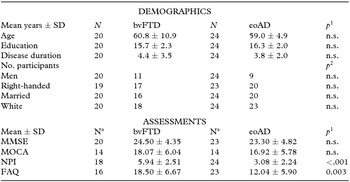
We identified 20 bvFTD and 24 eoAD participants evaluated between April 2010 and June 2014. Mean age, years of education, and disease duration were comparable between groups (Table 1). Although the cognitive scales (MMSE and MoCA scores) were similar between bvFTD and eoAD groups, the participants significantly differed on the other dementia severity measures that assessed neuropsychiatric symptoms (NPI), functional status (FAQ), and dementia stage (CDR and FTLD-CDR).
Demographics (top) and assessments of cognition, neuropsychiatric symptoms, and functional status (bottom) in bvFTD and eoAD participants

1 Two-group t-test was used.
2 χ2 test was used; Behavioral variant frontotemporal dementia (bvFTD); early-onset Alzheimer disease (eoAD); Functional Activities Questionnaire sum (FAQ); Mini-Mental State Examination (MMSE); Montreal Cognitive Assessment (MoCA); Neuropsychiatric Inventory sum of symptoms present (NPI); Not significant (n.s.); Standard deviation (SD).
a Number of subjects varied due to incomplete test data. Lower scores indicate greater impairment for MMSE (0–30) and MoCA (0–30). Higher scores indicate greater impairment for NPI (0–12) and FAQ (0–30).
The bvFTD participants had significantly worse neuropsychiatric scores on the NPI compared to eoAD participants [difference = 2.86, 95%CI: 1.37, 4.35; p < 0.001] (Table 1). Greater functional impairment as measured on the FAQ was also seen in the bvFTD participants compared to eoAD [difference = 6.46, 95%CI: 2.35, 10.56; p = 0.003].
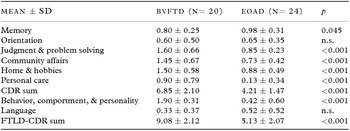
The bvFTD participants had significantly worse overall dementia severity as assessed by the FTLD-CDR [difference = 3.95, 95% CI: 2.67, 5.23; p < 0.001] (Table 2). On the individual items, the orientation and language items were found to be similar between groups; however, all other items were significantly worse in bvFTD, except for memory, which was significantly worse in eoAD.
Analyses of FTLD-CDR individual items between bvFTD vs. eoAD participants

Two-group t-test was used.
Behavioral variant frontotemporal dementia (bvFTD); Clinical Dementia Rating scale 6 item sum (CDR); Early-onset Alzheimer disease (eoAD); Frontotemporal lobar degeneration Clinical Dementia Rating scale 8 item sum (FTLD-CDR); Not significant (n.s.); Standard deviation (SD).
Higher scores indicate greater impairment (individual items scored from 0–3; CDR sum 0–18, FTLD-CDR sum 0–24).
In the adjusted analyses, controlling for FTLD-CDR, the NPI and FAQ scores were no longer significantly different between the bvFTD and eoAD groups. However, both the mean MMSE score and mean MoCA score were greater in the bvFTD group compared to the eoAD group (p < 0.001 and p < 0.05, respectively). Since the distribution of the MMSE score did not pass the normality test, the same regression analyses with the log-transformed MMSE were performed and the results were found to be similar.
Discussion
In clinical research studies, it is important to compare participants with different types of dementia with a measure that can control for the shared or common aspects of having a dementia; this is particularly true in bvFTD research. Executive function and behavior are most affected in bvFTD participants, whereas in AD, the “prototypical dementia” usually used as a comparison group, memory is primarily affected, along with visuospatial function and language. Investigators commonly use the MMSE and other global tests of cognitive function to match bvFTD and AD participants; however, this cognitive assessment is skewed to AD and is not comprehensive enough to account for the salient aspects of bvFTD. This study found that tests of cognitive function are insufficient for matching bvFTD and AD participants, as reflected in their continued differences on measures of behavior, function, and dementia stage, and suggests that the FTLD-CDR is a better measure for matching these two dementias.
We found that when bvFTD and eoAD participants with similar disease durations have similar cognitive scores on the MMSE and the MoCA, the bvFTD participants have more disturbances in neuropsychiatric symptoms and function, and are more advanced in dementia stage. Our results are in-line with previous studies that have compared bvFTD and eoAD participants. Rosen et al. (Reference Rosen2004) used the original 6-item CDR and similarly reports that people with bvFTD are worse than those with eoAD in the categories of judgment and problem solving, community affairs, home and hobbies, and personal care, despite comparable MMSE scores. Using the expanded FTLD-CDR, we find that the category of behavior, comportment, and personality is also more impaired among bvFTD participants compared to those with eoAD. Lima et al. (Reference Lima-Silva2013) further report that bvFTD participants have significantly worse function compared to the eoAD participants, as measured by the FAQ. In their study, they matched the dementia groups by the original CDR, and so it is not known if matching by the FTLD-CDR could have created more equivalent groups, as we suggest.
When we controlled for dementia stage with the FTLD-CDR, the dementia groups became comparable on neuropsychiatric symptoms and functional status; however, significantly better cognitive test scores for the bvFTD participants emerged after controlling for FTLD-CDR. This finding illustrates the fact that tests of cognitive function, particularly the MMSE, with its emphasis on orientation (10/30 items), language (8/30), and in smaller part memory (3/30), are not a good measure for evaluating the stage of dementia among people with bvFTD. People with AD would be expected to be worse than people with bvFTD of comparable dementia stage since the cognitive domains assessed by the MMSE are those most prominently affected in AD. Even the MoCA, with its added executive function items, emerged as significantly worse among those with AD compared to those with bvFTD.
Our study has potential limitations. The participants were recruited from a specialty clinic at a tertiary care hospital, and may not be representative of the general population of people living with dementia. We also evaluated only people with bvFTD and eoAD, and cannot generalize these findings to the larger population of those with diseases on the frontotemporal degeneration spectrum or late-onset AD. In addition, many other scales exist for testing cognition (Cullen et al., Reference Cullen, O'Neill, Evans, Coen and Lawlor2007), functional status (Desai et al., Reference Desai, Grossberg and Sheth2004), and neuropsychiatric symptoms (Apostolova and Cummings, Reference Apostolova and Cummings2008) in people with dementia, in addition to those used in this study, and we do not know how the FTLD-CDR would have fared in the context of these other measures.
Currently, there is no optimal measure for comparing people with different dementias. We found two cognitive scales, the MMSE and the MoCA, to be insufficient measures for ensuring comparability between bvFTD and AD groups, even at similar disease durations. The FTLD-CDR, which was developed, in part, for this purpose, may be better than cognitive scales for matching participants on global dementia stage, and should be considered for use in research studies. Future studies are warranted to create an even more comprehensive and accurate scale that can allow for comparisons between various types of dementia.
Conflict of interest
Dr. Mendez has previously received a grant (#R01AG034499-05) from the NIH, and receives royalties from Oxford University Press, Cambridge for book publications. The remaining authors have reported no conflicts of interest.
Description of authors’ roles
Mariel B. Deutsch, MD contributed to the design of the study, performed statistical analysis, analyzed the data, and wrote the article. Li-Jung Liang, PhD was responsible for the statistical design of the study and assisted with carrying out the statistical analysis and writing the article. Elvira E. Jimenez, MPH assisted with formulating the research question, designing the study, and analyzing the data. Michelle J. Mather, MA assisted with data collection and writing the article. Mario F. Mendez, MD, PhD formulated the research question, designed the study, and assisted with analyzing the data and writing the article.