INTRODUCTION
The continuous presence of a solitary wild bottlenose dolphin in a small coastal area can generate strong public interest. This attraction can result in an increase in boat presence in the proximity and may be harmful for the dolphin (Lockyer, Reference Lockyer, Leatherwood and Reeves1990; Samuels et al., Reference Samuels, Bejder and Heinrich2000).
High boat traffic may lead to the disturbance of bottlenose dolphins and could potentially cause the animals to alter their behaviour accordingly. Previous research has documented various strategies employed by bottlenose dolphins to avoid or reduce boat interaction. Several bottlenose dolphin populations have been observed avoiding boats by increasing the amount of time spent underwater (Janik & Thompson, Reference Janik and Thompson1996; Nowacek et al., Reference Nowacek, Wells and Solow2001; Lusseau, Reference Lusseau2003). Strategies used to avoid boat interaction are more likely to occur in smaller groups of dolphins than in larger groups (Nowacek et al., Reference Nowacek, Wells and Solow2001; Constantine et al., Reference Constantine, Brunton and Dennis2004).
The presence of a solitary male bottlenose dolphin in a small bay of the Ferrol firth (north-western coast of Spain) from 2003 until 2005 generated public interest hence, increasing the probability of boat interaction. As such, the aim of this study was to provide the first quantified data of diving behaviour of a solitary male wild bottlenose dolphin and to determine if he would modify his diving behaviour with the presence of boats. A focus on individual animals provides the basis for quantitative measures of behavioural events and duration of dives, all of which supply the basis for direct comparisons between boat disturbance conditions. By knowing more about the relationship between diving behaviour and boat disturbance conditions, it enables us to make more informed and wiser decisions about the conservation and management of bottlenose dolphins.
MATERIALS AND METHODS
Study area
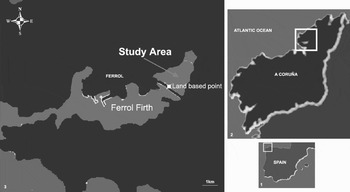
Observations were carried out within a bay at the end of the Ferrol firth (43°29′N 008°15′W), on the north-western coast of Spain (Figure 1). This is a relatively small bay (6 km2 area) delimited in the north by a bridge that traverses the firth east to west, and by the mouth of the River Xubia on the south side. Because it is a relatively narrow channel tidal currents are strong. The study area is characterized by a muddy bottom with a maximum water depth changing from 6 to 10 m dependent on tides. The area was used consistently by a variety of boats including motor boats used by clam fishers. Commercial dolphin watching trips were not operating in the area, although small private boats organized trips to observe the solitary dolphin.
Map of the study area (43°29′N 008°15′W), showing the location of the land based observation point.

Field procedure
Between April and August 2005, observations of a solitary male bottlenose dolphin were made from a land-based point, on the 15-m high bridge, that delimited the study area on the north side. Systematic surveys were made during daylight hours, at rising and falling tide, only when sea state was between 0 and 3 on the Douglas sea force scale. Observations were made with 10 × 50 binoculars and the naked eye by a minimum of two observers. This land platform was essential to record bottlenose dolphin behaviour that was undisturbed by the presence of researchers, to conduct observations in absence and presence of boats.
Throughout this study, we use the term ‘diving’ to refer to the subsurface behaviour of the bottlenose dolphin, involving information on dive duration (Hooker & Baird, Reference Hooker and Baird2001). Dive intervals were defined as the elapsed time between two breaths of the dolphin. The solitary bottlenose dolphin was encountered and identified in situ based on natural marks on the dorsal fin (Würsig & Jefferson, Reference Würsig and Jefferson1990). During the study, the bottlenose dolphin usually moved in front of the land based observation point for several hours each day. Dive intervals were successfully timed with a stopwatch and approximated to the nearest second, while simultaneously collecting data on different behavioural events prior to dives. Behavioural events prior to dives were defined by Shane (Reference Shane, Leatherwood and Reeves1990) as: (1) regular dive (only the blowhole, part of the back, and the dorsal fin are exposed); (2) tail-stock dive (the dolphin arches its back and exposes its peduncle but not its flukes); and (3) flukes-up dive (the dolphin arches its back and exposes its flukes as it dives). In addition, the number of boats present in the area was collected every 20 minutes.
DATA ANALYSIS
The duration of a respiratory sample can influence the overall mean dive time for that sample. It is expected that the correlation between the two variables will decrease as sample time increases. Partial correlations were calculated between the sampling period and mean dive interval in order to determine the threshold where the correlation was no longer significant (Williams et al., Reference Williams, Trites and Bain2002). Two respiratory samples beneath the threshold were discarded.
For each collected respiratory sample, the average dive time was calculated for the three different observed behavioural events prior to dives (regular dive, tail-stock and flukes-up). The range and overall mean dive time were obtained from these data in order to avoid influence by the frequency of events prior to dive during a sample. This technique measures the duration of the dives while presenting a perspective on the surfacing behaviour, rather than solely the dive duration.
The boat disturbance was recorded using two arbitrary categories (‘absence of boats’ and ‘presence of boats’) to compare diving behaviour during conditions of ‘control’ (no boats present) versus presence of a potential ‘boat disturbance’. The boats were only included if their position was within 100 m of the dolphin.
The data was analysed using a generalized linear mixed model (GLMM) to examine the role of boat disturbance on the diving time of the solitary bottlenose dolphin. The GLMM is useful for fitting linear relationships with non-Gaussian data distributions (McCullagh & Nelder, Reference McCullagh and Nelder1989). Generalized linear mixed models are also useful for accommodating the overdispersion often observed among non-normally distributed responses and for modelling the dependence among responses inherent in longitudinal or repeated measures data by incorporating random effects (Stiratelli et al., Reference Stiratelli, Laird and Ware1984).
The analysis was blocked for sample number, duration of respiratory sample and behavioural event prior to dive. Behavioural event prior to dive was treated as a random variable and sample number was treated as a covariate. To follow the assumptions of the GLMM (normality, homogeneity of variance and normality of residuals and linearity) the response variable (mean dive time) was Log10 transformed, and the residuals were examined. If the GLMM showed significant inequality of the means, a Tukey's post-hoc contrast was performed. Statistical significance was tested at the P < 0.05 level. The data are presented as means ±SE.
RESULTS
Between April and August 2005, over 110 h were spent observing the solitary wild bottlenose dolphin. Duration of respiratory samples was not related with the length of mean dive intervals (Spearman's correlation, ρ = 0.23, P = 0.19, N = 34) and all respiratory samples were analysed. A total of 4260 dive intervals was recorded, corresponding to 34 respiratory samples lasting over 7200 seconds. These samples had a mean duration of 11,244 ± 42 seconds.
The solitary bottlenose dolphin displayed dive intervals ranging between 1 and 375 seconds in length (mean = 62.6 ± 5.4).
The solitary bottlenose dolphin was accompanied by boats in 45.2% of respiratory samples. The number of boats in close proximity to the solitary bottlenose dolphin ranged from one to 15 boats, with a median value of 2 boats (mean = 2.7 ± 0.5).
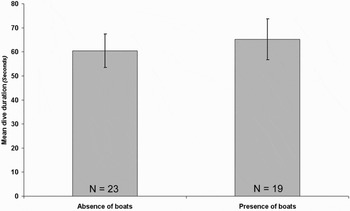
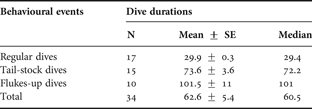
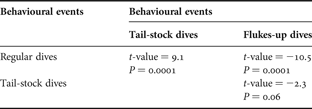
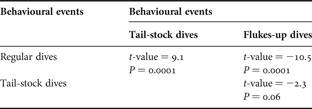
The GLMM explained 77.3% of the variability of length of dives and indicated that the solitary bottlenose dolphin diving behaviour did not have any significant variation between the absence and presence of boats (F1,41 = 1.14, P = 0.29, Figure 2). The only significant factor influencing the duration of dives was the behavioural event preceding the dive (F2,41 = 71.6, P = 0.000). This relationship allows an objective discrimination between two different types of diving behaviour (Tables 1 & 2). Moreover, there was not any significant interaction between the abundance of boats and the behavioural events prior to dive (F4,41 = 1, P = 0.42).
Distribution of dolphin dive duration in presence and absence of boats (N represents the number of respiratory samples; error bars represent the standard error).

Distribution of bottlenose dolphin dive durations (in seconds) with relation to behavioural events prior to dives.
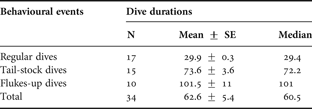
N, number of respiratory samples; SE, standard error.
Results of the Tukey's post-hoc contrast comparing behavioural events to all others.
DISCUSSION
These results provide the first quantified data on solitary dolphin diving behaviour and how this behaviour is not related to the presence of boats. Changes in dive patterns are commonly used as indicators of disturbance (Janik & Thompson, Reference Janik and Thompson1996; Díaz López et al., Reference Díaz López, Mussi, Miragliuolo, Chiota, Valerio and Evans2000; Ritcher et al., Reference Ritcher, Dawson and Slooten2001; Nowacek et al., Reference Nowacek, Wells and Solow2001). These measures may be indicative of avoidance reactions, and some researchers have claimed these as the most sensitive indicators of cetacean responses to vessels (Baker & Herman, Reference Baker and Herman1989). Our results may have meant that the solitary dolphin did not associate the proximity of boats with either potential danger or a negative effect on prey movement. The absence of a behavioural response to potential disturbance can be due to a variety of factors. It could be explained by the slow movement and predictable manner of the boats. Other studies have shown that the type of vessel interaction with the dolphins did not matter as much as the manner in which the boats moved around the dolphins (Lusseau, Reference Lusseau2003). Other studies have also shown an absence of negative (avoidance) or positive effects (attraction) of a limited amount of boat traffic on cetaceans (Jones & Swartz, Reference Jones, Swartz, Swartz and Leatherwood1984; Blane, Reference Blane1990; Ollervides, Reference Ollervides2001). The area is mostly frequented by daily clam fishers, and these boats are characterized by slow movements in the channel and predictable straight line patterns. These fishing boats rarely approached the solitary bottlenose dolphin directly. Occasionally, the lack of response signifies that no effect has occurred.
Otherwise, it may indicate that the solitary bottlenose dolphin has become habituated to the stimulus. Research on mammals exposed to frequent anthropogenic presence has shown that they usually become habituated to benign human presence, e.g. chimpanzees, Pan troglodytes (Johns, Reference Johns1996), grey whales, Eschrichtius robustus (Jones & Swartz, Reference Jones, Swartz, Swartz and Leatherwood1984) and bottlenose dolphins (Samuels et al., Reference Samuels, Bejder and Heinrich2000; Lusseau, Reference Lusseau2003). ‘Habituation’ can be defined as a ‘response decrement as a result of repeated stimulation’ (Abramson, Reference Abramson1994). Habituation has obvious survival value: it enables an animal to ignore stimuli that do not transmit any biologically significant information (e.g. about prey or predator presence), thereby minimizing energy that may be wasted on fleeing from ‘false alarms’ and giving it more time to engage in behaviours that enhance foraging or reproduction. In addition to identifying habituation status, it is important to know what costs are incurred by such changes in wariness to human activity. In particular, lone sociable dolphins suffered serious injuries or were dead as a result of their ‘habituation’ to humans (Lockyer, Reference Lockyer, Leatherwood and Reeves1990; Samuels et al., Reference Samuels, Bejder and Heinrich2000).
The existence of a relationship between the length of dives and the different behavioural events prior to dive was consistent with results observed in bottlenose dolphin populations (Shane, Reference Shane, Leatherwood and Reeves1990). Additionally, this relationship was not altered by boat presence. The two different ‘types’ of diving behaviour observed during this study confirm that bottlenose dolphin dive durations were not homogeneous. This view is supported by the relationships observed between regular dives and shorter dives, and tail-stock and flukes-up dives with longer dives. These last two behavioural events prior to dive are strongly associated with foraging (Shane, Reference Shane, Leatherwood and Reeves1990), and the long duration of dives has been associated with searching and catching prey (Baird et al., Reference Baird, Hanson and Dill2005). Many researchers have shown bottlenose dolphin mean dive durations in the order of 20–30 seconds (Würsig, Reference Würsig1978; dos Santos et al., Reference dos Santos, Xavier, Lazaro and Evans1990; Shane, Reference Shane, Leatherwood and Reeves1990; Lynn, Reference Lynn1995; Fortuna et al., Reference Fortuna, Bearzi, Nortarbartolo di Sciara and Evans1999; Casale, Reference Casale and Evans2000), which are shorter than those displayed by the solitary bottlenose dolphin. These dive durations, with maximum dives longer than 5 minutes, indicate that feeding behaviour could be the prevalent activity. Surfacing patterns characterized by long dives have been related to feeding activities (Gunter, Reference Gunter1954; Norris & Prescott, Reference Norris and Prescott1961; Hussenot, Reference Hussenot1980; dos Santos & Lacerda, Reference dos Santos and Lacerda1987; Bearzi, Reference Bearzi, Politi and Notarbartolo di Sciara1999) and a high availability of prey (Thompson & Fedak, Reference Thompson and Fedak2001; Cornick & Horning, Reference Cornick and Horning2003). Furthermore, the research site is characterized by strong tidal currents and high abundance of several fish species (local fishers, personal communication), leading us to consider the study area as a feeding area for the solitary dolphin (Harzen, Reference Harzen1998; Ingram, Reference Ingram2000). Animals tend to be attracted to food that is clumped or patchy in distribution (Krebs, Reference Krebs, Krebs and Davies1978). The dolphin presumably can reduce the proportion of time spent searching for food and possibly increase the quantity and quality of the food he consumes.
In summary, this study shows a solitary bottlenose dolphin did not vary his diving behaviour in relation to boat presence. The rare presence of ‘dolphin watching’ trips, the behaviour of fishers and the feeding activities could contribute to the absence of behavioural changes. Further studies are necessary to know the relationship between diving behaviour and the manner in which the boats approach the dolphin in order to implement precautionary management proposals that take into account the potential effects of boats on bottlenose dolphins.
ACKNOWLEDGMENTS
This study would have not been possible without the help and cooperation of the non-profit organization SGHN (Sociedade Galega de Historia Natural). We are grateful for the constant support that Mr Díaz d'a Silva contributed throughout this study. The English grammar was improved by Collette Thogerson. We would also thank Dr Ann Pulsford and two anonymous referees who provided valuable comments and critiques at various stages of this study.