Introduction
CI is one of the most disabling conditions in old age (Singh-Manoux et al., Reference Singh-Manoux2012). Defined as a progressive reduction in memory and thinking skills, CI reduces individuals' ability to be independent and has severe consequences on overall health. CI diminishes seniors' ability to effectively and accurately communicate pain to healthcare providers, cope with chronic disease symptoms, adhere to medication instructions, carry out functional activities of daily living, and perform self-care (Hart and Bean, Reference Hart and Bean2010). CI is closely correlated with increased care-giver burden and healthcare costs, and is a diagnostic criterion for Major Neurocognitive Disorder (American Psychiatric Association, 2013). CI has been shown to be prevalent in the resident population of long-term care homes, even among residents who have not been formally diagnosed with an impairment (Cahill et al., Reference Cahill, Diaz-Ponce, Coen and Walsh2010).
The ability for cognitive stimulation exercises to assist in counteracting cognitive decline and impairment is well-documented (Luttenberger et al., Reference Luttenberger, Donath, Uter and Graessel2012; De Oliviera et al., Reference De Oliveira2014; Dias de Macedo et al., Reference Dias de Macedo2015). For example, in a study by Luttenberger et al., 139 nursing home residents were assigned to six months of group cognitive stimulation delivered by a therapist or treatment as usual. Residents assigned to the stimulation program showed significant reductions in symptoms of dementia, as determined by nurses’ ratings. De Oliviera et al. also assessed the impact of a six month cognitive stimulation program, delivered in groups by therapists to individuals living in long term care homes or in the community. Both groups showed improved cognitive performance after the stimulation program, but the improvements were greater among the institutionalized participants. This study, however, did not contain a treatment-as-usual CG. Dias de Macedo et al. assessed the cognitive performance of the participants from the De Oliviera et al. study 2, 4, 6, 8, and 12 months after the end of the stimulation program. They found that the benefits of the program waned after as little as four months. The results of these studies are consistent with a Cochrane review by Woods et al. (Reference Woods, Aguirre, Spector and Orrell2012) who concluded from 15 randomized controlled trials that cognitive stimulation programs have a significant beneficial impact on cognition in persons with CI that lasted up to three months after the programs were completed.
Although these previous studies provide promising results on the cognitive benefits of stimulation in CI, to our knowledge the vast majority of prior research has relied upon paid, professional staff to deliver these programs. Thus, the leap from research to practical application remains a challenge for long-term care homes which are often faced with limited resources (e.g. funding, personnel) to meet the growing needs of an ever-expanding population of older adults (Canadian Institute for Health Information, 2011). The current study set out to explore the feasibility and efficacy of “re-tooling” an existing resource, specifically volunteers, to provide a sustainable means of implementing such a service, and to compare the effects of this service on patients’ cognitive functioning to the effects of a control, typical “friendly visitor” interaction.
Previous studies which have examined the use of volunteers to implement care-based programs have been limited and mostly small-scale. The results of such studies, however, have typically been positive with trained volunteers affecting change in targeted skills or behaviors. For example, Holmberg (Reference Holmberg1997) designed a volunteer-assisted clinical intervention to decrease unsafe wandering and reduce interpersonal tension on a dementia unit of a nursing home. The intervention was a walking program for physically active persons with severe dementia which aimed to meet residents' physical activity and social needs, a task which nurses and aides had no time to facilitate. Volunteers received brief training, a structured walking program, and a schedule to implement. On average, a clinically significant 30% reduction of aggressive events was shown. Inouye et al. (Reference Inouye1999) conducted a large-scale study which involved 852 patients (70+ years) and examined the Hospital Elder Life Program (HELP) – a multidisciplinary approach to caring for hospitalized patients at risk for functional decline, specifically delirium (an acute state of confusion and disorientation). The primary goals of HELP were to maintain cognitive and physical functioning of high risk older adults throughout hospitalization, maximize independence at discharge, assist with the transition from hospital to home, and prevent unplanned hospital readmissions. Volunteers each received 16 hours of training and then provided personal, supportive attention to vulnerable older patients as an integral part of the multidisciplinary program. Volunteer interventions targeted six risk factors for delirium: CI, sleep deprivation, immobility, visual impairment, hearing impairment, and dehydration. The interventions significantly lowered repeated episodes of delirium in patients in the intervention group. Such an effective application of facilities' volunteers calls for the research to be extended beyond wandering, language, and delirium prevention. In the closest study we could find to ours, Arkin (Reference Arkin1996) had student volunteers deliver a language and memory stimulation program for patients with Alzheimer's. Seven out of the 11 patients who completed the program increased their post-intervention scores by 9%, 14%, 48%, 58%, 93%, 161%, and 238% over baseline. However, this study lacked a non-stimulation CG.
Research objectives and hypotheses
The present study was designed to explore the feasibility and efficacy of an eight-week block of three-times per week volunteer-administered cognitive stimulation program compared to a treatment-as-usual CG. The materials and exercises for the stimulation program were taken from commonly used therapy materials, selected to effect changes in memory, reasoning, and attention, as these three domains are commonly affected by CI (American Psychiatric Association, 2013). Outcome measures included measures of memory and reasoning. It was hypothesized that the SG would show greater gains in memory and reasoning compared to the CG. In order to assess the specificity of the stimulation program effects, additional tests measuring other cognitive domains including vocabulary, working memory, and visuo-spatial processing were administered; we did not expect improvements on these tasks given that they were not directly addressed in the program.
Methods
The study was approved by the Research Ethics Boards of Queen's University (Kingston, Ontario, Canada) and Baycrest (Toronto, Ontario, Canada). For eight weeks, in the Spring and Summer of 2013, three times each week, for 20 minutes each visit, CG participants and volunteers met for standard “friendly visits” (casual conversation between a resident and volunteer) and SG participants met with volunteers to work through a variety of exercises meant to stimulate the reasoning and memory abilities of residents using uncomplicated, verbal (spoken and/or written) exercises. A cognitive battery was administered before and after the block of volunteer visits.
Settings and participants
Residents and volunteers were recruited from two long-term care homes. Both facilities are located in an urban setting and provide long-term care focused on the needs of older adults. All 37 of the resident participants were 65+ years of age; proficient in spoken English; had normal or corrected visual and auditory acuity; and were not currently taking psychotropic medications which might affect cognitive functioning. All 16 of the volunteer participants were recruited from the lists of existing volunteers in both long-term care homes. To participate in this study, the volunteers were required to have spoken and written proficiency in English.
Participant group allocation
Thirty-seven residents were enrolled in the study. To be enrolled in the study, residents had to submit, to the researcher (LVZ), a signed consent to participate form. Thirty-seven signed forms were submitted. Signed forms were numbered in the order in which residents submitted them. The numbered forms were then filed away. The 37 resident participants were then pre-tested by the researcher (LVZ), in a random order, based on resident availability. Following testing, resident test material and numbered consent forms were matched. By number, residents were then alternately allocated to either the SG or the CG, by the researcher. Nineteen resident participants were allocated to the SG and 18 to the CG. Following the withdrawal of one SG resident after three volunteer visits, there were 18 residents in the SG and 18 in the CG who completed eight weeks of visits and subsequent post-testing.
As with resident participants, volunteers were alternately allocated to either the SG or CG. Eight volunteer participants were allocated to the SG and eight to the CG. All of the 16 volunteers who started the study completed the study.
Interventions
Volunteer training
All volunteers received two hours of group training. The training contained both general and group-specific topics. General topics included directing volunteers to greet resident participants with a smile, the discontinuation of visits if residents became anxious or agitated in any way, and finishing each visit on a positive note. Following general training items, group-specific training items were reviewed. In the CG volunteer training, the format of a standard “friendly visit” was reviewed and rehearsed – a salutation followed by back and forth conversation with the resident about everyday topics such as personal health, personal histories, and current events, both personal and global.
In the SG volunteer training, volunteers reviewed cognitive challenges faced in aging and each volunteer was given a folder divided into three sections. Each section contained several exercises from each focus skill – reasoning, attention, and memory – with exercises ordered from least to most challenging. Volunteers were directed that one exercise from each focus skill had to be completed in each visit, for a minimum of three exercises per visit. SG volunteers were introduced to each of the stimulation exercises by discussing how the exercise aimed to target and stimulate a specified cognitive ability, reading through the instructions, and by rehearsing the administration of the exercise with another volunteer. They discussed and rehearsed how to progress through the activities, from least to most difficult.
Stimulation exercises
The reasoning, attention, and memory exercises used by the SG were taken from speech–language therapy and education workbooks and activity packages (Fogler and Stern, Reference Fogler and Stern1988; Foster, Reference Foster2004; Tomlin, Reference Tomlin2007a; Reference Tomlin2007b; Kaiser et al., Reference Kaiser, Romero-Davis, Schott and Yacono2008; Yacono et al., Reference Yacono, Schott, Romero-Davis, Kaiser and Galajda2008; PAPP International, 2012). Each exercise was chosen to suit the possible range of skills and abilities that might be found in the residents and volunteers participating in the study. The attention exercises were intended to support both memory and reasoning.
Nine reasoning exercises were included in the program. Residents were asked to match emotions to situations, match actions to consequences, and search for differences or incongruities in pictures. Residents were asked to distinguish between fact and opinion, to name objects by attributes (e.g. “What beverage can you drink hot or cold?”), or to put items in logical sequences (e.g. “search, lose, find”). They were also asked to mentally solve two-digit addition, subtraction, and multiplication problems and to complete number sequences.
The attention-stimulating exercises were word searches and card games which required attention to complete. Word searches were in large print and involved residents finding words hidden in a page of letters. For each of the card games (Red Card Double Down, Whole Deck Double Down, Peas & Carrots, and Step-by-Step) residents had to sort through either a partial deck or a whole deck, organizing cards by suits and/or in number order.
The six memory-stimulating exercises were word recall, delayed word recall, information recall, backward digit span, paragraph editing, and concentration played with playing cards. For the recall exercises, residents were asked to orally recall as many of the five or ten common items or names which had just been presented to them both orally and visually (volunteer would say the items/names while showing the resident a large card with the items/names printed on it). The stimulus items could be recalled in any order. For delayed recall, residents were asked at the end of the visit to verbally recall as many of the five or ten items that had been presented to them visually and orally at the start of the visit. In backward digit span, a series of three, four, or five numbers was verbally presented and residents had to immediately repeat the digits backwards. For paragraph editing, residents were shown a paragraph with errors which they had to correct. Depending on residents’ fine motor abilities they were given the option of making corrections on the sheet of paper or making corrections verbally to the volunteers. Concentration was played by having the volunteers place 10 or 20 cards face down on a table and asking the resident to match pairs of cards.
Control group visit structure
CG volunteers were trained to administer a standard, 20-minute, “friendly visit”. Visits were not scripted in order to allow conversations between a volunteer and a resident participant to develop organically. Our goal was for the CG visits to resemble what was already occurring in the facility. In both participating long-term care facilities, friendly visitors were previously trained by the respective facility to provide a salutation and were given general ideas for topics of conversation. CG volunteers visited two to three residents individually in each “shift”. They generally saw the same residents each shift, but were sometimes covered the shifts of other volunteers when it was required, essentially replicating real-life volunteering.
Stimulation group visit structure
SG visits were more structured. In the first visit, SG volunteers were instructed to spend approximately half (10 of the 20 minutes) of the visit involved in social conversation with each resident in order to establish a relationship. The remaining ten minutes were to be spent introducing the three types of exercises in which the residents would participate – reasoning, attention, and memory. Volunteers were to introduce the first exercise in the reasoning section of the folder, the first exercise in the attention section of the folder, and the first exercise in the memory section of the folder. Each section's first exercise was intentionally short to accommodate time needed for relationship building. The first reasoning exercise asked residents to look at a picture of a situation and apply logic to the picture in order to provide five visible reasons to substantiate why a specific emotion would be felt in that situation. The first attention-stimulating exercise was a relatively simple, five-word, word search. The first memory exercise was a five-word, word recall exercise. Residents who achieved 80% correct on exercises (four out of five correct), moved to the next exercise in that section of the folder. Residents who struggled to, or could not, achieve 80% correct on an exercise would jointly correct the exercise with the volunteer and then either repeat the same exercise in the following visit or would work through an almost-identical exercise during the following visit or visits until 80% correct was achieved. 80% correct was the percentage chosen to represent task mastery in this study.
In the second visit and onward, volunteers were instructed to start each visit with a salutation, a few social niceties, and then start work on the exercises. One exercise from each of the three sections had to be done, but volunteers were permitted to work through two or three exercises from each section, if time permitted.
Within each section of the folder (reasoning, attention, memory), exercises were grouped by activity. For example, reasoning activities included match emotions to situations, match actions to consequences, search for differences or incongruities in pictures, distinguish between fact and opinion, name objects by attributes, put items in logical sequences, mentally solve two-digit addition, subtraction, and multiplication problems, and complete number sequences. Within each group of reasoning activities, exercises were ordered from least to most challenging. The level of challenge was determined by an activity's content and the quantity of items to complete. This study introduced exercises to residents in the established order in which they appeared in the published therapy and education workbooks and activity packages – from least to most challenging. Each section of the folder (reasoning, attention, memory) contained approximately 75 exercises to accommodate up to three exercises being done in each of the three visits each week for eight weeks.
As with the CG volunteers, SG volunteers visited two to three residents individually each shift. They generally saw the same residents each shift, but sometimes covered the shifts of other SG volunteers when it was required.
Measures
Basic demographic data were collected from resident participants and their files, specifically age, gender, primary language, level of education achieved, and whether or not a resident had a diagnosis of dementia. Specific details concerning each resident participant's type and stage of dementia were not collected given that the goal of our small study was to determine feasibility and efficacy. It is important to note, however, that both homes contained additional wards/floors for residents diagnosed with moderate to severe impairment. Therefore, only residents with questionable or mild impairment were available for recruitment in this study.
Four standardized test batteries, two standardized tests, and one further test were administered for the pre-testing and post-testing of each resident. None of the tests administered had alternate forms. Two tests from the Wechsler Abbreviated Test of Intelligence – Second Edition (WASI-II; Wechsler, Reference Wechsler2011) standardized test battery were used as measures of general cognitive ability. The tests include normative data for ages 6:0-90:11 years, and consist of the Vocabulary and Matrix Reasoning tests. The Vocabulary test consists of 31 items (3 picture items, 28 verbal items) and is designed to measure an examinee's word knowledge and verbal concept formation. The examinee names objects presented in pictures, and defines single words that are read aloud by the examiner and presented on a card. Zero is the score given for incorrect responses or no response, one point for partially correct responses, or two points for each completely correct response. The test has a possible total score of 59. The Matrix Reasoning test, consisting of 30 items, asks examinees to solve incomplete matrices or series. One point is given for each correct response for a possible total of 30. Data reported are age-corrected T scores (mean = 50, standard deviation = 10). It takes approximately 15 minutes to administer the two-subtest version of the test. The test manual reports split-half reliability coefficients of 0.97 for the Vocabulary test and 0.94 for the Matrix Reasoning test (Weschler, Reference Wechsler2011, p.112).
The Test of Memory and Learning-Senior Edition (TOMAL-SE, Reynolds and Voress, Reference Reynolds and Voress2012), which tests the memory abilities of seniors, includes normative data for ages 55:0-89:11, and takes approximately 25–35 minutes to administer. Three subtests assess Immediate Verbal Memory: Memory for Stories (MFS), Word List Learning (WLL), and Object Recall (ObR). MFS requires examinees to recall the details of two short stories read by the examiner; the examinee receives a point for each element of the short story repeated correctly for a possible total score of 54 points. WLL is a list-learning task that contains five trials. Each trial is a 10-word list. After each list's words are read aloud by the examiner, the examinee is immediately asked to recall the 10 words, in any order, scoring one point for each word recalled correctly. In the ObR subtest, the examiner presents a page of 15 pictures (3 rows x 5 pictures), names each, and then withdraws the stimulus. The examinee is immediately asked to recall the name of each item, scoring one point for each item recalled correctly, regardless of sequence. There are five pages of 15 pictures each in the subtest for a possible maximum score of 75 points. Scores from the three subtests are combined to form the Immediate Verbal Memory Index and are reported as age-corrected Standard Scores (mean = 100, standard deviation = 15). Alpha reliability estimates for seniors have been calculated as 0.89 for MFS, 0.89 for WLL, 0.93 for ObR, and 0.96 for the Verbal Memory Index (Reynolds and Voress, Reference Reynolds and Voress2012).
The Learning Index, reported in Standard Scores, is a composite of WLL and ObR and assesses the “acquisition or learning of new information” (Reynolds and Voress, Reference Reynolds and Voress2012, p.45), which are both also part of the Verbal Memory Index. The alpha reliability coefficient for the Learning Index was 0.95 (Reynolds and Voress, Reference Reynolds and Voress2012).
Three TOMAL-SE subtests assess Immediate Non-Verbal Memory: Facial Memory (FM), Visual Sequential Memory (VSM), and Memory for Location (MFL). FM is a non-verbal task in which the examiner presents pictures of faces to the examinee. After looking at the picture(s) for 5 to 20 seconds, with exposure time increasing as the stimulus pictures increase in quantity and become more detailed, the examinee is then presented with a page containing a variety of faces and asked to “Put a chip on the face(s) you saw.” One point is given for each face correctly identified for a possible maximum score of 41 points. VSM is a nonverbal subtest that requires examinees to recall a series of four, five, or six irregular shapes in a specific order. When the stimuli have been withdrawn, another picture containing the same shapes is immediately presented to the examinee and the examinee is then asked to point to the shapes in the order that they appeared on the stimulus page. With a maximum score of 31 points, MFL is a nonverbal task that assesses spatial memory when the examinee is presented with a set of 4 to 9 large dots distributed on a page and then asked to recall the locations of the dots, in any order, for a maximum total of 79 points. These scores are combined to form the Non-Verbal Memory Index and are reported in Standard Scores. Alpha reliability for FM has been estimated to be 0.81, for VSM 0.87, 0.92 for MFL, and 0.94 for the Non-Verbal Memory Index (Reynolds and Voress, Reference Reynolds and Voress2012).
Delayed Memory is assessed by combining scores for the Facial Memory Delayed (FMD), Memory for Stories Delayed (MFSD), and Object Recall Delayed (ObRD) subtests. FMD asks the examinees to identify faces that were presented to them at the start of the battery, in the FM subtest. The examiner asks, “Have you seen this face before?” A point is given for each correct “yes” or “no” response. There are 40 items in this subtest MFSD asks the examinee to recall the elements of the two short stories heard in the MFS subtest. A point is awarded for each story element recalled correctly for a possible maximum score of 54 points. ObRD asks examinees to recall and identify the 40 items presented to them in ObR. A point is awarded for each correct object recalled for a maximum total of 40 points. Alpha coefficients have been estimated as 0.92 for FMD, 0.90 for MFSD, 0.98 for ObRD, 0.97 for the Delayed Recall Index (Reynolds and Voress, Reference Reynolds and Voress2012). Data are reported in Standard Scores.
The three further cognitive tests administered were the CDT, the Action Word Verbal Fluency Test, and a modified JS test; these are commonly used for screening seniors. The Action Verbal Fluency Test (VF) aims to assess working memory, planning, organization, and word retrieval. Examinees were asked to generate as many action words/verbs (i.e. eat, smell, etc.) as possible, within 60 sec. One point is given for each word stated. The test takes approximately 1–2 minutes to administer; the VF has a test–retest reliability of 0.73, and good convergent validity with other tests of fluency, working memory, and executive functioning (r = 0.20 - 0.59) (Woods et al., Reference Woods2005).
For the CDT, examinees are given a sheet of paper with a circle on it and are asked to follow a two-step instruction: “This is a clock. Please draw all the numbers on it and the time “ten past eleven.” This two-minute test was originally developed to assess visuo-constructional abilities, but it also requires language comprehension, numerical knowledge, planning, and memory. To score the test, the 6-point Shulman et al. (Reference Shulman, Gold, Cohen and Zucchero1993) scoring method was employed. Test–retest reliability has been reported ranging from 0.76 (Mendez et al., Reference Mendez, Ala and Underwood1992) to 0.94 (Manos and Wu, Reference Manos and Wu1994). Inter-rater reliability has been reported ranging from 0.85 (Eggins et al., Reference Eggins, Gustafsson and Cooke2010) to 0.97 (Rouleau et al., Reference Rouleau, Salmon, Butters, Kennedy and McGuire1992).
The modified LS test, the only non-standardized test administered, aims to assess working memory and concentration. Subjects are asked to spell a five-letter word forwards, then backwards, and then in alphabetical order. One point is given for each. The test usually takes approximately two minutes to administer. In a comparison of CI versus healthy controls, the LS test was found to have a sensitivity of 85%, a specificity of 88%, and a positive predictability value of 95% (Leopold and Borson, Reference Leopold and Borson1997).
All testing was completed by the first author who has a professional background in special education and psychometrics.
Results
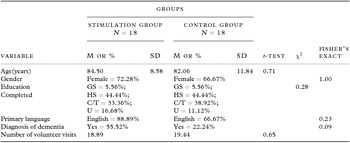
Descriptive statistics concerning the participants in the CG and SG groups are presented in Table 1. Independent samples t-tests were used to compare groups on continuous variables, and either χ 2 or Fisher's exact tests on the categorical variables. Group differences in age, gender, education, language, dementia, and number of visits were not statistically significant (all ps > 0.05). The only difference which approached significance was that regarding diagnosis of dementia (p = 0.09); marginally more people assigned to the SG had a diagnosis of dementia compared to the CG.
Descriptive statistics of resident groups and group comparisons

Note. GS = grade school, HS = high school, C/T = college or trade school, and U = university. All statistical tests are two-tailed. For t and Χ2 , computed values are shown (all ps were nonsignificant); for Fisher's Exact Test, probability values are shown.
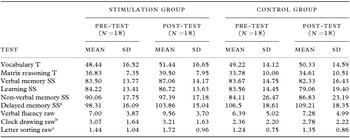
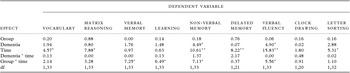
Table 2 shows test means and standard deviations. Three of the tests have reduced numbers of participants: for Delayed Memory, 39% in pre-testing (SG participants = 9, CG = 5) and 36% in post-testing (SG = 8, CG = 5) said it was too difficult and asked to stop the test before the test's discontinuation marker; for Clock Drawing, 39% in both pre- and post-testing (SG = 6, CG = 8) lacked sufficient manual dexterity, due to arthritis and missing digits; and for LS one participant in the CG stated that the test was too difficult at both time points. ANCOVA were used to examine group differences in test scores. The within-subjects variable was Time (pre- and post-test scores), the between-subjects factor was Group (Stimulation or Control), and the covariate was Dementia (because it had approached significance in the pre-test comparisons). A summary of the ANCOVA results is presented in Table 3.
Means and standard deviations of all measures in both groups

Note: T = t-Score (M = 50, SD = 10); SS = Standard Score (M = 100, SD = 15); Raw = Raw Score.
a Means and standard deviations reflect n = 13 in the Stimulation Group (SG) Pre-Test, n = 14 in the SG Post-Test, and n = 12 in the Control Group (CG) Pre- and n = 14 in the CG Post-Test.
b Means and standard deviations reflect n = 14 in the SG Pre- and Post-Test and n = 11 in the CG Pre-Test and n = 9 in the CG Post-Test.
c Means and standard deviations reflect n = 17 in the CG Pre- and Post-Test.
Summary of ANCOVA results (F values and significance levels)

*p < 0.05; **p < 0.01.
The covariate effect of Dementia was significant for two variables, Non-Verbal Memory (p = 0.042) and Fluency (p = 0.034). The interactions of Dementia and Time (pre-test/post-test) were not significant; however, showing that the Time effects were independent of prior diagnosis of dementia. There were no significant main effects of Group for any test.
Most of the variables showed Time effects, indicating improved performance at post-testing relative to pre-testing, likely due to practice effects. However, the effects of interest were the interactions between Group and Time, where practice effects are controlled for and the participants in the SG showed greater improvements from pre- to post-testing than those in the CG. Participants in the SG showed greater improvements from pre- to post-test than did those in the CG in Verbal Memory, F (1, 33) = 7.25, p = 0.011, η2 p < tex − math/ > = 0.18; Learning, F (1, 33) = 6.49, p = 0.016, η2 p < tex − math/ > = 0.16; Non-Verbal Memory, F (1, 33) = 7.13, p = 0.012, η2 p < tex − math/ > = 0.178; and VF, F (1, 33) = 5.56, p = 0.024, η2 p < tex − math/ > = 0.161.
Discussion
This study examined the feasibility and efficacy of a volunteer-administered, low resource, cognitive stimulation program. Efficacy was determined using standardized measures which have been extensively tested in other contexts (WASI-II, TOMAL-SE, the Action Word Verbal Fluency Test, and the CDT), and another non-standardized measure that has been used in dementia screening, a modified LS test. Results demonstrated that the program provided measurable gains in the cognitive abilities of older adults residing in long-term care. Significant gains were found in three areas of immediate memory (verbal, nonverbal, and learning), and in verbal fluency. These results demonstrate that it is possible, in a relatively brief amount of time, to improve long-term care residents’ ability to acquire new information and access their general knowledge in a fluent manner. It is worth noting that these gains were found despite the fact that marginally more people in the SG had a diagnosis of dementia compared to the CG (~55% and 25%, respectively) and our analyses controlled for dementia diagnosis. These results provide the very promising suggestion that volunteer-led cognitive stimulation has positive effects on episodic learning and verbal fluency, regardless of participants’ cognitive status.
The results of the present study are consistent with those of other studies in the area of geriatric cognitive stimulation. Many studies have addressed memory, attention, and reasoning abilities; provided participants with a number of weekly stimulation visits; and conducted pre- and post-intervention testing to measure possible changes in the abilities of participants. Meta-analyses of such studies have consistently reported that the cognitive stimulation exercises and programs resulted in “moderate” to “significant” improvements in the cognitive abilities of older adults, including in those with diagnosed dementia (Woods et al., Reference Woods, Aguirre, Spector and Orrell2012).
The significant contribution of the present study is its demonstration of significant cognitive gains made by its older adult participants in the context of a practical, resource-efficient, and sustainable program. Our results demonstrate that effective cognitive stimulation need not be delivered solely in the context of the essential, professional services provided by trained therapists, but that these services can be delivered by volunteers. The fact that statistically significant changes in the cognitive abilities of participants have been reported in programs administered by professionals and by volunteers in this study is important to note. It suggests that similar beneficial results can be obtained from properly trained, yet volunteer assistants. Given the documented physical and psychosocial benefits afforded to volunteers associated with their volunteer work (Anderson et al., Reference Anderson2014), a volunteer-administered cognitive stimulation program for long-term care residents could be a win-win for both parties.
The stimulation intervention did not have specific effects on delayed memory; this suggests that although the seniors in the SG improved in their ability to acquire new information, helping them retain that information remains a challenge. Perhaps activities more focused on retention of newly learned information over longer delays would have helped in this regard. Future studies with larger samples of both resident participants and volunteers should also examine the specific effects of characteristics such as gender, age, education, and diagnosis (those with normal cognition versus those with a diagnosis of Major Neurocognitive Disorder) on the delivery and effectiveness of the intervention.
Limitations
A larger sample of resident participants would have helped to increase the confidence in the generalizability of the results to a larger population of older adults. A future study should also use a randomized, controlled design to better help ensure the validity of the results of the clinical trial, with the assessor fully blinded to participants’ assignment to condition, which was not the case in this pilot study due to feasibility. This study examined only the immediate effects of a volunteer-led cognitive stimulation program. Future research should include longer-term follow-up assessments to determine the duration of these benefits. Previous studies employing professional therapists have determined that the cognitive benefits of stimulation programs dissipate by four months (Dias de Macedo et al., Reference Dias de Macedo2015), but whether the same applies to a volunteer-led program should be determined.
Another limitation was in the study's measures. Two of the tests (Delayed Memory and Clock Drawing) were too difficult for a third of the participants, which may have reduced our ability to detect changes in these tests' scores; alternative, easier measures should be employed in future studies. There was only one measure of reasoning (Matrix Reasoning); other measures of reasoning may have been more sensitive to the intervention format and participant population. While the positive effects of the intervention on memory and verbal fluency may be mediated by improved attention, the effects of the program on more targeted measures of attention also need to be assessed.
This study did not employ alternate forms at pre- and post-test; nevertheless, the fact that the gains in immediate memory and fluency were greater in the stimulation than CG indicates that the stimulation program conferred benefits over and above those attributable to re-test or practice effects alone. Moreover, strong evidence has been put forth to support the idea that modeling for practice effects is a more robust approach to this problem than is dealing with the often substantial differences in difficulty between forms of particular tests (Gross et al., Reference Gross2012).
Important in future research would also be to examine the impact of volunteers’ characteristics that may impact their instructional effectiveness. Looking at such volunteer characteristics in other contexts, such as peer tutoring, may provide information on how they may influence treatments and interventions.
Conclusion
Research into cognitive interventions for seniors with CI is a relatively new enterprise. Most studies in this area have shown moderate to significant gains made by the older adults who participated (Woods et al., Reference Woods, Aguirre, Spector and Orrell2012). The results have led to increased interest in such programming. To meet this new demand, communities and long-term care facilities are searching for ways to actualize the publicized theories and results, in a practical and sustainable manner. The present study investigated a means to lower the barriers to providing such services.
This study demonstrates the feasibility of organizing and providing a cognitive stimulation program for older adults in long-term care. Its real strength, however, lies in the efficacy of having the program delivered by an organization's existing volunteers, a practical and sustainable resource. The present study's results provide a strong impetus for other organizations to develop volunteered-administered cognitive stimulation programs in long-term care facilities and community organizations supporting the needs of older adults. Future research should determine if these effects, in turn, have beneficial effects on residents’ functioning and care as well as on healthcare costs, through an improved ability to communicate with healthcare providers and adhere to medication instructions, for example.
Conflict of interest
None.
Description of authors’ roles
Lorraine van Zon designed the study, collected, and analyzed the data, and wrote the paper. John R. Kirby supervised the study's statistical analysis and assisted with the writing of the article. Nicole Anderson supervised the data collection, assisted with the statistical analysis, and edited the article.