In addition to patient factors that lead to an increased risk for healthcare-associated infections (HAIs), such as tracheal intubation or bladder catheterization, extrinsic factors must also be considered in the pathophysiology. For example, suboptimal hand hygiene is a well-known correlate of infection,Reference Won, Chou and Hsieh 1 as are environmental factors such as contaminated surfaces and equipment.Reference Russotto, Cortegiani, Raineri and Giarratano 2 Infection control procedures have demonstrated effectiveness in reducing HAIs,Reference Weiner, Fridkin and Aponte-Torres 3 but HAIs still occur in concerning numbers, and the increase in prevalence of antimicrobial resistant organisms places additional strains on patients and workers in the healthcare environment.Reference Hidron, Edwards and Patel 4 Evidence that risk may be driven by occupancy characteristics of the patient care unit is increasing, even though multiple definitions of occupancy are used.Reference Kaier, Mutters and Frank 5 To accurately capture the risk for HAIs, researchers not only need to be clear about the definitions of occupancy used in their work but also need to apply the most appropriate statistical techniques for evaluation of the association between the occupancy exposure and HAI outcome.
DEFINING OCCUPANCY
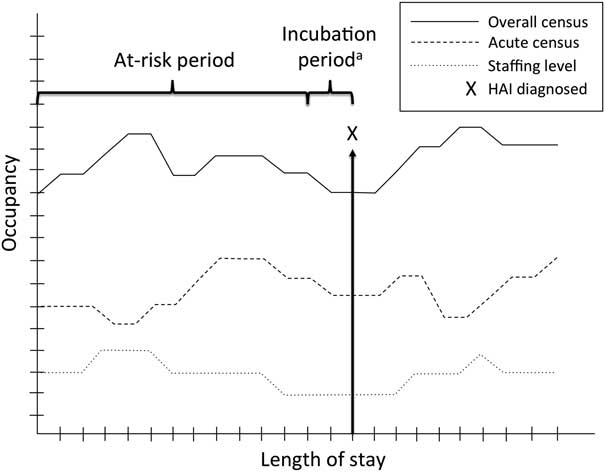
Occupancy is an imprecise concept that can refer to the number of occupied beds (census) or patient characteristics (acuity), and it influences healthcare worker demands (ie, staffing) (Figure 1). Importantly, occupancy may not be an actual cause but rather a proxy for factors that correlate to an increase in risk for HAIs (or other patient harm). For example, it may not be the number of patients in the unit but rather the increased demands on healthcare staff that leads to burnout, breakdown in hygiene procedures, and patient exposure to pathogens that lead to infection.Reference Cimiotti, Aiken, Sloane and Wu 6
The relationship of occupancy to length of stay for a hypothetical patient with a healthcare-associated infection. NOTE. HAI, healthcare-associated infection. a Incubation period may only be available for lab confirmed infection from known organisms, without colonization.

Before selecting the most appropriate occupancy variables, researchers need to consider the phenomenon under study. The potential causal pathway and mechanisms for HAIs must be considered to properly define an occupancy measure that is appropriate for the study and meaningful to those who can act upon it. For example, patients who are intubated represent a higher acuity level. The pathophysiology of ventilator-associated pneumonia may be a function of the number of occupied beds, reflecting time constraints on the staff leading to suboptimal hand or pulmonary hygiene. Therefore, a census measure of occupancy may be most appropriate. On the other hand, it may not be the number of occupied beds that places time constraints on the staff but rather how much hands-on time is required with each patient that motivates the use of an acuity-based occupancy measure. Perhaps the most appropriate measure is a combination of both number of patients and level of acuity. The number of choices and combinations highlight the difficulty in measuring and standardizing occupancy.
OPERATIONALIZING OCCUPANCY MEASURES
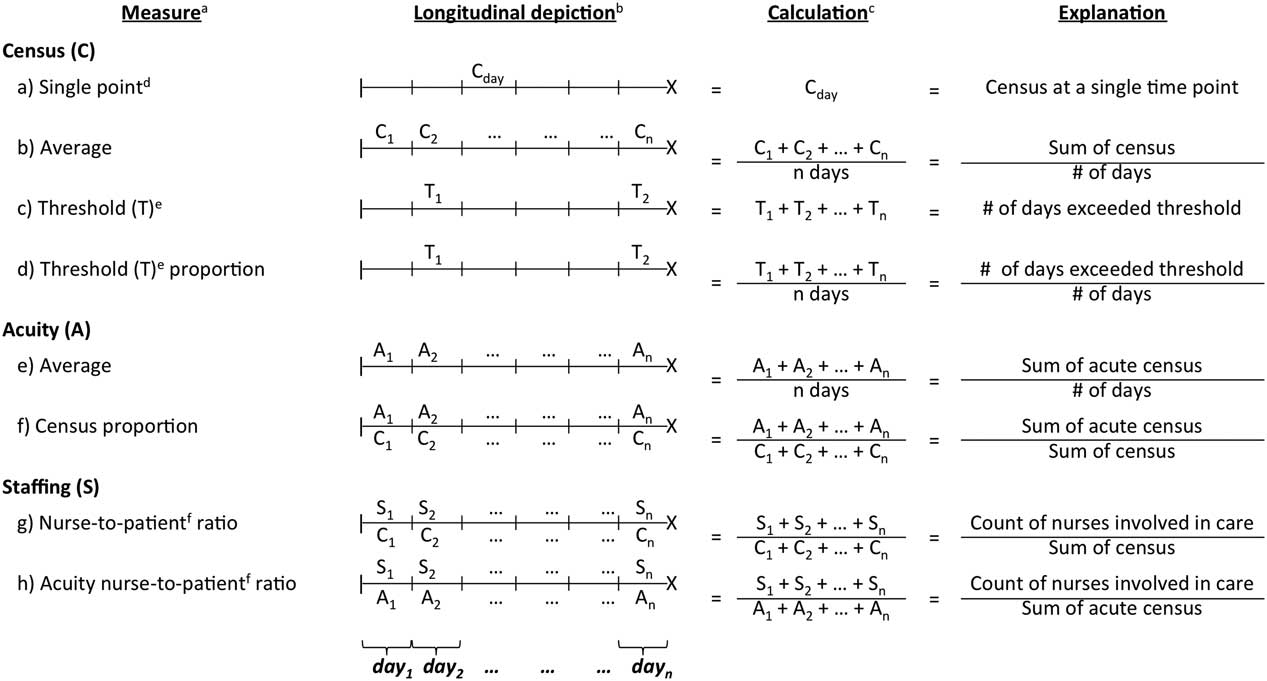
While it may appear trivial to count the number of occupied beds, acute patients, or staff members, in fact, several factors need to be considered. Many such factors change over time for each patient, and capturing and modeling these dynamic fluxes can be difficult. To simplify these aspects of care, the relevant data can be condensed into a single, static, unchanging measure for each patient (Figure 2).
Measures of occupancy and corresponding calculations. a All measures should only be calculated for the at-risk period defined as time from admission to healthcare-associated infection (minus the incubation period if available) or discharge, death, or transfer. b At-risk period concludes at X (event or censoring) in depiction. c Subscripts denote each day during stay of length 1 to n, where n concludes the at-risk period. d Census at a single time point, eg, upon admission, as long as the time occurs during the at-risk period. e The numerator is incremented for each day the census met or exceeded the threshold. f Although typically assessed as a nurse-to-patient ratio, other staff roles can be utilized in this measure.
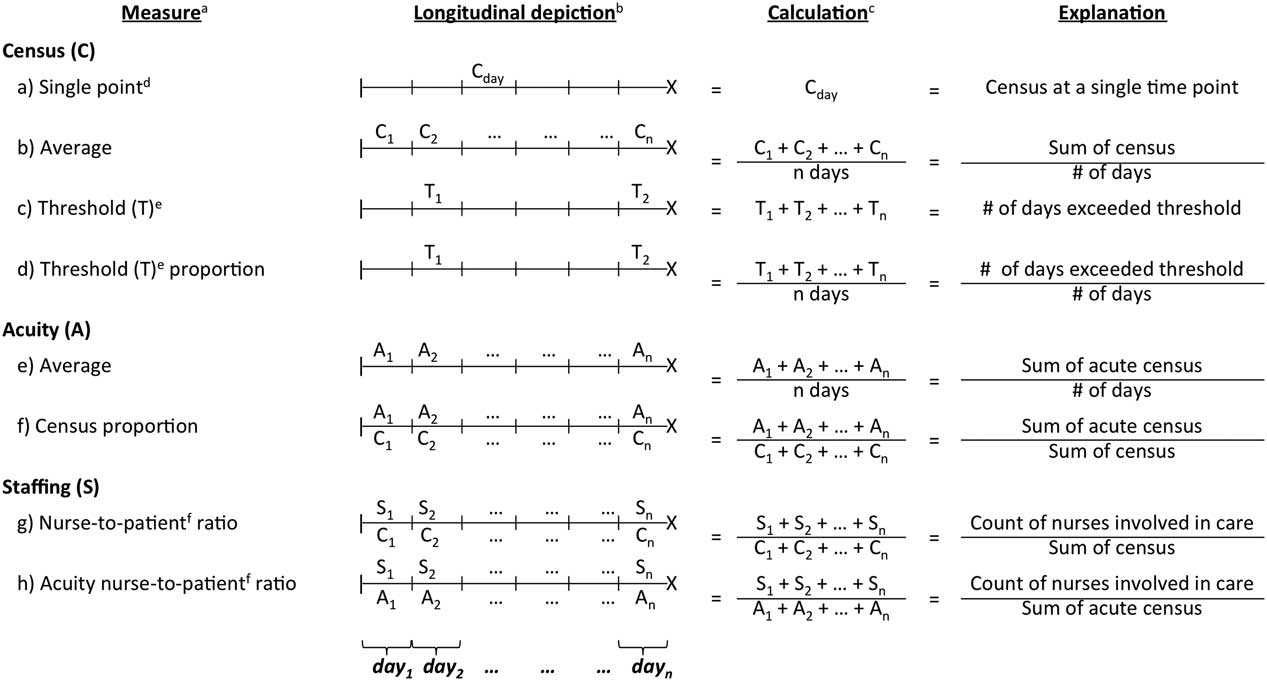
Census, a measure of the number of occupied beds, can be operationalized in several ways depending on the phenomenon studied. For example, when considering a surgical site infection requiring a short length of stay, the census on the day of surgery may be the most important metric (Figure 2a). If the risk for HAIs is constant over the course of the stay, it may beneficial to use the average census over the at-risk period (Figure 2b). Alternatively, the census effect may depend upon departmental characteristics. For example, an occupancy thresholdReference Orendi 7 may trigger additional infection control procedures or redirect patients to other units. This version of a census measure could be operationalized as a count of the number of days exposed to a “high” census, or it could become a proportion of total days for which the threshold was met or exceeded (Figures 2c and 2d, respectively).
Acuity measures of occupancy are based upon the census, but the characteristics of the patients in the unit should be considered. Accordingly, some factors corresponding to patient acuity need to be available. These data may be physiologic, such as the clinical risk index for babies score (CRIB) commonly used in neonatal intensive care units, or a surrogate of infant acuity, such as being <32 weeks in gestation.Reference Goldstein, Eppes, Ingraham and Paul 8 Regardless, these markers suggest that certain babies are in need of more health services than other babies, and the provision of these services may place increased demands on the unit or alternation in care practices, which potentially place patients at risk for HAIs. This variable can be calculated as the average acute census during the at-risk period (Figure 2e) or as a proportion of the total census (Figure 2f).
Staffing, on the other hand, can be viewed as a consequence of occupancy; staffing levels consider the patient and service volume, budget, experience and credentials, and other institutional factors.Reference Clarke and Donaldson 9 Staffing data can be expressed as the ratio of nurses (or other healthcare workers) to patients (Figure 2g), and thus are related to census. If markers of acuity are available, the measure can incorporate a refinement to the denominator from total census to acuity-based census (Figure 2h), according to the hypothesis that number of acutely ill patients is of greater concern for HAIs than the total number of patients.Reference Gagliardi, Corchia, Bellù, Coscia, Zangrandi and Zanini 10
These static measures of occupancy all assume that exposure is constant over the length of stay. It is also possible to calculate a dynamic, day-by-day measure of the census, acuity, or staffing, such as a moving average, but these measures require advanced modeling techniques.
ISOLATING THE OCCUPANCY EFFECTS THROUGH REGRESSION MODELING
The association between occupancy and HAIs can be estimated in a variety of ways. For a typical cohort study examining incidence, the outcome is binary for each patient: either an HAI occurred or it did not. In this case, logistic, Poisson, or Cox regression would be most appropriate to estimate the odds of exposure (logistic), incidence rate ratio if follow-up time is available for each patient (Poisson), or hazard of HAIs over the length of stay (Cox). For dynamic measures in which the exposure changes over time for each patient, a logistic model can incorporate repeated measures and a Cox model can incorporate occupancy as a time-varying effect. These models predict the likelihood of an HAI occurring for each patient, each day. For example, perhaps it is not the averaged high census that indicates patient risk but rather a single spiked increase in census that points toward a risk of an HAI the following day.
Regardless of the technique used, these models assume (often incorrectly) that the presence of an HAI for one patient does not affect the risk of an HAI for another patient. To account for this, colonization pressure can be included, that is, the proportion of patients in the same unit/area as the at-risk patient who harbor the disease of interest.Reference Bonten, Slaughter and Ambergen 11 Department design and patient location may influence the occupancy effect: private rooms may better protect against infection than semi-private or open-bay designs.Reference Lester, Hawes and Abar 12 The location of a patient when an HAI occurs may correlate to environmental contamination and may also relate to staff assignments; the healthcare worker becomes an intermediary for transmission of the pathogen when staff assignments are clustered by location. In practice, it may be worthwhile to model occupancy assuming that risk between patients is not independent using a mixed-effects framework where a clustering unit defines overlapping risk periods per patient, for example, by calendar dates, location, or nursing assignments.
Given the variety of occupancy measures and definitions, it may be difficult to arrive at a consensus of how best to model its effects. Provided multicollinearity can be avoided, we recommend including multiple averaged measures, such as census and acuity, to determine the exact pathway to infection.Reference Goldstein, Eppes, Ingraham and Paul 8 However, the choice is not only contingent upon theoretical causal pathways but also on pragmatic decisions, such as availability of the numerator or denominator. And perhaps most importantly, being explicit about the definition of occupancy will enhance comparability across studies.
ACKNOWLEDGMENTS
Financial support: No financial support was provided relevant to this article.
Potential conflicts of interest: All authors report no conflicts of interest relevant to this article.