I. INTRODUCTION
Adam Smith was an influential banking theorist. So influential, in fact, that the way subsequent generations of monetary economists interpreted The Wealth of Nations set the stage for the great banking controversies of the early nineteenth century. Smith was also an innovative banking theorist. Perhaps his most creative contribution was to argue that competition could automatically regulate the supply of money where each commercial bank is free to issue its own brand of redeemable, fractional reserve banknotes.
Smith’s writing on the subject of money and banking has been assessed by a large number of authors. Surprisingly, few of these authors have given Smith the appropriate amount of credit as a banking theorist. I do not mean to imply that Smith is universally underrated. Rather, as I attempt to show in this article, Smith is in the strange position of being given too much credit by some commentators and not enough credit by others.
The usual view, prominently expressed by Lloyd Mints (Reference Mints1945) and Mark Blaug (Reference Blaug1968), is that Smith was a poor banking theorist who promulgated the real-bills doctrine. According to this interpretation, Smith thought that if banks would discount only short-term merchant bills of exchange backed by real goods in the process of production, then the supply of money would be limited by the value of the collateral and would expand or contract passively to meet the needs of trade. Footnote 1 The less popular view, which is most prominently expressed by David Glasner (Reference Glasner1985, Reference Glasner1989a, Reference Glasner1989b, Reference Glasner1992, Reference Glasner2000) and Lawrence White (Reference White1984), is that Smith was an excellent banking theorist who incorporated banknotes into a price-specie-flow model of the balance of payments, and thereby developed a logically coherent and essentially correct theory of privately issued money.
I believe that both of these views are incorrect. As I attempt to show, Smith never claimed that banknotes loaned on real bills would be self-liquidating, and neither did he integrate banknotes into a price-specie-flow model of the balance of payments. The presumption in the literature is that Smith must have expressed either one of these views or the other. But this is a false dichotomy. What Smith’s theory actually involved was a law of reflux. But Smith’s law of reflux did not entail either the real-bills doctrine or the price-specie-flow mechanism. Although the interpretation is novel, I argue that both Henry Thornton (1802) and Jacob Viner (Reference Viner1937) expressed a fundamentally similar view. And in the more recent literature, David Laidler (Reference Laidler1981) perhaps comes closest to offering an interpretation along the lines developed below.
Smith wrote in The Wealth of Nations that if a bank issues money beyond the amount that “the channel of circulation can easily absorb and employ” (p. 440), Footnote 2 then the excess will return almost immediately to the overissuing bank. My interpretation of Smith’s remarks about the channel of circulation is that he assumed a transaction demand for coins and banknotes that was solely a function of real wealth, and that he erroneously concluded from this premise that the demand for money in countries on a commodity standard is fixed at a particular nominal value. Putting this anachronistically into the language of modern supply-and-demand analysis, it is as if Smith considered the aggregate demand for banknotes to be perfectly inelastic. If banknotes happen to be issued in an amount beyond the quantity demanded, the excess supply of money would “lie idle and unemployed” until its holders realized that they had no other option than to purchase foreign imports, resulting in an outflow of specie. This specie-flow theory of Smith’s denies that an excess supply of money can ordinarily make it into the domestic nominal income stream or influence prices or employment. The essence of Smith’s theory is not, as the real-bills interpretation would suggest, that banknotes are elastic credit instruments that accommodate changes in demand; rather, it is that the supply of money, including banknotes, is forced to regulate itself to a fixed demand. And unlike David Hume’s price-specie-flow mechanism, Smith’s specie-flow mechanism does not point to changes in domestic relative to world prices as the factor motivating market participants to engage in the trades that restore monetary equilibrium.
Below, I present my interpretation of Smith’s writing on the topic of money and banking in much greater detail. My goal is to persuade the reader that Smith did not present either the real-bills theory or a price-specie-flow theory of banknote regulation, but rather a more primitive reflux theory. My hope is that this will clear up a great deal of confusion in the literature and help to bring about a resolution to the debate over Smith’s legacy as a banking theorist.
II. SMITH’S PRICE THEORY
In order to adequately discuss Smith’s theory of money and banking, it is first necessary to provide a brief summary of Smith’s basic price theory. This will also make it possible to show that Smith’s analysis of the specie-flow mechanism is inadequate, even within the context of his own theoretical framework.
Smith recognized that all prices are determined by supply and demand. However, he made a crucial distinction between the “natural price” of a good, which is roughly equivalent to Alfred Marshall’s long-run price, and the “market price,” which is similar to the short-run price. Smith thought that the “natural” price of a good, which competition is always leading toward, is determined exclusively on the supply side by the costs of production, and that these costs do not vary with the rate of output. Conversely, he thought the long-run quantity is determined on the demand side by the “effectual demand,” or the amount that buyers are willing and able to purchase at the natural price.
Smith’s discussion of long-run prices is incomplete, but it is reasonable, given his implicit assumption that production always takes place under conditions of constant costs. It is equivalent to the special case where the long-run supply curve is perfectly horizontal and the demand curve determines the equilibrium quantity but has no influence on the equilibrium price.
In contrast to the “natural” price, Smith reasoned that the actual “market” price of a good is determined by the proportion between the quantity actually brought to the market and the quantity of effectual demand. If the quantity supplied were greater than the quantity effectually demanded, then sellers would lower their prices in order to entice buyers to purchase the excess inventories; and if the effectual demand were greater than the supply, competition between buyers would cause the price to be bid up until the market clears. In the short run the “market” price could be higher (or lower) than the “natural” price, but in that case profits (or losses) would induce the entry (or exit) of producers until, in the long run, the market price equals the natural price and there are zero economic profits.
Smith lacked the apparatus of marginal analysis and did not think in terms of a schedule of quantities supplied and demanded at various hypothetical prices. Footnote 3 Nevertheless, it is possible to construct such a schedule in a way that is consistent with his remarks about what would happen if the market price were above or below the natural price.
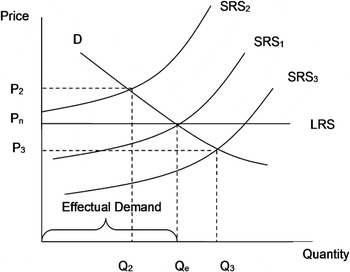
As shown in Figure 1, the natural price (Pn) is determined on the supply side by the cost of production. Footnote 4 The long-run equilibrium quantity (Qe) is determined by the effectual demand, which is depicted as the quantity demanded at Pn. If the actual supply brought to the market were less than the effectual demand, as depicted by SRS2, then competition between buyers would cause the market price (P2) to be bid up higher than the natural price. If the supply brought to the market were greater than the effectual demand, as depicted by SRS3, then competition between sellers would result in price cuts and the resulting market price (P3) would be less than the natural price. In the long run entry or exit causes the supply curve to shift to SRS1, and the supply regulates itself to the effectual demand. An increase or a decrease in demand would cause the long-run equilibrium quantity to change, but would have no effect on the equilibrium price.
Smith’s basic price theory.

III. THE PRICE LEVEL, THE CHANNEL OF CIRCULATION, AND THE INTERNATIONAL DISTRIBUTION OF SPECIE: SMITH’S ANALYSIS OF MONEY SUPPLY AND DEMAND
With Smith’s basic theory of price formation in mind, we are now in a position to make sense of, and evaluate, his analysis of money supply and demand. Analytically, if not organizationally, Smith proceeds as he always does with a supply-determined natural price, and then he confronts this price with the effectual demand in order to find the long-run equilibrium quantity.
According to Smith, the natural price of specie is determined on the supply side in the world market by the costs of production in mining. In the long run, Smith says, the relative price of specie depends “upon the richness or poverty of the mines,” and is equal to “the proportion between the quantity of labor which is necessary to bring a certain quantity of gold and silver to market, and that which is necessary in order to bring thither a certain quantity of any other good” (pp. 328–329).
Smith’s discussion of the demand for money is not as lucid. However, careful attention to detail reveals that he treats the demand curve very much as if it were perfectly inelastic. According to Smith, the sole purpose of holding money is to facilitate the circulation of goods and services. Thus, the inhabitants of a country demand the specific quantity of money necessary to circulate the whole of their goods, and are unwilling to hold either more or less than this amount. As a metaphor, Smith (p. 293) likens this to a channel of circulation of a fixed size that is necessary to accommodate the flow of goods throughout the economy. Footnote 5
If the amount of money in the economy is greater than the amount necessary to circulate goods, then according to Smith the channel of circulation will overflow. The excess money will sit around “lying idle and unemployed” (p. 440) because the domestic circulation is already full. Everyone already has enough money to transact their business, and no one wants to hold any more than this amount. Although the excess coins are useless for making domestic transactions, Smith is quick to point out that they will not lie idle for long because they are valuable and can be used to purchase foreign goods. The temporal sequence of Smith’s specie-flow theory is that the excess coins are thrown out of circulation and lie idle first, and then individuals see that they have a strong interest in exporting the excess coins because there is nothing to do with them domestically.
Here, Smith is asserting a transaction demand for money that is fixed at some given nominal value, instead of employing the correct notion of a transaction demand schedule that varies negatively with purchasing power. Footnote 6 This is strange because Smith (p. 75) had already implicitly recognized in his discussion of price determination that the amount of goods such as “corn, wine, oil, hops, &c.” that people want to buy depends upon their relative prices. The amount of money people want to hold likewise depends upon its purchasing power. If the supply of money happens to be greater than the demand at a given purchasing power, the excess supply will not lie idle and unemployed. On the contrary, the excess money will still be accepted in exchange, it is just that less will be offered in return than if the supply of money were less (and the marginal value were higher).
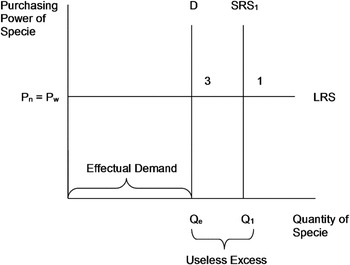
At this point it should be clear that Smith applies his ordinary price theory framework to the case of money, but that his statements imply some specific assumptions about the slope of the supply and demand curves that make his treatment of the specie-flow mechanism unusual. Figure 2 anachronistically depicts Smith’s specie-flow mechanism graphically for the individual country. The natural price of specie (Pn) is determined on the world market by the costs of production in mining, and is therefore equal to the world price (Pw). As always, these costs are not presumed to vary with the rate of output. Thus, the long-run supply curve is horizontal at the world price (Pw) for specie, which is taken as given for the individual country and appears as a perfectly elastic price line. However, since the supply of specie in a particular country is fixed at any given point in time, the short-run supply curve appears on the graph as a vertical line. The demand to hold money is fixed at the nominal quantity necessary to circulate the whole of individuals’ goods throughout the economy, and therefore it is perfectly inelastic and appears as a vertical line at the equilibrium quantity set by the effectual demand (Qe).
Smith’s theory of money supply and demand.

If the supply of money in a country at a given time is greater than the effectual demand, as depicted by SRS1, then no one is willing to hold the excess, and no one wants to spend it, so the surplus money does not circulate. The same quantity of money (Qe) will be used to carry on business as when the supply of money is equal to the effectual demand, and the extra money beyond this quantity is a useless excess that lies idle and unemployed. However, the excess coins are too valuable to lie idle for long, so they are used to purchase goods from foreign countries. On net, the current account in the balance of payments (or the “grand balance,” as Smith calls it) turns negative and specie flows out of the country. The domestic supply of money decreases, shifting the market supply curve to the left until the supply equals the effectual demand and monetary equilibrium is restored.
In the absence of trade restrictions, Smith argues, the quantity of specie in any given country cannot ordinarily deviate much from the equilibrium quantity because of the almost perfect arbitrage in the international specie market. Footnote 7 Any excess supply of specie will be used to purchase foreign goods, and the grand balance will turn negative and specie will flow out of the country until the excess is eliminated. And if there is an excess demand, specie will be acquired in like manner by selling more goods abroad.
Assuming that full-bodied coin is the only type of money in circulation, the domestic price level is determined solely by the inverse of the world price of specie and cannot easily deviate from this level. Smith likens the price level in different countries to the water level in different parts of the same body of water. A barrier in the form of export restrictions on specie may be constructed to keep the level higher in one place than another, but in the absence of some restraining force, it remains at a uniform level throughout. Footnote 8 Smith also notes that, in order for the purchasing power of specie to be the same in all places, those countries with a higher output must have a proportionately greater quantity of specie than those with a lower output. Smith’s conclusion is that the international distribution of specie is naturally self-regulating and proportional to the amount of wealth in each country.
IV. SMITH’S SPECIE-FLOW MECHANISM VERSUS HUME’S PRICE-SPECIE-FLOW MECHANISM
Smith’s argument that the amount of specie in each country is self-regulating has misled some commentators into thinking that he was simply restating the price-specie-flow mechanism that was so eloquently described by Hume ([1752] 1985). Most notably, Robert Eagly (Reference Eagly1970) has argued that Smith’s discussion of the international distribution of specie is the same as Hume’s, “except for the fact that Smith focused on the specie market and the commodity price of specie rather than on the commodity markets and the specie price of commodities” (p. 64). Footnote 9
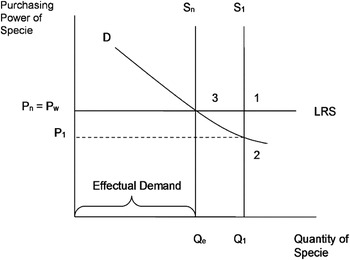
In order to identify how Smith’s theory differs from Hume’s, it is easiest to consider Eagly’s “Humean” interpretation of Smith graphically and compare it with my interpretation as presented above. According to Eagly’s interpretation, the world price of specie, as shown in Figure 3, is still determined on the world market by the costs of production in mining, and this price is taken as given for the individual country and appears as a perfectly elastic price line. And the supply of specie at any particular time is still assumed to be fixed, and so it appears on the graph as a vertical line. However, the crucial distinction is that the demand for specie is now supposed to be downward sloping instead of vertical.
Hume’s price-specie-flow theory.

In the long run, self-interest will drive the supply curve to Sn and the market price of specie will tend toward the natural or world price (Pn). If the supply of specie at any point in time happens to be greater than this amount, say S1, then the price will have to fall in order to induce people to hold the excess. So in the short run, the domestic market price will fall to P1. However, the recognition that the domestic market price is below the world price will induce individuals to purchase foreign goods because the purchasing power of specie is higher overseas. This causes the current account to turn negative, and specie will flow out of the domestic country, decreasing the supply until equilibrium is reached at Sn.
The differences between Hume’s discussion of the specie-flow mechanism, as just outlined, and Smith’s theory, as described in the previous section above, are straightforward. Hume says that a monetary disequilibrium will first result in a change in the price level, and that this will cause a divergence between prices in the domestic economy and prices in foreign countries. The difference in the prices of goods at home versus the prices of goods abroad then causes the specie flow that restores equilibrium. For instance, if there is an excess supply of money, then, according to Hume’s price-specie-flow mechanism, the domestic price level first rises, and then because of this individuals are enticed to export specie until equilibrium is eventually restored. In graphic terms, the economy moves sequentially from point 1, to point 2, to point 3, on Figure 3.
In contrast to Hume’s theory, careful attention to Smith’s discussion of the monetary equilibration process reveals that he does not adequately explain the motive that would cause people to send their specie abroad in the event that there is an excess supply of specie domestically. Smith did not say, as Hume did, that the higher domestic price level makes foreign goods appear relatively cheaper than domestic goods, and therefore prices guide the behavior of market participants back to equilibrium. Rather, what Smith said is that there will be more money in the economy than can be usefully employed in circulation, so the excess will be withdrawn and then exported because there is no use for it at home. In terms of the graph, he skips over the intermediate step, moving directly from point 1 to point 3 in Figure 2. The comparative statics result is the same as in Hume’s presentation, but the equilibrating mechanism is missing. Smith’s theory is a specie-flow mechanism similar to Hume’s, but without the “price” part of the story. Footnote 10
Eagly points to the passages where Smith says that an export restriction on specie causes prices to be dammed up to a new height, instead of causing the channel of circulation to overflow, as evidence that Smith thought that changes in the money supply could influence prices and output. Eagly relies on this evidence as confirmation of his thesis that Smith has a price-specie-flow mechanism at work in the background of his discussion of the international distribution of specie.
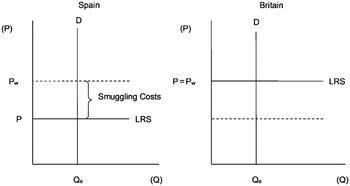
Upon closer examination, however, it becomes clear that these passages in fact provide evidence that Smith does not employ a price-specie-flow framework in The Wealth of Nations. Smith argues that domestic export restrictions act like an extra cost of transportation, which causes the domestic price of specie to diverge from the world price. Footnote 11 As depicted graphically in Figure 4, the difference in transportation costs causes the long-run domestic supply in a country with export restrictions (such as Spain) to remain permanently greater than in countries without export restrictions (such as Britain). The greater supply results in a lower price of specie in terms of commodities. In other words, the price of goods and services is permanently higher in a country with export restrictions than in other countries.
Smith’s theory of permanent price level divergence.

Smith says that the price inflation caused by export restrictions discourages domestic agriculture and manufactures, and reduces output. Footnote 12 This is the opposite effect on output from what would be expected if Smith was assuming a price-specie-flow framework. Smith’s (pp. 433–434) reasoning is that the higher cost of making exchanges acts like a tax and diminishes international trade. Nowhere in his discussion of export restrictions does Smith say that the increase in prices can stimulate employment or output. This is consistent with Smith’s theory of inelastic money demand, which precludes these effects.
Smith even criticized Hume’s price-specie-flow model on exactly this point in his Lectures on Jurisprudence. The lecture notes reveal that Smith provided his students with a good summary of Hume’s price-specie-flow mechanism. Smith acknowledged that Hume’s reasoning is ingenious, but then he criticized his friend’s theory for “having gone into the notion that public opulence consists in money” (1978, p. 507).The inference is that Smith rejected Hume’s logic because the price-specie-flow mechanism concedes that an increase in the supply of money could temporarily cause an increase in spending, and therefore could possibly increase overall employment and output in the short run. In opposition to Hume’s theory, Smith offered his own specie-flow mechanism, which denies that an excess supply of money can ordinarily make it into the domestic nominal income stream or influence prices or employment.
Ultimately, the notion that Smith incorporated the price-specie-flow mechanism into his discussion of the international distribution of specie is untenable. Perhaps this is what Smith should have done. As the eminent economist and peerless historian of economic thought Jacob Viner once said, Smith’s rejection of the price-specie-flow mechanism is one of the great mysteries in the history of economic thought. Footnote 13 The price-adjustment mechanism easily could have been incorporated into Smith’s discussion of money and banking in The Wealth of Nations, but unfortunately it was not. Footnote 14 Smith knew how to express himself, and if he wanted to present the same theory as Hume, he would have described the price-specie-flow sequence the same way that he did when he criticized the price-specie-flow mechanism in his Lectures.
V. BANK-ISSUED MONEY AND SMITH’S LAW OF REFLUX
Smith’s analysis of fractional reserve banking is embedded in a discussion of how this social institution evolves from a state where only commodity money is in use. Footnote 15 Smith (pp. 292–293) notes that bank receipts come to circulate as money if there is confidence that they can be redeemed for specie at any time upon request. At that point bankers quickly realize that they need to hold only a fraction of specie in reserve to meet the occasional redemption demands of their customers, so they begin to issue more banknotes than they have reserves. This raises banks’ profits because the cost of issuing and servicing the banknotes is less than the revenue that can be earned by charging interest for their use.
According to Smith, as banks issue their own banknotes on a fractional reserve basis, the supply of money in the economy increases. All else equal, however, the quantity of money required to circulate goods throughout the economy remains the same as before. As a consequence, the money supply is for a time greater than the amount that the circulation of the country can employ. This situation is the same as the case depicted in Figure 3, which was analyzed above, only now part of the money supply consists of banknotes. The supply of money is greater than the effectual demand, but prices do not increase because the excess supply is not needed for domestic trade and does not circulate. However, as discussed above, the excess money is too valuable to lie idle and unemployed for very long, and will be used to purchase foreign goods. Since foreigners will not accept banknotes except at a heavy discount, specie will be used to make these foreign purchases. Specie leaves the country and the supply of money decreases until it again equals the effectual demand. The end result is that the issue of banknotes simply displaces specie on a one-for-one basis.
Unless regulated, Smith says, banks will find it profitable to keep issuing more banknotes until paper money completely takes the place of gold and silver coins as a circulating medium of exchange. Footnote 16 Thereafter, gold and silver will remain in use only as bank reserves and as a means of making international payments. For example, Smith (p. 293) says that if the quantity of money necessary to circulate the annual produce of the country is £1 million, then banks will issue £1 million of banknotes, keeping perhaps £200,000 of gold and silver as reserves. The other £800,000 of specie is above what the circulation can employ, and will be used to import capital and commodities from abroad. Afterwards, the quantity of money in circulation will consist entirely of the £1 million in banknotes. Footnote 17
Although banks can fill the channel of circulation entirely with banknotes, once this limit has been reached they can no longer profit from issuing more notes. Smith (pp. 301–304) explains that if any individual bank were to issue more paper than can be employed in circulation, the excess notes will be returned for redemption “almost as fast as they are issued.” Since the excess notes are not necessary to circulate goods domestically, they are useless to their holders, and will be immediately exchanged for gold and silver that can be used to make purchases abroad. Footnote 18 This automatic reflux of excessive notes to the bank for redemption causes the bank’s specie reserves to dwindle. But in order to remain in operation, the bank must replenish its reserves. The cost of replacing lost reserves is greater than the trivial interest revenue earned off notes that return immediately, so a bank that overstocks the circulation with its banknotes will experience a reduction in profits. Thus, Smith concludes that self-interest is aligned with the social interest, and the profit motive will generally tend to ensure that banks do not issue more money than the circulation of the economy can employ.
Smith’s reflux theory of banknote regulation, just like his theory of the international regulation of commodity money, relies upon the supposition that the demand for money is fixed at a particular nominal quantity. The rationale behind this assumption is most clearly revealed in the following passage from the more recently discovered of the two lecture notes taken during Smith’s tenure at the University of Glasgow, the Report dated 1762–63:
If now we should suppose that the 6 great banking companies in Scotland should at once issue notes to the amount of 2 mills. These are given out to the merchants who have bank credit. Of the 2 mills of money in the circulation we shall suppose each bank keeps £50000 by them to answer any emergency of demand. The whole six will therefore have 300000 pounds by them. And there will be £1700000 of gold and silver and 2 mills of paper money to carry on the circulation; in all 3700000, so that the money for circulation is nearly doubled. For the paper (as is now the case) is as readily accepted of as the gold or silver, and can be exchanged for it on going to the bank which issued them. But notwithstanding of this the real wealth of no one is increased. If a merchant have bank credit, and being worth £1000 take out £1000 of notes from them, I have still but £1000 of wealth in my possession. The circulation in the kingdom depends on the wealth of the buyers; a man of £10000 will circulate 20 times as much as one of 500, and he five times as much as one of £100 pr annum. Every wise man is sensible that his wealth is not increased by this money, and tho some fools may spend more, thinking they have got an addition to their wealth, the prudent part which is to be supposed the majority will spend in the same manner as before. The exchange or circulation will therefore be pretty much the same as before (as the majority generally act with common sense in this matter), and the same quantity of money will carry it on. The two millions which were sufficient before still answer all the demands. The country can consume no more, and whatever is above that overflows. (Smith Reference Smith, Meek, Raphael and Stein1978, p. 379)
The thing that stands out about Smith’s explanation of the reflux mechanism is that he makes both nominal spending and the nominal demand for money functions of wealth and nothing else. He says the amount of money that individuals will circulate, whether the money consists in coins or banknotes, is determined by the real value of the transactions that they desire to make, which is proportional to their real wealth. Therefore, the amount of money that individuals will use is a constant fraction of the real value of output produced, and is fixed at a particular nominal value. Individuals will freely substitute banknotes for coins in their cash balances, but, holding wealth constant, they will never choose to hold or spend a nominal amount greater than the fixed amount that is necessary to conduct their transactions.
If new banknotes are produced, this increases the supply of money, but it does not alter the amount of wealth in society. Therefore, Smith reasons, the amount of spending and the quantity of money demanded will not change. Since the banknotes are issued by a bank as a loan that must be repaid, the recipients have more money than before but not an increase in their wealth. Consequently, the recipients will not desire to hold more money or spend any differently from before. Moreover, everyone else already has enough money to satisfy their transaction needs, and they also do not want to hold more money or spend more than before. The issuance of banknotes therefore causes an idle surplus of money to develop that no one wants to hold or spend. Smith the moral philosopher admits that a few individuals might spend more, but Smith the economist argues the empirical validity of the rationality assumption and concludes that the vast majority of individuals will realize that they are not richer than before, and therefore their spending behavior, which was already chosen in light of their real wealth, will not change. And since the holders of the excess supply do not wish to spend it or add it to their cash balances, the only way to make use of it is by returning banknotes to the bank and redeeming them for coins. Smith says that these coins cannot circulate domestically any more than the banknotes, given that everyone already has all the cash they desire. But the coins can be used to purchase goods abroad, whereas the banknotes could not. Footnote 19
These remarks clarify the theoretical underpinnings of Smith’s monetary theory as depicted in Figure 2. The role of the price level is completely ignored, and the nominal amount of spending (QeV) is assumed to be determined solely by the real value of the annual production of goods in the economy (Y), or QeV = Y. The effectual demand for money (Qe) is therefore a constant fraction (1/V) of the real value of the annual produce, or Qe = (1/V)Y, and is fixed at a given nominal value determined by Y. If the quantity of money supplied (SRS) is greater than the effectual demand (Qe), the surplus is not spent and does not circulate domestically. Total spending (QeV) in the economy remains constant, and the same quantity of money (Qe) carries on the circulation as before. The excess supply (SRS – Qe) is an idle surplus that no one wants to hold, and is eliminated as individuals convert idle balances of banknotes into specie that can be used to purchase foreign goods.
Smith’s reflux theory, as I have just outlined it, suffers from a number of serious errors. First of all, it lacks internal consistency. If the domestic circulation is assumed to be full and is not willing to admit of any more money, then, on the same grounds, neither should the circulation in foreign countries. Moreover, the theory claims that an issue of additional banknotes will leave people’s spending unchanged, but then claims that specie will be exported to pay for imports of foreign goods. But if the assumption is that no one will make any more purchases than before (abstracting from “some fools”), then how is it that they purchase more goods from abroad?
Another problem with Smith’s theory is that the very idea of a fixed channel of circulation is mistaken. The demand for money is not a fixed value, but a schedule that is inversely related to money’s purchasing power. If there happens to be more banknotes than people want to hold at the existing purchasing power of money—caused, say, by an in-concert overexpansion by all the domestic banks at once—this does not imply an unwillingness to hold on to the excess supply or to spend it. It just means that the purchasing power of money will fall as individuals spend their excess cash balances. This is the logic of Hume’s price-specie-flow mechanism.
Smith is correct that an increase in the supply of money does not increase real wealth in society. However, the relevant change is not a wealth effect but a substitution effect. Since the marginal utility of any good falls as holdings of it increase, an increase in the stock of money will cause the marginal value of holding money to decrease, and individuals will find that they have excess money balances. Some individuals might take banknotes directly to their bank for redemption, thereby causing a reflux of notes to the extent they choose this course of action. But Smith’s assumption that any excess supply will be automatically returned to the bank is purely arbitrary. If individuals prefer, they could just as easily choose to hold the notes in buffer-stock fashion with the intention of spending the excess on goods and services. In this case the prices of domestic goods will be bid up and a negative trade balance will cause reserve money to flow out of the economy until monetary equilibrium is re-established. Footnote 20
Smith’s analysis appears to suffer from confusion between nominal and real variables. The total amount of spending and the amount of money that is held and exchanged in an economy may be approximately the same following an increase in the supply of domestically issued paper money. But this will be true only after a process of equilibration that is brought about by changes in the nominal values of these variables. Smith ignored the role of the price level completely, and simply concluded that no one will be wealthier or spend more after an increase in banknote production from the premise that society will not be wealthier as a whole. Footnote 21 What is missing in his discussion of the regulation of banknote supply is the same thing that was missing in his discussion of the regulation of the international distribution of specie. In neither case does Smith identify an equilibration mechanism involving a change in the purchasing power of money.
Henry Thornton (1802, pp. 209–211) emphasized this point in his critique of Smith’s theory of banknote regulation:
Dr. Smith does not, in any of his observations on this subject, proceed sufficiently, as I conceive, on the practical principle of shewing how it is through the medium of prices (of the prices of goods in general, and of bullion in particular, compared with the price of the current circulating medium), that the operations of importing and exporting gold are brought about. He considers our coin as going abroad simply in consequence of our circulation at home being over full. Payment in coin, according to his doctrine, is demanded of every bank for as much of its paper as is excessive, because the excessive paper can neither be sent abroad nor turned to any use at home; whereas, when it is changed into coin, the coin may be transmitted to a foreign part, and may there be advantageously employed. The reader will perceive, that, according to the principle which I have endeavoured to establish, coin does not merely leave the country because, the circulation being full, no use can be found at home for additional circulating medium; but that every increase of paper has been represented as enhancing the price of goods, which advanced price of goods affords employment to a larger quantity of circulating medium, so that the circulation can never be said to be over full. This advanced price of goods is the same thing as a reduced price of coin; the coin, therefore, in consequence of its reduced price, is carried out of the country for the sake of obtaining for it a better market.
Thornton’s critique of Smith is perceptive. Smith did not integrate his theory of competitively supplied bank money into a price-specie-flow model of specie regulation, and thus did not present a fully coherent theory of the automatic regulation of the supply of money for a mixed currency that consists of both specie and banknotes. Rather, Smith incorporated bank money into his theory of inelastic money demand to create a less satisfactory law of reflux for excessive banknote issues.
VI. SMITH’S LAW OF REFLUX VERSUS THE MODERN MONETARY APPROACH TO THE BALANCE OF PAYMENTS
Since Smith’s reflux theory postulates that monetary disequilibrium will be corrected directly by an export of specie in exchange for imports of foreign goods, some commentators have leapt to the conclusion that Smith was espousing an early version of the monetary approach to the balance of payments. According to the monetary approach, both the price level and the demand for money are exogenous in a small open economy with a fixed exchange rate, and any surplus of money will automatically flow abroad as individuals work off their excess cash balances by increasing their net foreign expenditures.
A number of authors, including Arthur Bloomfield (1975, pp. 478–481), Lance Girton and Don Roper (1978), Thomas Humphrey (Reference Humphrey1981), and Jurg Niehans (Reference Niehans1990), have argued that Smith’s discussion of the balance of payments contains the fundamental aspects of the monetary approach, and that this explains why he did not link changes in the supply of money to changes in the price level. These authors credit Smith with understanding that the discrepancies in international prices that drive Hume’s price-specie-flow mechanism are precluded by the law of one price, and that equilibration must be brought about through direct spending (the real balance effect) instead of through relative price effects. This interpretation implies that Smith was an extraordinary monetary theorist who had a remarkably advanced understanding of the operations that drive changes in the balance of payments. Footnote 22
On the surface, Smith’s reflux mechanism does appear to be similar to the monetary approach to the balance of payments because both theories hold that an excess supply of money will be corrected directly by an outflow of reserve money. However, Smith did not say that the domestic price level is an exogenous variable imposed by fixed exchange rates and the law of one price, and therefore that the nominal domestic demand for money is fixed. What he said was that the demand for money is a fixed parameter determined by real output and nothing else. And, unlike in the monetary approach, Smith does not link the outflow of specie to an increase in spending brought about by the public’s desire to reduce their cash balances. On the contrary, Smith explicitly states that no one will spend more than before. According to Smith, the excess supply of money is an idle hoard that is not spent and does not circulate, and returns to the bank only because the holders have nothing better to do with it. The export of specie is a by-product of Smith’s theory of inelastic money demand, and the real balance effect does not enter into the discussion.
Interpretations of Smith that treat him as a forerunner of the monetary approach give him too much credit. Smith’s reflux mechanism is a primitive theory that dismisses the role that the price level plays in the monetary adjustment process. This is no less of a defect because the recently developed monetary approach suggests that under the institutional arrangements prevailing in the Scotland of Smith’s lifetime, the price level was determined exogenously and the money stock adjusted endogenously to meet money demand.
VII. SMITH AND THE REAL-BILLS DOCTRINE
While Smith should not be credited as an intellectual predecessor of the monetary approach to the balance of payments, he also should not be blamed for promulgating the long-discredited real-bills doctrine. Following Mints (Reference Mints1945), a large number of authors have mistakenly conflated Smith’s reflux theory with the theory that an inflationary overissue of money is impossible as long as banks lend only against sound, short-term commercial paper (e.g., Blaug Reference Blaug1968; Santiago-Valiente Reference Santiago-Valiente1988). Footnote 23 Notably, scholars including Neil Skaggs (Reference Skaggs1991), Jerome de Boyer des Roches (1998, 2013), and Arie Arnon (Reference Arnon2011) have argued that Smith was espousing an endogenous theory of credit money creation that was the font of that intellectual tradition “that continues through the antibullionists and the banking school to J. Laurence Lauphlin and Benjamin Anderson” (Skaggs Reference Skaggs1991, p. 463). According to this interpretation, Smith thought that if banks would discount only short-term merchant bills of exchange backed by real goods in the process of production, then the supply of banknotes would be limited by the value of the collateral and expand or contract passively to meet the needs of trade. Footnote 24
Contrary to the real-bills interpretation, however, Smith did not say that banknotes are elastic instruments of trade that accommodate fluctuations in business needs. Concern with elasticity is ruled out by Smith’s assumption that the quantity of money needed to circulate goods throughout the economy is fixed. Footnote 25 What Smith says is that the supply of money, including banknotes, is forced to regulate itself to a fixed demand. The automatic reflux of unneeded banknotes hypothesized by Smith is not a statement about the self-liquidating nature of bank-issued money that is issued on loan to finance real transactions. Rather, Smith’s theory states that if the quantity of banknotes supplied is greater than the amount needed to circulate goods, then an idle surplus will form that returns to the bank in exchange for specie that is (and can only be) exported.
Smith did say that banks cannot overissue banknotes if they discount only real bills that are drawn up as a legitimate instrument of finance between trading partners. But the reason he gave was not that banknotes issued to finance real transactions will vary proportionally with real output and therefore cannot be inflationary. The reason he gave was that when a bank discounts to a merchant a bill that is drawn by a real creditor upon a real debtor, the banknotes thus issued would merely replace the specie that otherwise would have been held in that merchant’s cash balance, and thus that the sum of banknotes lent to the merchant in this way could never be greater in face value than the amount of specie that he would otherwise be obliged to use. Footnote 26 Smith reasoned that what is true of the individual merchant is true of all the merchants together, so as long as banks are discounting only legitimate bills, they can rest assured that they have not issued a greater quantity of banknotes than the amount of specie that otherwise would have been needed to carry out transactions in the economy, and therefore that the total amount of banknotes issued is less than the fixed nominal amount of money that can be employed in circulation.
However, if banks are fooled by the process of drawing and redrawing into providing merchants with capital to finance their business operations, instead of merely relieving them of the necessity of holding specie in their cash balances, then, Smith thought, they might soon come to issue a sum of banknotes that is greater than the fixed amount of total money that can be employed in circulation. If this were to happen, the excess notes would not be traded and would be returned to the bank immediately, causing bank reserves to fall below the amount that is required to meet the occasional redemption demands of their creditors. The banks would then be forced to rely on costly endeavors to replenish their coffers, which would bring about a diminution of bank profits and possibly insolvency.
Unlike advocates of the modern-day real-bills doctrine, Smith’s intention was not to devise a policy rule for accommodating the fluctuating needs of business and prevent inflation. Such inflation is precluded by his reflux theory based upon a fixed channel of circulation. Rather, Smith’s discussion of real versus fictitious bills was directed towards explaining why banks had historically increased the supply of money beyond the inelastic demand, thereby bringing about a reflux of excess notes and a drain of specie reserves that could be replenished only at great expense by the banks.
VIII. SMITH’S CONTRIBUTION TO MODERN THEORIES OF COMPETITIVE BANKNOTE REGULATION
Although Smith’s analysis of banking was marred by a flawed monetary theory, he still deserves recognition for pioneering the economic analysis of competitive banknote production. The distinctive and novel feature of Smith’s analysis was his attempt to show that the banking system is guided by the invisible hand, just like any other branch of industry. Footnote 27 Smith argued that the profit motive would ensure that the supply of money is self-regulating even after the development of privately issued banknotes, and that a significant savings in social capital results from using paper instead of precious metals as circulating currency. In this way Smith attempted to show that free competition in the business of issuing currency directs self-interested market participants to unintentionally promote the social interest.
This was an innovative effort that has a number of positive aspects from the perspective of modern theories of competitively produced money, as developed variously by authors such as Benjamin Klein (Reference Klein1974), Earl A. Thompson (Reference Thompson, Horwich and Samuelson1974), Friedrich von Hayek (1976), and George Selgin and Lawrence White (1994). Although these authors approach the topic in different ways, they share in common Smith’s invisible hand conclusion that the profit motive is sufficient under the right institutional arrangements to ensure a stable and well-functioning money supply in a system of competitive money issue. Therefore, Smith deserves credit as the fountainhead of this interesting and controversial line of economic research.
Smith was the first to identify some of the key elements underlying any reasonable theory of a self-regulating money supply for a country on an international specie standard where banknotes are competitively issued and redeemable on demand for gold or silver base money. By considering the costs and benefits of banknote production from the perspective of an individual bank, and by observing that banks that issue too many banknotes suffer reserve losses and a diminishment in profits, Smith crudely anticipated the better developed and more coherent arguments of modern theorists, such as Selgin and White, who analyze the problem under these same institutional arrangements. However, the mechanism that links overissue to reserve loss in Smith’s theory is misidentified. According to Smith, banks lose reserves if they issue banknotes beyond the fixed nominal quantity that the circulation can employ, and thus the fixed channel of circulation is assumed to prevent, simultaneously, both overissue by the individual bank and overissue by the banking system as a whole.
The theory articulated by Smith is a long way off in development from the more reasonable explanation given by Selgin and White, who argue that the supply of money in a system of competitive note issue is determined by the marginal cost and the marginal benefit of banknote production. According to Selgin and White, the money supply in the world economy is anchored by the fixed stock of reserves and the banks’ demands to hold precautionary reserves, and not because the channel of circulation is fixed. Overissue by an individual bank is penalized by adverse clearings with other banks, and in-concert overexpansion is either discouraged at the outset by the higher variance of clearing losses occasioned by an overexpansion of the system as a whole or brought to an end by an outflow of reserve money abroad.
Unlike Selgin and White, Smith did not adequately explain why each individual bank within the domestic banking system would have an incentive to limit its note issues. Smith’s theory of a fixed channel of circulation is untenable, and therefore he did not provide any convincing reason why a bank that issues excessive notes would find its notes in particular coming back for redemption. Smith did not mention the clearing mechanism between banks, and he did not explain why an in-concert overexpansion would be contrary to the interests of the individual banks within the system, or even adequately explain why a system-wide overexpansion would lead to an outflow of reserve money abroad. Thus, while Smith identified many of the important elements that more convincing modern theories of competitive banknote regulation are based upon, he did not link all of the elements together in a convincing way.
A far more generous interpretation of Smith’s contribution to the theory of money and banking has been offered by Glasner (Reference Glasner1985, Reference Glasner1989a, Reference Glasner1989b, Reference Glasner1992, Reference Glasner2000), who eloquently argues that the monetary theory of a number of classical economists, and Smith in particular, is best understood as a theory of competitively produced convertible money in which the nominal quantity of inside money produced by the banking system has no effect on the price level exogenously fixed by the international price of specie.
Glasner credits Smith with understanding, even if he did not have the tools to rigorously explain, that the operation of the banking system must conform to the modern theory of competitively issued paper money for a small open economy with a commodity money base (as developed by Thompson Reference Thompson, Horwich and Samuelson1974) and perfect international commodity arbitrage (as described by Paul Samuelson 1980). According to this model, the real demand for cash balances is a function of the spread between the nominal interest rate and the interest rate paid on cash balances, and the nominal demand for cash balances is determined by the real demand for cash balances and the price level fixed by the world supply and demand for gold. Any monetary disequilibrium is not corrected by the real balance effect, as in the monetary approach; rather, “any excess demand for (supply of) money is offset not by an excess supply of (demand for) real goods but by an excess supply of (demand for) IOUs of the public to be held by the banks as backing for the IOUs they issue” (1985, p. 54).
While the model described by Glasner resembles Smith’s theory in some ways, the similarities are superficial. The model presented by Glasner hypothesizes a complex interrelationship among price levels, interest rates, the demand for holding money, and the quantity of money issued by banks. In contrast, Smith presented a simple theory that ignores the relationship between the price level and amount of money that individuals wish to spend or hold.
Glasner overestimates the similarity between Smith’s theory and his own model because he does not appreciate the key role played by the fixed channel of circulation in Smith’s system. According to Glasner (1992, p. 870), “Smith’s banking theory starts from two premises: that banks can profitably issue notes to replace gold and silver, and that the creation of these notes is governed by the marginal revenue and marginal cost of issuing them (though his theoretical apparatus was too primitive to admit even this degree of formalization).” However, Smith does not merely state that there is an optimal quantity of banknote issue for each particular bank, which is determined by the costs and benefits of banknote production. Rather, when Smith (p. 302) describes an overissue by an individual bank, he assumes a fixed maximum circulation of the bank’s notes that the economy can employ. Smith offers a sort of representative agent model where the fixed channel of circulation is divided up between the different banks such that the demand for each individual bank’s notes is also fixed at a given nominal quantity. If the bank prints more notes than this maximum amount, the demand for money will remain constant because the issue of new banknotes does not alter anyone’s wealth, and there will be an excess supply of money in the economy that will lie idle and unemployed until banknotes reflux to the overissuing bank for redemption in specie.
Smith says that banknotes can push commodity money out of the system, but once the circulation is filled entirely with banknotes, the banks have rendered all of the services that they can give by issuing paper money. Banks will hold the quantity of specie in reserve that is required for honoring the occasional redemption demands of their customers, and if they issue more notes than the limit set by the effectual demand, then the excess refluxes back to the bank and bank reserves will fall below the amount required to service redemption requests. Thus, banks experience a discontinuous jump in costs if they issue more banknotes than the fixed quantity that the circulation can employ because the excess notes reflux immediately in return for specie that has to be replaced at great expense. Glasner (1992, pp. 870–873) notices that Smith assumes a discontinuous jump in costs at a certain point, but does not realize it is connected to the assumption of a fixed channel of circulation. In Smith’s system inflation is assumed away by the supposition that the channel of circulation is fixed, and the profit motive merely encourages banks not to overfill the channel. The mechanisms at work in Smith’s theory are categorically different from those at work in the model presented by Glasner, where perfect international commodity arbitrage prevents inflation and banks adjust their holdings of financial assets to offset any monetary disequilibrium.
Smith took the first step down the road that ultimately led to reasonable modern theories that hold that a competitive monetary system is self-regulating, and he deserves all due credit for this contribution. However, this first step was a modest one and not the giant leap envisioned by Glasner. The current state of knowledge has evolved slowly over time. The major shortcomings in Smith’s presentation were remedied by some of his early followers, such as Peter King (1804), Samuel Bailey (Reference Bailey1825), and George Poulett Scrope (1830), who replaced the idea of a fixed channel of circulation with Hume’s price-specie-flow mechanism and integrated the role of adverse clearings into the theory (White Reference White1984). Modern economists then placed the theory soundly on the foundation of marginal analysis and have suggested more sophisticated mechanisms of monetary adjustment.
IX. CONCLUSION
Adam Smith’s discussion of money and banking in The Wealth of Nations contains a mixture of both strong and weak features. Smith’s central argument against mercantilistism, that the quantity of specie would automatically regulate itself internationally to meet the needs of each nation, contained an important element of truth. But Smith’s attempt to demonstrate this proposition was based upon a flawed specie-flow mechanism of the balance of payments, which held that only a certain amount of money is necessary to circulate goods throughout an economy and that any excess supply would go abroad simply because it would have no use domestically. This was a clear retrogression from Hume’s discussion of the balance of payments, which highlighted the key role played by prices in the equilibration process, and should not be confused with the modern monetary theory.
On the positive side, Smith was the first author to analyze the unique institutional arrangements of Scotland’s competitive banking system, and he managed to make some progress toward understanding how that system worked. Admittedly, his theory of banknote regulation left a lot to be desired because it incorporated a reflux mechanism based upon an outmoded monetary theory. But as mistaken as this theory is, Smith should not be held responsible for diverting monetary theory down the path of the real-bills doctrine. Smith never claimed that banknotes issued on real bills are self-liquidating credit instruments that expand or contract passively to meet the needs of trade. Rather, Smith’s basic premise was that the supply of money was self-regulating even under the institutions of competitive banknote issue that existed in Scotland during his lifetime. This is an interesting hypothesis that may even have been true.
Furthermore, Smith established the building blocks on which better theories were built. He correctly identified that the demand for precautionary bank reserves was an important element in limiting bank expansion and that international specie flows played a crucial role in restoring monetary equilibrium; and he incorporated these ideas into an economic theory based upon the self-interested actions of individuals. Even though Smith did not link all of the elements together in a coherent way, the major shortcomings of the theory were easily remedied by his successors. Smith led the way for others to follow, and he deserves credit for making this positive contribution to economic science.