I. INTRODUCTION
The discovery of carbon nanomaterials, such as fullerenes, nanotubes and graphene, triggered new research opportunities in science and technology. As isoelectronic counterparts to carbon analogs, the boron nitride systems have been extensively investigated due to their high-temperature stability, low dielectric constant, large thermal conductivity and oxidation resistance. Reference Chopra, Luyren, Cherry, Crespi, Cohen, Louis and Zettl1–Reference Srivastava, Menon and Cho9 Different AlN nanostructures have been synthesized and their applications are growing rapidly. Reference Wu, Hu, Wang, Lu, Chen, Xu and Chen10–Reference Chen, Ma, Hu, Wu and Chen22 Wu et al. Reference Wu, Hu, Wang, Lu, Chen, Xu and Chen10 synthesized faceted hexagonal aluminum nitride nanotubes with the length of a few micrometers and diameters from 30 to 80 nm. Liu et al. Reference Liu, Hu, Wu, Wang, Chen, Sang, Zhu, Deng and Xu11 reported the vapor–solid growth of quasialigned AlN nanocones on catalyst-coated wafers via the reactions between AlCl3 vapor and NH3 gas. Lei et al. Reference Lei, Yang, Li and Tang12 synthesized hexagonal AlN nanowires by the direct nitridization method at high temperatures. Lei et al. Reference Lei, Liu, Zhang, Zhu, Cui and Zou13 reported the vapor–solid growth of urchin-like nanostructures in DC arc plasma via the direct reaction between Al vapor and N2 gas. Investigations also indicate that B12N12 and Al12N12 cages have extraordinary stability and can be used as all-purpose building blocks for the synthesis of new cluster-assembled materials. Reference Beheshtian, Bagheri, Kamfiroozi and Ahmadi3,Reference Chang, Patzer, Sedlmayr, Steinke and Sülzle14–Reference Li, Xia, Zhao, Liu, Song, Li, Li and Huang17,Reference Matxain, Eriksson, Mercero, Lopez, Piris, Ugalde, Poater, Matito and Solà23–Reference Liu, Wang, Liu, Zhou, Sui, Wang, Zhu and Hou25
The electronic structure and stability could be changed by introducing different dopants. Hybrid BCN nanomaterials have received considerable attention as the potential materials to tune the electronic behavior of pure C and BN systems. Some hybrid materials have been successfully synthesized. Reference Zhang, Gu, Suenaga and Iijima26–Reference Wei, Wang, Bando and Golberg28 The effect of carbon incorporation on the structure and properties of BCN is quite sensitive to the C concentration. Wurtzite (BC2N) n (n = 1, 2, 3, 4, and 6) clusters have been studied using different theoretical models. Reference Luo, Guo, Liu, He, Yu, Xu and Tian29–Reference Fan, Zhu, Shen and Kuo31 The BN-substituted fullerenes C60−2x (BN) x and C70–2x (BN) x have been investigated. Reference Chen, Ma, Zhao, Pan, Zhao, Tang and Feng32–Reference Pattanayak, Kar and Scheiner34 Similarly, the properties of AlN systems can be tuned through doping different atoms. Reference Zhang, Cui, Wang, Zhang and Lu35–Reference Niu, Yu, Yang, Chen, Zhao and Huang40 Taniyasu et al. Reference Taniyasu and Kasu37,Reference Taniyasu, Kasu, Makimoto and Kobayashi38 have achieved n-type and p-type aluminum nitrides by Si and Mg doping, respectively. Wu et al. Reference Wu, Zheng, Liu, Meng and Huang39 have performed density functional calculations to investigate the energies of separated C acceptor bindings to C n –Si (n = 0, 1, 2, and 3) complexes in wurtzite AlN. Compared with the Mg/O codoping, the C/Si codoping is a more effective p-type doping method for AlN. Niu et al. Reference Niu, Yu, Yang, Chen, Zhao and Huang40 found that doping alkali atoms M (M = Li, Na, K) can be an effective strategy to improve not only the electronic but also the nonlinear optical (NLO) properties of AlN nanostructures. Shakerzadeh et al. Reference Shakerzadeh, Barazesh and Talebi41 investigated the structure, electronic and NLO features of B12N12 and Al12N12 clusters with the group III, IV, and V dopants. In this paper, the structures and stabilities of the electron redundant Al n Si12−n N12 (n = 0, 1, 2, and 4) fullerene-like cages are investigated and compared with those of Al12N12. It is usually considered that electron redundant systems are unfavorable in energy, and the research studies on such clusters are very scarce. The present calculations show that the stabilities of Al n Si12−n N12 and Al12N12 are very close. The electronic structures, bonding features and the NLO properties are investigated. The reason for the stability of these electron redundant cages is discussed. This work can promote the attention to the electron redundant systems and provide valuable insights into the design of SiN-based clusters and cluster-assembled materials.
II. COMPUTATIONAL METHODS
The calculations are carried out using the density functional method B3LYP (Ref. Reference Becke42) and second order perturbation theory (MP2). Reference Moller and Plesset43 The split basis sets with polarization functions 6-311G(d,p) and with polarization and diffuse functions 6–311++G(d,p) and aug-cc-pVDZ are used. Different isomers of Al n Si12−n N12 (n = 0, 1, 2, and 4) are optimized using B3LYP/6-311G(d,p). The low energy structures are optimized using higher level methods. The polarizabilities and hyperpolarizabilities are computed using static frequencies to predict the NLO properties. For charge analysis, the natural bond orbital (NBO) Reference Reed, Weinstock and Weinhold44 and atoms in molecule (AIM) Reference Bader45 models are adopted. The geometry optimization is carried out by the Gaussian 03 program. Reference Frisch, Trucks and Schlegel46 The electronic structure is analyzed using the Multiwfn program Reference Lu and Chen47 and the AIM charge is calculated using a AIMAll package. Reference Keith48
III. RESULTS AND DISCUSSION
A. The structures and stabilities of Si12N12 and Al substituted Al n Si12−n N12 (n = 1, 2, 4)
1. The structure of Si12N12
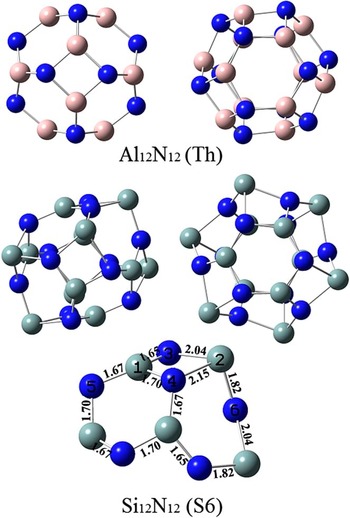
The structure of Al12N12 has been well confirmed. Reference Beheshtian, Bagheri, Kamfiroozi and Ahmadi3,Reference Chang, Patzer, Sedlmayr, Steinke and Sülzle14–Reference Li, Xia, Zhao, Liu, Song, Li, Li and Huang17,Reference Costales, Blanco, Francisco, Martín Pendás and Pandey19–Reference Chen, Ma, Hu, Wu and Chen22,Reference Zhang, Cui, Wang, Zhang and Lu35,Reference Wang, Yuan, Kuang, Hu, Zhang and Chen36 It consists of six squares and eight hexagons with Th symmetry. There are two different Al–N bonds in Al12N12: one is shared between two hexagons (R66) and the other between a square and a hexagon (R46). The Si12N12 is generated by substituting Al with Si in Al12N12. The structures with different spin multiplicities are optimized using unrestricted formalism, and the results show that the ground state is a singlet. Comparing with Al12N12, the structure of Si12N12 is distorted as shown in Fig. 1. The structure has S6 symmetry and the six squares still remain equivalent. One silicon atom in each Si2N2 square protrudes obviously from the cage surface. The other silicon atom is located approximately in the plane determined by the three bonding N atoms, and we will call it the “in-plane” silicon in the following sections. The eight hexagons form two groups; two of them are chair-like Si3N3 with closer Si–N bonds and the other six hexagons are markedly distorted. The four Si–N bonds (R46) in the Si2N2 square are different; the Si–N bonds shared between the square and hexagon (R66) have two different lengths. The corresponding bond lengths are presented in Fig. 1. To check the reliability of the theoretical models, the structures are optimized using B3LYP and MP2 with the basis sets 6-311G(d,p), 6-311++G(d,p) and aug-cc-pVDZ. The bond lengths calculated by different methods are listed in Table I. The structures optimized by these two different models with 6-311G(d,p) and 6-311++G(d,p) are in good consistence. The bond lengths calculated using aug-cc-pVDZ are slightly longer. The values show that the Si–N bonds formed by the protrudent Si are longer but the bonds formed by the in-plane Si are shorter than the corresponding Al–N bonds in Al12N12.
The optimized structures of Al12N12 and Si12N12 from two different views.

The bond length (in Å) in Al12N12 and Si12N12 calculated using different models.

2. The structures of Al n Si12−n N12 (n = 1, 2, 4)
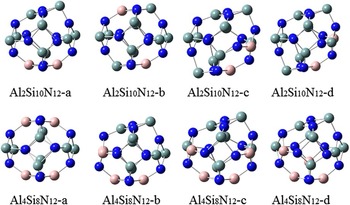
The structures of Al n Si12−n N12 (n = 1, 2, and 4) are generated by substituting Si atoms with Al in Si12N12. There are two different sites for silicon atoms in Si12N12. For AlSi11N12, there are two isomers and the energy is lower by 0.31 eV when the in-plane Si atom is substituted. For Al2Si10N12, there are 13 different substitution manners. When the two aluminum atoms form an Al2N2 square, the structure is most stable. When the two aluminum atoms are located at different squares, all these structures are optimized for the singlet and triplet states. The four low energy isomers are presented in Fig. 2. The isomers formed by substituting four of the 12 silicon atoms are very large. The substitution can be divided into three groups: the four Al atoms located at two, three and four squares. When the four Al atoms are located at two squares, it forms three isomers. The structure having the two Al2N2 squares at the opposite of the cage with C i symmetry is lowest in energy. When the four Al atoms are located at three squares, it forms 20 isomers. Optimization is performed for the singlet and triplet states and the calculations show that the singlet is lower in energy for all these structures. When the four Al atoms are located at four different squares, it forms 160 isomers. We choose 15 isomers with different structure features and perform optimization for the states having spin multiplicities 1, 3, and 5. The results show that all these structures are unfavorable in energy. The four low energy structures of Al4Si8N12 are also presented in Fig. 2.
Low energy isomers of Al n Si12−n N12 (n = 2 and 4).

3. The stabilities of Si12N12 and Al substituted Al n Si12−n N12 (n = 1, 2, 4)
The stability of the clusters can be judged by the binding energies:
 $${E_{\rm{b}}} = E\left( {{\rm{A}}{{\rm{l}}_n}{\rm{S}}{{\rm{i}}_{{\rm{12}} - n}}{{\rm{N}}_{{\rm{12}}}}} \right) - nE\left( {{\rm{Al}}} \right) - (12 - n)E\left( {{\rm{Si}}} \right) - {\rm{12}}E({\rm{N)}}\quad {\rm{,}}$$
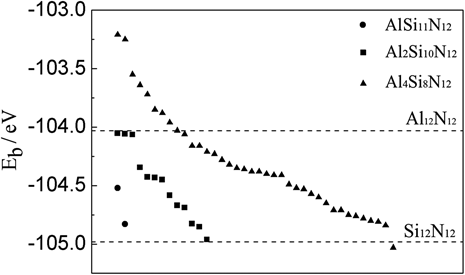
where the E(Al n Si12−n N12), E(Al), E(Si), and E(N) are the total energies of the Al n Si12−n N12 clusters, aluminum (Al 2P), silicon (Si 3P) and nitrogen (N 4S) atoms, respectively. The distribution of the binding energies of the isomers computed by B3LYP/6-311G(d,p) is presented in Fig. 3. The isomers formed by different substitutions may differ in energy by 1.82 eV but the energies of the most stable structures for Al n Si12−n N12 (n = 0, 1, 2, and 4) are very close.
Distribution of the binding energies of the different isomers of Al n Si12−n N12 (n = 1, 2, and 4) calculated at B3LYP/6-311G(d,p) level.

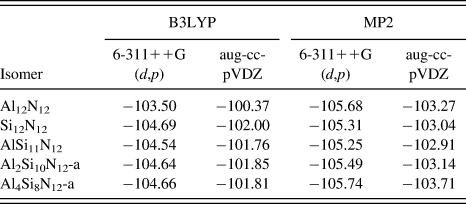
To evaluate the accuracy of the energies obtained by B3LYP/6-311G(d,p), we optimize the low energy structures in Fig. 2 using larger basis sets 6-311++G(d,p) and aug-cc-pVDZ. The MP2 model is also adopted to have a better consideration for the correlation energy. The energies calculated using B3LYP and MP2 with two different basis sets are in good agreement, and the energies calculated using aug-cc-pVDZ are a little smaller. The results show that the stability order decided by all these computations agrees completely for the isomers of Al2Si10N12 and Al4Si8N12. Table II lists the binding energies of Si12N12, AlSi11N12, Al2Si10N12-a and Al4Si8N12-a. The MP2 calculations show that Al4Si8N12-a is more stable than Al12N12 while the B3LYP results show that the pure Si12N12 is most stable. In fact, the values show that the stabilities of pure and Al-doped Al n Si12−n N12 (n = 1, 2, and 4) and Al12N12 are very close; the difference between the energies of the different systems is about 1 eV.
Binding energy (in eV) of Al12N12, Si12N12 and the most stable isomer of Al n Si12−n N12 (n = 1, 2, and 4) calculated using different models.

B. The electronic structures of Si12N12 and Al substituted Al n Si12−n N12 (n = 2 and 4)
According to the Koopmans' theorem, the highest occupied molecular orbital (the HOMO) level can be approximately regarded as the first ionization energy. The HOMO levels of Al, Si, and N atoms calculated using MP2 are −5.83, −8.13, and −15.46 eV, respectively, which agree well with the corresponding first ionization energy [5.99, Reference Martin and Zalubas49 8.15, Reference Martin and Zalubas50 and 14.53 Reference Eriksson and Pettersson51 eV]. The following analyses are based on the MP2 calculations.
1. The electronic structures of Al12N12 and Si12N12
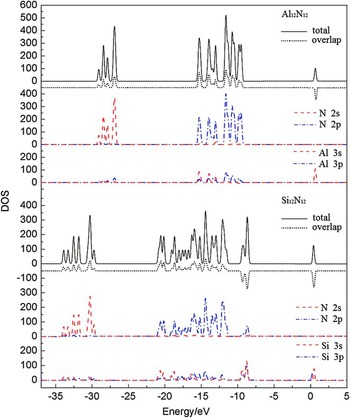
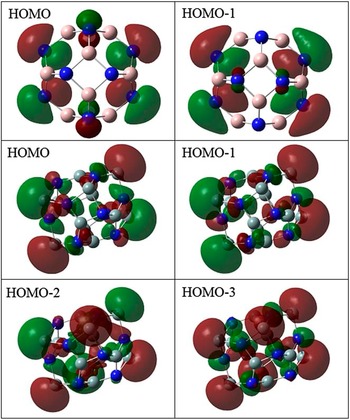
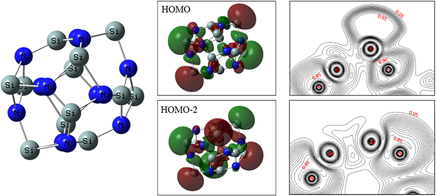
The density of states (DOS) and partial densities of states (PDOS) contributed from the valence orbitals of Al12N12 and Si12N12 are illustrated in Fig. 4. The densities are calculated using the Multiwfn program and the energy levels are represented by Gaussian distributions with a half width of 0.27 eV. Al12N12 has 96 valence orbitals that form 48 bonding orbitals and 48 antibonding orbitals. The 96 valence electrons occupy 48 bonding orbitals and form a “perfect closed-shell” structure. The 48 occupied orbitals form two bands. The lower band includes 12 orbitals which is dominated by the 2s orbitals of N. The upper band includes 36 orbitals from −15.34 to −9.52 eV and the PDOS shows that they are formed by the 2p of N and 3s3p of Al. The isosurface plots of HOMO and HOMO−1 (both orbitals are 3-fold degenerate) are presented in Fig. 5. It clearly shows that the top occupied orbitals in Al12N12 are formed by the N 2p orbitals perpendicular to the cage surface. Si12N12 has 108 valance electrons. The 12 excess electrons occupy 6 antibonding orbitals and form the top valence band, which include two double degenerate levels at −8.60 and −8.72 eV and two levels at −9.12 and −9.36 eV. The orbital composition shows that they are dominated by the 3s3p orbitals of the protruding silicon atoms. Figure 5 presents these four orbitals. The atomic orbitals in the protruding silicon atom hybrid in the similar way as in the nitrogen atom in NH3 and each of the six Si atoms has lone pair electrons at the outside of the cage surface. Comparing with Al12N12, the 36 states formed by the 2p of N and 3s3p of Si and the band formed by the 2s of N extend markedly and the levels move down to lower energies. The Si12N12 is an electron redundant cluster, but the HOMO level is only 0.33 eV higher than that of Al12N12. The lowest unoccupied molecular orbital (the LUMO) of Al12N12 and Si12N12 is formed by 3s3p of Al and Si, respectively, and the orbital level in Si12N12 is 0.33 eV lower.
Total and partial DOS and the overlap for Al12N12 and Si12N12.

The highest occupied orbitals in Al12N12 and Si12N12. HOMO and HOMO−1of Al12N12 are 3-fold degenerate; HOMO and HOMO−1 of Si12N12 are doubly degenerate and the six orbitals form the lone pair electrons on the six protrudent Si atoms.

2. The electronic structures of Al substituted AlnSi12−nN12 (n = 2 and 4)
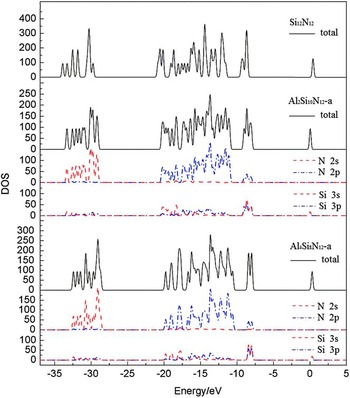
Figure 6 illustrates the DOS of the most stable structures Al2Si10N12-a and Al4Si8N12-a. The PDOS of Al are very small and not presented. The electrons decrease after Al replaces the Si atoms, so the states in the top band decrease. The other two bands of Si12N12, Al2Si10N12-a and Al4Si8N12-a are very similar. The energy levels move up slightly with the increase of Al atoms. Table III lists the energies of HOMO, LUMO and energy gap E g of Al n Si12−n N12 (n = 0, 1, 2, and 4) calculated by B3LYP with three different basis sets. The E g of Al n Si12−n N12 (n = 1, 2, and 4) are about 1 eV smaller than that of pure Al12N12 and also smaller than the gap of Si12N12.
Total and partial DOS of Al2Si10N12-a and Al4Si8N12-a.

Energy levels of HOMO, LUMO and band gap E g for Al12N12 and the most stable structures of Al n Si12−n N12 (n = 0, 1, 2, and 4) calculated by B3LYP with different basis sets.

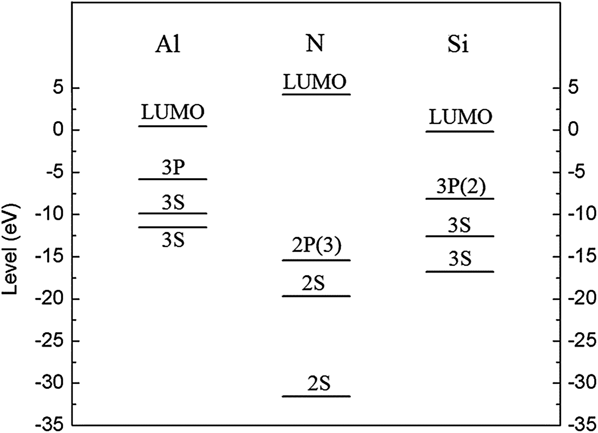
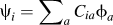
To better understand the electronic structures of the SiN based cages, Fig. 7 illustrates the orbital levels of Al, Si, and N atoms. The spin multiplicities of Al, Si, and N are 2, 3, and 4, and the 3p orbitals of Si and 2p of N are double and 3-fold degenerate, respectively. Due to the exchange interaction, the 2s/3s orbitals split into two levels. Figure 7 shows that the orbital levels in Si atom are lower than the corresponding levels in Al atom. According to the frontier orbital theory, the orbitals of Si and N can overlap better. To describe quantitatively the extent of the orbital overlap, the local term and the cross term of the density matrix are calculated. The molecular orbital ψ
i
is the linear combination of atomic orbitals {ϕ
a
},
 ${\psi _i} = \sum\nolimits_a {{C_{ia}}{\phi _a}}$
. The total number of states for a closed-shell system is:
 $$\sum\nolimits_i {\sum\nolimits_a {{{\left| {{C_{ia}}} \right|}^2}} } + \sum\nolimits_i {\sum\nolimits_a {\sum\nolimits_{b \ne a} {{C_{ia}}^*{C_{ib}}{S_{ab}}} } } \quad .$$
The valence orbital levels of Al, N, and Si atoms.

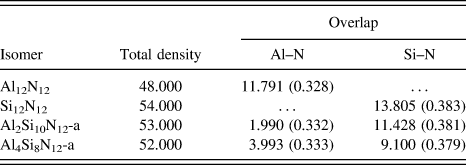
The first term is the local term of the atomic orbital ϕ a , and the second term is the overlap term between atomic orbitals ϕ a and ϕ b , where S ab is the overlap integral. By summing ϕ a over N 2s2p and ϕ b over Al or Si 3s3p, we obtain the overlap terms between orbitals of Al and N or between orbitals of Si and N. The total overlap densities are listed in Table IV, and the values averaged over the numbers of Al–N and Si–N bonds are presented in the parentheses. The results show that the overlap terms contribute about 25% to the total states, and the overlap of Si–N bonds is about 17% stronger than the Al–N bonds. The role of d-orbitals of Al and Si atoms in the stability of clusters are also considered. The integral of d-orbitals of Al in Al12N12 is 1.857 and contributes 3.87% to the total densities, and the integral of d-orbitals of Si in Si12N12 is 1.392 and contributes 2.58% to the total densities.
The integral of total density and the overlap of Al–N bonds and Si–N bonds in Al12N12, Si12N12, Al2Si10N12-a, and Al4Si8N12-a.

3. The charge distributions of Si12N12 and Al substituted Al n Si12−n N12 (n = 1, 2, 4)
Depending on the strategies to divide the overlap densities, there are different approaches to analyze the charge distributions. Here the NBO and AIM models are adopted. The NBO analysis has been widely used and is considered to provide satisfactory results. The AIM model proposed by Bader defines the region for each atom in a molecule by the surface on which the gradient of electron density is zero, and it offers a partition of the electron density with a clear physical meaning. The calculated charge on N/Al/Si atoms is given in Table V. The relative values of the NBO and AIM charge on N/Al/Si atoms agree very well. The charge on Al and Si atoms in Al2Si10N12-a and Al4Si8N12-a is same to the charge on the corresponding atoms in pure Al12N12 and Si12N12. Due to the smaller ionization potential (higher 3sp levels), metal atom Al transfer more electrons to N on average than the Si atoms do, but the charge on the six in-plane Si atoms is considerably larger than the charge on Al. The charge on the protrudent Si atoms is much smaller, however, there exist large local dipole moments due to the lone pair electrons and they may contribute considerably to the electrostatic interactions between the protrudent Si and N atoms.
The NBO and AIM charge in pure Al12N12, Si12N12 and the most stable isomers of Al n Si12−n N12 (n = 2 and 4) calculated using MP2.

To illustrate the bonding characters, we calculate the electron localization function (ELF) of the clusters. The concept of ELF was proposed by Becke and Edgecombe
Reference Becke and Edgecombe52
and developed by Savin and coworkers.
Reference Silvi and Savin53,Reference Savin, Nesper, Wengert and Fässler54
It depends on the total electron density ρ, its gradient Δρ and the kinetic energy density
 ${\sum\nolimits_i {\left| {\Delta {\psi _i}} \right|} ^2}$
:
 $${\rm{ELF}} = {\left[ {1 + \left( {{{{1 \over 2}\sum\nolimits_i {{{\left| {\Delta {\psi _i}} \right|}^2} - {1 \over 8}} {{{{\left| {\Delta \rho } \right|}^2}} \over \rho }} \over {{3 \over {10}}{{\left( {3{\pi ^2}} \right)}^{2/3}}{\rho ^{5/3}}}}} \right)} \right]^{ - 1}}\quad .$$
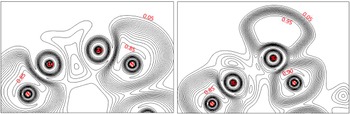
The ELF is fundamentally related to the electron pair probability and it can illustrate the core, the bonding and the lone pair regions effectively. The spatial distribution of the localization attractors (local maxima of ELF) provides a well-defined classification of chemical bonds, allowing an absolute characterization of covalency versus ionicity. The bonding attractors lie between the core attractors (which surround the nuclei) and characterize the covalent interactions. Figure 8 shows the ELF of Al12N12 and Si12N12 in the plane defined by atoms 1, 2, 5, and 6 in Fig. 1. One can see that the bonding attractors for the Si–N bonds formed by the in-plane Si atoms are similar to that of the Al–N bonds, and these attractors are located obviously at the outside of the N atoms. The bonding attractors for the Si–N bonds formed by the protrudent Si atoms are located between Si and N and suggest better overlap. The large attractors outside the protrudent Si atoms show the region of the lone pair electrons.
The contour maps of ELF of Al12N12 and Si12N12. The values of the contour lines with an interval of 0.05.

C. The polarizabilities and hyperpolarizabilities of Al12N12 and Al substituted Al n Si12−n N12 (n = 0, 1, 2, 4)
As the lone pair electrons are loosely bond, it is anticipated that the SiN based cages might have large polarizabilities and hyperpolarizabilities. When a system is in the weak and homogeneous electric field, its energy can be defined as:
 $$E = {E^0} - {\mu _\alpha }{F_\alpha } - {1 \over 2}{\alpha _{\alpha \beta }}{F_\alpha }{F_\beta } - {1 \over 6}{\beta _{\alpha \beta \gamma }}{F_\alpha }{F_\beta }{F_\gamma } - \cdots \quad ,$$
where E 0 is the molecular total energy without the electric field and F α is the electric field component along α direction. The μα, ααβ and βαβγ denote the dipole, the polarizability and the first hyperpolarizability, respectively.
The mean polarizability (α) and hyperpolarizability (β0) can be defined as Reference McLean and Yoshimine55 :
 $$\eqalign{ & \alpha = {1 \over 3}\left( {{\alpha _{xx}} + {\alpha _{yy}} + {\alpha _{zz}}} \right)\quad , \cr & \cr}$$
 $${\beta _0} = {\left( {{\beta _x}^2 + {\beta _y}^2 + {\beta _z}^2} \right)^{1/2}}\quad ,$$
in which
 $${\beta _i} = {3 \over 5}\left( {{\beta _{iii}} + {\beta _{ijj}} + {\beta _{ikk}}} \right)\quad i,j,k = x,y,z\quad ,$$
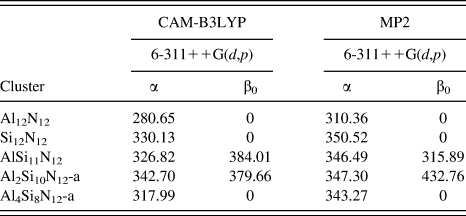
β0 is also known as the second-order NLO response coefficient. It is proved that the traditional B3LYP model has deficiencies in describing the exchange at long-range and can't provide reliable results for the polarizability and hyperpolarizability. A new hybrid exchange-correlation functional named Coulomb-attenuating B3LYP (CAM-B3LYP) has been proposed to overcome these limitations. Reference Yanai, Tew and Handy56 The polarizabilities and first hyperpolarizabilities of Al12N12 and Al n Si12−n N12 are computed by CAM-B3LYP and MP2 models with the basis set 6-311++G(d,p). The values are listed in Table VI. The polarizabilities (α) of Al n Si12−n N12 (n = 0, 1, 2, and 4) are obviously larger than that of Al12N12. Due to the symmetry of the structure, the hyperpolarizabilities of Al12N12, Si12N12, and Al4Si8N12 are zero. For hyperpolarizabilities of AlSi11N12 and Al2Si10N12, the CAM-B3LYP values are very close but the values based on MP2 are much lager for Al2Si10N12. Although the hyperpolarizabilities of AlSi11N12 and Al2Si10N12 are still smaller than that of the typical NLO compounds (the β0 is 794 a.u. for 4-nitro-2-toluidine at CAM-B3LYP), the results show that the electron redundant nanostructures are potential NLO materials.
The polarizabilities (α) and hyperpolarizabilities (β0) (in a.u.) of Al12N12 and the most stable isomer of Al n Si12−n N12 (n = 0, 1, 2, and 4).

IV. CONCLUSIONS
In this paper, the equilibrium geometries, stabilities, the electronic structures, the bonding properties, the polarizabilities and the hyperpolarizabilities of electron redundant Al n Si12−n N12 (n = 0, 1, 2, and 4) are investigated systematically. Extensive structures with different spin states are carefully investigated by employing B3LYP/6-311G(d,p). For the low energy structures, calculations with larger basis sets and MP2 model are also performed. The Si12N12 cage consists of six squares and eight hexagons with S6 symmetry. In each Si2N2 square, one of the two silicon atoms protrudes obviously from the cage surface. The optimization shows that Al atoms in Al n Si12−n N12 (n = 2 and 4) tend to form Al2N2 squares and the most stable structures are singlet. Computations based on different methods show that the stabilities of Al n Si12−n N12 (n = 0, 1, 2, and 4) and Al12N12 are very close.
The electrons in the Group III nitrides form a “perfect closed-shell.” Si12N12 has 12 excess electrons and they occupy the antibonding orbitals. Similar to the N atom in NH3, each protrudent Si atom has lone pair electrons at the outside of the cage surface. Comparing with the Al12N12, the states formed by the bonding orbitals in Si12N12 extend markedly and move down to lower energies. The electronic structures of the Al doped Al n Si12−n N12 cages are very similar to that of pure Si12N12. The AIM charge is larger than the NBO charge, but the relative values on Al, Si, and N atoms agree well. On average, Al atoms transfer more electrons to N than Si atoms do. The charge on the in-plane Si atoms is considerably larger than the charge on Al atoms. The charge on the protrudent Si atoms is much smaller, however, the lone pair electrons form a large local dipole moments and contribute to the electrostatic interactions. As the orbital levels of Si are closer to the levels of N, the valence orbitals of Si and N can overlap better. The calculation of the cross terms of the density matrix shows that the overlap of Si–N bonds is about 17% stronger than that of Al–N bonds. The ELF shows that the bonding attractors for the in-plane Si–N bonds and Al–N bonds are very similar. The bonding attractors between the protrudent Si and N show better covalent features. Due to the loosely bond lone pair electrons, the SiN based cages have large polarizability and hyperpolarizability and can be potential NLO materials.
ACKNOWLEDGMENTS
Financial support from the National Science Foundation of China (Grant No. 11164024) and from Northwest Normal University (NWNU-KJCXGC03-62). We also thank Gansu and Shenzhen Computing Center for technical support.