Totally anomalous pulmonary venous connection is a rare anomaly, representing 1% to 3% of all congenital cardiac malformations. Without surgery it carries a very unfavourable prognosis, with death occurring in the first three months for half of the patients, with four-fifths dying in the first year of life.Reference Delisle, Ando and Calder1, Reference Anderson and Macartney2 The clinical manifestation depends on the extent of the obstruction along the pulmonary venous pathway, as well as on the amount of left-to-right shunting. Obstructed pulmonary venous return is associated with pulmonary congestion and systemic low cardiac output. The impending circulatory collapse requires urgent surgical intervention.
Although surgical results have steadily improved over the past three decades, the operative risk for rerouting of anomalous pulmonary venous drainage remains substantial. Multi-institutional data from congenital databases of the European Association of Cardiothoracic Surgery and the Society of Thoracic Surgeons indicate a global early mortality of 10.7%, with 67 of 628 patients dying, the 95% confidence intervals varying from 8.4% to 13.4%. In one-fifth of cases, the postoperative hospital stay is greater than 21 days.Reference O’Brien, Jacobs and Clarke3 Worse outcomes have been noted in patients with functionally univentricular arrangements, in particular for those presenting with double inlet through a common valve and isomerism of the right atrial appendages,Reference Heinemann, Hanley and Van Praagh4–Reference Sinzobahamvya, Arenz, Brecher and Urban6 with a recent review revealing an intermediate survival of no more than half in this circumstance.Reference Lodge, Rychik, Nicolson, Ittenbach, Spray and Gaynor7 Recent quality control in our unit also showed a high operative rate of mortality and morbidity, prompting us to review our own experience over the last 15 years.
Patients and methods
Between January, 1995, and February, 2009, we undertook surgical repair in 71 patients for totally anomalous pulmonary venous connection. In 19 of these patients (27%), there was also a functionally univentricular arrangement, with all but 1 having double inlet ventricle. Of the overall group of patients, 10 died postoperatively, giving an early mortality rate of 14.1%, with 95% confidence varying from 6.9% to 24.4%.
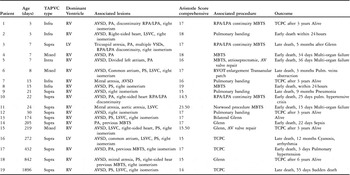
In Table 1, we summarize the main clinical features of the 19 patients requiring functionally univentricular repairs. Of this cohort of 19 patients, 12 (63%) underwent surgery in the neonatal period. Signs of pulmonary venous obstruction were present in all these newborns, except the tenth patient. In 3 of the 7 older patients, a modified Blalock-Taussig shunt had already been constructed to palliate pulmonary atresia or stenosis. No patient with infracardiac drainage was observed after the first month of life. The anomalous pulmonary venous connection had been discovered during surgery in the 16th patient.
Main clinical characteristics and outcome.

AV valve: atrio-ventricular common valve; AVSD: atrio-ventricular septal defect; LPA: left pulmonary artery; LSVC: left superior caval vein; LV: left ventricle; MBTS: modified Blalock-Taussig shunt; PA: pulmonary atresia; PS: pulmonary stenosis; RPA: right pulmonary artery; RV: right ventricle; TAPVC: totally anomalous pulmonary venous connection; TCPC: total cavo-pulmonary connection; VSD: ventricular septal defect.
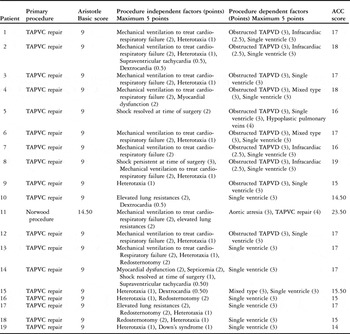
The dominant ventricle was of right ventricular morphology in 17 patients (89%). The majority, 12 in all, also had isomerism of the right atrial appendages. As described in a previous report,Reference Sinzobahamvya, Arenz, Brecher and Urban6 these patients had common atrioventricular junctions, obstruction of the right ventricular outflow tract, often in the form of pulmonary atresia, parallel arterial trunks, typically with the aorta anterior, and hypoplasia of the left ventricle. Flow of blood toward and through the pulmonary arteries was anatomically unrestricted in 5 patients, including the 11th patient, who had hypoplastic left heart syndrome. The comprehensive Aristotle scores (Table 2) ranged from 14 to 23.50 points. Median scores amounted to 17 points, and the mean was 16.76, with a standard deviation of 2.09.
Estimation of Aristotle comprehensive complexity score.

ACC: Aristotle comprehensive complexity; TAPVC: Totally anomalous pulmonary venous connection; TAPVD: Totally anomalous pulmonary venous drainage.
As shown in Table 1, other procedures were simultaneously performed in the neonatal period. These were a modified Blalock-Taussig shunt in 6 patients, and banding of the pulmonary trunk in 4 patients. Patients older than one month were managed by construction of a bidirectional cavo-pulmonary anastomosis in 4 patients, or a total cavo-pulmonary connection in 3. Regurgitation of the common atrioventricular valve required attention in 2 patients. Our 11th patient, a neonate with hypoplastic left heart syndrome, underwent the Norwood procedure combined with a modified Blalock-Taussig shunt. Overall cardiopulmonary bypass lasted on average 175 minutes, with a standard deviation of 56 min. Cardioplegic cardiac arrest was used in 14 patients, over a mean of 65 minutes, with a standard deviation of 40 minutes. Deep hypothermic circulatory arrest was needed in 10 patients, with a duration of 39 minutes and standard deviation of 16 minutes.
Outcome
Of the cohort with functionally univentricular arrangement, 8 patients died during the first 30 postoperative days, or later in hospital, giving an early mortality of 42.1%, with 95% confidence intervals for this figure ranging from 20.2% to 66.5%. This was much higher (p = 0.0002) than the mortality encountered in the patients in whom we achieved biventricular repair, with only 2 of this cohort of 52 patients dying over a comparable period, giving a mortality of 3.9%, and confidence intervals from 0.47% to 13.2%. Pulmonary venous obstruction, and/or elevated pulmonary vascular resistances, contributed either directly or indirectly to death. Our sixth patient was supported by extracorporeal membrane oxygenation for 32 days. All 4 patients with a comprehensive Aristotle score of at least 18 points died. The mean score for patients who experienced early mortality was 17.88, as opposed to a mean score of 15.95 for early survivors.
The postoperative course was complicated in all early survivors, apart from our 17th patient. We encountered low cardiac output and respiratory insufficiency in 6 patients, with 2 requiring inhalation of nitric oxide. Sepsis occurred in 7 patients, and peritoneal dialysis over a period of 3 days was needed required to treat renal insufficiency in our ninth patient. Obstruction at the opening of the right pulmonary veins into the atrium was observed in the sixth patient, which could not be relieved either by surgery or by catheter intervention. We transferred this patient, still on mechanical ventilation, to another hospital. In our 18th and 19th patients, however, both older than 1 month, extubation was achieved within a few hours of the surgical intervention. The other 8 early survivors needed mechanical ventilation for a median duration of 6 days, with a range from 3 to 22 days. Of these patients, 5 required ventilation for over 1 week.
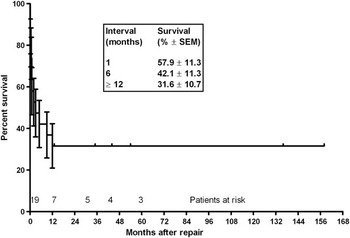
An additional 5 patients died subsequently, all within the first postoperative year. Their deaths were related either to persistent pulmonary venous obstruction or to sepsis. Actuarial survival stabilized at 31.6%, with a standard error of the mean of 10.7%, from one year onwards (Fig. 1). Only 3 of the 12 patients undergoing repair in the neonatal period remain alive. In this group, the rate of survival rate was 25%, with a standard error of 12.5% from the ninth month. By comparison, survival for the 7 patients undergoing surgery at an older age was estimated at 42.8%, with a standard error of 18.7%, from the 12th month on (p = 0.44).
The Kaplan-Meier estimate of survival after surgical repair of totally anomalous pulmonary venous connection associated with a functionally univentricular arrangement. The vertical bars represent the standard error of the mean.

Of the overall cohort of 19 patients, therefore, only 6 survive. Among these, 5 have proceeded to definitive palliation by means of total cavo-pulmonary connection, with 3 categorized in the second class of the New York Heart Association, and the other 2 in the first class. After a delay of 9 months, the remaining late survivor, our 13th patient, underwent repair of the regurgitant common atrioventricular valve. Aged 19 months at the last follow-up, he was still awaiting completion of the Fontan circulation.
Discussion
There is limited information in the literature charting the incidence of totally anomalous pulmonary venous connection in association with the functionally univentricular arrangement. The largest published series, of 91 cases,Reference Lodge, Rychik, Nicolson, Ittenbach, Spray and Gaynor7 with this combined malformation gives no global corresponding number of patients who underwent repair of totally anomalous pulmonary venous connection in the same period. In 2 reports supplying this information,Reference Caldarone, Najm and Kadletz8, Reference Hancock Friesen, Zurakowski and Thiagarajan9 the proportions ranged from 13%, representing 22 patients from a cohort of 170, to 32%, representing 39 of 123 patients.Reference Caldarone, Najm and Kadletz8, Reference Hancock Friesen, Zurakowski and Thiagarajan9 It was 27% in our series, or 19 of 71 patients.
Our experience confirms the obstructive nature of infracardiac connections, as all patients with this pattern of anomalous drainage required surgery in the neonatal period. Our findings also support the well-recognised association with isomerism of the right atrial appendages. Indeed, most reports mentioning this anomaly of the pulmonary veins in patients with functionally univentricular hearts relate to cardiac lesions observed in heterotaxy syndromes.
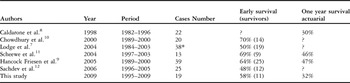
The combination of totally anomalous pulmonary venous connection and the functionally univentricular arrangement, therefore, presages a poor outcome. Reported operative mortalities range from 30% to 52% (Table 3), usually as a consequence of a persistent high pulmonary vascular resistance. Because of the small numbers in our cohort, we were unable to identify specific higher risk factors for early death after repair. It is clear, nonetheless, that preoperative pulmonary venous obstruction was an incremental factor. Right isomerism, present in two-thirds of our patients, also poses an obvious increased risk. Older reports classifying the combination in terms of the heterotaxy syndromes have revealed operative mortalities of 35% and 69%, respectively, these figures increasing to 64% and 75%, respectively, if surgery was carried out in the first month of life.Reference Sadiq, Stümper and De Giovanni13, Reference Hashmi, Abu-Sulaiman, McCrindle, Smallhorn, Williams and Freedom14 A more recent paper still reports a heavy mortality of almost half the patients submitted to operation.Reference Yun, Al-Radi and Adatia15
Reported survival for surgical repair of totally anomalous pulmonary venous connection and functionally single ventricle.

* Only includes patients who underwent repair of totally anomalous pulmonary venous connection.
? Not reported.
Our experience confirms the finding of these other reports that attrition continues during the first 12 months after operation, either because of unabated pulmonary hypertension or infection. Survival thereafter tends to stabilize, but at a low level, with survival at 1 year of no more than 30% to 47% (Table 3). Long-term outcome is also influenced by lesions related to the isomerism. An incompetent common atrioventricular valve usually poses a problem for palliation by conversion to the Fontan circulation. Children lacking spleens are also at permanent risk of dying from sepsis. According to an older study, almost four-fifths die during the first year of life.Reference Rose, Izukawa and Moës16
Repair of totally anomalous pulmonary venous connection repair has been assigned, as a procedure, an Aristotle basic complexity score of 9 points, with 3 points for each of its three components, namely the potential for mortality, the potential for morbidity, and the anticipated surgical technical difficulty. This corresponds to an early mortality of 5% to 10%, and a stay in the intensive care unit of from 4 to 7 days.Reference Lacour-Gayet, Clarke and Jacobs17 Observed figures drawn from data submitted to the European Association of Cardiothoracic Surgery and the Society of Thoracic Surgeons indicate higher rates of mortality and morbidity than would be expected on the basis of the Aristotle scoring.Reference O’Brien, Jacobs and Clarke3 This is almost certainly due to the mixing of functionally univentricular and biventricular repairs. Indeed, the deplorable outcome in those with the functionally univentricular arrangement after repair of this lesion contrasts sharply with the encouraging results achieved when the procedure is performed in biventricular hearts, this finding endorsed by our own experience. The use of the Aristotle comprehensive score (Table 2), nonetheless, which also includes patient-adjusted complexity factors carrying a maximum of 10 points,Reference Lacour-Gayet, Clarke and Jacobs17 permits discrimination of patients likely to have a greater risk for operative death.
What measures could be used to improve survival? As long as the drainage of the anomalously connected pulmonary veins appears unobstructed, repair may be delayed beyond the neonatal period, ideally until the child is able to undergo a bidirectional cavo-pulmonary anastomosis. In our series, 3 patients initially underwent successful palliation with a modified Blalock Taussig shunt alone. Of these, however, 2 did not survive to undergo subsequent palliation that was combined with redirection of the pulmonary veins. Unfortunately, the majority of patients, in particular those with infracardiac drainage, demonstrate obstruction in the first four weeks of life and have to be addressed urgently, whatever the risk. Transplantation of the heart is another option, but one that is rarely feasible due to the scarcity of adequate donors. Interventional stenting of the vertical vein may be considered for those having supracardiac drainage.Reference Jhang, Chang, Park, Oh, Kim and Yun18 This could also be an option when supracardiac drainage is associated with hypoplastic left heart syndrome, serving as an alternative to the Norwood procedure. Use of the so-called sutureless technique has the potential to prevent postoperative pulmonary venous obstruction. It should be considered as a routine option. Permanent antibiotic prophylaxis should also be the rule for patients known to lack the spleen. Although the goal is to convert to the Fontan circulation in the setting of the functionally univentricular arrangement, it is a bidirectional cavo-pulmonary anastomosis which becomes the ultimate palliation for a good number of patients with a problematic common atrioventricular valve, which is frequent in those with right isomerism.
In conclusion, even if our cohort is made up of small numbers of patients undergoing surgical repair over a long time span, our experience clearly indicates that totally anomalous pulmonary venous connection, when associated with the functionally univentricular arrangement, is one of the most complex congenital cardiac constellations, with one of the worst outcomes in current surgical practice.