INTRODUCTION
‘The world's most venomous animal’ (Endean, Reference Endean, Pearn and Covacevich1988) or ‘the deadliest creature on earth’ (Cropp & Cropp, Reference Cropp and Cropp1984) is the chirodropid (multi-tentacled box jellyfish) Chironex fleckeri Southcott (Reference Southcott1956). Notoriously the most rapidly lethal of venomous animals, Chironex fleckeri is reputedly found across Australia's tropical north from Exmouth in the west to Gladstone in the east (Williamson et al., Reference Williamson, Fenner, Burnett and Rifkin1996); it has killed at least 77 people since records began in 1884 (Gershwin, Reference Gershwin2014).
Speculation exists among researchers (Richardson et al., Reference Richardson, Bakun, Hays and Gibbons2009) and broadly in the media (e.g. McKechnie, Reference McKechnie2010; Peter, Reference Peter2010) that Chironex or other species of dangerous jellyfish may migrate southward with climate change. However, the ability of chirodropids to thrive in southern waters became a bit less speculative when a small chirodropid was discovered in March 2013 in one of the exclusive residential canals of the popular Gold Coast of south-east Queensland (Elder, Reference Elder2013; Marshall, Reference Marshall2013; NineNews, 2013). The discovery would not have been possible without the help of citizen scientists (including a curious young boy). Another specimen was subsequently found in November 2013, this time in a marina and residential canal estate area of the Mooloolaba River on the Sunshine Coast, some 160 km north of the first discovery. This small form has numerous major structural features inconsistent with Chironex fleckeri, and is more closely related to the far less toxic Chiropsella bronzie Gershwin (Reference Gershwin2006b), Chiropsella bart Gershwin & Alderslade (Reference Gershwin and Alderslade2006) and Chiropsella rudloei Bentlage (Reference Bentlage2013). Moreover, it is very small at maturity and – we believe – unlikely to be life threatening. This splendid little cubomedusa is described below as new to science.
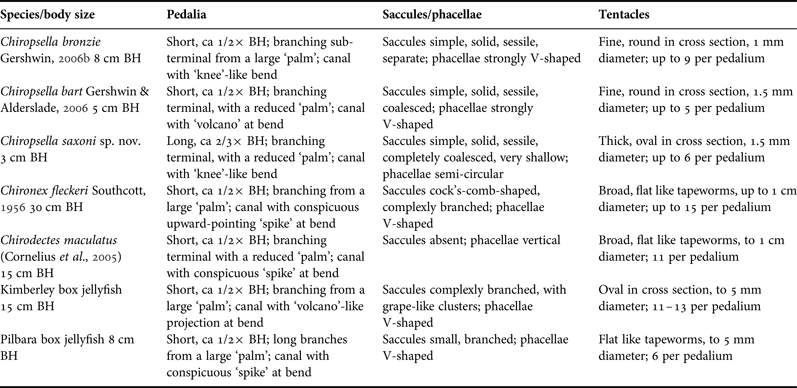
This new species now brings the total number of known Australian chirodropids to five; two more are yet to be named and classified (Table 1).
Comparison of main diagnostic criteria of Australian chirodropids.

MATERIALS AND METHODS
Three specimens were collected by members of the public and forwarded to the state museums in which they were found. Specimens were preserved in dilute formalin unless otherwise indicated. All taxonomic observations, digital photographs and measurements were made on preserved material under a dissecting scope. Measurements were made with Max-Cal digital calipers to the nearest 0.01 mm. Bell height (BH) was measured from the apex of the bell to the velarial turnover. Diagonal bell width (DBW) was measured across diagonally opposite pedalia on a flattened specimen, at the height of the pedalial lamella. Interrhopalial width (IRW) was measured on a flattened specimen between adjacent rhopalia, at the root of the rhopalial stalk. Tentacle base width (TBW) was measured across the widest diameter at the uppermost part of the tentacle, immediately below the pedalium. Sex was determined by biopsy. Nematocysts were examined with a compound microscope; all observations and photographs were made through a 40× objective (i.e. 400× magnification). Nematocysts were identified following the criteria of Gershwin (Reference Gershwin2006a). Complete descriptions of all characters used herein can be found in the senior author's PhD thesis (Gershwin, Reference Gershwin2005).
Other abbreviations used: QM: Queensland Museum; QLD: Queensland; AM: Australian Museum; NSW: New South Wales.
ZooBank ID: urn:lsid:zoobank.org:pub:55C01D23-807A-4C33-AE6C-B0B6DF2DD134.
SYSTEMATICS
Phylum CNIDARIA Verrill, 1865
Subphylum MEDUSOZOA Petersen, 1979
Class CUBOZOA Werner, 1973
Order CHIRODROPIDA Haeckel, 1880, sensu Gershwin, Reference Gershwin2006b
Family CHIROPSALMIDAE Thiel, 1936, sensu Gershwin, Reference Gershwin2006b
Genus Chiropsella Gershwin, 2006b
Chiropsella saxoni sp. nov.
TYPE MATERIAL
Holotype: QM G335085, Coast Guard Jetty, Mooloolah River, Mooloolaba, Sunshine Coast, Queensland, 26°40.935′S 153°08.139′E, coll. by Queensland Department of Fisheries, 1 November 2013; 27.11 mm BH, 1.37 mm TBW, male.
Paratypes: QM G333509, Paradise Point canal, Gold Coast, Queensland, 27°52.363′S 153°24.036′E, coll. by Saxon Thomas, Jasmine McDonald and Brock McDonald, 23 March 2013; preserved in ethanol; 28.18 mm BH, 34.30 mm DBW, 19.49 mm IRW, 2.04 mm TBW, male. AM G16014, off Wooli, NSW, 29°52′S 153°16′E, coll. by I. Bennett, 19 May 1984; 31.45 mm BH, 43.64 mm DBW, 24.72 mm IRW, 6-tentacle stage, mature female gonads.
DIAGNOSIS
Chiropsella less than 30 mm body height at maturity; saccules simple, sessile, very shallow, completely coalesced; pedalial ‘wrist’ very long, about 2/3 body height, slender, with inner keels; pedalial branches arise distally on a reduced ‘palm’, in one tight cluster rather than in progressive pairs, with each branch bearing a single thick tentacle; pedalial canals with a knee-like proximal bend, divided distally into branches at the same level; gastric phacellae semi-circular; rhopalial niche ostia smoothly rounded, lacking a flap on the upper covering scale.
DESCRIPTION OF HOLOTYPE
Body small and rounded, cuboid overall, less than 30 mm high and wide (estimated 35–40 mm in life, allowing for shrinkage due to preservation). Exumbrella smooth, lacking nematocysts or warts. Apical dome thick and round, with a shallow sub-apical coronal groove (Figures 1, 2A & 5B). Interradial furrows well marked, dividing the central portion of the thickened pillars that form the corners of the box-shaped body, reaching the coronal groove but not the pedalia. Adradial furrows well defined throughout the height of the bell from the coronal groove to below the rhopalia, disappearing near the velarium.
Chiropsella saxoni sp. nov., QLD paratype, habitus, in life.
Chiropsella saxoni sp. nov., holotype. A. Habitus. B. Rhopalial niche ostium; note smooth upper covering scale (arrow).
Rhopalial niche slightly raised from bell wall. Rhopalial niches approximately 7/8ths down from coronal groove, with dome-shaped opening, flat orally, creating a 90° corner with the exumbrellar surface; aboral edge of opening smoothly convex, lacking a central flap (Figure 2B). Rhopalial horns lacking. Rhopalia four, deeply set within perradial niches, with two large median eyes with lenses and four smaller lateral pigmented slit eyes, looking in toward bell cavity. Statoliths short, rounded, rod-shaped, with straight sides. Subumbrellar rhopaliar windows flat, without convexity or concavity. Rhopaliar warts not observed.
Pedalia four, interradial, very long (about 2/3 BH), with a reduced ‘palm’ at distal end such that the finger-like branches arise close together (Figure 3); narrow, with an inner keel. Each branch bears a single tentacle. The uppermost finger-like branch projects outward in the interradial axis, perpendicular to the others. The distal finger-like branches are paired, imperfectly dichotomous, along the main ‘palm’-like portion of the pedalium. Pedalial canal laterally compressed throughout, with a knee-shaped bend (Figure 4B) in the proximal third. The canal bifurcates at the uppermost branch point, then divides into four branches at the claw-like distal end. Canals straight-sided at tentacle insertion.
Chiropsella saxoni sp. nov., holotype pedalia; note ‘fingers’ arising close together on reduced ‘palm’. A. Side view. B. Adaxial view. Inset of adaxial view of other species for comparison: C. Chiropsella bronzie, D. Chiropsella bart.
Chiropsella saxoni sp. nov., holotype. A. Phacellae; note semi-circular shape and short, singly-rooted cirri. B. Pedalial canal; note knee-shaped bend (arrow).
Tentacles five per pedalium, comprising four paired and one opposing higher up, perpendicular to the rest. Each pedalium also has a puny stub at the centre of the four clustered tentacles. Tentacles hollow, oval in cross section, thicker than ends of finger-like branches on which they attach; straight-sided at base. Tentacular nematocysts borne on evenly raised bands.
Velarial canals complexly branched, with a single main canal-root extending from the gastric cavity in each octant, with non-anastomosing branches, bearing lateral branchlets; approximately seven branches reach velarial margin in each octant (Figure 5A). Perradial lappets broadly rounded-triangular, with few branches, reaching velarial margin. Frenulum a single, simple flexible sheet of tissue, not thickened at base, nearly reaching velarial margin.
Gastro-gonadal pouches four, completely separated by four interradial septa. Gastric phacellae four, almost perfectly semi-circular, opening away from corners, distinctly separated at the perradii; appearing similar to a four-leaf clover when viewed from the aboral surface (Figure 5B). Cirri singly rooted, short (Figure 4A). Manubrium long, extending about 2/3 the distance to bell margin; bearing mouth with four short, folded lips with simple margins; lacking conspicuous nematocyst warts. Mesenteries as very narrow flap-like structures in stomach region only; extending as wide, unraised clear strips all the way to rhopalia. Lateral gonads along entire length of interradial septum, narrower at very top where they are interrupted by the saccules; holotype specimen, as evidenced by the ‘fingerprint’ surface pattern, male.
Chiropsella saxoni sp. nov., holotype. A. Velarial structures of one octant. B. Apical view; note semi-circular phacellae; note also exumbrellar sculpturing.
Gastric ‘saccules’ fused as four shallow, smooth, bean-shaped, interradial convexities arising from body wall (Figure 6C); lacking digitations and not covered over by gonad.
Chiropsella gastric saccules, marked with white arrows. A. Chiropsella cf bart. B. Chiropsella bronzie. C. Chiropsella saxoni.
Variation from holotype
Due to the nature of preservation and the degradation prior to preservation, the fine details of the Gold Coast specimen cannot be interpreted. However, the major characters like body size, maturity, pedalia and saccules make it clear that the specimen belongs to the same species as the Sunshine Coast specimen.
The Wooli specimen is slightly larger than the holotype and has six tentacles per pedalium instead of five like the holotype. Moreover, this specimen is female (whereas the holotype is male); whether the larger size is characteristic of females of this species cannot be determined from this small sample size.
It is interesting to note that all specimens have a puny stub between the tentacles on each pedalium; the fact that all specimens have it, regardless of their size, suggests that it is not a young tentacle.
Etymology
The species name, saxoni, is in honour of Saxon Thomas, who at the age of nine, found the Gold Coast specimen while fishing in a backyard canal with his friends Jasmine McDonald and Brock McDonald. It was through Saxon's curiosity and persistence that we first came to know of this new species.
Type locality
Mooloolah River, Sunshine Coast, Queensland, Australia.
Distribution
Currently known only from the canals of residential estates on the Gold Coast and Sunshine Coast of south-eastern Queensland, and from Wooli in northern New South Wales. Historical sightings of small chirodropid box jellyfish at Newcastle (L. Gershwin, unpublished notes), Coffs Harbour (Anonymous, 2011) and Sydney Harbour (Ben Cropp, personal communication, 2003) are possibly also of this species.
Ecological notes
The Sunshine Coast specimen (holotype QM G335085) was found swimming upstream at the surface about 3–4 berths out from the water's edge, where there was good flow and an eddy downstream from a pontoon. The water was clear, 2–4 m deep over a sandy/muddy bottom, with a lot of tiny baitfish and small shrimp present in the area. The nearest mangroves were at least 1 km upstream. It was about 9:30 am near the top of the tide. The water temperature was 22–24°C. There had recently been a lot of northerly winds. When this specimen was first observed in situ, the tentacles were at least 60 cm long.
The Gold Coast specimen (QM G333509) was found at the surface at 10:00 am at high tide in the quiet protected waters of a man-made residential canal cul de sac. This canal is only 1 km from the Coomera River and the nearest mangroves, 12 km from the ocean.
The collection habitat of the Wooli specimen (AM G16014) is unknown. However, it may have been associated with the Wooli Wooli River.
It seems intriguing that these specimens have been found in or near riverine habitats, similar to their larger, more virulent tropical brethren.
Nematocysts and sting power
At least three types of nematocysts are present on the tentacles (Figure 7). The primary type is a bananaform mastigophore, with a long and straight undischarged shaft, with a relatively short, loosely wound tubule. The next most common type is a large oval rhopaloid with a long, thick shaft and circuitously packed tubule. There are also sparsely scattered very tiny rhopaloids. A fourth unidentified type was also present, which was shadowy in appearance, but it is unclear at this time whether it was an undescribed type of nematocyst, immature nematoblasts or disintegrating organelles (Figure 7C, E).
Chiropsella saxoni sp. nov., nematocysts of holotype under 400× magnification. A. Mastigophores (arrow, lower left) and rhopaloids (arrow, upper right). B, D. Tiny rhopaloids (arrows). C, E. Unidentified nematocysts (arrows).
Very little is known about the sting power of Chiropsella saxoni, beyond the fact that it seems unlikely to be highly venomous, but this is only based on the lack of serious envenomation cases in the regions where it is found. Given the high recreational usage of aquatic zones in these tourism regions, priority should be given to quantifying the toxicity and population density of C. saxoni to confirm that it is not life threatening.
REMARKS
Morphology
Chiropsella saxoni differs from other Australian chirodropids in numerous diagnostic characters (Table 1). Most notably, its extraordinarily small size at maturity and its semi-circular phacellae are unique. In most chirodropids, the pedalia are divided into a fairly short columnar ‘wrist’ portion and a radiating ‘palm and finger’ portion, with the majority of tentacles branching successively off the latter. However, in Chiropsella saxoni, the ‘wrist’ portion is very long and the ‘palm’ portion is very small, such that the tentacles appear to branch off the distal end simultaneously.
This new species is most similar to Chiropsella bart, which also has a reduced pedalial ‘palm’, in that both are fairly small, the gastric saccules are coalesced (Figure 6A), and there are about five tentacles per pedalium. However, in Chiropsella bart, the pedalia are about 1/2× bell height, whereas in Chiropsella saxoni they are about 2/3× bell height. Moreover, the rhopalial niche ostia have a central flap on the upper covering scale in Chiropsella bart, whereas the upper scale lacks a central flap in Chiropsella saxoni. Furthermore, in Chiropsella bart the pedalial canal is volcano-shaped, whereas it is more rounded like the bend of a knee in Chiropsella saxoni. Finally, Chiropsella bart is found in the deep tropics of Arnhem Land in the Northern Territory, whereas Chiropsella saxoni is found in sub-tropical Queensland and New South Wales.
The other congeners of Chiropsella saxoni are less similar. Both Chiropsella bronzie from North Queensland and Chiropsella rudloei Bentlage (Reference Bentlage2013) from Madagascar have V-shaped phacellae, flaps on the rhopalial niche covering scales, and shorter pedalia with a broad ‘palm’ and lacking keels. In Chiropsella bronzie the gastric saccules are very well developed (Figure 6B).
The ‘reduced palm’ is also a feature of Chirodectes maculatus (Cornelius et al., Reference Cornelius, Fenner and Hore2005), to which Chiropsella saxoni is only distantly related. However, Chiropsella saxoni could not easily be mistaken for Chirodectes, which is quite large and spotted, and the saccules, gonads, phacellae and subumbrellar musculature are entirely distinctive.
Distribution
While examples exist elsewhere of chirodropids in subtropical waters (e.g. Chiropsalmus quadrumanus to Beaufort, North Carolina, 34°N, and Chironex yamaguchii in Okinawa, 26°N), this is the first scientific report of a chirodropid normally resident in sub-tropical Australia. The confirmed range of Chiropsella saxoni stretches from Mooloolaba, Queensland (26°S) to Wooli, New South Wales (29°S), and is believed to extend to Sydney (33°). This is some 450–1400 km from the previously assumed southerly limit of chirodropids at Gladstone (Williamson et al., Reference Williamson, Fenner, Burnett and Rifkin1996; Gershwin et al., Reference Gershwin, De Nardi, Fenner and Winkel2009) and in a different biogeographic province (IBRA, 2012), raising some compelling ecological and evolutionary questions.
First, and perhaps most importantly, do these few records of one chirodropid species in this habitat signal the presence of suitable habitat for the larger, more dangerous Chironex fleckeri? To answer this satisfactorily, urgent research is necessary.
Second, where is Chiropsella saxoni actually native to? The Gold Coast and Sunshine Coast canals are man-made structures, so this begs the question of where Chiropsella saxoni was living before it found suitable habitat in these waterways. One possibility is that it is actually native to New South Wales. In addition to the Wooli paratype, small chirodropid specimens have been reported a few times at various locations throughout northern and central New South Wales (Anonymous, 2011; Ben Cropp, personal communication 2003; Surf Life Saving, unpublished notes). It may be that those were sightings of Chiropsella saxoni, but without specimens they cannot be confirmed. Another possibility is that the species has always existed in these rivers and estuaries in small numbers, but its discovery is purely a function of growing urbanisation. It is also still a possibility that Chiropsella saxoni may normally live offshore or to the north, and be blown in by wind and currents, including the southerly East Australia Current. An offshore explanation seems unlikely because of the necessity of polyp substrate to complete the life cycle.
It is also curious that within a year of these subtropical occurrences, other examples of unusual southerly activity of potentially lethal jellyfish were reported, including a cluster of at least 23 Irukandji stings at Ningaloo Reef in central Western Australia from April to June 2013 (Gershwin & Hannay, Reference Gershwin and Hannay2014); two fatalities possibly resulting from Irukandji stings near Coral Bay just to the south of Ningaloo Reef in May 2013, as reported in the media (AAP, 2013; Tyrrell, Reference Tyrrell2013); and a severe life-threatening box jellyfish sting at the Gold Coast in south-east Queensland in April 2014 (Corkeron et al., unpublished; Gershwin et al., unpublished). Determining whether these late-season events can be interpreted as a meaningful pattern requires further research.
ACKNOWLEDGEMENTS
We gratefully acknowledge the assistance of numerous people and organisations that were involved in collecting and forwarding the specimens of this new species to us (in alphabetical order): Queensland Fisheries, Puk Scivyer, Justin Thomas, Saxon Thomas, Bobby Joe (BJ) Tompkins, Underwater World Sunshine Coast and WIN TV. We are also grateful for the helpful comments from two anonymous reviewers. This research received no specific grant from any funding agency, commercial or not-for-profit sectors.