Introduction
The COVID-19 pandemic has exposed several inequalities worldwide, including the populationsʼ access to healthcare systems and economic differences that impact the access to vaccination, medical resources, and health care services. Reference Roseboom, Ozanne and Godfrey1 Scientific research activities were not an exception, such that scientific research was profoundly impacted globally. Reference Servick, Couzin-Frankel and Guglielmi2,Reference Gao, Myers, Lakhani and Wang3 Research trainees and early career researchers (ECRs) are the life force of scientific discovery around the world, and their work and progress in research was dramatically affected by the COVID-19 pandemic. 4,Reference Herman, Nicholas and Watkinson5 ECRs are a particularly vulnerable group as they are in a formative stage of their scientific careers when they are required to be proactive, and any disruptions during which is going to likely impact their lifelong career trajectory. Reference Fisher and James6 Rising case numbers, mandatory quarantine or self-isolation, travel bans and restrictions, and work from home had profound effects on ECRs daily activities. The pandemic limited in-person learning and networking research opportunities as ECRs were unable to travel to begin new internships, international fellowships, or attend scientific conferences, which are all extremely crucial for laying a strong foundation for the careers of emerging young scientists. It is an urgent task to investigate the impact of COVID-19 on our emerging generation of scientists, and scientific societies should take a lead in driving such efforts.
The International Society of Developmental Origins of Health and Disease (DOHaD) comprises of established, mid, and ECRs in the DOHaD field. Although the pandemic differentially impacted lives and livelihoods of DOHaD researchers around the world, some experiences were shared. This provided an impetus to form a special interest group of ECRs, who represent ECRs of affiliated DOHaD Societies/Chapters around the world (Australia and New Zealand, Japan, Pakistan, French Speaking DOHaD, Latin America, USA, and Canada), to share their unique challenges and experiences of how COVID-19 impacted lives and research experiences of ECRs in their regions. The International DOHaD committee meets once every 2 months, and regional DOHaD Societies/Chapters have monthly meetings. The anecdotal evidence summarized in this brief report, provide an overview of the findings of the DOHaD ECR special interest group, specifically focusing on the impact of the evolving COVID-19 pandemic on daily research activities and its effects on career development plans of ECRs. This comprise of personal experiences as well as observations of ECRs who are elected representatives of DOHaD Society/Chapter of their geographical region. In addition, it includes survey data from ECRs of DOHaD Japan society. Each ECR representative collated evidence from their geographical region and it was communicated to the International DOHaD ECR and Communication Committee via email and discussed over zoom meetings. In this report, we have summarized this anecdotal evidence and also discuss how our learnings from these shared experiences can strengthen collaborative work for the current and future generation of scientists.
Impact on daily research activities
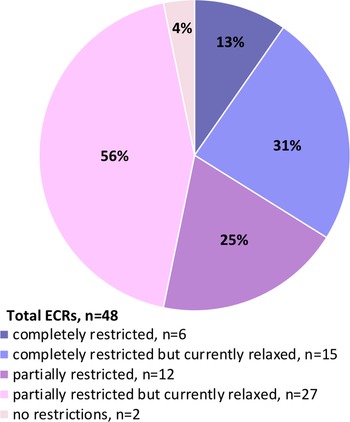
Our ECR colleagues of the Trainee Organization (ASTRO) of the affiliated DOHaD Japan Chapter conducted a short survey to investigate the effects of COVID-19 on DOHaD research in Japan, and strategies that can be undertaken to mitigate its effects. A real-time questionnaire, using the Zoom Polling option (n = 48), was performed during the 31st DOHaD Japan young investigator virtual seminar. It comprised of the following three questions: (1) Have your research activities been restricted due to the COVID-19 pandemic? (2) Are you conducting any research related to COVID-19? (3) How should DOHaD Japan Society approach the issue of COVID-19? Most DOHaD Japan ECRs reported their research activities were either “completely restricted,” “completely restricted but currently relaxed,” “partially restricted,” or “partially restricted but currently relaxed” [13% (n = 6), 31% (n = 15), 25% (n = 12), 56% (n = 27), respectively], while only n = 2 (4%) ECRs reported “no restriction” (Fig 1).
Impact of COVID-19 pandemic on DOHaD Japan ECRs research activity.

The impact of the pandemic and its associated restrictions have imposed barriers to research productivity, which raised concerns about academic future for ECRs globally. 4,Reference Herman, Nicholas and Watkinson5 Our DOHaD Canada ECR representatives shared their observation and reported that when the pandemic started, most ECRs were not allowed to go back to their institutions and had to switch to working remotely. Due to the rapidly changing nature of the pandemic, the wet-lab ECRs were found unprepared, with no standardized procedures for halting experiments, delays or cancelations on their experiments. At the same time, others faced challenges with remote working. In-person lectures and trainings were virtualized or canceled. University students were affected in particular, and struggled to complete their credentials as planned due to rescheduling of graduation and defense dates, or cancelation of courses by the institutions, as was also reported in the Statistics Canada survey. 7 Many students alerted toward the rising debt, and expressed significant concern about using up their savings. 7 These experiences were not unique to Canada, as our ECR representatives from Australia & New Zealand, France, USA, Japan, Pakistan and Latin America expressed similar concerns from their regions.
Another key challenge was the lack of networking and collaborating opportunities for ECRs during this period due to the lack of in-person conferences. This was particularly concerning for ECRs in Oceania who are geographically further afield from their North American or European peers. Although there were virtual networking platforms, these were less enriching learning or networking experiences compared to attending an in-person conference. ECRs received limited support from their institutions in regard to providing personal development opportunities or solution to face these unprecedented challenges, as much of academic community was caught off guard.
Exposed inequalities
The pandemic undoubtedly exposed existing disparity in our research sector, this includes disproportionate impact of COVID-19 on women and caregivers in academia and science, Reference Littleton8-10 as well as on those from underprivileged backgrounds, Reference Arnold and Woolston11 and those who work in low-middle income countries. Reference Ghosh12 Overall, it is projected that during and post-pandemic, popular and well-resourced Universities might fare better than less popular or under-resourced Universities. Reference Witze13,Reference Yezdani14 Consistent with this, our anecdotal evidence suggests that DOHaD ECRs of well-resourced Universities and projects are coping better with the COVID-19 challenges in contrast to under-resourced sectors globally. DOHaD Latin American representatives shared their observations that the COVID-19 pandemic highlighted economic differences among University students. Many students had limited resources to be able to successfully adapt to a virtual mode of learning. For example, unstable internet connection, limited access to internet service, and difficulties of sharing only one mobile device within a family were amongst the many reported shortfalls. Furthermore, regional emerging economic problems due to the ongoing pandemic threatened the continuity of financial support for training programs of postdoctoral fellows, graduates, and postgraduate students.
DOHaD ECRs in Pakistan reported that growing case load (1 million cases, 24,000 deaths and the fourth wave at its peak) overwhelmed the already weak health infrastructure in the country. Despite this situation, the general public remained in denial. One of our ECRs reported that “A few weeks ago, I was speaking to a young pregnant woman at one of our community-based research sites who was not wearing a mask and wanted to shake my hands. As I explained the situation to her, she abruptly said ‘the poor donʼt get corona, this is a disease of the rich’.” The prevailing misconception in the community has been suggested to worsen the situation in the country.
Moreover, during the course of the pandemic the disparities between different research disciplines became even more apparent. For instance, DOHaD ECR representatives from Australia & New Zealand, Canada and USA reported that those who conducted wet-lab research were more dramatically impacted (e.g., restricted daily laboratory work, animal experiments, human clinical sample collection), compared to their bioinformatics peers for whom the pandemic did not directly affect day-to-day research activity.
Effects on future employment and career development plans
Another significant impact of the pandemic was on the employment plans. Reference Lane15 Consistent with this, our DOHaD ECR representatives report that transitioning to a new academic position or getting a job in the industry took longer than expected. In addition, starting a new job, or joining a new lab during the pandemic came with new challenges, as there was limited in-person networking opportunity to learn about new colleagues or research teams.
One of our ECRs shared their own personal experience and mentioned, “In October 2020, I started my first postdoctoral experience in Paris, in the midst of restrictions, bans and the so-called curfew. In the first months, it was really difficult to get to know new colleagues and working environment: masks were hiding faces, conferences were all online, and chatting wasnʼt permitted during coffee breaks. As a consequence, discussions around my new research area and opportunity to network with my new colleagues was highly limited. This resulted in a loss of motivation and reduced my passion for my research study.” Unfortunately, this was not an isolated experience, such that DOHaD ECR representatives from Australia & New Zealand, Canada, USA, Latin America, Pakistan and Japan shared similar observations from their regions. Similar concerns were also highlighted in a survey of 7670 postdoctoral researchers representing 93 nations conducted by Nature. Reference Woolston16
Furthermore, our observations from the DOHaD ECR group suggest that international travel bans severely hampered the opportunity to acquire overseas education or work experience for ECRs, since ECRs could not travel to commence undergraduate, postgraduate, or PhD studies, or Postdoc positions at an overseas institution. Consequently, many new PhD students or Postdocs could not start or started offline by working on drafting research plans and proposals and relying heavily on communication with their supervisors via email, phone, or zoom. International ECRs who did not have access to visa were even more severely affected because they could not apply or were hesitant to apply for suitable courses or overseas positions compared to ECRs with a visa or who did not require a visa. This is also reported in previous studies demonstrating reduced enthusiasm in international students to apply for educational programs at an overseas University due to COVID-19. Reference Martin-Barbero and Marmolejo17 Overall, the COVID-19 pandemic associated travel restrictions affected education and employment timeline for DOHaD ECRs who had planned to embark upon a new course or position in 2020 and 2021.
Not only starting a new position, but also starting new projects was extremely challenging- specifically, as our DOHaD ECR representatives indicated that commencing clinical projects was a challenge because collecting patient samples was not permitted due to healthcare restrictions. Also, Universities faced financial crisis due to loss of student intake, leading to a substantial decline in research funding. Reference Witze13,Reference Estermann, Kupriyanova and Stoyanova18 Our DOHaD ECR representatives also reported that due to lack of financial and human resources, ongoing studies were prioritized over commencing new projects. Existing reports suggest that many Universities around the world struggled to keep their staff employed Reference Witze13,Reference Estermann, Kupriyanova and Stoyanova18 with a staggering 40,000 (and counting) academic jobs lost in Australia in 2021 alone. Reference Littleton and Stanford19 Some Universities requested their staff to take voluntary redundancy or reduce their working hours. Reference Ball20 Our findings suggest that some DOHaD ECRs reduced their working hours due to difficulty juggling house chores, childcare/caring for elderly and work from home. This specifically affected female ECRs, who whilst working from home took a greater share of performing house chores and carer’s responsibilities than men. Reference Roseboom, Ozanne and Godfrey1,Reference Kasymova, Place, Billings and Aldape21 We also observed that ECRs in particular faced job insecurity, as they are less involved in employment decision making and hence more vulnerable to losing their jobs than senior academics. Employment uncertainty, need to manage competing priorities, and perceived loss of career prospects was even reflected through the survey conducted by the Early- and Mid-Career Researcher Forum of Australia, 22 as well as by the Times Higher Education in the UK Reference Baker23 and Nature’s survey of postdocs worldwide. Reference Woolston16 The situation was even worse for ECRs in resource-poor settings, Reference Ghosh12 as also indicated by ECRs of DOHaD Latin America (see preceding section).
Toll on mental health and social well-being
The uncertainties imposed by COVID-19 exacerbated anxiety about career advancement and financial situation among academic staff globally. Reference Maslen24-Reference Lewis26 Our DOHaD ECR representatives from Australia & New Zealand, Canada, France, Japan, Latin America, Pakistan and USA shared similar concerns. The pandemic, mandated isolation and social distancing enormously affected the psychological and social aspects of everyone’s lives. Many family events were canceled, and the uncertainty of when one can see their families took a toll on mental health. This was particularly challenging for our international ECRs, who had their family and loved ones overseas with no foreseeable insights into when they can be united. International ECRs who commenced a new position were stuck in limbo, as some had their partner overseas and international border restrictions did not allow travel.
Day-to-day activity was also affected. An ECR reported that “After a busy day in laboratory, grocery stores and public transport were overcrowded in Paris, people exhausted and nervous. Back at home in the tiny Parisian apartment it was too late to counteract the accumulated stress by doing sports or even a walk outside. During the winter, while the curfew was regular, managing the high workload and the family life in the small time-window from 6 am to 6 pm, was a real challenge.” In addition to the mandatory quarantine or self-isolation and social distancing to limit the spread of the coronavirus, the news of illness/demise of friends/family members affected mental health of DOHaD ECRs. Similar concerns were also reported in a previous study of ECRs in the UK. Reference Byrom27 Consequently, our DOHaD ECR group observed and experienced that research productivity was impacted, which was reflected through periods of procrastination and lack of motivation to continue working at home, leading to reduced publication rate. Female ECRs and those with carer responsibilities were even more severely impacted, as has also been reported previously. Reference Kasymova, Place, Billings and Aldape21,Reference Viglione28
Learnings and mitigation strategies
Undoubtedly, the COVID-19 pandemic has had a detrimental impact on the academic sector worldwide, including loss of thousands of academic jobs, leading to heightened job uncertainty and funding insecurity in the sector, and rising toll on mental health as discussed in the preceding sections. Under these grim scenarios, a level of survivorship bias has been observed, with many forced/deciding to leave the academic sector and those who can or who have chosen to stay are struggling with limited resources. This includes our DOHaD ECRs whose resilience is being tested in these difficult times. DOHaD ECRs are struggling, but with limited support, they are managing to keep themselves motivated to get passed this tough period. The personal experiences and observations of the members of the DOHaD ECR Committee suggests that DOHaD ECRs stayed focused on tasks that could be achieved during these times; this included data analysis and writing manuscripts. Many ECRs adapted new virtual working style, and communicated more frequently with their supervisors, mentors and colleagues sharing their thoughts and concerns. ECRs very rapidly learnt resource management strategies. While toilet paper was hoarded in the first weeks of uncertainty, pipette tips and conical tubes were very soon regarded as gold.
Learning new skills of online teaching and presenting via virtual platforms was welcomed by ECRs. In fact, ECRs expressed that virtual academic spaces have allowed collective demonstrations of support and solidarity. While online platforms offer less enriching networking experience compared to in-person meetings, ECRs regarded virtual platforms as a valuable tool to continue DOHaD education and training during times when travel is not a possibility (e.g., international travel ban witnessed during COVID-19 pandemic). It is suggestive that these platforms might be valuable to mitigate and prevent public health crisis in the future but cannot replace the more enriching in-person learning/networking experiences.
Around the world the pandemic brought researchers together in ways only possible while in a pressure cooker. Collaborative biomedical, clinical and public health research efforts commenced and are hoped to prove effective to collectively combat the growing challenges of COVID-19. In France, the COVID-19 pandemic and the applied mitigations strategies by the French government stirred up professional and personal life for researchers in France. In Germany, the members of the Quest Center of the Berlin Institute of Health launched a guide for ECRs, which aims “to foster kindness and de-stigmatize mental health issues”. 29 Globally, newly formed scientific collaborations tackled COVID-related research. The survey result from DOHaD Japan demonstrates that despite COVID-19 restrictions, 37% ECRs (n = 18 out of 48) started or were ready to start COVID-19 related research. Follow up studies investigating the impact of COVID-19 on pregnant women have already commenced in Australia, 30 Canada, 31 United Kingdom, 32 and USA. Reference Villar, Gunier and Thiruvengadam33 During these challenging times, it was also reassuring that at least some funding agencies and collaborators have been supportive and allowed for flexibility in terms of costs and deliverables, as indicated by our ECRs from DOHaD Canada, Australia & New Zealand, and USA. This was also reflected in an Editorial from Nature indicating that at least in some parts of the world funders extended grant deadlines, or extended funded positions, however, this was not a universal finding and majority of postdocs continue to remain anxious about continued funding support. 34,Reference Malik, Crookes and Sundaram35
This pandemic also highlighted the value of science education and communication for general public. For example, in the United States as people displayed a need for legitimate and understandable scientific information, ECRs of DOHaD USA joined their network to form the “League of Science Superfriends”. As a team of scientists, from varying backgrounds of origin and expertise, they reach internationally to empower people to make decisions based on authentic scientific information. While this year has been challenging, it showed the strength of the scientific community especially when working together to address research questions and educate the public. We hope such efforts continue to exist and flourish moving forward.
The International DOHaD Society provided support by investing in ECR projects through the newly launched Brain Mobility awards, as well as hosted monthly DOHaD webinar series, which included ECR speakers. International DOHaD affiliated societies/chapters around the world also engaged with their ECRs actively either through hosting ECR tailored webinars (DOHaD ANZ, and DOHaD Latin America), or conducting surveys (DOHaD Japan). Some were more proactive than others. These webinars and surveys have provided greater assurance and means of continued connectivity and engagement for ECRs during the COVID-19 pandemic. Similar to the DOHaD Japan affiliated chapter, DOHaD Canada affiliated society and its Trainees Committee has developed a survey to understand ECRsʼ concerns better and identify key aspects affected by the pandemic. The results of this survey will inform DOHaD Canada on how to best help its ECRs overcome identified issues. Acting now will be vital in adequately supporting the ECRs who are the future leaders of the DOHaD research community.
Concluding remarks
The COVID-19 pandemic adversely affected research activities and career development of ECRs with profound impact on their mental health, social well-being and long-term career trajectory. Young researchers lived through diverse experiences around the world. ECRs in different research disciplines were impacted differently, such that research productivity and output of those conducting hands on research (e.g., wet-lab, field-based, or clinical trials) was more dramatically affected than their bioinformatics peers for example. The pandemic also highlighted research inequalities, with more severe consequences for ECRs in resource-poor settings, international ECRs, female researchers and on caregivers. Despite multiple challenges, our DOHaD ECRs displayed incredible resilience, welcomed technological advances, and adapted new ways of learning and researching. We hope that the lessons learnt from this pandemic provide impetus to create and strengthen research networks and scientific cooperation worldwide. Many ECRs around the world continue to struggle when commencing new position, or face job insecurity with no foreseeable extension (despite losing 18 months of research productivity since the commencement of the pandemic) or support from their host institution. As such it is critically important for professional Societies around the world to step up and support the ECR community either by investing in ECR research projects through more seed funding opportunities or providing more opportunities to ECRs to present their research work and remain connected with the wider research community. It is critical to form collaborative and inclusive scientific community and build a supportive framework to foster the growth and development of our youngest generation of researchers. Professional Societies, such as DOHaD, played an important role in responding to the needs of ECRs and provided a template for future global emergencies.
Acknowledgements
We would like to thank all the ECRs who contributed to the discussion, including Dr Bevin Blake of DOHaD USA, Dr Yoshinori Kubo of DOHaD Japan, and Nathalee L X Ribeiro and Fabian Vega Ponticia of DOHaD Latin America. We also thank the ECRs across Canada and Japan who contributed to develop the surveys for understanding the needs and experiences of the ECRs in these regions.
Author’s contribution
AB: Chair of the ECR committee of the International DOHaD Society, conception, planning, assembling the group, writing the first draft and edited subsequent versions. GAA: Co-Chair of the ECR committee of the International DOHaD Society, involved in conception, planning, and writing the first draft. EH, KH, HH, ZH, HD, CAI, RAM, TNG, and KM: ECR representatives of International DOHaD affiliated Societies/Chapters, shared experiences of DOHaD ECRs from their regions, reviewed manuscript draft, and approved final version. CRI: Chair of the Communication Committee of the International DOHaD Society, involved in conception, planning, reviewed manuscript draft, and approved final version.
Conflict of Interest
The authors declare no conflict of interest.