Introduction
With the elderly people now the fastest-growing segment of the general population (Thies and Bleiler, Reference Thies and Bleiler2012), dementia has become one of the most common and serious medical problems (Dramé et al., Reference Dramé2012). Given that memory impairment is the earliest and most invalidating core symptom of dementia, the majority of early interventions aim to slow cognitive decline. Currently, pharmacological interventions, such as cholinesterase inhibitors, are most commonly used to achieve this (Aderinwale et al., Reference Aderinwale, Ernst and Mousa2010). However, studies into their use with people with dementia have found them to have limited effectiveness (Evans et al., Reference Evans, Wilcock and Birks2004). Thus, recent research has focused on developing alternative, non-pharmacological memory interventions to alleviate the cognitive deficits associated with dementia. Numerous interventions capitalize on the relatively intact implicit memory system, which utilizes an automatic and unconscious form of remembering that is expressed through the performance of skills and habits (see Grandmaison and Simard, Reference Grandmaison and Simard2003 for a review).
One such technique is that of spaced-retrieval (SR) training, a direct memory intervention that teaches new information via active recall attempts over progressively longer retention intervals (Camp, Reference Camp, Attix and Welsh-Bohmer2006). Originally based on early work by Landauer and Bjork (Reference Landauer, Bjork, Gruneberg, Morris and Sykes1978), Camp (Reference Camp, Gilmore and Whitehouse1989) adapted SR for people with dementia, finding that the use of performance-adjusted delays between recall trials enabled participants to successfully learn and retain name–face associations of nurses. The overall goal of SR is to enable individuals with memory impairment to remember information for clinically relevant periods of time (e.g. days, weeks, and months; Vance and Farr, Reference Vance and Farr2007). SR is administered by first providing the client with a prompt question and associated target response. When successful at recalling the response, the client is required to actively recall the target information using either uniform or increasingly longer inter-trial intervals (Brush and Camp, Reference Brush and Camp1998a). If at any time the client is unable to recall the response, they are provided with the information and asked to repeat it (Camp et al., Reference Camp, Foss, Stevens, O’Hanlon, Brandimonte, Einstein and McDaniel1996b). Typically, the training is considered successful if the participant correctly responds to the prompt question at the beginning of three consecutive sessions (Brush and Camp, Reference Brush and Camp1998a), as long-term retention of the information has been demonstrated.
At present, little research has been conducted into the theoretical mechanisms underlying SR training (Camp et al., Reference Camp, Bird, Cherry, Hill, Bäckman and Neely2000). However, Camp (Reference Camp, Attix and Welsh-Bohmer2006) suggested that the technique integrates four different methods of learning. First, SR is a form of “ecologically valid priming,” whereby previous exposure to a stimulus influences later detection and identification of that stimulus (Sohlberg and Turkstra, Reference Sohlberg and Turkstra2011). Second, SR is also thought to use “spacing effect;” information is learned and retrieved more effectively when trials are distributed over time rather than mass practiced (Camp et al., Reference Camp, Bird, Cherry, Hill, Bäckman and Neely2000). The utilization of both these methods is thought to be particularly beneficial to individuals with dementia, as they capitalize on the relatively spared and automatic implicit memory system (Camp et al., Reference Camp, Bird, Cherry, Hill, Bäckman and Neely2000). Third, SR is regarded as a form of conditioning; strong associations are formed between the target question and response through repetition and successful recall trials may serve as intrinsic reinforcers (Camp, Reference Camp, Attix and Welsh-Bohmer2006). Lastly, SR can also be considered a form of errorless learning (e.g. Haslam et al., Reference Haslam, Hodder and Yates2011), as it minimizes the possibility of errors during the acquisition phase of learning by ensuring mistakes are repeatedly corrected (Camp et al., Reference Camp, Bird, Cherry, Hill, Bäckman and Neely2000).
Interestingly, while SR training appears to be gaining increasing support and attention within the field of aged care, to our knowledge only two literature reviews have been conducted: one for a French audience only (Erkes et al., Reference Erkes, Raffard and Meulemans2009) and one by Hopper et al. (Reference Hopper2005). As a number of new studies using SR training have been conducted in recent years, the purpose of this review was to provide an up-to-date overview of this promising technique. Therefore, this paper describes published research testing the effectiveness of SR training to teach people with dementia new information and behavioral strategies. In addition, when other outcome measures (such as secondary non-cognitive benefits) have been studied, these findings are also presented in the review.
It must be noted that to date, only three randomized controlled trials (RCTs; the gold standard for evaluating clinical interventions) have been conducted on SR training (Davis et al., Reference Davis, Massman and Doody2001; Hawley et al., Reference Hawley, Cherry, Boudreaux and Jackson2008; Lin et al., Reference Lin2010), with most research lacking a control condition or group and/or utilizing a case study or single-subject design. Nevertheless, all published studies found were included in this review for the sake of completeness.
Methods
From January to April 2012 (and updated in September 2012), a search of PsychINFO, MEDLINE, and Scopus was performed using the key terms: “spaced-retrieval,” “memory training,” “memory rehabilitation,” “cognitive training,” “cognitive rehabilitation,” “dementia of the Alzheimer's type,” “dementia,” and “Alzheimer’s/Alzheimer disease.” Reference lists of relevant papers were also searched to identify articles that described SR in this population. The review was restricted to primary, peer-reviewed research studies that were published in English and focused on the use of SR training for people with dementia.
Using the Australian National Health and Medical Research Council's (NHMRC, 2000) level of evidence hierarchy, all studies reviewed were graded according to their design quality. Specifically, systematic reviews of level II studies were considered to be level I evidence; RCTs were classified as level II evidence; pseudo RCTs were classified as level III-1 evidence; non-randomized experimental trials (including pre-test–post-test studies), cohort studies, case–control studies, and interrupted time series studies with a control group were classified as level III-2 evidence; historical control studies, two or more single arm studies, and interrupted time series studies without a parallel control group were classified as level III-3 evidence; and a case series with either post-test or pre-test–post-test outcomes was classified as level IV evidence.
Results
In total, 34 studies were included in this review, with the studies being classified into four types based on the goals of SR training: (1) name–face associations, (2) object–name associations, (3) cue–behavior associations, and (4) mixed goals/other.
Name–face associations
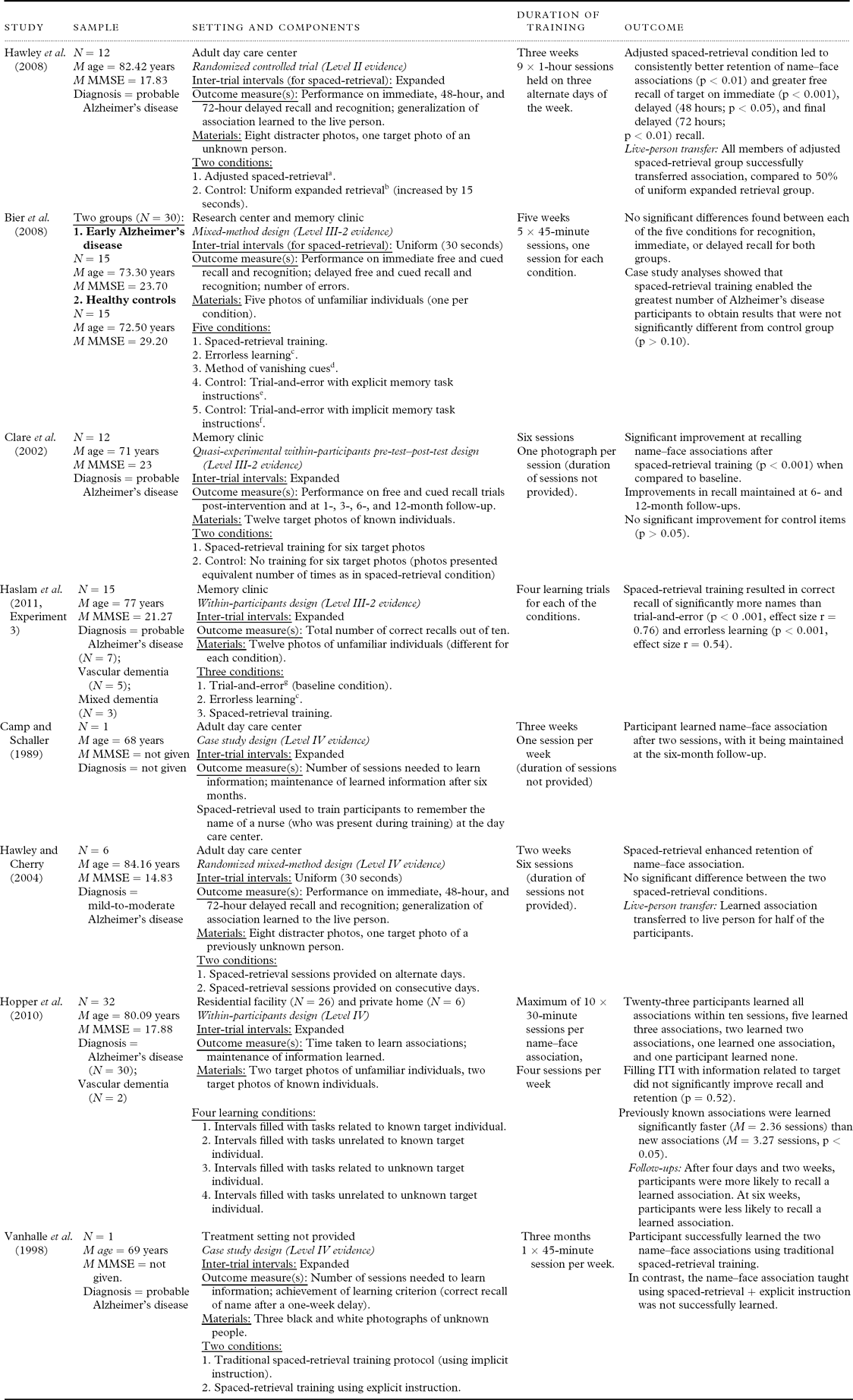
In total, eight studies focused on the effectiveness of SR to teach people with dementia to associate a name with a specific face (see Table 1). One study was classified as level II evidence (Hawley et al., Reference Hawley, Cherry, Boudreaux and Jackson2008), three were level III-2 evidence (Clare et al., Reference Clare, Wilson, Carter, Roth and Hodges2002; Bier et al., Reference Bier2008; Haslam et al., Reference Haslam, Hodder and Yates2011), and four studies were level IV evidence (Camp and Schaller, Reference Camp and Schaller1989; Vanhalle et al., Reference Vanhalle, Van der Linden, Belleville and Gilbert1998; Hawley and Cherry, Reference Hawley and Cherry2004; Hopper et al., Reference Hopper, Drefs, Bayles, Tomoeda and Dinu2010). Two studies taught participants the names of familiar people (Camp and Schaller, Reference Camp and Schaller1989; Clare et al., Reference Clare, Wilson, Carter, Roth and Hodges2002), while five studies taught participants to associate an unfamiliar match (Vanhalle et al., Reference Vanhalle, Van der Linden, Belleville and Gilbert1998; Hawley and Cherry, Reference Hawley and Cherry2004; Bier et al., Reference Bier2008; Hawley et al., Reference Hawley, Cherry, Boudreaux and Jackson2008; Haslam et al., Reference Haslam, Hodder and Yates2011;). One study taught participants the names of both unfamiliar and familiar faces (Hopper et al., Reference Hopper, Drefs, Bayles, Tomoeda and Dinu2010).
SR training to teach name–face associations

Note: MMSE = Mini-Mental State Examination.
aAdjusted spaced-retrieval: The length of time between each trial was governed by whether the participant correctly or incorrectly recalled the target information. Correct recall was followed by a longer inter-trial interval, while incorrect recall led to shorter inter-trial intervals.
bUniform expanded retrieval: Each trial was separated by the same amount of time, regardless of whether the participant correctly or incorrectly recalled the target information.
cErrorless learning: Aims to prevent or eliminate errors during training by either providing the correct answer immediately during learning, or by asking people to generate a response using cues which eliminate most errors. In Haslam et al. (Reference Haslam, Hodder and Yates2011), participants were presented with the face and the correct name for three seconds, then completed filler tasks for 8 minutes 30 seconds. They were then asked to recall the name in the same manner as in the trial-and-error condition. In Bier et al. (Reference Bier2008), the face–name association was presented for 5 seconds with the following instructions, “Here is a picture of a man, whose name is Mr. X. Can you repeat his name and try to remember it?” The picture and name were hidden, and then the picture was immediately presented again. The participant then had 20 seconds to recall its associated name, with the correct answer provided if they made a mistake or could not give an answer.
dMethod of vanishing cues: Participant was provided with progressively stronger or weaker cues following a recall attempt of the target information. If at any stage the prompt question was answered correctly, cues were gradually withdrawn from subsequent trials until they could correctly recall the information without any assistance. If during any of the trials the participant provided an incorrect response, additional cues were provided one at a time until they were able to provide the correct response.
eTrial-and-error with explicit memory task instruction: Each of the five associations was presented for five seconds. For each photo the experimenter stated: “Here is a picture of a man, whose name is Mr. X. Can you repeat this name and try to remember it?” One of the photos was then presented again and the participant asked to provide the associated name, with the experimenter explicitly asking the participant to remember the name presented earlier. The participant had 20 seconds to answer, with the experimenter providing the answer after an incorrect response. This procedure was done for each photo (in a random sequence) in three cycles of three presentations.
fTrial-and-error with implicit memory task instruction: The method was identical to the one described above, with the only difference being the recall instructions given to participants. Namely, participants were told to give the first answer that came to mind, even if it seemed like a guess, with no reference made to the preceding learning trials.
gTrial-and-error: At the beginning of each trial, a photograph was presented along with the first letter of the name and dashes to represent missing letters. Participants were required to guess the name, with feedback given on accuracy. If after either ten seconds or four attempts the name had not been guessed correctly, the correct name was presented for three seconds and participants were explicitly asked to remember the association. To ensure a minimum of one error per item was made, a substitute was used if the target name was correctly guessed on the first attempt. This was done for all 12 photos in the set and was repeated four times in total. The recall test was then administered, whereby participants were presented with the photos in a random order and required to recall the corresponding name. They were encouraged to guess if unsure of the correct answer.
Overall, the articles reviewed were largely positive. Using a case study design, both Vanhalle et al. (Reference Vanhalle, Van der Linden, Belleville and Gilbert1998) and Camp and Schaller (Reference Camp and Schaller1989) successfully taught their participant name–face associations, while three studies (one randomized mixed-method design; one RCT; and one within-participants design) found at least half of the participants learned the associations taught (Hawley and Cherry, Reference Hawley and Cherry2004; Hawley et al., Reference Hawley, Cherry, Boudreaux and Jackson2008; Hopper et al., Reference Hopper, Drefs, Bayles, Tomoeda and Dinu2010). Furthermore, using a within-participants pre-test–post-test design, Clare et al. (Reference Clare, Wilson, Carter, Roth and Hodges2002) found a significant improvement in participants’ performance on trained items from baseline to post-intervention, while no significant improvement was found for control (untrained) items. Haslam et al. (Reference Haslam, Hodder and Yates2011) found SR to significantly improve the correct recall of the target name–face associations compared to other techniques. Conversely, using a mixed-method design, Bier et al. (Reference Bier2008) found that SR was not statistically superior to other cognitive training methods, including errorless learning, the method of vanishing cues, and trial-and-error. However, case study analyses demonstrated that SR resulted in the greatest number of participants with early Alzheimer's disease achieving similar results to the healthy controls.
Two studies also investigated whether the name–face association learned using a photograph could be transferred to the actual person (Hawley and Cherry, Reference Hawley and Cherry2004; Hawley et al., Reference Hawley, Cherry, Boudreaux and Jackson2008). Both studies found this generalization of the learned response to be successful, with Hawley et al. (Reference Hawley, Cherry, Boudreaux and Jackson2008) finding that all participants in the adjusted SR condition correctly named the person, while Hawley and Cherry (Reference Hawley and Cherry2004) found three out of six participants were able to correctly name the person from the photograph.
Object–name associations
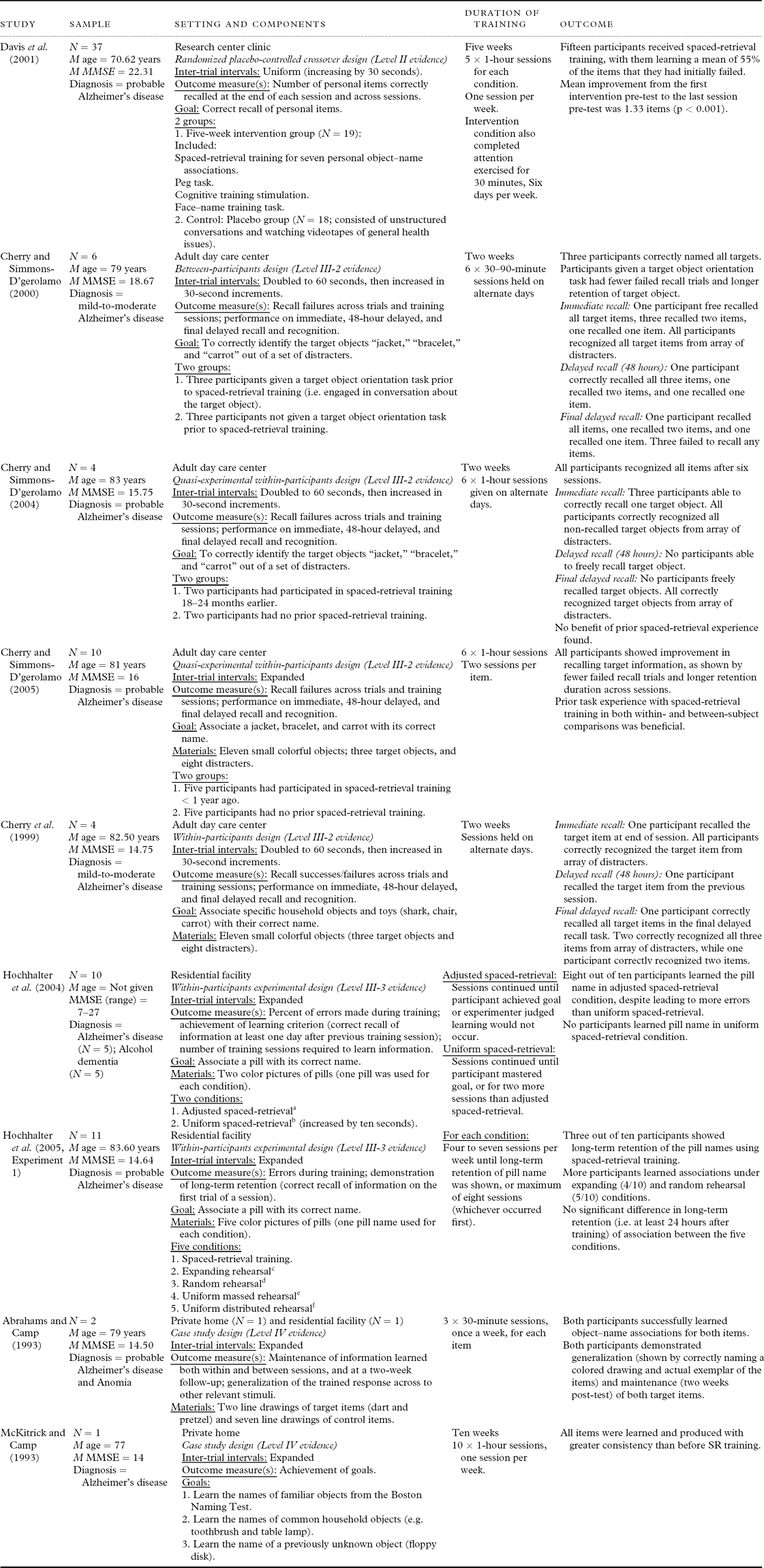
Nine studies utilized the SR technique to help people relearn the names of objects (see Table 2). One study was classified as level II evidence (Davis et al., Reference Davis, Massman and Doody2001), four studies were level III-2 evidence (Cherry et al., Reference Cherry, Simmons and Camp1999; Cherry and Simmons-D’Gerolamo, Reference Cherry and Simmons-D’Gerolamo2000; Reference Cherry and Simmons-D’Gerolamo2004; Reference Cherry and Simmons-D’Gerolamo2005), two studies were considered to be level III-3 evidence (Hochhalter et al., Reference Hochhalter, Bakke, Holub and Overmier2004; Reference Hochhalter, Overmier, Gasper, Bakke and Holub2005), and two studies were level IV evidence (Abrahams and Camp, Reference Abrahams and Camp1993; McKitrick and Camp, Reference McKitrick and Camp1993). Six studies (one case study; one between-participants design; three within-participants design; and one randomized placebo-controlled crossover design) taught participants the names of previously known but forgotten objects (Abrahams and Camp, Reference Abrahams and Camp1993; Cherry et al., Reference Cherry, Simmons and Camp1999; Cherry and Simmons-D’Gerolamo, Reference Cherry and Simmons-D’Gerolamo2000; Reference Cherry and Simmons-D’Gerolamo2004; Reference Cherry and Simmons-D’Gerolamo2005; Davis et al., Reference Davis, Massman and Doody2001), while two studies used a within-participants design to explore the effectiveness of SR training in teaching participants the names of previously unknown and unfamiliar pills (Hochhalter et al., Reference Hochhalter, Bakke, Holub and Overmier2004; Reference Hochhalter, Overmier, Gasper, Bakke and Holub2005, Experiment 1). Moreover, McKitrick and Camp (Reference McKitrick and Camp1993) used SR to teach one participant the names of both previously known and unknown objects.
SR training to teach object–name associations
Note: MMSE = Mini-Mental State Examination.
aAdjusted spaced-retrieval: The length of time between each trial was governed by whether the participant correctly or incorrectly recalled the target information. Correct recall was followed by a longer inter-trial interval, while incorrect recall led to shorter inter-trial intervals.
bUniform spaced-retrieval: Each trial was separated by the same amount of time, regardless of whether the participant correctly or incorrectly recalled the target information.
cExpanding rehearsal: The same inter-trial intervals experienced during spaced-retrieval training were arranged in increasing order, regardless of performance.
dRandom rehearsal: The same inter-trial intervals experienced during spaced-retrieval were arranged in a random order.
eUniform massed rehearsal: All trials were separated by a ten-second delay.
fUniform distributed rehearsal: All trials were separated by a four-minute delay (which was close to the mean of the eight possible inter-trial intervals of spaced-retrieval). This was included to test if variability in inter-trial intervals is important when distributed practice is used, or if a uniform schedule of trials with relatively long inter-trial intervals is sufficient to produce long-term retention.
All studies were successful in using SR training to achieve goals with some or all participants. Hochhalter et al. (Reference Hochhalter, Overmier, Gasper, Bakke and Holub2005, Experiment 1) did not find that SR training led to long-term retention of pill names more often than other memory techniques, with the authors finding that random and expanding rehearsal patterns led to long-term maintenance of more pill names. In addition, Cherry and Simmons-D’Gerolamo (Reference Cherry and Simmons-D’Gerolamo2004) found that while all participants demonstrated fewer errors per trial and increased retention duration across sessions, there was little evidence of the long-term benefits of SR training on performance. More specifically, the two participants who had completed SR training 18 to 24 months prior had a greater number of failed recall trials compared to original testing, with little difference in performance also found compared to the two control participants with no prior training. However, this may have been because the test delay was too long to demonstrate any potential long-term effects of the technique, with Cherry and Simmons-D’Gerolamo (Reference Cherry and Simmons-D’Gerolamo2005) finding clear evidence that, despite an increase in the severity of Alzheimer's disease, prior experience of SR had both within- (i.e. compared to their original performance) and between-subject (i.e. compared to controls) benefits for five participants who had undertaken the training less than a year ago.
Cue–behavior associations
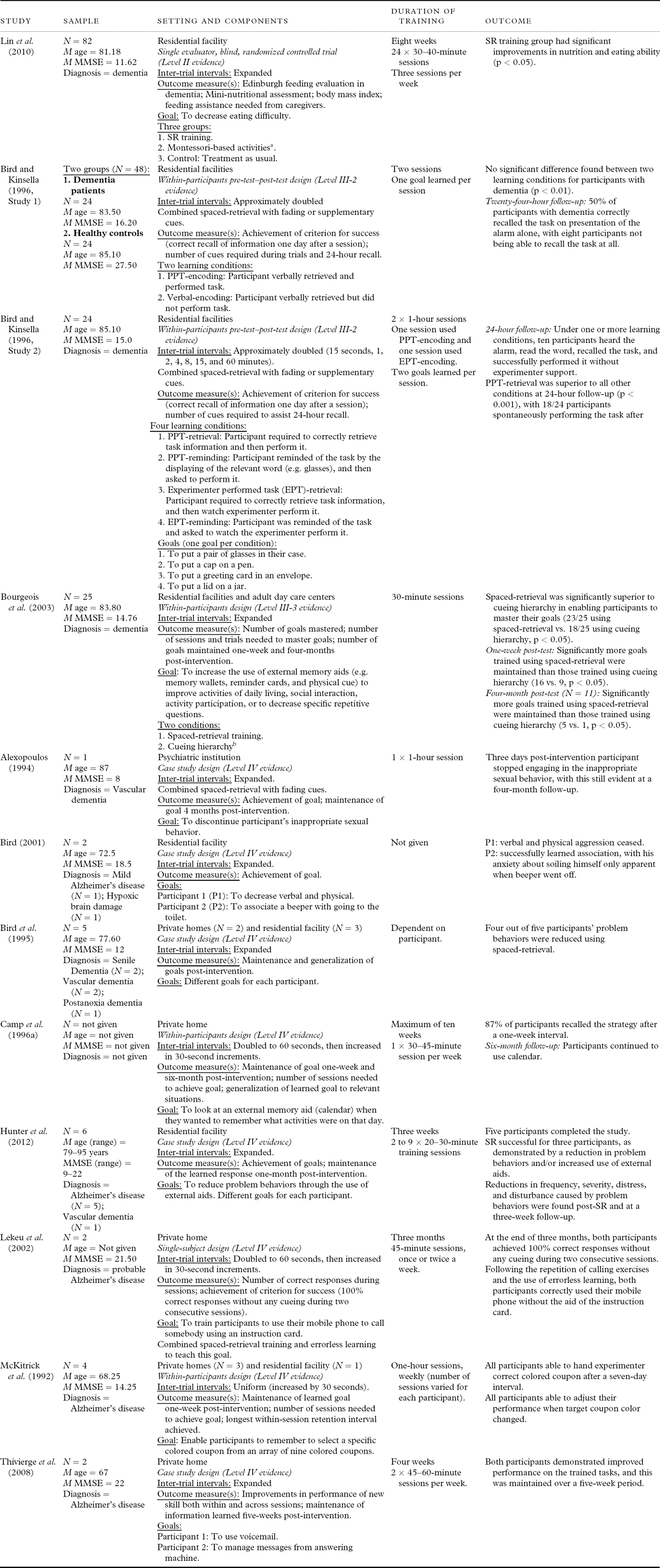
Altogether, 11 articles (describing 12 studies) utilized the SR technique to teach associations between a cue and a specific behavior (see Table 3). One study was classified as level II evidence (Lin et al., Reference Lin2010), two studies were considered to be level III-2 evidence (Bird and Kinsella, Reference Bird and Kinsella1996, Studies 1 and 2), one study was level III-3 evidence (Bourgeois et al., Reference Bourgeois2003), while eight studies were classified as level IV evidence (McKitrick et al., Reference McKitrick, Camp and Black1992; Alexopoulos, Reference Alexopoulos1994; Bird et al., Reference Bird, Alexopoulos and Adamowicz1995; Camp et al., Reference Camp, Foss, O’Hanlon and Stevens1996a; Bird, Reference Bird2001; Lekeu et al., Reference Lekeu, Wojtasik, Van der Linden and Salmon2002; Thivierge et al., Reference Thivierge, Simard, Jean and Grandmaison2008; Hunter et al., Reference Hunter, Ward and Camp2012).
SR training to teach cue–behavior associations
Note: MMSE = Mini-Mental State Examination; PPT = Participant Performed Task.
aMontessori-based activities: Teach skills to participants by breaking them down into steps or activities that progress from simple to complex. Often the activities are developed according to each participant's background and interest. In Lin et al. (Reference Lin2010), activities were designed to improve hand–eye coordination, scooping, pouring, and squeezing.
bCueing hierarchy: A systematic and graded sequence of cues of increasing power that are response contingent. Successive levels of the hierarchy are presented until the participant provides the correct response, after which the order of cues is reversed. The aim is to elicit the desired response with the least powerful cue.
Two studies used SR training to directly reduce problem behaviors, with Alexopoulos (Reference Alexopoulos1994) undertaking a case study, while Lin et al. (Reference Lin2010) conducted a RCT. Five studies (three case studies and two within-participants designs) utilized the technique to increase the use of external aids (Bird et al., Reference Bird, Alexopoulos and Adamowicz1995; Camp et al., Reference Camp, Foss, O’Hanlon and Stevens1996a; Bird, Reference Bird2001; Bourgeois et al., Reference Bourgeois2003; Hunter et al., Reference Hunter, Ward and Camp2012), while three studies (one within-participants pre-test–post-test design; one single-subject design; and one case study) taught participants how to use functionally relevant objects (Bird and Kinsella, Reference Bird and Kinsella1996, Study 2; Lekeu et al., Reference Lekeu, Wojtasik, Van der Linden and Salmon2002; Thivierge et al., Reference Thivierge, Simard, Jean and Grandmaison2008). Two studies were more exploratory in nature, with Bird and Kinsella (Reference Bird and Kinsella1996, Study 1) teaching 24 participants to associate a verbal and auditory cue with the action of opening a book or box, reading instructions and performing them, while McKitrick et al. (Reference McKitrick, Camp and Black1992) taught four participants to select a specific colored coupon out of an array of distracters.
Five studies found that all participants successfully learned the cue–behavior associations (McKitrick et al., Reference McKitrick, Camp and Black1992; Alexopoulos, Reference Alexopoulos1994; Bird, Reference Bird2001; Lekeu et al., Reference Lekeu, Wojtasik, Van der Linden and Salmon2002; Thivierge et al., Reference Thivierge, Simard, Jean and Grandmaison2008), while six studies found that more than half of participants learned the strategies or behaviors being taught (Bird et al., Reference Bird, Alexopoulos and Adamowicz1995; Bird and Kinsella, Reference Bird and Kinsella1996, Studies 1 and 2; Camp et al., Reference Camp, Foss, O’Hanlon and Stevens1996a; Bourgeois et al., Reference Bourgeois2003; Hunter et al., Reference Hunter, Ward and Camp2012). Lin et al. (Reference Lin2010) did not state for how many participants SR training was successful, however, they reported a significant improvement in participants’ eating ability and a decrease in eating dependency post-intervention.
Six studies also demonstrated that the functional goals and strategies learned continued to be maintained at post-intervention follow-ups ranging from 24 hours to six months (Alexopoulos, Reference Alexopoulos1994; Bird et al., Reference Bird, Alexopoulos and Adamowicz1995; Camp et al., Reference Camp, Foss, O’Hanlon and Stevens1996a; Bourgeois et al., Reference Bourgeois2003; Thivierge et al., Reference Thivierge, Simard, Jean and Grandmaison2008; Hunter et al., Reference Hunter, Ward and Camp2012). Additionally, Bird et al. (Reference Bird, Alexopoulos and Adamowicz1995) found that one participant was still effectively using a beeper to tell him when to go to the toilet one year after SR training was implemented, with this learned cue–behavior association also continuing to reduce his anxiety about soiling himself.
Bourgeois et al. (Reference Bourgeois2003) found SR training to be more effective than the method of cueing hierarchy.
Mixed goals/other target information
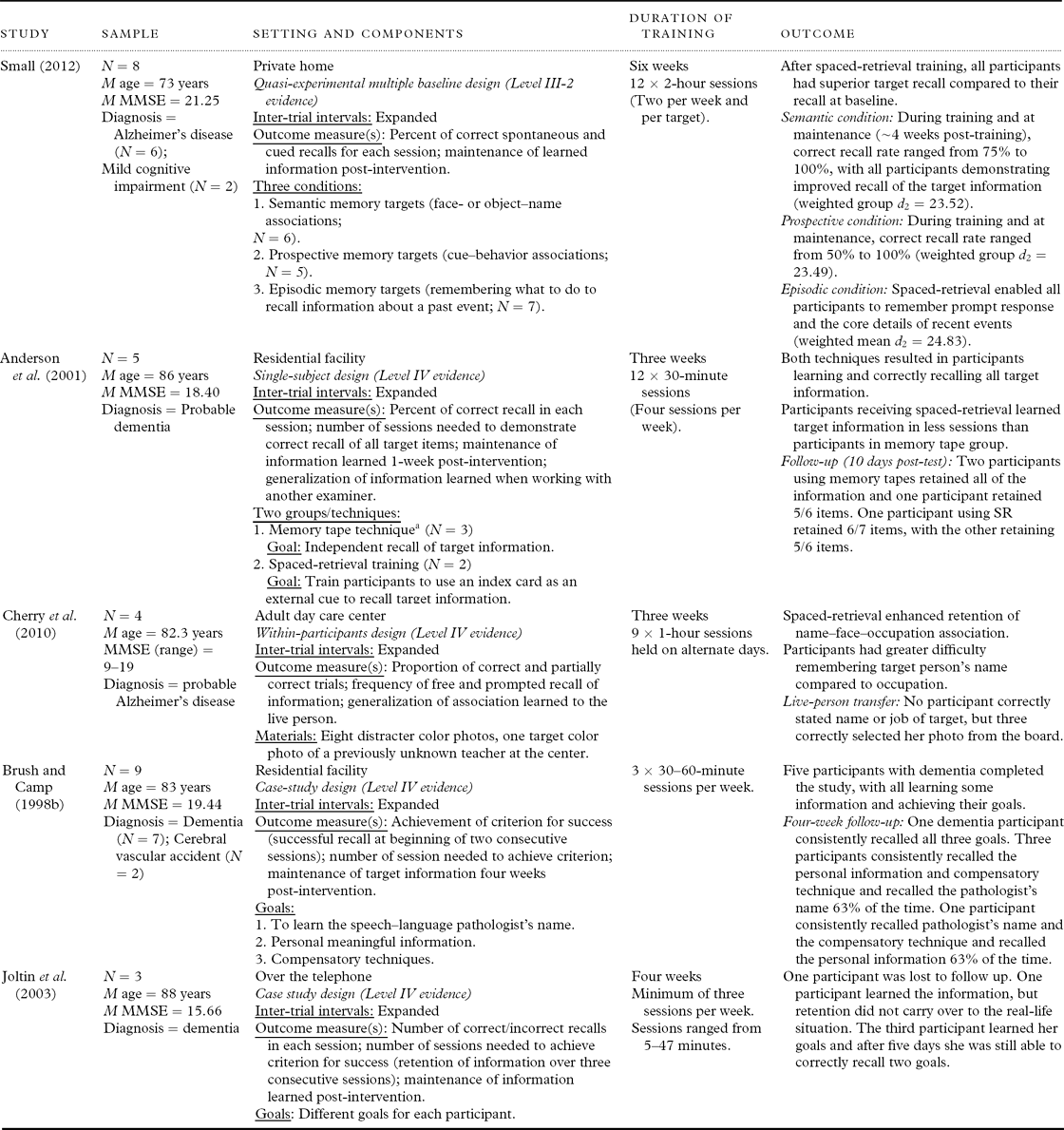
Five studies used SR to teach participants a variety of new associations and goals, with all studies finding that the technique improved and enhanced retention and recall of target information in the majority of the participants (Table 4). One study was classified as level III-2 evidence (Small, Reference Small2012), while the remaining four studies were considered to be level IV evidence (Brush and Camp Reference Brush and Camp1998b; Anderson et al., Reference Anderson, Arens, Johnson and Coppens2001; Joltin et al. Reference Joltin, Camp and McMahon2003; Cherry et al., Reference Cherry, Walvoord and Hawley2010).
SR training to teach mixed goals/other target information
Note: MMSE = Mini-Mental State Examination.
aMemory tape technique: Utilized personalized audio-tapes that included short segments of facts relevant to the individual, followed by questions related to those facts. Each session required the participant to listen to five repetitions of the tape and recall as much information as possible. This was then followed by a three-minute conversational interval, after which the participant listened to another five repetitions of the tape. If the participant was unable to recall the information independently, the tape provided the correct answer after a brief pause for a response.
Using a quasi-experimental multiple baseline design, Small (Reference Small2012) utilized SR to teach participants diagnosed with Alzheimer's disease (N = 6) or amnesic mild cognitive impairment (N = 2) semantic (i.e. face- or object–name associations), prospective (i.e. cue–behavior associations), and episodic (i.e. a significant past event) memory targets. He found that, compared to their recall at baseline, all participants had superior target recall for all three types of information after participating in SR training, with improvements being found both during training and ~4 weeks post-intervention.
Cherry et al. (Reference Cherry, Walvoord and Hawley2010) utilized a within-participants design to train four participants to recall a name–face–occupation association and attempted to transfer this association over to an actual person. Overall, participants found it easier to recall occupations compared to names. After one week of SR training, no participant was able to freely recall the target person's name or job when they walked into the room. However, after prompting from the researcher, one participant was able to recall the target's job and another was able to provide her job after recognizing her photo. After two weeks of training, the authors still found that no participants could freely recall the target's name or job when they entered the room. However, three participants correctly selected her picture from the array of distracters, with one participant then being able to correctly recall her name and job.
A case study analysis of three participants by Joltin et al. (Reference Joltin, Camp and McMahon2003) demonstrated that SR training could be successfully implemented over the telephone, with the authors successfully using the technique to increase the retention of target information in two of the participants. One participant successfully learned three goals during the study, with two of the goals still being correctly recalled at a five-day follow-up.
Employing a single-subject design, Anderson et al. (Reference Anderson, Arens, Johnson and Coppens2001) compared the effectiveness of SR training to a memory tape technique in helping five participants with dementia recall personal orientation information. It was found that while both techniques improved recall and retention of the target information, participants in the SR group learned all the target information in fewer sessions than the memory tape group. Thus, the authors concluded that this technique was more appropriate for training functional information.
Lastly, using a case study design, Brush and Camp Reference Brush and Camp(1998b) used SR training to teach seven participants with dementia three goals. Out of the five participants that completed the study, all were successful in achieving the criterion of correctly recalling the information at the beginning of two consecutive sessions. At the four-week follow-up, it was found that all participants were still able to correctly recall at least two target goals, with one participant still able to correctly recall all three.
Discussion
Overall, the 34 studies reviewed provide some evidence that SR training can effectively teach people with dementia both new and previously known information, as well as strategies that aim to reduce behavioral problems and increase functional skills. While the majority of studies found that participants learned some or all of the target information following the intervention, the range of methodological shortcomings found across the studies does warrant some caution when interpreting results.
Nevertheless, despite this and the variability found across studies with regard to the training conditions, interval schedules, duration, type of goals, and participants’ severity, and type of dementia, SR training consistently resulted in positive outcomes. This demonstrates the versatility and reliability of this memory intervention, providing further evidence of its practical application for this diverse population. In addition, this review replicates and extends the conclusions drawn by Hopper et al. (Reference Hopper2005). More specifically, through the inclusion of a number of more recent studies, the current review highlights and provides further evidence of the positive effects and especially the clinical applicability of SR training for people with dementia.
Limitations of studies
One key limitation of the literature as a whole is the wide variability found between studies with regard to study design, outcome measures, and the presentation of results. This diversity makes it challenging for readers to compare findings and draw conclusions. Similarly, both the wide variations found across studies in SR methodology and its similarities with some comparison conditions (e.g. errorless learning), not only makes it difficult to draw clear conclusions about the efficacy of this memory intervention, it also prohibits the formulation of a clear definition of SR training.
Methodologically, only 11 of the 34 studies included a control condition or group. This makes it difficult to draw firm conclusions from these studies about the effectiveness of SR, as the gains found could be attributed to a number of other variables. Moreover, only two of these 11 studies used observers that were blind to the conditions (Davis et al., Reference Davis, Massman and Doody2001; Lin et al., Reference Lin2010). Thus, for the remaining nine studies, there was the potential for performance bias in the observers assessment of participants.
In addition, a general limitation of both face- and object–name association studies is the low ecological validity of the goals, with 13 out of 17 studies teaching participants information that they are highly unlikely to need during the course of their daily activities. For example, Haslam et al. (Reference Haslam, Hodder and Yates2011) and Hawley et al. (Reference Hawley, Cherry, Boudreaux and Jackson2008) used SR to teach participants the names of individuals who were unknown and unfamiliar, while Abrahams and Camp (Reference Abrahams and Camp1993) used the technique to teach participants to correctly name line drawings of a “pretzel” and “dart.” Additionally, with regard to the ecological validity of studies teaching name–face associations, only three studies investigated whether the associations taught using photographs could be successfully transferred over to the actual person (Hawley and Cherry, Reference Hawley and Cherry2004; Hawley et al., Reference Hawley, Cherry, Boudreaux and Jackson2008; Cherry et al., Reference Cherry, Walvoord and Hawley2010).
The type of filler tasks undertaken during inter-trial intervals is also a potential limitation. For example, of the 11 studies that described filler tasks, three studies filled this time with activities such as logic, word, and numerical puzzles (Bourgeois et al., Reference Bourgeois2003; Hopper et al., Reference Hopper, Drefs, Bayles, Tomoeda and Dinu2010; Haslam et al., Reference Haslam, Hodder and Yates2011), while another two engaged in conversations about the past with the participant (Camp and Schaller, Reference Camp and Schaller1989; Vanhalle et al., Reference Vanhalle, Van der Linden, Belleville and Gilbert1998). These activities could be seen as potential confounding variables, as recalling early memories and completing puzzles have been found to have cognitively enriching effects that may improve memory and recall.
Moreover, 11 studies made their findings on SR training less clear and more complex by using the technique in combination with other memory training interventions. For instance, Alexopoulos (Reference Alexopoulos1994), Bird (Reference Bird2001), and Bird et al. (Reference Bird, Alexopoulos and Adamowicz1995) used SR training in combination with fading cues to teach five participants to associate a specific external cue with an alternative behavior aimed at reducing a variety of problem behaviors, while Thivierge et al. (Reference Thivierge, Simard, Jean and Grandmaison2008) used a combination of SR and errorless learning to teach one participant to successfully use his voicemail. Furthermore, while there is evidence of long-term retention and maintenance of information learned using SR training, only nine studies followed up participants for more than one month post-intervention.
Lastly, 23 studies did not conduct any statistical comparisons between pre- and post-intervention data, often because the sample consisted of one or two participants. This should not be seen as a limitation of previous research per se, as the number of positive results from case studies and single-subject designs demonstrates the effectiveness of SR training at an individual level. However, for SR to be deemed an empirically valid intervention, quantitative measurements and analyses should be undertaken.
Limitations of this review
While this review provides evidence and support for the use of SR training, it has a couple of limitations. First, we only included papers written in English. Second, as with most reviews, it could be argued that there is a systematic bias as studies with significant and positive findings are more likely to be published than those with non-significant or negative results (Olson et al., Reference Olson2002). This may have led to an overestimation of the success of SR training for people with dementia.
Implications
In terms of the clinical implications, the efficacy of SR training in teaching new information and behavioral strategies is a particularly significant finding, as it requires little expenditure of cognitive effort and is a simple memory intervention for people with dementia. The findings suggest that this technique could be effectively implemented by caregivers or staff in a variety of settings. In addition, the finding by Joltin et al. (Reference Joltin, Camp and McMahon2003) that SR could also be successfully administered over the telephone has significant implications for both community-dwelling individuals and underserved populations, such as those who are immobile, live in remote areas, or do not have access to transport. Furthermore, the finding that successful SR performance produces significant secondary benefits with regard to improved overall quality of life (Hawley and Cherry, Reference Hawley and Cherry2008) is also of considerable clinical importance.
Recommendations for future research
To expand on current research and to ensure that the conclusions drawn about SR training are accurate, the following recommendations could be made:
1. Future studies should aim to address the limitations of previous research by including a control condition and blinding evaluators and observers.
2. Future studies should aim to minimize the use of memory during inter-trial intervals. Therefore, thoughtful consideration should be given to the types of filler tasks undertaken during these periods.
3. A large enough sample should be recruited so that strong statistical techniques can be used to compare pre- and post-intervention data, as this will help to provide empirical evidence for the effectiveness of SR training for this population.
4. Future research should aim to recruit a more uniform sample to determine the effectiveness of SR training for specific subgroups and/or populations. For example, studies could recruit individuals who all have the same level of impairment and are at the same phase of dementia (i.e. mild, moderate, and severe), as this may help to establish the stage at which the technique is most and least effective.
5. SR training should explicitly be used to teach functional and clinically relevant associations. For instance, the technique could be used to help prompt people to independently engage in activities of daily living, such as remembering to use their walking aids when needed, maintenance of personal hygiene (e.g. brushing their teeth, washing), and dressing.
6. Studies should aim to conduct longitudinal (e.g. one year) RCTs that periodically track participants’ retention and maintenance of the target information, as this will help determine the long-term benefits of this technique.
7. With Small (Reference Small2012) finding that SR training could effectively improve the recall of episodic memory targets, future research should aim to replicate and extend these findings using a larger sample size and conducting longer follow-up sessions.
8. Future research should also aim to assess a range of outcome measures, as this will help establish the presence and/or extent of any secondary non-cognitive benefits. For example, it would be of interest to expand on Hawley and Cherry's (Reference Hawley and Cherry2008) findings and assess both the participants’ and their caregivers self-reported quality of life pre- and post-intervention.
Conclusion
In conclusion, results from this review suggest that SR training is an effective and viable memory intervention for elderly people with dementia. Future studies should aim to address the limitations noted above and focus on a more practical application of SR training that enhances the independence and everyday functioning of people with dementia.
Conflict of interest
None.
Description of authors’ roles
AC drafted the review. EvdP and D’OC commented on versions of the paper and approved the final paper.