INTRODUCTION
Over the past 40 years, the association between religion and politics had become decidedly gendered, with conservative religious groups in the United States exerting significant effort toward protecting traditional gender roles through public policy, including recent debates over traditional marriage, insurance coverage and availability of contraceptives, and state-level restrictions on abortion (Wuthnow Reference Wuthnow1989a; Groothuis Reference Groothuis1993; di Mauro and Joffe Reference di Mauro and Joffe2007; Lewis Reference Lewis2014).Footnote 1 In spite of this trend, research on religiosity tends to focus on more gender-neutral beliefs and practices like sub/denominational identity, commitment to orthodox religious beliefs, church attendance, and private devotional intensity. However, looking exclusively at these aspects of religiosity fails to fully account for diversity among religious Americans, even among those from the same denomination. Beyond this, gender itself poses a puzzle for understanding the link between religiosity and political thinking: namely, the contradictory findings that, in sum, women are both more liberal and more religious than men.
To address these often overlooked questions about gender, we investigate how the gendered views of authority conveyed in religious doctrine shape political identities and attitudes about moral issues. In particular, we focus on the characteristics and behaviors that individuals apply to God, which is an important set of beliefs across religious traditions and denominations.Footnote 2 We argue that a masculine view of God represents belief in a masculine authority, which permeates into an individual's life, extending far beyond their religious experiences (Daly Reference Daly1985; Morton Reference Morton, McIntosh and Bagley1989). Because an individual's view of God is a representation of how that person perceives power, status, and hierarchy, it bears directly on individual political identities and attitudes. Thus, viewing God as a masculine entity, including identifying God as a “He,” conveys gendered notions of authority that also influence beliefs about gender and authority in human social relations (Whitehead Reference Whitehead2012). Despite widespread beliefs in masculine images of God and gendered authority among the religiously faithful, the effect of these beliefs on political and moral attitudes remains unexplored.
In this article, we use the 2007 Baylor Religion Survey (BRS), a nation-wide survey of Americans, to evaluate the relationship between gendered views of authority and political thinking across religious traditions and denominations. We find that masculine views of God contribute to adherence to traditional views of gender roles. Gendered notions of authority, reflected in masculine images of God and traditional gender roles, strongly contribute to political conservatism and moral attitudes. Adherence to gendered authority matters even when controlling for traditional indicators of religious experience as well as other images of God. This suggests the influence of masculine authority on political thinking is substantively meaningful in its own right; it does not merely convey theological conservatism or religious intensity.
Attention to the gendered dimension of religious authority also helps to explain some of the well-documented gender gaps among American citizens, in which women are more supportive of liberal candidates and policies than men (Norrander and Wilcox Reference Norrander and Wilcox2008; Ondercin and Bernstein Reference Ondercin and Bernstein2007; Huddy, Cassese, and Lizotte Reference Huddy, Cassese, Lizotte, Wolbrecht, Beckwith and Baldez2008). We show that these beliefs about authority mediate the effect of respondent gender on partisanship, ideology, and social policy attitudes, accounting for a significant portion of the political differences between men and women, which explains women's seemingly contradictory tendency toward political liberalism and religiosity (Kaufmann and Petrocik Reference Kaufmann and Petrocik1999). Ultimately, our findings point to a complex link between religion and politics in the United States and the underscore importance of evaluating the gendered dimensions of religious and social authority.
RELIGIOUS BELIEFS AND IMAGES OF DIVINE AUTHORITY
In the United States, religious beliefs play an important role in shaping political identities and attitudes (Hunter Reference Hunter1991; Kellstedt et al. Reference Kellstedt, Green, Smidt, Guth, Kellstedt, Guth, Green and Smidt1996; Layman Reference Layman1997; Wuthnow Reference Wuthnow1989a; Kaufmann Reference Kaufmann2002; Klemp Reference Klemp2010; Wald and Calhoun-Brown Reference Wald and Calhoun-Brown2014). While most of the developed world has become less religious, Americans continue to express a high level of commitment to religious institutions (Norris and Inglehart Reference Norris and Inglehart2004). Strong adherence to religious belief, coupled with changing patterns of engagement between religion and politics, shapes the American political context in important ways. For instance, the political mobilization of conservative evangelical voters since the 1970s has catalyzed the increased use of family values frames in political discourse (Hunter Reference Hunter1991; Lakoff Reference Lakoff2002). Scholars argue these frames have contributed to heightened ideological polarization among the mass public as a whole (e.g., Abramowitz Reference Abramowitz2010) and stronger ties between religious and political identities, thus solidifying religion as a central cleavage among American voters. And, while Christianity is the dominant religious tradition in the United States, the connection between religious views and political behavior is not limited to Christianity (e.g., Jamal Reference Jamal2005).
Research suggests that the relationship between religion and politics can vary across religious denominations and according to adherents' religious intensity. However, there is significant heterogeneity within religious traditions, which limits our ability to characterize people politically based solely on their religious identification. For example, while white Evangelical Protestants are commonly identified as a core of the Republican Party, more than 22% identified as Democrats in 2012 (Pew Forum on Religion & Public Life 2012) and more than 15% of Evangelicals reliably view abortion as acceptable in most circumstances (Baylor University 2007), despite abortion serving as a central motivating factor for the move right politically among many Evangelicals since the 1970s.
Another important source of heterogeneity within religious traditions is gender. While women report higher levels of religiosity and religious fundamentalism than men (Kelley and De Graaf Reference Kelley and De Graaf1997; Trzebiatowska and Bruce Reference Trzebiatowska and Bruce2012), have a stronger commitment to religion and religious institutions (Tolleson Rinehart and Perkins Reference Tolleson Rinehart and Perkins1989), and more frequently engage in private religious behaviors, such as prayer and reading the bible (Trzebiatowska and Bruce Reference Trzebiatowska and Bruce2012), they frequently express more liberal attitudes on a variety of political issues, such as gay rights, welfare spending, gun control, and government use of force (Huddy, Cassese, and Lizotte Reference Huddy, Cassese, Lizotte, Wolbrecht, Beckwith and Baldez2008). Gendered beliefs about authority embedded in the religious experience may provide an avenue for understanding why we see significant political differences within religious traditions and across men and women.
Conceptualizations of authority are intimately tied to the images of God that people develop through religious and social experiences. Andrew Greeley (Reference Greeley1995) argues that cognitive representations of God provide a key link — a narrative — between complex religious ideals and beliefs and concrete attitudes about the social and political world. He writes: “The central religious symbol is God. One's ‘picture’ of God is in fact, a metaphorical narrative of God's relationship with the world and the self as part of that world” (Greeley Reference Greeley1995, 124). Rodney Stark (Reference Stark2001, 631) puts it more simply: “God matters, even if ritual participation does not.” Given that a view of God is a representation of how people perceive power and authority in society, it should also bear directly on their political beliefs.
Belief in God is widespread in the United States; estimates suggest that between 90 and 95% of Americans believe in God, more than identify with an organized religious tradition (Newport Reference Newport2011). However, although almost everyone believes in God, not all believe that God has the same characteristics (Froese and Bader Reference Froese and Bader2008). These differences in conceptualizations of God provide insight into how people understand the social world. Psychologists note meaningful variation in how people view God, e.g., as distant or proximate, loving or angry (Mallery, Mallery, and Gorsuch Reference Mallery, Mallery and Gorsuch2000), and link these images to whether people help others and how they are motivated to achieve goals (Weiner Reference Weiner1985). Research on particular images of God reveals a connection with political tolerance, specific policy beliefs, and political ideology (Bader and Froese Reference Bader and Froese2005; Froese and Bader Reference Froese and Bader2008; Froese and Bader Reference Froese and Bader2010; Stroope, Draper, and Whitehead Reference Stroope, Draper and Whitehead2013). In particular, scholars have found that images of God can influence a wide set of attitudes, including concern about the environment, political ideology, mental health, moral absolutism, trust in others, and political participation.
Research on the effects of images of God on attitudes and behavior have utilized a broad set of Godly images, which is unsurprising given the diversity of individual views of God. Conceptualizations in the scholarship frequently include views of God as directly involved in or removed from worldly affairs (Driskell, Embry, and Lyon Reference Driskell, Embry and Lyon2008) or as active (or passive) (Froese, Bader, and Smith Reference Froese, Bader and Smith2008; Froese and Bader Reference Froese and Bader2008). Others have examined the effects of believing that God has specific characteristics, including thinking of God as “motherly” (Greeley Reference Greeley1988; Reference Greeley1995), masculine (Whitehead Reference Whitehead2012), and loving (Mencken and Fitz Reference Mencken and Fitz2013; Stroope, Draper, and Whitehead Reference Stroope, Draper and Whitehead2013). Past research has linked masculine images of God to social attitudes like adherence to traditional gender roles and attitudes about gay marriage (Whitehead Reference Whitehead2012; Reference Whitehead2014). Given the association between religion and gender issues, we extend this approach and carry it forward in an examination of a broader set of political and moral attitudes. In doing so, we argue that masculine images of God not only contribute to gendered views of authority, but also shape political attitudes and identities.
GENDERED IMAGES OF DIVINE AUTHORITY
A masculine view of God represents belief in a masculine authority, which can permeate an individual's life, extending far beyond their religious experiences (Daly Reference Daly1985; Morton Reference Morton, McIntosh and Bagley1989; Haidt and Graham Reference Haidt and Graham2007). Such visions of authority influence social interactions, including holding the view that leaders across a variety of domains should be men (Eagly and Mladinic Reference Eagly and Mladinic1994). Feminist theologians argue that seeing divine authority as male serves to “keep women in a state of psychological dependence on men and male authority, while at the same time legitimating the political and social authority of fathers and sons in the institution of society” (Christ Reference Christ, Bagley and McIntosh1987, 164). In this way, masculine images of God legitimize traditional gender roles; if God is a man and man represents God on earth, then any woman's defiance of a man can also be seen as a defiance of God, setting up male authority in the cosmic and social structures of a person's life (Pevey, Williams, and Ellison Reference Pevey, Williams and Ellison1996; Froese and Bader Reference Froese and Bader2010). This is reflected in a religious adherence to particular passages in the Christian bible, including “Paul's teaching that women should ‘submit to their husbands as to the Lord’ (Eph 5) and should not ‘teach or have authority over men’ in the church because ‘Adam was created first’ and Eve ‘was deceived’ (I Tim 2)” (Gallagher Reference Gallagher2004, 218).
We contend that masculine images of God reinforce gendered conceptualizations of authority that extend to beliefs about gender-specific roles in human society and to related social policy attitudes. Recent work by Whitehead (Reference Whitehead2012) provides a basis for this expectation by revealing a connection between masculine images of God and patriarchal attitudes (see also Pevey, Williams, and Ellison Reference Pevey, Williams and Ellison1996). Using a single item indicating whether people view God “as a He,” Whitehead (Reference Whitehead2012; Reference Whitehead2014) uncovers a correlation between a masculine image of God and adherence to traditional gender roles and conventional notions of marriage and family. While this and other work provides support for the notion that gendered images of God have broader social consequences (e.g., Whitehead Reference Whitehead2014), the relationship between gendered images of God and partisanship, ideology, and a broader range of policy attitudes remains largely untested.
In this article, we investigate these gendered aspects of authority more closely. In particular, we examine whether masculine images of divine and human authority — above and beyond the influence of denomination and religious intensity and other God concepts — contribute to Americans' political thinking. While these common indicators of religiosity imply adherence to certain cognitive representations of God, they do not expressly address gendered images of authority or investigate their political consequences. We expect that images of masculine authority correspond to more conservative political identities and attitudes, but that the influences of these ideas are somewhat different for men than for women.
MASCULINE GOD, FEMININE VOTERS?
The different religious lives of women and men in the United States suggest a heterogeneous effect of religiosity on political thinking and behavior (Cassese and Holman, Reference Cassese and Holman2016). Religious commitment is particularly strong among women in the United States: women report higher levels of religiosity, adherence to fundamentalist religious ideas, and more frequent private devotional practices than men (Miller and Hoffmann Reference Miller and Hoffmann1995; Miller and Stark Reference Miller and Stark2002). At the same time, women are, on average, more liberal than are men. This is especially true for moral attitudes, where women generally express more permissive attitudes on issues like divorce and gay rights (Barringer, Gay, and Lynxwiler Reference Barringer, Gay and Lynxwiler2013). This discrepancy has led some scholars to conclude that the polarization of religious conservatives is more pronounced among men than women. For instance, Kaufman argues, “There is strong evidence that the culture wars — in particular partisan polarization over abortion and homosexual rights — may have recruited additional women to the ranks of the Democrats” (Kaufman Reference Kaufmann2002, 296). Layman (Reference Layman2001, 317) similarly contends that although men and women express comparable levels of religious traditionalism “there is a big difference in the moral values of traditionalists and modernists within each gender.”
Feminist scholars often focus on the role of agency for women in gender-traditionalist religions as a way of understanding the resolution of tensions between individual action and the patriarchy (Hekman Reference Hekman and Gardiner1995). Within the empowerment agency approach, women in patriarchal environments reinterpret elements of the religion to empower their individual life choices, which reaffirm the patriarchal elements of the religion. The empowerment approach suggests that men and women may experience religious messages differently as they reconcile their views and the content of religious messages (Burke Reference Burke2012). Women in conservative Protestant congregations often utilize masculine imagery of God; a woman's husband then represents that masculinity on Earth, serving as “the mediator between the family and God” (Brasher Reference Brasher1998, 154). Other conservative religious women use the masculine image of God to represent either the perfect father or ideal husband, which allows these women to develop an intimate relationship with their God (Griffith Reference Griffith1997). In addition, Wilcox's work on soft patriarchs finds that conservative evangelicalism influences the behavior and attitudes of men in unique ways, leading to distinctive “familism and gender-role traditionalism” behaviors (Wilcox Reference Wilcox2004, 86).
Religious experiences may also resonate differently with men and women. Hoffmann and Bartkowski (Reference Hoffmann and Bartkowski2008) find that patriarchal religious organizations reinforce women's biblical literalism and religious attitudes, without similarly effecting men. Other research links adherence to theological conservatism to traditional gender attitudes, but only among women (Peek, Lowe, and Williams Reference Peek, Lowe and Williams1991). Bartkowski and Hempel (Reference Bartkowski and Hempel2009) extend this research to find that a variety of religious attitudes, e.g., ideas about sin and salvation, connect to political conservatism among women but not men. In these ways, religious beliefs can mediate the effect of gender on political attitudes (Wald and Calhoun-Brown Reference Wald and Calhoun-Brown2014). These sex-specific consequences of religious experience suggest that the relationship between religious belief and political thinking is complex and reliant on an individual's gender.
HYPOTHESES
To better understand the political implications of religiosity, there is a critical need to further investigate gendered notions of authority. Past research has focused nearly exclusively on denomination and intensity as indicators of religiosity, overlooking many of the more gendered aspects of religious experience. We contend that these ideas about gender powerfully shape political thinking and also explain some of the divergence we observe between men and women. To gain an improved understanding of the connection between gender, religiosity, and political thinking, we evaluate the following three hypotheses:
Hypothesis 1:
Adherence to masculine images of God corresponds to increased endorsement of traditional gender roles.
Hypothesis 2:
Gendered beliefs about authority — masculine images of God and traditional gender roles — contribute to conservative political identities and a broad set of moral issues attitudes.
Hypothesis 3:
Masculine images of God and traditional gender roles mediate the effect of respondent gender on partisanship, political ideology, and attitudes toward gendered moral issues.
DATA
To test these hypotheses, we employed the 2007 wave of the BRS (Baylor University 2007). The survey was administered by mail to a national sample of households that were pre-selected through a random digit dialing sampling design. In the first wave of administration, 456 respondents returned the questionnaire (AAPORCOOP1 = 45.6%). In the second wave, 1,192 returned the questionnaire (AAPORCOOP1 = 64.9%), yielding a sample size of 1,648 across both waves (AAPOR 2011). Given the nature of our research questions, we restricted our sample to United States citizens and white Americans, limiting our analysis to 1,336 respondents.Footnote 3 We benchmarked the sample against the 2008 American National Election Study and 2012 Cooperative Congressional Election Study and found it to be representative of American adults over the age of 18 (see the Online Appendix and Froese and Bader's (Reference Froese and Bader2010) discussion of data quality for this survey).
KEY MEASURES
Political Identities and Attitudes
In this article, we examine how religious beliefs shape political identities and attitudes. Political identities include partisanship and ideology, measured on standard seven-point Likert scales, with high scores corresponding to Democratic Party and liberal identifications, respectively. The BRS asked about a variety of moral attitudes. These items clustered into three categories, two of which are gendered and one of which is not. The first — marriage and family — is commonly associated with stereo-typically women's issues. The variable consists of seven items inquiring about issues of reproductive rights, divorce, gay marriage, and school prayer. Specifically, respondents were asked, “How do you feel about the morality of the following? (1) Abortion, if the family cannot afford the child, (2) Abortion, if the pregnancy is the result of rape, (3) Divorce, if the couple does not have children, and (4) Divorce, if children are present. Responses were given on a four-point Likert scale ranging from “Always Wrong” to “Not Wrong at All.” Respondents were also asked to indicate their level of agreement on a four-point Likert Scale to the following statements: (5) Homosexuals should be allowed to marry, (6) Homosexuals should be allowed civil unions, and (7) the federal government should allow prayer in public schools. These seven items were combined to form a standardized scale with a good scale reliability coefficient (alpha = 0.89).
The second set of policy items inquired about the morality of government use of force, a policy area often described as stereo-typically male. Survey participants were asked to indicate on four point Likert scales their level of agreement with the following statements: (1) the federal government should abolish the death penalty, (2) the federal government should punish criminals more harshly, and (3) the federal government should enact stricter gun laws. Participants were also asked to indicate how they feel about the morality of war on a four-point scale ranging from not at all wrong to always wrong. A measurement model was used to create a standardized composite measure of these four items with good scale properties (RMSEA = 0.05, CFI = 0.99, TLI = 0.97).
A third set of policy items raised moral issues that are not expressly gendered, nor are they related to issues of family or the government use of force. These items asked: “How do you feel about the morality of the following? (1) physician-assisted suicide, (2) embryonic stem cell research, and (3) the use of marijuana.” Responses were given on a four-point Likert scale ranging from “Always Wrong” to “Not Wrong at All.” The items were combined to form a standardized scale with a good scale reliability coefficient (alpha = 0.78). For all three moral attitude measures, higher scores correspond to more progressive positions on these issues.
Religious Identification and Religious Intensity
Measurement problems plague the study of religion, with the “patchwork religion” in the United States leading to people in similar sub-denominations expressing significantly different beliefs (Wuthnow Reference Wuthnow1989b). As a solution, Steensland et al. (Reference Steensland, Robinson, Wilcox, Park, Regnerus and Woodberry2000) classify religious denominations into six nominal religious traditions: Catholic, black Protestant, evangelical Protestant, mainline Protestant, Jewish, and other. These six categories are widely used in empirical research on religiosity in the American context (Scheitle and Adamczyk Reference Scheitle and Adamczyk2009). Following this approach, we utilize a series of dummy variables for evangelical Protestants, Catholics, Jews, other, and no religious identification, with Mainline Protestants serving as the baseline category. Black Protestants are excluded because we restrict our sample to white respondents.
Biblical literalism is measured by a question asking respondents which option comes closest to their personal beliefs: (1) The Bible is an ancient book of history and legends, (2) The Bible contains some human error, (3) The Bible is perfectly true, but it should not be taken literally, word-for-word. We must interpret its meaning, or (4) The Bible means exactly what it says. It should be taken literally, word-for-word, on all subjects. We also include a measure of religious intensity that is not tied to any specific religious tradition. While there are some limitations to this approach (Hall, Meador, and Koenig Reference Hall, Meador and Koenig2008), these composite measures do have broad predictive purchase and have proven useful in many cases (Gorsuch Reference Gorsuch1984). The measure is a composite scale defined by three religious behaviors: attendance at religious services, frequency of prayer, and frequency of reading religious scriptures (alpha = 0.84).
IMAGES OF GOD
Consistent with past work on this topic, masculine images of God consisted of an item on which respondents indicated whether they view God as “a He” (Whitehead Reference Whitehead2012; Reference Whitehead2014). Responses were captured on a four-point Likert scale. We also included indicators of angry and involved images of God, following the measurement strategies laid out in past work on God concepts (Bader and Froese Reference Bader and Froese2005; Froese, Bader, and Smith Reference Froese, Bader and Smith2008; Froese and Bader Reference Froese and Bader2010). Images of an involved God is a composite scale consisting of responses to questions about perceptions that God is: (1) removed from worldly affairs, (2) concerned with the well-being of the world, (3) concerned with my personal well-being, (4) directly involved with worldly affairs, (5) directly involved in my affairs, (6) ever-present or (7) distant (reversed).
We estimated a single factor measurement model using these items (RMSEA = 0.05, TLI = 0.99, CFI = 0.98), and use the derived factor scores in subsequent analysis. Images of an angry God are a composite measure consisting of beliefs that God is: (1) angered by human sin, (2) angered by my sin, (3) critical, (4) punishing, (5) severe, and (6) wrathful. We also estimated a single factor measurement model here (RMSEA = 0.04, TLI = 0.99, CFI = 0.99), and used the derived factor scores for this composite measure in subsequent analysis. Inclusion of additional God concepts controls for authoritative aspects of God's image past literature demonstrates to be relevant to political thinking but not expressly gendered. This allows us to parse out the unique effect of explicitly gendered, masculine images of God. For each of the three God concepts measures, higher values correspond to views of God as more masculine, angry, or actively involved in human affairs.
Traditional Gender Roles
We hypothesize that attitudes toward the social roles men and women occupy channel some of the link between religious belief and political thinking because of the highly gendered nature of authority passed through religious institutions, scriptural messages, and religious beliefs (Whitehead Reference Whitehead2012). We measure beliefs about traditional gender roles through the extent of agreement with five items: (1) Most men are better suited emotionally for politics than most women, (2) A pre-school child is likely to suffer if his or her mother works, (3) If his wife works full-time, a husband should share equally in household chores, such as cooking, cleaning, and washing (reverse coded), (4) A husband should earn a larger salary than his wife, (5) The way society is set up, men have more opportunities than women (reverse coded). Responses were given on a four-point Likert scale, ranging from “Strongly Agree” to “Strongly Disagree.” We estimated a single factor measurement model (RMSEA = 0.04, TLI = 0.99, CFI = 0.98) and use the derived factor score for subsequent analysis. High scores correspond to preferences for traditional gender roles.
Demographic Controls
Education is an ordinal variable indicating whether respondents earned a high school degree or less, attended some college or technical school, earned a college degree, or completed post-graduate studies. Household income is measured on a seven point scale ranging from ≤ US$10,000 to > US$150,000. Age is measured in 10-year increments. Dummy variables indicate whether respondents are employed, married, have children in the home under the age of 18, and are female. Each of the non-dichotomous variables in the models was standardized (mean = 0, SD = 1). As a result, all of the coefficients in the models are on the same scale and the coefficients provide standardized effects. Descriptive statistics for these key variables are available in the Online Appendix.
RESULTS
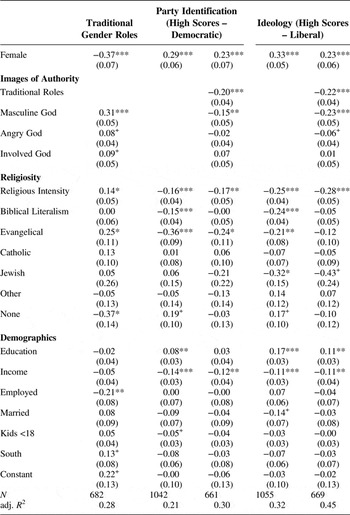
To test our first hypothesis — that masculine images of God correspond to greater support for traditional gender roles — we first estimated an ordinary least squares (OLS) regression model that predicted traditional gender roles as a function of respondent gender, beliefs about authority (including images of God as masculine, angry, and involved), religiosity, and a series of socio-demographic factors. The results are provided in the first column of Table 1. We find support for our hypothesis in that a masculine God concept is a strong predictor of support for traditional gender roles. A standard deviation increase in the masculine God scale corresponds to a 0.31 standard deviation increase in support for traditional roles (beta = 0.31, se = 0.05, p < 0.001), all else equal. Given that we report standardized effects, effect sizes are comparable across the independent variables. This allows us to determine that a masculine image of God has the strongest effect on gender roles of any of the God concepts included in the model. It is also a stronger predictor than most of the conventional indicators of religiosity included in the model, such as religious intensity, biblical literalism, and religious tradition. The only notable exception is the “Nones,” who report significantly lower support for traditional gender roles than any of the other religious traditions. This finding supports the notion that gendered ideas about God's authority translates to beliefs about men's authority in the home and family, even when controlling for other factors, including active and angry views of God.
Images of god, gender roles, and political identity

Entries are standardized ordinary least squares regression coefficients with robust standard errors in parentheses. *p < 0.05, **p < 0.01, ***p < 0.001, + p < 0.10. Dependent variables are listed in the column header. The baseline category for the denomination dummies is Mainline Protestant.
GENDERED BELIEFS ABOUT AUTHORITY AND POLITICAL IDENTITY
Our second hypothesis is that gendered beliefs about authority — both human authority and divine authority — contribute to conservative political identities and moral issues attitudes. Further, we expect that in doing so, these beliefs about authority mediate the effect of respondent gender, explaining some of the commonly observed gender gaps in political identities and issue attitudes (Hypothesis 3). To test these two hypotheses, we estimated pairs of OLS regression models — one with and one without the hypothesized mediators. For each pair of models, we consider the significance of the mediators and the change in the estimated effect of respondent gender on the dependent variable when the potential mediators are included in the model (Baron and Kenny Reference Baron and Kenny1986). We then conducted a series of Sobel Goodman tests (Sobel Reference Sobel1982) to determine whether the mediation effect is statistically significant and calculate the proportion of the effect of gender that that is mediated by masculine images of God and traditional gender roles.
The political identity models are presented in Table 1. Looking first at the coefficients for traditional gender roles and masculine images of God, we find support for Hypothesis 2. Gendered notions of authority are associated with more conservative partisan and ideological identifications. Traditional gender roles, which place authority with the male head of the family unit, are associated with more Republican and conservative political identifications, even when controlling for various aspects of religious identity and religious intensity. Specifically, a standard deviation increase on the gender roles measure (a movement towards more traditional gender role attitudes) corresponds to a 0.20 standard deviation movement in the Republican direction on the party identification measure and a 0.22 standard deviation movement in the conservative direction on the political ideology scale; again, the variables are standardized with a mean of zero and standard deviation of one, so these are quite large substantive effects. The effect of masculine images of God on partisanship is slightly smaller than for traditional gender roles (0.15 compared to 0.20), though the effect on ideology is comparable to that of gender roles (0.22 compared to 0.23).
With controls for traditional religiosity (religious denomination, biblical literalism, and religious intensity) and other non-gendered authoritative images of God in the models (active and angry God), we can be confident that masculine images of God and gender role attitudes are not just acting as proxies for religious intensity. Rather, they reflect an important, gendered dimension of religious experience and belief not captured in these traditional measures but relevant for understanding the connection between religious and political identity. We can also conclude that our masculine images of God measure is not merely serving as a proxy for other God concepts (e.g., Bader and Froese Reference Bader and Froese2005) as these variables are included in the models and have little effect on political identity.
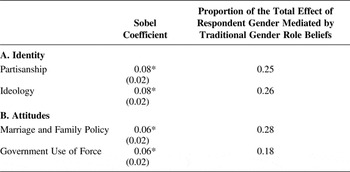
Turning to our third hypothesis, that gendered authority variables mediate the effect of respondent gender on political identity, we compare the effect sizes for responded gender in the political identity models. Consistent with the literature on the political gender gap, women are more liberal and more closely identified with the Democratic Party than men, as indicated by the positive and statistically significant coefficients in the models. However, inclusion of our proposed mediators — gender roles and masculine images of God — decreases the coefficient size on gender. While gender retains statistical significance in both cases, it is appreciably smaller when the mediators are present. Sobel mediation tests were conducted to evaluate the extent of mediation in both cases (Sobel Reference Sobel1982). The results, presented in panel A of Table 2, show that traditional gender role beliefs mediate 25% of the effect of respondent gender on political identity. The mediating effect for ideology is similar; attitudes about traditional gender roles mediate 26% of the effect of gender on political ideology.
Mediating effects of traditional gender roles on political identities and attitudes

Standard errors are in parentheses. *p < 0.001. Because there is no gender gap in attitudes toward gender-neutral moral policies, they are excluded from the table.
For masculine images of God, alternatively, there is no evidence of mediation. However, there is an indirect effect on the gender gap through the effect on masculine images of God (as shown in column 1 of Table 1). Overall, these results largely support Hypotheses 3. The effect of gender roles here suggests that failure to account for the more gendered aspects of religious belief may result in the over-estimation of the gender gaps in partisanship and political ideology.
GENDERED BELIEFS ABOUT AUTHORITY AND POLITICAL ATTITUDES
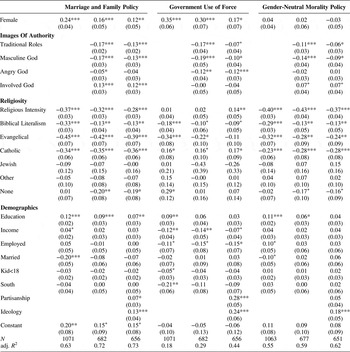
We expect the effects of gendered notions of authority influence not only political identity but also socio-political attitudes pertaining to moral issues. Moral issues serve as foundational elements in contemporary identity politics in the United States (Haidt and Graham Reference Haidt and Graham2007). Scholars contend that partisan and ideological orientations are converging in large part because of the growing salience of moral issues like gay rights and reproductive choice (Abramowitz Reference Abramowitz2010; Jelen Reference Jelen1990). In addition, many of these issues relate closely to beliefs about appropriate social roles for women and ideas about who holds moral authority. Thus, we anticipate finding evidence supporting Hypotheses 2 and 3 when exploring moral policy attitudes — particularly those with a direct bearing on marriage and the family. We test these hypotheses following the same method used for evaluating political identity: pairs of OLS regression models, followed by Sobel Goodman tests of mediation. As a robustness check, we also estimated the models with controls for partisanship and ideology, producing three models for each moral policy variable. The models are presented in Table 3.
Gendered God, gender roles, and socio-political attitudes

Entries are standardized OLS regression coefficients with robust standard errors in parentheses. *p < 0.05, **p < 0.01, ***p < 0.001, + p < 0.10. Dependent variables are listed in the column header. High scores on the policy measures correspond to more liberal political positions. The baseline category for the denomination dummies is Mainline Protestant.
Consistent with our expectations, traditional gender roles and masculine images of God have a significant, conservatizing effect on moral issue attitudes. The effect sizes for gendered beliefs about divine and human authority are roughly comparable across our three moral policy areas, even controlling for other indicators of religiosity and religious identification, which also have considerable influence on opinion in these areas.
Changes in the size of the coefficient on respondent gender in two of the three policy areas indicate that the mediated relationship between respondent gender and socio-political attitudes outlined in Hypothesis 3 is present. In the baseline models, women report significantly more progressive opinions than men do on for marriage and family policy and government use of force. No gender differences are apparent for the gender-neutral policy items. Inclusion of the gendered authority mediating variables reduces the size of the coefficient on respondent gender, and the addition of the party and ideology variables decreases it further. While the meditational relationships here are complex (as respondent gender relates to both traditional gender roles and political identity), Sobel tests reveal that beliefs about traditional gender roles account for about 28% of the gender gap on marriage and family policy and just under 20% of the gender gap in support for the government use of force (see Table 2). As with the political identity models, there is no evidence that masculine images of God directly explains any of the gender gap in moral issue attitudes, but they do relate to endorsement of traditional gender roles (Hypothesis 1) and thus likely exert an indirect effect on the gender gap through gender roles. Collectively, these results offer further support for Hypothesis 3. Across all of our models, we demonstrate that a failure to account for the more gendered aspects of religion and authority inflates estimates of the gender gap in political identity and moral policy attitudes.
DISCUSSION
Our results suggest that cultural and political divisions in the United States have a gendered dimension to them. Masculine images of God convey gendered notions of authority that translate into beliefs about male dominance in human social relations (Whitehead Reference Whitehead2012). These gendered notions of authority have a conservatizing effect on the political identities and socio-political attitudes of both men and women. Our results are particularly relevant given the importance of women voters in recent elections and the ongoing rhetoric around the Republican “War on Women.” In recent elections, gender has played a central role in campaigns and voting behavior. Both candidates in the 2012 presidential election appealed directly and indirectly to women through campaign ads, recruitment, and mobilization efforts with a variety of messages, including rhetoric about appropriate gender roles (Holman, Schneider, and Pondel Reference Holman, Schneider and Pondel2015). For example, the Obama campaign's emphasis on equal pay legislation (and Romney's attempts to avoid questions about his position on it) brought attitudes about the appropriate roles and responsibilities of women into the forefront of voters' minds during the election. It is also evident in the 2016 Presidential primary contest, in which the large gender gap in support for Republican candidate Donald Trump has been partially attributed to his highly publicized spat with Fox News anchor Megyn Kelly and other remarks about women. The continued politicization of gender in modern political campaigns requires that we better understand how gendered views of authority influence political thinking.
Our results point to oversights in current strategies for measuring religiosity. We know that religiosity is a complex, multi-faceted construct, but scholars have often overlooked gendered images of authority. We gain explanatory purchase on the relationship between gender, religiosity, and political attitudes when we account for these factors in addition to traditional measures of religious devotion. As religious denominations continue to exhibit high levels of internal diversity, it becomes more important to understand how gendered religious beliefs, and not simply religious denomination, influence political thinking. In particular, the relative dearth of research connecting ideas about orthodoxy (Hunter Reference Hunter1991) to moral frames (Lakoff Reference Lakoff2002) provides ample opportunities for future investigations, as do evaluations of how these two worldviews influence political cognition and a variety of political behaviors (Barker and Tinnick Reference Barker and Tinnick2006). The addition of a gendered view of authority into this puzzle could provide a key to understanding how people view and interact with the social and political world.
Our results have clear consequences for the support of women's issues in politics today. In particular, we find that masculine views of authority influence moral attitudes, including a broad set of gendered moral attitudes. We know from previous scholarship that gendered views of authority influence attitudes about gender roles (Whitehead Reference Whitehead2012; Reference Whitehead2014). Scholars have also shown that the concentration of politically-active, conservative evangelicals in states inversely relates to the proportion of women in state legislatures, suggesting support for traditional gender roles translates into preferences for male candidates and leadership (Merolla, Schroedel, and Holman Reference Merolla, Schroedel and Holman2007). Future research could explore the effect of masculine views of authority on gender stereotypes, support for female candidates, and women's willingness to run for political office (Calfano and Djupe Reference Calfano and Djupe2011). Given that we find different effects for men and women, continued research on how these beliefs shape political behavior and engagement among women is particularly important.
While our results speak to the need for more nuanced understanding of religion and the importance of attending to differences across social categories, the available data limits our ability to make such comparisons. The BRS data collection method under-sampled racial minorities, including African-Americans and Hispanics. As a result, we cannot draw conclusions about the connection between religion and political thinking among these groups. Research shows that Black Protestants and Hispanic Catholics often differ in meaningful ways from their white counterparts (e.g., Putnam and Campbell Reference Putnam and Campbell2012) and that views of God play a significant role in the religious-political connection in Black churches (Calhoun-Brown Reference Calhoun-Brown1999; Reese and Brown Reference Reese and Brown1995). The BRS does not situate us to evaluate these differences. Additional research might also apply our findings in a comparative context to evaluate whether we see similar patterns across racial and ethnic groups and also in places with different cultural and institutional relationships surrounding religion and politics.
A second limitation of our approach is that measuring correlated religious and political views through a single survey instrument like the BRS does lead to the possibility of common source bias generating spurious relationships. However, research on views of God finds that they develop very early on in life (De Roos, Iedema, and Miedema Reference De Roos, Iedema and Miedema2004), and are thus a precursor to other identities, including political identities, which do not crystalize until later in adolescence (e.g., Kinder and Sears Reference Kinder and Sears1981). Future research might better address this question by more directly investigating how religious and political socialization influence and/or reinforce one another.
The research we present here focused on the connection between gendered views of authority — both at the divine and human level — and political identities and general attitudes. Future research might evaluate how gendered views of authority influence political participation, views on the appropriate role of government, or tolerance of diversity and minority groups. Overall, our research demonstrates the importance of considering how people view the ultimate authority — God — and how this influences their perceptions of other types of authority, including political structures and social institutions like the family.
Supplementary materials and methods
To view supplementary material for this article, please visit http://dx.doi.org/10.1017/S1755048316000407.