Introduction
Understanding the evolutionary and ecological processes involved in species geographical distribution is not only an objective in ecology and evolutionary biology, but also of growing importance for species conservation (Hargreaves and Eckert, Reference Hargreaves and Eckert2014). Dispersal as the passive or active movement of individuals from their birth place to their breeding place, plays a key role in species responses to the current drivers of biodiversity loss including habitat loss, overharvesting, biological invasions and climate change (Pereira et al., Reference Pereira, Leadley, Proença, Alkemade, Scharlemann, Fernandez-Manjarrés, Araújo, Balvanera, Biggs and Cheung2010). However, the ecological role of dispersal in the dynamics and stability of ecological communities is poorly understood. It is essential to clarify the mechanisms and environmental effects of species dispersal over long distances in environments facing rapid and drastic changes (Schupp et al., Reference Schupp, Jordano and Gómez2010). This is even more important in the case of plants which have very limited mobility and thus depend on external factors for their dispersal.
Seed dispersal affects most key dimensions of plant ecology, e.g. species migration (McConkey et al., Reference McConkey, Prasad, Corlett, Campos-Arceiz, Brodie, Rogers and Santamaria2012), plant regeneration (Neuschulz et al., Reference Neuschulz, Mueller, Schleuning and Böhning-Gaese2016) and establishment of new plant communities (Beckmann and Berger, Reference Beckmann and Berger2003), plant invasion (Guiden et al., Reference Guiden, Gorchov, Nielsen and Schauber2015), predator avoidance (Manzaneda et al., Reference Manzaneda, Fedriani and Rey2005), resource competition avoidance, and improvement of individual fitness (Croteau, Reference Croteau2010). Long-distance plant dispersal between fragmented patches plays a key role in the response of communities to environmental changes (Panter and Dolman, Reference Panter and Dolman2012; Plue and Cousins, Reference Plue and Cousins2013; Auffret and Plue, Reference Auffret and Plue2014).
Seed dispersal depends on various biotic (zoochory) or abiotic (e.g. wind and water) factors (Picard and Baltzinger, Reference Picard and Baltzinger2012). Wind and water can, in some cases, transport diaspores over long distances (Harwell and Orth, Reference Harwell and Orth2002; Harries and Clement, Reference Harries and Clement2013). However, zoochory or animal-mediated seed dispersal plays a major role in long-distance dispersal and plant spatial distribution (Couvreur et al., Reference Couvreur, Vandenberghe, Verheyen and Hermy2004; Pellerin et al., Reference Pellerin, Picard, Saïd, Baubet and Baltzinger2016; Lalleroni et al., Reference Lalleroni, Quenette, Daufresne, Pellerin and Baltzinger2017), and consequently, the stability of ecological communities (Albert et al., Reference Albert, Auffret, Cosyns, Cousins, D'hondt, Eichberg, Eycott, Heinken, Hoffmann and Jaroszewicz2015).
Mammals, especially wild ungulates, are the main seed dispersal vectors over long distances, both within and among forest areas (Albert et al., Reference Albert, Auffret, Cosyns, Cousins, D'hondt, Eichberg, Eycott, Heinken, Hoffmann and Jaroszewicz2015). Many ungulates are abundant, widely distributed and regularly move between different habitats for feeding (Bacles et al., Reference Bacles, Lowe and Ennos2006; Dovrat et al., Reference Dovrat, Perevolotsky and Ne'eman2012). Therefore, their dung, which contains plant diaspores, not only reflects their feeding behaviour, but also the composition of the plant communities where they feed.
Seed characteristics affect the ability of the plant species for dispersal through endozoochory (Cosyns et al., Reference Cosyns, Delporte, Lens and Hoffmann2005; Couvreur et al., Reference Couvreur, Cosyns, Hermy and Hoffmann2005; Picard et al., Reference Picard, Chevalier, Barrier, Boscardin and Baltzinger2016; Wang et al., Reference Wang, Lu, Waly, Ma, Zhang and Wang2017). Previous studies have shown that species with dry, small and inconspicuous seeds and with no specific adaptations for other modes of dispersal can be potentially dispersed through endozoochory (Janzen, Reference Janzen1984; Pakeman et al., Reference Pakeman, Digneffe and Small2002). However, the characteristics of their vectors can largely determine the effectiveness of endozoochory and the subsequent composition of the dispersed flora. The efficiency of vectors for endozoochorous seed dispersal mainly depends on animal body size, dietary preferences and digestive physiology (Jaroszewicz et al., Reference Jaroszewicz, Pirożnikow and Sondej2013; Milotić and Hoffmann, Reference Milotić and Hoffmann2016a; Pellerin et al., Reference Pellerin, Picard, Saïd, Baubet and Baltzinger2016). Thus, functional groups of seed vectors may play different and complementary roles in endozoochorous seed dispersal (McConkey and Brockelman, Reference McConkey and Brockelman2011; Schleuning et al., Reference Schleuning, Fründ and García2015). Few studies have simultaneously evaluated the seed dispersal potential of a guild of mammalian herbivores and omnivores within a single area (Eycott et al., Reference Eycott, Watkinson, Hemami and Dolman2007; Jaroszewicz et al., Reference Jaroszewicz, Pirożnikow and Sondej2013; Picard et al., Reference Picard, Chevalier, Barrier, Boscardin and Baltzinger2016); therefore, it is currently difficult to assess the relative contribution of each mammal to plant dispersal.
Moreover, effective habitat and vegetation management in protected areas requires a clear understanding of plant–animal interactions. In this paper we specifically address the three following questions:
(i) Which plant species and associated growth forms are most frequently dispersed by the herbivores and omnivores present in Golestan National Park (hereafter GNP)?
(ii) Do the studied mammals selectively disperse certain plant species and growth forms?
(iii) How redundant or complementary are these mammals considering plant dispersal?
Materials and methods
Study area
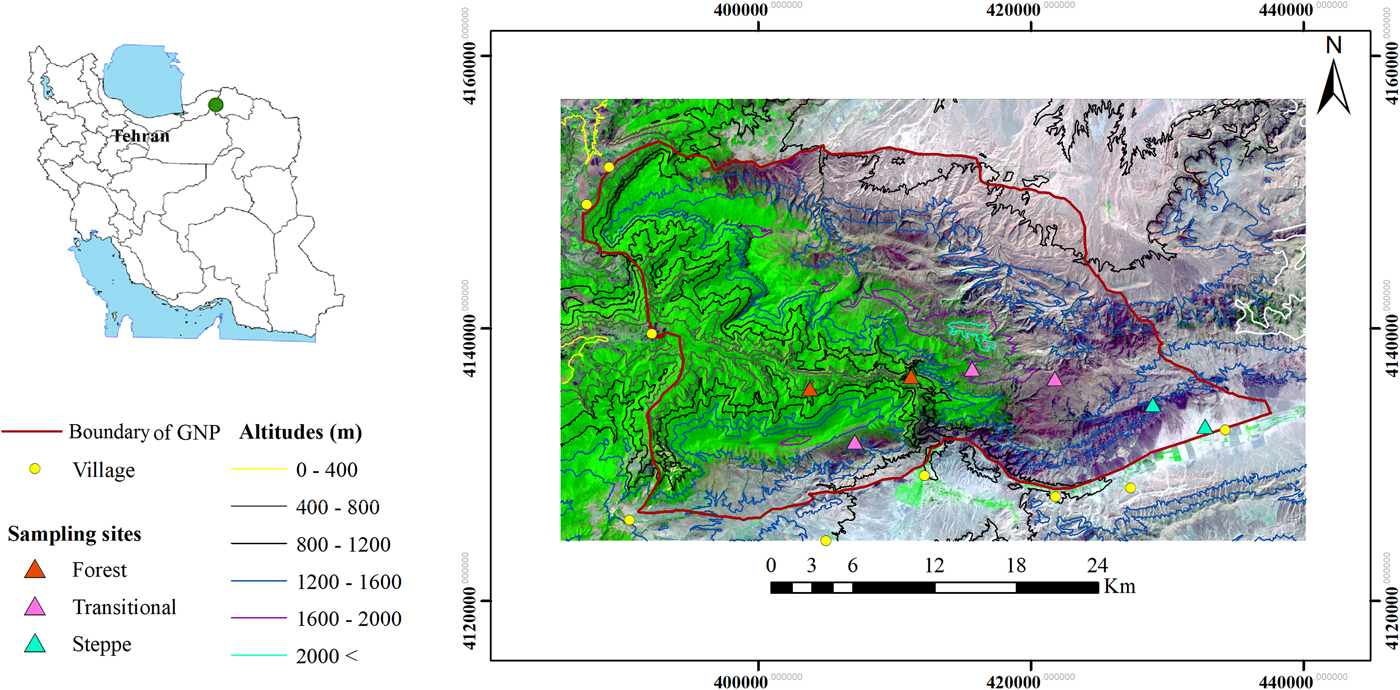
The study was carried out in GNP, north-eastern Iran (37°16′ to 37°31′ N, 55°43′ to 56°17′ E). GNP covers an area of 920 km2 (Fig. 1). The elevation ranges from 450 m above sea level in the eastern part of GNP to 2411 m in the western parts (Akhani, Reference Akhani1998). Annual average temperature and precipitation range from + 11.8.°C and 150 mm in the east up to + 18.8°C and 1000 mm in the west, respectively. Minimum relative humidity of the region is 60% but increases up to 83% during summer. GNP represents a rich biodiversity protected area incorporating one-third of national bird species richness (more than 170 species), 50% of national mammal species listed (more than 90 species) and over 1362 plant species (Akhani and Khoshravesh, Reference Akhani, Khoshravesh, Öztürk, Mermut and Celik2011).
Satellite map of Golestan National Park, showing Hyrcanian forest from the centre to the west and surrounding steppes towards east, north and south. The transitional scrub and juniper woodlands occur at higher altitudes between forests and steppes.

GNP is a transitional zone situated in Euro-Siberian and Irano-Turanian phytogeographical regions. Hyrcanian forests with humid and temperate climate conditions occur in the western section of the park, which belongs to the Euro-Siberian region (most important arboreal plant taxa include Quercus castaneifolia, Q. macranthera, Carpinus betulus, C. orientalis, Zelkova carpinifolia, Parrotia persica, Tilia caucasica, Sorbus torminalis, Ulmus glabra, U. minor, Acer spp., Crataegus spp., Rubus spp., Colutea buhsei and a rich fern and bryophyte flora) (Akhani et al., Reference Akhani, Djamali, Ghorbanalizadeh and Ramezani2010). The extreme eastern section of GNP is a dry steppe, covered by Irano-Turanian type vegetation with a remarkable number of endemic plants belonging to the Khorassan-Kopet-Dagh floristic province (Acantholimon spp., Acanthophyllum spp., Allium spp., Astragalus spp., Centaurea spp. and Cousinia spp.) (Akhani et al., Reference Akhani, Khoshravesh and Malekmohammadi2016; Memariani et al., Reference Memariani, Zarrinpour and Akhani2016). At higher altitudes, both Euro-Siberian and Irano-Turanian elements intermingle in transition between the two sections of the east and west with minor introgression of Mediterranean elements in the form of bi- and tri-regional species: Irano-Turanian/Mediterranean, Euro-Siberian/Mediterranean and Euro-Siberian/Irano-Turanian/Mediterranean. The main vegetation units of GNP include closed forests, scrubs, mountain meadows, Artemisia and Stipa steppes and rich halophytic and aquatic vegetation and a unique savanna-like vegetation dominated by C4 grass flora in a temperate forest (Akhani, Reference Akhani1998; Akhani and Ziegler, Reference Akhani and Ziegler2002). The flowering season for most of the plants extends from early April to the end of July, whereas the seed production season starts from mid-June and ends in late November.
Animal vectors and sampling sites
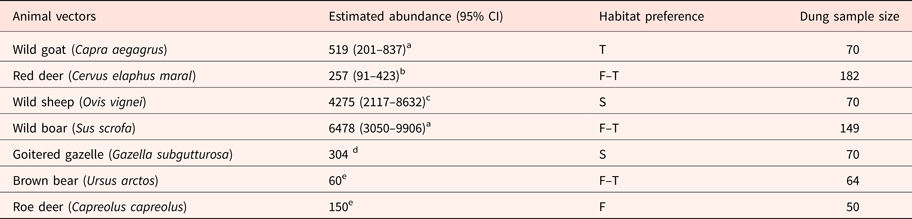
In our multi-species approach in GNP, we investigated the potential for endozoochorous seed dispersal by five herbivores wild sheep (Ovis vignei as a grazer), wild goat (Capra aegagrus), goitered gazelle (Gazella subgutturosa) and red deer (Cervus elaphus maral) as intermediate mixed feeders; roe deer (Capreolus capreolus as a concentrate selector), and two omnivores, wild boar (Sus scrofa) as an opportunistic omnivore frugivore (Hofmann, Reference Hofmann1989; Clauss et al., Reference Clauss, Nijboer, Loermans, Roth, Van der Kuilen and Beynen2008) and brown bear (Ursus arctos) as a carnivore frugivore. Wild boar is the most abundant species in the park, followed by wild sheep, whilst roe deer and brown bear are not very frequent in GNP. Based upon the known distribution of the studied animals and the three major vegetation types in GNP, we considered three habitat types, namely Hyrcanian closed forest (hereafter forest), transitional scrub and Juniper woodland (hereafter transitional scrub), and Artemisia and halophytic steppe (hereafter steppe) (Table 1).
Estimated mammal abundance in the entire park, habitat preference, and dung sample size for each mammal studied in Golestan National Park, Iran

aGhoddousi et al., Reference Ghoddousi, Soofi, Hamidi, Lumetsberger, Egli, Khorozyan, Kiabi and Waltert2016a; bSoofi et al., Reference Soofi, Ghoddousi, Hamidi, Ghasemi, Egli, Voinopol-Sassu, Kiabi, Balkenhol, Khorozyan and Waltert2017; cGhoddousi et al., Reference Ghoddousi, Soofi, Khorozyan, Kiabi and Waltert2016b; dBagherirad et al., Reference Bagherirad, Norhayati, Abdullah, Amirkhani and Erfanian2013; eannual population estimation by Golestan National Park office, 2016 (unpublished). Habitat types: F, Hyrcanian closed forest; T, transitional scrub and Juniper woodland; S, Artemisia and halophytic steppe. Dung sample size depended on the frequency of encounter.
Dispersed flora sampling
Within each of the three habitat types, seven different sampling sites, each with an area of about 7 km2, were selected (Fig. 1). The distances range from 5 to 18.3 km between transitional scrub and forest sampling sites and from 7.5 to 25.5 km between transitional scrub and steppe sampling sites. Considering the differences in animal abundances and defecation rates, we collected variable dung samples along random transects in the sampling sites of each habitat type from May to November. This period spans the range of the seed shedding. We only collected intact, fresh and wet dung in order to limit contamination by the surrounding local seed rain (Jaroszewicz et al., Reference Jaroszewicz, Pirożnikow and Sondej2013). Overall, we collected a total of 655 dung samples (Table 1). From each dung sample, we took a subsample of 20 g to investigate the potential for endozochoorous seed dispersal. Dung samples and subsamples were not mixed before the germination experiment. Following the method of Picard et al. (Reference Picard, Chevalier, Barrier, Boscardin and Baltzinger2016), we assessed the seed load of each dung subsample by checking seed germination under greenhouse conditions at natural day length and controlled temperature over a period of 15 months.
Local flora sampling
In each habitat type, we recorded the abundance-dominance of each plant species following Braun-Blanquet (Reference Braun-Blanquet1964) and using the seven cover-abundance categories (Old Braun-Blanquet's cover-abundance scales). We monitored the vegetation within vegetation units along the dung sampling transects using a total of 28 plots during the growing season from May to June 2016. For each vegetation type, the size of the plot was determined according to the minimum area method (Mueller-Dombois and Ellenberg, Reference Mueller-Dombois and Ellenberg1974): 25 m2 for steppe, 100 m2 for transitional scrub, and 400 m2 for forest. We classified each plant from local and dispersed flora according to their growth form (tree, shrub, herb and graminoid), life history (annual, biennial and perennial) and local rarity degree. The species with 1–3 records were considered as endangered (END), with 4–8 records as vulnerable (VUL), from 9 to 15 records as rare (RAR), and the remaining species categorized as non-threatened (NOT) (Akhani, Reference Akhani1998). We also indicated species with indeterminate (IND) status.
Data analysis
We presented the frequency of occurrence of each plant species in the dung samples for each mammal and habitat type, and also the share of plant species among mammals within each habitat type using the package VennDiagram. Species accumulation curves were built based on the Chao estimator in order to control whether sample size affected the completeness of species richness (Chao, Reference Chao1987). According to the list of plant species identified in the local and dispersed flora, we assessed the frequency of occurrence of each growth form within each habitat type. We then carried out Spearman correlation tests between the local flora and the dispersed flora for each mammal and each habitat type. We compared the pool of the dispersed plant species among mammals and habitat types through canonical correspondence analysis (CCA). Due to the high number of plant species, we gave plotting priority to those plant species that were most abundant in the dung samples using Hill's N2 diversity index. To examine whether mammals were associated with specific growth forms, we used the chi-squared test of independence. The share of each growth form in each mammal dung sample was then obtained by the Pearson residuals of the chi-squared tests. All statistical analyses were performed in software R (version 3.4.4; R Foundation for Statistical Computing, Vienna, Austria) and using VennDiagram (Chen and Boutros, Reference Chen and Boutros2011), psych (Revelle, Reference Revelle2014), corrplot (Wei et al., Reference Wei, Simko, Levy, Xie, Jin and Zemla2017) and vegan (Oksanen et al., Reference Oksanen, Blanchet, Kindt, Legendre, Minchin, O'Hara, Simpson, Solymos, Stevens and Wagner2013) libraries.
Results
A total of 3107 seedlings germinated from the collected dung samples (n = 655). We identified a total of 154 plant taxa, 145 to the genus level and 136 to the species level, resulting in 31 families and 107 genera. Twenty-nine plants were native invaders. Conyza canadensis as the only exotic plant species was dispersed by wild boar. Conyza canadensis usually is dispersed by wind, hence its occurrence in wild boar dung may be linked to secondary seed attachment to fresh dung.
Two taxa dominated the dispersed flora in terms of seedling abundance: the native Urtica dioica (623 seedlings, from 24 samples) and the native invader Cyperus fuscus (383 seedlings, from 96 samples). Portulaca oleracea and C. fuscus were the two most frequent plant species occurring in 24% (n = 157) and 15% (n = 96) of total dung samples, respectively. Both P. oleracea and U. dioica are weed or ruderal species in the area. Poaceae was the most represented family including 18 genera, 27 species and 11% of all the seedlings, followed by Brassicaceae with 17 genera and 19 species. Seven different Poaceae species were only identified at the family level, and hence were categorized in one group.
The most frequent growth forms dispersed by brown bear were shrubs and trees with fleshy fruits such as Berberis sp. (37%; n = 24), Crataegus sp. (15.6%; n = 10) and Cerasus sp. (14%; n = 9) (see Supplementary Appendix 1). We recorded C. fuscus in 29.5% (n = 44), P. oleracea in 12.7% (n = 19) and Phleum paniculatum in 10.7% (n = 16) as the most frequent species in wild boar dung. Red deer dispersed most often P. oleracea (25.8%, n = 47), C. fuscus (24.1%, n = 44) and Blitum virgatum (13.7%, n = 182). Nearly 50% of the total emerged species were dispersed by red deer (with 42% of them not dispersed by another studied mammal). Portulaca oleracea, Echinochloa crus-galli and Sonchus oleraceous occurred most frequently in roe deer dung samples with the following respective frequency: 42% (n = 27), 14% (n = 7) and 14% (n = 7). The most commonly dispersed species by wild goat were Catapodium rigidum and Sisymbrium irio (with similar frequency of 11.4%, n = 8) and P hleum paniculatum and Conringia perfoliata (again with similar frequency of 11.4%, n = 6) by wild sheep. The most common species dispersed by goitered gazelle were Suaeda microsperma, Alyssum desertorum and Astragalus asterias with the following respective frequency: 18.5% (n = 13), 12.8% (n = 9) and 12.8% (n = 9). Herbs and graminoids were the most frequently dispersed plant growth forms by the studied animal vectors (except brown bear).
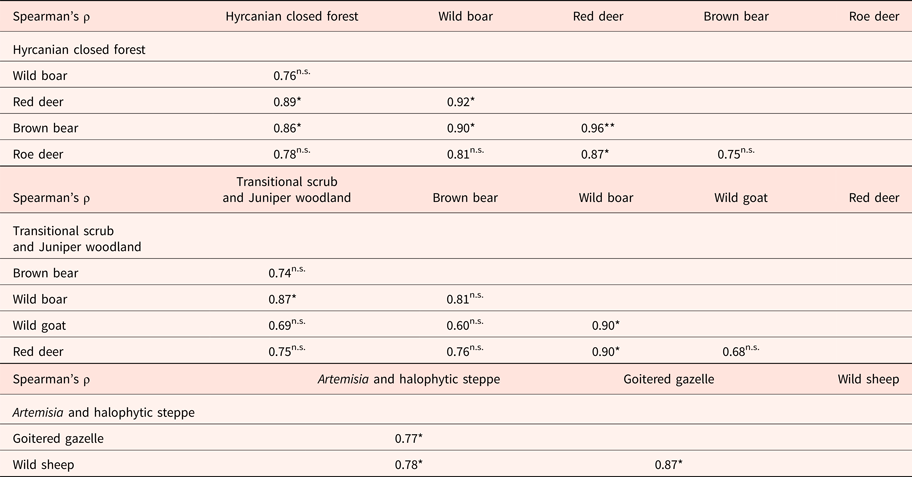
We showed high correlations between local and dispersed flora of steppe habitat type for goitered gazelle (P = 0.04, r = 0.77) and wild sheep (P = 0.04, r = 0.78) and for red deer (P = 0.02, r = 0.89) and brown bear (P = 0.03, r = 0.86) in forest habitat type. In transitional scrub habitat, this was only the case for wild boar (P = 0.03, r = 0.87) (Table 2).
Correlations of the frequency of growth forms (trees, shrubs, herbs and graminoids) between local and dispersed flora by animal vector, and between animal vectors for the dispersed flora in each habitat type: Hyrcanian closed forest, transitional scrub and Juniper woodland, and Artemisia and halophytic steppe
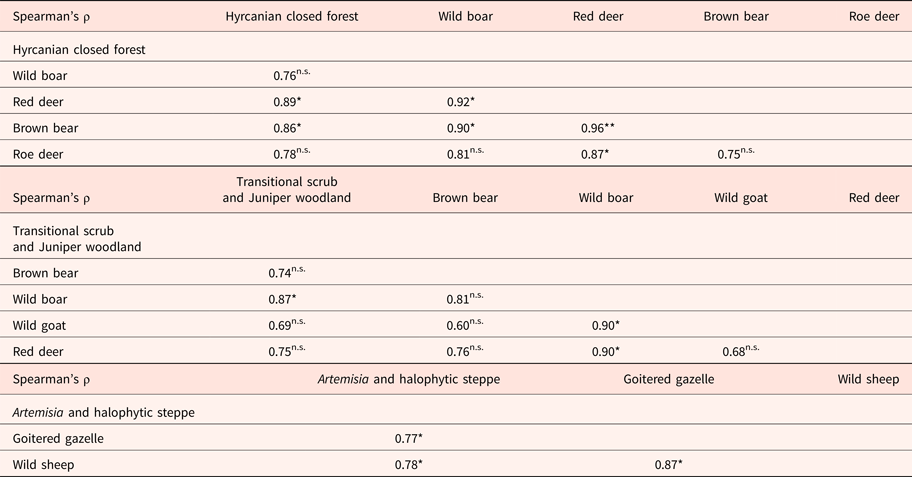
Spearman correlation coefficients and significant level (**P < 0.01; *P < 0.05; n.s., not significant) are presented.
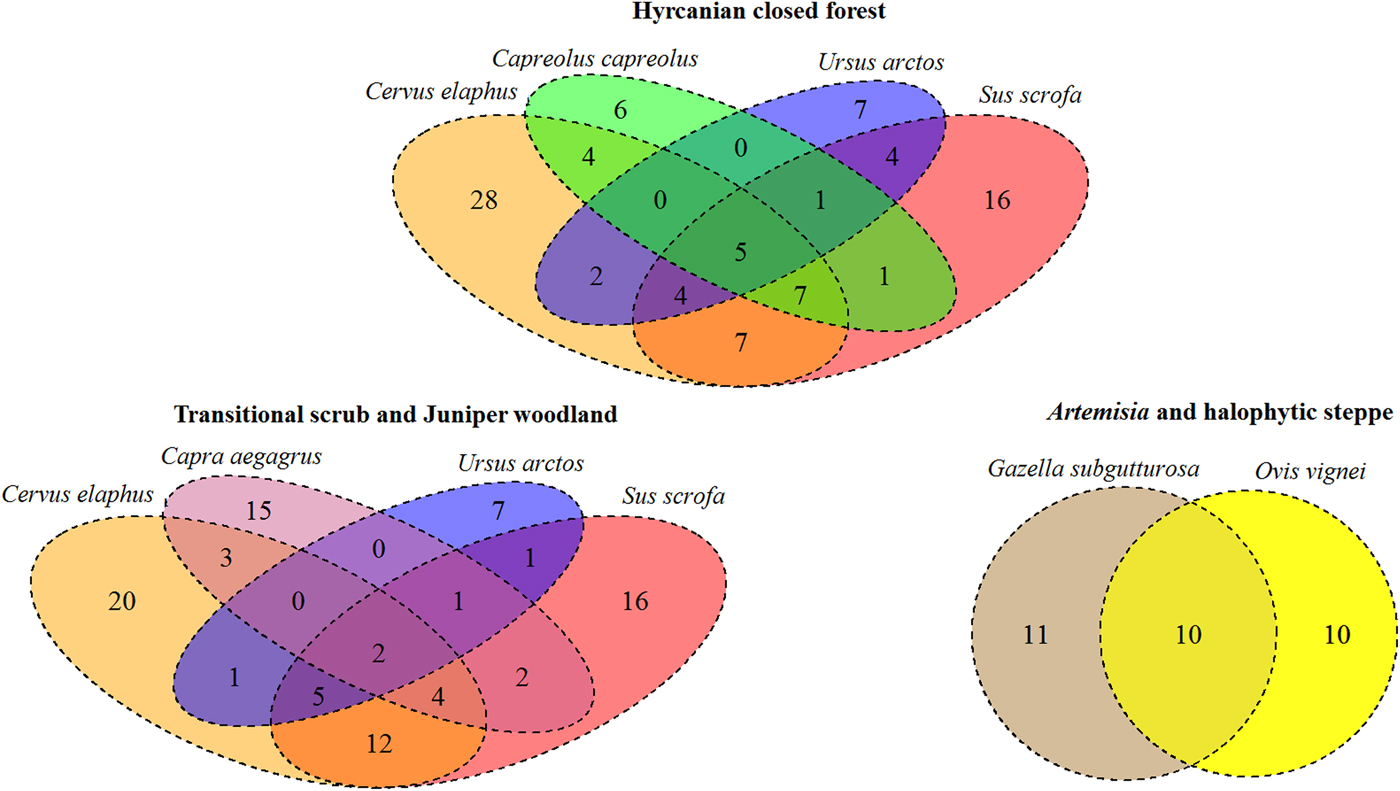
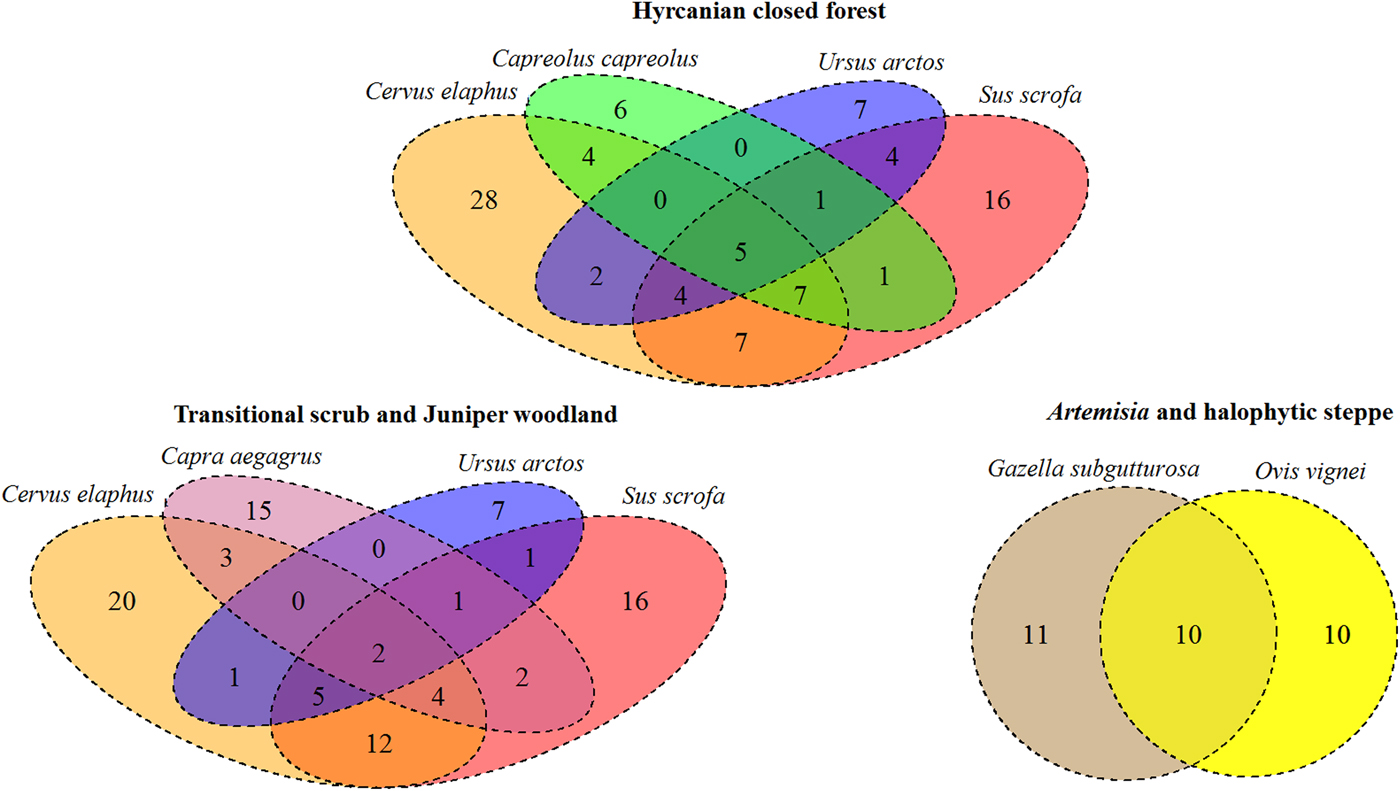
Based on our results, about 32% of plant species in steppe habitat type were dispersed by both goitered gazelle and wild sheep, while nearly 38% of plant species were commonly dispersed by at least two mammals in forest and transitional scrub habitat types (Fig. 2). In steppe habitat, 32% of plant species were specifically dispersed by wild sheep, and goitered gazelle dispersed an additional 35%. In forest habitat, 22, 18, 17 and 7.8% of the plant species were respectively and exclusively dispersed by red deer, wild boar, wild goat and brown bear. In transitional scrub habitat, red deer exclusively dispersed 30% of the plant species followed by wild boar (17%), brown bear (7.6%) and roe deer (6.5%).
Schematic representation of the species either dispersed by a single vector or shared by at least two vectors in three habitat types.
More than 17, 19 and 9% of the local flora respectively recorded in transitional scrub, forest, and steppe habitat types were also observed in the dispersed flora. We additionally compared our estimates of dispersed species richness for each mammal studied with results from previous studies (Supplementary Appendix 2).
The estimated species richness based on the Chao estimator showed that red deer followed by wild boar dispersed a substantially higher number of species compared with other mammals (Supplementary Appendix 3). The species accumulation curves did not reach a plateau and continued to increase for red deer and wild boar, stressing that the dung sample sizes used in our study were not sufficient. The overall trend is similar for the different mammals, but with moderate curve slopes for wild sheep, goitered gazelle, roe deer and wild goat. The overall observed species richness represented 75% of the expected species richness, ranging from 65% for wild boar to 94% for wild sheep.
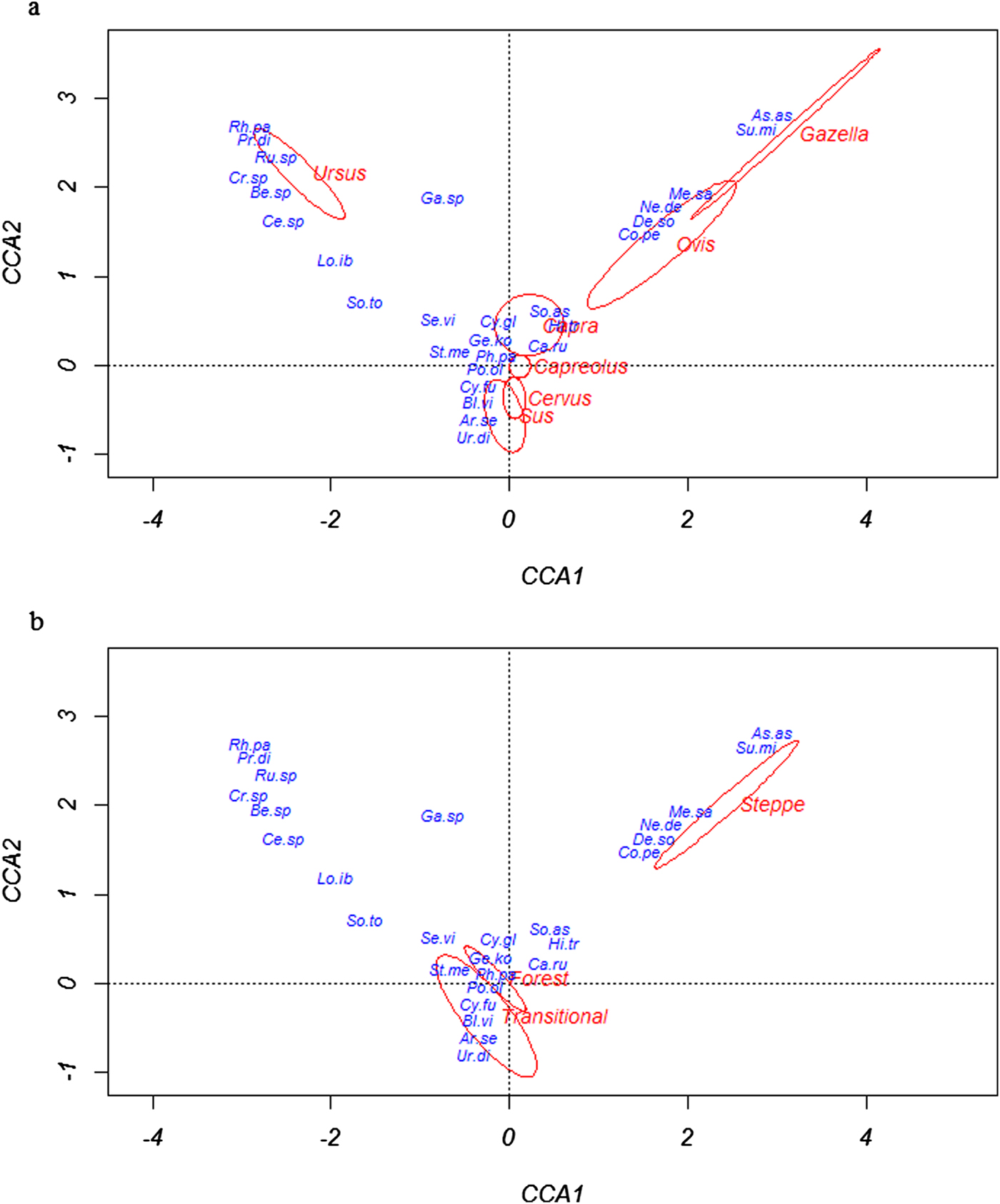
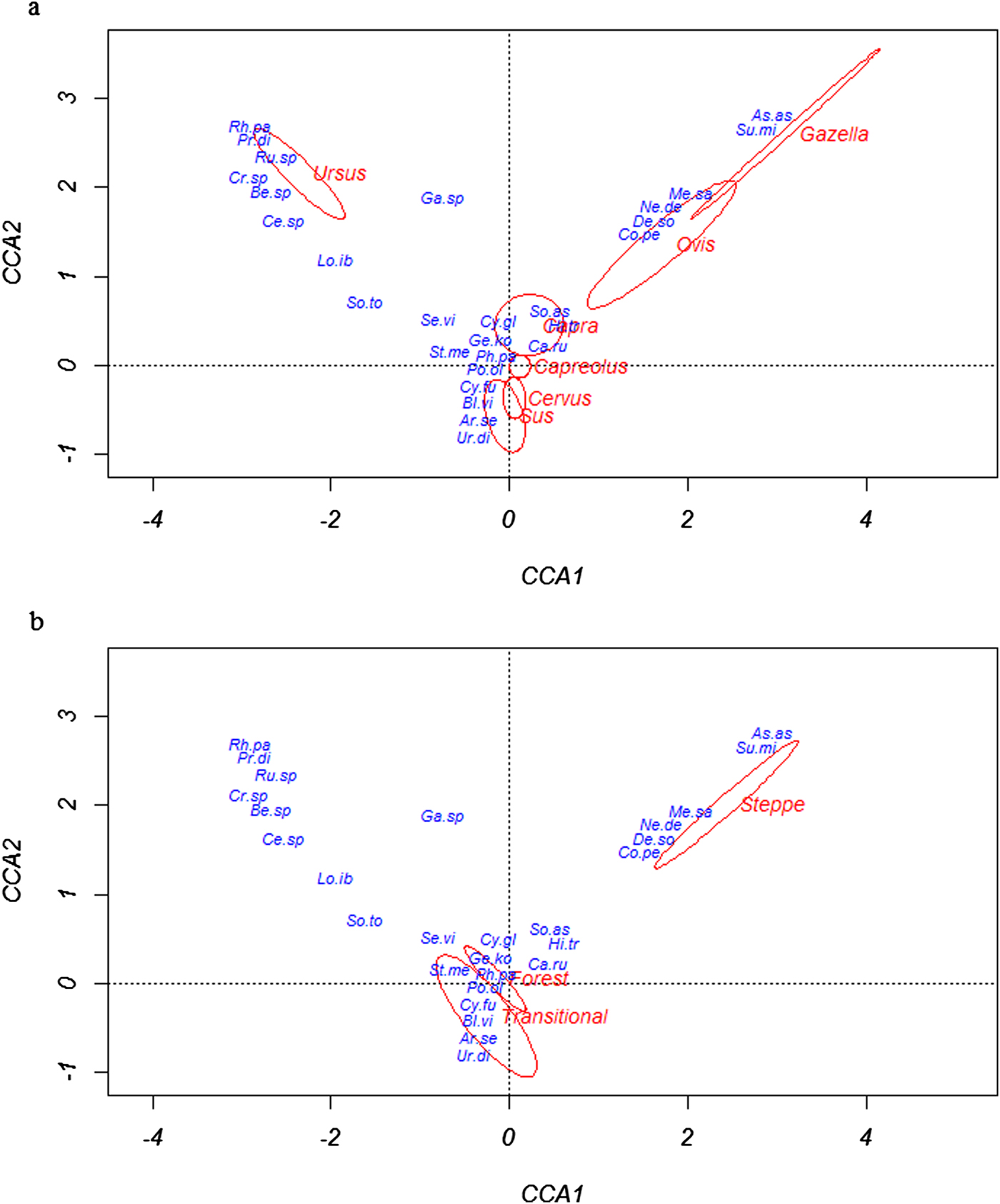
At the community level, the subcommunities of plants were clearly separated in terms of species composition (F 7,527 = 3.85, P = 0.001) when we considered mammals and habitat types in the CCA biplot (Fig. 3). The three first CCA axes explained 20, 18.3 and 16% of the variation respectively.
Bi-plots showing results of the canonical correspondence ordination analysis. The first (3a) and second (3b) plots show the position of each animal vector and each habitat type, respectively, on the first two axes (CCA1, CCA2) of dispersed plant species space. Ar.se, Arenaria serpyllifolia; As.as, Astragalus asterias; Be.sp, Berberis sp.; Bl.vi, Blitum virgatum; Ca.ru, Camelina rumelica; Ce.sp, Cerasus sp.; Co.pe, Conringia perfoliata; Cr.sp, Crataegus sp.; Cy.fu, Cyperus fuscus; Cy.gl, Cyperus glaber; De.so, Descurainia sophia; Ga.sp, Galium spurium; Ge.ko, Geranium kotschyi; Hi.tr, Hibiscus trionum; Lo.ib, Lonicera iberica; Me.sa, Medicago sativa; Ne.de, Neotorularia dentata; Ph.pa, Phleum paniculatum; Po.ol, Portulaca oleracea; Pr.di, Prunus divaricata; Rh.pa, Rhamnus pallasii; Ru.sp, Rubus sp.; Se.vi, Setaria viridis; So.as, Sonchus asper; So.to, Sorbus torminalis; St.me, Stellaria media; Su.mi, Suaeda microsperma; Ur.di, Urtica dioica.
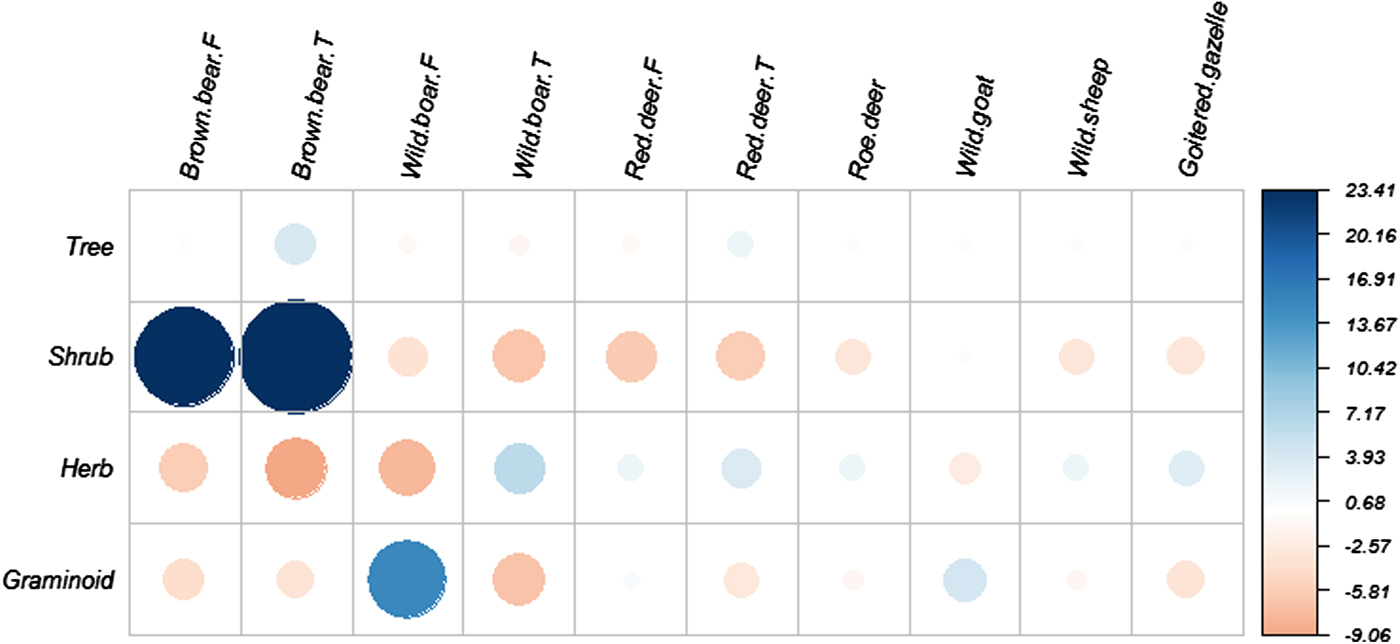
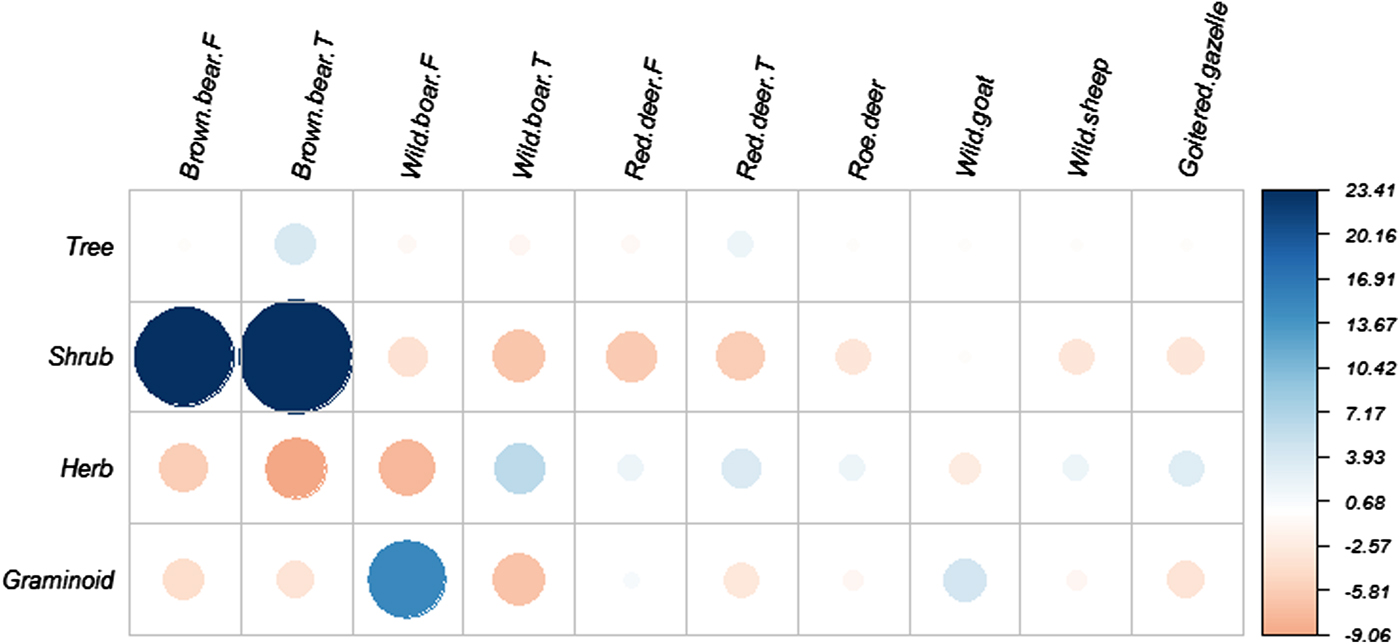
Growth forms and mammals were significantly associated (χ2 = 2291.7, d.f. = 27, P <0.001), with a positive association between brown bear and shrubs in forest and transitional scrub habitat types. In transitional scrub habitat type, wild boar was positively associated with graminoids but negatively with herbs, whereas an opposite pattern was found in the forest habitat (Fig. 4). Except for wild goat, there was a systematic positive association between herbivores, particularly red deer, and herbs.
The share of each growth form in the dung of each animal vector which was obtained by the Pearson residuals of the chi-squared tests. The scale colours denote whether the association is positive (blue circle) or negative (red circle) between animal vectors and growth forms. The larger and darker circles represent higher association, and vice versa. F, Hyrcanian closed forest; T, transitional scrub and Juniper woodland.
Discussion
Our results show that each of the herbivores and omnivores occurring in GNP plays a specific role in the endozoochorous seed dispersal process. The different seed loads in the mammal dung samples reflect differing feeding regimes, digestive systems (Malo and Suárez, Reference Malo and Suárez1996; Heinken and Raudnitschka, Reference Heinken and Raudnitschka2002) and habitat use (Mouissie et al., Reference Mouissie, Vos, Verhagen and Bakker2005). Each animal vector exclusively dispersed a considerable proportion of the plant species, hence the set of plant species dispersed by each animal overlapped only partly with those of other vectors. Dispersing the highest number of plant species (14% of the plant species recorded in the local flora of its habitat range), red deer was the most effective animal vector among all herbivores and omnivores studied, followed by wild boar. These findings are in agreement with other studies that found red deer as the most efficient endozoochorous seed disperser among other animal vectors (Eycott et al., Reference Eycott, Watkinson, Hemami and Dolman2007; Jaroszewicz, Reference Jaroszewicz2013; Picard et al., Reference Picard, Chevalier, Barrier, Boscardin and Baltzinger2016). Wild boar dispersed over 40% of germinated plant species, among which 38% were exclusively dispersed by this ungulate.
Many plants such as Urtica dioica, Cyperus fuscus, Portulaca oleracea, Chenopodium album, Suaeda microsperma and Berberis sp. recorded in this study and other studies (e.g. Schmidt et al., Reference Schmidt, Sommer, Kriebitzsch, Ellenberg and von Oheimb2004; Williams et al., Reference Williams, Ward and Ramakrishnan2008; Iravani et al., Reference Iravani, Schütz, Edwards, Risch, Scheidegger and Wagner2011; Picard et al., Reference Picard, Chevalier, Barrier, Boscardin and Baltzinger2016) appeared frequently in the dung samples confirming their great ability to survive gut passage. Due to a high seed production per flower, these plants provide more chances for their seeds to be picked up by animals. Most of the emerged plant species from dung material show no morphological adaptations for endozoochorous dispersal. This finding supports the ‘foliage is the fruit’ hypothesis (Janzen, Reference Janzen1984), which assumes that animal vectors select palatable foliage for feeding with seeds eaten inadvertently at the same time.
Poaceae, Brassicaceae, Asteraceae and Fabaceae were the most frequent families in both dung-germinated species (45% of species) and standing vegetation species (38% of species). However, the frequency of Portulacaceae and Cyperaceae was clearly higher compared to the standing vegetation due to the high representation of P. oleracea and C. fuscus in dung samples. Portulaca oleracea belongs to open and disturbed areas and potentially occupies rides (forest tracks). The result is astonishing because this species was only recorded once during intensive studies up to 1996 (Akhani, Reference Akhani1998). There are two explanations: either the animals feed in the neighboring agricultural lands where P. oleracea is a common weed, or the disturbed areas after flooding, which have frequently occurred in recent years, provide a suitable habitat for this weedy species. Cyperus fuscus is an native invader plant which depends on the early successional stages. Therefore, low-light conditions especially within forests might be the most important factor limiting the spread of these two plants in the local flora (Williams et al., Reference Williams, Ward and Ramakrishnan2008). In contrast, Apiaceae, although frequent in the standing vegetation, did not emerge at all from dung. Two reasons might explain this pattern: the soft seed and fruit coats in Apiaceae and their rich resinous seeds that might deter many herbivores. A considerable number of the plants dispersed occurred only at low frequencies.
In our study area, each animal vector dispersed a higher number of plant species than reported in several other studies performed in forested landscapes. This effect can be justified by the high plant species richness and habitat diversity of GNP (Akhani, Reference Akhani1998). On the other hand, the number of dispersed plant species was lower compared with some other studies. This pattern may be partly due to methodological variability among studies in using seed germination experiments: open greenhouse versus controlled greenhouse (Panter and Dolman, Reference Panter and Dolman2012); or outdoor conditions (Pakeman and Small, Reference Pakeman and Small2009; Milotić and Hoffmann, Reference Milotić and Hoffmann2016b); duration and time periods of dung sample collection (Malo and Suárez, Reference Malo and Suárez1995; Jaroszewicz, Reference Jaroszewicz2013), and the period of time samples are left in the greenhouse. The differences among the vectors in the number of species and in the frequency of different growth forms dispersed reflect their body size, dietary preferences, digestive physiology and habitat preference.
Wild boar use a wide variety of food depending on the availability of different food and its energy requirements (Ballari and Barrios-García, Reference Ballari and Barrios-García2014). This omnivore was the most efficient dispersal vector for early successional plant species such as Chenopodium sp., Urtica dioica, Cyperus fuscus and Sisymbrium irio. The significant correlations between the frequency of growth forms dispersed by wild boar and expressed in the local flora indicate that this animal disperses different growth forms according to their frequency in the local flora. A good example is Urtica dioica, which was frequent both in the local flora and wild boar faeces. This is consistent with the observed frequent consumption of Urtica dioica by wild boar in previous studies (Schmidt et al., Reference Schmidt, Sommer, Kriebitzsch, Ellenberg and von Oheimb2004; Jaroszewicz et al., Reference Jaroszewicz, Pirożnikow and Sondej2013). Urtica dioica is the most abundant plant species recorded in wild boar dung collected in transitional scrub habitat. The strong association between wild boar and herbs may be closely linked to its dependence on U. dioica. In contrast, in forest habitats wild boar mostly depend on graminoid forage such as Phleum paniculatum. In addition, some cultivated plant species, such as Citrulus vulgaris and Solanum lycopersicum, are known to be dispersed by wild boar from agricultural areas into protected natural ecosystems or when they feed from the waste left by tourists along the roads (Dovrat et al., Reference Dovrat, Perevolotsky and Ne'eman2012).
In contrast with the ungulates, brown bear dung samples contained the greatest number of woodland species, especially shrub (e.g. Berberis sp., Rubus sp.) and this association was strong in the forest habitat. However, considering the lower frequency of shrubs in transitional scrub, the correlation was convergent but lower in this habitat type. This pattern of seed dispersal by brown bear had also been documented in previous studies (e.g. Willson and Gende, Reference Willson and Gende2004; Lalleroni et al., Reference Lalleroni, Quenette, Daufresne, Pellerin and Baltzinger2017).
In agreement with other studies (Heinken et al., Reference Heinken, Hanspach, Raudnitschka and Schaumann2002; Von Oheimb et al., Reference Von Oheimb, Schmidt, Kriebitzsch and Ellenberg2005; Picard et al., Reference Picard, Chevalier, Barrier, Boscardin and Baltzinger2016), shrubs with fleshy fruits were very rare in the herbivores’ dung samples; in the case of roe deer, no shrub species were recorded at all in our study. As expected and in agreement with previous studies (Eycott et al., Reference Eycott, Watkinson, Hemami and Dolman2007; Jaroszewicz et al., Reference Jaroszewicz, Pirożnikow and Sondej2013; Picard et al., Reference Picard, Chevalier, Barrier, Boscardin and Baltzinger2016), the number of plant species dispersed by roe deer as a selective feeder was lower than for red deer. Selection of high-quality browse and other nutritive food items by roe deer (Moser et al., Reference Moser, Schütz and Hindenlang2006) led to a lower correlation between the dispersed growth forms and those represented in the local flora. As a consequence of its feeding regime, roe deer consume less graminoid than herbaceous forest species. Red deer is a large herbivore species with a comparatively low energy requirement per unit of body weight. Owing to their mixed feeding regime and their larger body size, red deer occupy larger home ranges (Bruinderink et al., Reference Bruinderink, Van Der Sluis, Lammertsma, Opdam and Pouwels2003), where they encounter and consume more plant species (Eycott et al., Reference Eycott, Watkinson, Hemami and Dolman2007); while roe deer are more selective and with much smaller home ranges may also encounter fewer plant species (Chapman et al., Reference Chapman, Claydon, Claydon, Forde and Harris1993).
In the transitional scrub habitat, wild goat played an important complementary role by exclusively dispersing 15 out of the 27 plant species observed in its dung. This may be partly due to different diet of wild goat (mainly graminoids) and its low habitat overlap with other studied mammals occurring in this transitional zone. Catapodium rigidum, a graminoid that occupies rocky outcrops and vertical cliffs (Akhani, Reference Akhani1998), was the most abundant and frequent plant species observed exclusively in wild goat dung.
The similarity of dung seed content between herbivores in the steppe was very high. Desert plants have limited ability in long-distance dispersal due to the lack of specific adaptations for dispersal by abiotic factors (Fllner and Shmida, Reference Fllner and Shmida1981). This makes them more dependent on animal vectors (Polak et al., Reference Polak, Gutterman, Hoffman and Saltz2014). Goitered gazelle and wild sheep are the only large herbivores of GNP steppe habitat. Therefore, it is expected that in this specific habitat, the dispersal of plant species mainly occurs through these two herbivores. This is also an explanation for the positive association found between the local flora and the flora dispersed by each of these two herbivores.
Our study reveals that the studied omnivores and herbivores are efficient endozoochorous seed dispersers for a wide range of plant species of different growth forms in forest, scrub and steppe communities of NE Iran. The fact that 54% of the total plant species dispersed only emerged from a specific mammal dung sample stresses that each of the mammal studied plays a unique and irreplaceable role in our study area. This study also emphasizes that the mammals studied, due to different aspects of their ecology (e.g. feeding regimes, habitat use, home range size, seed dispersal distance), complement the role of each other for plant dispersal.
Nevertheless, the obtained results were based on greenhouse emergence, which assesses potential endozoochorous seed dispersal, whereas rates of germination are generally and significantly lower under natural conditions (Pakeman and Small, Reference Pakeman and Small2009). In addition, larger dung sample sizes might provide a longer list of plants dispersed in under-studied regions. Moreover, mammals may provide additional dispersal opportunities through epizoochory.
Supplementary material
To view supplementary material for this article, please visit https://doi.org/10.1017/S0960258518000351
Acknowledgements
We are grateful to Esmail Ghadimi, Mojtaba Ghadimi and Javd Pourrezaei for assisting with data collection, and Atefeh Ghorbanalizadeh for her help in the field and assisting in identification of some plants species. We also thank Mehdi Koochak and Javd Selyari, current and former manager and the other staff of Golestan National Park for field and logistical assistance.