INTRODUCTION
The brown dog tick, Rhipicephalus sanguineus, is one of the most widespread ticks in the world, being a common ectoparasite of dogs living in both urban and rural areas. The cosmopolitan distribution of this tick is, in part, favoured by its ability to survive in different ecological contexts and under variable climatic conditions (Dantas-Torres, Reference Dantas-Torres2010). Although R. sanguineus is a typical ectoparasite of dogs, it can occasionally parasitize other hosts, including humans (Walker et al. Reference Walker, Keirans and Horak2000; Dantas-Torres, Reference Dantas-Torres2008). Accordingly, R. sanguineus is a competent vector of several pathogens causing diseases in dogs (e.g. Babesia vogeli, Ehrlichia canis and Hepatozoon canis) and in humans (e.g. Rickettsia conorii and Rickettsia rickettsii) (Dantas-Torres, Reference Dantas-Torres2008).
Due to its medical and veterinary relevance, R. sanguineus is one of the most well-known and -studied tick species. Indeed, a number of studies of its biology and ecology have been conducted in different parts of the world (reviewed by Dantas-Torres, Reference Dantas-Torres2010). However, there are still important knowledge gaps regarding the biology and ecology of R. sanguineus, particularly under natural climatic conditions. Undoubtedly, new insights into the natural history of R. sanguineus are essential for a better understanding of the eco-epidemiology of certain tick-borne diseases, such as Rocky Mountain spotted fever and Mediterranean spotted fever (Dantas-Torres, Reference Dantas-Torres2010).
The first laboratory studies of the biology of R. sanguineus appeared in the literature in the early 20th century (Nuttall, Reference Nuttall1915). Recently, exposure of eggs to low temperature was negatively correlated with egg hatch rate and larval longevity, emphasizing that temperature is a major limiting factor for the establishment of R. sanguineus populations in cold regions of Europe (Dantas-Torres et al. Reference Dantas-Torres, Giannelli, Figueredo and Otranto2010). Experimental laboratory studies, however, can be somewhat artificial, mainly because non-parasitic tick stages (e.g. engorged larvae, nymphs, and females) are maintained under strictly controlled conditions (e.g. constant temperature and relative humidity – RH). In nature, ticks are under the pressure of constantly changing climatic conditions that can directly affect their life cycle, particularly more the xerophilic species that spend most of their time in the environment (Dantas-Torres, Reference Dantas-Torres2008).
To date, there have been no investigations of the biology of R. sanguineus under natural Mediterranean climatic conditions. In particular, it is unknown whether summer conditions (i.e. high temperature and low RH) negatively affect the biology of this important tick under natural conditions. In order to test this hypothesis, we systematically investigated the effect of both laboratory and natural climatic conditions of southern Europe on the reproduction and development of R. sanguineus. We recorded several biological parameters, during different seasons, and assessed their correlation with climate data. The results are discussed in relation to climate changes, ecology of R. sanguineus and the eco-epidemiology of the diseases that this tick transmits.
MATERIALS AND METHODS
Tick collection and identification
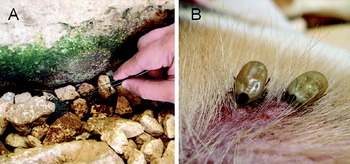
In April 2009, engorged female ticks were collected from the environment (Fig. 1A) in a private dog shelter located in Putignano (40°51′N, 17°7′E), where R. sanguineus is highly prevalent on dogs (Fig. 1B) (Lorusso et al. Reference Lorusso, Dantas-Torres, Lia, Tarallo, Mencke, Capelli and Otranto2010). Putignano is a small town (99·11 km2) in the province of Bari (Apulia region), southern Italy. With a typical hot and dry Mediterranean climate, this region is well suited for the development of many tick species, including R. sanguineus. Engorged female ticks were identified using the diagnostic keys and species description of Walker et al. (Reference Walker, Keirans and Horak2000). Furthermore, first generation (F1) larvae were mounted on slides in Hoyer's medium and also identified based on their morphology (Walker et al. Reference Walker, Keirans and Horak2000).
Collection of ticks from the environment (A). Engorged females (B) attached to a dog housed in the same cage were from the engorged females were collected.

Examination of oviposition of wild-collected females
Wild-collected engorged females were rinsed in distilled water and dried on filter paper. Ten females were placed in individual plastic vials and transferred to an incubator (26±1°C, 70±10% RH, scotophase) for them to lay eggs. Meanwhile, 10 females placed into individual plastic vials were placed into a small metal framed insect cage (25 cm×20 cm×18 cm) covered with a rock and kept under natural climatic conditions in a shadowed area at the Faculty of Veterinary Medicine of the University of Bari, in the municipality of Valenzano (41°3′N, 16°53′E). Egg masses laid from each female were weighed daily on a precision balance (0·01 mg) and the mean number of eggs present in 10 mg of eggs (∼256 eggs) determined.
Experimental infestation of rabbits
Ticks were fed on rabbits (Oryctolagus cuniculus) using cloth bags, as described elsewhere (Srivastava and Varma, Reference Srivastava and Varma1964). Each of 2 naïve rabbits was infested 3 times, initially with 200 larvae, then with 100 nymphs, and finally with 40 adults (sex ratio 1:1). Ticks were 15–30 days old when they were placed on the host. One rabbit was used exclusively to feed ticks that were maintained under laboratory conditions, whereas the other was used to feed ticks that were kept under natural climatic conditions. During tick infestation, rabbits were kept in individual metal cages under natural climatic conditions and provided with water and commercial food ad libitum. All procedures were carried out according to the guidelines for animal experimentation and were approved by the University of Bari (protocol no. 1115/10). Cloth bags were inspected daily and detached engorged ticks were collected. Detached larvae and nymphs were then stored separately in glass tubes closed with cotton wool plugs, in groups according to detachment day, whereas engorged F1 females were placed individually into plastic vials, as described for wild-collected females.
Biological parameters assessed
The following biological parameters were recorded: tick yield (number of engorged ticks/number of applied ticks×100); engorged female weight (mg); pre-oviposition period (number of days from detachment to the beginning of oviposition); oviposition period (number of days from the beginning to the end of oviposition); daily egg mass weight (mg); oviposition rate (proportion of engorged females that oviposited); egg production efficiency (EPE) (weight of eggs/weight of the engorged female×100); reproductive efficiency index (REI) (number of eggs/weight of the engorged female); reproductive fitness index (RFI) (number of eggs that hatch into larvae/weight of the engorged female); incubation period (number of days from the beginning of oviposition to the hatching of the first larva); egg hatch rate (mean value of visual evaluation performed by 3 examiners); feeding period (number of days from the liberation of ticks on the cloth bags till their detachment); pre-moult (number of days from detachment to ecdysis); and moulting rate (proportion of engorged ticks that moulted).
Recording of microclimate data
Temperature (°C) and RH (%) were recorded throughout the entire study period with the aid of a high-precision data logger (HD226-1 Delta OHM, Padua, Italy) that was placed inside the cage containing ticks that were kept in the environment. The data logger was set to record both temperature and RH every hour. Mean daily temperature and RH were then calculated from the sum of the maximum and minimum values of temperature or RH recorded in a given day and divided by 2.
Statistical analyses
Data comparisons were performed using Student's t-test, Mann-Whitney U or Chi-square tests, as appropriate. Differences were considered statistically significant when P was 0·05 or less (P⩽0·05). Pearson (r) and Spearman (rs) correlations were used to assess the association between different biological and climatic variables recorded during this study. Statistical analyses were performed using BioEstat version 5.0 (Mamirauá/CNPq, Brazil) and Epi Info version 6.04 (Centers for Disease Control and Prevention, USA).
RESULTS
Natural resting places of engorged females
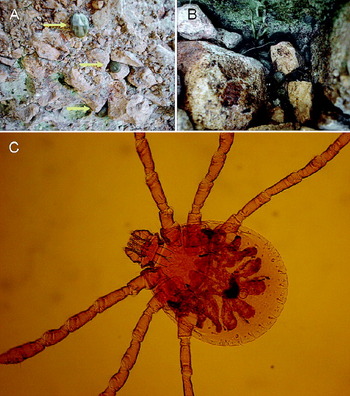
Engorged females were typically found in humid and shadowed environments. They were in crevices in the walls (Fig. 2A) of the animal shelter, but several of them were found between rocks on the ground (Fig. 2B). All engorged females were morphologically identified as R. sanguineus, which was confirmed later by the examination of their progeny (Fig. 2C).
Engorged females in crevices in the wall of the animal shelter (A) and several engorged females between rocks (gravel) on the ground (B). A slide-mounted larva (C) descedent from one of the wild-collected females.

Comparison of biological parameters of wild-collected females kept under laboratory or environmental conditions
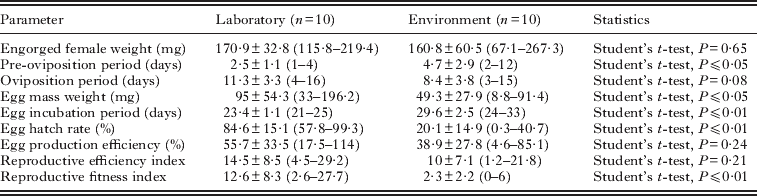
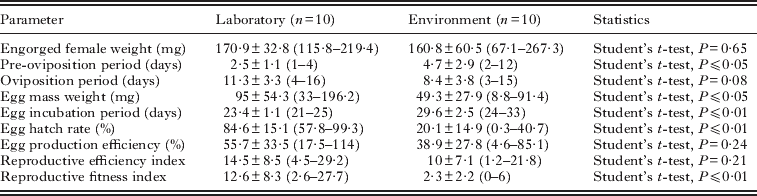
The body weights of wild-collected engorged females allocated in both groups (laboratory and environment) were homogeneous. Reproductive parameters of females kept under laboratory or environmental conditions are shown in Table 1. Wild-collected females maintained under environmental conditions had a longer pre-oviposition period and a tendency for a shorter oviposition period, as compared with females kept in the laboratory. The egg incubation period was longer in the environment than in the laboratory. Also, the RFI of females maintained in the environment was significantly lower than that in the laboratory.
Reproductive parameters of wild-collected females of Rhipicephalus sanguineus maintained either in the laboratory (26±1°C, 70±10% RH, scotophase) or in the environment (southern Italy, May–June 2009)
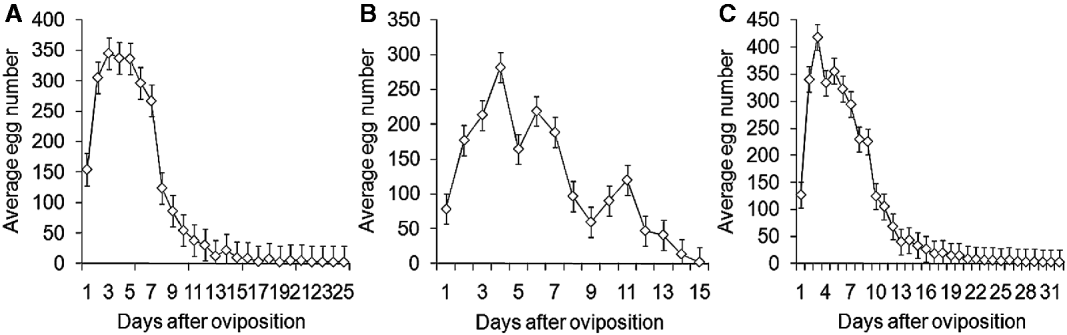
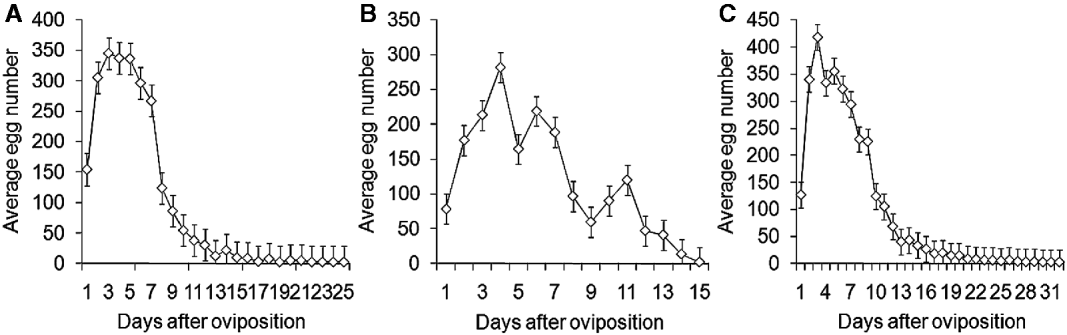
Most wild-collected females completed oviposition by day 14 in the laboratory and by day 10 in the environment. Average daily egg production peaked at day 4 either for females kept in the laboratory (mean, 468·6±222·1 eggs per female) or in the environment (mean, 281·7±221·4 eggs per female). Three females (2 kept in the environment and 1 in the laboratory) interrupted oviposition for 1 day and then continued the following day. The maximum number of eggs laid in the laboratory by a single female was 5032. The number of eggs laid by females maintained in the laboratory (mean, 2434·8±1392·1 eggs) was higher compared with those under environmental conditions (mean, 1264·3±715·8 eggs) (Student's t-test, P⩽0·05).
Comparison of biological parameters of larvae and nymphs fed on rabbits and kept under laboratory or environmental conditions
All biological parameters recorded for larvae and nymphs fed on rabbits and maintained under either laboratory or environmental conditions are given in Tables 2 and 3. The feeding period of larvae in the environment was significantly longer than in the laboratory. Again, the proportion of larvae from the environment that successfully engorged was significantly higher than that from the laboratory.
Biological parameters of Rhipicephalus sanguineus larvae fed on rabbits and kept either in the laboratory (26±1°C, 70±10% RH, scotophase) or in the environment (southern Italy, June–July 2009)

Biological parameters of Rhipicephalus sanguineus nymphs fed on rabbits and kept either in the laboratory (26±1°C, 70±10% RH, scotophase) or in the environment (southern Italy, July–August 2009)

The feeding and the pre-moult periods of nymphs kept in the environment were significantly shorter than of those in the laboratory. Again, the proportion of nymphs that engorged was higher among those kept in the environment.
Sex ratio of ticks in the laboratory and in the environment
The overall male:female sex ratio in this study was 1:1, although it was male-biased (1·5:1) in the laboratory and female-biased (1:1·4) in the environment during summer. Indeed, the proportion of nymphs that moulted to males in the laboratory (59·5%) was slightly higher than that in the environment (41·8%) (Chi-square test, P⩽0·05). Conversely, the proportion of nymphs that moulted to females in the environment (58·2%) was higher than that in the laboratory (40·5%) (Chi-square test, P⩽0·05).
Biological and reproductive parameters of females fed on rabbits and kept under laboratory or environmental conditions
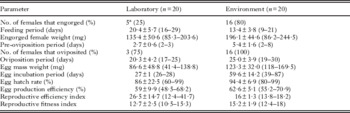
Reproductive parameters of F1 females fed on rabbits are given in Table 4. The feeding period of females kept in the environment was shorter than of those in the laboratory. Accordingly, the proportion of females that successfully engorged was significantly higher among those from the environment. These females were also heavier when compared to those from the laboratory and their pre-oviposition period took twice as long. Average daily egg production peaked at day 2 (average, 298·3 eggs per female) for females kept in the laboratory and at day 3 (average, 418·3 eggs per female) for those in the environment (Fig. 3). The mean number of eggs laid by females in the environment (3161·5±819·6 eggs; range, 1433–4346 eggs) was higher when compared to those in the laboratory (2260·7±1251·7 eggs; range, 1062–3559 eggs). Females maintained in the environment presented also higher mean EPE when compared to those in the laboratory. Reproductive parameters recorded for females kept under laboratory (n=3) and environmental conditions (n=16) were not statistically compared due to the small number of females available in the former group.
Daily mean number of eggs laid by wild-collected females kept in the laboratory (A) or in the environment in spring (B), and of first generation females kept in the environment in autumn (C).
Reproductive parameters of first generation females of Rhipicephalus sanguineus fed on rabbits and kept either in the laboratory (26±1°C, 70±10% RH, scotophase) or in the environment (southern Italy, September–November 2009)

a One female was crushed accidentally the day she detached from the rabbit and therefore her reproductive parameters were not recorded.
Comparison of reproductive parameters of wild-collected females with F1 females kept in the environment during spring and autumn, respectively
The mean body weight of wild-collected females (n=10; mean weight, 160·8 mg) was lower than that of F1 females (n=16; mean weight, 196·1 mg), although this difference was not significant (Student's t-test, P=0·10). However, the EPE, REI and RFI of wild-collected females were significantly lower (Student's t-test, P⩽0·05, P⩽0·05 and P⩽0·01, respectively) and their pre-oviposition period was shorter (Mann-Whitney U test, P⩽0·01) than that of F1 females. The oviposition and incubation periods were significantly longer for F1 females than for wild-collected females (Student's t-test, P⩽0·01). Again, the egg hatch rate was significantly higher for F1 females than for wild-collected females (Mann-Whitney U test, P⩽0·01).
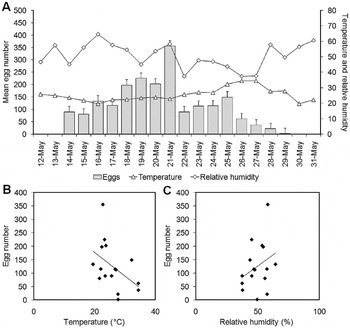
The oviposition period of wild-collected females in the environment took place from 14 to 29 May 2009 (spring), when the mean temperature and mean RH were 31·8°C (range, 14·3–49·3°C) and 48·9% (range, 11·2–86·5%), respectively (Fig. 4A). On 26 May 2009, when the temperature raised to 34·4°C and the RH fell to 37·4%, the number of eggs laid by the females started to decline drastically reaching zero 4 days later. No significant correlations were found between the number of eggs laid daily and the daily mean RH (rs=0·22, P=0·41) (Fig. 4B) and temperature (rs=−0·46, P=0·06) (Fig. 4C), although in the latter case the correlation tended to be negative.
Mean number of eggs laid by wild-collected females kept in the environment during spring in relation to daily mean temperature and daily mean RH recorded during the oviposition period (A). Linear correlation between mean number of eggs and either daily mean temperature (y=−8·8542x +354·12, R²=0·20) (B) or daily mean RH (y=3·3586x−41·738, R²=0·10) (C).

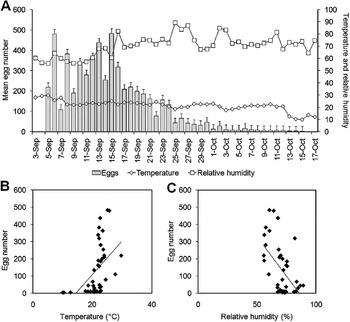
The oviposition period of F1 females in the environment took place from 7 September to 15 October 2009 (autumn), when the mean temperature and mean RH were 19·5°C (range, 6·1–32·8°C) and 65·1% (range, 28·4–98·4%), respectively (Fig. 5A). From 13 October onwards, when the temperature fell to around 10°C, the number of eggs laid by the females declined near to zero. No significant correlation (rs=−0·17, P=0·28) was found between the mean number of eggs laid daily and the daily mean RH recorded during the oviposition period (Fig. 5B). On the other hand, there was significant positive correlation (rs=0·57, P⩽0·01) between the mean number of eggs and daily mean temperature (Fig. 5C).
Mean number of eggs laid by first generation females kept in the environment during autumn in relation to daily mean temperature and daily mean RH recorded during the oviposition period (A). Linear correlation between mean number of eggs and either daily mean temperature (y=19·429x−280·64, R²=0·24) (B) or daily mean RH (y=−9·1536x +785·47, R²=0·28) (C).

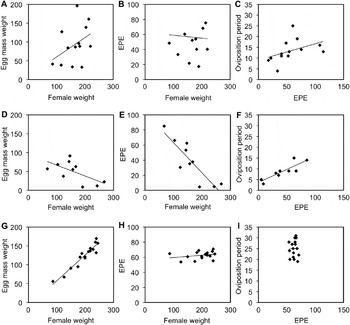
Overall, the relationships between egg mass weight, female body weight, EPE and duration of oviposition period in wild-collected females maintained in the laboratory (Fig. 6A–C) differed from those kept in the environment during spring (Fig. 6D–F), but more or less similar to F1 females in the environment during autumn (Fig. 6G–I). In particular, a negative (r=−0·62, P⩽0·05) and a positive (r=0·95, P⩽0·01) correlation between body weight and egg mass weight were recorded for wild-collected females in spring (Fig. 6D) and for F1 females in autumn (Fig. 6G), respectively. Additionally, EPE was not correlated with the length of oviposition period in F1 females (r=0·03, P=0·92) (Fig. 6I), but it was positively correlated in wild-collected females (r=0·88, P⩽0·01) (Fig. 6F).
Correlation between different reproductive parameters of wild-collected and first generation females (F1). (A) Egg mass weight and body weight of wild-collected females in the laboratory (y=0·5115x+9·3035, R²=0·16). (B) Egg production efficiency (EPE) and body weight of wild-collected females in the laboratory (y=−0·0391x+62·863, R²=0·00). (C) Oviposition period and EPE of wild-collected females in the laboratory (y=0·0759x+9·1008, R²=0·19). (D) Egg mass weight and body weight of wild-collected females in the environment in spring (y=0·6835x−10·741, R²=0·91). (E) EPE and body weight of wild-collected females in the environment in spring (y=0·0313x+56·415, R²=0·08). (F) Oviposition period and EPE of wild-collected females in the environment in spring (y=0·022x+23·622, R²=0·00). (G) Egg mass weight and body weight of F1 females in the environment in autumn (y=−0·288x+95·602, R²=0·39). (H) EPE and body weight of F1 females in the environment in autumn (y=−0·4004x+103·24, R²=0·76). (I) Oviposition period and EPE of F1 females in the environment in autumn (y=0·1209x+3·7009, R²=0·78).

Duration of the life cycle in the laboratory and in the environment
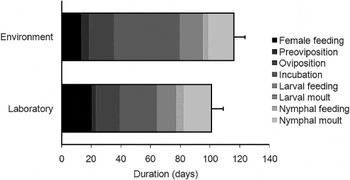
Excluding pre-feeding periods, the entire life cycle of R. sanguineus lasted a mean of 101·4 days under laboratory conditions and 116·2 days under environmental conditions (Fig. 7). The specific phase accounting for the slightly longer life cycle duration in the environment was the egg incubation period of F1 females during autumn 2009. Spearman correlation revealed an almost perfect positive correlation between the duration of different phases (i.e., female feeding, pre-oviposition, oviposition, egg incubation, larval feeding and moult, nymphal feeding and moult) of the life cycle of R. sanguineus in the laboratory and in the environment (rs=0·91, P⩽0·01).
Mean durations of feeding and moult periods of Rhipicephalus sanguineus under laboratory and environmental conditions.

DISCUSSION
In this study, we investigated several biological parameters of R. sanguineus under both laboratory and natural climatic conditions of southern Europe and assessed their relationship with climate data, during different seasons. Definitely, our results showed that the Mediterranean climate affects the biology of R. sanguineus and that this tick responds differentially to spring, summer and autumn conditions. Remarkably, high feeding and moulting rates were recorded in larvae and nymphs during summer and high EPE, REI and RFI in females during autumn.
In contrast to what occurs in laboratory conditions, the effect of temperature and humidity on the oviposition of R. sanguineus varied according to season. In particular, it was observed that the number of eggs was positively (yet not significantly) correlated with humidity and negatively correlated with temperature during spring. This evidence indicates that at high temperature, the RH becomes vital for R. sanguineus even considering that this tick is adapted to xeric environments (Yoder et al. Reference Yoder, Benoit, Rellinger and Tank2006). On the other hand, there was a positive correlation between the number of eggs and temperature during autumn, which emphasizes the need for a minimum threshold temperature (about 10°C) for female oviposition (Nuttall, Reference Nuttall1915; Koch, Reference Koch1982). Certainly, R. sanguineus is sensitive to low temperatures, which is one of the main factors limiting the establishment of populations of this tick in colder temperate regions of Europe (Dantas-Torres et al. Reference Dantas-Torres, Giannelli, Figueredo and Otranto2010). However, considering the climatic projections for Europe, a northward spread of R. sanguineus might be expected in future decades. Indeed, it has been stated that an increase of about 2–3°C in the mean temperature from April to September could prompt the establishment of stable R. sanguineus populations in northern temperate Europe (Gray et al. Reference Gray, Dautel, Estrada-Peña, Kahl and Lindgren2009).
Consistent with previous laboratory observations (Srivastava and Varma, Reference Srivastava and Varma1964), the general sex ratio recorded in this study was 1:1. However, the sex ratio was biased towards female in the environment during August, the peak of the summer season. The sex ratio of R. sanguineus ticks collected from dogs is usually male-biased (Dantas-Torres et al. Reference Dantas-Torres, Melo, Figueredo and Brandão-Filho2009) due to the fact that males remain longer on the host than females (Nuttall, Reference Nuttall1915). However, it has been observed previously that the proportion of males and females of R. sanguineus found on dogs might vary according to season. For instance, in a study carried out in Israel, sex ratio was male-biased in winter, but the proportion of females tended to increase during summer (Mumcuoglu et al. Reference Mumcuoglu, Burgan, Ioffe-Uspensky and Manor1993). Our data might suggest that the combination of high temperature (maximum, 39·7°C) and low RH (minimum, 14·2%) recorded between late July and early August 2009 might have influenced the sex ratio of ticks kept in the environment. This could be a biological strategy of R. sanguineus towards compensating the low egg production of females under stressful climatic conditions (high temperature and low RH), by increasing the proportion of females in the population.
Wild-collected females maintained in the environment during spring had a longer oviposition period, lower egg production, lower EPE, lower REI and lower RFI, when compared with those in the laboratory. This indicates that the combination of high temperature and low RH affected negatively the reproductive parameters of females during spring. Interestingly, EPE was negatively correlated with female weight, indicating that lighter females were more efficient in converting their body mass in eggs. Lighter females were evidently able to metabolize the bloodmeal faster and to start the egg production earlier in comparison with heavier females.
The proportion of engorged larvae was significantly higher among those previously kept under natural climatic conditions as compared to those in the laboratory. Recent studies have reported that exposure to high temperatures increases the propensity of R. sanguineus to bite rabbits and humans (Parola et al. Reference Parola, Socolovschi, Jeanjean, Bitam, Fournier, Sotto, Labauge and Raoult2008; Socolovschi et al. Reference Socolovschi, Raoult and Parola2009). In particular, it has been shown that larvae kept at 40°C for 4 days attach to rabbits more rapidly than larvae kept at 25°C (Socolovschi et al. Reference Socolovschi, Raoult and Parola2009). Moreover, although R. sanguineus can infest dogs during the whole year (Dantas-Torres, Reference Dantas-Torres2008), in Europe they are more abundant during spring and summer (Lorusso et al. Reference Lorusso, Dantas-Torres, Lia, Tarallo, Mencke, Capelli and Otranto2010). Altogether, these data might explain the seasonal pattern of Mediterranean spotted fever in southern Europe and North Africa, with a peak in incidence in the summer, when R. sanguineus is more abundant and would tend to bite humans more often (Parola et al. Reference Parola, Socolovschi, Jeanjean, Bitam, Fournier, Sotto, Labauge and Raoult2008).
It might be questioned whether the differences in the biological parameters of wild-collected and F1 females kept in the environment in spring and autumn, respectively, were due to climate- or host-related factors, since in the first case the females were fed on dogs and in the second case on rabbits. Our data do not support the hypothesis that host-related factors might have affected the differences between the wild-collected and F1 females since it has been shown that females fed on dogs are heavier and lay more eggs than those fed on rabbits (Koch, Reference Koch1982). Again, because a single rabbit was used to feed each tick group, it might be argued that differences observed in this study could have been influenced by the individual immune response of each rabbit. In fact, the low number of engorged females in the laboratory group may suggest that the rabbit developed some degree of immunity after being infested with larvae and nymphs (Garin and Grabarev, Reference Garin and Grabarev1972). On the other hand, this fact does not impair the interpretation of our data since the results obtained with ticks kept under natural conditions were consistent and data from the laboratory group were not used in the analysis. Certainly, the use of more than 1 rabbit per group could help to dilute the ‘host effect’, but for ethical reasons the number of hosts was kept to a minimum.
It is worth mentioning that in pioneer studies on R. sanguineus biology, ticks were often kept at room temperature (Nuttall, Reference Nuttall1915). Unquestionably, the climate conditions in an indoor laboratory environment are quite different from the natural climate conditions in an outdoor environment. Although it might be alleged that plastic vials used in this study cannot perfectly simulate the natural tick habitat (e.g. crevices on the wall), the vials were placed into a small cage covered with a rock and placed in a shadowed area, being microclimate data monitored throughout the whole study period using a high-precision data logger placed inside the cage with the vials. Therefore, the authors are quite confident that the actual temperature and RH within the vials were very close to what ticks would experience under ‘real’ natural conditions.
The present results advance our knowledge of the biology and ecology of R. sanguineus in natural climatic conditions. Definitely, it showed that the Mediterranean climate affects the biology of R. sanguineus and that low egg production and egg hatch rate during spring are counterbalanced during summer and autumn. Our results also contradict the old notion that R. sanguineus is ‘immune’ to low RH (Sweatman, Reference Sweatman1967; Koch and Tuck, Reference Koch and Tuck1986; Yoder et al. Reference Yoder, Benoit, Rellinger and Tank2006) and confirms that a combination of high temperature and low humidity is deleterious for ovipositing females and their eggs. It follows that the establishment of permanent populations of this tick in a given area will also be dependent on the RH available during the hottest months of the year. These data will be of crucial importance to the understanding of the eco-epidemiology and the spread of tick-borne diseases transmitted by R. sanguineus in Europe.
ACKNOWLEDGEMENTS
This work was supported by the Fondazione Cassa di Risparmio di Puglia. Thanks to Alessio Giannelli, Domenico Carbone, Riccardo Lia, Vincenzo Lorusso and Viviana D. Tarallo (Università degli Studi di Bari, Italy) for their support with some field and laboratory activities and to Andrey José de Andrade (Universidade Federal de Minas Gerais, Brazil) for his help with statistical analysis. Thanks also to Robin Gasser (Department of Veterinary Science, University of Melbourne, Australia) for his comments and suggestions on the manuscript.