Implications
This study shows that current pig slaughter regimes involving carbon dioxide stunning carry a risk of conscious animals being exposed to painful further processing steps such as dressing and scalding. Business operators have a legal and social obligation to prevent this scenario. An automatic detection method would be preferable, considering the rarity of cases and the level of industry automation. We demonstrated that pigs with signs of life showed movements during automatic spraying with hot water. If combined with an automatic detection unit, the resulting system could provide a reliable last check at this stage of the slaughter process.
Introduction
Stunning with ⩾80 vol% carbon dioxide (CO2) in air is routinely used in commercial pig slaughter. Common exposure times induce a period of reversible unconsciousness and death is caused by a chest stick (Wotton and Gregory, Reference Wotton and Gregory1986; Forslid, Reference Forslid1987; Martoft et al., Reference Martoft, Stodkilde-Jorgensen, Forslid, Pedersen and Jorgensen2003). Animal welfare is compromised when consciousness is present at any time in the period between the end of the stunning intervention and death. Known risk factors include insufficient stunning effectiveness as well as delayed, ineffective or omitted sticking (Rodríguez et al., Reference Rodríguez, Dalmau, Ruiz-de-la-Torre, Manteca, Jensen, Rodríguez, Litvan and Velarde2008; Von Wenzlawowicz et al., Reference Von Wenzlawowicz, von Holleben and Eser2012; Llonch et al., Reference Llonch, Rodriguez, Jospin, Dalmau, Manteca and Velarde2013). The affected pigs run the risk of being exposed to further processing steps (usually scalding) if no additional stun/kill intervention is performed. Within the European Union, sustained unconsciousness and insensibility are statutory requirements and business operators are required to implement risk-based monitoring procedures. Further processing is only allowed once the absence of signs of life (SOL) has been verified (Council Regulation (EC) No 1099/2009, 2009). For this purpose, hot-water spraying (HWS) has been suggested. The hypothesis is that following stunning and bleeding reactions to a painful stimulus can be triggered in pigs with SOL (Troeger and Meiler, Reference Troeger and Meiler2006). The stimulus as well as the detection of triggered movements could be automated, preventing these pigs from being processed further. We, therefore, set out to (1) develop an automatic HWS device; (2) investigate the feasibility and performance of HWS as a diagnostic tool to verify that SOL are absent before further processing; (3) gain information about the SOL expressed at this stage of the slaughter process; and (4) identify indicators of sustained SOL. The detection system was developed simultaneously but is not part of this publication.
Animals, material and methods
Animals and abattoirs
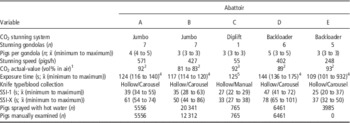
A sample of 37 108 finishing pigs was assessed during routine slaughter in five commercial German abattoirs (A to E). Eligibility criteria included the use of CO2 stunning, the business operator’s willingness to participate in the study and the accessibility of the bleeding line. Process parameters for stunning and sticking, as well as sample size distributions, are given in Table 1.
Process parameters for stunning and sticking and sample sizes in abattoirs A to E

SSI-1/X=stun-to-stick intervals for the first/last pig within a stunning gondola.
1 As displayed at the systems’ control terminals.
2 Measuring point: first stop within the CO2 atmosphere.
3 Measuring point: bottom of the pit.
4 First to last stop within the CO2 atmosphere.
5 Time in ⩾80 vol% CO2.
HWS
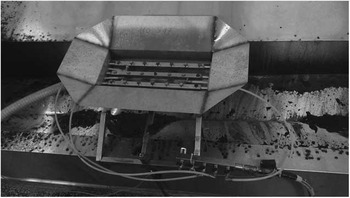
Before further processing, hot water was applied using a purpose-built spraying device (Figure 1). It consists of three nozzle holders, each equipped with up to three flat spray nozzles aligned in parallel within a rectangular trough (600×300 mm). The holders are connected to a distributor that is attached to a nearby line. An electric water heater is interconnected when necessary. Spraying is triggered when a programmable logic controller (LOGO! 24RC, Siemens, Munich, Germany) receives information of a passing slaughter hook via a mechanical sensor (Schmersal, Wuppertal, Germany) and activates a solenoid valve (Buschjost, Bad Oeynhausen, Germany) located at the inflow of the system. Inflow volume can be adjusted using turncocks located at the inlet of the distributor as well as its outlets to the nozzle holders.
Purpose-built hot-water spraying device (BANSS, Biedenkopf, Germany) used to test pigs for signs of life before further processing.

The system was centrally installed on the bleeding line, and the vertical water jets were adjusted to a height of ~600 mm. Suspended pigs were, thus, sprayed onto the muzzle, head and front legs as well as other cranial body parts depending on the pigs’ size. HWS took place while the animals were being conveyed from sticking toward further processing. The stick-to-spray interval range was 143 to 258 s, varying between abattoirs due to differences regarding the accessibility of the bleeding line. Within the same abattoir, stick-to-spray intervals varied according to the number of pigs buffered between sticking and HWS as well as stops of the slaughter line. Each pig was sprayed for a period of 4 to 10 s depending on the abattoirs’ line speed. Water temperature was repeatedly measured (Testo 946; Testo, Lenzkirch, Germany) at the level of the muzzle and ranged from 55°C to 72°C. During HWS, pigs were closely observed for any activity. All pigs were videotaped from a fixed angle for retrospective analysis of relevant sequences (1440×1080 p; HDR-PJ260VE and HDR-CX570E; Sony, Tokyo, Japan). Intensity scores were assigned to any movements recorded, ranging from hardly visible (1/3) to obvious (2/3) to strong (3/3).
Manual examination and captive bolt application
Following HWS, pigs were manually examined. An LED Flashlight (5200 cd; FenixTM E21, Fenixlight, Shenzhen, China) was pointed at one eye and approached until nearly touching the cornea. The size and any response of the pupil were assessed. A positive dazzle reflex was noted if this procedure led to the closing of the eye. Subsequently, the cornea of one eye was touched using the tip of pliers (see next test). A positive corneal reflex consisted of closing of the eye. Finally, modified bent-nose telephone pliers were inserted into the pigs’ nostrils and the nasal septum was pinched. A positive nasal septum pinch was noted if this manipulation led to a distinct movement. In total, 25 094 pigs were manually examined (Table 1), as 8040 pigs from abattoir B and all pigs from abattoir E were examined only when activity during HWS was present. A penetrating captive bolt gun (Cash Magnum.25 Euro Stunner with black cartridges, Accles & Shelvoke, Sutton Coldfield, UK) was applied to pigs with positive manual findings or active movements following HWS, after which the manual examination was repeated. In addition, 50 pigs from abattoir B without activity during HWS were shot as well, in order to compare reactions.
Data assignment
Pigs were assessed in groups of 50 to 200 consecutive animals. The first pig of each group was tagged using animal marking spray, and the group number was displayed to the cameras when it passed by. Unique identifiers were assigned to each pig consisting of the group number and number within the group obtained by mechanical counters. Any findings of the HWS and manual examination were dictated to digital voice recorders (ICD-BX112; Sony), stating the affected animal’s identifier and signalment. The corresponding pig on the film was identified using these data as well as the synchronized digital timestamps in the audio and video recordings.
Video analysis of the bleeding process
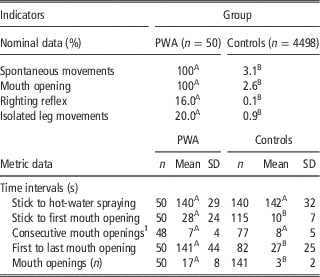
In addition to the HWS, the bleeding process was video monitored as well. Obtained footage from both recordings was used to analyze the occurrence of spontaneous movements (SM) between sticking and HWS in abattoir B. For this purpose, pigs with activity during hot-water spraying (PWA) were compared with 4498 pigs without such activity (controls). For both groups, the frequencies of SM in general as well as of the following subtypes were determined: mouth opening, righting reflex and isolated leg movements. The total number of mouth openings observed per pig was counted. In addition, the following time intervals were calculated from the video files for both PWA and controls with SM: stick to HWS, stick to first mouth opening and first to last mouth opening. Intervals in between mouth openings were assessed as well.
Statistical analysis
Data were processed using Microsoft Excel and StatSoft Statistica 12. Fisher’s exact test was used for 2×2 contingency tables. Diagnostic parameters for HWS were obtained as follows: pigs tested positive if any active movements occurred during HWS. By comparison, pigs were considered suitable for further processing if the manual examination was negative and no active movements were present following spraying. Metric data were non-normal according to an extended Shapiro–Wilk W test. Distributions were, therefore, accessed using Mann–Whitney’s U-test. Goodman–Kruskal’s gamma was used for correlations.
Results
Activity in hot water
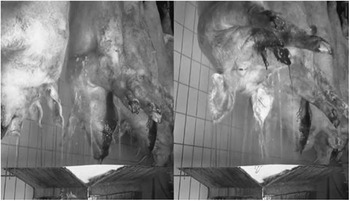
Activity during HWS occurred in 0.14% (n=51) of the pigs. It was only seen in abattoirs B (0.25%; n=50) and D (0.02%; n=1). PWA showed movements of the following categories: activity of the facial musculature (88%; n=45), mouth opening (78%; n=40), righting reflex (63%; n=32) and isolated leg-kicking or paddling (35%; n=18). High-frequency vocalization was noted in 4% (n=2) of those pigs. Activities were shown in varying intensities and combinations (Figure 2). Movement intensity was rated 1/3 or 3/3 in 31% (n=16), respectively, and 2/3 in 37% (n=19).
Pig from abattoir B at the start of hot-water spraying (left side) and 5 s later (right side). Interval between sticking and spraying was 144 s. The movement was categorized as a righting reflex. Mouth opening and facial muscle movements were also present. Overall intensity was rated strong (3/3).

Results of the manual examination and captive bolt application
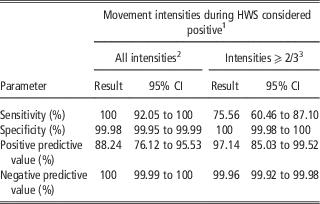
PWA had positive manual findings in 71% (n=36) of the cases, whereas all inactive pigs tested negative (P<0.001). The corneal reflex was present in 67% (n=34), and the dazzle reflex was positive in 53% (n=27) of the pigs. Responses to the nasal septum pinch were noted in 33% (n=17). One pig did not vocalize during HWS but did during the manual examination. All three tests were positive in 31% (n=16), whereas 20% (n=10) was positive in either two or one of the test categories, respectively. Within the PWA group, the correlation between movement intensities and the number of positive test categories in the manual examination was not significant (γ=0.15; P>0.05). Clearly constricted pupils were present in 8% (n=4) of PWA, whereas pupillary reactions were noted in 4% (n=2). Otherwise, findings regarding the pupils were ambiguous, and therefore discarded. An incidental finding was that two PWA (4%) had positive threat reflexes. In those pigs, righting movements could be triggered by quickly approaching their eyes. Sticking was omitted in the sole case of PWA in abattoir D. The captive bolt gun was applied to 44 PWA and it instantly terminated any positive manual findings and mouth opening movements. Active movements following captive bolt application were seen in 27% (n=12) of shot PWA and were not found in inactive pigs (P<0.001). These movements resembled those seen in live pigs shot with a captive bolt (i.e. tonic-clonic spasms). Their occurrence was limited to PWA with positive manual findings (P<0.05). Parameters obtained regarding the performance of HWS are shown in Table 2.
Performance of hot-water spraying as a diagnostic test for signs of life in slaughter pigs before further processing (n = 25 094)

HWS=hot-water spraying.
Pigs tested positive when active movements occurred during spraying. Signs of life were considered to be absent if the following criteria were met: no active movements and no corneal reflex, dazzle reflex or reaction to a nasal septum pinch following spraying.
1 Movement intensities were scored as follows: hardly visible (1/3); obvious (2/3); strong (3/3).
2 All movement intensities are regarded as a positive test outcome.
3 Only obvious and strong movement intensities are regarded as a positive test outcome.
Results of the video analysis
Following sticking and before HWS, SM were observed in all PWA. All PWA showed mouth opening, whereas other types of SM were only seen in a part of PWA (Table 3). In pigs lacking activity during HWS, the incidence of SM was significantly lower (P<0.001). In 22.0% of PWA and 18.4% of controls with SM, the hollow knife was pulled out right after sticking (i.e. used like a conventional knife; P>0.05).
Indicators for signs of life before further processing for pigs from abattoir B; pigs with activity during hot-water spraying are compared with pigs without such activity (controls)

PWA=pigs with activity during hot-water spraying.
A,BValues within a row with different superscripts differ significantly at P<0.001 (Fisher’s exact test, Mann–Whitney’s U-test).
1 739 mouth-opening intervals (540 from PWA and 199 from controls); 1 to 26 intervals obtained per pig.
Mean intervals from sticking to HWS were similar for both PWA and controls. Mouth opening was seen more often and for a longer period of time in PWA, whereas the first mouth opening following sticking was observed earlier in controls (all findings P<0.001). The pigs’ mouth-opening intervals did not differ significantly between PWA and controls.
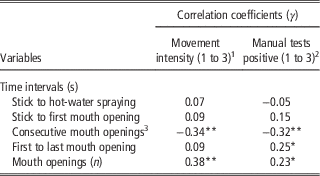
For PWA, movement intensities during HWS as well as the number of positive manual test types were significantly higher in pigs with larger mouth-opening counts and lower mouth-opening intervals (Table 4). When mouth openings were observed for a longer period of time, significantly more manual test types were positive, whereas movement intensities during HWS were not affected. Stick-to-HWS intervals and stick-to-first mouth-opening intervals did not affect the number of positive manual test types or movement intensities during HWS.
Correlation coefficients for variables in pigs with activity during hot-water spraying

Movement intensities during hot-water spraying and the number of positive test categories in the subsequent manual examination are correlated with variables regarding the moment of spraying as well as mouth-opening movements.
1 Movement intensities were scored as follows: hardly visible (1/3); obvious (2/3); strong (3/3).
2 Manual tests performed: dazzle reflex, corneal reflex and reaction to a nasal septum pinch.
3 Medians of 1 to 26 intervals obtained per pig.
*/**Goodman–Kruskal’s gamma correlations are significant at *P<0.05 or **P<0.01.
Discussion
Defining SOL
European abattoir operators are obliged to verify the absence of SOL before further dressing and scalding, but no definition is given for this non-medical term (Council Regulation (EC) No 1099/2009, 2009). It could be inferred that the legislator wanted death to be present before pigs enter the scalding tank. This would require cardiac arrest and irreversible loss of brain activity to be proven, which to date is an unfeasible task in abattoir environments. Recent publications have focused on indicators of consciousness and sensibility (EFSA Panel on Animal Health and Welfare (AHAW), 2013; Verhoeven et al., Reference Verhoeven, Gerritzen, Hellebrekers and Kemp2015) without referring to the regulation’s wording. We started from the premise that pigs lack SOL if our selected indicators of consciousness as well as any active movements are absent.
Performance and appropriateness of HWS
Following this definition, HWS is a reliable diagnostic test for SOL, as activity during HWS was observed in all pigs with SOL. An automatic detection module should ideally be able to detect all movement intensities, as pigs with lower movement intensities are not subordinate from an animal welfare point of view. This is supported by the fact that movement intensities did not correlate with the number of positive test types in the manual examination. The low frequencies of SOL observed in this study underscore the need for an automated individual testing method, as the sample sizes used in practice (e.g. checks by the welfare officer) are unlikely to detect pigs with SOL before scalding. HWS as described in this study could be implemented in most abattoir environments without any major building alterations. The method has been shown to work in electrically stunned pigs as well (Arnold et al., Reference Arnold, Parotat, Moje, Machtolf, von Wenzlawowicz, Troeger and Luecker2014) and may be applicable for other species too.
From an ethical point of view, using a painful procedure (hot water) to detect pigs with SOL is not ideal. However, HWS is supposed to be applied at a time when death should have long occurred (Wotton and Gregory, Reference Wotton and Gregory1986), and testing pain perception is an established tool during bleeding (AHAW, 2013). Systems predicting irreversible unconsciousness by analyzing the individual blood loss have been investigated (Troeger, Reference Troeger2011) and are sometimes implemented industrially. If validated under present abattoir conditions, they could provide an alternative or additional safety measure for abattoirs with individual blood collection. However, when knives are pulled out right after sticking, these systems cannot detect insufficient blood loss.
SOL and consciousness
Our findings suggest that consciousness of varying degrees was present in pigs with SOL. Welfare was seriously compromised at least in some of the cases as our observations of righting movements and vocalizations imply (Grandin, Reference Grandin2013). Further, indicators incompatible with brain stem death were present in the majority of cases (European Food Safety Authority (EFSA), 2004). On the other hand, the presence of consciousness could be disputed on the basis that movements following noxious stimulation can occur in an unconscious state (Antognini et al., Reference Antognini, Barter and Carstens2005). This is in line with the fact that some pigs reacted to the hot water but were negative in the manual examination. It is also true that clinical indicators lack sufficient validation by electroencephalographic methods, which are considered to be the most reliable tools for accessing consciousness (Humane Slaughter Association, 2014; Verhoeven et al., Reference Verhoeven, Gerritzen, Hellebrekers and Kemp2015). It must be stressed, however, that even their data are open to interpretation, especially in transitional stages of consciousness (Alkire et al., Reference Alkire, Hudetz and Tononi2008).
Therefore, we propose that the absence of SOL must include the cessation of any movements, as is German law. This gives pigs the benefit of doubt and is an unambiguous criterion for the stakeholders involved.
Risk factors of SOL before further processing
Abattoir B obviously stood out against the remainder of the plants, providing 50 out of 51 PWA discussed here. The underlying reasons were not investigated in detail. However, dwell times and CO2 concentrations were relatively low in this abattoir, whereas stun-to-stick intervals were rather long. These variables are known to be of crucial importance in preventing SOL (Atkinson et al., Reference Atkinson, Velarde, Llonch and Algers2012; Von Wenzlawowicz et al., Reference Von Wenzlawowicz, von Holleben and Eser2012; Llonch et al., Reference Llonch, Rodriguez, Jospin, Dalmau, Manteca and Velarde2013). In addition, the stick-to-hot water interval was relatively short in this abattoir, possibly increasing the likelihood of SOL at the time of HWS.
The implications of using hollow knives in the same way as conventional knives (i.e. pulling out the knife right after sticking) warrant closer examination, given the high frequency of this technique in both PWA and controls with SM. The initial blood loss may have been reduced due to an early collapse of the sticking wound. Further, this procedure was frequently observed when pigs piled up at the sticking position, putting pressure on the employee in charge and possibly prolonging stun-to-stick intervals. This is consistent with other studies that have investigated the influence of different sticking techniques in more detail (Anil et al., Reference Anil, Whittington and McKinstry2000; Schweiger et al., Reference Schweiger, Fischer and Troeger2013).
The sole PWA of abattoir D was overlooked at the sticking carousel and lacked an incision at the time of HWS. A peculiarity in this abattoir was that the six-knife sticking carousel was operated by a single employee who had <10 s per pig for sticking, knife-pulling and surveillance combined. An automatic system for the detection of pigs lacking incisions exists (Lykke et al., Reference Lykke, Arnmark and Borggaard2010) but is not implemented in German abattoirs. We propose that the frequency of slaughtered pigs lacking sticking incisions should be routinely monitored by business operators.
Indicators of SOL before further processing
Stick-to-hot water intervals did not differ for the PWA and control groups, showing that the occurrence of PWA was not a mere function of time. Rather, the groups differed already shortly following sticking as indicated in the respective stick-to first mouth-opening intervals. A possible explanation is that the mouth openings (MO) seen within the control group were primarily gasping motions signifying a dying brain stem (Blackmore and Newhook, Reference Blackmore and Newhook1981; EFSA, 2004). On the other hand, the MOs in PWA seem to be consistent with the recovery of regular breathing. According to our findings, differentiating between the two by mere observation is not possible at the beginning of bleeding because the intervals between MOs were similar for both groups. The difference only becomes apparent later, given the mean number of MOs in PWA, which were a multiple of those seen in controls. PWA with lower mouth-opening intervals and, therefore, higher mouth-opening counts were then more likely to show stronger movements during HWS and possess more positive manual test types. In consequence, we suggest that any form of repeated respiratory activity during bleeding is unacceptable, irrespective of its regularity. The differentiation between gagging, gasping and breathing is ambiguous (compare Verhoeven et al., Reference Verhoeven, Gerritzen, Hellebrekers and Kemp2015) and of little practical value in plants with high-throughput rates and short per-animal observation times.
Although these findings are based on pigs from a sole abattoir, recent studies have also found MO to be the predominant indicator for impaired welfare of pigs during bleeding (Atkinson et al., Reference Atkinson, Velarde, Llonch and Algers2012). To our understanding, this underscores the importance of skilled employees who not only monitor the stunning but also the bleeding effectiveness. Business operators should encourage additional stun/kill interventions when necessary and provide adequate tools. A high-energy captive bolt gun seems to be a reliable tool for euthanasia in the context discussed here (Woods, Reference Woods2012). It should be preferred over electrical methods, as long as doubts regarding their effectiveness following CO2 stunning have not been disproven (EFSA, 2004). According to our findings, undirected movements following a captive-bolt shot indicate poor welfare in affected pigs.
We conclude that current pig slaughter regimes involving CO2 stunning carry a risk of conscious pigs being exposed to painful further processing steps. HWS as described in this study is a robust, sensitive and feasible method to detect pigs with SOL. In combination with a sensitive detection unit, the resulting system could provide a justifiable measure to prevent longer-lasting suffering as long as painless methods or irreversible stunning methods are not at hand. All pigs with SOL before further processing could have been identified by observation of the bleeding process. This underscores the importance of adequate human and technical resources at this stage of the slaughter process.
Acknowledgments
The project is supported by funds of the Federal Ministry of Food and Agriculture (BMEL) based on a decision of the Parliament of the Federal Republic of Germany via the Federal Office for Agriculture and Food (BLE) under the innovation support program.