Introduction
The 20th biennial conference of the International Planning History Society (IPHS) took place on 2–5 July 2024 in Hong Kong, China, with a one-day online event on 28 June. After a hiatus in 2020 due to the COVID-19 pandemic and the largely online 19th conference hosted by Delft University of Technology in 2022, the Society’s anticipated 20th gathering in Hong Kong signalled a shift in narrative aligned with international political, strategic and discourse changes. The conference was co-organized by Professor Ian Morley (Department of History) and Professor Hendrik Tieben (School of Architecture) from the Chinese University of Hong Kong (CUHK). Being a Special Administrative Region of the People’s Republic of China, a former British colony and a long-established trading hub, Hong Kong provided an anchor for various topics. Scholars collectively addressed the critical issues of planning in the context of technological revolution, economic contrasts, globalization, colonialism and the role of urban heritage in contemporary practices. The key topics that emerged from these discussions included environmental resilience, social justice, urban ecology, historical preservation, colonial and post-colonial planning, pandemic and urban health, planning in high-density urban contexts, community empowerment and the impact of urban planning on socio-economic structures. Scholars drew on various methodologies, from historical analysis to fieldwork and comparative assessments. This methodological diversity reveals how planning practices can serve as critical entry points for urban historians and enrich historiographical debates about spatial change.
Themed ‘The (High-Density) Metropolis and Region in Planning History’, the conference called for exploration of planning approaches for socio-environmental challenges in contemporary development and underscored the significance of historical planning practices (full papers composed and submitted prior to the 2024 conference are accessed from the website: https://journals.open.tudelft.nl/iphs/issue/view/1025). Renato Leão Rego’s conference report published earlier presents the readers with a general overview.Footnote 1 Overall, the conference included four keynote presentations, one roundtable and various panels addressing different topics, as well as one-day excursions in Hong Kong and Shenzhen. On the evening of 3 July, chaired by Professor Hendrik Tieben, Professor Carola Hein, Professor Laura Kolbe and Professor Barry Wilson respectively emphasized the value of planning history in addressing contemporary urban challenges such as public health, sustainability and interdisciplinary education. In the Gordon E. Cherry Memorial Lecture on 4 July, Professors John Gold and Maggie Gold introduced the historical legacy of mega-events such as the Olympics and international expositions and highlighted the uneven impacts of these events, particularly the challenges in the cities of the Global South. In addition to paying special attention to the tension between the social-political environment and urban planning strategies in Hong Kong and Shenzhen, this report notes the strong concerns about environmental issues especially in water-rich territories, the allocation of social resources and urban transitions, as well as emerging methodological richness in planning history to amplify marginalized voices in panel discussions.
The 20th IPHS biennial conference brought together researchers from nearly 30 countries across five continents, reflecting a global discourse on urban planning history. For the first time since the pandemic, it provided an opportunity for scholars to reflect in person on the future we need to create through historical perspectives and planning methods that can benefit humanity. Due to its geographical location, similar to the 2018 Yokohama conference, Asian scholars once again made up almost half of the attendees. Scholars critically examined the historical evolution of planning ideas as well as practices in relation to pressing contemporary issues, including environmental sustainability, gender and social justice, housing and public health, heritage and memory, and the legacies of colonial and transnational planning. Through diverse case-studies and methodological reflections, the conference offered valuable insights. This report summarizes and highlights three main aspects: (1) the complex planning practices and high-density urban space of Hong Kong and Shenzhen shaped by entangled histories of power, (2) the crucial role of natural resources and shifting awareness of resource exploitation in shaping environmental governance and planning strategies, (3) the significance of using alternative archives and recovering marginalized voices to expand urban historiography beyond official narratives.
The dynamics of urban development in high-density contexts: keynote presentations about Hong Kong and Shenzhen
The three keynote presentations offered an in-depth interpretation of the planning history of Shenzhen and Hong Kong, exemplifying the impact of socio-historical processes on planning policy and the built environment, as well as the resulting far-reaching effects on community life. The first keynote presentation took place online on 28 June, the first full conference day. Titled ‘Building, Planning, and the Production of Space in a Speculative City’, Associate Professor Cecilia L. Chu (CUHK) introduced the ‘speculative landscape’ of Hong Kong from the late nineteenth to the early twentieth century, revealing the contradictions embedded in colonial urban development which promoted native investment while enforcing hierarchical segregation. She argued that urban landscapes were shaped by negotiations between competing stakeholders and posited the built environment as a critical mediator in realizing collective aspirations in a racially stratified yet ascending city. The presentation addressed the relationship between the built environment and socio-historical processes and their impacts on the lives of local communities, and underscored the inequitable distribution of urban spatial resources resulting from colonialism. This speech shared similar core ideas expressed in Cecilia Chu’s new publication Building Colonial Hong Kong: Speculative Development and Segregation in the City, which was awarded the 2024 IPHS Second Book Prize.Footnote 2
Online the same day, Associate Professor Carmen C.M. Tsui (Lingnan University) delivered the second keynote presentation ‘Vertical Living: A Historical Perspective on Hong Kong’s High-Rise Planned Communities’ and discussed the innovative concept of high-rise ‘planned communities’ that Hong Kong’s urban planners initiated after World War II as a response to the twin urban challenges of land scarcity and population growth. Using the example of Mei Foo Sun Chuen, an early planned community with modern communal amenities and housing management for the middle class, this presentation delved into the factors that have driven Hong Kong’s urban transformation from modest tenements to the forest of residential towers since the 1960s, and discussed the relationship between policy, investment and social dynamics.
A third keynote presentation was delivered on 2 July. Titled ‘From a Border Town to China’s Silicon Valley: The Power of Planning in Shenzhen’, Professor Mee Kam Ng (CUHK) addressed the decisive role of Shenzhen’s master plan at different stages in the city’s policies, urban design strategies and rapid development, which transformed Shenzhen from a fishing village and border town connecting Hong Kong and China’s mainland to a Chinese Silicon Valley. By demonstrating Shenzhen’s master plans at different phases, Professor Ng explained the shift in Shenzhen’s development goals: from the two early master plans in the 1980s, which aimed at establishing the Shenzhen Special Economic Zone (SSEZ) of China, to the third master plan in the 1990s, which aimed at building a new financial centre and information hub outside the SSEZ by learning from Singapore’s environment and Hong Kong’s planning strategy. She argued that the focus of Shenzhen at this stage is to develop smart sustainable urbanism. These evolving plans revealed how the power of the Chinese state, economic ambition and influential global urban models are historically negotiated through spatial strategy. It provided critical insight into how national ideologies and transnational influences have shaped urban transformation over time.
The impact of formal and informal planning: an observation during the Shenzhen excursion
On 5 July, the excursion day of the conference, participants could choose to visit one of the five selected sites in either Hong Kong or Shenzhen arranged and guided by professional experts according to their interests. The sites – Shatin, Mei Foo, Tsim Sha Tsui Waterfront, West Kowloon in Hong Kong and Futian District in Shenzhen – provided vivid insights into the urban development of both cities and expanded upon the themes presented in the three keynote speeches.
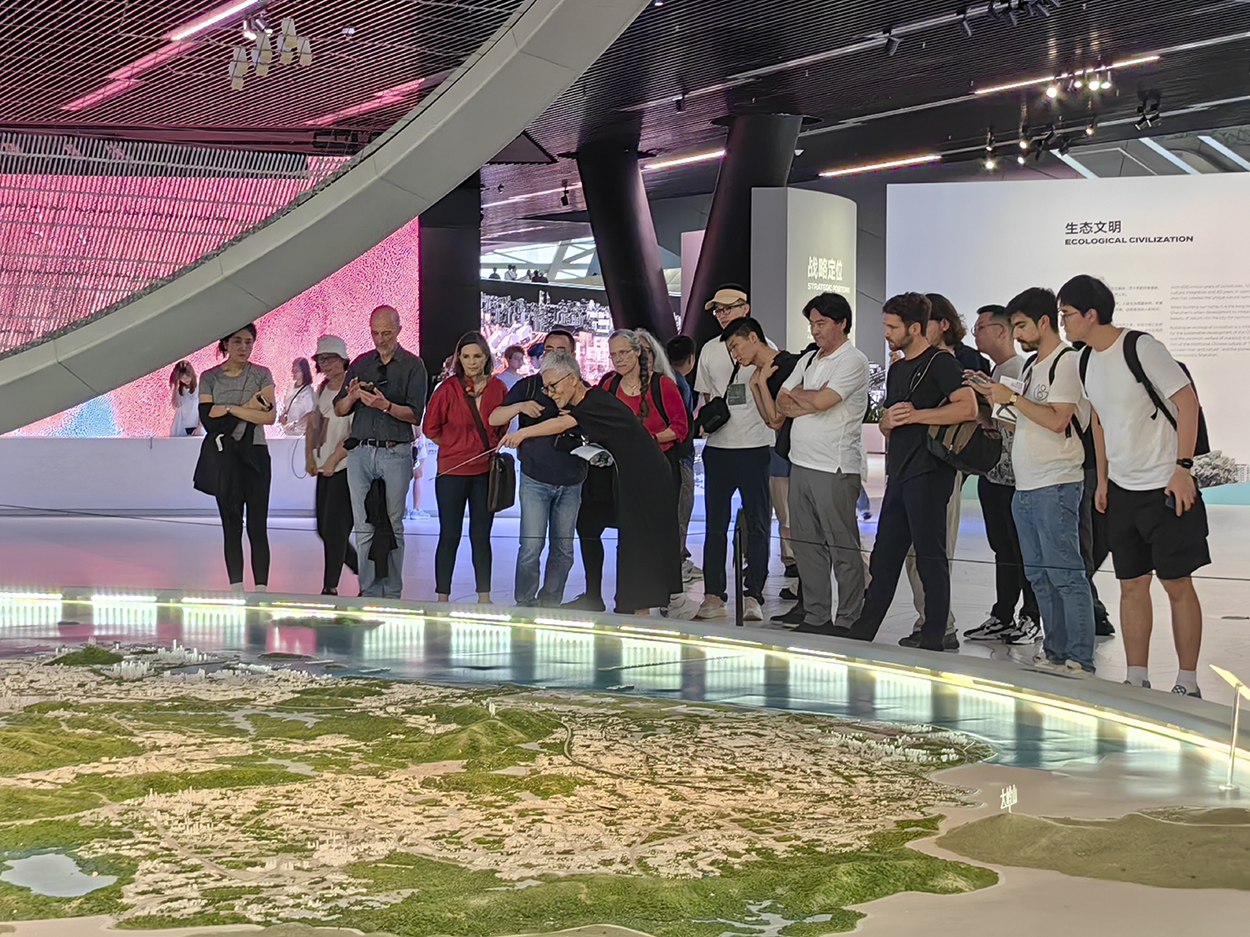
The Shenzhen tour, initiated and organized by Professor Richard Hu (University of Canberra) and led by local planning expert Dr Yixin Chen,Footnote 3 highlighted both the meticulously planned Futian Central Business District (CBD) and the bottom-up development of Gangxia Urban Village (Figure 1). This duality also reflects broader tensions and synergies between state-led modern planning and grassroots urbanism, such as spatial contestation, order differentiation and dynamic cultural conservation and transmission.
Dr Yixin Chen explaining the planning history of Shenzhen to participants in Shenzhen Museum of Contemporary Art and Urban Planning, 2024.

Figure 1. Long description
The photo captures a wide-angle view inside a modern museum.
* In the foreground, a large, illuminated circular architectural model of Shenzhen is displayed at waist height. The model features green topographical areas, white miniature buildings, and blue water bodies representing the coastline.
* At the center of the group, Dr Yixin Chen, dressed in black, leans forward and points a thin rod toward a specific section of the urban model.
* Surrounding Dr Yixin Chen is a diverse group of approximately fifteen participants. They are standing in a semi-circle, observing the model and the demonstration. Some participants are taking notes or photos, while others listen intently.
* The background features the museum's contemporary interior, including a large curved architectural element on the left with a pink-toned digital display.
* To the right, a large white wall panel displays text in Chinese and English, with the English heading Ecological Civilization.
* The ceiling is dark with linear industrial lighting and exposed structural supports.
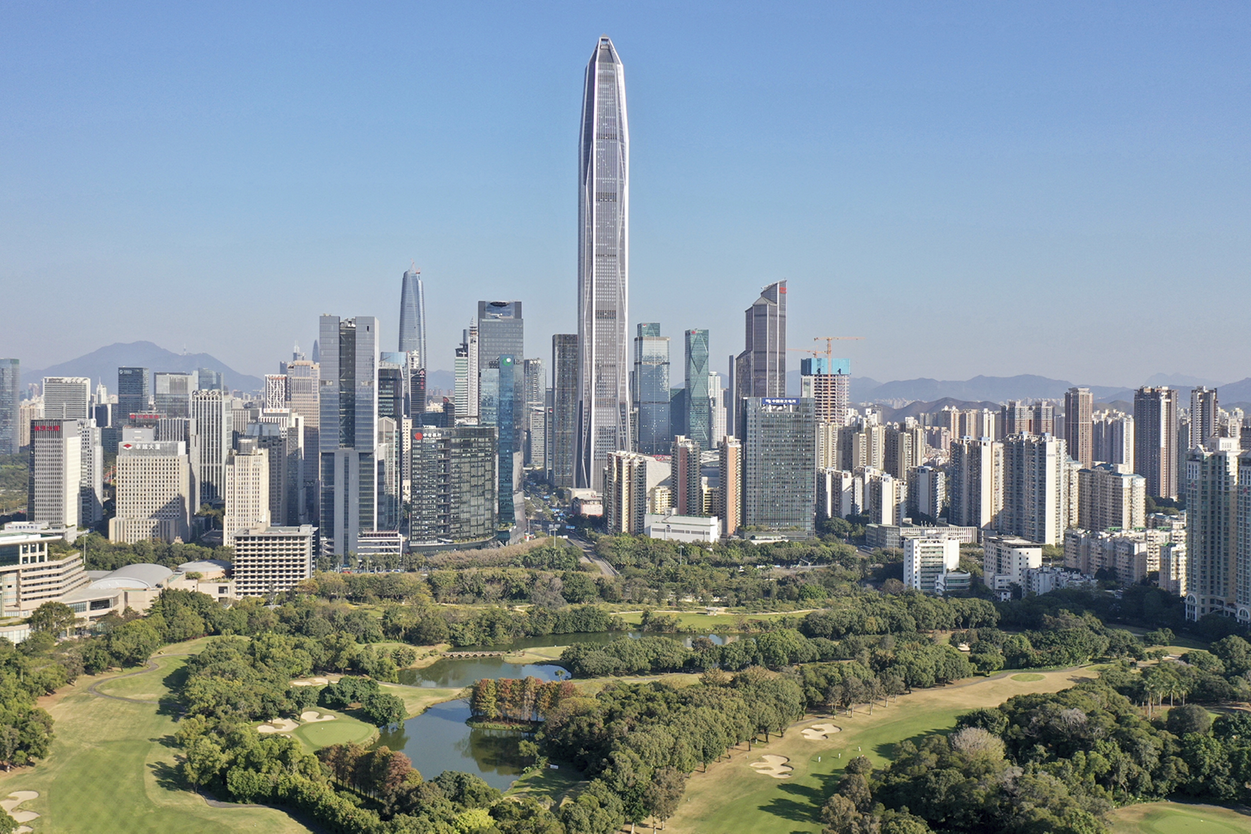
The Futian CBD stands as a testament to meticulous urban planning, featuring iconic structures such as the Shenzhen Civic Centre (which contains the Shenzhen Museum of Contemporary Art and Urban Planning, MOCAPE), and the Ping An Finance Centre. These landmarks showcase Shenzhen’s rapid development and its ambition to become a global city through iconic architecture and well-designed public space and green infrastructure (Figure 2). The visit to MOCAPE offered a broad perspective on Shenzhen’s urban planning strategies, among which the application of Ecological Civilization – as a national strategy of China – stood out as particularly memorable for participants. Prioritizing the Special Economic Zone and export-oriented industrialization in Shenzhen’s early master plans, planners created a framework that enabled the integration of ecological goals in later phases. Planners have intentionally embedded environmental stewardship into the city’s historical identity and urban form, seeking to reconcile rapid urbanization with long-term ecological health. This approach echoes historical precedents, from the nineteenth-century Garden City movement advocating nature–urban integration, to UNESCO’s Man and the Biosphere Programme establishing global ecological networks since the 1970s, and China’s Indigenous Shan-shui City philosophy rooted in Taoist principles of landscape harmony. Through its evolving master plans, Shenzhen has established a cross-temporal dialogue that translates inherited wisdom into adaptive and stage-specific solutions to urban challenges. It also illustrates how planning has embedded ideological shifts into spatial form and how concepts like Ecological Civilization are historically constructed and strategically mobilized to align national ambition with global environmental discourse.
The skyline of the Futian CBD, with the tallest building Ping An Finance Centre in the background and a green golf course in the foreground.

Figure 2. Long description
The photo is divided into three distinct horizontal layers.
At the bottom, the foreground consists of a sprawling green golf course with manicured fairways, sand traps, and a small lake reflecting the sky. Clusters of mature trees are scattered throughout the park-like setting.
In the middle ground, a dense wall of high-rise commercial and residential buildings forms the city skyline. The architecture is modern, characterized by glass facades and varied geometric shapes.
In the background, the Ping An Finance Centre stands as the central vertical anchor, a tapered silver skyscraper that significantly taller than the surrounding buildings. To its left and right, other notable towers include a slender curved skyscraper and several rectangular office blocks. In the far distance, hazy blue mountain ridges are visible under a clear, pale blue sky.
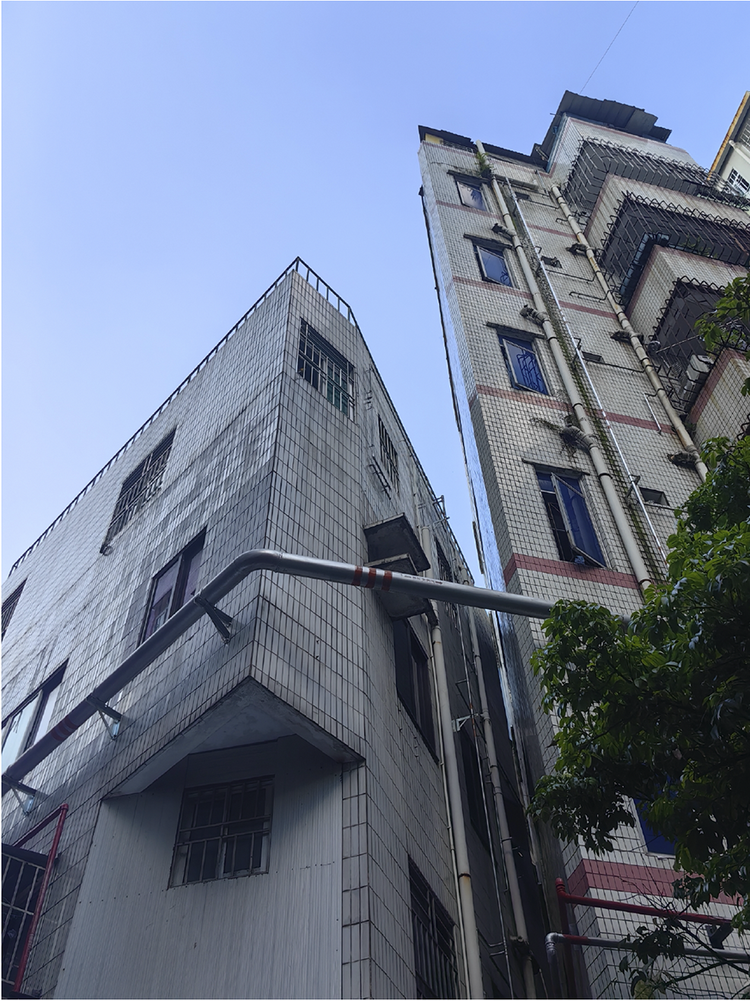
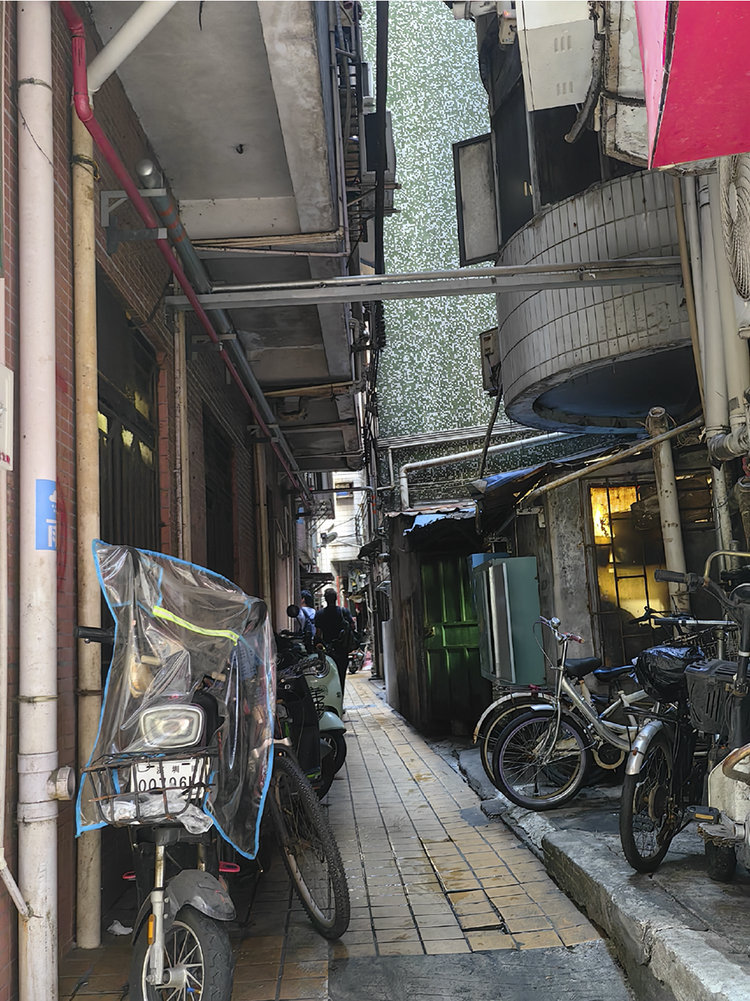
In contrast, Gangxia’s informal development highlights the resilience of self-organized communities, whose adaptive reuse of space and social networks challenge conventional notions of sustainability rooted solely in formal planning. Known for its ‘handshake buildings’ (where adjacent structures nearly touch each other), the village grew haphazardly due to historical land-use policies and rapid migrant influx (Figure 3). This urban village has thrived with a dense population, small businesses and a unique community spirit, highlighting the resilience and adaptability of its inhabitants. The Gangxia Urban Village, meanwhile, reveals the limitations of purely technocratic sustainability models. Its dense ‘handshake buildings’ and vibrant informal economy demonstrate how migrant communities historically excluded from formal planning processes have developed their own sustainable practices, such as resource-sharing and micro-scale entrepreneurship.
The street scene of the ‘handshake buildings’ in Gangxia Urban Village.

The street scene of the ‘handshake buildings’ in Gangxia Urban Village.

Figure 3b. Long description
The photo captures a ground-level view of a narrow pedestrian alley paved with light-colored square tiles.
* Foreground: On the left, a parked electric scooter is covered with a clear plastic rain shield. On the right, several bicycles and scooters are parked against a weathered concrete wall with a glowing yellow window.
* Midground: The alleyway recedes into the distance where a few pedestrians are visible as small figures. The space is extremely narrow, constrained by the vertical walls of multi-story buildings on both sides.
* Architecture and Infrastructure: The buildings exhibit a mix of materials including red brick, grey concrete, and white tiling. Numerous utility pipes, including white and red P V C pipes, run vertically and horizontally along the walls. Metal bars and structural supports bridge the gap between the buildings overhead.
* Background: At the end of the alley, a building facade with a green and white mosaic tile pattern is visible, partially obscured by the extreme proximity of the flanking structures, illustrating the handshake building phenomenon where structures are built so close they nearly touch.
Environmental governance and historical shifts in resource awareness
The conference’s emphasis on water management and environmental ethics offered urban historians a lens to examine the interplay between ecological transformation, colonial power, hydraulic engineering and planning strategies. The conference panels involved multiple dimensions related to environmental issues, such as historical landscape evolution, environmental policy and water city transitions. These reflected the in-depth scholarship taking place on the history of the urban environment.
Addressing the issues of water-related urban history, the topics presented ranged from adaptive infrastructure development to ecological restoration. The case of Bowrington Canal presented by Cecilia L. Chu exemplified how colonial water infrastructure served land speculation. The colonial project, which converted suburban terrain into commercial plantations and public parks, entrenched spatial segregation and ecological degradation – a pattern mirrored in Christopher Cowell’s (London South Bank University) study of Kowloon’s role during the British colonial expansion and its crucial effects on Victoria’s growth and infrastructure planning. By analysing Kaunas in Lithuania, a city at the confluence of two rivers, Dalia Dijokiene and Inesa Alistratovaite-Kurtinaitiene from Vilnius Gediminas Technical University revealed how industrial development diminished the function and cultural role of rivers in riparian areas, while Azmah Arzmi (University Malaysia Sarawak) critiqued the evolution of four Malay fishing villages on the periphery of Kuching, Sarawak and highlighted how urban expansion severed Indigenous fishing villages from riverine lifeways.
In the panel ‘Water and Ports’, Raffaele Pernice (University of New South Wales), Alice Covatta (University of Montreal) and Leonardo Zuccaro Marchi (Polytechnic University of Milan) provided a historical overview of Tokyo’s expansion of its waterfront from 1950 to the 2020s and analysed how national ambitions of the Japanese government drove the burial of natural waterways beneath concrete, severing communities from hydro-social cycles. Similarly, Shinichiro Nakamura (Nagoya University) examined the phenomenon of lost rivers in Tokyo, highlighting the impact of urban planning on human–water interaction with natural resources. He exposed the irreversible consequences of prioritizing economic growth over ecological resilience.
In the same panel ‘East and South East Asia Urban Development and Water’, other scholars offered counter-narratives, demonstrating contemporary practice towards the environment and ecological transformation. Yixin Cao (University of Lyon) discussed the transformation of waterways into artificial canals and the subsequent restoration efforts in Hong Kong, reflecting a global trend towards green infrastructure and climate change adaptation. Tran Thi Huyen (Vietnam National University) introduced the application of a multi-agent participatory simulation model LittoKONG in Vietnam’s Mekong Delta and explained how this model facilitated planners’ cognitive learning about complex risk systems and management strategies through inter-district collaboration, to achieve sustainable practices. Darren C.J. Yeo (National University of Singapore, NUS) presented how Singapore has recently integrated the environment and enhanced the biodiversity of its natural waterways by restoring ecosystems in artificial habitats such as reservoirs and canals.
The conference’s attention to water and planning activities revealed how power dynamics, economic imperatives and technocratic paradigms have historically prioritized economic growth over ecological and social equity. From colonial water projects in Hong Kong to the planning of Tokyo, these cases underscored the lasting consequences of severed human–water relationships, including the cultural erasure of riparian communities and the ecological costs of industrial waterfront expansion. Therefore, planning historians at the conference advocated for ecologically informed planning that acknowledged historical insights and marginalized practices. This awareness of environment urged a shift from the human-nature-separated planning methods of the past to a strategy that integrates ecological memory, community knowledge and adaptive capacity.
Urban inequality and resource allocation
The conference’s discussions on resource allocation underscored how historical planning practices have perpetuated inequities in access to water, energy and public space – issues at the heart of sustainable urban development, particularly in high-density areas. Yunjie Zhang (Tongji University & TU Berlin), Li Hou (Massachusetts Institute of Technology) and Wentao Yan (Tongji University) investigated the interplay between water resource redistribution in the Greater Bay Area of China over six decades, focusing on how different actors at various levels adapted their strategies. They revealed how state resource interventions reshaped urbanization patterns and power dynamics by utilizing water to favour elites while displacing marginalized groups. Yuan He’s (NUS) analysis of wind energy policies demonstrated how market-driven ‘green’ agendas often replicate historical inequities and revealed how environmental policies could shape energy landscapes.
The panel ‘The Unfinished Project of the Socialist City in Eurasia and Europe’ moderated by Jasna Mariotti (Queen’s University Belfast) and Ginanni Talamini (City University of Hong Kong) addressed socialist urban planning aimed at promoting egalitarianism left unfinished due to centralization, economic constraints and complex co-ordination among stakeholders during the national reconsolidation following World War II.Footnote 4 Jingyuan Wang and Songtao Wu from Harbin Institute of Technology examined the global new town planning through the case-study of Vällingby in Sweden, introducing the People’s Home initiative and showing how Marxist humanism inspired welfare-state urbanism, yet faltered under bureaucratic centralization. Zeynep Gunay (Istanbul Technical University) discussed how art transformed heritage into sites of democratization, healing and reconciliation in post-conflict Istanbul, and highlighted how sustainable development requires confronting historical trauma.
In the panel ‘Planning and Infrastructure’, Elizabeth M. Keslacy (Virginia Tech Washington-Alexandria Architecture Center) examined how the Memphis Mid-America Mall was transformed from a true public realm to a constrained quasi-public space, revealing the tension between private ownership and public space, especially in terms of accessibility and inclusiveness of social justice. Luiz de Carvalho Filho, Diaan van der Westhuizen and Paul van de Coevering from the University of Paris Nanterre investigated how urban design indicators relate to commuting behaviour and evaluated strategies to promote cycling. They emphasized the need to consider walking and cycling in the face of urban sprawl and car-centric development to democratize mobility.
Marginalized voices and alternative archives in urban historiography
The 20th IPHS biennial conference emphasized methodologies to recover histories erased by dominant planning paradigms. Notably, gender and women’s histories were especially foregrounded in both panel discussions and institutional recognitions. Chaired by Wes Albrecht (Cardiff University), the panel ‘Photography and/in Planning Histories’ paid special attention to the contributions of women and highlighted how visual media was employed to assert alternative urban narratives. Wes Aelbrecht analysed the influence of the Women’s Council for Urban Renewal in 1950s Chicago, demonstrating how the Council used slideshow presentations and photographic taxonomies to influence planning legislation and advocate for policy changes. Laura Bowie (University of Greenwich) analysed the 1977 film The All-Around Reduced Personality: Outtakes, directed by Helke Sanders, focusing on a female photographer’s narrative within a women’s collective. She explored how these collectives used photography to assert autonomy, document their experiences and create alternative urban narratives amidst the political and cultural divisions of 1970s Berlin.
This gendered focus extended to case-studies from Japan. Yudai Nakagawa (Kokugakuin University) examined the gendered history of Japanese urban planning after the Great Kanto Earthquake (1923) and the women’s movement. Their research revealed the divergence between women’s demands for social justice and the male-dominated planning authorities’ reluctance to address them, particularly in the context of red-light districts and public prostitution. Naoto Nakajima (University of Tokyo) analysed the gap between democratization ideology and the practical exclusion of citizen participation in Japan’s post-World War II urban planning and reconstruction, and the country’s failure to achieve social justice and democratization in urban development.
The prominence of gender and feminist scholarship was echoed in the conference’s institutional recognition of women scholars. All keynote speakers at the 2024 conference were female, and a majority of the awardees were women as well.Footnote 5 Among them, Professor Donatella Calabi received the Sir Peter Hall Award for Lifetime Achievement in Planning History. Her work on Venice and wider European urban contexts – particularly in relation to markets, buildings, minorities and communities – was celebrated for advancing inclusive and transnational approaches to urban planning history beyond the anglophone world.
Besides gender, the conference also addressed other forms of marginalization, including class, ethnicity and global positionality. David Vernon (RMIT University), Marco Amati (RMIT University) and Rod Buchanan (University of Melbourne) introduced how international perspectives influenced public housing policy, housing types and construction methods in Melbourne in the 1950s and 1960s. Parallel to this, Guido Campi (Paris Nanterre) compared two different interpretations of Horst Rittel’s planning ideas as applied to low-income housing designs in Chile and Argentina. Campi underscored how these approaches empowered residents to co-design their living environments, marking a shift from politically driven, top-down, bird’s-eye view planning to more community-engaged housing solutions. Comparing these cases to Gangxia Urban Village in Shenzhen mentioned above, where bottom-up initiatives occurred in response to formal planning exclusions through community cohesion, highlights how informal urbanism can cultivate social resilience and spatial innovation in the application of modern planning. This transformation not only challenged the dominant modernist paradigm but also fostered social justice by centring local residents in the urban development process.
Discussion: insights for urban historians
The 20th IPHS biennial conference illustrated the deep interconnections between planning and urban history, offering analytical tools to uncover how cities are shaped by political regimes, environmental interventions and marginalized social actors. Rather than viewing planning as a technical domain, the conference positioned it as a historically embedded practice that could reveal the spatial dimensions of power, ideology and identity of multiscale urban spaces.
Reading entangled histories of power through planning
First, the comparative lens of Hong Kong and Shenzhen revealed how different political and planning systems have converged through shared but asymmetrical historical trajectories influenced by different forces. In Hong Kong, the planning created during its colonial era fostered speculative development and spatial segregation, creating persistent inequalities in the distribution of land and infrastructure. Its neighbouring city, Shenzhen, by contrast, is the product of post-socialist state planning and economic experimentation, structured through a master plan aligned with Chinese economic reform and ecological ambitions. In the last two decades, within the framework of ‘one country, two systems’, the two cities have operated under a partially unified planning logic, reflecting how spatial governance has become an instrument of both differentiation and resource consolidation. These entangled trajectories of power through planning provide urban historians with important insights into how urban form has been influenced not only by local needs, but also by larger political and ideological goals and international images.
Rethinking environmental histories to understand shifting human–natural relations
Second, this conference prompted a critical re-examination of how environmental histories have been integrated into urban planning, particularly through infrastructure, water systems and resource-based urban development. The scholars in attendance reviewed how planning has historically served anthropocentric needs, such as industrial growth, territorial control and colonial plunder. These environmental histories have often come at the expense of ecosystems, the fragmentation of people and nature and the marginalization of Indigenous communities. However, examples from cities such as Shenzhen also revealed a shift in environmental consciousness, where the material legacy of resource depletion has catalysed a new planning discourse centred on Ecological Civilization. This emerging new planning concept and discourse represents more than a technical shift but also marks an evolving historical narrative about the professionals’ understanding of the relationship between humans and nature. By tracing the ideological shift across planning documents and urban forms, historians can uncover how ecological ethics have been reimagined. Natural resources and the environment are not seen as consumables for urban development, but as components of a new spatial and historical imaginary. By criticizing the past oppression and destruction of the environment, urban space can be reframed in terms of environmental co-existence.
Centring marginalized narratives and expanding alternative archives
A third key insight from the conference was the methodological richness offered by attention to marginalized actors and alternative archives. Both scholarly presentations and institutional recognition at the conference demonstrated a growing commitment within the International Planning History Society to address historical exclusions and diversify the narratives that shape urban knowledge. By highlighting women’s contributions, community agency and non-Western perspectives, several panel discussions challenged dominant and technocratic planning paradigms. For urban historians, the use of photography, film and participatory media to trace alternative urban narratives underscored how alternative archives could reveal the socio-political dynamics embedded in urban practices. The methodological innovation offered urban historians new ways to access emotional, affective and experiential dimensions of urban space that are often missing from official records. The recognition of women scholars and the emphasis on inclusive research signalled a shift toward acknowledging the contributions of those who have shaped urban space from below and through alternative means – not only through formal master plans, but also through representation, memory and visibility.
Conclusion
The 20th IPHS biennial conference examined diverse global and domestic challenges and revealed how planning history can offer a vital lens through which to interpret the complexities of urban transformation. Scholars explored pressing issues such as climate change, resource allocation, resource depletion, environmental degradation, gender and racial inequality, migration, geopolitical tension and socio-economic inequalities. The conference emphasized evolving practices in water management, ecological planning, heritage preservation and regeneration, and high-density urban development. These topics highlighted the interdisciplinary nature of urban studies. By engaging with diverse historical geographies, interdisciplinary methods and critical perspectives, the conference presentation emphasized that urban history is a product of contested ideologies, shifting environmental paradigms and often-overlooked social actors. Through the comparison of Shenzhen and Hong Kong, analysis of environmental histories in urban development and a focus on marginalized voices and methodological expansion to use alternative archives, the discussions at the 20th IPHS biennial conference provide urban historians with key tools to deconstruct the spatial legacies of power, challenge traditional narratives and paradigms, as well as engage more inclusively with the past.
Looking ahead, the 21st IPHS biennial conference is set to take place in the summer of 2026 in Atlanta, Georgia, USA, with Professor Stephen J. Ramos from the University of Georgia as the convenor. This upcoming event promises to further build on the themes and insights explored in Hong Kong and will foster deeper engagement within the IPHS, particularly in exploring new research methods and deconstructing and expanding historiography. Establishing a dialogue between historians in different fields becomes increasingly important because the purpose of historical research is not to predict the future, but to understand how cities are imagined, contested and shaped over time. In the interim, IPHS activities will continue to promote collaboration and meaningful contributions to the global discourse on historiography, including writing workshops and thematic webinars.
Acknowledgments
We extend our heartfelt gratitude to Professor Carola Hein, the president of the International Planning History Society (IPHS), for her invaluable insights, which have greatly enriched this report. We also wish to thank Professor Ian Morley and Professor Hendrik Tieben, whose specific and constructive feedback enhanced the quality of our work.
Funding statement
This research is funded by the National Natural Science Foundation of China [grant number 52108003]. BUCEA Talent Pyramid Cultivation Program [grant number JDYC20220801].
Conflict of interests
The authors declare none.