Developmental studies of self-control in relation to problem or competence outcomes typically have been conducted either at the relatively molar level of temperament or personality traits (e.g., Eisenberg et al., 1997) or at the relatively molecular level of laboratory measures of specific cognitive or neuropsychological measures of executive functions (EFs; Pennington & Ozonoff, 1996). Whereas temperament and personality traits are often construed as related primarily to emotion regulation (e.g., effortful control, behavioral regulation, resiliency; Eisenberg et al., 1997), EFs connote cognitive control, maintenance of behavior toward a goal, and adjustment of behavior to context demands (Pennington & Ozonoff, 1996). However, in some instances, these domains are expected to overlap because some forms of regulation are closely related to the deliberate, strategic response that characterizes EFs.
Both temperament and EF have been fruitful in identifying precursors and mediators of childhood psychopathology (Barkley, 1997; Eisenberg, Guthrie, et al., 2000; Nigg, 2000), as well as in understanding developmental competence in multiple domains (Block & Block, 1980; Eisenberg et al., 1997; Nigg, Quamma, Greenberg, & Kusche, 1999). Although trait and laboratory measures designed to tap various regulatory abilities are rarely studied together, a substantial theoretical basis exists suggesting that they may be related (Luria, 1966; Murray & Kochanska, 2002; Nigg, 2000; Rothbart & Bates, 1998; White et al., 1994), perhaps because of mediation by similar neural mechanisms, or by the interdependent nature of their development.
Data on the relation between trait measures of regulatory control and laboratory measures of EF have only recently begun to appear (e.g., Kochanska, Murray, & Harlan, 2000). Most such attempts focus on preschool children, thus necessarily neglecting the neuropsychological and cognitive tasks often used to study psychopathology in older children. Other attempts have found rather modest effects (White et al., 1994). It thus remains unclear whether traits are related to EF in the manner expected, as well as to what extent (a) personality or temperament traits and (b) neuropsychological EF measures make incremental versus overlapping contributions to important outcomes such as psychopathology. We approached these questions with key trait predictors including those hypothesized to be related to EF, then looking at both traits and EF as predictors of outcome together.
Regulatory Domains in Temperament and Personality Models
The boundaries of temperament versus personality remain imprecise (Caspi, Roberts, & Shiner, 2005). Temperament is often defined as biologically based, individual differences in reactivity and self-regulation (Rothbart, Posner, & Hershey, 1995). Personality has been defined as the dynamic structure of an individual's psychophysiological qualities that respond and adapt to the environment (Rothbart, Ahadi, & Evans, 2000). Temperament and personality may be viewed as related constructs because of their overlap and interdependence throughout development (Caspi et al., 2005). One perspective is that temperament contributes to the development of personality by influencing the environment and quality of socialization (Rothbart et al., 2000). In this view, temperament is the antecedent to, and a core component of, adolescent and adult personality. Although temperament is often viewed as reflecting traits that are substantially genetically influenced, genetic influences are apparent in measures of personality as well. Further, even the biological aspects of major temperamental traits appear to be influenced by socialization in that the brain responds in an adaptive manner to early experience in development (Posner & Rothbart, 2000; Rothbart et al., 2000). This epigenetic adaptation, in turn, contributes to the development and emergence of personality. Based on such logic and the fact that our longitudinal sample spans preschool to late adolescence, the traits examined here likely incorporate aspects of both temperament and, perhaps even more so, personality.
The basic structural framework guiding our investigation is a two-component model that specifies reliable individual differences in regulatory and reactive adaptive response. The basic model was the most extensively described by Rothbart and colleagues (Rothbart et al., 2000; Rothbart & Bates, 1998) and Eisenberg and colleagues (2003; see also Block & Block, 1980). Following Eisenberg et al. (2003), we refer to (a) resiliency and (b) reactive control.
Resiliency connotes the flexible mechanisms aimed at coping with the environment and thoughtfully adjusting the level of control to be appropriate to the context (Block & Block, 1980; Eisenberg et al., 1997, 2003). Eisenberg et al. (2004) distinguish it from the related idea of effortful control, which we did not separately assess. However, one view is that resiliency is expected to depend on the maturation of frontal neural circuits that support deliberate self-regulation (Eisenberg et al., 2003; Rothbart & Bates, 1998). Specifically, resiliency is thought to entail thoughtful, deliberate control of behavior in response to changing contextual demands. Supporting this perspective, effortful control is related to higher levels of resiliency and social competence in children (Eisenberg et al., 2003). Thus, if this model is correct, resiliency should be related to EF, because EF is also related to maturation of frontal neural circuitry, as explained below. At the same time, we expect resiliency to be related to child competence and (inversely) with behavior problems (Eisenberg et al., 2003). It is unknown whether EF and resiliency contribute incrementally to child outcomes, however.
Reactive control (related to the temperament construct of behavioral inhibition; Kagan, Reznick, & Snidman, 1990) is a form of regulation that is motivated by immediate incentive and is sufficiently spontaneous and automatic that it generally is not viewed as deliberate. In comparison with resiliency, reactive control is viewed as more reflexive and less dependent on conscious thought and deliberation. Heuristically, it reflects a relatively “bottom-up” form of control, versus the more “top-down” control envisioned for resiliency. Reactive control is related to the older construct of ego undercontrol (Block & Block, 1980; Eisenberg et al., 1996), which is believed to predict impulsive, externalizing behavior problems. However, Eisenberg et al.'s (2003) findings suggest that extremely high levels of reactive control may also be maladaptive, perhaps leading to internalizing problems. Thus, it appears that resiliency is adaptive at high levels, but reactive control is adaptive at intermediate levels. As a result, we expected a curvilinear relation between reactive control and resiliency, and potentially between reactive control and outcome. We also expected distinct relationships between reactive control and the various child outcome domains.
Neuropsychological Executive Functioning
In the neuropsychological literature, the concept of EF is both ubiquitous and underspecified (Pennington & Ozonoff, 1996; Zelazo, Muller, Frye, & Marcovitch, 2003). However, the construct refers to cognitive operations that help maintain behavioral adaptation to context and maintain a goal set (Pennington & Ozonoff, 1996; Posner & Rothbart, 2000). By definition, then, EFs are related conceptually to personality traits that imply deliberate self-regulation, including resiliency, as well as effortful control (Nigg, 2000). EF, like the cognitive science term “cognitive control” (Botvinick, Braver, Barch, Carter, & Cohen, 2001), is thought to involve multiple component operations, including strategically suppressing a dominant response to express subordinate ones, planning the multiple steps required to solve a problem before carrying it out, holding information in working memory, shifting mental set as requirements of a situation change, and interrupting a prepared response when cued (Barkley, 1997; Fuster, 1997; Lyon & Krasnegor, 1996; Pennington & Ozonoff, 1996; Zelazo et al., 2003). Related functions sometimes included in the EF rubric and sometimes set apart from it entail arousal regulation, effort, and preparedness. In all, the many neuropsychological tasks used to assess EF likely tap multiple constituent operations (Miyake, Friedman, Emerson, Witzki, Howerter, et al., 2000; Nigg, 2000; Pennington & Ozonoff, 1996).
Relation of Executive Functioning to Resiliency and Reactive Control
The logic just outlined suggests that EFs are related to resiliency (Eisenberg et al., 2004), whereas Eisenberg and colleagues (2004) suggest that reactive control should be unrelated to EF. One goal of the present study was to test this differential validity question. With few exceptions (e.g., Kochanska et al., 2000), neuropsychological EF measures usually employed in studies of psychopathology (Pennington & Ozonoff, 1996) have rarely been studied in relation to current conceptions of resiliency and reactive control (Nigg, 2000).
Developmentally, precursors to reactive control are observable from infancy, and precursors to resiliency from the toddler years onward in development (Rothbart & Bates, 1998). Later, with maturation, capabilities that can rightly be called EF develop more fully. With neural development of prefrontal cortex maturing all the way through adolescence (Benes, 2002), EF and resiliency are expected to continue to consolidate and mature during the adolescent period, even as personality is coalescing and social and academic competencies are being consolidated.
In a neural sense, the expected association of resiliency with EF is supported by the close similarity of the hypothesized neural systems involved. Resiliency is thought to be related to an anterior attention system, anchored in the anterior cingulate gyrus and prefrontal cortex with projections to basal ganglia and thalamus (Eisenberg et al., 2003; Rothbart & Bates, 1998; Rothbart et al., 2000). Likewise, EFs are linked to dorsolateral and orbital–prefrontal cortex and anterior cingulate in addition to associated subcortical structures in the thalamus and basal ganglia (Barkley, 1997; Botvinick et al., 2001; Miller, 2000; Pennington & Ozonoff, 1996).
In contrast, reactive control is hypothesized to be governed by bottom-up neural control processes. For example, imaging findings implicate amgydala in reactive response to negative incentive and nucleus accumbens to positive incentive (Casey et al., 1997; McManis, Kagan, Snidman, & Woodward, 2002). Activation of these limbic regions presumably interrupts previous ongoing behavior via circuity linking limbic and prefrontal cortex. Thus, we associate reactive control with limbic–prefrontal circuity, conceptualizing it as a bottom-up process of limbic signaling to cortex (Rothbart & Bates, 1998). From the perspective of the Alexandrian circuits (Alexander, DeLong, & Strick, 1986), we can think of these two operations schematically as involving frontal–striatal and frontal–limbic circuits, respectively, for heuristic purposes. Because they are mutually influencing (Rothbart & Bates, 1998), they are expected to correlate, but they remain distinct constructs.
Our suggestion of a relationship between EF and related traits is not a new one (Eisenberg et al., 2003, 2004; Eysenck, 1947; Gray, 1991; Kagan et al. 1990; Luria, 1969, 1981; Murray & Kochanska, 2002; Nigg, 2000; White et al., 1994). Underlying this hypothesis are two general ideas. The first idea is that perhaps personality traits such as resiliency and EF are different levels of analysis of the same basic psychological or even neural operations. The second idea is that traits (or emotion regulation) and EF (or cognitive control, here referring to strategic but not reactive control) work together in an additive or interactive manner to shape action selection, cognition, and behavior (Pickering & Gray, 1999; Rothbart, 1989a). We therefore might expect, in a more nuanced hypothesis, that EF would be relatively closely related to resiliency, while also being related, albeit more weakly, to reactive control. Each of these domains might be expected to contribute in some degree to adolescent outcomes, but differentially to internalizing and externalizing behavior problems.
Importance of Competence and Problem Behavior Outcomes in Adolescence
The importance of understanding the development of competence and problem behaviors can hardly be overstated. The correlates of both academic and social competence and problem behaviors are important for advancing our understanding of children in normal and risk populations. The relation of EF with externalizing problems is well established (Barkley, 1997; Nigg, 2000; Pennington & Ozonoff, 1996), and longitudinal evidence has begun to appear linking EF to both problems and competence in childhood (Nigg et al., 1999). Further, the relation of traits to the development of child competence and internalizing and externalizing behavior has begun to be described (Eisenberg et al., 1996, 1997, 2001, 2004; Valiente et al., 2003). However, to date, no studies have looked at the additive contribution of EF and personality to distinct domains of child adjustment.
The Current Study
The current study addressed empirically the joint contribution of two major domains of early personality development (resiliency and reactive control) and a laboratory battery of EF to adolescent internalizing and externalizing behavior problems, and to academic and social competence, in a population sample at elevated risk of problem outcomes. The use of a high-risk sample, in this case one at risk because of familial alcoholism and associated dense clustering of low socioeconomic status (SES), family psychopathology, and other risk factors (cf., Zucker, Ellis, Bingham, Fitzgerald, & Sanford, 1996), may be invaluable for characterizing the true nature of these relations because of the full spectrum of trait variation and outcome that might be expected. We asked the following questions: (a) Can the distinction between resiliency and reactive control be validated by their differential association with EF measures? (b) Are the contributions of resiliency, reactive control, and EF to adolescent outcomes incrementally additive or are they essentially the same? (c) Do the patterns of predictive correlation for resiliency, reactive control, and EF differ meaningfully for distinct outcome domains in relation to adolescent problems and competence?
As noted earlier, we expected a curvilinear relationship between resiliency and reactive control (Eisenberg et al., 2003). We also hypothesized that resiliency but not reactive control would be related to EF and that resiliency, EF, and reactive control would contribute additively to the emergence of adolescent competence and problems. Although we primarily expected additive effects, we also checked on potential interactive effects between traits and EF. Because twin studies suggest that social competence is heavily influenced by shared environment (Edelbrock, Rende, Plomin, & Thompson, 1995), we expected EF (which we conceptualize as a relatively endogenous characteristic here) to have a weaker predictive association with it. In contrast, the same literature indicates substantial heritability for academic performance and problem behaviors, which could be mediated in part by EF as well as traits (if those are also conceptualized as substantially heritable). Indeed, Eisenberg et al. (2001) found distinct personality predictors for internalizing and externalizing problem domains. Thus, in all, we expected some divergence in the predictive pattern for the different outcome domains.
Method
Participants
The participants were 498 children (362 boys, 136 girls) from 275 families who had completed either the Wave 4 (at 12–14 years of age) or Wave 5 (at 15–17 years of age) EF battery of an ongoing, prospective, multiwave high-risk study. That study is following a community sample of families with high levels of alcohol use disorder, other substance use disorder (SUD), and other psychopathology (depression spectrum disorders, antisocial behavior disorder) along with a community contrast sample of families drawn from the same neighborhoods but without the high substance abuse profile, and with concomitant lower levels of nonsubstance abuse psychopathology (Zucker et al., 2000). Multiple siblings were included per family when possible. Thus, these 275 families included 92 families with 1 child participant, 146 families with 2 child participants, 34 families with 3 child participants, and 3 families with 4 child participants.
These 275 families were drawn from an initial recruitment sample of 302 families who were ascertained through the father's alcoholism for the high-risk group, and absence of SUD for both parents in the contrast sample. (a) Men were initially identified through a network covering all courts in a four countywide area. All men with a drunk driving conviction involving a blood alcohol concentration of at least 0.15% if first conviction (or at least 0.12% if a previous drinking-related legal problem had occurred) were potential study candidates. In addition, they were required to (b) meet a Feighner et al. (1972) diagnosis for probable or definite alcoholism, (c) have at least one son between 3 and 5 years of age, and (d) be living with the child and his biological mother at the time of enrollment. The presence of a child with fetal alcohol syndrome was exclusionary, and maternal diagnosis was free to vary.
A contrast/control group of families who resided in the same neighborhoods as the alcoholic families, but with no substance abuse history in either parent was recruited using epidemiological door-to-door canvassing (n = 82). In addition, an intermediate risk group (n = 54) was provided by recruiting all families with an alcohol abuse/dependence diagnosis who were found during the community canvass. At later data waves, all siblings within ±8 years of the primary male target child were also recruited; they are included here if they had completed the neuropsychological assessment protocol at least once. Additional descriptions of study procedures, recruitment strategies, and eligibility criteria are found in Zucker et al. (1996) and Zucker et al. (2000). Full family assessments involving both parents and participating children occurred at 3-year intervals, starting at baseline, Wave 1. This child sample is thus at considerably enhanced risk for substance use disorders, as well as other psychopathology (Zucker & Wong, 2005).
Data ratings on key traits were available at multiple time points during childhood, whereas laboratory data were available at two time points in early and midadolescence, enabling us to begin to ask about independent associations over time and to obtain aggregated measures obtained across different time points and multiple observers of the children's development. The present study reports on data from preschool (Wave 1: IQ and personality; child age = 3.0–6.0 years), middle childhood (Waves 2 and 3: IQ, problems and competence, personality; child age = 6.0–12.0 years), and adolescence (Waves 4 and 5: child age = 12.0–18.0 years) when additional outcome measures along with the EF battery were obtained. Requiring that a child have at least one wave of both neuropsychological and personality measures restricted the original sample of n = 654 children from 302 families to the 498 children from 275 families. Those excluded did not differ from those included in terms of percentage of parents who were alcoholic at Wave 1 (t = −.28, p = .78), percentage of children with alcohol problems at Waves 4 and 5 (t = −1.52, p = .13), percentage of girls included (t = −.90, p = .37), family SES at Wave 1 (t = −.03, p = .98), total problems on the teacher report Child Behavior Checklist (CBCL; Achenbach, 1991) at Waves 2 and 3 (t = −1.15, p = .25), or risk group classification at Wave 1 (t = .45, p = .65). We therefore proceeded with our analysis of the available children.
Measures of regulation and reactive control
California Q-Sort
Child personality was assessed at Waves 1 through 4 by having a test administrator, who knew the child and the family well after having spent essentially a full day of data collection with them, complete the California Child Q-sort (CCQ) common language version (Block & Block, 1980; Caspi et al., 1992). The administrator made use of all available data from the hours spent interviewing and assessing the child in completing their ratings. Therefore, their ratings were not completely independent of concurrent problem and competence scores. We address this methodologically by controlling childhood problem and competence scores in our outcome models. Ratings were relatively independent of neuropsychological scores at Wave 4 in that the staff person was not aware of the final normative score or the child's risk group or study hypotheses. However, as a precaution, we also checked results restricted to Wave 1–3 ratings looking at Wave 4–5 outcomes in secondary analyses. These checks did not lead to any change in results. This lack of change in results when these confounds were checked is not surprising in that a different administrator completed the Q-sort at each wave. This should maximize the validity of these ratings as an aggregate measure of the child's personality functioning over time (Caspi et al., 1992) and minimize any effect of nonblindness of individual raters on the concurrent outcome variables.
The CCQ is a Q-Sort consisting of 100 cards that must be placed in a forced-choice, nine-category normal distribution. The rater (staff person) described the child by placing descriptive cards in one of the categories, ranging from 1 = least descriptive to 9 = most descriptive. To create measures of our two core personality domains, we utilized previously published and validated Q-sort item lists. Items for reactive control were taken from the list suggested by Eisenberg and colleagues (1996; e.g., is restless and fidgety [R]; has a rapid personal tempo, reacts and moves quickly [R]). Items for resiliency were taken from the list suggested by Eisenberg et al. (2003; e.g., is resourceful in initiating activities; uses and responds to reason). Consistent with those reports, these scales achieved adequate internal reliability in our sample (both composite α = .91).
Intelligence and neuropsychological executive functioning
Intelligence was viewed as an important construct in our models because of its expected influence on the development of competence and problems in youth. We therefore assessed intelligence at Wave 1 (preschool) using the Stanford–Binet form L-M, which provided an estimated full-scale IQ, and at Waves 2–3 and 4 using the Wechsler Intelligence Scale for Children—Revised (Wechsler, 1974; all 12 subtests were administered). We include a composite full-scale IQ averaged across all time points for purposes of this report. EF was assessed at Waves 4 and 5, with six tests chosen for their wide use in the developmental psychopathology literature and for their ability to capture the multidimensional nature of this construct. These tests were administered during visits in the family's home or on campus.
Wisconsin Card Sorting Test
To obtain a complex measure of executive functioning that included both working memory and set shifting, we administered a computerized version of the Wisconsin Card Sorting Test. The test is associated with activation in the dorsolateral prefrontal cortex (Weinberger, Berman, Gold, & Goldberg, 1994), perhaps because of its requirement to protect working memory (Botvinick et al., 2001), and is impaired in patients with prefrontal brain injury (reviewed by Lezak, Howieson, Loring, Hannay, & Fischer, 2004). During this test, participants match a key card to one of four other cards. After 10 correct decisions, the rule changed without the participant's knowledge. The two main outcome measures, number of perseveration errors (i.e., decisions based on a previous category) and the number of categories completed, were correlated (r = −.65 at Time 4, r = −.75 at Time 5). Therefore, we created a composite index after reverse coding categories and standardizing both scores. The Wave 4/5 composite of perseverative errors and categories was reliable (α = .77) and served as a measure of working memory and set-shifting in further analyses. We coded the final variable so that high scores indicated better performance.
Stopping Task
Executive behavioral inhibition, as measured by the Stopping Task, requires the suppression of a prepotent motor response (Logan, 1994; Nigg, 2000). This function entails activation of areas in the prefrontal cortex, particularly the right inferior frontal gyrus (Aron, Fletcher, Bullmore, Sahakian, & Robbins, 2003) and associated regions in the striatum, particularly the caudate (Casey et al., 1997). During this two-alternative choice reaction time task, participants see an X or an O on a computer screen and respond rapidly with one of two keys. On 25% of trials a tone sounds shortly after the X or O is displayed, indicating that participants are to withhold their response. After two practice blocks of 32 trials each, four blocks of 64 trials are administered. We averaged the final three blocks unless data quality checks suggested otherwise (see Nigg, 1999). The most reliable estimates of stop signal reaction time (RT) are obtained with a response–reaction time tracking methodology (Band, van der Molen, & Logan, 2003). In this procedure the delay between the visual stimulus and the warning tone is varied to maintain 50% success rate at withholding the response. A quantitative model of RT processes enables calculation of each participant's speed of stopping or inhibiting a response (the stop signal RT or SSRT) by subtracting average stop signal delay from average RT (Logan, 1994). This SSRT score thus indicates how much warning time was needed in order for the child to interrupt a response. It served as the primary index of executive inhibition, or response regulation (Nigg, 2000). Further, “go” RT (response speed on “go” trials with no stop tone) and variability of go RT on the Stopping Task were also computed and were viewed as indices of arousal or effort. Variables were reverse coded so high scores are better.
Symbol–Digit Modalities Test (SDMT)
Response regulation in the SDMT can involve alertness, activation, or effort; it is typically indexed as relating to slower and more variable output speed on fast, effortful tasks (Sergeant, van der Meere, & Oosterlaan, 1999). In the SDMT (Smith, 1982), several symbols are associated with digits. The participant is shown the symbols and required to give the correct digit associated with that symbol. The participant is to respond as rapidly as possible. Thus, the task requires rapid cognitive processing of routine information paired with a rapid response. The outcome of interest here was the total number of correctly completed items. Oral and written measures were obtained, and they were combined for our purposes here.
Controlled Oral Word Association Task (COWAT)
Fluency, defined as the ability to rapidly generate verbal associations to a particular concept, was assessed with the COWAT. This paradigm was operationalized with the verbal production method developed by Thurstone and Thurstone (1949). The task appears to activate a range of neural language areas, including the left dorsolateral prefrontal cortex, which appears to be especially important for controlling word search (Frith, Friston, Liddle, & Frackowiak, 1991; Perret, 1974). In the COWAT, participants generated as many words beginning with various letters as they can in one minute (Benton & Hamsher, 1978). Three letters are given (C, F, and L). The total number of valid words generated became part of a composite measure discussed below.
Stroop Color–Word Interference Test
Interference control, the ability to monitor response conflict and suppress a competing response to carry out a primary response, was operationalized with the Stroop Color–Word Interference Test (Golden, 1978). The test activates the anterior cingulate and dorsolateral prefrontal cortex (Cabeza & Nyberg, 1997). A widely used clinical and cognitive measure (MacLeod, 1991), the paper and pencil version of the Stroop was administered with 45 s per trial. Outcome measures included a word-reading, color-naming, and color–word naming scores. Interference control was calculated by regressing the color–word naming score on the word-reading and color-naming scores. Word-reading and color-naming scores became part of a naming speed composite discussed below.
Tower of Hanoi
The term “planning” is used here to describe the ability to manipulate complex visual information in working memory. It was operationalized with the Tower of Hanoi procedure (Lezak et al., 2004). Impaired performance on tasks of this nature is associated with frontal neural injury (Goel, Pullara, & Grafman, 2001) and we speculate that the task activates spatial working memory modules in the right prefrontal cortex as described in the cognitive neuroscience literature (Courtney, Petit, Maisog, Ungerleider, & Haxby, 1998). In this test, adolescents moved different-sized rings on a three-peg board from one peg to another, following specific rules including not placing a smaller ring on top of a larger one and only moving one ring at a time. In later adolescence, a more difficult four-ring problem was used over two trials because of the adolescents' increased cognitive capacity. To equate and average these scores and take into account efficiency (time spent on the problem), a ratio was computed for accuracy (moves made divided by minimum number of moves needed) and for speed (time spent divided by minimum moves required). Both of these ratios were standardized within wave. The four variables (the two ratios at each wave) were then averaged to form a planning efficiency composite (α = .60). This score was then reverse coded so that a high score indicated better performance. Cross-wave convergence was low for this measure, a point we address in the results.
Academic and social competence and externalizing and internalizing problem behaviors
Wide Range Achievement Test—Revised (WRAT-R) and 3rd edition (WRAT-III)
Academic competence was assessed with the reading, spelling, and arithmetic subtests of the WRAT-R (Jastak & Wilkinson, 1984) at Waves 2 and 3 and WRAT-III at Waves 4 and 5. Standardization within form was used to remove any mean differences between forms. The reading, spelling, and arithmetic subtests were averaged at Waves 2/3 and Waves 4/5 to generate a composite academic competence score in childhood (α = .95) and in adolescence (α = .96).
CBCL and Teacher Report Form (TRF)
Child social competence and child problem behavior was assessed at each wave beginning at Wave 2 with the CBCL and TRF (Achenbach, 1991). Social competence scores were computed in the manner suggested by Achenbach (1991), using the mean rather than the sum. The scale included questions about “number of friends” and “participation in organizations.” The internalizing and externalizing scales were used as measures of child problem behavior. Maternal and paternal reports were averaged to form a composite of social competence in childhood (Waves 2/3: α = .96, r = .50, p < .01) and adolescence (Waves 4/5: α = .95, r = .32, p < .01). Maternal, paternal, and teacher reports were combined to create a composite of internalizing problem behavior in childhood (α = .93, r = .14–.24, p < .05) and adolescence (α = .93, r = .20–31, p < .01) and externalizing problem behavior in childhood (α = .96, r = .34–.55, p < .01) and in adolescence (α = .96, r = .39–.66, p < .01). Note that the TRF does not include social competence. These modest cross informant correlations are typical of what is seen in the literature (Achenbach, 1991), although exploring them was beyond the scope of the present study. Because of the multiple data points available in the longitudinal design, they were able to be combined into reliable composites that are believed to capture cross-informant consistencies in behavior (Achenbach, McConaughy, & Howell, 1987). For purposes of this study, therefore, we opted to examine the cross-informant composite scores.
Data reduction
Interrelations among the neuropsychological variables
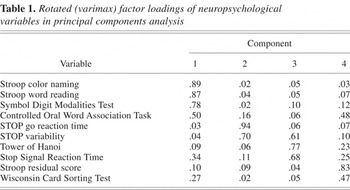
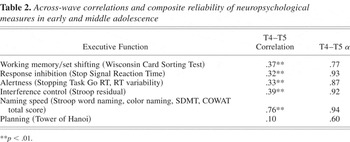
From the neuropsychological tests, we obtained 10 scores. As noted, we reverse scored these as needed such that high scores were always equated with good performance. We examined the correlations among scores, and an exploratory principal components analysis with varimax rotation was conducted to achieve further data reduction. Four factors were extracted explaining 67.51% of the variance in neuropsychological scores. The rotated factor loadings are displayed in Table 1. In our judgment, only the first two factors were interpretable. Reliable, unit-weighted composite scores were created for these two factors. First, a variable called “naming speed” was created from standardized scores for Stroop word and color naming, COWAT, and symbol digit across Waves 4 and 5 (α = .94). We viewed this factor as one related to language facility, and therefore expected it to show some relation to regulation measures. Second, a variable we labeled alertness (but also connoting arousal and effort) was created from the composite of response speed and response variability from the Stopping Task at Waves 4 and 5 (α = .87). We expected it to be somewhat distinct from other EF measures. The remaining variables were retained as separate variables for further analysis because we judged that combining them violated the conceptual purpose of the measures. The neuropsychological measures to be analyzed then became (a) naming speed composite, (b) alertness, (c) working memory/set shifting (Wisconsin Card Sorting Test), (d) interference control (Stroop residual score), (e) response inhibition (stop signal RT), and (f) planning efficiency (Tower of Hanoi). Table 2 shows these measures' correlations across time and their composite reliabilities.
Rotated (varimax) factor loadings of neuropsychological variables in principal components analysis

Across-wave correlations and composite reliability of neuropsychological measures in early and middle adolescence

Although the cross-time correlations were sometimes low, perhaps due in part to developmental change, in view of our goal of using these scores in relation to trait and outcome measures and the adequate reliability of the cross-wave composite scores, we opted to create cross wave composites by taking the mean score of all available trials or subscores across the two waves (e.g., the stopping task had three trials, so a total of six scores were averaged to form the composite). As Table 2 indicates, these composite scores had adequate reliability. We checked results for Wave 4 and Wave 5 separately and found no differences in any significance decisions (except Stroop interference). For these reasons, we relied on the cross-wave composites as our best indicator for the subsequent analyses. Tower of Hanoi had a very low cross-wave correlation, as shown in Table 2. However, using both Wave 4 and Wave 5 measures separately did not yield any change in results, so we chose to report the cross-wave composite for simplicity.
Correlations among these composites were generally modest; all were below r = .40, indicating that each pair of variables shared <16% of their variance. It was not surprising that the one exception was that IQ was correlated at r > .5 with naming speed.
Handling of missing data
As with all longitudinal data sets, data were sometimes missing because of changes in study procedure, a participant missing a data collection wave, lack of resources to collect all data, or computer malfunction. Because siblings were added in an ongoing manner as the study progressed, our N for trait ratings moved from 285 at Wave 1, to 368 at Wave 2/3, and 425 at Wave 4. Four hundred sixty children had trait ratings at one or more waves and had their available data used in composite estimates; the others were imputed as explained below. We present the raw data correlations across Waves in Table 2 with these numbers. Four hundred thirty-five children had neuropsychological data at Wave 4, and 303 had neuropsychological data at Wave 5. In all, 498 had data at either Wave 4 or Wave 5, and thus were included in this data set. Those wave data were averaged as explained earlier. Within waves, a small amount (2%) of neuropsychological data points were missing because of subject fatigue or examiner error. To assess the pattern of “missingness,” following Cohen, Cohen, West, and Aiken (2003), we created an amount of missingness variable as follows. Each dependent and independent variable was assigned a score for each subject of either present (0) or missing (1). Then, these dummy codes were summed across all variables, such that each child had a single score for total amount of missing data. This missingness score was then examined in relation to the data. Across all variables, the amount of missing data was not significantly correlated with most of the outcome and predictor variables (omitting achievement variables, these correlations averaged r = .04). However, achievement outcomes and several cognitive measures were related to amount of missingness. We therefore conducted further precautionary steps.
First, after creating composite variables as explained earlier, we imputed missing data using the expectation maximization algorithm, which is one form of maximum likelihood estimation. These methods preserve similar parameter estimates to the raw data and are viewed as superior to older alternatives such as listwise deletion of cases (now viewed as introducing substantial bias in its own right) or estimating missing data points via regression (Schafer & Graham, 2002). Overall, we estimated just over 5% of the composite variables data points in the entire data matrix for most models. However, because of siblings added later, this total rose to just over 9% for composite variable models that included childhood academic and social competence scores (Tables 6–7). This was well within the tolerances of the imputation procedures. The small average change in correlations between the personality and neuropsychological variables because of imputation (change in r = .01) supported the validity of the procedure.
Second, as a further precaution against any bias this may have introduced, as suggested by Cohen et al. (2003), we covaried “amount of missing data” from our multivariate models, in effect adjusting for the fact that we had imputed data. That missingness variable had significant effects in only one model (academic outcomes), with no change in conclusions from that model, and was otherwise always nonsignificant. It is therefore omitted from the results tables to simplify the presentation.
Siblings and nonindependence
Our sample included multiple siblings from most families, violating the independence assumption of standard multiple regression procedures. To address this, we evaluated regression models using the SPSS mixed-model procedure with family as a grouping variable. This is a multilevel modeling procedure that takes into account the nonindependent observations (Singer, 1998; Singer & Willett, 2003). The tables report parameter estimates from these models. Because all of our models relied on standardized variables for predictors and outcomes, the parameter estimates in the models are equivalent to standardized regression coefficients. We therefore designate them with beta. To gauge effect sizes, we computed the proportional reduction in error variance (PRE) value for within-family and between-family (intercept) variance for each model, as explained in the Results section. Those effects, along with the Level 1 base model residual variance and intercept variance values, are reported to enable readers to evaluate magnitude of effects in a manner analogous to r2 in linear regression. We report goodness of fit statistics to describe the best-fit models after model trimming.
Because the sample's risk status was defined so markedly by alcoholism risk, we covaried family (parent) initial alcoholism status in all models. This enables effects to be interpreted apart from any alcoholism risk embedded in the traits or cognitive scores.
Results
Descriptive statistics
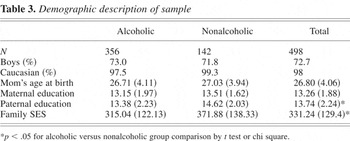
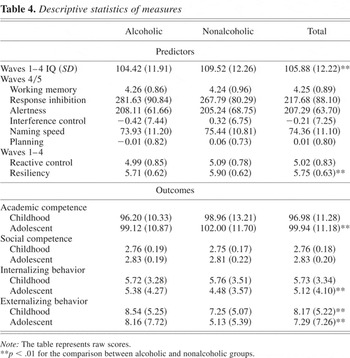
Descriptive statistics for the sample can be seen in Table 3. Descriptive statistics on the scales can be seen in Table 4. Chi-square and t-test statistics were conducted to evaluate differences in gender, ethnicity, maternal age at birth, parental education, and family SES between the control and high-risk groups. Paternal education and family SES significantly differed between the two groups (p < .05), and therefore were checked as covariates in the models with little change in results. Paternal education was kept in the externalizing behavior model because it was significantly correlated with this outcome.
Demographic description of sample

Descriptive statistics of measures

Interrelation of resiliency and reactive control
We next evaluated the relation of resiliency and reactive control. Block and Block (1980) expected no linear association. Eisenberg and colleagues (Eisenberg, Fabes, et al., 2000) suggested a curvilinear as-sociation such that at very high and very low levels of reactive control, resiliency should be low, but at middle levels of reactive control, resiliency should be high. A two-step regression curve fit analysis supported both predictions. With resiliency as the dependent variable, at Step 1 the linear term showed no association with reactive control (β = −.07, p > .05), but at Step 2 the quadratic term exhibited a significant relationship (β = −.15, p < .01). Figure 1 provides a plot of this relationship for the raw scores.

A plot of the curvilinear relation of resiliency and reactive control raw scores. [A color version of this figure can be viewed online at www.journals.cambridge.org]
Relation of resiliency and reactive control to adolescent EF
Linear associations between traits and EFs
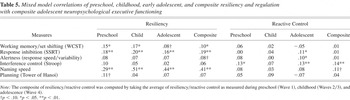
Using the mixed model procedure, we examined linear correlations of resiliency and reactive control as measured at preschool, childhood, and early adolescence (Wave 1, Waves 2 and 3, and Wave 4) with EF measures during early adolescence and late adolescence (Waves 4 and 5). The linear relations between resiliency and EFs were generally significant even when predicting from preschool resiliency levels to adolescent EF scores, as shown in the left-hand columns of Table 5. In contrast, correlations between reactive control and the executive measures were generally not significant, even when measured concurrently. The only exception was that interference control was related to reactive control but not to resiliency. To evaluate whether these correlations differed in magnitude, we compared them statistically with a t score with 3 degrees of freedom using the cross-wave composite scores for personality and EF. Response inhibition showed a significantly stronger relation with resiliency (r = .19) than with reactive control (r = .01, comparison p < .05). Naming speed likewise showed a significantly stronger relationship with resiliency (r = .51) than with reactive control (r = .11, comparison p < .05). These data supported the hypothesis of Eisenberg et al. (2003) that resiliency is related to executive functioning, whereas reactive control generally is not.
Mixed model correlations of preschool, childhood, early adolescent, and composite resiliency and regulation with composite adolescent neuropsychological executive functioning

In view of the stability of these relations over time and the consistency of effects across waves, a parsimonious summary of the trait variables is provided by the composite scores across waves. In a companion paper, we examine the slope of the change in these variables across time through growth curve analysis. In the current paper, resiliency and reactive control scores were averaged across the four time periods at which they were assessed, with composite effects shown in the right hand columns under each variable in Table 5. Those scores provide the best overall estimate of the magnitude of association between trait and laboratory tests across childhood and adolescence.
Trait, EF, and competence outcome
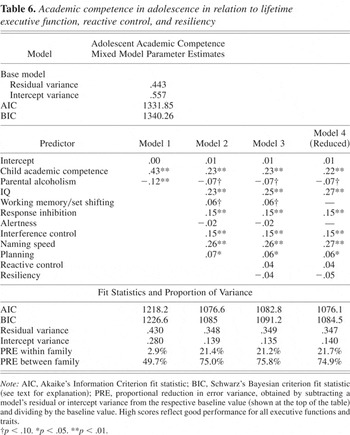
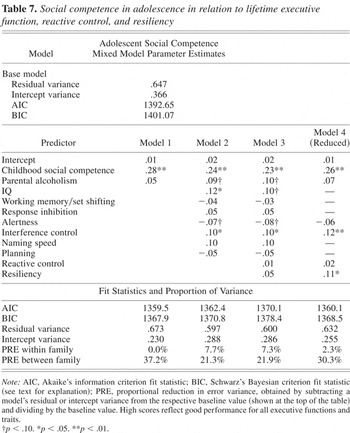
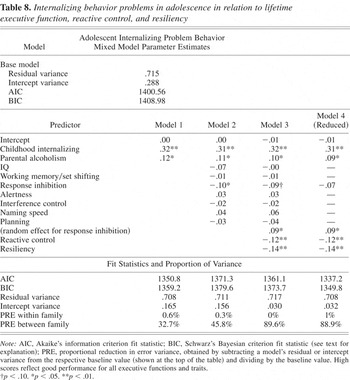
We next examined how resiliency, reactive control, and EFs jointly and independently contributed to important adolescent outcomes. We evaluated these relations in a hierarchical manner using a series of mixed models. For each model, we report the parameter estimates, along with fit statistics, to evaluate whether adding predictors improves model fit and to describe a final, best-fitting model. Thus, for each model, we present the results of a full model (Model 3) with all variables included. Then, to obtain the best fitting model, we provide the results at the final stage (Model 4 [reduced]) of each analysis after sequentially eliminating cognitive predictors with p values greater than .10, and then reestimating the model. We continued this process until we eliminated all nonsignificant cognitive variables using the p > .10 criterion. However, resiliency and reactive control were always forced to remain in the models given the centrality of quantifying their effects in relation to the guiding hypotheses of the study. The fit statistics reported are Akaike's (1973) information criterion and Schwarz's (1978) Bayesian information criterion. These two information criteria allow the comparison of both nested and nonnested models. Note that smaller values indicate better fit for both of these indicators. According to Raftery (1995), a change in these indicators of 0–2 is weak, 2–6 is a positive improvement, and >6 is a strong fit improvement. As an indicator of effect size, we compute a proportional reduction in error variance statistic (PRE), that is, proportion of variance explained by the additional parameters in the more complex model (Singer, 1998). This measure describes how much of the residual variance was eliminated from the baseline model. The value of the PRE can be compared from one model to the next to gauge the increment in variance explained by the addition of a set of variables; alternatively, one can compare each model with the baseline model to look at the total variance explained.
In the first model, we examined the outcome of academic competence (as assessed by the composite WRAT score). We entered childhood academic competence and risk group (i.e., alcoholic vs. nonalcoholic group) at Step 1, child full-scale IQ and EFs at Step 2, and reactive control and resiliency at Step 3 to determine if they contributed to outcomes over and above the other variables. Results are displayed in Table 6. Better response inhibition, interference control, naming speed, and planning jointly predicted academic competence, with sharp improvement in model fit. We assessed the effect size by computing the reduction in residual variance because of the addition of each set of predictor variables (i.e., the PRE statistic shown in the table for each model). That computation indicated that addition of these measures explained an additional 20% of the within family and 26% of the between-family variation in child academic competence (derived by comparing the PRE for Model 2 and Model 1, both of which, in turn, reflect change from the baseline model with no predictors). Reactive control and resiliency did not contribute to the development of academic competence, actually worsening model fit by their inclusion. Thus, EFs, but not traits, contributed to the development of academic competence. Interactions between trait and gender of the child were nonsignificant for both resiliency (β = .06, p = .37) and reactive control (β = −.05, p = .42).
Academic competence in adolescence in relation to lifetime executive function, reactive control, and resiliency

Next, we examined how these same constructs related to social competence as measured by parent report on the CBCL. Conceptually, we expected different traits and EFs to more strongly influence social competence than academic competence. We followed the same modeling logic as before, as shown in Table 7. In contrast to the academic competence model, this model identified only good interference control and resiliency (in the final, reduced model) as contributors to social competence. This result was consistent with our supposition of distinct contributors to academic versus social competence. Again, interactions with gender of the child were nonsignificant for resiliency (β = .06, p = .51) and reactive control (β = .02, p = .83). However, effects in this model were small and only marginally improved model fit, probably because of the strong stability between childhood and adolescent social competency.
Social competence in adolescence in relation to lifetime executive function, reactive control, and resiliency

Traits, EF, and problem behavior outcome
We examined the predictors of internalizing and externalizing problem behavior using the same modeling strategy, using the cross-informant composite scores as explained earlier. For internalizing problems (shown in Table 8), low reactive control and low resiliency were unique predictors. However, the additional variance explained by the EF variables was small (about 3% of the between family and no within-family variance; this can be seen by comparing the PRE values for Model 1 and Model 2), with minimal improvement in model fit. In contrast, the addition of trait variables to the model explained an additional 44% of the between family variation (comparing PRE for Model 2 and Model 3). The best-fitting model was achieved by eliminating most of the neuropsychological variables and retaining the trait variables, as illustrated in the final column of Table 8. When we examined interactions of resiliency and reactive control with gender of the child, we found a significant interaction for resiliency (β = .19, p = .038). This was because of a moderate and significant effect of low resiliency in boys (β = −.34, p < .01) and no effect in girls (β = −.10, p = .25). Interactions between gender of the child and reactive control were nonsignificant (β = .09, p = .30).
Internalizing behavior problems in adolescence in relation to lifetime executive function, reactive control, and resiliency

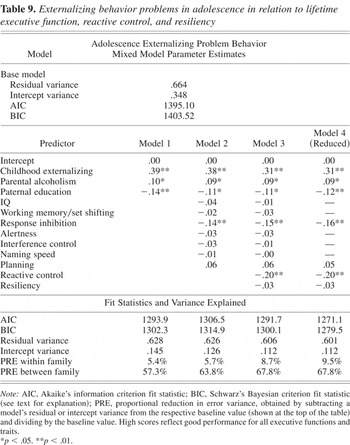
Paternal education was a significant predictor of externalizing problems; therefore, it was included in this model. For externalizing problems (shown in Table 9), poor response inhibition (fueling a 6% increment in variance explained at Model 2) and low reactive control (incrementing an additional 3% of the within family and 4% of between family variance at Model 3) were clear additive predictors. This finding was consistent with psychopathology theories (Barkley, 1997). Again, however, the best-fitting model was achieved by eliminating several of the neuropsychological variables. Interactions with gender of the child were nonsignificant for both resiliency (β = .09, p = .30) and reactive control (β = .06, p = .50).
Externalizing behavior problems in adolescence in relation to lifetime executive function, reactive control, and resiliency

Final data checks
To further examine whether results differed because of child risk status, we ran a two-group structural equation model. In these models, we compared results when the coefficients were allowed to be different in the alcoholic and nonalcoholic groups (free) versus when they were fixed to be equal in each group. We describe the results in terms of −2 log likelihood (−2LL, i.e., −2 × the difference in LL) between the free and fixed models. This statistic follows approximately a chi-square distribution, with degrees of freedom equal to the difference in the number of parameters between the two models. For all four outcomes, forcing the control and alcoholic groups to have equivalent covariance structures did not result in a significant loss of fit, suggesting a noninteractive model was appropriate. Specifically, the −2LL was nonsignificant for the academic achievement model (−2LL = 12.94, p > .05), the social competence model (−2LL = 17.62, p > .05), the internalizing model (−2LL = 10.36, p > .05), and the externalizing model (−2LL = 14.92, p > .05). For these models, the critical value for significance at the .05 level with 10 degrees of freedom (i.e., the 22 parameters free to vary in the free model minus the 12 degrees of freedom free to vary in the fixed model) was 18.31; thus, none of these nonsignificant results verged on significance.
We examined interactions of child personality/trait scores with family alcoholism status, with no significant findings. Interactions between traits and EF measures were also examined; however only 4/48 possible interactions were significant and so they were not further interpreted. Curvilinear relations between reactive control and outcomes were also examined, but none were significant (all p > .12).
Discussion
The broad domains of resiliency and reactive control identified by varying rubrics in trait and neuropsychological literatures are theorized to be crucial to the development of competence as well as psychopathology in children (Eisenberg et al., 2000). We found several associations of interest in this study of high-risk children and adolescents. Although the effect sizes for individual variables were in many instances small or modest in size, they are of significant theoretical interest. Most psychopathology and/or competence research has focused on either trait or cognitive executive measures, and few studies have looked at these domains together. Yet, both (a) reactive control and resiliency and (b) executive functioning, as cognitive control, should influence the consolidation of competence and problems over development, albeit with differing configurations of prediction expected for different outcomes. Moreover, the relations between reactive control, resiliency, and EF have not been sufficiently clear empirically, despite suggestions of closely related neural networks thought to relate to EF and resiliency.
We chose two higher order traits that may be viewed as reflecting childhood personality or temperament: reactive control and resiliency. Consistent with the original personality trait model from which they were derived (Block & Block, 1980), reactive control and resiliency were essentially orthogonal in terms of their linear relation. However, consistent with more recent theorizing by Eisenberg, Fabes, et al. (2000), there was a modest, curvilinear association between them, such that both over- and undercontrol were noted when resiliency was low.
Both traits, although conceptualized temperamentally as relating to emotion regulation, may be related to EF to some degree. However, recent theories suggest that resiliency but not reactive control should be primarily related to EF (Eisenberg et al., 2003). The latter supposition was borne out in our data. This basic finding suggests two important possibilities. The first is that resiliency and EF influence one another during development. For example, early resiliency might contribute to later consolidation of EF by allowing for successful coping so that problem-solving skills can be strengthened, or early EF may support resiliency by enhancing coping skills. A second possibility is that resiliency shares some underpinnings with the adaptive capability associated with frontal and executive abilities. The lack of relationship between resiliency and our proxy measures of alertness or arousal is consistent with this picture, because the latter systems are also more distal from executive functioning per se.
The joint contributions of emerging reactive control, resiliency, EFs, and intelligence were somewhat distinct for different outcome domains. As might be expected by a cognitive account of the determinants of academic achievement, achievement was related to EFs (and intelligence) but not personality. In contrast, as one might expect from an adaptive account of social functioning, social competence was predicted additively by resiliency and interference control, but not IQ or the other EF components.
Because social competence is important in a child's life earlier than academic competence, the modest relationship between resiliency and social competence speaks to a contributory role for flexible adaptation in the development of caregiver–infant relationships (Nigg & Huang-Pollock, 2003). One possible sequence is that as social competence begins to be fostered, resiliency enhances the development of EFs like inhibition, naming, interference control, working memory/set shifting, and planning. These EFs, in turn, contribute along with ongoing resiliency to the development of academic competence.
We also found that personality and EF were related to the development of problem behavior in children. These results suggest that problem behavior has roots in both early personality as well as executive functioning, but this varies by problem domain. Specifically, poor response inhibition (weakly), low reactive control, and low resiliency contributed to the development of internalizing problems; poor response inhibition and weak reactive control contributed to the development of externalizing problems. Although effects were not large, these results are consistent with Eisenberg and colleagues' (Eisenberg et al., 1996; Eisenberg, Guthrie, et al., 2000) findings that low levels of regulation predict problem behavior in children, and with well-established associations of EF weakness and problem behaviors (Pennington & Ozonoff, 1996), as well as the prominence of response inhibition as an EF deficit associated with externalizing behavior problems (Barkley, 1997; Nigg, 2000). Our finding that these constructs are joint contributors suggests that both cognitive control and emotional control play some role in the development of problem outcomes, supporting the effort to develop integrated understanding of both cognitive and affective regulation in psychopathology (Calkins & Fox, 2002; Nigg & Huang-Pollock, 2003).
Insofar as the trait of resiliency is conceptualized as the ability of the individual to modify his/her level of control in response to the environment or specific situation (Block & Block, 1980; Eisenberg, Fabes, et al., 2000; Rothbart, 1989b), these findings may tell a straightforward story of the relationship between traits and EF. High levels of resiliency were related to better EF on neuropsychological tests, suggesting that individuals with better EF are more successful at modifying their level of control in response to the dynamic nature of the environment and the specific situation. The flexible adaptation of control (i.e., resiliency) appears to be more important in determining success of executive functioning than is the actual level of control. Further, the successful development of executive functioning likely also enhances personality structure and resiliency by providing the cognitive capacity and skill necessary for a flexible approach to problem solving. Thus, resiliency, reactive control, and executive functioning appear to contribute to adolescent outcomes in an additive, incremental fashion rather than being largely overlapping in their effects.
Key limitations of these data should be noted. Other important personality or temperament trait domains were not assessed, including effortful control. Thus, a more complete picture of the emergence of traits with EF remains to be filled in. We did not have measures of EF in early childhood; therefore, our ability to fully evaluate reciprocal influences in development was limited. In addition, we combined measures of EF across Waves, potentially masking developmental change; however, results were the same when individual wave data were examined. The possible influences of in home versus on campus assessments are unknown in this data set. Further, the same assessor that administered the test battery also completed the Q-sort ratings in many instances, which may have introduced a bias or a shared variance effect, although we controlled this to some extent by covarying earlier outcome measures. Note that the magnitude of the effect sizes of the individual variables in these multivariate models was often small, although not in all instances. This underscores the importance of recognizing that these individual variables operate in conjunction with multiple other determinants of these outcomes. Nonetheless, it is important that these significant, specific contributors to outcome be recognized in full developmental models.
Conclusion
In conclusion, the present data help to fill in the unfolding picture of developmental abilities that contribute to self-regulation, competence, and problem outcomes in a high-risk sample of children and adolescents. Reactive control and resiliency emerge as differentially related to EF, with only resiliency showing reliable associations. Reactive control, resiliency, and EF may each contribute in varying degrees additively to academic and social competence and internalizing and externalizing problem behavior in adolescence.