Introduction
Various jurisdictions across the world have legalized, or are in the process of legalizing, cannabis for medical purposes (NCSL, 2013; Belle-Isle et al., Reference Belle-Isle, Walsh, Callaway, Lucas, Capler, Kay and Holtzman2014). Israeli medical cannabis regulations have allowed oncologists to recommend medical cannabis use since 2010. However, there is no systematic and standard educational system that teaches physicians on issues related to medical cannabis use. Therefore, the recommendation and training in how to safely use, store, and handle medical cannabis depends to a great extent on the oncologist's self-education.
As with other psychoactive medications, medical cannabis carries a risk of diversion to people who use it illegally. Indeed, cannabis has psychoactive properties and is the worlds' most commonly used illicit drug (UNODC, 2017). Studies from other areas of prescription medicine have shown that adolescents (Inciardi et al., Reference Inciardi, Surratt, Kurtz and Cicero2007) and young adults (McCabe et al., Reference McCabe, Cranford, Boyd and Teter2007) are more likely to obtain controlled medications for non-medical use from family members/friends than from drug dealers/strangers. Moreover, studies show that a substantial proportion of cannabis users report obtaining cannabis from someone with a medical cannabis license (Salomonsen-Sautel et al., Reference Salomonsen-Sautel, Sakai, Thurstone, Corley and Hopfer2012; Thurstone et al., Reference Thurstone, Lieberman and Schmiege2011; Tandowski et al., Reference Tandowski, Zolotov and Sznitman2019).
Medical cannabis stored improperly in households may increase the risk of diversion and also that people, and children in particular, will accidentally ingest cannabis (Wang et al., Reference Wang, Roosevelt and Heard2013; Wang et al., Reference Wang, Roosevelt, Le Lait, Martinez, Bucher-Bartelson, Bronstein and Heard2014; Kim and Monte, Reference Kim and Monte2016). Recommendations and guidelines for safe storage and disposal of unused prescription medications have been developed (Volkow and McLellan, Reference Volkow and McLellan2011; ISMP, 2018; WHO, 2003). Nevertheless, research has found widespread improper storage and disposal of prescription medications, such as keeping medication in unlocked locations (Tanabe et al., Reference Tanabe, Paice, Stancati and Fleming2012). Indeed, unsafe storage may increase if medical cannabis is used outside the home as it would necessitate bringing the medicine to places (e.g. at work or in cars/public transportation) where locked storage may not be available.
As far as the authors are aware, only one study has used data from medical cannabis patients to directly examine the potential risk and the mechanisms of medical cannabis diversion (Sznitman et al., Reference Sznitman, Goldberg, Sheinman-Yuffe, Flechter and Bar-Sela2016). The study, conducted among oncology medical cannabis patients in Israel, found high rates of suboptimal storage of medical cannabis (e.g. stored in unlocked places, used outside of home) but few incidences of theft, diversion, and unintentional ingestion. In terms of receiving information about safe storage, 62% of patients reported that they had received such information.
The current study's overarching aim is to further develop the knowledge base related to the risk of improper storage and diversion of medical cannabis. The current study does this by focusing particularly on the length of medical cannabis treatment among Israeli oncology patients, one of the largest groups of medical cannabis patients in the country. It is possible that safe storage practices are most satisfactory at the outset of cannabis treatment because this is when patients typically receive training in terms of how to use and safely handle medical cannabis. Patients may be particularly cautious when treatment is novel, and it is possible that safety behavior deteriorates as time passes. It is also possible that as more time passes, patients are increasingly likely to be exposed to people asking them to share their medical cannabis because more people will know about the medical cannabis treatment. In other words, it is possible that the risk of diversion and accidental ingestion of medical cannabis is particularly prevalent among long-term medical cannabis patients as safety practices may become less salient to patients once the treatment becomes part of everyday life and as more friends and family members know about the medical cannabis treatment. If so, it would suggest that in addition to patient safety training at the outset of medical cannabis treatment, there is also a need to implement booster training sessions in order to reinforce and consolidate knowledge and safety practices gained in the initial training.
With the legalization of medical cannabis in several jurisdictions, it is imperative to better understand safety practices related to the handling of medical cannabis. It is also important to examine the extent to which health care providers provide safety guidelines to their patients about the safe handling of medical cannabis. This study is one of the first to delve into this area of evolving medicine and is thus exploratory in nature. The study's first aim is to examine whether patients who have used medical cannabis for longer periods differ from those who have used for shorter periods in terms of sociodemographic background and other key aspects of medical cannabis use. This study also examines the relationship between length of medical cannabis treatment and risk factors related to storage and diversion. Finally, the study examines the extent to which oncologists provide information to their patients about safe storage and disposal.
Methods
Sample recruitment and data collection
Patients were identified through medical cannabis license forms at the Division of Oncology at Rambam Health Care Campus in Haifa, Israel. Inclusion criteria included 18 years of age or older and current medical cannabis license holders. According to Israeli regulations, there are two indications for medical cannabis in oncology: (1) under-treatment of anti-cancer drugs to relieve treatment side effects, and (2) relief of cancer symptoms in advanced cancer disease. All included patients were given cannabis according to those regulations. Face-to-face interviews by a physician or nurse were conducted when patients came to the oncology department. As reported elsewhere (Sznitman et al., Reference Sznitman, Goldberg, Sheinman-Yuffe, Flechter and Bar-Sela2016), the study sample was similar to the patient population at Rambam in terms of gender, ethnicity, and living in a city vs. rural area. However, the study sample was younger (mean 53.8 vs. 58.7, p < 0.01) and more likely to have children (93% vs. 82%, p ≤ 0.01) than medical cannabis patients who did not participate in the survey.
In addition, oncologists working in the same Rambam Oncology Department were recruited to take part in a survey. In addition to basic demographic information (age, gender), the survey asked about recommending medical cannabis to their patients and the extent to which they talk to their patients about medical cannabis safe storage practices. The study protocol was approved by the institutional ethics committee and all participants signed an informed consent form.
Measures
Patient survey
Number of months of medical cannabis treatment was calculated by subtracting the date of the interview with the date of medical cannabis license request. In Israel, it typically takes two to four weeks before medical cannabis license requests are approved. During the patient interview, data was collected on age, gender, whether or not respondents had children living in their household, ethnicity (Arab vs. Jew), whether or not they had higher education beyond high school, and whether they lived in a city or rural area.
In terms of medical cannabis, data was collected on whether patients administrated medical cannabis primarily through smoking or other methods. This measure was deemed important because medical cannabis stored and used in smoked form is potentially at higher risk for being diverted to the black market than cannabis stored in edible form or in oil, ointments, creams, etc. Indeed, smoking cannabis is the main method of administration for recreational cannabis use in Israel and elsewhere (Sznitman, Reference Sznitman2017). Data on whether or not the patients had medical cannabis stored in the household at the time of the interview was recorded. Data on quantity of medical cannabis used in the past month was originally collected according to the following categories: 1–10 g, 11–20 g, 21–30 g, 31–40 g, 41–50 g, 50+ g. Because of the skewed distribution of the variable (43% reported using 11–20 grams of medical cannabis per month, and 34% reported using 21–30 grams per month), the variable was coded as 0 = 20 grams or less, 1 = 21 grams or more).
No validated scales exist for measuring safe storage practices of medical cannabis or risk for diversion. Therefore, we developed questionnaire items that tested the extent to which patients adhere to safe storage practice guidelines put forth in the medical cannabis academic literature (MacCallum and Russo, Reference MacCallum and Russo2018) and guidelines set out by the Israeli Ministry of Health (Landschaft et al., Reference Landschaft, Elbo, Mechoulam, Shapira, Biler, Afek, Lev, Dor, Schwartzberg and Roska2017). Specifically, to measure storage practices, patients were asked (1) how often they stored medical cannabis in unlocked places, and (2) how often they used medical cannabis outside the home. Response categories were originally measured on a Likert scale (0 = always, 4 = never). However, the responses were highly skewed so that the vast majority of respondents reported that they either always (48.7%) stored medical cannabis in unlocked places, or never do so (40.7%), with the majority (77%) reporting that they never use medical cannabis outside their home. Therefore, responses were dichotomized (0 = never/rarely/sometimes, 1 = always/very often). Patients were also asked if they had been asked by others to give them medical cannabis (0 = no, 1 = yes).
Physician survey
In the physician survey, oncologists' data on age and gender were collected. In addition, physicians were asked how many patients they had recommended medical cannabis to and how many patients had asked them for a medical cannabis license in the past month. Furthermore, we adopted items from a previous study (Linares et al., Reference Linares, Choi-Nurvitadhi, Cooper, Ham, Ishmael and Zweber2016) that asked respondents: When you discuss medical cannabis with your patients, how often do you advise them on the following issues: 1) legal prohibitions (e.g. that it is illegal to use in public or to sell to third parties); 2) safe storage practices; and 3) safe disposal practices. Response categories were: never, 1–25% of the time, 26–50% of the time, 51–75% of the time, 76–99% of the time, and every time.
Data analysis
In order to examine whether length of medical cannabis treatment was related to patients' sociodemographic background and other key aspects of medical cannabis treatment, independent sample t-tests were used for categorical variables (gender, children living in household, ethnicity, higher education, city vs. rural area, administration by smoking, use of 21 grams or more) and simple Pearson correlation was used to test the correlation with age.
To examine the independent relationship between length of medical cannabis treatment and risk factors related to storage and diversion, logistic regression models were used. In a previous study where we used the same data as in the present study, we found that the three main indicators for risk of medical cannabis diversion (always/very often stored medical cannabis in unlocked places; always/very often used medical cannabis outside the home; been asked by others to give them medical cannabis) were related to age, gender, higher education, and whether or not patients stored cannabis at home at the time of the interview (Sznitman et al., Reference Sznitman, Goldberg, Sheinman-Yuffe, Flechter and Bar-Sela2016). The core focus of the current analyses—length of medical cannabis treatment—was not examined in the previous study. In order to test whether length of medical cannabis treatment had an independent relationship with risk factors related to storage and diversion, over and above the covariates that were previously found to be associated with the outcomes, we conducted three logistic regression models for the following dependent variables: medical cannabis stored in unlocked places (model 1); medical cannabis used outside the home (model 2); asked to give away medical cannabis (model 3). The independent variables in each model were the same as found to be associated with the dependent variables in the previous study (age, gender, higher education, and whether or not patients stored cannabis at home at the time of the interview) as well as length of medical cannabis treatment. Simple descriptive analyses were used for the physician data. Data were analyzed using SPSS (SPSS, Reference SPSS2013).
Results
Patients
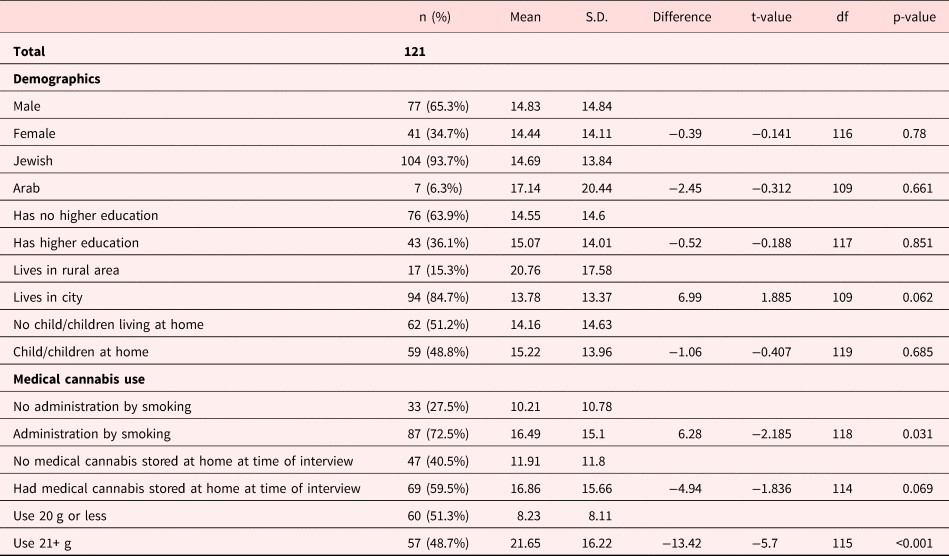
Sample descriptives are shown in Table 1. Among the 121 patients participating in the study, 65% were male, 6% were Arab, 85% lived in cities, 36% had higher education, and 49% had children living at home. The mean age of the sample was 53.81 years (min = 21, max = 92, SD = 13.98).
Sample descriptives and t-test results comparing background variables on length of medical cannabis treatment

* Association between the two continuous variables, age and length of medical cannabis treatment, was based on Pearson correlation
Patients had used medical cannabis for 14.68 months on average (min = 0, max = 63, SD = 14.26). There was no difference in mean length of medical cannabis treatment between men and women, Arabs vs. Jews, those living in cities and those living in rural areas, those with or without an academic degree, or those with or without children (all p ≥ 0.05, see Table 1). Age was also not correlated with length of medical cannabis treatment (r = 0.111, p = 0.227).
Patients who administered medical cannabis through smoking had been treated with medical cannabis for longer than those administrating medical cannabis through other means (mean months 16.49 vs. 10.21, p = 0.031). Patients who reported using more than 20 grams of medical cannabis per month had used cannabis for longer than those using less than this amount (mean months 21.65 vs. 8.23, p < 0.001, see Table 1). Reporting storing medical cannabis at home at the time of the interview was not related to length of medical cannabis treatment (p > 0.05).
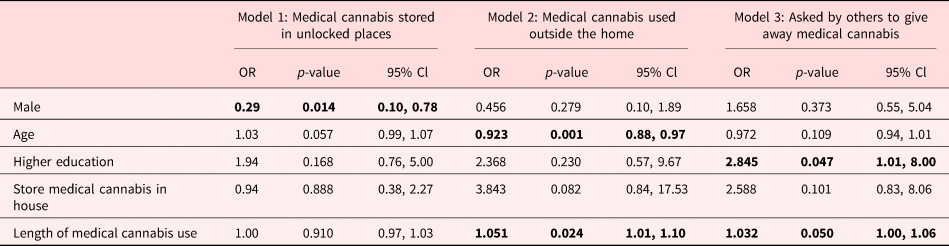
The distribution of variables measuring storage practices and having been asked to give away cannabis have been provided elsewhere (Sznitman et al., Reference Sznitman, Goldberg, Sheinman-Yuffe, Flechter and Bar-Sela2016). Briefly, 54% (n = 60) reported always/very often storing medical cannabis in unlocked places, 20% (n = 21) reported always/very often using medical cannabis outside the home, and 21% (n = 25) of the respondents reported that they had been asked to give away medical cannabis. In terms of the independent relationship between length of medical cannabis treatment and these three variables, logistic regression results showed that length of treatment was related with higher probability of using cannabis outside the home (OR = 1.05, p = 0.02) and having been asked about giving away medical cannabis (OR = 1.03, p = 0.05). Length of treatment was unrelated to storing medical cannabis in unlocked places (p = 0.910, see Table 2)
Logistic regression predicting risk of medical cannabis diversion and unsafe storage

Physicians
In the physician survey, there were 55 oncologists who participated (mean age = 42.60, SD = 10.48, 62% male). In terms of recommending medical cannabis to their patients, 31% (n = 17) reported that they had not recommended medical cannabis in the past month, 58% (n = 32) reported that they had recommended medical cannabis to 1–10 patients, and 11% (n = 6) reported having recommended medical cannabis to 11 patients or more. Very few oncologists (5.5%, n = 3) reported that no patients had asked them for a medical cannabis license in the past month, 56% (n = 31) reported that between 1 and 10 patients had asked them, and 38% (n = 21) reported that more than 10 patients had asked them for a medical cannabis license in the past month. In other words, patient-physician discussions related to medical cannabis were common in this sample.
When asked about talking to patients about safe storage practices, 30% reported that they never advise patients about legal prohibitions (e.g. that it is illegal to use in public or to sell to third parties), and 23% reported they always spoke to their patients about these issues. In terms of safe storage, 40% reported never speaking to their patients about these issues, whereas 7.5% reported they always spoke about these issues. Lastly, 47% reported never speaking to their patients about safe disposal of medical cannabis whereas 6% reported they always spoke to their patients about these issues (see Table 3).
Physician responses to how often they provide safety information (n = 55)

Discussion
Patients who have used cannabis for longer also use higher dosages and are more likely to administer medical cannabis by smoking. Both these factors could lead to higher risk of diversion of medical cannabis to the black market because recreational users tend to prefer cannabis in smoked form as this provides rapid psychoactive effects. Cannabis patients who have used for longer periods are also more likely to use cannabis outside of their home where safe storage practices may be suboptimal and they are more likely than others to have been asked to give away cannabis. The associations were low, however, Combined, this suggests that there is an ongoing risk of unsafe storage and diversion over the course of medical cannabis treatment. Therefore, there may be a need for continued training in safe storage practices among long-term medical cannabis patients.
In several states in the U.S, formal guidelines have been developed for medical cannabis that includes specifications for a health care professional to document a written treatment plan that includes the need to notify patients that cannabis should not be shared with third parties and the need to safeguard medical cannabis (Brown et al., Reference Brown, Gnana and Kirchmeyer2017; Federation of State Medical Boards, 2017). Similar guidelines have been developed in Israel and the Israeli Ministry of Health that suggest information about storage and disposal should be provided to patients by growers (Landschaft et al., Reference Landschaft, Elbo, Mechoulam, Shapira, Biler, Afek, Lev, Dor, Schwartzberg and Roska2017). Yet, it may be more useful to make physicians responsible for providing this training. Not only do physicians meet with patients on a regular basis, a previous study also found that patients are particularly interested in receiving information from physicians related to safe storage and disposal (Sznitman et al., Reference Sznitman, Goldberg, Sheinman-Yuffe, Flechter and Bar-Sela2016). The study further showed that patients who had received such information from physicians were significantly more likely to store medical cannabis in locked places. This suggests that information from physicians may be particularly salient to patients. The current study does, however, show that physicians are not providing relevant information to patients in a regular manner to ensure that important instructions about storage and disposal are given to medical cannabis patients. As medical cannabis treatment, including long-term treatment, is becoming more common, guidelines should be developed that indicate physicians' role in providing safety information to their patients. These guidelines can be adopted from safe storage and disposal guidelines already developed in other areas of prescription medications (Volkow and McLellan, Reference Volkow and McLellan2011; ISMP, 2018; WHO, 2003; NHS, 2017). In addition, there needs to be more routine monitoring conducted on medical cannabis diversion risk to provide data on the extent of the problem.
Limitations
This study includes limitations that need to be acknowledged. Firstly, there are no validated and standardized questionnaires for storage practices for medical cannabis or for how medical staff discusses medical cannabis with patients. More research is needed to examine whether the items used here predict actual diversion and unintentional ingestion of medical cannabis and the extent to which the items measuring information provision are reliable and valid.
Currently in Israel, medical cannabis patients purchase their cannabis from nine privately licensed medical cannabis growers. Each grower produces a range of different strains with different levels of potency. We did not have data on the type of strain or potency used by patients which may influence the cognitive ability to answer the questions posed in the interview. The cognitive effects of medical cannabis use, especially in the older patient population, are unknown to a great extent (Feinstein et al., Reference Feinstein, Banwell and Pavisian2015; Gruber et al., Reference Gruber, Sagar, Dahlgren, Racine, Smith and Lukas2016). Thus, at this stage it is difficult to make any specific hypotheses of whether or not different types of strains and potency of the medical cannabis used by participants influenced patients' responses to interview questions as conducted in the current study.
Another limitation of this study is that it does not include a control group. Future research would benefit from the inclusion of a non-medical cannabis patient group and by examining the rate of safe storage practices of medical cannabis compared to other prescription medications. Overall, the Arab patient population at Rambam is smaller than the Jewish one, with Arabs representing approximately 20% of the patient population. However, in the current sample, Arabs are underrepresented. This may have occurred due to limited resources where the interviews were conducted in Hebrew. More research is needed to examine whether Arabs differ in practice toward medical cannabis handling than in the Jewish population. This data may be used to develop tailored and multi-lingual information about medical cannabis handling.
It also needs to be acknowledged that the study was limited to data collection in a single oncology center, possibly limiting the generalizability of results. Given these limitations, the conclusions that can be drawn from the results are limited and one may wish to consider the results presented here as preliminary. Indeed, this study is exploratory in nature and more studies in this area are needed.
Conclusion
Illicit cannabis use continues to be prevalent with some costs to society and individuals such as dependence and accidents (UNODC, 2017). At the same time, increasingly more jurisdictions have legalized or are in the process of legalizing medical cannabis. This study suggests that increasingly more thought and intervention may be needed to safeguard public health and safety related to this evolving field of medical cannabis. This is especially true as the prevalence of long-lasting medical cannabis programs will mean that increasingly more patients will be long-term users of medical cannabis. Results presented here suggest that there is an ongoing risk of unsafe storage and diversion over the course of medical cannabis treatment. There may be a need for oncologists, as well as other physicians and healthcare providers, to give more consistent and continued training in safe storage and disposal practices, especially among long-term medical cannabis patients.
Author ORCIDs
Yuval Zolotov, 0000-0002-5391-7379