1 Introduction
This paper presents an analysis of predictable vowels in Kalam, a Trans New Guinea language of the Bismarck and Schrader Ranges in Madang Province, Papua New Guinea. Kalam sound patterns are of interest in presenting two distinct vowel types: full vowels /a e o/, which are of relatively long duration and always stress-bearing, and predictable vowels, which occur word-internally between consonants and in monoconsonantal utterances. Predictable vowels, in contrast to full vowels, are short, have contextually predictable qualities, are only stressed in certain positions and alternate with zero in certain contexts. Here we compare Kalam predictable vowels to similar sound patterns in other languages and assess the implications for phonological theory.
In a recent treatment of inserted vowels, Hall (Reference Hall2006) presents a two-way classification based on phonological status and distribution: ‘epenthetic’ vowels are phonologically visible and serve to repair illicit phonotactics; ‘intrusive’ vowels are phonologically invisible and can be viewed as predictable transitions from one consonant to another. One central finding is that Kalam predictable vowels do not fit neatly into this classification: they have some properties of epenthetic vowels and other properties of intrusive vowels. If, as argued here, Kalam predictable vowels are treated as non-lexical, lexical representations will contain long strings of consonants, and even vowelless words. Our suggestion is that the seemingly mixed typological status of Kalam predictable vowels and the long strings of consonant found in the lexicon are both related to the historical origins of these enigmatic vowels. In Kalam, and other languages with similar sound patterns, synchronic vowel insertion results from inversion of historical vowel reduction and loss. Historical rule inversion can result in vowels whose gestural properties are similar to those of intrusive vowels, but whose distribution likens them to epenthetic vowels. The reduction and loss of all but a single stressed vowel within the phrase or word give rise to characteristically long consonant strings in the lexicon.
§2 begins with an overview of predictable vowels, and reviews Hall's (Reference Hall2006) typology. §3 provides an overview of Kalam sound patterns, and a detailed description of Kalam predictable vowels. These vowels fail to fit into the simple two-way classification proposed by Hall, and motivate a reconsideration of the typology of inserted vowels in terms of multiple pathways of evolution. For Kalam, we demonstrate that many synchronic predictable vowels are the remnants of historical vowel reduction and deletion. At the same time, synchronic patterns show predictable vowels in non-historical positions, suggesting a reanalysis of historical vowel reduction/deletion as synchronic insertion. §4 highlights other languages with predictable vowels similar to those in Kalam. Historical explanations best account for the mixed set of synchronic phonological properties they exhibit, including long consonant clusters and vowelless words.
2 Predictable vowels
In many languages, sound patterns are characterised by predictable vowels within the phonological word or phrase. Predictable vowels are those whose quality, quantity and position can be determined from phonological context.Footnote 1 In most languages, predictable vowels alternate with zero in at least some contexts, motivating vowel-insertion processes within classical generative accounts and constraints yielding surface vowels within optimality treatments.Footnote 2
There are many different types of predictable vowels. One way of classifying these is by relevant phonological domain or context, as in (1)–(3). In this classification, three types of predictable vowels are distinguished: those based on the form of phonological words (1), syllables (2) and consonants (3).
(1)


In (1), words from Eastern and Central Arrernte are represented in the native orthography. In many Australian languages, including Arrernte, all phonological words end in vowels.Footnote 3 In Eastern and Central Arrernte (1a), words end in a schwa-like vowel (spelled <e>), though this schwa is not found medially before another vowel (1a). Final schwa in Arrernte is a predictable feature of phonological words, and this sound pattern characterises loanwords as well (1b). Word-final inserted vowels are often referred to as paragogic vowels.
A better-studied epenthesis type is that triggered by constraints on syllable structure.Footnote 4 In many languages, the maximal word-medial syllable is CV(V)C, where onsets and codas constitute single consonants. If morphology or syntax yields consonant clusters which cannot be syllabified in this way, predictable epenthetic vowels surface (Itô Reference Itô1989, Blevins Reference Blevins and Goldsmith1995: 224–227). Well-studied examples of this kind include the Yawelmani dialect of Yokuts (see note 4), and a range of Semitic languages (Rose Reference Rose2000), including many Arabic dialects (Selkirk Reference Selkirk, Borer and Aoun1981, Broselow Reference Broselow, Broselow, Eid and McCarthy1992, Kiparsky Reference Kiparsky, Féry and Vijver2003). The data in (2) is from Mapuche (also known as Araucanian and Mapudungan), an isolate of Chile.
(2)
In Mapuche, a high central vowel is obligatorily inserted in triconsonantal clusters (2a), and in word-final biconsonantal clusters (2b), and can be stressed as in these examples (Smeets Reference Smeets2008: 51). Due to this process, all suffixes of the form -C- or -CC … can be seen as having two allomorphs: one with an initial high central vowel, occurring after C-final stems, and one without, occurring elsewhere. As shown in (2c, d), epenthesis is also apparent in Spanish loans which do not conform to the maximal Mapuche CV(V)C syllable template.Footnote 5
The least-studied patterns of predictable vowels are those which can be linked to consonant transitions. Transition vowels have been referred to variously as excrescent, intrusive, invisible, moraless, paragogic, parasitic, svarabhakti, transitional and weightless (Harms Reference Harms1976, Levin Reference Levin1987, Dell & Elmedlaoui Reference Dell, Elmedlaoui, Durand and Laks1996a, Warner et al. Reference Warner, Jongman, Cutler and Mücke2001, Hall Reference Hall2006). In some languages, like Piro (Matteson Reference Matteson1965: 22–47) and Imdlawn Tashlhiyt Berber (Dell & Elmedlaoui Reference Dell and Elmedlaoui1985), these fleeting vowels are interpreted as phonetic realisations of syllabic consonants. Even so, one characteristic that sets them apart from predictable vowels of the type illustrated in (1) and (2) is a clear dependency between phonetic vowel quality and the quality of adjacent consonants (Dell & Elmedlaoui Reference Dell and Elmedlaoui1996b, Coleman Reference Coleman2001). The association of vowels of this sort with consonant transitions is clear in the data from Sye (Erromangan), an Oceanic language of Vanuatu (Crowley Reference Crowley1998: 14).
(3)
As illustrated in (3), the predictable vowel is found between /h/ or /ɣ/ and a following consonant (3a), or between /ɣ/ or /ŋ/ and a preceding consonant (3b); the predictable vowel is schwa in free variation with zero, or a copy of a mid vowel in a preceding syllable. Main stress in Sye is penultimate, but these predictable transitional vowels are never stressed, and do not count for the purposes of stress assignment.
Another way of classifying predictable vowels like those in (1)–(3) is by their phonological status. Vowels which function as syllabic nuclei for phonological processes are placed in one category, while those which do not appear to play any active role in the phonology are placed in another (Harms Reference Harms1976, Levin Reference Levin1987, Warner et al. Reference Warner, Jongman, Cutler and Mücke2001, Hall Reference Hall2006). Hall's (Reference Hall2006) recent cross-linguistic survey of ‘inserted vowels’, which are absent lexically, but present on the surface, is a prime example of this type of classification. Inserted vowels are divided into two basic types: epenthetic vowels and intrusive vowels. Intrusive vowels are phonetic transitions between consonants and are generally phonologically invisible. In contrast, epenthetic vowels are not simple phonetic transitions, and are phonologically visible. Intrusive vowels do not seem to have the function of repairing universally rare or ‘marked’ structures (3), while epenthetic vowels do function in this way (2). The full range of properties generally associated with each predictable vowel type is given in (4) and (5) from Hall (Reference Hall2006: 391).
(4)
(5)
In addition to offering new diagnostics for intrusive vowels, Hall (Reference Hall2006) provides new evidence that intrusive vowels are not phonological units and do not form syllable nuclei at any level of representation. An additional claim is that three general properties of intrusive vowels follow from the characterisation of vowel intrusion in terms of abstract articulatory gestures within the model of Articulatory Phonology (Browman & Goldstein Reference Browman and Goldstein1986, Reference Browman, Goldstein, Docherty and Ladd1992). By treating intrusive vowels as retimings of existing articulatory gestures without addition of a vowel articulation, their quality (copy vowels or schwa-like), distribution (typically restricted to heterorganic clusters) and variability (likely to be absent in fast speech) are accounted for. In contrast, epenthetic vowels are those which add a vowel articulation to the gestural score. To relate these two kinds of predictable vowels, Hall (Reference Hall2006: 422–423) invokes diachrony. The general claim is that intrusive vowels may become phonologised, and in doing so, shift from intrusive to epenthetic over time.
While it is clear that many intrusive and epenthetic vowels have their origins in this sort of articulatory retiming and subsequent phonologisation, other well-known pathways exist for the evolution of predictable synchronic vowel–zero alternations. Perhaps the best known, discussed further in §4, is the process of historical vowel loss. Regular vowel loss yields vowel–zero alternations, which can be reinterpreted as insertions via rule inversion. A simple case of this kind is found in Manam, an Oceanic language of Manam Island of the north New Guinea coast, as analysed by Lichtenberk (Reference Lichtenberk1983: 35–39). In Manam, /i/-epenthesis occurs when an adnominal suffix is added to a consonant-final stem: /tama-gu/ ‘my father’, but /tamim-i-gu/ ‘my urine’, where the underlined /i/ is epenthetic. Historically, word-final high vowels /i/ and /u/ were lost after nasals: *tamimi > /tamim/ ‘urine’. However, when this form was suffixed, the high vowel was protected and retained, as in the reflex of *tamimi-gu. This vowel–zero alternation was reanalysed as /i/-insertion, a fact evident in *u-final stems: from Proto-Oceanic *danum ‘water’, Manam /daŋ/<*danu, /mata-daŋ/ ‘tears (eye-water)’, but /mata-daŋ-i-gu/ ‘my tears’, with reanalysed epenthetic /i/, not **/mata-daŋ-u-gu/.
If articulatory retiming is not the sole source of predictable vowels, and if clusters of properties exhibited by predictable vowels are in part attributable to their source, then we should not be surprised if Hall's synchronic typology appears incomplete. Given other pathways of synchronic vowel–zero alternations, like the inversion of vowel deletion sketched above, we might expect other predictable vowel types, with a mix of the properties in (4) and (5), or with additional properties of their own. In the remainder of this paper, we describe and analyse predictable vowels which do not fit neatly into Hall's typology. The sound patterns of interest are found in Kalam, and described in detail in §3. In Kalam, predictable vowels have the properties shown in (6), where ‘E’ indicates a property associated with Hall's epenthetic class, ‘I’ a characteristic of Hall's intrusive class and ‘N’ a new property not clearly associated with either of Hall's predictable vowel types.
(6)
In §4 we note other languages with similar predictable vowels, and suggest how some of the properties in (6) can be explained in terms of parallel historical developments.
3 The Kalam language
Kalam is spoken by about 20,000 people living around the junction of the Bismarck and Schrader Ranges on the northern fringes of the central highlands of Papua New Guinea. Most Kalam speakers live in the high, mountainous valleys of the upper Simbai, Kaironk and Asai Rivers, and on the northern slopes of the Jimi Valley adjacent to the Kaironk and Simbai Valleys. Most of the Kalam-speaking area is in Madang Province, though on the southern fall of the Bismarck Range, Kalam speakers are found in the Western Highlands Province as well.
Kalam is one of two members of the Kalamic group, the other being Kobon. Kobon is spoken by approximately 10,000 people just west of the Kalam area, in the Schrader Ranges. The Kalamic group, in turn, is a branch of the Madang group of approximately 100 languages, itself a subgroup of the large Trans New Guinea family.
The two major dialects of Kalam are Etp Mnm (‘Etp language’) and Ti Mnm (‘Ti language’), where /etp/ and /ti/ are the words for ‘what?’ in the respective dialects.Footnote 6 Data cited below is from Etp Mnm unless noted otherwise. Where dialect differences are relevant to the discussion, they are noted in the text. After glosses, (pl) indicates a word from ‘Pandanus Language’, whose distinctive lexicon is used in certain ritually dangerous contexts, (t) indicates a Ti Mnm form and (l) a loan from Tok Pisin or English.Footnote 7
Compared to most languages of the Trans New Guinea family, Kalam is fairly well studied. Descriptions include Biggs' (Reference Biggs1963) initial phonemic analysis, focusing on the vowel system, Pawley's (Reference Pawley1966) grammar of Etp Mnm, a Kalam–English and English–Kalam dictionary (Pawley & Bulmer Reference Pawley and Bulmer2003), various studies of syntax, semantics and speech processing, and a number of ethnographic and ethnobiological studies treating areas of Kalam lexical semantics. Historical work is much less extensive, but includes a first reconstruction of Proto-Kalamic phonology and lexicon (Coberly Reference Coberly2002) and some wider comparative studies which touch on Kalam historical phonology and subgrouping, including Pawley & Osmond (Reference Pawley and Osmond1998) and Pawley (Reference Pawley, Pawley, Ross and Tryon2001, Reference Pawley2008).
3.1 An overview of Kalam phonology
In this section we provide an overview of the segment inventory, syllable structure and stress patterns of Kalam as background to our analysis of predictable vowels. Our treatment of Kalam segmental phonology follows closely that of Pawley (Reference Pawley1966). The segmental phonemes include 16 consonants, shown in (7a), and three vowels, as in (7b).Footnote 8
The symbols in (7) are those of the practical orthography of Pawley & Bulmer (Reference Pawley and Bulmer2003) ; we use them here to facilitate look-up of dictionary forms. Departures from approximate IPA values are: /c/ and /j/ for palatalised dentals, voiced symbols /b d j g/ for prenasalised stops and /y/ for the palatal glide. All non-sonorant consonants have a range of allophones. In word-initial position they have close to their IPA values (modulo the notes above), word-medially there is intervocalic voicing and spirantisation of the /p t k/ series and word-finally the voiced prenasalised series is devoiced. Phonetic transcriptions are in square brackets and use IPA symbols.
(7)
While the consonant system is relatively straightforward, a few notes are in order concerning the vowel system in (7b). Though only three underlying vowels are posited, as shown in (8), on the surface there is a six-way contrast of vowel quality in CVC monosyllables. Following Pawley (Reference Pawley1966), the high vowels i and u are analysed either as vocalised instances of /y/ or /w/, or as predictable vowels whose quality is determined by a preceding or following /y/, /w/ or palatalised dental consonant. When glides are vocalised, the resulting high vowels are heard and transcribed as half-long (and stressed) [ˈiˑ ˈuˑ], like the full vowels /a e o/, transcribed as [ˈaˑ ˈeˑ ˈoˑ]. When surface [i u] are the result of predictable vowel insertion, they are heard and transcribed as short, and can be unstressed. We follow Pawley's (Reference Pawley1966) analysis here, treating only /y/ and /w/ as underlying, and justifying this below. However, we emphasise that the central argument for Kalam predictable vowels as a novel type, with origins in vowel reduction/deletion, is independent of whether or not some instances of surface [i] and [u] derive from underlying vowels.Footnote 9
(8) shows that, in addition to a contrast between /a e o/ and the vocalised glides /y w/, there is a surface high central short [ɨ], with a word-final [ə] allophone, and other qualities (e.g. [i u o ø]) under optional assimilation to neighbouring segments. This high central vowel occurs predictably between consonants in words like /kn/ ‘sleep’. Predictable vowels of this kind are the focus of this study, with their quality and distribution detailed below. However, before turning to characteristics of predictable vowels, we briefly justify the analysis of the vowel system in (7b).
(8)
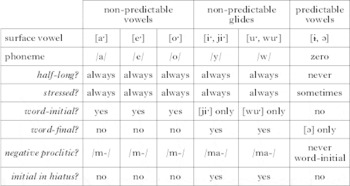
Arguments for the simple vowel system in (7b) are based on quantity, distribution and predictability.Footnote 11 In general, the vowels /a e o/, as well as vocalised glides, have longer surface realisations than predictable vowels, and consistently attract word stress. Predictable vowels are shorter and in some contexts are unstressed.
While /a e o/ are found word-initially in native words, there are no native words beginning with /i/, /u/ or any central vowel. Instead, words may begin with [ji] or [wu] phonetically. Examples of these word-initial patterns are shown in (9).
(9)
A third argument for the vowel system in (7b) is based on the fact that the end of the word shows a complementary pattern to that in (9). If a word begins with a phonetic vowel, it can only begin with [a], [e] or [o] (6), but if a word ends in a phonetic vowel, as in (11), it cannot end in [a], [e] or [o]. A general feature of the Kalam lexicon is that words end in consonants, including the glides /y w/. Representative examples of word-final obstruents, nasals, liquids and glides are shown in (10).
(10)
Surface exceptions to this generalisation, shown in (11), involve either final [iˑ uˑ] from /y w/ respectively, or predictable final [ə] in monosyllables. It is only when the vowels /a e o/ are distinguished from vocalised glides and predictable vowels that the consonant-final phonotactics of the language can be viewed as exceptionless, as they are when underlying forms like those in (11) are adopted.
(11)
A fourth argument for the treatment of /a e o/ as underlying vowels and /y w/ as underlying consonants comes from allomorphy. In Kalam, there are two allomorphs of the negative prefix or pro-clitic: /ma-/ and /m-/ ‘not, not yet’. The choice of allomorph is phonologically determined: /m-/ occurs before vowels /a e o/ and /ma-/ occurs elsewhere: /m-ag-p/ ‘he did not speak’, /m-ow-p/ ‘he has not come’, /m-o-ng-gab/ ‘he will not come’ vs. /ma-pkp/ ‘it has not struck’, /ma-dan/ ‘don't touch’, /ma-ynb/ ‘it is not cooked’, /ma-wkp/ ‘it is not cracked’. If instead of /y/ and /w/, /i/ and /u/ were posited, we would have no explanation for the absence of derived /m-i …/ or /m-u …/ forms.
A final argument for the vowel system in (7b) involves the distribution of surface hiatus. The only word-internal surface vowel sequences in Kalam are [iːaː, iːoː, iːeː, uːaː, uːoː, uːeː], as in /kyaw/ [ˈkiˑˈaˑw] ‘tree sp.’, /kyep/ [ˈkiˑˈeˑp] ‘excrement’, /kyon/ [ˈkiˑˈoˑn] ‘insect sp.’, /kwam/ [ˈkuˑˈaˑm] ‘tree sp.’, /kwel/ [ˈkuˑˈeˑl] ‘tree sp.’, /kuok/ [ˈkuˑˈoˑk] ‘bowl’. In these cases, the long high vowels are surface realisations of vocalised phonemic high glides /y w/. The absence of all other surface vowel sequences is explained by the fact that, word-internally, no phonological vowel sequences are permitted. Since the predictable central vowel [ɨ] is not underlying, and inserted only between consonants, it never occurs in surface hiatus.
A summary of phonological arguments for distinguishing /a e o/ from underlying glides /y w/ and predictable vowels in Kalam is given in Table I. §3.2 presents a full synchronic description and analysis of predictable vowels. Their typological status is discussed in §3.3, and their historical development in §3.4. Here, we expand on the basic distributional and qualitative properties of predictable vowels, along with further arguments that predictable vowels are not part of Kalam speakers' lexical representations.
Distinguishing underlying vowels, glides and predictable vowels.

Kalam predictable vowels were analysed as ‘non-phonemic’ vocoids by Pawley (Reference Pawley1966: 33ff). Since the position and quality of these vowels was predictable, they were assumed to be absent in underlying representations. Pawley's description of these vowels bears a striking resemblance to aspects of ‘intrusive’ vowels in the sense of Hall (Reference Hall2006) :
A vowel occurs predictably between all adjacent consonant phonemes not separated by juncture, or following any consonant which occurs between junctures. Such a vowel is regarded as the release of the preceding consonant. Elsewhere, i.e. in the case of a consonant followed by a vowel, or a final consonant which is not preceded by juncture, consonant release is realized as zero … In most environments the consonant release vocoid is a short high central to mid central unrounded vowel (Pawley Reference Pawley1966: 33).
In addition to the properties listed in (6) and Table I, predictable vowels have two other notable characteristics that set them apart from other vowels. First, there are many words of four, five and six syllables where the only surface vowels are predictable vowels: /pkpnp/ [ ] ‘while I was fastening’. Second, predictable vowels appear to have the highest frequency of any vowels: a sample count from two Ti Mnm texts with a total of 2088 vowels yields 36·3% predictable vowels, 32·7% /a/, 14·5% /o/, 9·9% /e/, 4% /u/ and 2·4% /i/.
Some predictable vowels have already been exemplified. The last example in (8) shows a high central predictable vowel in /kn/ [ˈk n]. In (9a) a predictable vowel is found within the medial /mŋ/ consonant cluster in [ˈoˑmˈŋaˑl], while in (11a) the predictable vowel [ə] surfaces word-finally in /m/ [ˈm
 ].
While the properties in Table I suggest that predictable vowels have a different phonological status from the vowels /a e o/ and the glides /y w/, it is the distribution, quality and alternation of predictable vowels with zero that argue most strongly for their absence in underlying forms.
These properties are illustrated in (12), where predictable vowels are underlined in phonetic transcriptions. Monomorphemic words are shown in (12a–f). In (12a–d) a predictable vowels occurs between consonants within the word. When there is no glide or palatal consonant to colour the predictable vowel, it typically surfaces as a neutral central high vowel [ɨ].Footnote 12
(12)
In (12e–f) a predictable vowel occurs as schwa in monoconsonantal words. When these same stems occur in morphologically complex words followed by vowels, the predictable vowels do not surface, as in [ˈmbaˑk] ‘that man’, from /b-ak/, or [ˈmaˑˈndeˑŋ] ‘taro plant sp.’, from /m-adeŋ/. If underlying central vowels were posited for these stems, they would constitute a true anomaly in the language: they would be the only vowel-final lexemes, and they would be the only words with underlying central vowels.
Morphologically complex words are shown in (12g–j). For each pair (12g–h) and (12i–j) the initial morphemes /an, ap/ can occur in isolation. In isolation, each word is pronounced without a final vowel: [ˈaˑn, ˈaˑp]. However, in line with Pawley's description above, a predictable vowel occurs between adjacent consonants within the word when these morphemes are followed by consonants. Furthermore, the predictable vowel can vary in quality, depending on surrounding consonants and vowels: compare [ɨ] in (12g, i) with [u] before /w/ in (12h) and [i] before /y/ in (12j). Finally, the predictable vowel is optional if the underlying sequence is Vs-CV (12k, l), and generally absent if the sequence is VG-CV, where G is the glide /y/ (12m, n) or /w/ (12p, q). This pattern is robust across the entire language: whenever two intervocalic consonants come together within a word, and the first is not a glide or /s/, a predictable vowel is present on the surface, though the same vowel is absent when the first morpheme occurs word-finally. If /an, ap/ and every other consonant-final morpheme in the language were analysed instead as vowel-final (/anɨ, apɨ/, etc.), we would face similar anomalies to those noted above for a final underlying schwa: with the exception of glide-final words, all words would end in central vowels, though these vowels would delete in word-final position, no words would end in vowels /a e o/ and there would be no relationship between the predictable quality of these vowels and their distributional regularities.
Further evidence for the non-lexical status of Kalam predictable vowels can be found in loanword phonology and orthographic practice. Only a process of synchronic vowel insertion can account for the appearance of predictable vowels in loans.Footnote 14 Some loans from Tok Pisin and English are given in (13). In (13a), the loan source has a word-internal consonant sequence, which, as in the native vocabulary, appears to be broken up by a predictable vowel. In (13b), VyCV and VsCV sequences are not split by an epenthetic vowel, in line with the generalisation above that predictable vowels are optional in these contexts.
(13)
In addition to evidence from native sound patterns and loan vocabulary, there is some complementary evidence from native speaker intuitions for the non-lexical status of predictable vowels.Footnote 15 Few Kalam are literate in their own language, writing to each other mainly in Tok Pisin or English. Some have learnt to read the orthography developed by the Summer Institute of Linguistics team (Scholz Reference Scholz1976). This orthography is used in the Kalam translation of the New Testament and in texts used in Anglican church services. The SIL orthography uses i for the predictable vowel, while writing the vowel /i/ as iy. However, those few literate Kalam who have been regularly exposed to the orthography used here, which lacks predictable vowels, have had little difficulty using it. The most prolific native-speaking Kalam writer we know of, the late Saem Majnep, wrote hundreds of pages in Kalam,Footnote 16 and was comfortable with this orthography. Of special interest here is the fact that Majnep had no particular problems with the lack of vowels in words like /kd/, /mnm/ ‘speech, language’, /b/ or /m/. Writing words with phonetic [u] and [i] with /w/ and /y/ respectively did not cause any problems either. We view this as additional evidence that predictable vowels are not part of lexical phonological representations in Kalam. A fuller description and analysis of Kalam predictable vowels is provided in §3.2. The basic properties noted above allow us to provide a brief overview of syllable structure and stress patterns in the paragraphs that follow.
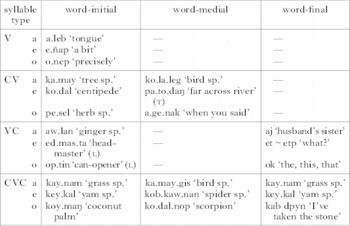
Syllable structure in Kalam is maximally CVC, and minimally V. The full range of syllable types is illustrated in Table II. As discussed above, words are underlyingly C-final; therefore, V and CV syllables are not found word-finally in the lexicon. Vowel-initial V and VC syllables (where V=/a e o/) are common word-initially, but not found medially in underlying forms. (Recall that glide vocalisation can result in V-initial surface syllables, as in /kyep/ [ˈkiˑˈeˑp].) There are also very few words with underlying medial CV syllables in V.CV.CV strings: it is likely that most sequences of open syllables have undergone historical syncope of *VCVCV>VCCV (see §4). Compare, for example, conservative Ti Mnm /pa.to.daŋ/, shown in the word-medial column of Table II, and its reduced Etp Mnm counterpart /patdoŋ/ [ˈφaˑrɨˈndoˑŋ]. As noted earlier, in word-medial intervocalic CC clusters where the first C is not a glide or /s/, a consonant is released, with a predictable vowel appearing. The forms in Table II with medial C.C clusters do not show predictable vowels, and were chosen to illustrate unambiguous phonological and phonetic CVC syllable types. Predictable vowels are absent in these forms either because the first consonant is a glide (/kay.nam/) or because there is a phonological word-boundary between the consonants: e.g. /kodal nop/ ‘scorpion’, from /kodal/ ‘centipede’, /nop/ ‘father’; /kab dpyn/ [ˈkamp.dɨ.ˈßiˑn], from /kab/ ‘stone’, /dpyn/ ‘I have taken’. In this latter example, the word-final position of /kab/ is evident both in the absence of a predictable vowel before the next consonant, and in the final devoicing of /b/.
Syllable types.

A final aspect of Kalam sound patterns that needs to be introduced is word stress. Every Kalam phonological word has at least one word stress, and many have multiple stresses. There is no clear evidence for primary vs. secondary stress within the word. Basic rules of stress placement are shown in (14), and stated in terms of vowels as stress-bearing units.Footnote 17
(14)
The rules in (14) are well known from metrical stress theory (Hayes Reference Hayes1995): (14a) assigns stress to the last stress-bearing unit, ‘end-rule final’, (14b) assigns stress based on vowel-quantity (see Table I), a case of quantity-sensitivity, or ‘weight-to-stress’, and (14c) assigns initial stress, an instance of ‘end-rule initial’ with clash avoidance. Since predictable vowels may be stressed by (14a) or (c), a derivational model must order vowel insertion before stress assignment.
The basic stress rules in (14) are illustrated in (15), where ‘v’ represents a predictable vowel. (15a–d) have non-predictable (full) vowels only. (15e–h) are words with only predictable (reduced) vowels. (15i–l) have a mix of vowel types.
(15)
The rules in (14) account for the majority of surface stress patterns, including inflected verbs (16a) and compounds (16b).Footnote 18
(16)
3.2 Kalam predictable vowels
As highlighted earlier, in addition to vocalised glides, two kinds of vowels can be distinguished in Kalam: the full vowels /a e o/, which are stable, of unpredictable quality, always stressed, of relatively long duration and limited to word-initial and word-medial positions, and predictable vowels. Predictable vowels, as already noted, are of relatively short duration, occur predictably between consonants within the word, never occur word-initially and are only stressed in final syllables (14a) or in initial syllables preceding unstressed vowels (14c). In this section we provide further details of the phonology of Kalam predictable vowels. Our aim is to show that Kalam predictable vowels are neither ‘epenthetic’ nor ‘intrusive’ in the sense of Hall (Reference Hall2006), and to explain aspects of their mixed status.
3.2.1 Why Kalam predictable vowels are not ‘intrusive’ vowels
Hall's class of intrusive vowels are phonologically invisible. The most obvious property of Kalam predictable vowels that eliminates them from ‘intrusive’ vowel candidacy is the fact that they are stressed by the regular stress rules (14a) and (14c) in word-final and word-initial positions respectively. Examples of stressed intrusive vowels were given in (15) and (16). Some of these are repeated in (17), along with other examples of lexically vowelless words. Although it is possible to view all the vowels in (17) as simple transitions from one consonant to the next, it is not possible to analyse all predictable vowels as phonologically invisible, since some of them carry stress.
(17)
Another aspect of Kalam predictable vowels which would appear to eliminate them from the ‘intrusive’ vowel class is their dual function. Though in many cases, like (17), they can be viewed as simple transitions from one consonant to the next, this is not the case for all words. In one small class of words, predictable vowels are ‘epenthetic’, in the sense of serving to repair illicit structures. The small class of words in question, shown in (18), are those that Pawley (Reference Pawley1966) analyses as phonologically monoconsonantal.Footnote 19
(18)
When these morphemes are uttered as independent phonological words, predictable vowels occur. However, as shown in (18), when these morphemes are part of bigger words and followed immediately by a vowel, the monoconsonantal realisation is found. The predictable vowels in isolation forms cannot be interpreted as transitions from one consonant to the next, for the simple reason that there is no following consonant. In this case, it seems that what triggers the appearance of the stressed predictable vowel is the constraint stated in (19) that a minimal word must consist of at least one syllable which itself can carry word stress. Predictable vowels in (18) then serve to bulk subminimal words up to minimal words by adding a final vowel.
(19)
As noted in §3.1, accounting for the monosyllabic isolation forms in (18) in terms of predictable vowels seems preferable to positing underlying vowels for three reasons. First, as with other predictable vowels, the quality and position of these vowels is rule-governed. Second, if underlying vowels are posited in these words, they would be the only underlying vowel-final words in the language. Third, if underlying central vowels are posited in these words, they would be the only underlying central vowels in the language. We conclude, then, that the predictable vowels in (18) serve a clear ‘repair’ function: phonological words consisting of only a single consonant are too small to constitute minimal words, and are bulked up to stressable CV syllables by this process. In these cases, the predictable vowel has properties of an epenthetic vowel, not an intrusive vowel.
Stressability is the most salient property of Kalam predictable vowels that eliminates them from Hall's intrusive vowel category. At the same time, the quality of Kalam predictable vowels is not precisely what one expects under Hall's intrusive classification either. Recall from (5) two heuristics regarding the quality of intrusive vowels, repeated as (20a).
(20)
Kalam predictable vowels are sometimes schwa (the first four examples in (18)), and sometimes a copy of a nearby vowel, or influenced by the place of surrounding consonants (21i–r): (21i–l) show the regular pattern of palatals triggering a following short [i], (21m–n) show optional [i] preceding palatals, (21o–q) show [u] after /w/ and (21r) shows optional [u] before /w/. These assimilatory patterns are the expected type for intrusive vowels, in line with (20a). However, the most common realisation of the Kalam predictable vowel is [ɨ] (21a–d), a high central vowel.Footnote 20 Further, when the vowel quality is a copy of another vowel over an intervening consonant, the intervening consonant need not be a sonorant or guttural, as per (20b). Rather, as shown in (21e–h), there are no clear restrictions on the nature of intervening consonants, and full anticipatory vowel copy or harmony is optional, and unbounded within the word (21g).
(21)
A final aspect of Kalam predictable vowels which make them unlike Hall's intrusive vowels is their invariability. In (5d) intrusive vowels are described as ‘likely to be optional’ and ‘have a highly variable duration or disappear at fast speech rates’. However, apart from the VsCV and VGCV contexts discussed in §3.1, Kalam predictable vowels do not show this property. Though they are short, they do not disappear altogether at fast speech rates.
The fact that Kalam predictable vowels can be stressed seems to rule them out as canonical invisible ‘intrusive’ vowels. Where vowel quality and variability is concerned, Kalam predictable vowels do not pattern with intrusive vowels either. We conclude that Kalam predictable vowels are not instances of intrusive vowels in the sense of Hall (Reference Hall2006).
3.2.2 Why Kalam predictable vowels are not ‘epenthetic’ vowels
If Kalam predictable vowels are not intrusive vowels, then perhaps they are epenthetic vowels. Recall that epenthetic vowels are phonologically visible. In addition, they serve to repair otherwise illicit structures. The fact that Kalam predictable vowels can be stressed is consistent with phonological visibility. Further, we have seen in (18) that some predictable vowels in Kalam serve to repair illicit structures by bulking up subminimal words.
In addition, there is another set of contexts where predictable vowels may be viewed as epenthetic. Recall from (12) and (13) that, though predictable vowels occur word-internally between nearly all CC sequences, they are rare in VC1.C2V when C1 is /y/ or /w/, and optional when C1 is /s/. However, in C1C2 clusters where C1 is /y/, /w/ or /s/, and one or both of the consonants are unsyllabifiable, a predictable vowel is obligatory. Examples are given in (22), and suggest that, at least in a limited set of contexts, predictable vowels in Kalam are epenthetic in the sense of creating well-formed CV or CVC syllables.
(22)
Given that predictable vowels can be stressed, bulk up subminimal words and create well-formed syllables, in what way are they not instances of Hall's class of epenthetic vowels? Recall from our earlier discussion that not all predictable vowels appear to serve the bulking or syllabification function. In particular, word-medially in VC1C2V strings, a predictable vowel is obligatory between the two consonants, provided that C1 is not /y/, /w/ or /s/. In this position, they serve neither the bulking function nor the syllabification function, since coda consonants are the norm word-finally: /an/ [ˈaˑn] ‘who’ in isolation, /an kun agak/ [ˈaˑnˈkuˑˈnaˑˈŋgaˑk] ‘who said so?’ with [nk] in sandhi, but /an-ket/ [ˈaˑnˈɣeˑr] ‘whose?’ (12g), /anwak/ [ˈaˑnuˈwaˑk] ‘co-wives’ (12h), where the word-internal CC cluster is split by a predictable vowel.
Though Hall (Reference Hall2006: 407) says explicitly that ‘epenthesis … is a way of repairing syllables that violate a language's abstract structural rules’, she also uses a broader definition, where an epenthetic vowel simply ‘removes a marked structure’ (Hall Reference Hall2006: 393). Under this broad definition, Kekchi morphologically conditioned vowel insertion between C-final roots and certain C-initial verbal suffixes is treated as epenthesis: ‘CC clusters are avoided in many languages, so the epenthesis removes a marked structure’. However, apart from this vowel-insertion process itself, there is no evidence that CC clusters are marked in Kekchi.Footnote 21 Furthermore, in the majority of languages where CC clusters are avoided, it is possible to restate the generalisation in syllabic terms: avoidance of medial CCC and final CC in Yokuts is attributed to a maximal CVC syllable template (see note 4). More generally, since this broader definition of epenthesis allows any process of vowel insertion to be functionally defined as epenthesis on the basis of some markedness constraint, it is not particularly useful in distinguishing vowel insertion types. Nevertheless, we briefly consider two ways that all Kalam predictable vowels, including those inserted between medial VCCV clusters, might be analysed as repairing illicit or marked structures, and show how each falls short of descriptive adequacy.
One possibility is to view Kalam predictable vowels as repairing not syllable structure, but word phonotactics. Under this view, Kalam predictable vowels are inserted to eliminate word-internal consonant clusters. A general statement of the constraint is *CC, where the relevant domain is the phonological word.Footnote 22 Words illustrating the general nature of this constraint across different consonant types are shown in (23). Wherever possible, underlying VCCV strings are used for illustration, since predictable vowels inserted between clusters in this context cannot be viewed as serving a word-bulking or obligatory syllabification function. (O=obstruent, R=sonorant, N=nasal, Ci=place feature identity).
(23)
Recall, however, that there are two systematic exceptions to this statement: the glides /y w/ and the fricative /s/ need not be followed by predictable vowels within the word when preceding another consonant, as illustrated in (12k–r), with further examples in (24). After glides, the predictable vowel is more often absent (24a). After /s/, it is usually variable (24b). These exceptions make it difficult to state a general *C1C2 constraint, since for C1 /y w s/ must be excluded, but for C2 the same consonants must be included (24c).Footnote 25
(24)
We suggest that the generalisation being missed by *CC, or any structural constraint, is that /y w s/ are the only consonants in Kalam which lack a phonetic release. Since the glides are vowel-like, there is neither closure nor release. Similarly, the fricative /s/ involves a constriction, but no closure, and therefore no release. All other consonants in Kalam are stops, or in the case of /l/, involve central closure and release (7a). Once this generalisation is taken into account, the distribution of predictable vowels in words like those in (23) can be related to conditions on consonant release, as stated in (25).Footnote 26
(25)
The simple conditions in (25) are the kind associated with Hall's ‘intrusive’ vowel class. Vowels associated with consonant release do not seem to have the function of repairing illicit structures. Further, the consonant clusters in which the vowel occurs may be less marked (e.g. RO in VR.OV) than clusters which surface without vowel insertion in the same language (e.g. sR in Vs.RV).Footnote 27 In addition, the conditions in (25) are natural: there are many languages in which consonants are released word-internally (e.g. Moroccan Arabic), and many others where they are unreleased word-finally (e.g. Cantonese).Footnote 28 Under this analysis, predictable vowels appearing in words like (23) are not epenthetic, though other predictable vowels like those in (18) may serve an epenthetic function. Before providing further arguments along these lines, we consider one other potential analysis where Kalam predictable vowels like those in (23) would serve to ‘repair marked structure’.
Instead of a ban on CC clusters within the word, predictable vowels in forms like (23) could be attributed to a constraint demanding that ‘all syllables be open’, where this constraint holds word-internally, but not word-finally. Within an optimality treatment this would involve a ranking of FinalC (‘prosodic words must end in consonants’) over NoCoda (‘syllables should be open’) over Dep (‘no epenthesis’). There is at least one technical problem with this account: monoconsonantal words like those in (18) surface with final predictable vowels, suggesting that for these derivations it is NoCoda which dominates FinalC, not the reverse. Since technical problems within OT grammars can always be solved by invoking additional constraints, we turn to a more fundamental problem with the analysis. This, again, concerns the data like that in (24a, b), where glides and /s/ can close word-medial syllables. Even if a mechanical solution is proposed where predictable vowels are inserted everywhere, but deleted optionally after glides and /s/, or where glides and /s/ are preferred word-medial codas, there is no explanation for why glides and /s/ form a natural class for optional deletion or preferred coda status. In contrast, under the analysis proposed in (25), release or ‘open transition’ between two segments will, in part, depend on the phonetic nature of the segment involved: if it does not involve closure, then there will be no release, or no significant or audible open transition. In sum, though it is possible to view some predictable vowels in Kalam as epenthetic in the sense of Hall (Reference Hall2006), not all submit to analysis in these terms. In particular, seeming transition vowels in word-internal VC.CV sequences, like those in (23), seem best analysed as non-overlapping consonant gestures, where word-medial consonants are released (25).
A further property which sets Kalam predictable vowels apart from both canonical epenthetic and intrusive vowels is consonant-cluster splittability. Hall's intrusive vowels generally appear in heterorganic clusters (5c), and regular rules of vowel epenthesis have been claimed to respect geminate integrity, failing to split morpheme-internal geminate clusters (Kenstowicz & Pyle Reference Kenstowicz, Pyle, Kenstowicz and Kisseberth1973, Guerssel Reference Guerssel1977).Footnote 29 The examples in (23) show, however, that Kalam predictable vowels are found between any two word-internal consonants, including sequences of obstruent–obstruent (a), sonorant–sonorant (b), obstruent–sonorant (c), sonorant–obstruent (d), homorganic nasal–obstruent (e) and identical (geminate) morpheme-internal consonant sequences (f).
Finally, as noted in the preceding subsection, the quality of Kalam predictable vowels results in their classification as intrusive, not epenthetic vowels. As illustrated above in (21), Kalam predictable vowels can be central, a copy of a nearby vowel or influenced by the place of surrounding consonants, exactly as Hall describes for intrusive vowels (5a). The quality of predictable vowels is not fixed, but highly variable and sensitive to phonetic context (16b).
The fact that Kalam predictable vowels do not always serve to repair illicit structures seems to rule them out as classical epenthetic vowels. In particular, their word-internal function between consonants in VCCV contexts appears to be primarily one of release or open transition, regardless of cluster composition (25). Kalam predictable vowels have variable quality, determined by the phonetics of surrounding vowels and consonants, another characteristic atypical of epenthetic vowels. We conclude that, although Kalam predictable vowels are phonologically visible for stress, they cannot all be fruitfully analysed as instances of epenthetic vowels in the sense of Hall (Reference Hall2006). In sum, Kalam predictable vowels appear to have mixed properties. In terms of quality, and certain aspects of their distribution, they mimic intrusive vowels. In terms of stressability, and a subset of their functions, they are more like epenthetic vowels. In the following section, we suggest that the synchronic mix of properties exhibited by Kalam predictable vowels is partly explained by their historical origins.
3.3 Kalam predictable vowels as ‘remnant’ vowels
Recall from §2 that Hall's account of intrusive vowels is based on their source in articulatory retiming of consonant gestures. If clusters of properties exhibited by predictable vowels are in part attributable to their source, and if articulatory retiming is not the sole source of predictable vowels, then we should not be surprised if Hall's synchronic typology appears inadequate or incomplete. Given other pathways of synchronic vowel–zero alternations, we might expect other predictable vowel types, with a mix of the properties in (4) and (5), or additional properties of their own. We have demonstrated above that Kalam predictable vowels have a mix of properties in (4) and (5), as listed in (6a–f). In addition, they appear, in some cases, to be related to consonant-release features (6g). A final property of Kalam predictable vowels is that their absence in lexical representations results in long strings of consonants, and words that may lack vowels altogether (6h): /kslm/ ‘night, darkness’, /lknm/ ‘small frog sp.’, /plkd/ ‘wing’, /sblŋ/ ‘umbilical cord’, /ssnm/ ‘wild millet’, /pkcg/ ‘fasten’, /kñgld/ ‘vine sp.’, /pktbk/ ‘attach’, /pkpnp/ ‘I could have hit’, /mdnknŋ/ ‘while I was staying’, /pbtknknŋ/ ‘while I was fastening’. Though this property might seem unique to Kalam, we show in §4 that it is typical of languages with the same mixed type of predictable vowels, and therefore worthy of explanation.
In the remainder of this section, we explore the historical origins of Kalam predictable vowels, and suggest ways in which their mixed properties follow from these origins. We will refer to predictable vowels with Kalam-like properties as ‘remnant’ vowels. Remnant vowels are historical traces of vowel reduction and loss, found sometimes in their historical positions, and sometimes elsewhere. Though synchronically, their distribution can be predicted by insertion algorithms, diachronically they reflect inversion of unstressed reduced vowel loss. Since remnant vowels evolve from reduced vowels, they share many of the properties of reduced vowels: they are typically unstressed, very short and greatly influenced by coarticulatory effects.Footnote 30 Unlike Hall's ‘intrusive’ vowel category, remnant vowels are not a rephasing of existing gestures which result in vowel-like percepts. For this reason, they have none of the articulatory hallmarks of intrusive vowels: they are not generally limited to heterorganic clusters, and they do not have a highly variable duration. Like epenthetic vowels, remnant vowels do involve synchronic ‘insertion’ in the generative sense, leading to true vowel–zero alternations, as in data like (18) above. Unlike epenthetic vowels, remnant vowels may not serve any obvious function: as in Kalam, they may simply reflect former positions of unstressed reduced vowels, and nothing more.Footnote 31
As noted earlier, Kalam is one of two members of the Kalamic group, the other being Kobon. Historical work on Kalamic is not extensive, but includes Pawley & Osmond (Reference Pawley and Osmond1998), Pawley (Reference Pawley, Pawley, Ross and Tryon2001, Reference Pawley2008) and Coberly (Reference Coberly2002). Of these works, only Pawley (Reference Pawley, Pawley, Ross and Tryon2001) and Coberly (Reference Coberly2002) deal with the phonological history of Kalamic as such. Of the two dialects of Kalam, Ti Mnm and Etp Mnm, Ti Mnm is more conservative phonologically, with more full (vs. predictable) vowels, and syllable-final /l/, which has often vocalised in Etp Mnm.
Our working hypothesis is that historical vowel reduction/deletion led to a restructuring of parts of the Kalam phonological system, with its many predictable vowels. Some predictable vowels in Kalam are true remnants of once-present reduced vowels, while others are non-etymological consequences of reanalysis. Vowel reduction should occur where vowels are unstressed. Although we described Kalam word stress above as falling on final vowels as well as on all full vowels, we did not mention an important fact about Kalam stress: in phrasal contexts, all but the last stress tends to be subordinated, weakened or lost. Since many morphemes and words in the language will often be in non-phrase-final position, they may be unstressed, and therefore targets of vowel reduction. It is this stress subordination at the phrasal level that seems to have given rise to significant vowel reduction in the Kalamic group.
As preliminary evidence for this hypothesis, we note that vowel reduction is an ongoing process in Etp Mnm, and, to a lesser extent in Ti Mnm, as evidenced by full and reduced variants of many words. Consider the word /jwn/ ‘head’ in (26a). While this noun can occur alone in a noun phrase, it is often a modifier, as in: /jwn-bad/ ‘head-like appendage’, /jwn kas/ ‘head hair’, /jwn mok/ ‘brain’, etc. In fast speech, when /jwn/ is not in phrase-final position, it is often reduced to /jn/ [dyin]. The situation is similar for /swd/ ‘sword-grass sp.’. Though this word can occur alone, referring to the taxon, it is very common as a modifier, as in: /swd aydk/ ‘common sword-grass’, /swd yŋleb/ ‘Thysanolena maxima’, /swd magi/ ‘seed-heads of sword-grass’, etc. In these contexts, it is often reduced to /sd/. In (26) we list all words noted with fast-speech reduced forms from Pawley & Bulmer (Reference Pawley and Bulmer2003). In most cases, it is the surface vowel [u] (from vocalised /w/) that is reduced (26a, b). In two examples, (26b), a vowel is reduced between identical consonants, suggesting a historical source for the many words like those in (23f) with initial identical consonants. Though this might seems a minor point, a cross-linguistic generalisation holding of epenthesis into seeming geminate clusters is that, in all known cases, the historical sound change in question giving rise to this sound pattern was unstressed vowel loss between identical consonants (Blevins Reference Blevins2004: 184–188, Blust Reference Blust2007). In (26c), the first /a/ in CaCaC is reduced. Though we refer to this process as vowel reduction, based on the difference between surface forms in (26), following our account of predictable vowels above, it appears to involve vowel deletion at the lexical level.
(26)
Stronger evidence for predictable vowels having sources in historical vowel reduction/deletion is found in comparative data from the two major Kalam dialects and Kalam's closest relative, Kobon. In (27), where Ti Mnm has an underlying full vowel /a e o/ (in bold), the Etp Mnm cognate has no lexical vowel, but shows a predictable vowel in the same position, underlined in the broad phonetic transcription.
(27)
Since one can only predict the reduced vowel from the full vowel, and since minimal pairs like Ti Mnm (27a) and (b) are associated with homophones in Etp Mnm, the data supports the hypothesis that predictable vowels are remnants of vowel reduction at the phonetic level, and vowel loss at the lexical level. For four of these forms, (a–c, f), Kobon cognates exist (namely Kobon /pak-, pa-/ ‘hit, strike’, /po/ ‘ripe’, /pöd/ ‘yam (generic)’, /mɨlep/ ‘dry’) and in each case these support the hypothesis that Ti Mnm is conservative in retaining a full vowel.
Some of the cognate sets in (27) also lend support to the association between vowel reduction and phrasal stress subordination mentioned above. Recall our observation above that non-final words within the phrase may be produced without lexical stress. This means that words which are first elements of compounds or set phrases will occur unstressed at higher frequencies than other words. One class of words of this kind in Kalam are generics, like (27c): /ped/, /pd/. In Kalam, this lexeme is found as first member of a number of longer phrases referring to kinds of yams, yam parts, tools relating to yam cultivation and so on. Examples include Etp Mnm /pd kolem aydk/ ‘wild yam sp.’, /pd sgoy/ ‘wild yam sp.’, /pd magi/ ‘aerial tuber of wild yam’, /pd kot/ ‘yam pole (for staking vines)’, /pd sbel/ ‘narrow base of yam tuber’ and /pd yŋ/ ‘section cut from yam tuber for use as seed’. If this was an isolated example, it would not lend much support to the stress-subordination hypothesis, but many lexically vowelless words like (27c, d) appear to be more common in phrase-initial or medial position than in phrase-final position.
A further interesting fact which may lend support to the stress-subordination hypothesis is the existence of homophones in Ti Mnm, where one form is reduced in Etp Mnm and the other is not. Three quite common homophones in Ti Mnm are shown in (28) with their Etp cognates, as well as examples indicating common usage. The lexeme /tep/ ‘good’, which has not undergone reduction in Etp Mnm, is common in phrase-final position (28a). Two homophones in Ti Mnm, /tep/ ‘place (generic)’ (28b) and the adverb /tep/ ‘again, once more’ (28c) have different syntactic distributions. As discussed above for /ped/, generics are common in initial position of phrases which refer to specific attributes of the generic. The examples in (28b) illustrate the same principle for this lexeme. Finally, the examples in (28c) show the positioning of the adverb /tp/ before the verb; in this construction type, the adverb is not in non-phrase-final position.
(28)
We highlight these facts because they may support vowel reduction as a function of phrasal stress subordination. However we should stress that the subordination hypothesis will remain speculative until a fuller study of Kalam phrasal prosody is carried out. If vowels which are more often subject to reduction are those which are lost first, then a more general aspect of sound change is supported: where sound change is due to variation along the hyper-to-hypoarticulation continuum, frequency of reduced tokens can play an important role in the reanalysis of lexical forms (Bybee Reference Bybee2001, Blevins Reference Blevins2004: 36–37).
Comparison of Kalam and its sister language Kobon also supports the view that Kalam predictable vowels were historically full vowels that have undergone reduction and (in some cases) loss. Cognate sets are presented in (29), with Kobon data from Davies (Reference Davies1980, Reference Davies1981, Reference Davies1985). Where more than one form is cited for Kobon, these reflect dialectal variants. A slash separates strings being compared. Kobon full vowels which are absent in Kalam are printed in bold. In reconstructions, ‘V’ indicates a vowel of indeterminable quality. (29a–j) show reduction/loss of vowels which are not in absolute initial or final position, and which, following Davies (Reference Davies1980), are not predictable in Kobon. In (29a–e) we see evidence of regular Proto-Kalamic *s>h in Kobon; while (29f–h) show Kobon regular lenition of Proto-Kalamic coda *k>∅. The Kobon forms with final vowels in (29k–t) are cognate with C-final forms in Kalam. Kobon stress is synchronically penultimate (Davies Reference Davies1980: 58–59), and it is clear, even in Kobon, that word-final vowels are being reduced and lost (29q), though again, these vowels are not predictable in Kobon.Footnote 32 This sound change has come to completion in Kalam, where, as noted earlier, there is evidence that at the phonological level, all words are C-final. Vowel loss in Kalam has occurred initially as well, as exemplified in (29u). There is also external evidence for some of the Proto-Kalamic reconstructions in (29). For example, Proto-Kalamic *kabV (29l) is part of a widespread cognate set for which Pawley (Reference Pawley2008) reconstructs Proto-Trans New Guinea *ka(mb,m)u[CV]. Another reconstruction with external support is Proto-Kalamic *sib (29d), a reflex of Proto-Trans New Guinea *simb(i,u). Additional Proto-Trans New Guinea (PTNG) reconstructions with zero vowel reflexes in Kalam include PTNG *nVŋg- ‘know, see, hear’>Kalam /nŋ/, /ng-/ (t), PTNG *imbi ‘name’>Kalam /yb/, PTNG *ambi ‘man’>Kalam /b/, PTNG *pana(a,e) ‘woman, girl’>Kalam /pañ/, PTNG *takVn(V) ‘moon’>Kalam /takn/, PTNG *mundun-maŋgV ‘heart’>Kalam /md-magi/.
(29)
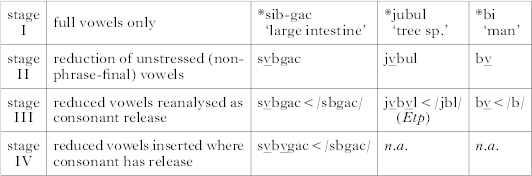
In sum, there is ample evidence that some Kalam predictable vowels are the remnants of once full vowels. When these vowels are in phrasal positions in which lexical stress is subordinated to phrasal stress they are reduced. If such reduced forms become frequent enough, they replace former lexemes with full vowels. At the stage where every (or nearly every) consonant-to-consonant transition within the word has a reduced transition vowel, the language learner may reverse the historical process of vowel loss/reduction, and assume that these transition vowels are inserted.Footnote 33 We summarise the historical developments in Table III, with representative forms.
Vowel reduction reanalysed as vowel insertion, leading to predictable vowels.
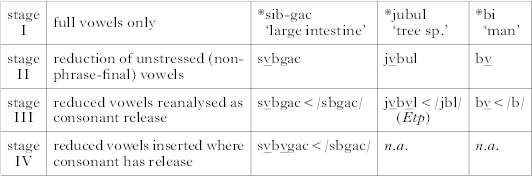
The phrasal nature of reduction, combined with the fact that words can be pronounced as independent phrases, means that even without a shift in the stress system, vowels reduced in Table III are still potentially stress-bearing in some contexts. This allows us to explain why the seemingly predictable reduced vowel in Kalam can be stressed in word-final syllables.Footnote 34 Stage III, where reduced vowels are analysed as consonant release, allows us to explain the seemingly odd distribution on non-historical vowels in VC.CV contexts: as in the reflex of *sabliŋ ‘umbilical cord’, Kalam /sblŋ/ [ˈsɨmbɨˈlɨŋ], vowels appear in the context of consonants which have a closure release. Finally, the analysis sketched above makes it clear why long strings of consonants may arise in languages which have undergone this pathway of predictable vowel evolution: if all but phrase-final vowels are potentially unstressed and reduced, and if all reduced vowels are ultimately reinterpreted as lexically absent, strings of consonants and vowelless words are expected.
4 Remnant vowels in a broader perspective
Both Levin (Reference Levin1987) and Hall (Reference Hall2006) propose typologies of predictable vowels with two types: phonologically present (lexical) vowels, and phonologically absent (non-lexical) vowels. Within Hall's typology, a further proposal is made that phonologically absent vowels are ‘intrusive’ vowels. In addition to offering new diagnostics for intrusive vowels, Hall (Reference Hall2006) claims that her gestural analysis is able to account for three general properties of intrusive vowels: their quality (copy vowels or schwa-like), their distribution (typically restricted to heterorganic clusters) and their variability (likely to be absent in fast speech). She also shows how intrusive vowels develop diachronically from retiming of consonant-to-consonant transitions.
However, retiming of consonant-to-consonant transitions is only one pathway by which predictable vowels can arise. The present study suggests that the typology of predictable vowels be expanded to include vowels from other historical sources. In Kalam, we have found predictable vowels which defy description within the previous typology. Kalam predictable vowels are similar to intrusive vowels in terms of their quality, and their distribution. But Kalam predictable vowels can be stressed, and so cannot be phonologically invisible. Furthermore, they are common between identical (homorganic) consonants. We have suggested that the seemingly mixed properties of Kalam predictable vowels follow from their history in vowel reduction and reanalysis. Unlike intrusive vowels, predictable vowels in Kalam do not have their origins in elongated consonant-to-consonant transitions. Rather, a clear historical process of vowel reduction has been documented, leading us to classify Kalam predictable vowels as remnant vowels with the properties described in (6), and repeated as (30).
(30)
Of particular interest are two new properties associated with predictable vowels: association with consonant release (30g) and long consonant strings in the lexicon (30h). Under earlier treatments (e.g. Levin Reference Levin1987), association with consonant release was a typical property of non-lexical (excrescent) vowels, but the same vowels were expected to be invisible to stress and other phonological patterns. Long strings of consonants in the lexicon have, as far as we know, not been generally associated with the existence of any predictable vowel type in the literature.
Is it possible that other cases of predictable vowels with sources in unstressed vowel reduction may have a similar profile? Languages classified by Hall (Reference Hall2006) as having intrusive vowels include Imdlawn Tashlhiyt Berber, Tiberian Hebrew, Mokilese, Piro and Upper Chehalis (Coast Salishan). Since all of these languages have known histories of vowel reduction, a careful review of predictable vowel phonology may reveal that their properties are not entirely explained by the articulatory model. This appears to be the case for Tashlhiyt Berber (Dell & Elmedlaoui Reference Dell and Elmedlaoui1985, Reference Dell, Elmedlaoui, Durand and Laks1996a, Reference Dell and Elmedlaouib, Coleman Reference Coleman, Ohala, Hasegawa, Ohala, Granville and Bailey1999, Reference Coleman2001). In this Berber language, as in Kalam, words may consist entirely of consonants at the lexical level. And, as in Kalam, predictable vowels occur on the surface, and may be stressed. Though Hall classifies these as ‘intrusive’ vowels, due to their quality, distribution and variability, the fact that Berber intrusive vowels can be stressed seems to argue for their phonological visibility. It is not surprising then, that in the literature cited above, there is some debate as to the synchronic status of these vowels.
Other predictable vowels with profiles similar to those in Kalam are found in other Papuan languages of New Guinea. The analysis of short high-to-mid central surface vowels has been problematic in many languages of the Sepik area, including the Wosera dialect of Abelam (Ndu family), as sketched by Laycock (Reference Laycock1965), Alamblak, as analysed by Bruce (Reference Bruce1984: 61–70), and Yimas (Lower Sepik family), as treated by Foley (Reference Foley1991: 44–50). In all of these languages, vowelless words and strings of consonants are found in the lexicon. In Wosera, the mixed status of the central vowel is analysed by Laycock (Reference Laycock1965: 44) in terms of two kinds of schwa: a phonemic schwa and a ‘linking schwa’. The linking schwa occurs word-internally between heteromorphemic consonants in VC1-C2V, similar to the Kalam patterns in (20), except where C1 and C2 are identical or homorganic. Here, as in Kalam, the presence of the linking vowel is tied to release, since it is stated explicitly that the first of a sequence of homorganic consonants is not released. In Bruce's (Reference Bruce1984: 62–63) analysis of Alamblak, underlying central high/mid vowels are also distinguished from predictable vowels of the same quality, since there are a range of consonant clusters where the presence vs. absence of a transition vowel appears to be lexically determined. While predictable vowels are invisible for subparts of the stress-assignment algorithm and for a phonological process of low vowel dissimilation, the same vowels can be stressed as a last resort, showing simultaneous phonological visibility and invisibility. Similar sound patterns are found in Yimas, where Foley (Reference Foley1991: 46–49) also proposes underlying and epenthetic high central vowels. Epenthesis of [ɨ] in Yimas occurs between all underlying clusters which are impermissible surface clusters in the language. Unlike Wosera and Kalam, the predictable vowel is never inserted at a syllable boundary. While Yimas [ɨ] comes closest to a canonical epenthetic vowel, it also shows mixed visibility with respect to stress. In the primary and secondary stress rules stated by Foley (Reference Foley1991: 75), input includes only underlying vowels. However, as in Alamblak, the same predictable vowels can be stressed as a last resort. In Yimas, a surface phonetic constraint requires that one of the first two vowels carry primary stress: if both are predictable [ɨ], then primary stress falls on the first of these (Foley Reference Foley1991: 77).
The recognition of remnant vowels as a distinct predictable vowel type may also assist with analysis of newly discovered predictable vowels. A recent finding of this kind involves a non-Papuan language of Papua New Guinea. The Selau dialect of Halia, an Oceanic Austronesian language of the northern tip of Bougainville, is described by Blust (Reference Blust and Lynch2003) as having predictable schwa in words which, lexically, have no vowels. Historically, most of these forms result from high vowel reduction and loss. Representative Selau forms are shown in (31), with Proto-Oceanic reconstructions.
(31)
Notice that, as in Kalam, some predictable vowels appear to reflect historically reduced vowels, while others do not. Blust (Reference Blust and Lynch2003: 149) is explicit on this point: final high vowels were lost in Selau; where a word-final schwa is pronounced, as in (31a, c, e), it is ‘little more than a transitional vowel permitting speakers to pronounce what would otherwise be a disallowed final consonant cluster’. Supporting the view that Selau schwas are intrusive vowels within Hall's (Reference Hall2006) typology, is the fact that such vowels are not fixed in position. Words like /lma/ ‘hand/ (< Proto-Oceanic *lima) can be pronounced as [ləma] or [əlma]: ‘such free variation suggests that the schwa in these forms is little more than an automatic facilitating vowel which enables speakers of the language to pronounce the underlying consonant clusters in lma and lsa respectively’ (Blust Reference Blust and Lynch2003: 148). If schwa is intrusive, then, under Hall's classification, it is expected to be phonologically invisible. However, this is not the case. Although Blust's (Reference Blust and Lynch2003) description, based on his own fieldnotes, does not show stress, Capell's (Reference Capell1963) 100-item Selau wordlist does. Selau stress is usually on the penult, and in penultimate position, schwa is stressed: [aˈsn∊n] ‘her breast’, [ˈnnta] ‘egg’ (where Capell uses long ‘n’ instead of schwa), [lmˈlmou] ‘wind’ (cf. Proto-Oceanic *timu(R) ‘wind bringing light rain’; Ross et al. Reference Ross, Pawley and Osmond2003: 131). Again, we appear to have an instance of a predictable vowel which is neither ‘intrusive’ nor ‘epenthetic’. Rather, due to regular vowel reduction and loss, and the inversion (and extension) of this historical process, predictable vowels in Selau are remnant vowels. Selau remnant vowels facilitate the pronunciation of consonant sequences at the phonetic level, but, at the same time, are phonologically stress-bearing.Footnote 35
Broader implications of this study relate to relationships between contemporary sound patterns and sound change. Blevins (Reference Blevins2004, Reference Blevins2005, Reference Blevins and Good2008) has argued that many aspects of sound patterns reflect recurrent patterns of sound change. In two specific areas, typologies have been expanded in significant ways. In the study of geminate inventories, Blevins (Reference Blevins2004, Reference Blevins2005) shows a close match between pathways of geminate evolution and geminate inventory composition: small geminate inventories are typically the result of local restricted consonant assimilations, while full inventories of geminates are common results of post-tonic lengthening and vowel loss between identical consonants. Where earlier studies of geminate inventories attempted to account for composition in terms of natural classes (sonorants, obstruents, etc.), the strongest predictor of geminate inventory composition appears to be pathway of geminate evolution.
Closer in content to the vowel–zero alternations examined here are typologies of consonant epenthesis. Blevins (Reference Blevins and Good2008) proposes a major three-way division: (i) consonant epenthesis arising from phonetically transitional intervocalic glides, or glide percepts, (ii) consonant epenthesis from phonologisation of laryngeal boundary marking and (iii) consonant epenthesis from inversion of historical coda loss. In addition to these three major types, subsequent fortition of glides arising from (i) can result in synchronic obstruent epentheses. Each type has a set of expected segmental and distributional properties which distinguish it from the others. Consonant epentheses with sources in V-to-V transitions typically give rise to segments /j w/, and are found intervocalically, but not word-initially or finally. Consonant epentheses based on phonologisation of laryngeal boundary markers generally show themselves as /h ʔ/, and are most common word-initially and word-finally. Consonant epentheses which have origins in weak coda loss show alternations in derived environments, where consonants are those most subject to coda weakening.
In the body of this paper, we have focused on the description and analysis of predictable vowels in Kalam, and implications of this analysis for a typology of predictable vowels. We have shown that a simple two-way division between intrusive phonologically invisible vowels and epenthetic phonologically visible vowels is too restrictive, and that ‘remnant’ vowels of the Kalam type should also be included. Further, we have shown that the origins of Kalam predictable vowels in historical vowel reduction and loss account for the mixed synchronic properties they exhibit, and the long strings of consonants posited in lexical forms. Given other pathways of vowel evolution, other types of predictable vowels are expected. In (32) we list at least six distinct identifiable pathways by which predictable vowels can arise from natural phonetic processes and reanalysis (i.e. historical rule inversion), and suggest typological classifications based on their known properties.Footnote 36
(32)
A full treatment of these alternative pathways and the predictable vowels types associated with them begs for future study. For now, we offer brief comments based on available case studies. Pathways (32a) and (32b) are discussed at length in Hall (Reference Hall2006) and lead to the synchronic patterns she classifies as intrusive vowels. Pathway (32c) leads to the evolution of word-final paragogic vowels, whose quality and distribution distinguish them from intrusive vowels. Unlike intrusive vowels which occur between consonants, paragogic vowels are common word-finally. Further, unlike intrusive vowels (5b), paragogic vowels are often copies of the preceding vowel, independent of the quality of the intervening consonant. Pathway (32d) would seem to classify the synchronic stage of Kobon as described above: reduced vowels are found only in their historical positions, while (32e) describes the extension of reduced vowels via reanalysis: a stage of reduced vowel–zero alternations gives rise to a synchronic rule of predictable vowel insertion which is extended to environments where no historical vowels were present. This is the pattern found for Kalam. Finally, (32f) shows the pathway of a more restrictive type of historical vowel loss: medial vowel syncope. When vowel–zero alternations arising from this historical process are interpreted as synchronic vowel insertions, vowels appear to function as syllable repairs.
A notable property of the typology in (32) is that it is agnostic with respect to whether vowels are ‘phonological’ or ‘phonetic’. A phonetic process begins as a gradient variable aspect of the speech signal and evolves into a categorical invariant pattern. At the early stages, the process will have features we associated with phonetic effects, at some point, effects associated with phonologisation, and later, the pattern may simply be left as a fossil record in the lexicon. Hall (Reference Hall2006: 422) acknowledges that this is the case for vowel intrusion: ‘like other phonetic processes, it may become phonologised. A vowel sound that originated as intrusive may be reanalysed over time as a segmental vowel’. We suggest that this is true for all of the phonetically based processes giving rise to predictable vowels. Since any predictable vowel arising from the pathways in (32) may be phonologised, phonological visibility is not a useful heuristic for establishing vowel type. Pathways (32a–c) will typically give rise to phonologically invisible vowels at their origins. However, since all predictable vowels can undergo phonologisation, the visibility of vowels in the phonology may tell us little about other typological characteristics. Recall from the discussion above that in both Alamblak and Yimas certain parts of the stress-assignment algorithm must ignore predictable vowels, although, at what, under rule-ordering accounts would be ‘later’ levels of the derivation, the same vowels can be stressed.
Under the reconceptualisation of predictable vowel typology in (32), a wider range of predictable vowel types than the two proposed by Hall (Reference Hall2006) is expected, with a range of distributional properties, quality patterns and visibility parameters. Articulatory and perceptual expansion of the speech stream are not the only sources of predictable vowels; reduction and loss play a role as well, along with systematic reanalysis of alternating segments. As the Kalam data shows, articulatory reduction, deletion and reanalysis can lead to a pattern of predictable vowel distribution with its own identifiable signature. As more languages with this signature are discovered, and other patterns of predictable vowels are carefully explored, the proposed typology in (32) can be more thoroughly evaluated.