1. Introduction
In this paper, we investigate the possibility of subject omission in the history of Icelandic, including the syntactic and pragmatic conditions under which it could arise. The empirical basis for our study is the Icelandic Parsed Historical Corpus (IcePaHC; Wallenberg et al. Reference Wallenberg, Ingason, Sigurðsson and Rögnvaldsson2011), a parsed corpus of historical Icelandic prose from the earliest records to the present day. Previous research by Sigurðsson (Reference Sigurðsson1993), building on empirical work by Hjartardóttir (Reference Hjartardóttir1987), has outlined the basic possibilities for argument drop in Old Icelandic (1150–1400) and presented a syntactic analysis. Nevertheless, there are numerous reasons to revisit the topic at this point, ranging from the empirical to the theoretical to the typological.
From an empirical perspective, the availability of the IcePaHC permits us to fill the lacunae present in earlier studies. The possibility of subject omission has been noted in the literature since Nygaard Reference Nygaard1894:4–5, and Hjartardóttir (Reference Hjartardóttir1987) provides a broad selection of examples from texts of the 13th–19th centuries. However, claims about argument drop in Icelandic have never been put to the test quantitatively. For instance, Nygaard (Reference Nygaard1906:8–9) observes that 1st and 2nd person null subjects are rarer than 3rd person null subjects (see also Sigurðsson Reference Sigurðsson1993:253). Is this the case, and if so, how much rarer? Only a quantitative study of a large balanced corpus can answer this kind of question, and the IcePaHC allows us to conduct quantitative and qualitative research on a scale not possible before. One particularly important fact here is that, as noted by Sigurðsson (Reference Sigurðsson1993:249), no significant weakening of verbal morphology has taken place in the recorded history of Icelandic, and yet the language has nevertheless lost certain kinds of null subjects. This is in stark contrast to other languages in which there has been a change in the availability of null subjects and in which it is possible to investigate that change in detail in the historical record, such as French (see Vance Reference Vance1989, Roberts Reference Roberts1993, Zimmerman Reference Zimmerman2014) and Brazilian Portuguese (see Duarte Reference Duarte and Lamoglia1995 and Modesto Reference Modesto, Kato and Negr2000).
From a theoretical perspective, the understanding of the issue has come a long way since the last detailed treatment by Sigurðsson (Reference Sigurðsson1993), over 20 years ago. Sigurðsson's discussion is framed in late Government & Binding (GB) terms. Since then, however, the move to Minimalism has forced scientists to rethink their theoretical approaches to null subjects by questioning the status of empty categories such as pro and PRO, as well as principles such as the ECP. In recent years, even the parametric approach to null subjects as developed in most GB and Minimalist work since Rizzi Reference Rizzi1982 has been called into question (see Sigurðsson Reference Sigurðsson2011).
Relatedly, significantly more is now known about the typology of null argument languages than twenty years ago: Alongside consistent and radical null subject languages, expletive null subject languages and at least one type of partial null subject language must also be recognized (see Huang Reference Huang2000; Holmberg Reference Holmberg2005; Barbosa Reference Barbosa2009, Reference Barbosa2011, Reference Barbosa2013; Holmberg & Roberts Reference Holmberg2010). Furthermore, the explosion of work on the syntax and pragmatics of the left periphery since Rizzi Reference Rizzi and Liliane1997 has led to progress in understanding of the discourse conditions under which arguments may be null (see Frascarelli Reference Frascarelli2007 and subsequent work). All of these developments offer new perspectives with which to approach the Icelandic data.
Finally, the null subject properties of related early Germanic languages have become much better understood in the last decade or so. Old English has been investigated by van Gelderen (Reference van Gelderen2000, Reference Gelderen2013), Walkden (Reference Walkden2013, Reference Walkden, Cuesta and Sanz2016), and Rusten (Reference Rusten2013, Reference Rusten2015); Old High German by Axel (Reference Axel2007) and Axel & Weiß (Reference Axel, Weiß, Wratil and Gallmann2011); Old Norwegian by Kinn (Reference Kinn, Kristin and Eide2014, Reference Kinn2015); Old Swedish by Falk (Reference Falk1992), Magnusson (Reference Magnusson2003), and Håkansson (Reference Håkansson2008, Reference Haegeman2013); Old Saxon by Walkden (Reference Walkden2014); and Gothic by Fertig (Reference Fertig2000) and Ferraresi (Reference Ferraresi2005). Rosenkvist (Reference Rosenkvist2009) and Walkden (Reference Walkden2014:157–226) provide a comparative perspective: In general, the early Germanic languages, with the exception of Gothic, display a remarkable homo-geneity with regard to the conditions under which null arguments may occur. It is therefore of interest to see to what extent Old Icelandic contrasts with its sister languages, and to what extent it displays the same behavior.
The null argument property of Old Icelandic/Old Norse is discussed to varying degrees of detail in Nygaard Reference Nygaard1894, Reference Nygaard1906, Thráinsson & Hjartardóttir Reference Thráinsson, Thóra, Östen and Holmberg1986, Hjartardóttir Reference Hjartardóttir1987, Sigurðsson Reference Sigurðsson1989, Faarlund Reference Faarlund, König and van der Auwera1994, Reference Faarlund2004, Hróarsdóttir Reference Hróarsdóttir1996, Lander & Haegeman Reference Lander and Haegeman2014, and Walkden Reference Walkden2014.Footnote 1 However, the most influential and in-depth study to date is that of Sigurðsson (Reference Sigurðsson1993), and it will serve as our main point of reference in this paper. Sigurðsson makes three main claims that are of relevance to our investigation:
(i) Old Icelandic had both topic drop and genuine pro-drop, with different licensing/identification mechanisms;
(ii) Dropping of 1st and 2nd person arguments was very rare (see Nygaard Reference Nygaard1894, Reference Nygaard1906);
(iii) Icelandic did not lose its null argument property until the eighteenth and nineteenth centuries (based on Hjartardóttir Reference Hjartardóttir1987).
Sigurðsson's claims serve as hypotheses that we test against new data. To these can be added a fourth hypothesis, based on the distribution of null subjects in other early Northwest Germanic languages (see Rosenkvist Reference Rosenkvist2009 and Walkden Reference Walkden2014): Null subjects are rarer in subordinate clauses than in main clauses. This is the case for at least the early West Germanic languages (Old English, Old High German, and Old Saxon), as well as Old Swedish. These four items are the hypotheses we are investigating in this paper.Footnote 2
The paper is structured as follows: Section 2 describes the method we used to obtain our data. Section 3 presents and discusses quantitative results that bear on the effects of text and genre, distribution across clause types, the effect of person and number, and the date of the change. Section 4 addresses the first hypothesis mentioned above: Can a principled case be made for distinguishing two types of argument drop in early Icelandic? This section also addresses the nature of the change that has taken place in the licensing of null arguments, and sketches a syntactic analysis. Section 5 discusses the extent to which the Icelandic findings converge with those for other Northwest Germanic languages. Section 6 then summarizes and concludes.
2. Methodology
The present investigation harnesses corpus-linguistic methods of data collection and data handling. It is based on extensive empirical material drawn from the IcePaHC corpus, which comprises 1,002,390 words and consists of sizable samples from 61 texts covering the period 1150–2008 CE. This enables us to conduct a large-scale, empirically-based longitudinal investigation that places under scrutiny ca. 850 years of the history and development of Icelandic. Moreover, the texts contained in the corpus represent a wide variety of genres and registers, and should therefore provide an eminently representative base for generalizations concerning the null subject property in the history of Icelandic.
Using the CorpusSearch 2 program (Randall et al. Reference Randall, Kroch and Taylor2005–Reference Randall, Kroch and Taylor2013), searches were run to extract all occurrences of overt and null pronominal subjects from all 61 texts in the corpus. This investigation concerns itself exclusively with empty subjects tagged *pro*, as in 1a. Thus, subjects elided under coordination (tagged *con*, as in 1b), and empty expletive subjects (tagged *exp*, as in 1c) have not been considered.Footnote 3
(1)

It should be noted that the IcePaHC annotators tag as oblique subjects all non-nominative noun phrases that are subjects in present-day Icelandic. We have adhered to the IcePaHC annotation.Footnote 4 In the interests of exhaustiveness, then, all overt and null subjects have been extracted, whether nominative or non-nominative. Searches for both overt and null pronominal subjects were restricted to those occurring in finite clauses.
Following extraction, the dataset was manually enriched with information on person and number, as the corpus texts are not tagged for these features. Thus, all citations containing a null subject token have been examined manually. The make_lexicon feature in CorpusSearch was utilized in order to ascertain that all collected overt pronominal subject tokens were fit for inclusion in the dataset. Any obviously mistagged tokens identified as overt pronominal subjects were discarded. In the case of the null subjects, it was noted that it occasionally may be questioned whether a token identified as *pro* would be better analyzed as *exp*. This is, however, often a challenging distinction, and one that is certainly much less clear-cut than the cases of mistagged overt pronouns referred to above. Thus, since this problem affects no more than a restricted number of tokens, and since the quantitative results are not influenced, we have opted to accept the IcePaHC annotation as concerns the distinction between expletive and nonexpletive null subjects. On the basis of similar considerations, we have also accepted the IcePaHC annotation of some null subjects that should perhaps rather be analyzed as imperative subjects or as instances of conjunction reduction.Footnote 5
The results presented in this paper have been tested statistically by means of a generalized mixed-effects logistic regression model computed in Rbrul (Johnson Reference Johnson2009). The regression model takes “text” and “genre” as random effects, and “year”, “person”, “number”, and “type” as mixed effects. In addition, we tested for possible interaction between “year” and “person” and between “year” and “type”. The predictors of “text”, “year”, “genre”, “person”, and “number” should be self-explanatory. The final predictor, “type”, specifies the clausal environment of the pronominal token, whether occurring in a verb-initial main clause, a non-verb-initial main clause, a verb-initial conjunct clause, a non-verb-initial conjunct clause, or a subordinate clause.
Mixed-effects regression modeling offers several advantages over both nonparametric null hypothesis tests, such as Pearson's chi-squared test, and nonhierarchical generalized linear models, such as those commonly used in sociolinguistics since the 1970s (see, for example, the references in Tagliamonte & Baayen Reference Tagliamonte and Harald Baayen2013:142). First, it is well known that the chi-squared test is sensitive to sample size (see, for example, Mosteller Reference Mosteller1968:2), such that deceptively low probability values are frequently reported with large datasets.Footnote 6 Additionally, computation of the effect of several variables in a single contingency table can cause spuriously low probability values (see, for example, Jenset Reference Jenset2010:81). Logistic regression modeling allows us to represent a linguistic phenomenon (in our case, realization of a pronominal subject) as a binary response—that is, as overt or null—while relating that response to a number of hypothetically relevant variables simultaneously, while avoiding the weaknesses of the chi-squared test.
Second, unlike nonhierarchical generalized regression models, mixed-effects models can account for both fixed and random effects.Footnote 7 In the case of this investigation, “text” and “genre” are clearly random effects: Many more Icelandic texts exist than those included in the corpus, and it cannot be assumed that the genres represented in the IcePaHC exhaust the possible range of genres. If random effects are treated as fixed by the statistical model, the results of the regression analysis would not technically be generalizable beyond the specific texts and genres investigated (see, for example, Baayen Reference Baayen2008:241). Mixed-effects modeling eliminates this problem, and is therefore preferable to nonhierarchical regression modeling. Finally, all Icelandic examples cited in this article are taken from the text of the IcePaHC and carry the corpus identification label, which indicates the text ID, as well as the date of composition and genre of the text in question.
3. Results
3.1. Overview
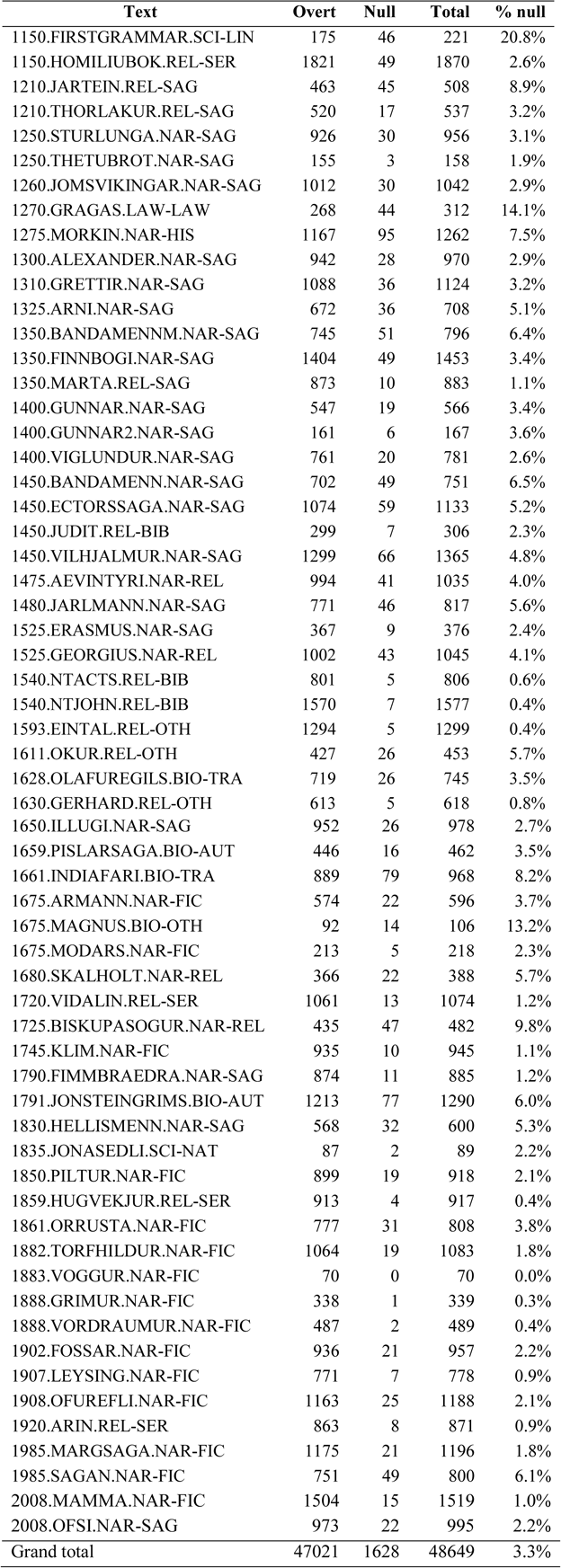
Table 1 gives an overview of the occurrence of overt and null pronominal subjects in the IcePaHC. In table 1, relative frequencies for null subjects are given as a percentage of the total number of pronominal subjects. The results are illustrated in figure 1.
Overt versus null subjects in the IcePaHC (Wallenberg et al. Reference Wallenberg, Ingason, Sigurðsson and Rögnvaldsson2011).

Null subjects by text across time.
Table 1 shows that null subjects occur at an overall relative frequency of 3.3% in 61 Icelandic texts composed between ca. 1150 and 2008. Although the data in the table are characterized by considerable variation, a number of the texts feature null subjects at quite robust frequencies. For example, 20.8% of all pronominal subjects are realized as null subjects in the First Grammatical Treatise (composed ca. 1150). Null subjects occur at frequencies of 8.9% in the Jarteinabók (ca. 1210) and 14.1% in Grágás (ca. 1270).
Moreover, the table demonstrates that relatively robust frequencies for null subjects occur well beyond the Old Icelandic period: Um ætt Magnúsar Jónssonar (1675) and Biskupasögur Jóns prófasts Halldórssonar í Hítardal (1725) display frequencies for null subjects of 13.2% and 9.8%, respectively. It is also notable that 5.3% and 3.8% of all pronominal subjects are null in Hellismanna saga and Orrusta, which were published in 1830 and 1861, respectively. This finding provides substantial quantitative corroboration of the claims put forward by Hjartardóttir (Reference Hjartardóttir1987) concerning the longevity of the null subject property in Icelandic.
Even so, the commonness of null subjects in Icelandic should not be overstated: It is evident on casual perusal of table 1 and figure 1 that null subjects are not a highly frequent phenomenon at any stage of the language—a fact highlighted by the relatively low overall frequency of 3.3% for the entire period under investigation. Null subjects are found at a frequency of less than 1.5% in 15 of 61 texts, whereas another 16 texts have frequencies in the range of 1.8%–2.9%. Only three texts display frequencies exceeding 10%, yet 14 texts feature null subjects at frequencies ranging from 5.1% to 9.8%. On the basis of the data in table 1, then, it can be concluded that null subjects are a low-frequency but stable phenomenon in the Icelandic texts under analysis, with higher frequencies generally occurring in texts from early stages of Icelandic.
3.2. Effects of Text and Genre
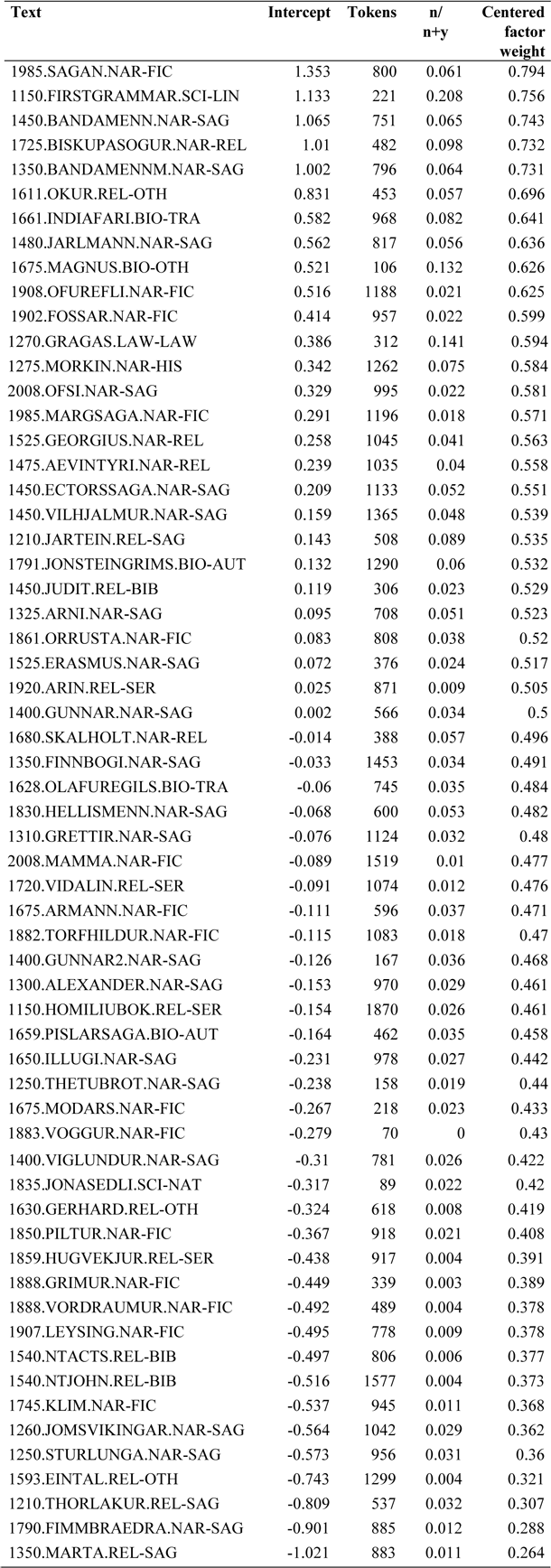
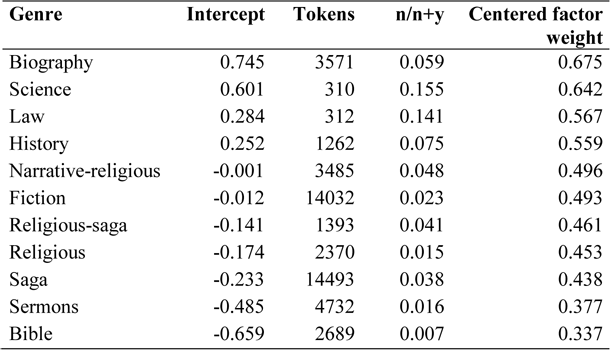
In the regression model, both text and genre were taken as random effects. Tables 2 and 3 give the strength of these effects.
Random intercepts by text.
Random intercepts by genre.
The overall R2 of the regression model, a measure of its goodness of fit to the data, is 0.449, indicating that about 44.9% of the data can be predicted using the independent variables we have selected. Of this, 0.104 comes from the random factors of text and genre. No obvious pattern emerges from table 2. The texts that favor null subjects the most (given other factors) are the First Grammatical Treatise, the oldest text in the corpus (dated ca. 1150), and Pétur Gunnarsson's novel Sagan öll, one of the most recent (1985).
As for genre, it appears from table 3 that scientific texts are likely to contain more null subjects, but since the First Grammatical Treatise and Jónas Hallgrímsson's Um eðli og uppruna jarðarinnar are the only scientific texts in the corpus, this result has to be taken with a grain of salt. Religious texts of all types (including sermons, Bible translations, and religious sagas) seem to disfavor null subjects, with Bible texts being the least favorable environment of all. This casts doubt on the potential argument that null subjects in early Icelandic are an artificial feature present in texts solely because of Classical influence: If it were so, one would predict Bible translations to have an extremely high incidence of null subjects, contrary to fact.Footnote 8
3.3. Clausal Distribution
The clausal distribution of null subjects has been a central concern in both traditional and recent accounts of the null subject phenomenon. As illustrated by the examples in 2 below, null subjects occur in all clause types in the investigated material, whether main, 2a, conjunct, 2b, or subordinate, 2c.Footnote 9
(2)
In section 1, it was hypothesized on the basis of the distribution of null subjects in other early Northwest Germanic languages, that null subjects will be rarer in subordinate clauses than in main clauses. However, while no previous large-scale quantitative investigation of the clausal distribution of null subjects in early Icelandic has been carried out, there is reason to believe that Icelandic may provide a counterpoint to its early Germanic sisters: Sigurðsson (Reference Sigurðsson1993:262) says that null subjects were “frequent in subordinate clauses.” Similarly, Walkden (Reference Walkden2014:166–168) finds that null subjects are actually more frequent in subordinate than in main clauses in four texts from the 12th and 13th centuries.
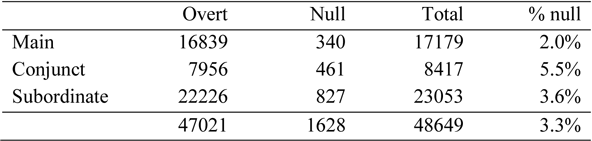
We are now in a position to provide extensive quantified data on the clausal distribution of null subjects in the history of Icelandic. For this purpose, table 4 gives aggregate frequencies for the distribution of overt and null subjects according to clause type in the entire IcePaHC corpus.
Random intercepts by genre.
Overt versus null subjects according to clause type.
Table 4 shows that null subjects are most frequent in conjunct clauses, at a frequency of 5.5% of the total number of pronominal subjects in such clauses. The frequency for null subjects in main clauses is notably lower, at 2%. It is also notable that null subjects are comparatively frequent in subordinate clauses, at a relative frequency of 3.6%. If frequencies for main and conjunct clauses are collapsed, it can be observed that the distribution of null subjects is remarkably similar across main and subordinate clauses: In the entire period under investigation, 3.1% of all subjects in main clauses are null. Thus, null subjects are slightly more frequent in subordinate than in main clauses across the investigated period. This result provides substantial quantitative corroboration of Sigurðsson's (Reference Sigurðsson1993) assertion that null subjects are frequent in sub-ordinate clauses in Old Icelandic, at least if it is acknowledged that null subjects are rare in all clause types. It also mirrors and extends the quantitative findings of Walkden (Reference Walkden2014).
3.4. Person and Number
The person and number features of the omitted argument have also constituted factors of central importance in both traditional and modern accounts of the null subject phenomenon. In early Principles and Parameters theorizing, as well as in traditional grammar, the possibility of null arguments was related in large part to the concomitant presence of rich, morphologically instantiated, verbal agreement (see traditional works, such as, for example, Bopp Reference Bopp1820 and Ohlander Reference Ohlander1943, and works couched in early generative theory, such as Taraldsen Reference Taraldsen1978, Chomsky Reference Chomsky1982, Rizzi Reference Rizzi1982, Reference Rizzi1986, and Jaeggli & Safir Reference Jaeggli, Safir, Jaeggli and Safir1989).
Although it has proven difficult to formalize, this connection is also considered relevant by authors working within the current Minimalist Program (see, for instance, Platzack Reference Platzack, Epstein and Peter1996, Holmberg Reference Holmberg2010, and van Gelderen Reference Gelderen2013). The connection between rich verbal agreement and null arguments in early Scandinavian languages is assumed by, for example, Falk & Torp (Reference Falk and Torp1900), Falk (Reference Falk1993), and Holmberg & Platzack (Reference Holmberg and Platzack1995). Since both early and present-day Icelandic encode a relatively wide range of person and number features, and since there has been remark-ably little loss of verbal inflections in the course of the history of the language (Sigurðsson Reference Sigurðsson1993:249), it might be expected that null subjects should be able to occur relatively freely with 1st, 2nd, or 3rd person reference, whether singular or plural. In terms of existential evidence, this expectation is borne out by the IcePaHC data, as illustrated in the examples below, which show a 1st person singular null subject in 3a, and 2nd person singular and 3rd person plural null subjects in 3b,c.
(3)
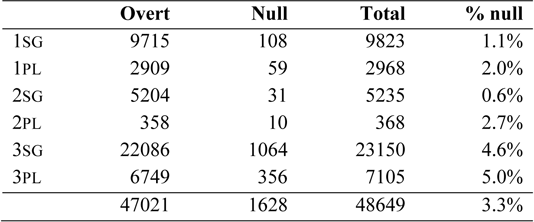
However, previous research indicates that null subjects were not freely distributed across persons. Even at an early stage, as noted above, Nygaard (Reference Nygaard1894:4–5) claimed that omission of 1st and 2nd person pronouns was very rare in Old Norse, except in imperative clauses and in conjunction reduction contexts (see also Nygaard Reference Nygaard1906:8–9 and Sigurðsson 1993:253). Consequently, it may be expected that null subjects in early Icelandic also primarily have 3rd person reference. Table 5 presents the results of a quantitative investigation of the person and number features of the pronominal subjects in the IcePaHC.
Overt versus null subjects according to person and number.
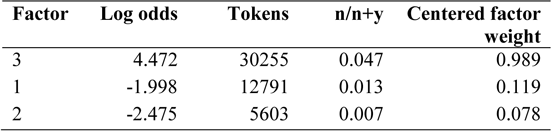
The table shows that 3rd person subject pronouns indeed are more frequently null than 1st and 2nd person pronouns. Third person singular pronouns are null in 4.6% of the cases, and 3rd person plural pronouns are null in 5% of the cases. The corresponding frequencies for the 1st person are 1.1% (singular) and 2% (plural), whereas the frequencies for the 2nd person are 0.6% (singular) and 2.7% (plural). There is a substantial effect for “person” in the regression analysis. As illustrated in table 6 below, 3rd person can be observed to favor nullness across the entire dataset. The table indicates that 3rd person pronouns are most likely to be realized as null, whereas 1st and 2nd person pronouns are less likely to be. This finding offers robust statistical support favoring the intuition that pro-drop is largely restricted to the 3rd person in early Icelandic.
Results of a one-level regression analysis for the predictor person.
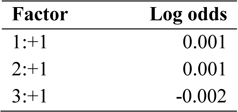
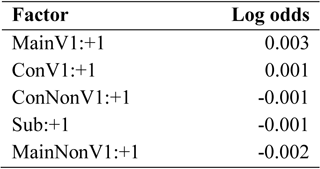
A striking feature of the dataset is that the person distribution of the null arguments shifts substantially in the history of Icelandic: 3rd person null arguments become rarer, while 1st and 2nd person null arguments become more frequent. This is illustrated in figures 2 and 3 below. The interaction between “person” and “year” is highly significant (p<0.0001). Table 7 shows that with each passing year, 1st and 2nd person subjects are slightly more likely to be null, and 3rd person subjects are slightly less likely to be. This supports the view that the licensing mechanisms for null arguments in Icelandic have changed (see section 4.2).
3rd person null subjects by text across time.
1st and 2nd person null subjects by text across time.
Interaction between the predictors person and year.
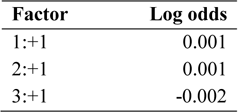
We also note that the apparent modest conditioning effect of number, with log odds values of 0.063 for plural and −0.063 for singular, does not emerge as significant at the 0.01 level (p=0.0444).
3.5. Icelandic Null Subjects According to Period
Upon scrutiny of table 1 and figure 1, it may be observed that relative frequencies for null subjects decline somewhat over time, although the change is by no means dramatic. In fact, once the interactions of “year” with “person” and “type” are accounted for (see tables 7 and 10), there is no significant effect of “year” as a predictor (p=0.134). That is, the absolute decrease in proportion of null subjects over time is not considered to be a change distinguishable from noise.
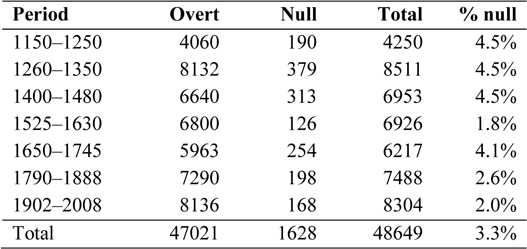
In light of this, and also in light of Hjartardóttir's (Reference Hjartardóttir1987) assertion that null subjects survive until the 19th century, it would appear a fruitful venture to quantitatively chart the process by which Icelandic null subjects gave way to the topic drop of today (see section 4.1). Thus, the diachronic development of nonovert subject pronouns in the IcePaHC is highlighted in table 8. The table gives frequencies for overt versus null subjects aggregated into periods comprising roughly 100 years. The periodization—like any periodization—is largely arbitrary, and is presented only for ease of visualization of the trends: We do not base any substantive claim on this division of texts. Each period contains between 8 and 11 texts, with the exception of the earliest period, for which only 6 texts were available. Within the periods, the texts are for the most part well spread out rather than clustered—though of course the dates given for many texts, especially in the earlier periods, are approximate rather than exact, as the precise date of composition is often not known. Readers interested in a more detailed breakdown of the figures given here can consult table 1 and figure 1.
Overt versus null subjects by period.
As the table shows, relative frequencies for null subjects remain relatively stable at below 5% but above 1.5% of all pronominal subjects in all seven periods. There is a decline from 4.5% to 2% from the earliest to the latest period. It may be noted that frequencies for null subjects remain stable at 4.5% during the three earliest periods, covering ca. 330 years. There is a comparatively sharp drop to 1.8% in the next period, 1525–1630. This decline is followed by a similarly sharp increase to 4.1% in the immediately following period covering 1650–1745. The two final periods under investigation, 1790–1888 and 1902–2008, display lower frequencies than those observed in the earlier periods, at 2.6% and 2%, respectively. However, it should be kept in mind that, aside from certain texts, the phenomenon is actually quite rare at all stages of Icelandic.
Hjartardóttir (Reference Hjartardóttir1987) and Sigurðsson (Reference Sigurðsson1993) are able to claim that Icelandic lost its null subject property in the 19th century, although they acknowledge that modern Icelandic has topic drop. Tables 1 and 8 show, however, that the relative frequencies for null subjects in the 20th century—at which stage Icelandic is not a null subject language—are essentially the same as those in the period covering the late 18th and the 19th centuries. Thus, since the difference between these periods is negligible, and since there are no significant diachronic differences in the frequencies for nonovert subjects in the entire period investigated, we would like to argue that Icelandic permits null arguments throughout its history but shifts to a fundamentally different licensing mechanism at the turn of the 20th century. We address this issue in the immediately following section 4.
4. Licensing Mechanisms
4.1. One or Two Licensing Mechanisms in Early Icelandic?
Many modern Germanic non-null-subject languages, including Icelandic, allow dropping of constituents in main clauses when Spec CP is empty, that is, in verb-initial (V1) main clauses, in certain registers (see, for example, Ross Reference Ross1982 and Trutkowski Reference Trutkowski, Cummins, Elder, Godard, Macleod, Schmidt and Walkden2011 on German; Haegeman Reference Haegeman1990 and Weir Reference Weir2012 on English; de Korte Reference de Korte2008 on Dutch; Mörnsjö Reference Mörnsjö2002 and Wendt Reference Wendt, Ask, Byrman, Hammarbäck, Lindgren and Stille2006 on Swedish; Pouplier Reference Pouplier2003 and Thráinsson Reference Thráinsson2007:277 on Icelandic; and Stjernholm Reference Stjernholm2008 and Nygård Reference Nygaard2013 on Norwegian). This phenomenon is often referred to as topic drop (alternatively: diary drop, pronoun zap, discourse ellipsis), and it is commonly assumed to be fundamentally different from pro-drop, due to the positional and stylistic restrictions on its distribution (see Sigurðsson Reference Sigurðsson2011 for a unified account, though).Footnote 10 Modern Icelandic topic drop is illustrated in example 4 (from Thráinsson Reference Thráinsson2007: 477).Footnote 11
(4)
Sigurðsson (Reference Sigurðsson1993) advocates a distinction between topic drop (on his analysis, a null topic operator binding a variable) and genuine pro-drop in Old Icelandic. On such an analysis, there would be two licensing mechanisms for null subjects, of which only one was lost during the transition into modern Icelandic. According to Sigurðsson (Reference Sigurðsson1993), pro-drop and topic drop are found in different positions: Topic drop occurs in V1 main clauses, while pro-drop is restricted to subordinate clauses and V2 main clauses. One of Sigurðsson's arguments in favor of the distinction is related to an alleged difference in terms of antecedent relations: Sigurðsson (Reference Sigurðsson1993:251–252) claims that pro always requires an overt DP antecedent (or NP antecedent, in his terms) in the preceding discourse, whereas dropped topics in V1 main clauses can occur without an overt DP antecedent. On Sigurðsson's account, antecedentless topic drop is possible because dropped topics can be identified by “free coindexing at LF with a construed, clause-external topic” (Sigurðsson Reference Sigurðsson1993:260). The antecedent of a dropped topic can be split, partial, or not present at all (Sigurðsson Reference Sigurðsson1993:252); in the latter case, it must be inferred from the context.
In the more recent works of Sigurðsson (Reference Sigurðsson2011), Håkansson (Reference Haegeman2013), and Walkden (Reference Walkden2014), only one licensing mechanism is assumed. This has theoretical advantages: If one licensing mechanism can account for all null subjects, it is not desirable to postulate two. However, none of the three works discusses empirical reasons for treating early Icelandic null subjects in a unified way.
The IcePaHC data reveal that counterexamples to Sigurðsson's (Reference Sigurðsson1993) generalization about antecedent relations can be found. In other words, null subjects that do not have a DP antecedent do sometimes occur in contexts other than V1 main clauses. This is not a frequent phenomenon, but we have found the examples in 5–8, which we discuss in some detail. The context of example 5 is a fight. Jökull has just attacked a man called Gunnbjörn when Finnbogi enters the scene.
(5)
Finnbogi's weapon is not mentioned in the previous discourse but must be inferred from the extralinguistic context.
Example 6 is from the New Testament, more precisely from the scene in which Jesus has been crucified and is offered vinegar to drink. Jesus utters the words cited in 6.
(6)
The null subject must refer to Jesus' mission on Earth, which is not explicitly mentioned in the previous discourse.
In example 7, the main character, Illugi, suspects that a treasure might be hidden in the vicinity, and he asks a woman, Kaðlin, about this. Kaðlin responds as follows:
(7)
The mound in 7 is not previously mentioned, and thus it must be inferred from the context. A potential objection is that the null subject could be interpreted as nonreferential; an equivalent Modern Norwegian sentence may optionally be construed with a nonreferential det ‘that’. However, such a reading of 7 would be problematic: In early Icelandic, nonreferential null subjects trigger 3rd person singular neuter agreement on participles and adjectives (see, for example, Nygaard Reference Nygaard1906:16), but the participle kallaður is masculine and agrees with haugr ‘mound’. The example in 8 is about a king who hosts a big Yule party.
(8)
The null subject is most naturally interpreted as referring to the number of people present at the Yule party. The group of people is not explicitly mentioned as a referent, but must be inferred from the adjective fjölmennt ‘with many people’.
The context of example 9 is the appointment of pope Gregory X. The null subject refers to the entity that has been páfalaust ‘without pope’, which is most naturally interpreted as the papacy. The papacy is not explicitly mentioned in the previous context but must rather be inferred.
(9)
Another issue, not mentioned by Sigurðsson (Reference Sigurðsson1993), is the fact that the referent of a null subject is not necessarily a person or a thing. Sometimes the referent is a situation or a proposition, and referents of this type are often represented as CPs rather than DPs. Sometimes there is a CP in the preceding discourse that directly corresponds to the null subject. These cases are not necessarily problematic for Sigurðsson's generalization: pro has an antecedent, though it is a CP rather than a DP. In other cases, the referent of the null subject does not directly correspond to any CP in the preceding context. Arguably, such referents also require inference by the speaker. The null subject is thus antecedentless. See the subordinate clause in 10a and the last main clause in 10b.
(10)
On the most obvious interpretation of 10a, the null subject refers to the fact that there appeared to be children crying. If the whole preceding CP were the antecedent, it would imply that the subject was the fact that people heard children cry. In 10b, the null subject is, on the most obvious interpretation, referring to the whole situation described in the preceding discourse, not just the last sentence. There is, in other words, not a single CP antecedent. To sum up, the data in 5–10 seem to show that there is no absolute rule against antecedentless null subjects in contexts other than V1 main clauses.Footnote 12 We discuss the implications of this below.
4.2. Shift from Pro-drop to Topic Drop
It was mentioned in section 3.5 that the decline in raw numbers of null subjects over the 850-year period under investigation is not statistically significant: The predictor “year” had a nonsignificant value on its own. Furthermore, table 8 shows that there is little to distinguish relative frequencies for null subjects in the two periods 1790–1888 and 1902–2008 from one another, as the periods have frequencies for null subjects of 2.6% and 2%, respectively. As recalled, Hjartardóttir (Reference Hjartardóttir1987) claims that Icelandic licensed null subjects until the end of the 19th century. An obvious way to reconcile this claim and our empirical finding with the standard view that modern Icelandic generally requires overt subjects is to argue that Icelandic changed the mechanism by which nonovert subjects could be licensed. By virtue of this change it transitioned from a system with restricted pro-drop to one where only topic drop is licit. We argue that our data indicate that the shift to what we refer to as the “modern” stage—where pro-drop yields to topic drop—arises in Icelandic in the early 20th century, in agreement with Hjartardóttir's (Reference Hjartardóttir1987) earlier study.
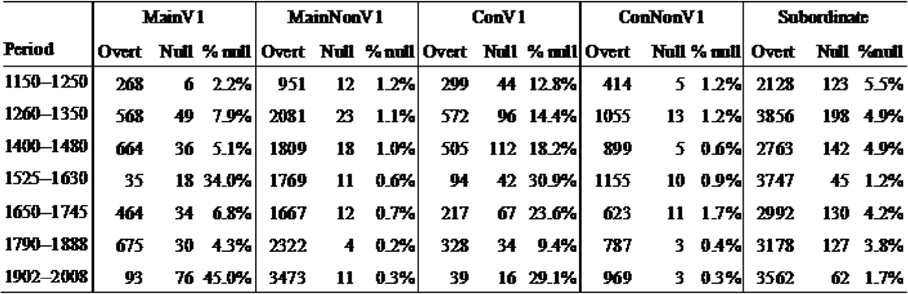
Tables 9 – 12 provide empirical support for this argument. Consider first table 9, which gives relative frequencies for null subjects according to period, clause type, and initial/noninitial position of the finite verb. Distinction is made between verb-initial (MainV1) and non-verb-initial main clauses (MainNonV1), verb-initial (ConV1) and non-verb-initial conjunct clauses (ConNonV1), and subordinate clauses. We abstract away from the possibility of fronting constituents to Spec CP in subordinate clauses, hence no distinction as to verb position is made for this clause type.
Overt and null subjects according to period, clause type, and initial/noninitial position of the finite verb.
First, our data show that there is a clear decline of null subjects in subordinate clauses in the period 1902–2008. Subordinate clauses are a context in which topic drop is not licit; we take the decline of omitted subjects in subordinate clauses to indicate that pro-drop is disappearing and topic drop is taking over. Second, and relatedly, observe that there is a clear rise of omitted subjects in nonconjunct V1 main clauses in the period 1902–2008, as compared to previous periods.Footnote 13 We take the rise of omitted subjects in V1 main clauses to be evidence that the new licensing mechanism and the new pragmatic function of topic drop is gaining ground.
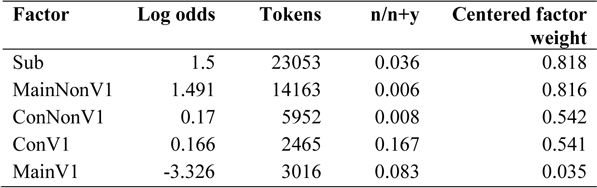
Finally, consistently with our hypothesis, null subjects in non-V1 main clauses (both conjunct and nonconjunct) are very infrequent in the period 1902–2008. This is another context in which topic drop is ruled out. Figure 4 illustrates the decline of null subjects in the three contexts where it is illicit under a standard topic drop analysis: non-V1 main and conjoined clauses, and subordinate clauses in general. By the end of the 20th century, the frequency of null subjects in these contexts is minuscule.Footnote 14 The interaction between “type” and “year” is clearly significant in the regression analysis (p<0.0001; see table 10).Footnote 15
Interaction between the predictors type and year.
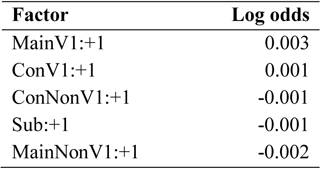
Results of a one-level regression analysis for the predictor (clause) type.
Null subjects in non-topic-drop contexts by text across time.
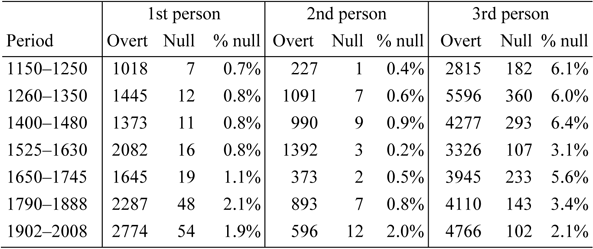
Evidence based on person features may also support our argument that the modern stage arises in Icelandic in the early 20th century. Modern Germanic topic drop of subjects does not involve any grammatical restrictions on person (Mörnsjö Reference Mörnsjö2002:70, de Korte Reference de Korte2008, Weir Reference Weir2012), though some studies indicate topic drop of the 1st person to be particularly frequent (Wiggen Reference Wiggen1975:88, Faarlund et al. Reference Faarlund, Lie and Ivar1997:676, Barton Reference Barton1998).Footnote 16 The situation observed in early Icelandic does not conform to this state of affairs, as shown in table 12 and figures 2 and 3.
Overt and null pronominal subjects according to period and person.
In the early periods, the vast majority of null subjects have 3rd person reference. In contrast, in the latest period, differences between grammatical persons are almost completely leveled. This situation is more in line with what one would expect from a language allowing topic drop. Some examples of modern, omitted subjects with 1st person reference are provided in 11.
(11)
Omitted 2nd and 3rd person subjects appear in 12a and 12b, respectively.
(12)
To sum up, we have argued that antecedent relations as well as person features suggest a pro-drop analysis for all early Icelandic null subjects. As a reviewer correctly points out, we cannot provide unequivocal evidence that excludes the possibility of an additional licensing mechanism at this stage altogether; perhaps a subset of the early null subjects were derived by topic drop or a predecessor of this phenomenon. In our view, however, the default hypothesis should be that there was one licensing mechanism only, as long as there are no strong empirical arguments to the contrary. Regardless of whether topic drop was available as an additional licensing mechanism already in early Icelandic, clause type and person data suggest a shift to a pure topic drop system at the modern stage.
4.3. Sketch of a Syntactic Analysis
Our aim in this paper is not to arrive at a fully fleshed-out syntactic account of the historical Icelandic facts, especially since there is no consensus on the details of the machinery needed to account for null arguments in current theories of syntax. ather, we have aimed to present the data and draw the generalizations that any descriptively adequate syntactic analysis of early Icelandic would need to account for. In this section, we present a sketch of one analysis consistent with these generalizations. It should be borne in mind that other theoretical perspectives are possible, and that we leave a fully explanatory account to future research.
In Minimalist syntactic theorizing, null subjects are typically taken to arise from a constellation of interacting factors, in particular the lexical specification of functional categories—such as C or T—the structure of pronouns, and third-factor (non-language-specific) considerations (see Biberauer Reference Biberauer and Biberauer2008 for an overview). Sigurðsson (Reference Sigurðsson2011) argues that referential null arguments are universally available but must be licensed by agreement with syntactically-active left-peripheral features, a process he refers to as c/edge-linking. In the modern Germanic topic-drop languages, null arguments are permitted only when raised into the C-domain, since in these languages the head C counts as an intervener and blocks agreement. In contrast, for languages such as Chinese Sigurðsson (Reference Sigurðsson2011:297–299) suggests that C does not count as an intervener for the purposes of C/edge-linking, and hence null arguments may occur clause-internally as well. We assume that in early Icelandic, as in Chinese, the featural make-up of the functional category C was such that it did not intervene.Footnote 17
In addition, in early Icelandic one observes the person restriction discussed in section 3.4, namely, that 1st and 2nd person subjects are very rarely null. We hypothesize that this is due to differences in the internal structure of the pronouns involved. There are different ways of implementing this, and we remain agnostic as to which one is correct. We could assume that it is simply stipulated lexically whether a particular combination of phi-features may be null in a given language (see Faarlund Reference Faarlund, König and van der Auwera2013). Another option is to connect the overtness of 1st and 2nd person subjects with the fact that they realize larger syntactic structures. According to Richards (Reference Richards, Bornkessel-Schlesewsky, Malchukov and Richards2015:176), 1st and 2nd person pronouns are always DPs, unlike 3rd person pronouns (see also Déchaine & Wiltschko Reference Déchaine and Wiltschko2002). It may be that DPs, unlike smaller structures, are not universally able to be null. Under this account, the core change that has taken place is that C has become an intervener for the purposes of null argument C/edge-linking in the recorded history of Icelandic. A further change involves the lifting of the requirement that 1st and 2nd person subjects be overt.
5. Null Subjects in Early Northwest Germanic
Previous research on null arguments in other early Northwest Germanic languages has shown that these languages exhibit remarkable homogeneity with regard to the conditions under which null arguments may occur. The findings presented in this paper corroborate many of the results of previous research, although some clear differences also emerge. This section provides a cross-Germanic perspective assessing the degree to which our findings for early Icelandic converge with those for its sister languages.
One notable point of such convergence pertains to person features: There is considerable empirical evidence that the person split discussed in section 3.4 applies to the early Northwest Germanic languages as a whole. Several studies have ascertained that early Germanic null subjects predominantly tend to have 3rd person reference, although 1st and 2nd person null subjects are documented. Based on data drawn from Eggenberger's (Reference Eggenberger1961) study of subjectless clauses in Old High German, Axel (Reference Axel2007:314) notes that “[r]eferential null subjects are attested in all persons and numbers,” but that “it is only in the third person singular and plural that the null variant is used more frequently than the overt one.” A similar pattern holds in a variety of Old English textual genres, whether interlinear glosses (Berndt Reference Berndt1956, van Gelderen Reference van Gelderen2000, Reference Gelderen2013, Walkden forthcoming), prose (Walkden Reference Walkden2013, Reference Walkden2014; Rusten Reference Rusten2013), or poetry (Rusten Reference Rusten2015), though here null subjects in general are much less frequent than in Old High German.
The 3rd/non-3rd person split is also observed in the Old Saxon Heliand (Walkden Reference Walkden2014), in a selection of Old Swedish texts (Håkansson Reference Håkansson2008), in the Old Norwegian Óláfs saga ins helga and in The Old Norwegian Homily Book (Kinn Reference Kinn2015). Walkden (Reference Walkden2014) consequently reconstructs a partial null subject property for Proto-Northwest Germanic, which allowed subjects to be null under certain conditions, predominantly in the 3rd person.Footnote 18 This article provides further comparative evidence suggesting that the 3rd person had special status in conditioning null subjects in early Germanic.
Moreover, in section 4.1, we argued that Sigurðsson's (Reference Sigurðsson1993) distinction between pro-drop and topic drop may be empirically problematic: Contrary to predictions, antecedentless null subjects occurring in non-verb-initial contexts can be found in early Icelandic. Existential evidence from Old English (examples 13a,b) and Old Norwegian (example 13c) suggests that our argument may possibly be extended to these languages as well.Footnote 19
(13)
No overt antecedent matching the null subject is present in any of the examples above, none of which can be interpreted as topic drop.
As remarked above, certain aspects of the evidence from early Icelandic contrast with findings from other early Germanic languages. First, the longevity of the null subject property in Icelandic is remarkable in a cross-Germanic perspective. It has been documented that other Germanic languages, including English (Walkden Reference Walkden2013, Reference Walkden2014, Rusten Reference Rusten2013, Reference Rusten2015), German (Axel Reference Axel2007), and Swedish (Håkansson Reference Håkansson2008, Reference Haegeman2013), lost the null subject property at much earlier stages. Additionally, it may be noted that null subjects are generally much more frequent in early Icelandic as compared to, for example, Old English and Old Swedish, where occurrence of null subjects is extremely restricted.
Second, as also mentioned above, null subjects have been shown to be considerably more frequent in main clauses than in subordinate ones in other early Germanic languages. This leads Walkden (Reference Walkden2013) to suggest for Old English that null subjects may constitute a main clause phenomenon (in the sense of, for example, Hooper & Thompson Reference Hooper and Thompson1973, Green Reference Green1976, and Haegeman & Ürögdi Reference Haegeman and Ürögdi2010). Data from some early Germanic languages could be taken as support for such a conclusion: In Old English (Walkden Reference Walkden2013, Rusten Reference Rusten2013, Reference Rusten2015), Old Saxon (Walkden Reference Walkden2014), and Old Swedish (Håkansson Reference Håkansson2008, Håkansson Reference Haegeman2013), null subjects are predominantly found in root environments, and only exceptionally in subordinate clauses. This clause asymmetry is also evident in the Old High German texts investigated by Axel (Reference Axel2007), although the overall frequencies for null subjects are much higher here than in the other languages. The Icelandic data, however, show that there is no distinction in null subject frequency between main and subordinate clauses, and even that null subjects are marginally more frequent in subordinate clauses than in main ones overall, across the period under investigation. This is unexpected in the context of early Germanic, suggesting that additional work still needs to be done on this topic.
6. Summary and Conclusion
This paper has presented the results of a large-scale, longitudinal corpus-based investigation of null subjects in Icelandic. Based on substantial data and regression analysis, we have provided robust empirical support for Hjartardóttir's (Reference Hjartardóttir1987) claim that null subjects persist until a very late stage in Icelandic. We have also argued that there is evidence only for one licensing mechanism for null subjects in early Icelandic, contra Sigurðsson (Reference Sigurðsson1993). The findings also remain problematic for any analysis of null subjects that ties them to rich verbal agreement (as proposed, for instance, in Axel Reference Axel2007 for Old High German and in van Gelderen Reference Gelderen2013 for Old English), since there has been no real change in Icelandic verbal morphology over the last millennium. We have sketched a syntactic analysis which is based on Sigurðsson (Reference Sigurðsson2011), in combination with the assumption that pronouns may have different internal structure. On the basis of the position of the null subject and its person features, we have tentatively argued that the modern stage, where predominantly 3rd person pro-drop yields to a system permitting topic drop of all persons, arises in Icelandic in the early 20th century.