Introduction
Subclinical psychotic experiences are common in the general population, implying a continuum of the psychosis phenotype (Johns & van Os, Reference Johns and van Os2001; Scott et al. Reference Scott, Chant, Andrews and McGrath2006; van Os et al. Reference van Os, Linscott, Myin-Germeys, Delespaul and Krabbendam2009, Yung et al. Reference Yung, Nelson, Baker, Buckby, Baksheev and Cosgrave2009; Nuevo et al. Reference Nuevo, Chatterji, Verdes, Naidoo, Arango and Ayuso-Mateos2010). While most experiences are transient and resolve spontaneously (Dhossche et al. Reference Dhossche, Ferdinand, van der Ende, Hofstra and Verhulst2002; Hanssen et al. Reference Hanssen, Bak, Bijl, Vollebergh and van Os2005; Wiles et al. Reference Wiles, Zammit, Bebbington, Singleton, Meltzer and Lewis2006; Dominguez et al. Reference Dominguez, Wichers, Lieb, Wittchen and van Os2011), a small proportion of individuals with mild psychotic experiences will progress to psychotic disorder (Poulton et al. Reference Poulton, Caspi, Moffitt, Cannon, Murray and Harrington2000). Low-level delusional thinking and mild hallucinations often precede clinical disorder (e.g. Yung & McGorry, Reference Yung and McGorry1996; Poulton et al. Reference Poulton, Caspi, Moffitt, Cannon, Murray and Harrington2000; Welham et al. Reference Welham, Scott, Williams, Najman, Bor, O'Callaghan and McGrath2009), particularly when persistent (Dominguez et al. Reference Dominguez, Wichers, Lieb, Wittchen and van Os2011). During adolescence, when psychosis proneness is at its peak (Verdoux et al. Reference Verdoux, Van Os, Maurice-Tison, Gay, Salamon and Bourgeois1998), subtle psychotic experiences are frequently reported (Wigman et al. Reference Wigman, Vollebergh, Raaijmakers, Iedema, van Dorsselaer, Ormel, Verhulst and van Os2009; Yung et al. Reference Yung, Nelson, Baker, Buckby, Baksheev and Cosgrave2009).
A suggested paradigm for understanding the development of psychosis is the proneness–persistence–impairment model. This model proposes that transition from subclinical psychosis to clinical disorder is preceded by the persistence of these subtle psychotic experiences and accompanied by progressive impairment, depending on additional psychopathological, developmental and psychological factors which lead to (i) persistence of these experiences and (ii) need for care (Cougnard et al. Reference Cougnard, Mercelis, Myin-Germeys, de Graaf, Vollebergh, Krabbendam, Lieb, Wittchen, Henquet, Spauwen and van Os2007; van Os et al. Reference van Os, Linscott, Myin-Germeys, Delespaul and Krabbendam2009). Focus on the development of subclinical psychotic symptoms over time, rather than on cross-sectional and possibly transient psychotic experiences, may be useful in distinguishing true underlying vulnerability to schizophrenia from incidental, benign experiences or clinical ‘noise’ around a non-psychotic disorder (Nelson & Yung, Reference Nelson and Yung2009; Yung et al. Reference Yung, Nelson, Baker, Buckby, Baksheev and Cosgrave2009). Previous studies have found that persistence of subclinical psychotic experiences in general population samples is associated with poor outcome, such as diagnosis of psychotic disorder (Dominguez et al. Reference Dominguez, Wichers, Lieb, Wittchen and van Os2011), poor social functioning (Rössler et al. Reference Rössler, Riecher-Rossler, Angst, Murray, Gamma, Eich, van Os and Gross2007), high levels of depression (Mackie et al. Reference Mackie, Castellanos-Ryan and Conrod2010; Wigman et al. Reference Wigman, van Winkel, Raaijmakers, Ormel, Verhulst, Reijneveld, van Os and Vollebergh2011) or negative symptoms (Dominguez et al. Reference Dominguez, Saka, Lieb, Wittchen and van Os2010) and greater use of health care (Wigman et al. Reference Wigman, van Winkel, Raaijmakers, Ormel, Verhulst, Reijneveld, van Os and Vollebergh2011).
Coping style may play a role in shifts along the extended psychosis continuum, i.e. in persistence and possible development of clinical psychotic disorder (Krabbendam et al. Reference Krabbendam, Myin-Germeys, Bak and van Os2005; Philips et al. Reference Phillips, Francey, Edwards and McMurray2009). Coping has been defined in a number of ways, one distinction being between task-oriented coping (e.g. talking to someone, actively looking for a solution), emotion-oriented coping (e.g. worry, self-blame) and avoidance-oriented coping (e.g. distraction, social diversion) styles (Endler & Parker, Reference Endler and Parker1990). In general, task-focused coping is more adaptive in dealing with psychotic symptoms and daily stressors than emotionally driven coping (Phillips et al. Reference Phillips, Francey, Edwards and McMurray2009). Such adaptive coping is related to feelings of control and higher levels of functioning (Bak et al. Reference Bak, Myin-Germeys, Hanssen, Bijl, Vollebergh, Delespaul and van Os2003; Krabbendam et al. Reference Krabbendam, Myin-Germeys, Bak and van Os2005). Coping is related to psychotic symptoms at all levels of the extended psychosis continuum: non-adaptive coping is associated with poor outcome in chronic schizophrenia populations (Ritsner et al. Reference Ritsner, Ben-Avi, Ponizovsky, Timinsky, Bistrov and Modai2003), first-episode (Boschi et al. Reference Boschi, Adams, Bromet, Lavelle, Everett and Galambos2000; Thompson et al. Reference Thompson, McGorry and Harrigan2003) and ultra-high risk for psychosis (Ruhrmann et al. Reference Ruhrmann, Paruch, Bechdolf, Pukrop, Wagner, Berning, Schultze-Lutter, Janssen, Gaebel and Möller2008) samples, and within the general population (Schuldberg et al. Reference Schuldberg, Karwacki and Burns1996; Bak et al. Reference Bak, Myin-Germeys, Hanssen, Bijl, Vollebergh, Delespaul and van Os2003; Krabbendam et al. Reference Krabbendam, Myin-Germeys, Bak and van Os2005; Dangelmaier et al. Reference Dangelmaier, Docherty and Akamatsu2006).
Gender differences in coping with psychotic symptoms have been identified, but findings are inconsistent. Some studies show no differences between genders (Boschi et al. Reference Boschi, Adams, Bromet, Lavelle, Everett and Galambos2000; Dangelmaier et al. Reference Dangelmaier, Docherty and Akamatsu2006; Modestin et al. Reference Modestin, Caveng, Wehrli and Malti2009), whereas others report that females use more adaptive coping strategies than their male counterparts (Thompson et al. Reference Thompson, McGorry and Harrigan2003).
To date, most research on coping and psychosis has been cross-sectional. This is a limitation, as it does not allow causal inferences to be drawn on the relationship between the two. To better identify individuals at highest risk of developing a psychotic disorder, longitudinal data are necessary to clarify the mechanisms that might be associated with the persistence of subclinical psychotic experiences and possible transition to psychotic disorder.
Investigating different coping styles in relation to developmental trajectories of subclinical psychotic experiences may inform possible preventive interventions, since coping with psychotic symptoms has been shown to be modifiable through psychotherapy (Farhall et al. Reference Farhall, Greenwood and Jackson2007). Given that intervention may be most beneficial when applied before the onset of psychotic disorder (Mrazek & Haggerty, Reference Mrazek and Haggarty1994; McGorry et al. Reference McGorry, Hickie, Yung, Pantelis and Jackson2006), the rationale for understanding the relationships between subclinical psychotic experiences and coping is evident.
Aims and hypotheses
The present study investigated the relationship between subclinical positive psychotic experiences and coping styles (emotion-, task- and avoidance-oriented) over 3 years in a large adolescent general population cohort. First, the associations between subclinical positive psychotic experiences and different coping styles over time were assessed bi-directionally. Second, distinct developmental trajectories of subclinical psychotic experiences were identified and compared on measures of general psychopathology. Third, the mean use of different coping styles was compared across each trajectory. Since higher levels of psychopathological problems are associated with the use of more coping styles in general (Escher et al. Reference Escher, Delespaul, Romme, Buiks and van Os2003), the proportional use of each coping style was also investigated.
It was hypothesized that: (i) the increased use of emotion- and avoidance-oriented coping would be longitudinally associated with higher levels of subclinical positive psychotic experiences, (ii) increasing or persistent trajectories of psychotic experiences would be associated with higher levels of psychopathology and lower functioning, and with (iii) more use of emotion- and avoidance-oriented, and less task-oriented coping.
Method
Participants
Participants were recruited through secondary schools in Western Metropolitan Melbourne, Australia; 60 secondary schools were approached and 34 consented (20 government, five Catholic and nine independent schools). Three data collection waves were completed: T1 (baseline), n=813; T2 (12 months after baseline assessment), n=646 (73% of original cohort); and T3 (3 years after baseline assessment), n=514 (58% of original cohort). At baseline, 51% of the sample was female. Mean age was 15.6 (s.d.=2.6) years.
Procedure
At T1, students were assessed via questionnaire during one study period. Trained research assistants were present to answer queries. All participants provided written informed consent and assent from their parent/guardian. The second wave of data collection (T2) was conducted 12 months later. This assessment comprised semi-structured interview and questionnaires. Written consent was again obtained from participants and from their parent/guardian if they were still under the age of 18 years. This process was repeated 3 years after baseline (T3). The study was approved by Research and Ethics Committees at the University of Melbourne, Victorian Department of Education and Catholic Education Office.
Instruments
The Community Assessment of Psychic Experiences (CAPE) positive experiences subscale (20 self-reported items) was used to assess psychotic experiences in all study phases (Stefanis et al. Reference Stefanis, Hanssen, Smirnis, Avramopoulos, Evdokimidis, Stefanis, Verdoux and van Os2002; Konings et al. Reference Konings, Bak, Hanssen, van Os and Krabbendam2006). Each item rates two aspects of psychotic experiences (frequency and associated distress) on a four-point scale of never/not distressed (1) to nearly always/very distressed (4). The 20 frequency items showed good internal consistency at all time points (Cronbach's α=0.82 to 0.85). Sum scores were used as continuous indicators of subclinical positive psychotic experiences.
Coping styles were assessed using the adolescent version of the Coping Inventory for Stressful Situations (CISS; Endler & Parker, Reference Endler and Parker1990). Three different coping styles were assessed on a five-point scale of not at all (1) to very much (5). Task-oriented coping refers to purposeful efforts aimed at solving the problem, cognitively or physically. Emotion-oriented coping describes self-oriented emotional reactions, self-preoccupation and fantasizing. Avoidance-oriented coping refers to activities and cognitive changes intended to avoid the situation (Endler & Parker, Reference Endler and Parker1990). Scores for each coping style were calculated as the sum of item scores per style at each time point. The proportional use of each coping style was calculated from the total amount of all coping styles used by the individual at each time point. Internal consistency of the CISS was good at all assessments (Cronbach's α=0.88 to 0.91).
The Centre for Epidemiologic Studies Depression Scale (CES-D) assessed depressive symptomatology over the past week (Radloff, Reference Radloff1977). The CES-D consists of 20 self-report items rating frequency of depressive symptoms. General mental health was measured using the General Health Questionnaire-12 (GHQ-12), a 12-item self-report screen for psychological strain in the general population (Goldberg & Williams, Reference Goldberg and Williams1988). The Revised Multidimensional Assessment of Functioning Scale (RMAFS) is a 23-item self-report questionnaire, designed at Orygen Youth Health, to assess functioning in the domains of family, peer and general daily life. Items are rated from not at all/rarely applicable (0) to (almost) always applicable (5). Higher scores indicate better functioning.
Analyses
Analyses were conducted with Mplus 5.1 (Muthén & Muthén, Reference Muthén and Muthén1998–Reference Muthén and Muthén2007; Muthén & Muthén, USA) and PASW Statistics 18 (SPSS Inc., USA). Full information maximum likelihood (FIML) was used for estimation of missing values and, given that data were non-normally distributed, robust maximum likelihood was used for model estimation. This method estimates a mean-adjusted χ2 robust to non-normality (Brown, Reference Brown2006). Differences between participants who completed all assessments and those who dropped out at T2 or T3 were analysed using analysis of variance for continuous variables and odds ratios (ORs) for binary variables.
Step 1: path analysis
Path analysis was used to investigate the relationships between subclinical positive psychotic experiences and the different coping styles (task-, emotion- and avoidance-oriented) over time, using only observed variables. Paths were drawn to allow psychotic experiences to predict the three different coping styles over time and vice versa. The CAPE score and the three scores on the different coping styles were allowed to correlate at all time points, but the three coping styles were not allowed to predict other coping styles over time because this was not of primary interest.
Several fit indices were used for model evaluation (Brown, Reference Brown2006). For good model fit, the χ2 should be low; the comparative fix index (CFI) should be above 0.90 or 0.95 and the root mean square error of approximation (RMSEA) should be lower than 0.08 or 0.05 for acceptable and good model fit, respectively. Multi-group analysis on gender was conducted to investigate whether regression coefficients differed for gender. To do this, two models were compared: (i) a model with the different paths constrained to be equal for both genders and (ii) a model with the paths freely estimated. If the model with the freely estimated paths does not differ significantly from the constrained model, paths can be considered to be equal for females and males. Models do not significantly differ if ▵CFI <0.010 and ▵RMSEA <0.015 (Chen, Reference Chen2007). Differences in mean coping scores between genders were assessed with multivariate analysis of covariance, with the coping scores as dependent and gender as independent variables, controlled for age at T1. As secondary analyses, it was investigated whether the possible gender difference was due to rating bias or the number of coping styles effectively used. Coping style items were recoded to 0=never used this style or 1=ever used this style. Multivariate analysis of variance (MANOVA) was used to assess the difference in the number of coping styles used by each gender.
Step 2: latent growth modelling
First, the development of subclinical positive psychotic experiences over time was analysed using a latent growth model (LGM). Latent growth modelling is a variant of structural equation modelling, in which two latent growth factors are identified, indicated by repeated observed variables and representing intercept (initial score) and slope (change in score over time) (Duncan & Duncan, Reference Duncan and Duncan2004).
Subsequently, different growth trajectories were assessed within this growth model by conducting latent class analyses (LCA). In LCA, a set of mutually exclusive latent classes can be identified that account for the distribution of cases occurring within a cross-tabulation of observed variables (McCutcheon, Reference McCutcheon1987). Thus, LCA was used here to find the smallest number of classes of individuals with similar developmental trajectories of subclinical psychotic experiences. MANOVA was used to compare the different classes on CAPE frequency and distress, CISS coping style (mean and proportion), CES-D, GHQ-12 and RMAFS scores.
Results
Drop-out analyses
There were no significant differences in age, socio-economic status, CES-D or CAPE scores between participants who completed all study phases and those who dropped out at T2 or T3. Significantly more females participated in all phases compared with those who completed only T1 and T2 [OR 1.50, 95% confidence interval (CI) 1.03–2.17, p=0.03]. There were no other significant group differences in gender proportion. Participants who completed all study phases showed higher task-oriented coping [F(3, 829)=4.81, p=0.003] and higher emotion-oriented coping [F(3, 819)=5.72, p=0.001] at baseline than participants who only completed T1. There were no baseline group differences on avoidance-oriented coping.
Step 1: path model
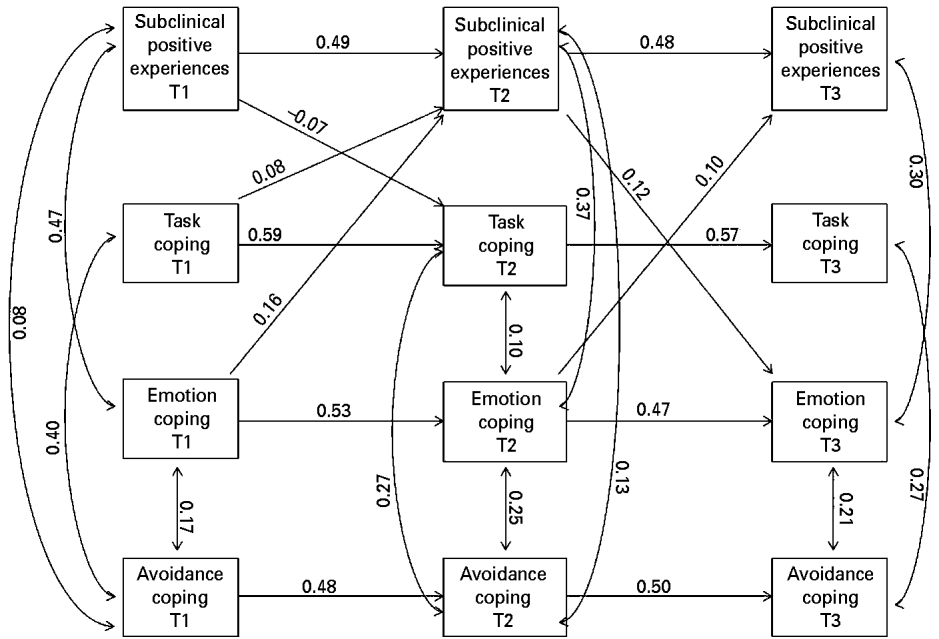
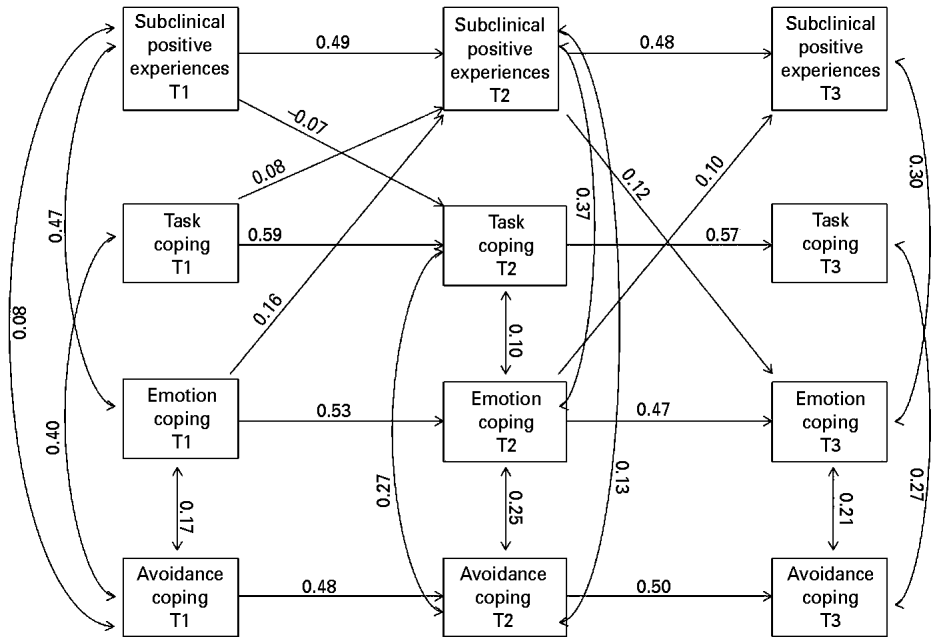
The model with all paths included showed acceptable model fit [χ 2(28)=165.85, CFI=0.911, RMSEA=0.075]. In Fig. 1, all significant paths (p<0.05) are shown (β coefficients indicating path strength). As expected, coping styles were intercorrelated at the different time points, although task-oriented and emotion-oriented were not related at T1 and T3. All correlations between coping styles were positive. Subclinical psychotic experiences were (positively) correlated with emotion-oriented coping at all three time points and (positively and negatively) with task-oriented coping at T1 and T2, but never with avoidance-oriented coping. Over time, task-oriented coping at T1 predicted psychotic experiences at T2 (and vice versa). Emotional-oriented coping at T1 predicted psychotic experiences at T2. Emotional-oriented coping at T2 predicted psychotic experiences at T3 (and vice versa).
Path model of positive subclinical psychotic experiences and different coping styles (task-, emotion- and avoidance-oriented). Only significant paths are shown. The values represent β coefficients. Minor differences in the model when controlled for depression are outlined in the Results section.
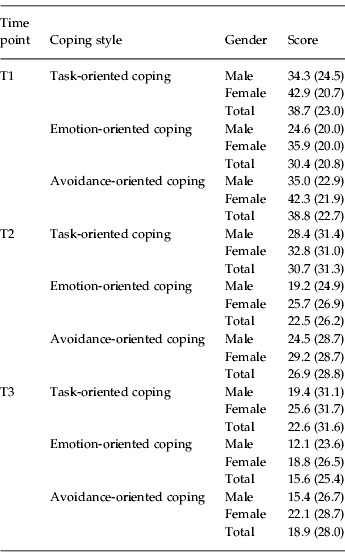
The model with the paths freely estimated for females and males was not significantly better than the model with paths constrained to be equal for both genders (▵CFI <0.004, ▵RMSEA <0.008), indicating that the regression coefficients were equal for females and males. Mean scores for each coping style at each time point are presented in Table 1. Females reported higher levels of all coping styles at all time points [F(9, 945)=9.87, p<0.001]. When scores were recoded to ‘never’ versus ‘ever’, the differences between genders remained significant, except in task-oriented and avoidance-oriented coping at T2. This suggests that the gender differences cannot be ascribed to females rating their use of coping styles as more often, but rather that females use a broader range of coping styles.
Coping scores on the three different coping styles for males, females and the total sample

Data are given as mean (standard deviation).
T1, baseline; T2, 12 months after baseline assessment; T3, 3 years after baseline assessment.
Effects of depression
Since (i) later analyses (see step 2) showed that individuals with different trajectories of subclinical psychotic experiences demonstrated different levels of depressive symptomatology, and (ii) coping may be affected by depression, the cross-lagged path model was rerun controlling for depressive symptoms at all time points. This did not substantially change the results: model fit was still good, and only one pathway, from emotion-oriented coping at T2 to CAPE at T3, was no longer significant at conventional α (p<0.08). Most regression coefficients did not decrease substantially (maximum decrease Δβ=0.08), with the exception of two important pathways: the regression coefficient of emotion-oriented coping at T1 predicting CAPE at T2 decreased from 0.16 to 0.08 and the regression coefficient of CAPE at T2 predicting emotion-oriented coping at T3 increased from 0.12 to 0.24. Therefore, although different in strength, there was still a longitudinal association between CAPE score and emotion-oriented coping from T1 to T3 when controlling for depression. Depression appears to play a (small) role in the association between coping and subclinical psychotic experiences, but cannot explain all of this relationship.
Step 2: Linear growth model development
A linear growth model was found to describe the data well [χ 2(1)=2.04, p<0.012, RMSEA=0.040, CFI=0.993]. In this case, the slope between T1 and T2 was fixed at 1, and the slope between T2 and T3 was fixed at 2, even though the difference between T1 and T2 was smaller than between T2 and T3. This model had an unstandardized intercept of 31.33 (95% CI 30.87–31.79) and an unstandardized slope of –2.12 (95% CI –2.34 to –1.86) (p=0.001), indicating a significant decrease in level of subclinical psychotic experiences over time.
Different developmental trajectories of subclinical psychotic experiences
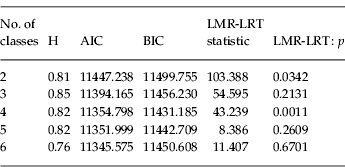
Several subsequent LCAs were conducted with an increasing number of classes to distinguish trajectories of subclinical psychotic experiences (Table 2). A model with four classes best described the data. This model was significantly better than a model with three classes (p<0.001) and showed a good entropy value (H=0.824). A model with five classes was not significantly better than a model with four classes. Average class probabilities were high (0.84–0.93), indicating that participants were correctly assigned to their respective latent classes.
Criteria for deciding the number of classes within the longitudinal trajectory of CAPE positive experiencesFootnote a
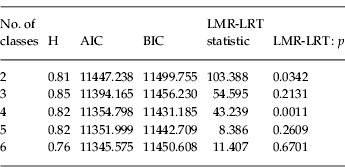
CAPE, Community Assessment of Psychic Experiences; H, entropy measure, which can vary between 0 and 1, with higher values indicating clearer discrimination of classes; AIC, Akaike's information criterion; BIC, Bayesian information criterion; LMR-LRT, Lo–Mendell–Rubin likelihood-ratio test.
a A model is chosen if AIC and BIC are low(est), entropy is acceptable (>0.80) to good (>0.90) and succeeding models with one extra class at a time are no longer significant.
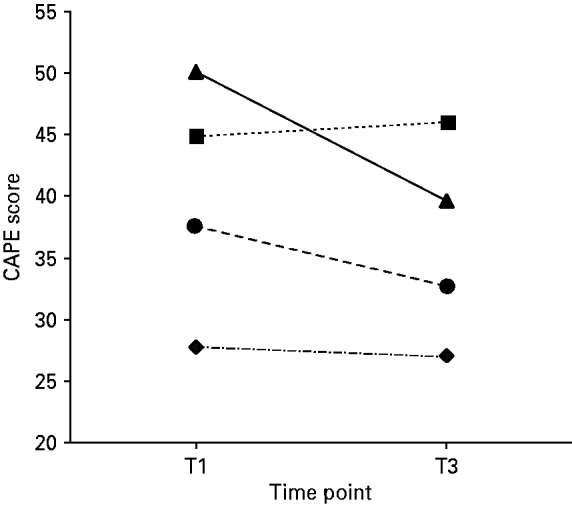
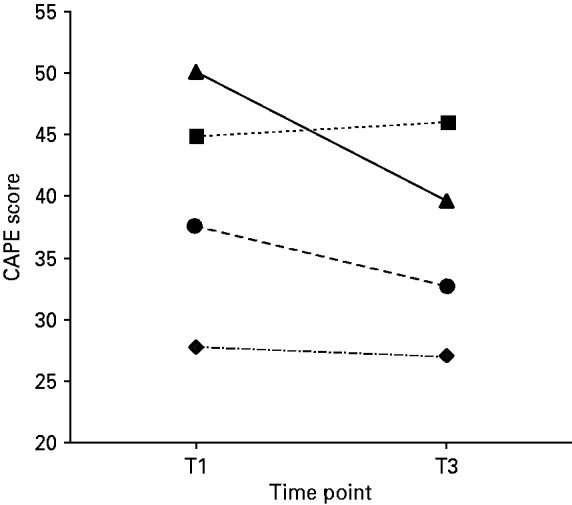
The four classes represent different trajectories (Fig. 2). The first class had the largest number of individuals (n=624, 71% of sample) and was characterized by a low intercept (unstandardized intercept 27.81) and a small but significant decrease in subclinical psychotic experiences over time (unstandardized slope – 0.72, p<0.0001), hereafter labelled the ‘low (subclinical psychosis) group’. The second class consisted of 209 individuals (24%) and was characterized by a higher intercept (unstandardized intercept 37.43) and a significant decrease in subclinical psychotic experiences over time (unstandardized slope −4.83, p<0.0001), labelled the ‘moderate-decreasing group’. The third group (n=35, 4%) was characterized by a very high intercept (unstandardized intercept 50.07) and a very steep decrease over time (unstandardized slope –10.42, p<0.0001), labelled the ‘strong-decreasing group’. The last group was very small with only seven individuals (1%). It was characterized by a high intercept (unstandardized intercept 44.94) and no significant change in subclinical psychotic experiences over time (unstandardized slope 1.04, p<0.554), labelled the ‘persisting group’.
Visual representation of the four courses of subclinical psychotic experiences (- -♦- -, low; - - • - -, moderate decreasing; –▴–, strong-decreasing; …▪…, persistent) over time on total Community Assessment of Psychic Experiences (CAPE) score at each time point. T1, baseline; T3, 3 years after baseline assessment. Note. There was no significant change over time for the persistent subgroup.
Subgroup characteristics
The four subgroups, representing four different trajectories of subclinical psychotic experiences over time, did not differ in mean age [F(3, 855)=1.694, p<0.167]. Males and females were not equally present in all groups [χ2(3)=9.912, p<0.019]: in the low group, 50% were female; in the moderate-decreasing group, 54%; in the strong-decreasing group, 62%; and in the persistent group, 57%. Gender proportion was significantly different between the low and strong-decreasing groups (OR 0.60, 95% CI 0.44–0.83, p=0.002).
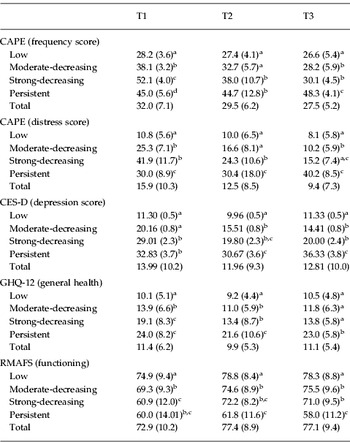
The four subgroups differed significantly on CAPE distress scores [F(9, 710)=60.0, p<0.001], CES-D depression scores [F(9, 1175)=19.0, p<0.001], severity of general mental problems rated on the GHQ-12 [F(9, 1102)=12.4, p<0.001] and the RMAFS index of daily functioning [F(9, 1029)=9.1, p<0.001] at all time points (see Table 3). The level of distress mirrored the frequency of subclinical psychotic experiences. The persistent group reported significantly higher levels of depression at all three time points. Functioning of the moderate-decreasing and strong-decreasing groups normalized over time. At T1, the low group was significantly better functioning than all other groups, whereas at T3, the persisting group showed significantly poorer functioning than all other groups.
Scores of CAPE frequency and distress, CES-D, GHQ-12 and RMAFS per subgroup and in total

Data are given as mean (standard deviation).
CAPE, Community Assessment of Psychic Experiences; CES-D, Centre for Epidemiologic Studies Depression Scale; GHQ-12, General Health Questionnaire-12; RMAFS, Revised Multidimensional Assessment of Functioning Scale; T1, baseline; T2, 12 months after baseline assessment; T3, 3 years after baseline assessment.
a,b,c Mean values within a column with unlike superscript letters were significantly different (p<0.05).
Note: higher scores on frequency, distress and depression indicate greater pathology. Higher scores on GHQ and lower scores on RMAFS indicate poorer general mental health and functioning.
Coping
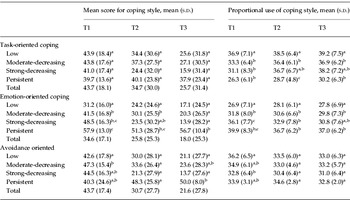
The four subgroups differed in overall use of coping styles [F(24, 1065)=4.641, p<0.001] and in proportional use of coping styles [F(18, 1001)=3.645, p<0.001] (Table 4). The highest mean scores for emotion-oriented coping were consistently reported by the persistent group. No significant group differences were found in the mean scores for task-oriented coping, and only small, inconsistent differences for avoidance-oriented coping.
Mean score and proportional use of different coping styles by subgroup

Data are given as mean score/proportion (s.d.).
T1, baseline; T2, 12 months after baseline assessment; T3, 3 years after baseline assessment.
a,b,c Mean values within a column with unlike superscript letters were significantly different (p<0.05).
Note: higher scores indicate greater mean or proportional use of the coping style.
In terms of the proportional use of each coping style (Table 4), no significant differences were found in avoidance-oriented coping. All groups showed a trend for using a greater proportion of task-oriented coping and lesser proportion of emotion-oriented coping over time and these trends seemed to be strongest in the strong-decreasing group. The persistent group consistently reported the lowest proportional use of task-oriented coping and the highest proportional use of emotion-oriented coping.
Discussion
Subclinical psychotic experiences were related to coping style in the present adolescent general population sample. When examining the whole sample, emotion-oriented coping and subclinical psychotic experiences enhanced each other over time, whereas associations with task- and avoidance-oriented coping were inconsistent or negligible. When different developmental trajectories of subclinical psychotic experiences were examined, the association with emotion-oriented coping remained most prominent; persistence of subclinical psychotic experiences was associated with higher mean levels and higher proportional use of emotion-oriented coping. In this analysis, avoidance-oriented coping continued to show no significant relationship to subclinical psychotic experiences. However, the importance of task-oriented coping was highlighted; an increase in proportional use of task-oriented coping was associated with a decrease in subclinical psychotic experiences over time.
Emotion-oriented coping predicted subclinical psychotic experiences over time and vice versa, forming a vicious cycle. This finding, at a subclinical level, is consistent with previous research in adults with schizophrenia (Ritsner et al. Reference Ritsner, Ben-Avi, Ponizovsky, Timinsky, Bistrov and Modai2003; Philips et al. Reference Phillips, Francey, Edwards and McMurray2009). Furthermore, a marked dose–response relationship was seen between developmental levels of subclinical psychotic experiences and emotion-oriented coping – the more experiences endorsed, the more emotion-oriented coping was used, particularly in the persistent group. This group consistently reported the highest mean and proportional use of emotion-oriented coping, even though at T1 the frequency of subclinical psychotic symptoms was higher in the strong-decreasing group. This suggests that emotion-oriented coping is associated specifically with persistence of subclinical psychotic experiences, rather than the level of experiences at a single time point. Taken together, our findings suggest a causal relationship between the persistence of subclinical psychosis and emotion-oriented coping.
While no specific coping style is thought to be effective across all situations, emotion-oriented coping is generally considered least adaptive (Phillips et al. Reference Phillips, Francey, Edwards and McMurray2009). In patients with schizophrenia, emotion-oriented coping is associated with lower quality of life (Ritser et al. Reference Ritsner, Ben-Avi, Ponizovsky, Timinsky, Bistrov and Modai2003) and hospital admission (Strous et al. Reference Strous, Ratner, Gibel, Ponizovsky and Ritsner2005). There are several possible explanations for this relationship. Task-oriented coping, while considered most effective, may only be so in controllable situations. When a situation is uncontrollable, as subclinical psychotic experiences may be, emotion-oriented coping may be a better coping strategy (Parker & Endler, Reference Parker and Endler1992). Second, psychotic symptoms may be associated with feelings of powerlessness and loss of control (Birchwood & Chadwick, Reference Birchwood and Chadwick1997; Garety & Freeman, Reference Garety and Freeman1999; Krabbendam & van Os, Reference Krabbendam, Myin-Germeys, Bak and van Os2005). This, coupled with confusion around the experiences, may elicit emotional, rather than active–cognitive coping. In line with the former explanation, the path from coping to psychotic experiences may be partly mediated by depression (Escher et al. Reference Escher, Delespaul, Romme, Buiks and van Os2003), which is strongly associated with subclinical psychotic experiences (Yung et al. Reference Yung, Buckby, Cotton, Cosgrave, Killackey, Stanford, Godfrey and McGorry2006; van Rossum et al. Reference van Rossum, Dominguez, Lieb, Wittchen and van Os2009). Emotion-oriented coping may be particularly related to depression because it captures affective responses to stressors. When the relationship between coping and subclinical psychotic experiences was controlled for depression, there was evidence that depression accounted for some, but not all, of the variance.
Consistent with existing literature, we found that task-oriented coping was associated with better functioning over time. This type of coping is generally considered most adaptive (Endler & Parker, Reference Endler and Parker1990) and is associated with better outcome (Bak et al. Reference Bak, Myin-Germeys, Hanssen, Bijl, Vollebergh, Delespaul and van Os2003). Although the relationship was not detected when the sample was studied as a whole, the importance of task-oriented coping was highlighted when the different trajectories were examined. Specifically, an increase in the proportional use of task-oriented coping was associated with a decrease in subclinical psychotic experiences and better functioning over time.
The finding that avoidance-oriented coping was not significantly related to subclinical psychotic experiences was somewhat surprising, given that patients with schizophrenia often employ avoidance strategies (Philips et al. Reference Phillips, Francey, Edwards and McMurray2009). It could be hypothesized that avoidance-oriented coping only begins to play a role when psychotic experiences become more pathological, i.e. in the clinical range of the extended psychosis continuum.
In this study, females reported using more coping styles at all time points (except task- and avoidance-oriented at T2) and using these different coping styles more often than males at almost all time points. The use of more coping styles by females is well documented in general (Hobfoll et al. Reference Hobfoll, Dunahoo, Ben-Porath and Monnier1994), but less consistently in relation to psychosis (Boschi et al. Reference Boschi, Adams, Bromet, Lavelle, Everett and Galambos2000; Thompson et al. Reference Thompson, McGorry and Harrigan2003; Dangelmaier et al. Reference Dangelmaier, Docherty and Akamatsu2006; Modestin et al. Reference Modestin, Caveng, Wehrli and Malti2009). In this study, the paths between coping styles and subclinical psychotic experiences did not differ by gender, suggesting that although the number and frequency of styles employed by each gender may differ, the pathways between coping and subclinical psychotic experiences are the same.
The finding of distinct trajectories of subclinical psychosis over time is similar to previous studies (Mackie et al. Reference Mackie, Castellanos-Ryan and Conrod2010; Wigman et al. Reference Wigman, van Winkel, Raaijmakers, Ormel, Verhulst, Reijneveld, van Os and Vollebergh2011). The overall patterns of subclinical psychotic experiences are conceptually comparable and confirm the dynamic nature of psychosis proneness in adolescence. In all of these studies, the largest proportion of adolescents had the lowest levels of subclinical psychotic experiences and other psychopathology. Other patterns (i.e. decreasing, increasing or persistent, all characterized by higher levels of subclinical psychotic experiences) were associated with greater psychopathology. The current findings are similar: reduction in subclinical psychotic experiences was associated with decreases in distress and depression, and improved general mental health and functioning. This study, however, is the first to relate these distinct trajectories to the use of different coping styles over time.
Results can be interpreted within the framework of the proneness–persistence–impairment model (Cougnard et al. Reference Cougnard, Mercelis, Myin-Germeys, de Graaf, Vollebergh, Krabbendam, Lieb, Wittchen, Henquet, Spauwen and van Os2007). Persistence of subclinical psychotic experiences is associated, at every time point, with (i) higher levels of emotion-oriented (non-adaptive) coping, (ii) poorer functioning and mental health and (iii) higher levels of depression. Furthermore, an increase in the proportional use of more adaptive coping (task-oriented coping) is associated with decreased psychotic experiences and improved functioning. We speculate that emotion-oriented coping may play a causal role in the persistence of subclinical psychotic experiences, deterioration of functioning and development of impairment and need for care. Task-oriented coping may be important for breaking the cycle and decreasing the level of subclinical psychotic experiences.
In this context, the present findings have clinical implications. Improved understanding of the relationship between coping styles and subclinical psychotic experiences provide the possibility of preventative intervention. Interventions aimed at modifying coping styles may aid in decreasing subclinical psychotic experiences (French & Morrison, Reference French and Morrison2004; Farhall et al. Reference Farhall, Greenwood and Jackson2007). The target of intervention would be to prevent or delay progression towards a clinical psychotic disorder (Yung & McGorry, Reference Yung and McGorry1996; Bak et al. Reference Bak, Myin-Germeys, Hanssen, Bijl, Vollebergh, Delespaul and van Os2003).
These results should be interpreted in the light of the study's strengths and limitations. To our knowledge, this is the first study to assess interrelationships between coping styles and psychotic experiences over time in a general population sample. An important addition to the existing literature lies in taking two perspectives; by first looking at broader associations between subclinical psychotic experiences and coping over time, and then linking the different trajectories with coping style. These associations were studied before the onset of clinical disorder, targeting the phase in which early intervention may be most effective.
A major limitation is that the most problematic subgroup, the persistent group, consisted of only seven individuals, increasing the risk of type II error, skewed scores and a large deviation around the mean. Significant differences were evident even in this small sample, suggesting that the relationships detected are a true effect; however, replication is needed. The drop-out rate in this study was significant, although the method used for model estimation (FIML) incorporates all available data, without list-wise deletion and partially overcomes this issue. A further limitation is that self-report measures may lead to loss of information; however, several studies have shown self-report to be a reliable method to assess psychotic experiences (Allardyce et al. Reference Allardyce, Suppes and van Os2007; Kelleher et al. Reference Kelleher, Harley, Murtagh and Cannon2011). Future research should investigate the predictive value of the distinct trajectories of subclinical psychotic experiences for clinical disorder and the role of coping in this process. It is important to note that coping is only one of many factors that determine the persistence of subclinical psychotic experiences and outcome. Finally, coping is associated with many other factors, as underlined by the low coefficients found in the models. These factors, such as personality (Wong et al. Reference Wong, Lee, Ang, Oei and Ng2009) and childhood abuse (Shapiro & Levendosky, Reference Shapiro and Levendosky1999), should be incorporated in future studies.
Acknowledgements
The current collaboration was supported by a grant to J.T.W.W. from the Dutch ‘Stichting Koningsheide’ and a National Health and Medical Research Council (NHMRC) program grant (no. 566529). The study was part funded by a National Alliance for Research on Schizophrenia and Depression (NARSAD) independent investigator award to A.R.Y. and an NHMRC program grant (no. 350241). B.N. is supported by a Ronald Phillip Griffith fellowship and an NARSAD young investigator award. A.R.Y. is supported by an NHMRC senior research fellowship and an NHMRC program grant (no. 566529). No funding source played any role in the collection, analysis, interpretation or publication of data.
A.L. and J.T.W.W. both contributed equally to the development of this paper.
Declaration of Interest
J.v.O. is/has been an unrestricted research grant holder with, or has received financial compensation as an independent symposium speaker from Eli Lilly, BMS, Lundbeck, Organon, Janssen-Cilag, GSK, AstraZeneca, Pfizer and Servier, companies that have an interest in the treatment of psychosis. A.R.Y. has received travel support and honoraria from Eli Lilly, BMS, Janssen-Cilag and AstraZeneca.