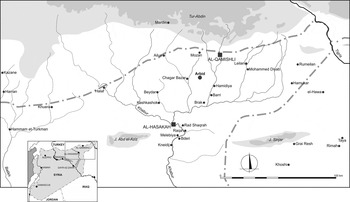
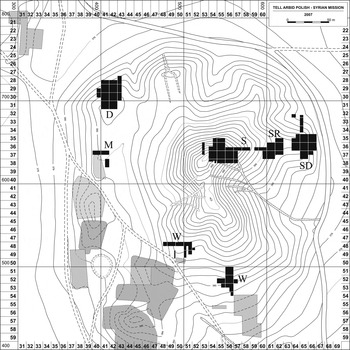
The site of Tell Arbid, excavated between 1996–2010, has produced much new data on the Ninevite 5 period in the Syrian Jezirah (Fig. 1).Footnote 1 At this time Tell Arbid emerged as a significant centre within the Upper Khabur basin, occupied—without major breaks—from Early Jezirah (EJZ) 1 to EJZ 5 as well as in the Khabur Ware and Mitannian periods.Footnote 2 The latest traces of settlement at the site date to the Neo-Babylonian and Hellenistic periods. The Ninevite 5 period occupation extends from the Painted and Early Incised Ware phase to the Late Excised pottery (EJZ 1–EJZ 2) phase.Footnote 3 During this time, the site of Tell Arbid must have been an extensive settlement as evidence has been encountered in nearly all of the excavated areas (Areas W, D, SS and SD), both on the main tell and in the area of the so-called lower town (Fig. 2).
The Khabur region

Tell Arbid: a topographic map with excavated areas

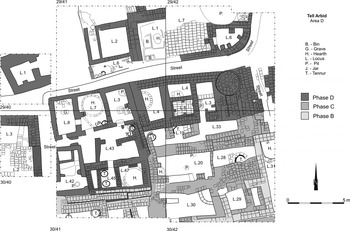
The pottery presented below was recovered from Area D, in the north-western area of the site, where a living quarter covering an area of over 500 square meters has been excavated (Fig. 3). Among the architectural units, spaced along some streets and courtyards, various types of structures were recorded: residential dwellings, granaries for grain storage, kitchens with ovens and hearths, and mud-brick platforms. Throughout the quarter numerous installations and artefacts used in household activities were revealed. These included, among others, fire installations, storage bins, basalt grinders and querns, flint and obsidian tools, and a large assemblage of various types of pottery vessels.
Tell Arbid: Area D dwelling quarter

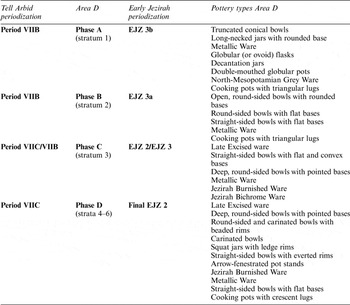
The dwelling quarter excavated in Area D was settled in the final stage of the Ninevite 5 (final EJZ 2) and EJZ 3 periods.Footnote 4 Four phases have been distinguished that correspond to six architectural strata: Phase A (Stratum 1), Phase B (Stratum 2), Phase C (Stratum 3), and Phase D (Strata 4–6) (Table 1). Phases A and B correspond to the EJZ 3b and EJZ 3a periods. Phase D represents the latest phase of Ninevite 5 period, corresponding to the final EJZ 2 period. Phase C can be regarded as transitional between the EJZ 2 and the EJZ 3 period.Footnote 5
Chronological table

Late Ninevite 5 (final EJZ 2) is a period characterized by the presence of variety of wares and pottery types. It is mostly defined by a distinct type of excised decoration, sometimes combined with incised patterns (late excised ware) and some morphological types that occur both as decorated and plain vessels. New pottery traditions and morphological types also make their first appearance in the final EJZ 2 period (e.g. Metallic Ware, Jezirah Bichrome Ware, Jezirah Burnished Ware or straight-sided bowls).
The pottery from Area D has been analyzed typologically and technologically, and its chronological variation has been closely studied. The large spatial exposure in Area D and the high number of diagnostic pottery sherds enabled quantitative analysis. The frequencies of the different pottery types in the different strata have been recorded and, for each of the chronological phases, “index fossil” forms have been identified. Pottery data were diachronically analyzed to show changes and general trends between the pottery production of the final Ninevite 5 (Phase D) and post-Ninevite 5 phases (Phases C and B).
Ninevite 5 pottery with late excised decoration is especially connected with the Khabur region (north-east Syria), having a limited presence in northern Iraq (Mohammed Arab 3).Footnote 6 Small samples of this pottery have also been found at sites in the upper Tigris region in south-eastern Turkey, which marks the northern border of the distribution of this type of pottery.Footnote 7 The pottery from Phase D in Area D of Tell Arbid is a coherent group of vessels comparable to the pottery from other sites in the Khabur region where final EJZ 2 occupation has been attested, such as Tell Leilan IIId (strata 15–17), Tell Barri strata 45–40 (phases T–W), Tell Brak (Phase K), Tell Hamoukar, Tell Hamidiye, Tell Raqa'i level 3, Tell Atij and Tell Muhammed Diyab.Footnote 8
Main pottery types
In the typological study of pottery from Area D several morphological classes have been distinguished: bowls, cups, jars, pots and other shapes such as pot stands and lids. Among these some sub-classes and types have been identified based on a number of variables: the general shape of the profile (rounded, carinated, or straight walled); proportions (such as ratios of the rim diameter to height or maximum diameter); size (big, medium, small and miniature vessels); rim shape and orientation (beaded, simple, everted, etc.); base shape (pointed, rounded, flat, pedestal, disc, ring, etc.); and the presence of appendages (spouts, lugs). The morphological types belong to two main technological groups: Fine Ware and Common Ware.Footnote 9 These were distinguished by their fabric and technology of production. Apart from Fine and Common wares, some other classes have been identified which combine morphological types with a specific fabric and technology, surface treatment, colour or firing. They include Metallic Ware, Kitchen Ware and Jezirah Burnished Ware.
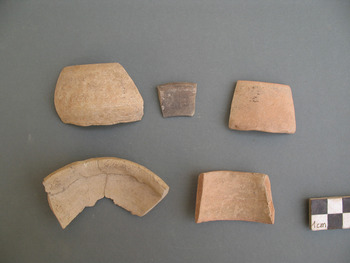
Pottery vessels of the final EJZ 2 period from Tell Arbid were produced locally. The presence of pottery workshops in Tell Arbid's Area D is indicated by waste pottery as well as numerous vessels that had warped during the firing process, as well as several pottery ring scrapers used for finishing the newly-produced vessels (traces of scraping are ubiquitous on Common Ware jars and bowls) (Fig. 4).Footnote 10 Moreover, laboratory tests confirmed a local origin of the clay used for the production of the vessels.Footnote 11
Pottery scrapers. Area D

Fine Ware
Fine Ware is represented predominantly by small and medium-sized bowls and jars but there were also some pot stands and single examples of large jars. Their fabric is fine-grained, with no coarse inclusions. Individual, medium-sized lime and black mineral particles are sometimes visible that were most probably present in the clay source. In the case of some vessels, the fabric is distinguished by more numerous lime particles and a “lime popping” effect visible at the vessel's surface. Fine Ware vessels are usually thin-walled (approximately 0.2–0.5 centimetres thick) and wheel-made: wheel marks are visible on the vessels’ surface. Some bear traces of trimming on their outer surfaces (excess clay and imperfections were cut away from the vessel with a knife or another sharp tool when it was leather-hard). The fabric of Fine Ware vessels is usually dense, although—as attested by laboratory analyses of pottery from Area D—many of them have an open porosity of over thirty percent.Footnote 12 Firing temperatures of Fine Ware vessels vary from 700 to 1100 degrees Celsius although most were fired at higher temperatures (900–1100 degrees Celsius).Footnote 13 The colours of the vessels are usually buff/pale yellow (Munsell 5Y8/2, 2.5Y8/2) (sixty-eight percent of the assemblage) and olive (in the case of ceramics fired at high temperatures) (Munsell 5Y5/3) (five percent of the assemblage). Pale brown (Munsell 10YR8/2) also has a significant presence (twenty-three percent of the assemblage), whereas reddish yellow (Munsell 7.5YR 6/6) and light red (Munsell 2.5YR6/8), although present, are much less frequent (four percent). These colours are typical of pottery made of calcareous clay and fired in an oxidizing atmosphere. Pale yellow, buff and pale brown colours are generally characteristic for the final EJZ 2 pottery assemblage, while a grey colour, which was common in EJZ 1 mainly at northern Iraqi sites, is hardly ever encountered.
Bowls
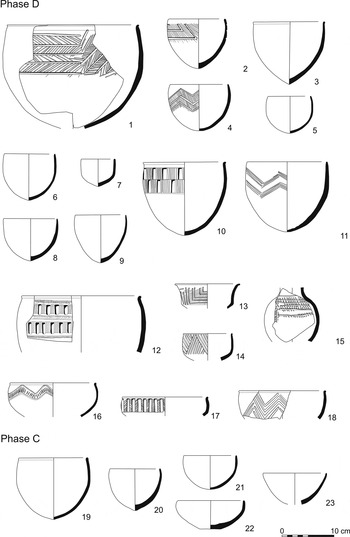
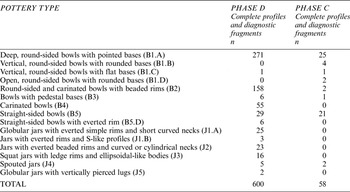
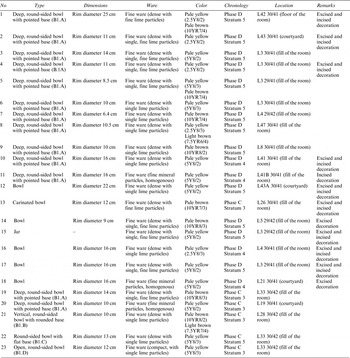
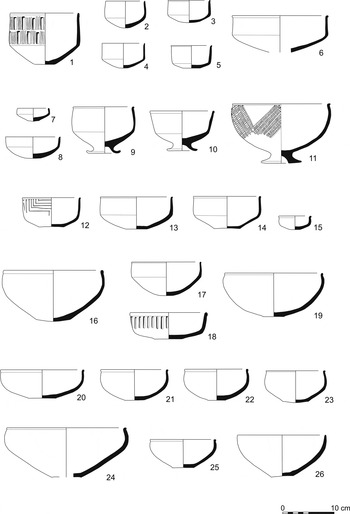
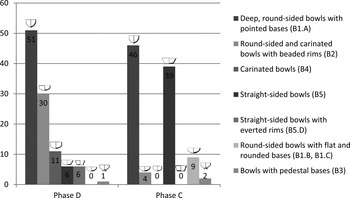
Fine Ware bowls include small and medium-sized bowls with typical rim diameters of up to approximately 20 centimetres, although some specimens can measure up to 25 centimetres. Bowls are the most numerous and the most morphologically varied category of Fine Ware represented in the final EJZ 2 period in Area D. Deep, round-sided bowls with pointed bases (B1.A) (fifty one percent of the Fine Ware bowls assemblage) and round-sided and carinated bowls with beaded rims (B2) (thirty percent) are the most common forms (Table 2). Deep, round-sided bowls with pointed bases vary in size and rim shapes (B1.A) (Fig. 5 and Table 3: 1–11, 19–20). Bowls with rim diameters of 7–10 centimetres are most common; all have simple rims (Fig. 6). Less numerous are larger bowls, with rim diameters of 12–17 centimetres; they usually have beaded rims. There is also a miniature bowl, with rim diameter of 4.5 centimetres and a big bowl, measuring 25 centimetres at the rim (Fig. 5: 1). Round-sided bowls with pointed bases are the deepest bowls in the EJZ 2 period (their rim diameter to height ratio being approximately 1:1).
Fine Ware bowls. Phases C (19–23) and D (1–18)

Deep, round-sided bowls with pointed bases. Phase D

Frequency of Fine Ware pottery types in Phases C and D

Fine Ware bowls. Phases C and D (Fig. 5).

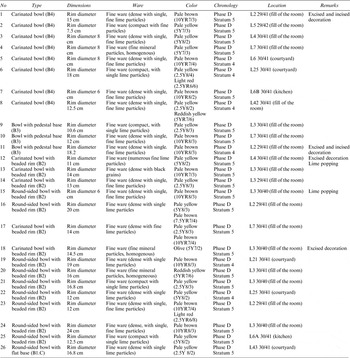
The round-sided and carinated bowls with beaded rims have flat (or mini-flat) or concave bases (Fig. 7 and Table 4: 12–25).Footnote 14 The bowls differ in size and proportions. The rim diameters of the majority of the bowls are 11–14 centimetres but there are some larger bowls with rim diameters of over 20 centimetres and several examples of small bowls with rim diameters of just 6–7 centimetres. Bowls with beaded rims usually have a height to rim diameter ratio of 1:2 (standard bowls) but some shallower specimens, with ratios of 1:3 are also attested (low bowls).Footnote 15 Bowls with carinated profiles (B4) take several forms, such as vertical carinated bowls with flat bases and simple rims (Fig. 7: 1–2, 4, 7–8), wide carinated bowls with beaded rim, flat base and vertical profileFootnote 16 (Fig. 7: 6), small carinated bowls with flat or mini–flat base, low carination and beaded rim (Fig. 7: 3, 5)Footnote 17 or open carinated bowls with everted rims (Fig. 5: 13).
Fine Ware bowls. Phase D

Fine Ware bowls. Phase D (Fig. 7).

Bowls with pedestal bases (B3) are scarce but they still make up a diagnostic group in Phase D (Fig. 7: 9–11). They usually have carinated (or, less frequently, rounded) profiles and beaded rims. One of the bowl is distinctive for its hatched step pattern (Fig. 7: 11), while the other examples are undecorated. Bowls with pedestal bases have also been found in Phases C and B; however, in these periods, they feature a more rounded profile.Footnote 18
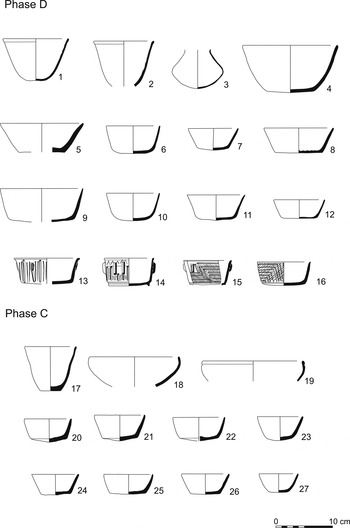
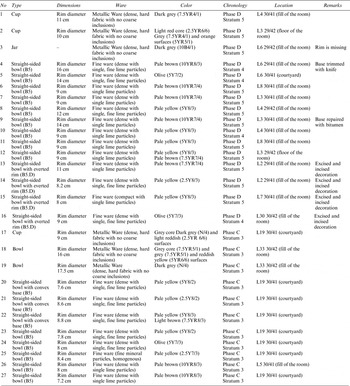
Straight-sided (or conical) bowls (B5) are one of the less-common forms in the final EJZ 2 period (they make up six percent of Fine Ware bowls); their numbers increase in Phase C (thirty nine percent). With regard to their bases, they can be divided into straight-sided bowls with either flat, slightly rounded or convex bases (Fig. 8 and Table 5: 4–12, 20–27). For the low straight-sided bowls the height to rim diameter ratio is 1:3; for the—more common—standard bowls, the ratio is 1:2. Examples of the straight-sided bowls have been attested in each of the Phase D strata in Area D.Footnote 19
Fine Ware bowls (4–16, 20–27) and Metallic Ware (1–3, 17–19). Phases C and D

Fine Ware bowls and Metallic Ware. Phases C and D (Fig. 8).

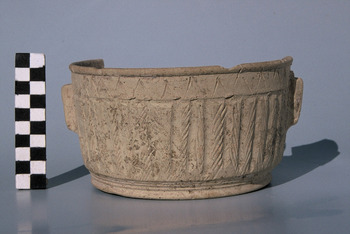
Straight-sided bowls with everted rims (B5.D) make up a small but recognizable group of Fine Ware vessels in the Phase D pottery repertoire of Area D (Fig. 8: 13–16). They are more elaborate in form and decoration than other Fine Ware bowls from that phase. These bowls usually have flat (or ring) bases and everted, simple or beaded rims; some have special attributes, such as vertical lugs and deep incisions just above the base.Footnote 20 One of the straight-sided bowls with everted rim has a ring base and a few deep, parallel incisions just over the base (Fig. 8: 14; Fig. 9); two pairs of vertical lugs are placed opposite each other. The bowl is decorated with a band of vertical excised lines: the panels between the excised lines are alternately decorated with incised oblique hatching, resulting in a herring-bone-like pattern. There is a band of incised chevrons on the upper part of the bowl, just beneath the rim.
Decorated straight-sided bowl with everted rim and vertical lugs. Phase D

Vertical, round-sided bowls with simple rims and rounded (B1.B) or flat bases (B1.C) are rare. Single specimens of vertical, round-sided bowls with simple rims and flat bases (B1.C) were found in Phases D and C (Fig. 5 and Table 3: 22; Fig. 7 and Table 4: 26). Four vertical round-sided bowls with rounded bases (B1.B) have been attested only in Phase C (Fig. 5: 21). The final EJZ 2 phase lacks open, round-sided bowls (B1.D); a few open, simple rims, which might belong to bowls of this type were attested in Phase C (Fig. 5: 23).
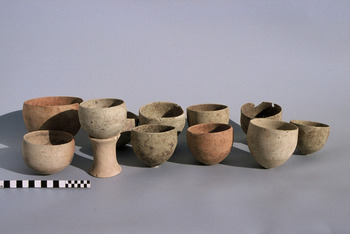
Fine Ware bowls could have been used for drinking, eating small helpings of food, or serving foodstuffs. Two main size groups can be recognized among the deep, round-sided bowls with pointed bases (B1.A), straight-sided bowls (B5) as well as the round-sided and carinated bowls with beaded rims (B2). The smaller bowls, with rim diameters of approximately 7–14 centimetres, are more numerous and may have been used by individuals either for drinking/eating or presenting a small quantity of food. The larger (rim diameter of 14–25 centimetres), family-sized bowls with about twice the capacity of an individual-sized bowl, were less numerous than the smaller bowls and may have been used for serving food. Within a room in the residential quarter of Area D, eight deep, round-sided bowls with pointed bases (rim diameter 7–10 centimetres) were found on the floor next to a small jar. Along with animal bones, they were evidence of a communal gathering during which they may have been used for serving food or drink.
Jars
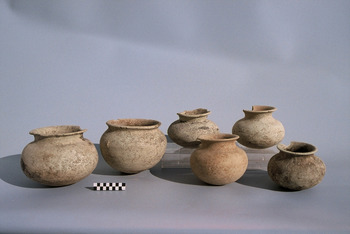
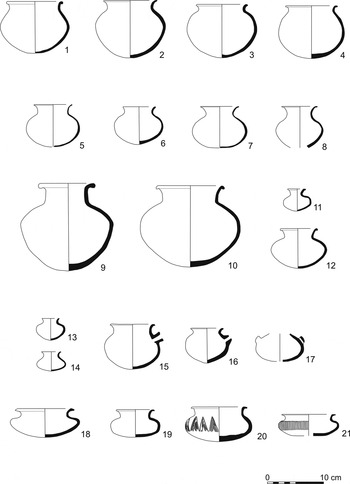
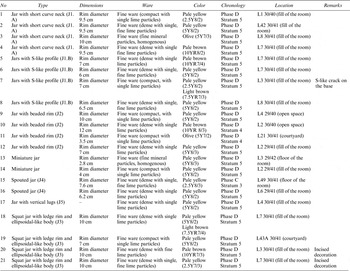
Fine Ware jars are either small or medium-sized. Those from Area D have most commonly rim diameters of up to 12 centimetres and a maximum height of 15 centimetres.Footnote 21 Such jars may have been used for serving drink/food or for storing small quantities of some precious substance, such as perfume or special oils. On the basis of the rim and neck shape and their general proportions, as well as such attributes as spouts or lugs, several types of Fine Ware jars can be distinguished (Fig. 10). Globular jars with everted, simple rims and short curved necks are most popular (J1.A) (Fig. 11 and Table 6: 1–4).Footnote 22 Jars with everted, beaded rims and higher, curved or cylindrical necks are also common (J2) (Fig. 11: 9–12).Footnote 23 Jars of this type vary in size and can be divided into medium, small and miniature. A few examples have everted rims, clearly distinguished necks and S-like profiles (J1.B) (Fig. 11: 5–8). Small squat jars with ledge rims and ellipsoidal-like bodies are a diagnostic group (J3) (Fig. 11: 18–21).Footnote 24 Some spouted jars have been found (J4) in Phase D (Fig. 11: 16) and Phase C (Fig. 11: 15) Small globular jars with vertically pierced lugs (J5) are represented by single examples in Phase D (Fig. 11: 17).
Fine Ware jars. Phase D

Fine Ware jars. Phases C (15) and D (1–14, 16–21)

Fine Ware jars. Phases C and D (Fig. 11).

Common Ware
Common Ware is for the most part associated with large bowls and jars and with the majority of pot stands. The vessels are usually thick-walled (approximately 0.5–1.5 centimetres), made either by hand (for example, by coiling) or by a composite method (on the wheel and by hand). Common Ware vessels—bowls, jars and pot stands—bear marks left by scraping, a technique often used for handmade vessels. Such technological marks have not been documented in Fine Ware vessels, which were wheel-made. Scraping was often used to eliminate defects on the surface of vessel walls and to thin down the walls by removing excess clay. A variety of tools could be used for scraping, including shells, flaked stones, bones as well as pottery scrapers. Common Ware fabric contains a vegetal temper mixed with the clay in various ratios. Pottery analyses have shown that the Common Ware vessels from Area D were fired at various temperatures ranging between 600–1000 degrees Celsius.
Bowls
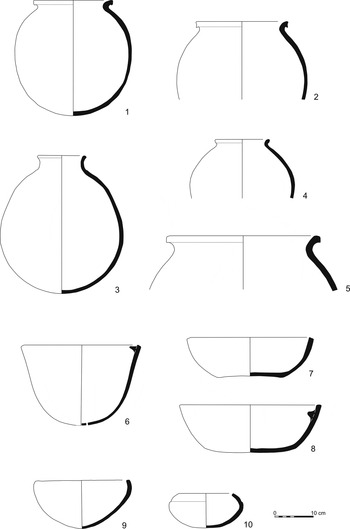
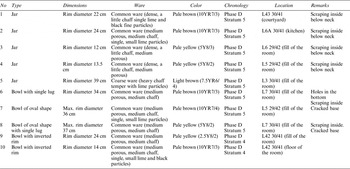
Common Ware bowls are represented by large vessels (with rim diameters typically exceeding 20 centimetres), mainly with unrestricted orifice.Footnote 25 Bowls have flat, bevelled or simple rims and flat or rounded bases (Fig. 12 and Table 7: 6–8). Many of the bowls have an oval shape. Some have a single crescent-shaped lug applied on the inside, just under the rim. Two main types of bowls can be distinguished, differing in proportions: low bowls that are 10–13 centimetres high (Fig. 12: 7–8), and deeper bowls, reaching approximately 20 centimetres in height (Fig. 12: 6). Deep bowls include a hemispherical bowl-colander with holes in the base and with a crescent-shaped lug under the inside rim (Fig. 12: 6). A rare type of Common Ware bowl in the Phase D pottery assemblage is round-sided with restricted orifice and inverted rim (only two complete bowls and two rim fragments have been documented) (Fig. 12: 9–10); one of the bowls has a ridged outer profile.
Common Ware bowls and jars. Phase D

Common Ware bowls and jars. Phase D (Fig. 12).

Common Ware bowls form a technologically uniform group. The vessels were shaped by hand. Characteristic technological marks include traces of scraping on the inner surface and the outer surface sometimes bears signs of texturing by brushing. Colour is a diagnostic trait: the bowls are usually pale brown (Munsell 10YR7/3, 10YR8/2), pinkish (Munsell 7.5YR7/4) or reddish yellow (Munsell 5YR7/6). Only approximately twenty fragments (from over 200 diagnostic potsherds of this type of bowls registered in Area D) are of a pale yellow/buff colour (Munsell 5Y8/2). In terms of fabric, two main groups of Common Ware bowls can be distinguished based on the proportion of vegetal temper in their clay matrix. Both lack coarse mineral inclusions, with only fine individual lime and/or black mineral particles, probably naturally present in the clay. One group is formed from a dense clay with little chaff, the other is more porous with a moderate chaff temper. These same groups are also representative of the Common Ware jars, which points to a common production technology for both vessel types. Large Common Ware bowls could have been used in food preparation and processing food products. Bowls have unrestricted orifice allowing easy access to the contents of the vessel. Thick walls (1.0–1.5 centimetres) make the bowls more resistant to stirring, pounding or grinding of their contents.
Jars
Common Ware jars display virtually no morphological differences. They have short, curved necks, everted rims, globular bodies and rounded bases. The jars differ only in size, particularly in the rim diameter to maximum body diameter ratio. Two main types can be recognized: wide-mouthed jars with rim diameters of approx. 20–30 centimetres (ratio of rim diameter to maximal diameter of approximately 1:1.5) (Fig. 12: 1–2) and jars with more restricted orifice (rim diameters of 12–13 centimetres and a rim diameter to maximal diameter ratio of approximately 1:2) (Fig. 12: 3–4). Wide-mouthed jars, with rim diameters of 20–30 centimetres are more popular compared to jars with a more restricted orifice, making up some seventy-five percent of the Common Ware jars in the Phase D pottery assemblage.
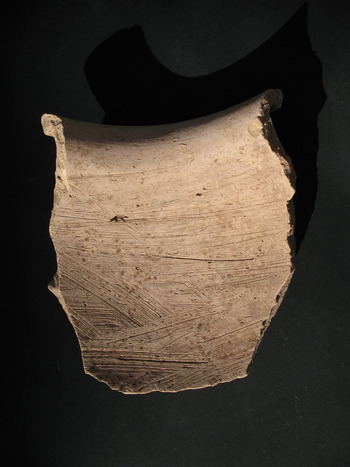
The Common Ware jars were probably made using a composite method—on a wheel and by coiling. The neck and rim were probably formed separately and then applied to the body; in a few examples there is evidence of pinching or squeezing at this juncture. Occasionally, a horizontal crack just beneath the neck can be traced; this is probably the result of the clay drying too much before the two pieces were joined. The neck and rim of the jars were probably wheel-made (or were coil built and finished on the wheel). The main body may have been formed by coiling since no wheel marks are visible either inside or outside—just traces of smoothing with a soft tool (some fragments indicate a delicate brushing). Scraping of the inside of the vessel below the neck is a diagnostic feature of Phase D Common Ware jars regardless of their type and size (Fig. 13). The predominant colours of Common Ware jars are buff/pale yellow (Munsell 5Y8/2, 5Y8/3, 2.5Y8/2, 2.5Y 8/3). Pale brown (Munsell 10YR7/3, 10YR8/3) is also popular, with olive (Munsell 5Y5/3) and pink (Munsell 7.5YR7/4) followed by reddish yellow (Munsell 5YR6/6) in smaller numbers. The largest groups of Common Ware jars have fabrics with no coarse mineral inclusions (just individual fine lime and black particles, probably natural inclusions). As with Common Ware bowls, the jars can be divided into those formed from dense clay with little chaff temper and those of a more porous clay mixed with a moderate amount of chaff.
Traces of scraping (Common Ware jar). Phase D

Judging by the different sizes of the vessels, especially their mouths, the two main forms of Common Ware jars would have served different functions. Wide-mouthed jars, with rim diameters of 20–30 centimetres were more suited to storing solid products. Jars with more restricted orifice (rim diameters ranging round 12–13 centimetres) may have been used for temporary storage of liquids. The latter are also suitable for carrying water and other liquids as the restricted orifice and necks would have prevented liquids from spilling but also facilitated pouring.
Extra-large jars (rim diameters as much as 30–40 centimetres) are usually representative of Coarse Ware with heavy chaff temper; some have also a lime admixture (Fig. 12: 5). These jars were usually fired at low temperatures (a black core is often visible in the section). A few examples with different characteristics have been encountered in this group. These have a fabric resembling that of the Fine Ware and thus are made from dense clay with no visible coarse inclusions. Such Fine Ware storage jars were fired at higher temperatures and may have had a different function to the coarser jars. Storage jars with heavy plant temper are distinctive for their high porosity (which occasionally exceeds forty percent) and would not have been suitable for storing liquids but must have been used for long-term dry storage.
Pot stands
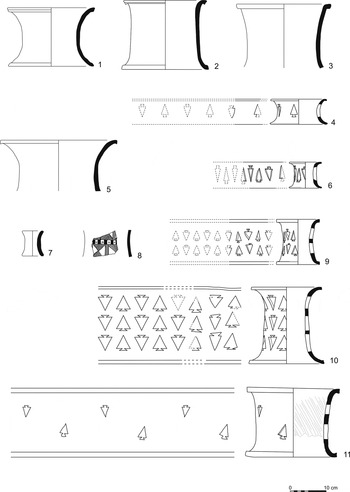
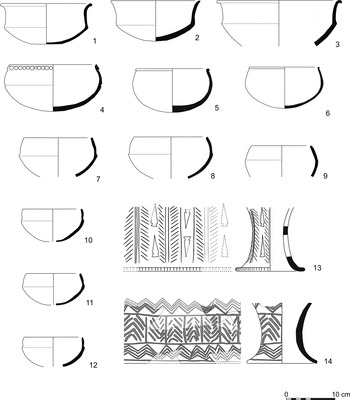
Compared with the earlier phases of the Ninevite 5 period (EJZ 1 and early EJZ 2), pot stands become a more common and diverse pottery type, both at Tell Arbid and throughout the Khabur region, during the final EJZ 2 period. In Area D, four types of pot stands have been distinguished based on their decoration and surface treatment: plain (PS1); arrow-fenestrated (PS2); bichrome (Jezirah Bichrome Ware) (PS3); and burnished (Jezirah Burnished Ware) (PS4). The first two types are the most numerous, the others represented by only occasional finds.
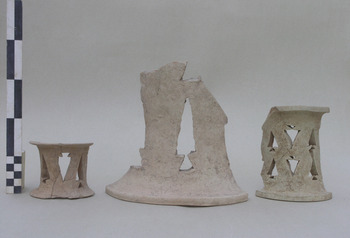
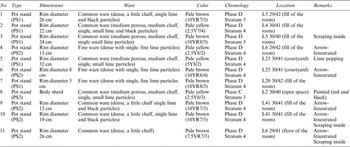
Over forty diagnostic fragments of plain pot stands have been found in Phase D. They vary in size, with diameters ranging between 12–30 centimetres (Fig. 14 and Table 8: 1–3, 5, 7), although a few specimens measuring just 4–6 centimetres in diameter with a common height have also been encountered. Another popular category in Area D is arrow-fenestrated pot stands. These represent approximately half of all Phase D pot stands (with about forty fragments identified) (Fig. 14: 4, 6, 9–11).Footnote 26 At Tell Arbid, arrow-fenestrated pot stands are limited to the final EJZ 2 period. The arrow-shaped “windows” are combined into various patterns (Fig. 15); on some of the larger vessels these are usually organised within vertical bands of three or four arrows. With smaller pot stands, the “windows” are frequently arranged as a horizontal band, with the arrows pointing alternately up and down. The arrow-shaped “windows” are a new motif in the final EJZ 2 period that has, so far, been attested only within a restricted geographical area.Footnote 27 Their appearance in the Khabur region and absence outside the Jezirah, points to a local origin of the motif in connection with the Ninevite 5 pottery tradition. Immediate predecessors of the arrow-fenestrated pot stands should be sought among triangle-fenestrated pot stands known in the early EJZ 2 period, exemplified also in the Tell Arbid assemblage. Both plain and arrow-fenestrated pot stands are, for the most part, Common Ware, with small amounts of chaff and mineral inclusions, although a few examples belong to the Fine Ware tradition, with no visible coarse inclusions. Many pot stands bear traces of scraping on their inner surface, and the surfaces show a “lime popping” effect.
Pot stands. Phases C (8) and D (1–7, 9–11)

Arrow-fenestrated pot stands. Area D

Pot stands. Phases C and D (Fig. 14).

Area D has yielded one fragment of a Jezirah Bichrome pot stand from the Transitional Phase C (Fig. 14: 8). This is decorated with two horizontal bands of hatched red-and-back hour-glasses motifs arranged into metopes separated with red painted vertical bands. Between the hourglass-bands is a black band with unpainted rectangles, each with a central red dot.Footnote 28
Kitchen Ware
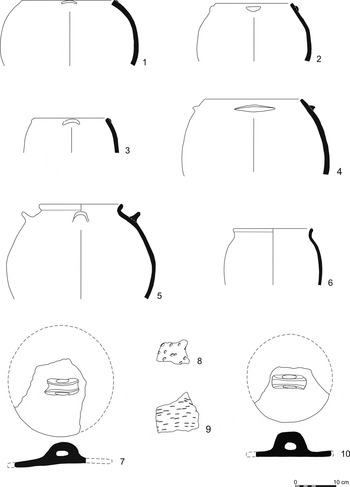
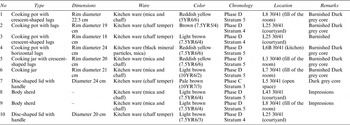
Within the Kitchen Ware assemblage from Phase D of Area D, hole-mouth pots represent the largest component (ninety percent), but wide-mouthed jars with short curved necks and rounded bases are also present (Fig. 16 and Table 9).Footnote 29 Crescent-shaped lugs are common in both forms; horizontal lugs are also encountered but these appear to be less numerous.
Kitchen Ware. Phases C (7) and D (1–6, 8–11)

Kitchen Ware. Phases C and D (Fig. 16).

As for technological distinctions, the largest group in the Kitchen Ware category is distinguished by chaff temper (sixty-five percent); grains of mica as well as lime particles can be observed in some fabrics. The vegetal temper made the vessels more porous following firing and may have contributed to their function; the pores could have improved their resistance to thermal shock.Footnote 30 Another significant group within the Kitchen Ware assemblage (twenty-six percent) features the presence of mica, which probably originated from the micaceous clay source favoured by the potters. These vessels were also tempered with chaff, but to a lesser extent than the first group. Individual grits, dark grains and white particles can also be observed. The least numerous group is distinguished by a mineral temper (e.g. basalt) and mica (nine percent), which becomes more numerous only in post-Ninevite 5 Kitchen Ware (EJZ 3).
These cooking vessels were fired at uniformly low temperatures. All analyzed samples point to a firing temperature of 600–700 degrees Celcius. Their sections often reveal a dark grey core, the result of a short firing time or low firing temperature. The surface of some cooking pots was burnished or textured: burnishing sealed the vessel walls against leakage while texturing ensured a strong handgrip. The latter was created by fingernail impressions, although single examples of circular and triangular impressions have also been attested (Fig. 16: 8–9).
Kitchen Ware of the final EJZ 2 period includes characteristic disc-shaped lids with handles (Fig. 16: 7, 10). The lids are porous and heavily tempered with chaff. Some of the lids have a porosity of about fifty percent. Most of the lids have diameters of 20–25 centimetres and correspond in size with cooking pots with the most popular rim diameters ranging between 15–25 centimetres.
Metallic Ware
Metallic Ware is distinguished by its outstanding technological production—a dense “clinky” fabric that was fired at high temperatures resulting in a low water absorption.Footnote 31 Small quantities of Metallic Ware are present in all final EJZ 2 strata in Area D (with approximately five diagnostic fragments identified in Phase D) (Fig. 8: 1–3). Metallic Ware was more abundant in Phase C (eight examples) (Fig. 8: 17–19) with bowls and cups being the most numerous forms. Small jars are represented by only a few examples (including one in grey-orange and one in dark grey). In Phase D Metallic Ware is represented by high, straight-sided beakers with corrugated walls and low, round-sided bowls with flat beaded rim. The Tell Arbid finds corroborate the fact that late excised Ninevite 5 pottery (final EJZ 2) and Metallic Ware co-existed for a short period of time, as is indicated by data from other sites in the Khabur region.Footnote 32
Jezirah Burnished Ware
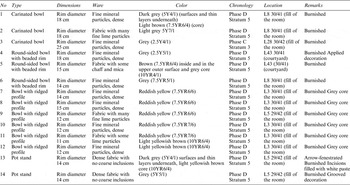
In Area D, in the context of late excised Ninevite 5 ware, some vessels have been encountered with burnished surfaces, distinctive forms and technological features that comprise a group called Jezirah Burnished Ware (Fig. 17 and Table 10).Footnote 33 Their distinguishing technological features, apart from the burnished surface, are firing conditions (prevalent reducing atmosphere and, usually, low firing temperature), and their colour (grey and orange).Footnote 34 Jezirah Burnished Ware vessels, dated to the final EJZ 2 and EJZ 3a periods, are known from just a handful of sites in the upper Khabur region; apart from Tell Arbid they include Tell Barri and Tell Leilan. In Arbid's Area D, forty-nine fragments of Jezirah Burnished ware have been registered, representing various vessel forms—bowls, being the most numerous (with 35 fragments), pot stands and jars. There are three main types of bowls: grey burnished carinated bowls (Fig. 17: 1–3),Footnote 35 orange burnished hemispherical bowls with ridged profile (Fig. 17: 7–12)Footnote 36 and burnished round-sided bowls with beaded rims (Fig. 17: 4–6). Within each of these types, technological differences have been observed, for the most part related to the vessels’ firing.
Jezirah Burnished Ware. Phases C (3) and D (1–2, 4–14)

Jezirah Burnished Ware. Phases C and D (Fig. 17).

Among the burnished pot stands, dark grey burnished arrow-fenestrated pot stands with white-inlays as well as grey and brownish burnished pot stands with grooved decoration can be singled out (Fig. 17: 13–14). One of the best-preserved specimens was decorated with cut arrows arranged one above the other, in vertical bands. The bands of arrows are bordered with a herring-bone pattern, made of regular, oblique, incised lines arranged vertically, each column separated with two or three vertical lines. The incisions are filled with white paste.Footnote 37
Jezirah Burnished Ware does not belong to the Ninevite 5 pottery tradition; it does however show affinities to Early Transcaucasian Ware and Anatolian pottery traditions, where—unlike in Mesopotamian traditions—burnishing is typical.Footnote 38 The Jezirah Burnished Ware and late Ninevite 5 pottery from Area D offer a chance to study the mixing of pottery resulting from cross-cultural connections. Arrow-fenestrated pot stands (PS2) and round-sided bowls with beaded rims (B2) are forms that appear at Tell Arbid within two different pottery traditions, each based on a different technology—both in the final EJZ 2 pottery tradition with buff or pale yellow and wet-smoothed surfaces and in the Anatolian or Transcaucasian tradition with burnished, grey or orange, surfaces and white inlays.Footnote 39
Decoration
Bowls were the most frequently decorated vessels from the final EJZ 2 strata of Area D. Among the over 150 decorated potsherds with recognizable shapes, only seven belonged to jars (Figs. 5: 15; 13: 20–21).Footnote 40 A step pattern (also called a zigzag pattern) and a panel motif are the most popular decorative motifs in the Phase D pottery assemblage, just as they are in the wider Khabur region. The step pattern comprises fifty-five percent of decorated pottery sherds and features excised lines, often combined with incised hatching (Figs. 5: 1, 2, 4, 13, 15; 7: 11–12; 8: 15–16). The step pattern is characteristic of the Khabur region from where it may have originated. It is also known from northern Iraq (Mohammed Arab 3) and south-east Turkey (Girnavaz, Salat Tepe).Footnote 41 In the repertoire of late Ninevite 5 pottery the step pattern remains in use longer than the panel motif. In the assemblage from Area D the step pattern is known from Phases B–D whereas the panel motif has been recorded only in Phase D.
The panel design consisting of a band of vertical excised lines represents the second most frequently found motif of late excised Ninevite 5 pottery decoration in Phase D of Area D—thirty-one percent of the decorated sherds assemblage (Figs. 5: 10, 12; 7: 1, 18).Footnote 42 This design is also known from the incised and excised ware (early EJZ 2).Footnote 43 A simple pattern of excised panels encircled a few bowls (Fig. 7: 18) while other vessels had decorative bands of excised panels and the surrounding frames with vertical (occasionally oblique) incised hatching (metope pattern). In some instances, above and/or beneath such a “metope” band, a strip of oblique incised strokes was added. One of the recovered sherds features an even more elaborate decoration (Fig. 5: 12): two bands with the panel design are separated by a band with an incised herring-bone pattern. Both the top and the bottom of the composition are bordered by bands with an impressed rocker pattern; this appears to be distinctive of the final EJZ 2 period.Footnote 44 In some cases, the vertical excision was surrounded by diagonal hatching forming a herring-bone pattern (Figs. 5: 17; 8: 14). Among simple decorative motifs there are incised and excised vertical lines (Fig. 11: 21), incised chevrons consisting of parallel lines (Fig. 11: 20) and multiple horizontal zigzags (incised or excised) (Fig. 5: 11, 18).
Chronological observations of pottery development
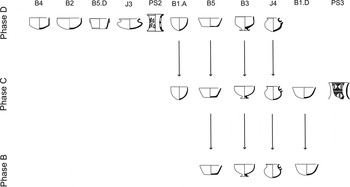
Observations of the morphological development of vessels—especially of Fine Ware bowls—between the final EJZ 2 (Phase D) and the post-Ninevite 5 periods (Phases C–B) reveal some important changes and general trends. Some of these are related to the increase or decrease in the popularity of some forms (Table 2 and Fig. 18). In Area D, a significant ceramic horizon (Phase C) exists at the transition between the EJZ 2 and EJZ 3 periods, where some pottery types from Phase D survived and occurred alongside pottery characteristic of Phase B.
Frequency of types of bowls in the final EJZ 2 period (Phase D) and Phase C

In the Transitional Phase C, continuity in the pottery repertoire with the final EJZ 2 (Phase D) period is evident in a few forms (Fig. 19). Among them are deep, round-sided bowls with pointed bases (B1.A), that is, the most common Fine Ware bowls (forty six percent). However, there is no evidence for these in Phase B. These bowls are still represented at sites mainly in the eastern part of Jezirah during the early EJZ 3a period.Footnote 45 In Phase C straight-sided bowls with convex and flat bases (B5) become more common when compared with the final EJZ 2 strata, where they are rarely attested. The same can be said of round-sided bowls with rounded and flat bases (B1.B and B1.C), which are the least numerous pottery category in Phase D. Both straight-sided (B5) and round-sided bowls with flat and rounded bases (B1B and B1C) become a well-attested type in the EJZ 3 period. In Phase C, there is an increase in the quantity of the Metallic Wares, a small number of which were present in all final EJZ 2 strata in Area D. In Phase C, new forms, typical for the EJZ 3 period, also appeared (a few fragments of open, round-sided bowls with rounded bases, B1.D). Jezirah Bichrome Ware was found only in Phase C. A set of drinking vessels left behind the social gathering in Area D is a good illustration of trends in pottery development in Phase C (early EJZ 3a). It includes one Metallic Ware cup, two deep, round-sided bowls with pointed base and six straight-sided bowls.
Chart of pottery types and their chronological correlations (Phases B–D). Area D

The most evident change in pottery between the final EJZ 2 and post-Ninevite 5 (EJZ 3) periods is the disappearance of excised and incised decoration. Vessels with late excised decoration are still present in Phase C. The few fragments of decorated vessels from the Phase B strata can be regarded as residual or very late survivals.Footnote 46 All the sherds from Phase B were decorated with the hatched step pattern; this survived longer than the panel decoration which is already absent in Phase C.
Phases C and B lack round-sided and carinated bowls with beaded rims (B2), which are diagnostic for the final EJZ 2 period. A few beaded rims which may have belonged to bowls of this type were registered in the post-Ninevite 5 phases but these can be considered as residual material. The same is true with arrow-fenestrated pot stands and only a few individual fragments were found in Phase C. Unlike other straight-sided bowls that became more popular in the post-Ninevite 5 strata, straight-sided bowls with everted rims (B5.D) are typical for the final EJZ 2 strata (Phase D) but are unknown in Phases C and B in Area D.Footnote 47 The same applies to squat jars with ledge rims and ellipsoidal-like bodies (J3) which have been recorded only in Phase D.
Carinated bowls are characteristic for the final EJZ 2 period in Area D but are rarely attested in post-Ninevite 5 strata. Compared to the earlier phases of Ninevite 5 pottery, their number decreases in the final EJZ 2 period, as do forms with a sharp carination.Footnote 48 Deep, round-sided bowls with pointed bases, typical for the final EJZ 2 repertoire, seem to have been a product of the evolution of the carinated bowls.Footnote 49 Deep, round-sided bowls with pointed bases (B1.A) may have evolved, in turn, into vertical, round-sided bowls with rounded bases (B1.B), several examples of which were registered in the Transitional Phase C.
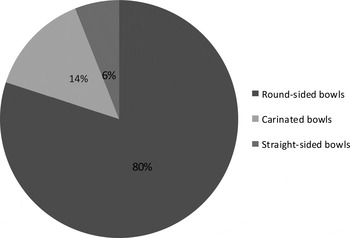
Between the final EJZ 2 and EJZ 3 periods, Fine Ware bowls display some general trends concerning the shape and orientation of their profiles. Carinated forms decrease during the final EJZ 2 period, giving way to round-sided and straight-sided forms, common in post-Ninevite 5 strata. In the final EJZ 2 pottery vertical round-sided bowls are the most frequent (eighty percent), followed by carinated (fourteen percent) and straight-sided (six percent) examples (Fig. 20). Vertical and closed Fine Ware bowls are more numerous in Phase D strata, while open Fine Ware bowls are more common in the EJZ 3 period. Open, round-sided bowls with simple rims and flat and rounded bases are not present in Phase D. They are more abundant in the EJZ 3 period (Phase B), being the most numerous group of Fine Ware bowls in Area D.
Frequency of bowls in the final EJZ 2 period (Phase D) according to profile type

The frequency of finds of the different types of rims and bases of Fine Ware bowls points to temporal changes between the final EJZ 2 and post-Ninevite 5 strata. Pointed bases, represented abundantly in Phase D, are the most diagnostic of the Fine Ware bowls in the final EJZ 2 period. Another common, although less distinctive, are flat bases, reflecting the popularity of round-sided and carinated bowls with beaded rims (B2), and, to a lesser extent, of straight-sided bowls (B5). Convex bases, associated primarily with straight-sided bowls, are particularly common in Phase C. Pedestal bases are another feature diagnostic of the final EJZ 2 pottery assemblage, but they are much less popular than pointed and flat bases; they have a long life-span, appearing earlier in the Ninevite 5 pottery tradition and continue in post-Ninevite 5. Rounded bases are not typical for the final EJZ 2 Fine Ware bowls, becoming more common among EJZ 3 bowls. They are, however, associated with Fine Ware jars. In the final EJZ 2 period, vertical and closed, simple or beaded rims dominate, and are associated with deep, round-sided bowls with pointed bases (B1.A) and round-sided and carinated bowls with beaded rims (B2). In the post-Ninevite 5 strata, there is an increase in the number of open, simple rims, which may be associated with an increase in the popularity of hemispherical and conical bowls.
Conclusions: Characteristics of the final stage of Ninevite 5 pottery
The most distinctive feature of ceramics of the final EJZ 2 period is excised decoration. Incised motifs are present—used as an addition to the excised patterns—but are less common than in earlier periods (EJZ 1 and early EJZ 2), when they are more elaborate. Among the various decorative motifs, the step pattern is the most diagnostic element for final Ninevite 5 pottery; unlike the panel motif, it is not known from earlier phases. In chronological terms the step pattern is associated with the final EJZ 2 and early EJZ 3a periods within the Khabur region, along with the complete late Ninevite 5 pottery tradition.
Another important element of the final EJZ 2 pottery is some distinctive morphological types related to the decorated Ninevite 5 tradition. Among the pottery from Tell Arbid (Area D) “index fossils” are deep, round-sided bowls with pointed bases (B1.A), round-sided and carinated bowls with beaded rims (B2), carinated bowls (B4), straight-sided bowls with everted rims and vertical lugs (B5.D), squat jars with ledge rims and ellipsoidal-like body (J3), and arrow-fenestrated pot stands (PS2).
Pottery types less diagnostic of the final EJZ 2 period—but that become more common in the EJZ 3 period—include straight-sided and round-sided bowls with flat or rounded bases. Straight-sided (or conical) bowls (B5) appear in Phases A–D of Area D (final EJZ 2–EJZ 3), and therefore cannot serve as precise chronological markers. However, an increase in their popularity in later periods can be observed along with some variation in the types represented. Generally speaking, shallow, straight-sided bowls (standard and low) are a type characteristic for the final EJZ 2 period (Phase D), while in Phases A and B high, conical bowls are also present. Bowls with pedestal bases and spouted jars recorded in the final EJZ 2 period in Area D are also of limited chronological value, as they have longer life-spans than Phase D, extending into Phase C and B. Some differences can be observed between the morphology of Fine Ware jars from the final EJZ 2 pottery assemblages—typically squat jars (with a height to maximum diameter ratio of approximately 1:1) with short necks and globular bodies—and those from later periods (EJZ 3–EJZ 4) when elongated jars with high necks and more restricted orifice become popular.
Common and Kitchen Wares are less useful as precise chronological markers. Despite this, some types appear to be characteristic of the final EJZ 2 period. Bowls (some oval in shape) with single crescent-like lugs on the interior and globular jars with short curved necks are the most characteristic Common Wares in the final EJZ 2 in Area D. Cooking pots with crescent lugs and disc-shaped lids with handles are a feature of the final EJZ 2 period, but they are not precise chronological indicators, as they were recorded in all phases of Ninevite 5 pottery (EJZ 0–EJZ 2).
Some pottery types and wares from Area D are less common in the wider final EJZ 2 pottery assemblage and may be a distinctive feature of Tell Arbid and a few other sites in the Khabur region. These include arrow-fenestrated pot stands that have a limited presence at other sites but form a substantial group among the Tell Arbid finds. For the final EJZ 2 period in Area D, the occurrence of Jezirah Burnished Ware is also characteristic; its presence at Tell Arbid and at a few sites of the Jezirah can be attributed to cross-cultural relations between the upper Euphrates and Tigris regions and that of the Khabur basin in the final EJZ 2 period.Footnote 50
The pottery assemblage from the final EJZ 2 reflects a decrease in the number of decorated vessels compared with earlier phases of the Ninevite 5 pottery tradition (EJZ 1 and early EJZ 2). Not only is the number of decorated vessels much lower than in the earlier phase but also the repertoire of motifs is poorer and simplified. By the end of EJZ 2 decoration nearly disappears. Decorated vessels amount for barely six percent of the major Fine Ware bowls assemblages in Phase D. This trend initiates changes in pottery production related to a standardization of production and a preference for plain vessels which is characteristic of pottery assemblages across northern Mesopotamia in the second half of the third millennium b.c. (EJZ 3, EJZ 4) and is likely to be related to economic and political changes in the region: in the Syrian Jezirah the final EJZ 2 period is marked by an increase in the number of settlements and the emergence of large urban centres which exhibit a growing complexity.