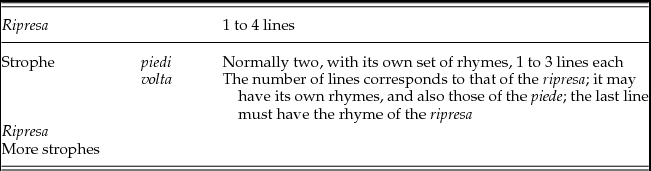
Despite the obscure historical origins of the Italian ballata,Footnote 1 scholars over the centuries have not hesitated to state, with greater or lesser conviction, that the genre grew out of practices of singing while dancing.Footnote 2 The word ballata of course suggests a connection to dancing. As defined in the anonymous treatise Capitulum de vocibus applicatis verbis, written after 1332,Footnote 3 ‘Ballatas are words applied to sounds, and they are called ballatas because they are danced’ (‘Ballade sunt verba applicata sonis, et dicuntur ballade quia ballantur’).Footnote 4 In his treatise Summa artis rithimici vulgaris dictaminis (1332), Antonio da Tempo noted that ‘ballatas of this kind are sung and danced’ (‘tales ballatae cantantur atque coreizantur’).Footnote 5 The poetic structure of the ballata, which divides into refrain or ripresa–piedi (normally two)–volta–ripresa, lends itself to singing by several performers: the refrain by the group, and the piedi and volta by the soloist (see Table 1).Footnote 6
Poetic structure of the ballata.

Danced ballatas comprised multiple strophes in which long stories or discourses unfolded. The ballatas of Simone de’ Prodenzani's Il Sollazzo (1410), which according to the narrative were danced at the court of an ideal governor, Pietrobono, fall into this category.Footnote 7 Rather than such polystrophic pieces, however, the preserved Trecento musical repertory contains many short ballatas of one strophe on philosophic-moral themes.Footnote 8 What led Trecento composers to alter the traditional understanding of the genre as music intended for dancing?Footnote 9
The monostrophic ballata as a separate species
Trecento musical sources contain over four hundred ballatas, about two-thirds of the entire repertory.Footnote 10 Modern scholars observe that interest in the ballata was greater in Florence than in northern Italy,Footnote 11 and further attest to the rise of the ballata in the 1360s and its flourishing beginning in the 1370s. Accordingly, we have no ballatas by the so-called first generation of Trecento composers: Magister Piero and Giovanni da Firenze. Jacopo da Bologna's Nel mio parlar di questa donna eterna ‘is the only surviving example of a polyphonic ballata from before 1360; however, judging from its text this piece is a lauda’.Footnote 12 A few ballatas come down to us by second-generation Florentine composers Lorenzo, Gherardello and Donato, but there is none by Vincenzo da Rimini. Niccolò da Perugia composed madrigals and ballatas in near equal numbers, seventeen and twenty-one, respectively. The balance shifts with later composers Bartolino da Padova (twenty-seven ballatas, eleven madrigals) and Paolo da Firenze (at least forty ballatas, thirteen madrigals). Preference for the ballata was stronger for Andrea da Firenze, exclusively predisposed to the ballata, and Antonio Zacara da Teramo, who composed about twenty ballatas and only one madrigal. Yet even against this backdrop, the disproportion between ballatas and madrigals in the music of Francesco Landini – 141 vs 12 – is remarkable.
Agostino Ziino has further noted that most Trecento ballatas set to music are monostrophic.Footnote 13 Indeed, most by Gerardello and Lorenzo comprise one strophe, Niccolò wrote some monostrophic ballatas, and about a half of Bartolino's and over a hundred of Landini's ballatas are monostrophic. Still, the question arises whether monostrophic structure was originally intended or a consequence of missing strophes. Loss is demonstrable in several cases, judging by manuscript concordances. For example, Bartolino da Padova's ballata Gioia di novi odori is found with one strophe in the Lucca Mancini Codex (fol. 26r) but two in Squarcialupi (fols. 119v–120r) and Reina (fol. 24r). Yet loss of residua is an insufficient explanation for the abundance of monostrophic ballatas. To understand the situation we need to take into account certain tendencies in the historical development of the species.
Discussing typology, Guido Capovilla noted that the ‘mechanism of the ballata form permits the accumulation of an unlimited number of strophes’ and indeed, seventy-five per cent of all Duecento ballatas are polystrophic. During the Trecento, though, the tendency to reduce the number of strophes is clear, especially with Cino da Pistoia and Petrarch, such that only forty per cent of the ballata repertoire is polystrophic.Footnote 14
Moreover, we may infer from the hierarchic order of genres in the anonymous treatise Capitulum de vocibus applicatis verbis, from better-known, older forms to lesser-known, newer ones, that the later variant, called sonus, was not intended for dancing, but only for singing:Footnote 15 ‘Soni, or sonetti, are words applied only to a single melody’ (‘Soni sive sonetti sunt verba applicata solum uni sono’).Footnote 16 According to da Tempo, the main characteristic of the sonus, or ballata magna, is the greater size of its parts and the limitation to one stanza:
Dicitur autem ballata magna respectu sequentium, quia haec ballata magna est plurium versuum et maiorum partium quam sint infrascriptae aliae, et vulgariter etiam appellatur sonus magnus (XXXVI, De ballatis magnis et earum formis)
sed in ballatis magnis . . . non est consuetum fieri quod habeant nisi unam stantiam. (XXXV, De Ballatis)Footnote 17
(The ballata magna bears that name because this type consists of more lines and a greater size of parts, by comparison with others we will describe below. In the vernacular they are called sonus magnus.
it is not customary, however, that the ballata magna . . . should have more than one stanza.)
Although da Tempo did not indicate whether the sonus magnus or ballata magna were suitable for dancing, the fact that they are short compositions of eighteen lines including the repetition of the ripresa suggests they were not. The short and laconic sonus, a form without repetitions, was apparently considered a more elegant poetic genre than the polystrophic danced ballata, such that the anonymous author of the Capitulum viewed it as a separate genre.Footnote 18
In the Trecento musical repertoire, the earliest examples of which post-date da Tempo's treatise by around two decades, the tendency to monostrophism extended to ballatas with smaller structural units, namely the ballata media (from two to three lines per unit) and minima (one or two lines per unit). In other words, the monostrophic ballata seems to have become a kind of subspecies of the genre, an idea which finds support, albeit a posteriori, in Pietro Bembo's Prose della volgar lingua (1525). Discussing the attitude of the Trecento poets to the names of different poetic forms, Bembo expresses a curious opinion regarding the ballata vestita (‘attired ballata’), usually understood as a ballata set to music, whether written or unwritten:
Il medesimo di quelle canzoni, che ballate si chiamano, si può dire, le quali quando erano di più di una stanza, vestite si chiamavano, e non vestite quando erano d'una sola; sì come se ne leggono alquante nel Petrarca, fatte e all'una guisa e all'altra. (2.11)Footnote 19
(The same thing can be said about those songs that are called ballatas, which when they had more than one strophe were called ‘attired’, and were called ‘undressed’ when they had one strophe only, as in Petrarch we find several of both kinds. (Book 2, chapter 11))
For Bembo, the expression ‘vestire la ballata’ meant adding one or more strophes to an existing one. It is unclear why he proposed such a strange explanation for a quite common and widely used notion of ‘ballata vestita’,Footnote 20 but his interpretation unambiguously demonstrates the early sixteenth-century perception that the monostrophic ballata was a distinct species of Trecento poetry.
Regarding the content of the ballata, Antonio da Tempo wrote that, though ‘they are created chiefly for the sake of [singing about] physical love’ (‘gratia amoris venerei’), ‘sometimes moral and striking words are inserted by the poets for improvement and approval of the thoughts that are said in their text’ (‘aliquando in ipsis apponuntur per rithimantes verba moralia et notabilia, quod fit ad bene esse et ad probationem eius quod in sententia ipsarum dicitur’).Footnote 21 Da Tempo thus confirms the existence of ballatas on serious topics and observes that they normally give a kind of explanation or demonstration of a main thought or thesis, however personal-subjective or abstract-objective it may be, thereby rendering the content more comprehensible. As Agostino Ziino observed, besides the lyrical amorous subjects of Trecento ballatas, there are many of a more elevated tone, of an aphoristic and a moralising character.Footnote 22 In this respect, they are comparable to moralising northern Italian madrigals. Ziino also observed that the polystrophic ballatas have more agile and articulated verses, often of dialogic character, and a lighter and more fluent musical setting than the monostrophic ones.Footnote 23 It appears, then, that later poets and composers, mostly Florentine, preferred to use the short ballata form rather than that of the madrigal for serious and elevated topics. What may have been the reason?
The recurring refrain: what does it mean in the monostrophic ballata?
Much has so far been observed about differences of poetic form, but the madrigal also differs from the ballata in dramatic structure. In her recent research on late Trecento principles of composition, Signe Rotter-Broman noted that the madrigal, normally comprising two or three three-line strophes plus a one- or two-line ritornello, unfolds its discourse towards the conclusion in the ritornello.Footnote 24 Indeed, many madrigal plots consist of a story with a moral, often shaped as an allegorical fable or parable. They abound with mythological symbols. The Greek and Roman gods and heroes, the lambs, ravens, peacocks, falcons and snakes so often encountered in madrigals are rare in ballatas and only in those of the late Trecento. Unlike the madrigal, the discourse in the ballata, notes Rotter-Broman, is circular, with the thesis in the opening ripresa, the development in the piedi and volta, and the return of the opening thesis at the repeat of the ripresa. The question is whether the ballata's textual dramaturgy might be compared to a circular stair going upwards or a closed static circle.Footnote 25
That the repetition of the ripresa was an indispensable feature of the Italian ballata we learn from the following remark by Antonio da Tempo:
Vocatur autem prima pars ideo repilogatio quia de consuetudine approbata a tanto tempore, citra cuius non extat memoria, est quod statim finite cantu alterius [alicuius] voltae vel omnium verborum alicuius ballatae, cantores reassumunt et repilogant ac repetunt primam partem in cantu et ipsam iterato cantant.Footnote 26
(The first part is called repilogatio (refrain) because of a very long-standing custom, beyond distant memory, and it is that immediately after a volta or all the words of a ballata the singers resume, recommence and repeat the first part and sing it once again.)
It is now equally clear that the principle of the recurring refrain, with which the ballata starts and ends, defines its dramaturgy. Viewed from this perspective, what possibilities did the ballata form offer to the poet?
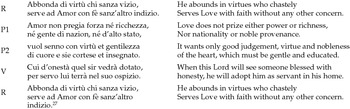
In danced polystrophic ballatas, the circularity is obvious, but in short ballatas a different kind of dramaturgic tension emerges (see Ex. 1). In Francesco Landini's ballata Abbonda di virtù chi sanza vizio, the ripresa presents the thesis, which asserts that anyone who serves Love in purity must be a person blessed with many virtues. Then the piedi and volta offer an explanation of the thesis, supported with arguments about the nature of Love. Love is not interested in social status, or riches or any other material thing, but rather praises nobility of thought and pureness of heart. Anyone who responds to these requirements will certainly be qualified as Love's sincere adept. With the repetition of the ripresa, the thesis returns, consolidated and enhanced: anyone who serves Love in purity must be a person blessed with many virtues.
Francesco Landini, Abbonda di virtù chi sanza vizio, ballata (text).

Considered from this perspective, the text structure of Landini's ballata might be said to resemble the familiar pattern of the so-called ‘geometrical demonstration’ used in Euclid's Elements: 1) proposition (theorem, problem or question), 2) demonstration and 3) return to the enhanced and now proven proposition, ‘which had to be demonstrated’ (‘quod erat demonstrandum’) (see Appendix). Can it be that the similarity was not casual?
Euclid in the Florentine context and Landini the Ockhamist
Euclid's Elements played an important role in medieval education. Boethius made the first-known Latin translation from the Greek around 500 ce but later translations from the beginning of the millennium also survive.Footnote 28 Adelard of Bath made a full Latin translation in 1142–6 from an Arabic source.Footnote 29 In 1189, Nicholas of Amiens applied the Euclidean method to theology in his treatise De arte seu articulis catholicae fidei. He introduced definitions, axioms and principles that did not need to be proven, but on which the demonstration of any quaestio had to rely, and not solely on the statements by different authorities.Footnote 30 Yet in scholastic philosophy, Euclidean axiomatic-deductive methods did not constitute an independent system per se, but were used occasionally for treating this or that quaestio or problem that needed to be given a logical proof, and not merely supported by a certain authority.
Knowledge of Euclid in medieval Italy is widely attested, particularly in the period of our interest. The Italian mathematician Giovanni Campano of Novara prepared a new Latin edition of the Elementa geometriae between 1255 and 1259 which expounded Euclidean geometry in a particularly coherent way, furnishing it with comments, his own and those of other authors, and sometimes with alternative solutions. Campano's version was for more than two hundred years the basis for the study of geometry in Italy, judging by the large number of surviving manuscripts. It was one of the first books printed in Venice (Preclarissimus liber elementorum Euclidis, 1482).Footnote 31
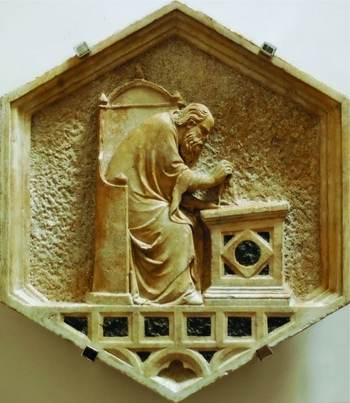
The Florentine reception of Euclid appears to have been particularly enthusiastic, not least on account of the great need for mathematics due to multifarious activities demanding good control of its different aspects: growing commerce, ambitious architectural projects and interest in astronomy. In his Nuova Cronaca, Giovanni Villani, writes about the flourishing of education in Florence at the end of 1330s and the beginning of the 1340s, the years when the young Landini must have started his primary school studies: ‘The boys who were about to learn abacus and numerical calculation in six schools numbered from 1000 to 1200, whereas those who learned grammar and logic numbered from 550 to 600 in four big schools.’Footnote 32 Euclid's Optics was no less important for astronomers, architects and painters.Footnote 33 A hexagonal panel depicting Euclid as an allegory of architecture or geometry – both are possible since he is measuring with a compass – is mounted on the east side of the Campanile of Santa Maria del Fiore (see Fig. 1).Footnote 34 It was designed by Giotto and constructed by Andrea Pisano between 1334 and 1336, around the time of Francesco Landini's birth (c.1335).
Andrea Pisano (after Giotto's drawing), Euclid, or Art of Geometry (1334–6), Florence Cathedral, Campanile, east side (with the kind permission of the Museo dell'Opera del Duomo in Florence).

As is well known, Francesco Landini's contemporaries praised his brilliant intellect and deep knowledge of philosophy and all the other liberal arts. The Florentine chronicler Filippo Villani, Giovanni Villani's nephew, in his book on famous Florentines (late 1380s/early 1390s) noted Landini's impressive competence in philosophy: ‘Besides, to crown the pile of praises I may add that he [Landini] learned grammar and dialectics in depth.’Footnote 35
Landini was also a protagonist of some literary opuses. His younger contemporary, Jacopo del Pecora da Montepulciano, in his poem Fimerodia (c.1395), praised him as ‘Francesco the Organist who sees with his mind more than with physical eyes’ (‘Francesco degli Organic che vede, / Con mente più che col corporal lume’) and Giovanni Gherardi da Prato, in his novel Paradiso degli Alberti (1425), wrote: ‘In that time flourished Francesco degli Organi, musical theorist and performer . . . He was accustomed to discuss with any artist and philosopher not just his music, but all the liberal arts, since he was erudite in a great part of them.’Footnote 36 When Giovanni da Prato presents his protagonists, the person named just before Landini is the ‘outstanding and famous theologian and mathematician maestro Grazia [de’ Castellani], no less of divine talent than of human’ (‘preclaro e famoso teolago [sic] e matematico maestro Grazia, non meno d'ingegno divino che umano’).Footnote 37 It appears that Landini felt at home in the company of philosophers and mathematicians.
Elsewhere I have shown that Giovanni da Prato and Francesco Landini could well have been ‘alumni’ of the same school, though at different times, and students of Antonio Pievano da Vado, ‘gramatice, loyce, rethorice optimus instructor’, as he is identified in a sentence with dedication in Landini's philosophical poem in defence of Ockham's logic, and ‘eccellente dantista e di quello lettore’ (‘excellent specialist in Dante and reader of his poems’), according to the Florentine Trecento poet Franco Sacchetti.Footnote 38 The hallmark of Antonio's school was a deep interest in the English philosophers of the Oxford school and in Dante, conspicuous both in Giovanni da Prato and in Landini. (Filippo Villani mentions Landini's comments on Dante's Comedy in Latin hexameters, now lost.Footnote 39 )
Landin's interest in philosophy, especially that of William Ockham, is documented in his poem in Latin hexameters, Vix bene dimidium, written in defence of Ockham's logic.Footnote 40 In addition, the text of Landini's ballata Contemplar le gran cose reflects an important tenet of Ockham that religious and spiritual postulates have no need to be proven, but must be accepted as they are, as Michael Long's work on Landini's intellectual background has shown.Footnote 41 Daniele Sabaino too has linked the ballata Contemplar le gran cose to Ochkamist philosophy.Footnote 42
For the present discussion, it is worth noting that Ockham gave particular attention to methods of demonstration, refining and clarifying them, and thereby rendering them approachable and readily applicable.Footnote 43 Ockham was the first to give a clear definition of the kinds of demonstration a priori and a posteriori.Footnote 44 The demonstration a priori, or propter quid (for what reason), takes its departure from a better-known fact taken as a cause to reason the effect or effects it may produce, that is, it starts ‘from what is prior to the effect’. A demonstration a posteriori, or quia (because), starts from the known effect and searches for the fact or facts that may have caused it, that is, it starts ‘from what is posterior to the cause’.Footnote 45 Broadly speaking, both methods seek out the hierarchical connection between given facts or elements of knowledge.Footnote 46 The method a priori, that is, from the cause to the effect, was held to be superior to the method a posteriori since it begins with basic causes, that is, from well-known and commonly accepted facts or maxims. Thereby it accords with the famous Aristotelian expression cited in the anonymous treatise Capitulum de vocibus applicatis verbis mentioned earlier: ‘as the Philosopher says at the beginning of his Physics: “Our knowledge starts with the better-known things”’ (‘sicut dicit Philosophus in principio Phisicorum: “Cognitio nostra incipit a notioribus”’.Footnote 47
Landini's expertise in philosophy and the liberal arts suggests that he might have known, among other classical writings, Euclid's Elements, the most important work in which the principles of logical demonstration are applied to mathematics. It would not have been difficult for him to recognise in the form of the ballata a structural similarity to Euclid's methods and see in it the huge potential to present and to prove philosophical concepts through the medium of art.
Euclidean demonstrative model in Landini's Abbonda di virtù che sanza vizio
With these premises in mind, let us reconsider once again Landini's ballata Abbonda di virtù che sanza vizio. The ripresa introduces the idea that anyone who serves Love in purity must necessarily be a person blessed with many virtues. This sentence is, in fact, a proposition that needs to be proven. In other words, Landini presents here an outcome that must have been caused by certain reasons. The reasons are listed in the piedi, namely the qualities Love seeks in humans (reason, honesty) and those in which it is not interested (money, social status). These qualities are obvious and proven by long-term human experience, so that they may be taken as axioms concerning the moral nature of human beings. Namely, these tenets are prior to the statement in the ripresa. The volta turns to the logical consequence, saying that when Love sees such a person, it immediately accepts him or her in its service. And the conclusion in the repeated ripresa follows: therefore, anyone who serves Love must necessarily be a person blessed with many virtues (‘quod erat demonstrandum’). In this context, Love appears as a philosophic category, and may be seen, for example, as the Love for God or Divine Love.
One more detail makes Landini's discourse on the nature of Love truly scientific, in terms of the methods used in the medieval philosophy. The tenets he exposes in the piedi are not only an outcome of human experience and common sense, but also reflect a long tradition of writings on love, in prose and in verse, in Latin and in the vernacular. The tradition starts with the rather humorous Ars Amatoria and Remedia amoris by Ovid, then passes through writings of the Church authorities, acquiring a religious aspect (from St Augustine's reflections on the love of God and the love of one's neighbour to St Bernard of Clairvaux's De diligendo Dei). In the later Middle Ages, the concept is expressed in both theoretical and literary works, such as De amore by Andreas Capellanus (twelfth century) and Consaus d'Amours by Richard de Furnival (the mid-thirteenth century).
It is difficult to ascertain which of such writings Landini could have been exposed to since we do not know which or how many were available to him. However, bearing in mind his relationship with Antonio Pievano da Vado, the great expert in Dante and an excellent teacher of logic, we may consider the so-called Detto d'amore, a poem quite certainly ascribed to Dante,Footnote 48 as a very likely source of Landini's set of axioms, upon which he could have built his demonstration. This apparently incomplete poem comprises 480 seven-syllable lines in couplet rhymes with sophisticated ‘homonymic rhymes’.Footnote 49 Scholars date it to the 1280s, as a work of the young Dante, written in conjunction with another poem, Il Fiore, a cycle of 232 sonnets. Both Dantean texts stem from the famous French poem Roman de la Rose, but the Detto d'amore is more a theoretical than a narrative text. Some postulates in the piedi and volta of Abbonda di virtù are easily traceable to the Detto d'amore: vv. 24–6, ‘Amor non vuol logaggio, / ma e’ vuol ben lo gaggio/ che ’l tu’ cuor si’ a lu’ fermo’ (‘Love does not want material compensation, but it does want the pledge that your heart will remain faithful to it’); v. 48, ‘Amor nessun non vaglia’ (‘Love does not reject anyone’); vv. 401–4, ‘ché fortemente pecca/ que’ che d'orgoglio ha pecca. / Cortese e franco e pro’/ convien che sie’ (‘since one strongly errs who is guilty of pride. It would be better for him to be gentle and candid’).
Considered in this light, it appears that Landini, with his renowned philosophical background, reinterpreted the fixed structure of the popular genre of the ballata as an excellent means to shape a logical demonstration. Of course, in reflecting upon Landini's way of shaping a philosophical concept in a musical composition, we cannot draw a direct parallel between a large treatise, such as the Elements, which clearly explicates the methods used and contains many components on which the procedure of demonstration is based (such as the necessary list of axioms, definitions, etc.), and the short form of the ballata. But what we discern in Landini's text – and we may be quite certain that the poem is by him – is the demonstration based on the axiomatic-deductive method, which successfully adopted the Euclidean model.Footnote 50 This method relies on tenets considered as firm, fixed and obvious, which were already accepted as axioms or previously examined and proved in the ample literary and philosophic legacy and, thus, constantly present in the background. From this standpoint, therefore, compositions such as Abbonda di virtù become part of a much greater unity consisting of many earlier texts, both written and unwritten. In this perspective, the topical question of intertextuality acquires an additional apparatus to analyse the motivation of authors to include this or that quotation, especially when they sought philosophic depth.Footnote 51
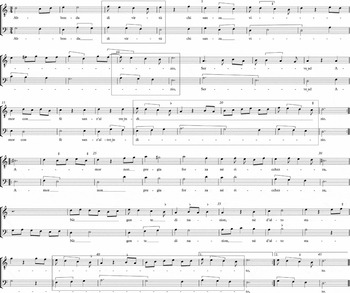
It is interesting that the music of Abbonda di virtù does not show the more refined elaborated techniques we find in Landini's other compositions, but contains some strange features that resist logical explanation (see Ex. 2).
Francesco Landini, Abbonda di virtù chi sanza vizio, ballata.

It consists of many repeated patterns: except for the separate motives in different voices, as in bars 31–2, there are the two-voice sections, as in bars 3–4, 10–11 and 42–3. The literal repetition in both voices of the music of the last four measures (18–22) of the ripresa at the end of the second piede (39–42), with some slight variation because of the aperto-chiuso cadence, is indeed unusual. It is difficult to say whether there was a specific connotation in using recurring formulas as a means of creating a ‘demonstrative logic’ in the music, since, except for bars 3–4, all other cases occur in the melismatic segments of the ballata, and are thus not reliant on the verbal contents. Nonetheless, one may perhaps sense a circularity that could well correlate with the structure of demonstration according to the Euclidean model.
Another important point concerns the use of parallel perfect consonances of the same species. This issue was first treated by Dorothea Baumann with regard to three-voice Trecento compositions, revealing that the kinds of cadences and the number of parallel perfect consonances are relevant for establishing the chronology.Footnote 52 Recently, Maria Caraci Vela extended this idea to the entire Trecento musical repertory, two-voice compositions included. Based contemporary theoretical thinking (mostly northern) regarding decisive prohibition against perfect parallel consonances established towards the 1340s, she noted that, for different reasons, in Italy it was applied later: perfect parallel consonances are not uncommon up to 1370, but from then on their quantity is gradually reduced.Footnote 53 The ballata Abbonda di virtù is free of perfect parallel consonances of the same species, except for the two opening parallel fifths. It could well be considered a mature work by Landini, if it were not for these parallel fifths, which appear quite deliberate within a composition otherwise without perfect parallel consonances, but abounding with parallel sixths and thirds, even in the cadences (bars 15–16 and 26–8).
Landini composed some other strictly philosophical ballatas, such as Chi più le vuol saper, quel men le sa and Se pronto non sarà l'uom al ben fare, which are marked by the demonstrative-explanatory tone, recalling Antonio da Tempo's description in his Summa. Further, many of Landini's ballatas on love and other personal expressions are also touched by this taste for demonstrative reasoning, as, for example, Come a seguir costei and the three-voice Che pena è questa al cor. All of them certainly deserve meticulous examination for their presumed sources and their musical setting. Hence, summarising the above, I propose that Landini's almost compulsive use of the ballata form might have been prompted by his vivid interest in philosophy: in this new and original way, he succeeded in unifying philosophy with music.
The monostrophic ballata by other composers and its further development
Landini was not alone among Trecento composers in such an approach to ballata form, but perhaps he was one of the first to discover in this form an appropriate tool of logical demonstration. Unfortunately the chronology of Landini's works is not known, and we know neither what ballatas of other composers could have preceded this one by Landini nor those written after it. The short ballatas of Gherardello and Lorenzo do not show such an elevated concept, but philosophical ballatas can be discerned in the compositions of Niccolò da Perugia; they are even more typical of Bartolino da Padova.
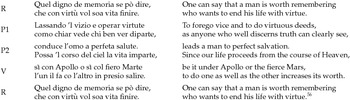
The relationship between Bartolino and the Florentine group of the Trecento musicians, as well as his personal presence in Florence, remain unclear for lack of documental confirmation. There are, however, suggestions that Bartolino became familiar with the Florentines: the inclusion of the almost all his works in the Squarcialupi Codex, and many of them in the palimpsest San Lorenzo 2211; mention of his name and music in such literary works of Tuscan authors as Giovanni da Prato's Paradiso degli Alberti, Simone Prodenzani's Liber saporecti and Giovanni Sercambi's Novelle.Footnote 54 It is difficult to say whether the idea of using the monostrophic ballata for reasoning on moral topics reached him from Florence or specifically from Landini. It might well have been his own recognition of the ballata's demonstrative potential in conformity with tendencies in the genre noticed by his more senior fellow citizen, the Paduan Antonio da Tempo. However, the fact that some ten monostrophic ballatas by Bartolino contain philosophical-moralising content, constructed according to the Euclidean axiomatic-deductive model, allows us to think that Bartolino had an especial predilection for philosophy and poured his reflections on morality into the rigorous and closed form of the ballata, as in his Quel degno di memoria (see Ex. 3).Footnote 55
Bartolino da Padova, Quel degno di memoria, ballata (text).

Later, the traditional ballata form in all its numerous variants underwent substantial changes.Footnote 57 The polystrophic ballata was transformed into the light and rather humorous genre of the polystrophic frottola-barzelletta, typical of the Quattrocento, whereas the monostrophic form was retained as serious Cinquecento musical poetry, often in the guise of the madrigale libero. As a musical form, the Cinquecento ballata, unlike its Trecento predecessor, was often set to music with much less attention to its structural units.Footnote 58 Antony Newcomb described the ballata texts used by sixteenth-century composers as: 1) a ripresa-like, self-contained opening unit (statement or question) of two to four lines; 2) a distinct central unit, often developing or contradicting the opening unit and often in two (sometimes more) piedi-like, roughly parallel metrical and syntactic units; and 3) a volta-like closing unit, sometimes announced by a summarising word such as ‘onde’, ‘così’, ‘quindi’ or ‘dunque’ (all words meaning ‘thus’ or ‘therefore’), and sometimes opening with a concatenazione-like line making a connection to the central unit.Footnote 59
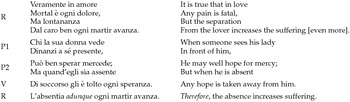
One such monostrophic ballata, Veramente in amore, which Giovanni Pierluigi da Palestrina set to music as a ‘madrigale libero’, may serve as a good example of the explanation above, in which the repeated ripresa is shortened from four lines to one, which includes the summarising word, ‘adunque’, therefore (see Ex. 4).Footnote 60
Giovanni Pierluigi da Palestrina, Veramente in amore (Secondo Libro dei Madrigali, 1586), monostrophic ballata (text).

Additionally, the volta of some madrigal–ballatas of the Cinquecento contains a shortened summary of the first part, namely the ripresa.Footnote 61 In other words, the ballata form continued to be seen as an appropriate device for demonstrative reasoning, although in Cinquecento ballatas it served more for personal lyrical expression than for presenting philosophical arguments. Nevertheless, we may claim that they reflect some fundamental principles of thinking elaborated in European culture from its very beginnings, in which one could shape a discourse designed to convince the reader or listener.
It is not surprising that in another epoch the same Euclidean principle was applied in the famous treatise Etica more geometrico demonstrata (1677) by Spinoza, which testifies in favour of a link between such a form of demonstration and ethical–moral issues. There is a striking affinity between the rhetorical form and contents of the argumentation in Landini's ballata Abbonda di virtù and those in Propositio 20, from Book 5 of Spinoza's Ethics, both speaking on Love, or better, on Love towards God that cannot be damaged by negative emotions and deeds, and that is the highest good that the mankind seeks under the guidance of reason:
PROPOSITIO XX: Hic erga Deum amor neque invidiae neque zelotypiae affectu inquinari potest sed eo magis fovetur quo plures homines eodem amoris vinculo cum Deo junctos imaginamur.
DEMONSTRATIO: Hic erga Deum amor summum bonum est quod ex dictamine rationis appetere possumus (per propositionem 28 partis IV) et omnibus hominibus commune est (per propositionem 36 partis IV) et omnes ut eodem gaudeant cupimus (per propositionem 37 partis IV) atque adeo (per 23 affectuum definitionem) invidiae affectu maculari nequit neque etiam (per propositionem 18 hujus et definitionem zelotypiae, quam vide in scholio propositionis 35 partis III) zelotypiae affectu sed contra (per propositionem 31 partis III) eo magis foveri debet quo plures homines eodem gaudere imaginamur. Q.E.D.Footnote 62
(PROP. 20. This love towards God cannot be stained by the emotion of envy or jealousy: contrariwise, it is the more fostered, in proportion as we conceive a greater number of men to be joined to God by the same bond of love.
PROOF: This love towards God is the highest good which we can seek under the guidance of reason (4:28); it is common to all men (4:36), and we desire that all should rejoice therein (4:37); therefore, (Def. of the Emotions, 23) it cannot be stained by the emotion envy, nor by the emotion of jealousy (5:18, see Def. of Jealosey, 3:35. note); but, contrariwise, it must needs be the more fostered, in proportion as we conceive a greater number of men to rejoice therein. Q.E.D.)
In effect, this text can easily be rewritten in the form of ballata. Of course, I do not mean to suggest a connection between Landini and Spinoza. But it cannot be denied that, in different times and places, they both relied on the same principles of thinking.
Appendix : Euclid, Elements, book I, proposition 6

If in a triangle two angles equal one another, then the sides opposite the equal angles also equal one another.
Let ABC be a triangle having the angle ABC equal to the angle ACB. I say that the side AB also equals the side AC.
If AB does not equal AC, then one of them is greater. Let AB be greater. Cut off DB from AB the greater equal to AC the less, and join DC. Since DB equals AC, and BC is common, therefore, the two sides DB and BC equal the two sides AC and CB respectively, and the angle DBC equals the angle ACB. Therefore, the base DC equals the base AB, and the triangle DBC equals the triangle ACB, the less equals the greater, which is absurd. Therefore, AB is not unequal to AC, it therefore equals it.
Therefore, if in a triangle two angles equal one another, then the sides opposite the equal angles also equal one another. Q.E.D.Footnote 63