No amount of effort in reconstructing what the stratification and occurrence of artifacts can ever inform us reliably about the actual situation at the site [Cougar Mountain Cave] before it was vandalized.
—Hester and Heizer Reference Hester and Heizer1973:16Over the past two decades, researchers from the University of Oregon's Museum of Natural and Cultural History, the University of Nevada, Reno, and the Nevada State Museum have conducted investigations at the earliest sites in the northwestern Great Basin (Connolly et al. Reference Connolly, Barker, Fowler, Hattori, Jenkins and Cannon2016; Connolly et al. Reference Connolly, Finley, Smith, Jenkins, Endzweig, O'Neill and Baxter2017; Felling Reference Felling2015; Jenkins Reference Jenkins, Graf and Schmitt2007; Jenkins et al. Reference Jenkins, Davis, Stafford, Campos, Hockett, Jones, Cummings, Yost, Connolly, Yohe, Gibbons, Raghavan, Rasmussen, Paijmans, Hofreiter, Kemp, Barta, Monroe, Thomas, Gilbert and Willerslev2012; Jenkins et al. Reference Jenkins, Davis, Stafford, Campos, Connolly, Cummings, Hofreiter, Hockett, McDonough, Luthe, O'Grady, Swisher, White, Yates, Yohe, Yost, Willerslev, Graf, Ketron and Water2013; Jenkins et al. Reference Jenkins, Holcomb and McDonough2017; Reaux et al. Reference Reaux, Smith, Adams, Jamaldin, George, Mohr and Rosencrance2018; Smith et al. Reference Smith, Pattee, Finley, Fagan and Pellegrini2014; Smith et al. Reference Smith, Felling, Taylor and Layton2015). Several projects have reinvestigated previously excavated sites such as the Paisley, Connley, Fort Rock, and Last Supper caves through additional fieldwork or renewed studies of museum collections. In all cases, Western Stemmed Tradition (WST) artifacts made up the diagnostic tools from the basal components of those sites. Collectively, these efforts have provided a clearer picture of Paleoindian chronology, technology, and subsistence during the terminal Pleistocene/early Holocene (TP/EH) in the northwestern Great Basin (Smith and Barker Reference Smith and Barker2017).
Located in Oregon's Fort Rock Basin about 20 km from Fort Rock Cave and the Connley Caves, Cougar Mountain Cave (CMC) is central to ongoing Paleoindian research in the region but has received limited attention from researchers. The cave was excavated almost entirely by avocationalist John Cowles in 1958, who reported his findings in a self-published book (Cowles Reference Cowles1960). Upon Cowles's passing in 1985, his collection (excluding some items retained by family members) was transferred to the Favell Museum in Klamath Falls, Oregon, where it currently resides. Eight years after Cowles excavated CMC, Thomas Layton (then a graduate student at the University of California, Davis) returned to the site to recover charcoal samples associated with obsidian points so that he could assign chronometric dates to his obsidian hydration sequence (Layton Reference Layton1972). He recovered a modest collection of lithic and fiber artifacts, mostly from Cowles's backdirt, and placed a few test units across the site. There is no published record of Layton's excavations; however, his fieldnotes, photographs, maps, and the artifacts and ecofacts he recovered are housed at the Nevada State Museum (Layton Reference Layton1966).
Diagnostic lithic and fiber artifacts suggest that human occupation of the CMC began during the TP/EH and spanned the Holocene. Furthermore, the diversity, quantity, and quality of the artifacts indicate that prior to its hasty excavation, CMC would have ranked among the most important sites in the Great Basin in terms of its data potential. Unfortunately, several factors have hindered attempts at further research: (1) the site has restricted access because it is on private land; (2) Cowles took few notes or photographs and only described the context of his finds in general terms; (3) Cowles's collection has long resided in a private museum; and (4) Layton's fieldnotes and the artifacts and ecofacts he collected were unknown to most researchers until last year. Recently, we approached both the Favell and Nevada State museums about studying their respective CMC collections. Both institutions graciously facilitated our analyses, which have generated important new information about when groups first occupied CMC and the age ranges and geographic distribution of diagnostic basketry types in the northwestern Great Basin. In this paper, we present the preliminary results of our work with the CMC collection, place them within the broader context of Paleoindian archaeology in the region, and assess the potential for future excavations at the site.
History of Research at Cougar Mountain Cave
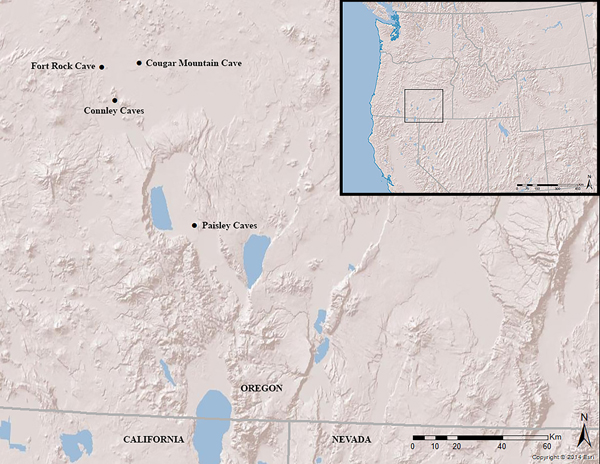
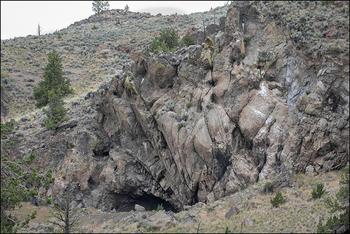
Cougar Mountain Cave is a large (~11 m x 11 m) south-facing rockshelter located beneath overhanging volcanic bedrock on the northern edge of the Fort Rock Basin (Figures 1 and 2). It sits 1,356 m above sea level, and its most recent inundation likely would have been by pluvial Lake Fort Rock before 13,000 cal BP (Freidel Reference Freidel, Aikens and Jenkins1994).Footnote 1 Based on Cowles's (Reference Cowles1960) description, the cave's deposits consisted of 6.5 ft. (~2 m) of sediment (probably aeolian) and volcanic ash (likely from Mount Mazama) overlying rounded lake gravels with roof-fall fragments intermixed.Footnote 2 Cowles (Reference Cowles1960:3) indicated that before he excavated the site, “a few rock hunters and amateur explorers had scratched at its surface, but none had become interested enough to work [the cave],” suggesting that the deposits were largely intact when he began. Over 63 days between February and June 1958, Cowles dug and screened most of the deposits behind the dripline to beach gravels. He excavated nine separate “systematic cuts” (starting on the east side) in arbitrary 1 ft. (30 cm) levels and as artifacts were uncovered, he measured their depths and screened sediments using ¼ in mesh (Cowles Reference Cowles1960:4, 50; John Cowles, personal communication October 1966). He “selected only the best pieces at each level for the collection,” which filled thirty-one 16 x 20 in cases (Cowles Reference Cowles1960:3).
Map of the northern Great Basin and sites discussed in text.

Overview of Cougar Mountain Cave looking north. Photo courtesy of Brent McGregor and used with permission.

Cowles indicated that he kept records of his work, but no notes or drawings are known to exist. His self-published book provides limited information about the contexts from which most artifacts were recovered; however, despite his lack of documentation and his coarse excavation techniques, Cowles provides several clues about the CMC's deposits. First, his description of the deposits provides our only understanding of the site's stratigraphy. He noted that at least 6.5 ft. (2 m) of deposits were present with a layer of tephra (again, likely deposited by Mount Mazama's eruption ~7,630 cal BP; Egan et al. Reference Egan, Staff and Blackford2015) occurring 4 ft. (1.2 m) above sterile lake gravels (Cowles Reference Cowles1960:4). Furthermore, he noted that the sediment in the lowest 8 to 12 in. (20–30 cm) was damper than that found in higher levels, writing that fiber sandals in the lower levels “had more dirt and mud inside them than those found above pumice” (Cowles Reference Cowles1960:32) and that leather string from the lowest 1 ft. (30 cm) was damp (Cowles Reference Cowles1960:44). Second, while Cowles's description of the vertical distribution of key artifact types are coarse (he assigned most of them to the 1 ft. level), they nevertheless provide a general sense of when groups occupied CMC. Except for fluted and Desert Series points, the entire sequence of Great Basin projectile points is represented, suggesting that the site saw repeated use throughout the Holocene and perhaps the terminal Pleistocene. Of particular relevance to our ongoing research, Cowles reported finding a variety of WST artifacts, including Haskett, Cougar Mountain, Parman, and square-based points; a crescent; and large ovate bifaces in the lowest 2 ft. (60 cm) of the deposits. Well-made scrapers resembling those from the Haskett component dated to the Younger Dryas at the nearby Connley Caves (Jenkins et al. Reference Jenkins, Holcomb and McDonough2017) were found in “the bottom part of the cave” (Cowles Reference Cowles1960:20). Perishable artifacts from the lowest 2 ft. (60 cm) include Fort Rock–style sandals, braided cordage, matting, bag and basket fragments, sewn leather, and leather string (Cowles Reference Cowles1960:32–44). Most of the osseous tools from the site, which include an atlatl spur, two eyed needles, a barbed harpoon fragment, and numerous awls and antler flakers, also came from the lowest 2 ft. (60 cm). Faunal remains include bison (Bison sp.), elk (Cervus elaphus), and mountain sheep (Ovis canadensis) (Cowles Reference Cowles1960:27–31). The WST points, scrapers, Fort Rock sandals, braided cordage, bone needles, and bison and elk remains are consistent with Paleoindian assemblages recovered from other TP/EH occupations in the region (Smith and Barker Reference Smith and Barker2017 and references contained within), suggesting that CMC was occupied relatively early. A conventional radiocarbon date of 8,510 ± 250 (10,230–8,980 cal BP) obtained on a Fort Rock sandal from “near the top of the earliest deposit” supports that possibility (Fergusson and Libby Reference Fergusson and Libby1962:111).Footnote 3
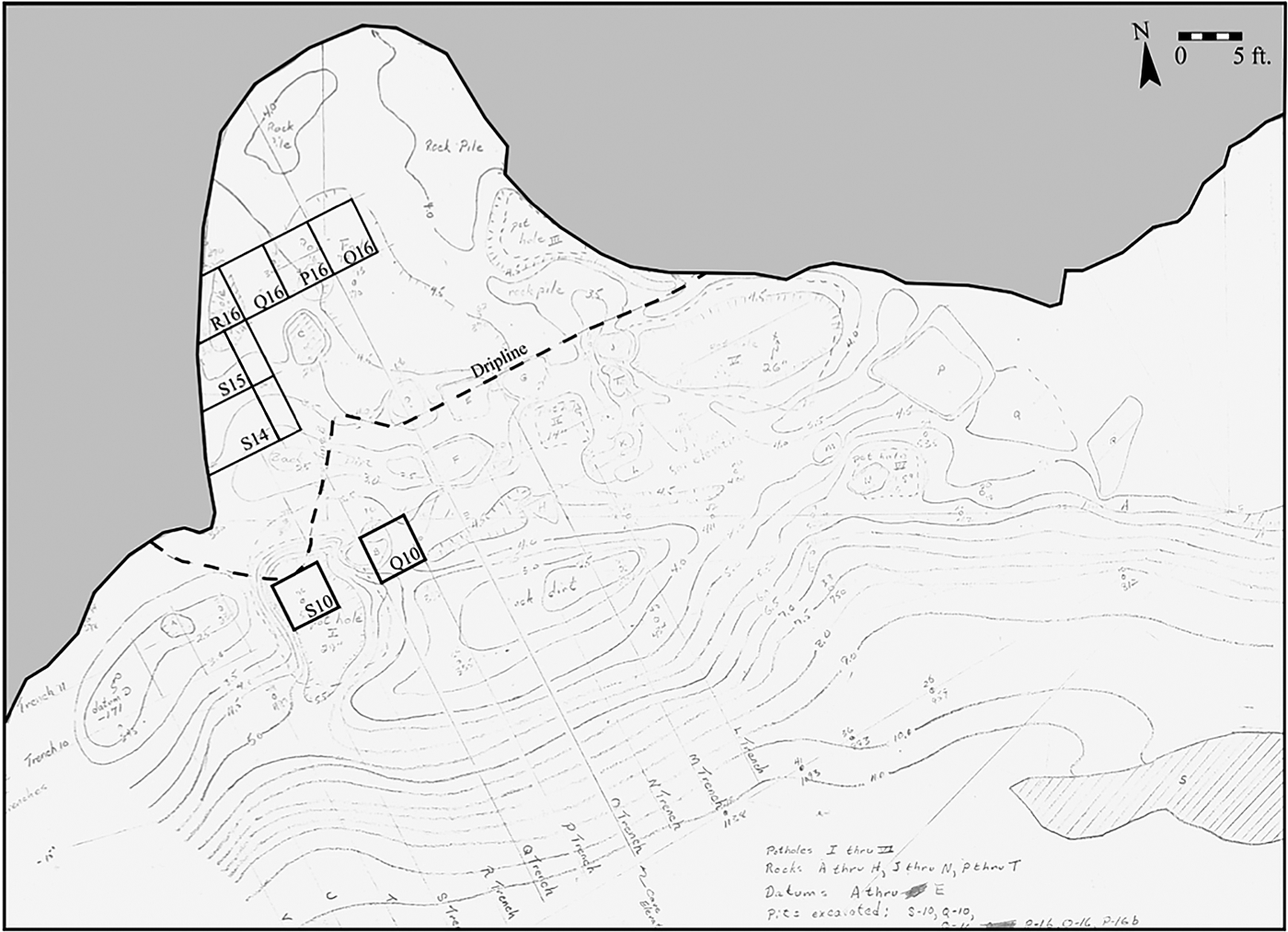
In September 1966, Tom Layton and a small crew from the University of California, Davis, visited CMC to assess the site's potential for additional research. Over the course of a week, they established a grid system using letters on the N-S axis and numbers on the E-W axis and mapped the cave in plan view and profile (Figure 3). They excavated five 4 x 4 ft. (120 x 120 cm) units (Q10, S10, O16, P16, and Q16); one partial 4 x 4 ft. unit against the cave's west wall (R16); and two partial 5 x 5 ft. (150 x 150 cm) units (S14 and S15) against the cave's west wall. Excavations were generally by 4 in. (10 cm) levels, and all elevations were recorded in inches below datum. The work was carefully documented in notebooks that contain sediment descriptions and drawings for each excavated level (Layton Reference Layton1966). Units S10, Q10, O16, P16, Q16, and R16 contained scrapers, edge-modified flakes, projectile point fragments, a cane arrow shaft, a piece of Catlow twine basketry, and a piece of three-strand braided cordage in poorly sorted matrices rich in rodent pellets, and occasional cigarette butts and newsprint fragments. As Layton noted (and we concur), those excavations likely took place mostly or wholly in backdirt produced during Cowles's excavation.
Plan view map of Cougar Mountain Cave with 1966 excavation units highlighted. Adapted from original 1966 plan view map.
Units S14 and S15 produced a similar array of artifacts. Importantly, excavation of those units exposed an eastern profile that provides a small cross section of the local deposits that forms the basis for our understanding of the context from which the team collected in situ charcoal fragments that we discuss below (Figure 4). Work began in Unit S14, which also encompassed the western ~24 in. (60 cm) of adjacent Unit R14, by removing 32 in. (80 cm) of disturbed deposits before switching to arbitrary 4 in. (10 cm) levels. Sediment descriptions vary for the deposits between 32 and 56 in. (80–140 cm) but are generally described as sand and silt with large amounts of angular gravels and cobbles. A fragment of newsprint was recovered in the 52 to 56 in. (130–140 cm) level, indicating that the deposits were disturbed to that depth. In the 56 to 60 in. (140–150 cm) level, the excavators noted a change in the western portion of the unit to a moist, red sandy silt (Layton Reference Layton1966). The next two levels, 60–64 in. (150–160 cm) and 64–68 in. (160–170 cm), were composed entirely of moist, red sandy silt. We believe that this change represents the transition into undisturbed deposits because as we outlined above, Cowles (Reference Cowles1960) described the lower 1 ft. or so (30 cm) as damp. Layton's team encountered rounded beach gravels at 71 in. (180 cm) below datum in Unit S14 and at 68 in. (172 cm) in Unit S15, which was located immediately to the north of Unit S14 and produced the same stratigraphic sequence. This suggests that the deposits dipped southward toward the mouth of the cave, as should be the case for undisturbed lacustrine deposits laid down by wave action.
East profile of units S14 (right) and S15 (left), showing the depths where sediment changes described by Layton (Reference Layton1966), modern material, and in situ charcoal were encountered. Adapted from original 1966 profile map.

Following Cowles's and Layton's campaigns, CMC received little attention from the professional archaeology community. No further excavations were conducted, and analysis of the materials was sporadic and focused on specific research questions. Fergusson and Libby (Reference Fergusson and Libby1962) published one radiocarbon date on a Fort Rock sandal from the site. Cowles granted Layton permission to conduct an obsidian hydration analysis of ~100 projectile points from his collection, which formed the basis for Layton's (Reference Layton1972) projectile point chronology for the Fort Rock Basin. Connolly's (Reference Connolly, Aikens and Jenkins1994) review of Fort Rock Basin basketry included CMC and noted the presence of plaited specimens in the assemblage. In 2006, Linsie Lafayette (Reference Lafayette2006; Lafayette and Smith Reference Lafayette and Smith2012) conducted a use-wear analysis of WST points from CMC. Recently, Sophia Jamaldin (Reference Jamaldin2018) characterized the obsidian from which the WST points were made as part of her study of Paleoindian mobility and cave use in the Fort Rock Basin. To our knowledge, these efforts represent the only published research to feature the CMC collection since Cowles published his report in 1960.
Methods and Materials
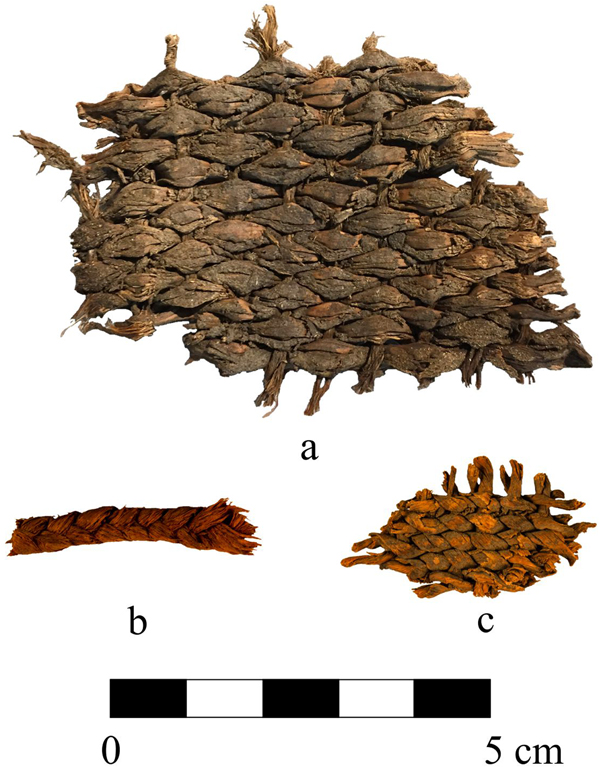
Given the diversity and quantity of artifacts recovered from CMC (which includes the most substantial WST assemblage ever recovered from a cave or rockshelter in the Great Basin) and the rich TP/EH occupations in nearby caves and shelters, we began a long-term study of the collection with a focus on establishing when the site was first occupied and how it fits into our understanding of the colonization of the northern Great Basin. Our first step was to contact the Favell Museum, who granted us permission to date, using accelerator mass spectrometry (AMS), one of two pieces of warp-faced plain weave basketry that Cowles (Reference Cowles1960:41) recovered from “above pumice.” The position of that piece above what likely constituted Mazama tephra suggested that it postdates 7,630 cal BP (Figure 5a). We directly dated the warp-faced plain weave basketry made of Schoenoplectus (tule) because the CMC examples are the northernmost occurrence of this technique, and its stratigraphic position suggested it may be considerably younger than all previously dated specimens.
Directly dated textiles from Cougar Mountain Cave: (a) warp-faced plain weave, (b) three-strand braided cordage, and (c) Catlow Twine.

We also dated two fiber artifacts currently housed in the Nevada State Museum that Layton's crew recovered from disturbed deposits: (1) a 3.5 cm long piece of three-strand braided cordage constructed of Artemisia (sagebrush) and (2) a 3 cm wide piece of Catlow Twine basketry made of Schoenoplectus (tule). The braided cordage is significant because it is similar to pieces directly dated to12,400–11,840 cal BP at the Paisley Caves (Connolly et al. Reference Connolly, Barker, Fowler, Hattori, Jenkins and Cannon2016). Catlow Twine basketry (Cressman Reference Cressman1942) has been recovered at dozens of sites across the northwestern Great Basin and dominates basketry assemblages in the region from ~9,500 cal BP and into the ethnographic period (Camp Reference Camp2017, Reference Camp2018; Connolly et al. Reference Connolly, Barker, Fowler, Hattori, Jenkins and Cannon2016).
Last, we submitted sagebrush charcoal collected by Layton for AMS dating. His fieldnotes indicate that the crew collected an in situ charcoal sample composed of multiple pieces (two of which we date) from the 60 to 64 in. (150–160 cm) level of Unit S14. No exact X, Y, and Z measurements were taken for the sample location, but fieldnotes for that level include a plan-view drawing and indicate that “carbon samples [were collected] from Rock 1 and 5” (Layton Reference Layton1966; Figure 6). We located only one in situ charcoal sample from the 60 to 64 in. (150–160 cm) level at the Nevada State Museum, and it contained multiple charcoal pieces, fine and coarse sand, fine gravel, and 12 pieces of small debitage. No rodent pellets, seeds, sticks, or other materials commonly found in Neotoma (woodrat) middens are present in the sample bag, suggesting that this portion of the cave's deposits was not disturbed by woodrat nest building. Layton insists that all charcoal recovered in situ was carefully collected using tweezers or spoons (Thomas Layton, personal communication 2018), suggesting that the potential for contamination from improper handling is low. We have no additional information about the provenience of the charcoal sample other than it is associated with one of the two large rocks; however, we determined that although the charcoal was collected from the 60 to 64 in. (150–160 cm) level, the excavators noted that they accidentally placed charcoal from the subsequent 64–68 in. (160–170 cm) level into the 60–64 in. charcoal sample bag. Therefore, we can only be certain that the charcoal we submitted for dating came from somewhere between 60 and 68 in. (150–170 cm) below datum in the western half of Unit S14 near rocks 1 and 5 (see Figure 6).
Plan view map of Unit S14, Level 60–64 in. The charcoal we dated was recovered from beneath rocks 1 and 5. Adapted from original 1966 plan view map.

Results
Radiocarbon determinations from CMC are presented in Table 1 and Figure 7. The two charcoal samples returned nearly identical radiocarbon dates of 10,430 ± 40 14C BP (12,525–12,105 cal BP) and 10,490 ± 40 14C BP (12,575–12,150 cal BP; Table 1), which is to be expected if they were deposited at the same time. The ages fall within the Younger Dryas period (12,900–11,600 cal BP) and provide a minimum age for the upper 8 in. (20 cm) of the lowest 12 in. (30 cm) of the deposits above beach gravels.
Radiocarbon chronology of CMC. Dates calibrated in OxCal 4.2 (Bronk Ramsey Reference Bronk Ramsey2009a) with IntCal13 curve (Reimer et al. Reference Reimer, Bard, Bayliss, Warren Beck, Blackwell, Ramsey, Buck, Cheng, Lawrence Edwards, Friedrich, Grootes, Guilderson, Haflidason, Hajdas, Hatté, Heaton, Hoffmann, Hogg, Hughen, Felix Kaiser, Kromer, Manning, Niu, Reimer, Richards, Marian Scott, Southon, Staff, Turney and van der Plicht2013) and presented as 2σ ranges.

Radiocarbon Dated Materials from Cougar Mountain Cave.

1. Dates calibrated using OxCal 4.3 online calibration program with the IntCal 13 curve (Bronk Ramsey Reference Bronk Ramsey2009a; Reimer et al. Reference Reimer, Bard, Bayliss, Warren Beck, Blackwell, Ramsey, Buck, Cheng, Lawrence Edwards, Friedrich, Grootes, Guilderson, Haflidason, Hajdas, Hatté, Heaton, Hoffmann, Hogg, Hughen, Felix Kaiser, Kromer, Manning, Niu, Reimer, Richards, Marian Scott, Southon, Staff, Turney and van der Plicht2013). Conventional dates and 2σ calibrated ranges rounded following Stuiver and Polach (Reference Stuvier and Polach1977).
2. Dates obtained on separate pieces of charcoal from the same sample.
3. Dates obtained on the same artifact.
The three-strand braided cordage returned a date of 10,450 ± 40 14C BP (12,540–12,130 cal BP), which is the same result obtained for the two charcoal samples. Because that date suggests that the cordage is one of the oldest textiles in North America (Connolly et al. Reference Connolly, Barker, Fowler, Hattori, Jenkins and Cannon2016), we submitted another sample to a second radiocarbon laboratory to confirm the first determination. That sample returned a date of 10,250 ± 30 14C BP (12,145–11,815 cal BP). These dates have only a small overlap at 2 sigma despite being taken from the same artifact. The dated material is short-lived plant fibers, so we do not expect variation in the age of material used. The actual age of the textile may fall within either of the two dates.
This discrepancy may be because the sample has existed in the archaeological record for two half-lives, leaving only one-quarter of the original 14C remains in the cordage. Smaller amounts of 14C increase the chances that differences in pretreatment or minor discrepancies in the measurement (from different labs) will result in different conventional ages (Bronk Ramsey Reference Bronk Ramsey2008, Reference Bronk Ramsey2009b). The older determination is more similar to the charcoal dates, and this may suggest that it more accurately reflects the age of the artifact. In any case, the cordage's age and style align closely with the braided cordage found in the Younger Dryas–aged botanical lens at the Paisley Caves (Connolly et al. Reference Connolly, Barker, Fowler, Hattori, Jenkins and Cannon2016; Jenkins et al. Reference Jenkins, Davis, Stafford, Connolly, Rondeau, Cummings, Hockett, McDonough, Luthe, O'Grady, Reinhard, Swisher, White, Yohe, Yost, Willerslev, Kornfeld and Huckell2016).
The warp-faced plain weave specimen returned a date of 6,580 ± 30 14C BP (7,560–7,430 cal BP). Other specimens from western and northwestern Nevada have produced dates ranging from 9,470 ± 60 (11,080–10,945 cal BP) to 8,720 ± 40 14C BP (9,890–9,550 cal BP), making the CMC specimen the youngest example of the type by several millennia (Connolly et al. Reference Connolly, Barker, Fowler, Hattori, Jenkins and Cannon2016). As we noted above, Cowles (Reference Cowles1960:41) indicated that the dated piece was found above the volcanic ash layer; the 6,580 ± 30 14C BP date (post-Mazama) supports that assertion.
Finally, the Catlow Twine basketry returned a date of 2,870 ± 30 14C BP (3,075–2,880 cal BP), which falls within a ~1,000 14C year gap between 2,250 ± 25 (2,340–2,160 cal BP) and 3,320 ± 30 14C BP (3,630–3,470 cal BP) in the current sample of directly dated specimens from the northwestern Great Basin (Camp Reference Camp2017, Reference Camp2018). This gap suggests a period of reduced human use of the northwestern Great Basin, where fiber artifacts tend to be preserved.
Discussion
Reinvestigating previously excavated caves and rockshelters and combing through museum collections, photographs, and level records are challenging endeavors. In many cases, we may never know the exact relationships between important artifacts and dated materials or be able to confirm researchers’ assertions made long ago (sensu Connolly et al. Reference Connolly, Finley, Smith, Jenkins, Endzweig, O'Neill and Baxter2017). Nevertheless, we firmly disagree with statements similar to Hester and Heizer's (Reference Hester and Heizer1973) quote at the beginning of our paper. Renewed fieldwork at the Paisley, Connley, and Fort Rock caves (Connolly et al. Reference Connolly, Finley, Smith, Jenkins, Endzweig, O'Neill and Baxter2017; Jenkins Reference Jenkins, Graf and Schmitt2007; Jenkins et al. Reference Jenkins, Davis, Stafford, Campos, Hockett, Jones, Cummings, Yost, Connolly, Yohe, Gibbons, Raghavan, Rasmussen, Paijmans, Hofreiter, Kemp, Barta, Monroe, Thomas, Gilbert and Willerslev2012; Jenkins et al. Reference Jenkins, Davis, Stafford, Campos, Connolly, Cummings, Hofreiter, Hockett, McDonough, Luthe, O'Grady, Swisher, White, Yates, Yohe, Yost, Willerslev, Graf, Ketron and Water2013; Jenkins et al. Reference Jenkins, Davis, Stafford, Connolly, Rondeau, Cummings, Hockett, McDonough, Luthe, O'Grady, Reinhard, Swisher, White, Yohe, Yost, Willerslev, Kornfeld and Huckell2016; Jenkins et al. Reference Jenkins, Holcomb and McDonough2017), as well as further study of the Last Supper Cave collection (Camp Reference Camp2017; Felling Reference Felling2015; Ollivier et al. Reference Ollivier, Smith and Barker2017; Smith et al. Reference Smith, Felling, Taylor and Layton2015), have demonstrated the utility of revisiting old sites and collections. The variety and volume of artifacts recovered from CMC, which appear to span most of Great Basin prehistory, make it one of the most important sites in the region. While details of the excavations are scant, we can nonetheless learn a great deal from studying the collections. In the remainder of this paper, we highlight the preliminary results of our work with a focus on stratigraphy and chronology, WST projectile points and basketry, and the potential for future excavations at CMC.
Stratigraphy, Chronology, and the Potential for Additional Excavations
Cowles's (Reference Cowles1960) report and Layton's fieldnotes provide a rough sense of CMC's stratigraphy. New dates from the site allow us to understand when the different strata were deposited and, in turn, how old artifacts may be that Cowles identified from 1 ft. levels. Beach gravels at the bottom of the site mark the last time pluvial Lake Fort Rock occupied the cave, which Freidel's (Reference Freidel, Aikens and Jenkins1994) work and more recent information from the Connley Caves suggest was sometime before 13,000 cal BP. Against the west wall of the cave, Layton's (Reference Layton1966) team encountered what we believe were undisturbed deposits. The moistness of the red sandy silt resting atop beach gravels is consistent with Cowles's (Reference Cowles1960) description of damp sediment in his 1 ft. level (represented by Layton's 60–64, 64–68, and 68–72 in. levels). Layton's crew encountered the red sandy silt ~60 in. (1.5 m) below datum, or ~12 in. (30 cm) above the basal gravels, which is also consistent with Cowles's comment that the red sandy silt was about 1 ft. (30 cm) thick. Our dates on Layton's charcoal indicate that this stratigraphic unit dates to at least the Younger Dryas and perhaps earlier.
The next stratigraphic unit we can be confident about is the extensive tephra band that Cowles (Reference Cowles1960) reported ~4 ft. (122 cm) above the beach gravels. Given the location of CMC, that tephra almost certainly marks Mount Mazama's eruption ~7,630 cal BP, a conclusion that is supported by the 6,580 ± 30 14C BP (7560–7430 cal BP) date on the warp-faced plain weave basketry from “above pumice” (Cowles Reference Cowles1960:41). Although we will never know the exact depths at which Cowles found most artifacts in his collection, the the age of the basketry fragment is consistent with its reported position relative to Mazama tephra, providing us with some confidence in his assignments of key artifacts to 1 ft. levels. More precise age estimates for the two 1 ft. levels above the tephra layer and four 1 ft. levels below it will only be provided by directly dating the numerous fiber, bone, or wood artifacts in the collection. Although Cowles's excavations are not as precisely recorded as we would like, his techniques are similar to that of professional archaeologists of the day, and he was astute enough to understand the importance of publishing what he found (Cowles Reference Cowles1960). Our work, drawing from his descriptions, shows the value of collections-based research for both legacy collections and materials not obtained through professional excavation.
Are there undisturbed deposits left at CMC? We believe that Layton's crew found a pocket of intact deposits along the cave's west wall eight years after Cowles excavated the site. Whether or not additional intact deposits remain is unknown, but recent work at the Connley Caves beneath Bedwell's (Reference Bedwell1970) extensive backdirt berm has produced a large WST assemblage in a primary context, indicating that even extensively disturbed rockshelters in the region hold potential, given careful reinvestigation (Jenkins et al. Reference Jenkins, Holcomb and McDonough2017; McDonough et al. Reference McDonough, Rosencrance, Holcomb and Jenkins2018). CMC remains privately owned, but we hope to engage in discourse with the owners about renewing excavations.
WST Projectile Points and Fiber Technology at CMC
WST Projectile Points
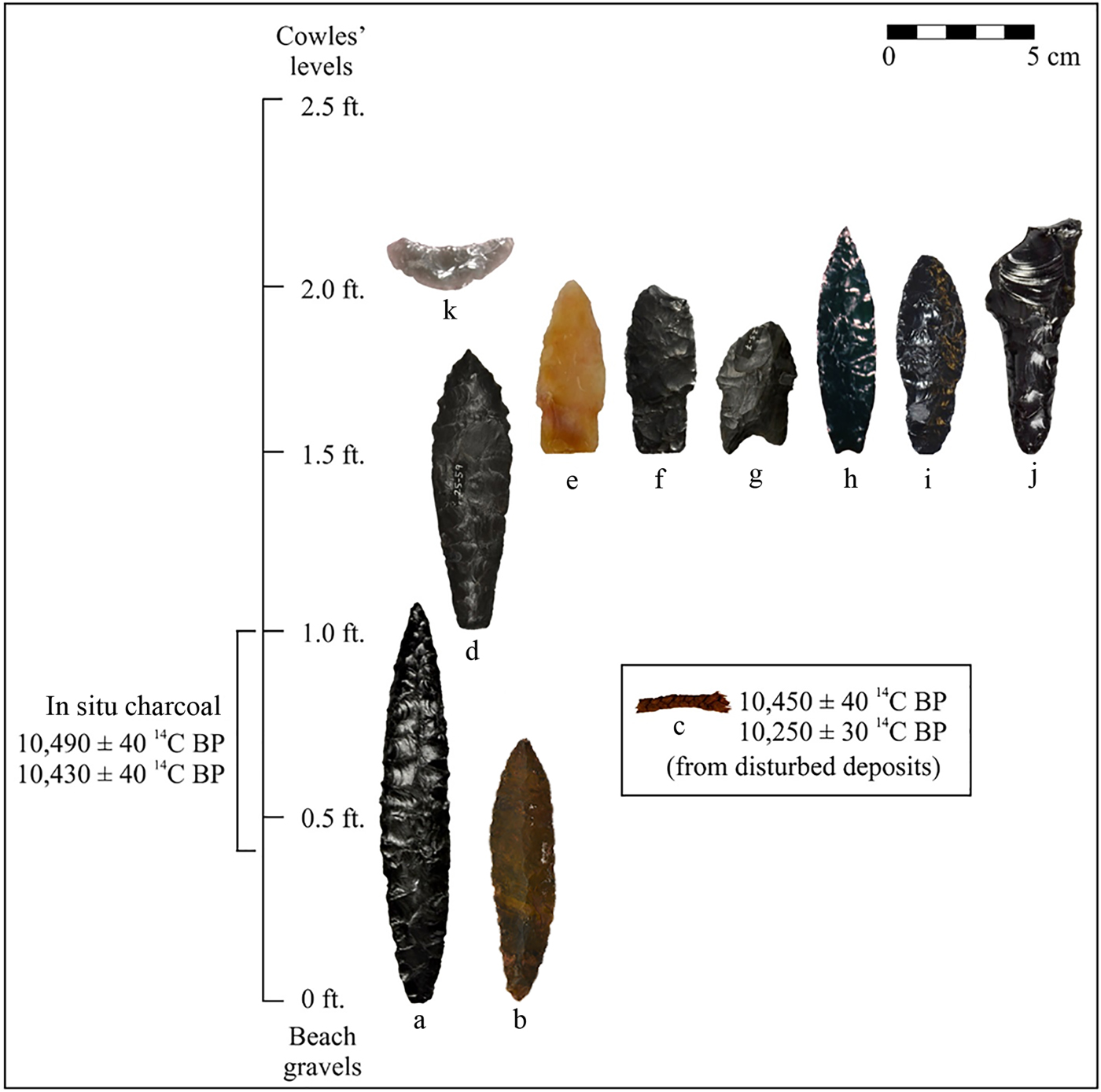
Due to the manner in which Cowles excavated the site and documented his discoveries, it is not possible to demonstrate close spatial associations between particular artifacts and dated samples; however, because he assigned diagnostic artifacts to the 1 ft. levels from which he recovered them, we can at least gain a sense of their relative ages. This is particularly important given that CMC contained what likely represents the largest sample of WST points (more than 50) ever recovered from a stratified site in the Great Basin. Given our poor understanding of the absolute ages of the various WST point types (Beck and Jones Reference Beck and George T.1997), the CMC record, despite its shortcomings, can offer some insight into their relative ages. Figure 8 illustrates the vertical distribution of WST points in the deepest 2.5 ft. of the cave's deposits based on the depths where Cowles reported encountering them. Cowles (Reference Cowles1960:17) indicates that large Haskett Type 2 points were the only points found in the basal 0 to 1 ft. level, while shorter Haskett Type 1 points appeared at the 1 ft. level. In a July 1966 letter to Tom Layton, Cowles indicates that he recovered Specimen B (Figure 8) “in the gravel in the bottom.” At 1.5 ft., square-based Cody/Alberta points, Windust, foliate (some with concave bases), Parman, and Cougar Mountain points appeared. The crescent was recovered 2 ft. above the basal gravels. Given their position at the bottom of the deposits, the Haskett points appear to be the oldest WST type at CMC; the dated charcoal recovered from the upper 8 in. (20 cm) of the lowest 12 in. (30 cm) of the deposits above beach gravels and the directly dated braided cordage suggest that they likely mark a Younger Dryas occupation. Such a scenario is consistent with the ages of Haskett points at the nearby Connley Caves (Jenkins et al. Reference Jenkins, Holcomb and McDonough2017). Unfortunately, because Cowles (Reference Cowles1960:17) simply stated that the Cody/Alberta, Windust, Cougar Mountain, Parman, and foliate points occurred 1.5–2.5 ft. above the basal gravels, their exact vertical and chronological relationship remains unknown and likely unknowable.
Western Stemmed Tradition artifact types at CMC arranged by Cowles's (Reference Cowles1960) excavation levels: (a-b) Haskett Type 2 point, (c) three-strand braided cordage collected from disturbed deposits with AMS dates, (d) Haskett Type 1 point, (e) and (f) Cody/Alberta points, (g) Windust point, (h) foliate point, (i) Parman point, (j) Cougar Mountain point, and (k) crescent. Approximate depth and AMS dates for in situ charcoal collected by Layton (Reference Layton1966) are shown on the left. Photographs of a and b, d through g, and i through k are courtesy of Sophia Jamaldin and used with permission.

Warp-faced Plain Weave Textiles
Warp-faced plain weave (plaited) basketry of the type present at CMC is notable for its fineness and evenness. These attributes and the width of some examples suggest the use of some type of loom (Fowler et al. Reference Fowler, Hattori, Dansie, Drooker and Webster2000). Warps are split tule stems, and wefts are fine 2-ply, S-spun, Z-twist cords. As the fine weft cords are packed between the warps, they are masked by the larger opposing elements, and the more robust warps constrict to form a diamond pattern (Figure 5a). This feature compelled both Rozaire (Reference Rozaire1974) and Dansie (Reference Dansie1997) to refer to this basketry as “diamond plaiting.” Previously dated specimens (nine dates from seven western Nevada sites) range in age from ~11,000 to 9,500 cal BP (Connolly et al. Reference Connolly, Barker, Fowler, Hattori, Jenkins and Cannon2016; Fowler et al. Reference Fowler, Hattori, Dansie, Drooker and Webster2000; Tuohy and Dansie Reference Tuohy and Dansie1997). They are among the earliest woven artifacts in the Americas, and their initial appearance as a well-developed complex technology is notable, as is their apparent abrupt disappearance prior to 9,000 cal BP. The warp-faced plain weave samples from CMC are significant for two reasons. First, the dated and undated pieces in the Cowles collection represent the northernmost occurrences of that basketry type. Second, they are ~2,000 years younger than the sample of dated warp-faced plain weave basketry from western Nevada. Our sample of dated specimens is too small to constitute a pattern, but it nevertheless compels a search for meaning in other assemblage elements.
CMC in a Broader Context
CMC was one of the most important sites in the northern Great Basin before being dismantled by the pick and shovel of John Cowles in 1958. While we have focused primarily on the earliest occupations of the site, the collection retains the potential to inform on the entire sequence of Fort Rock Basin and, ultimately, Great Basin prehistory. The aridity of the cave's deposits preserved leather, fur, hair, grass, string, rope, and wood artifacts ranging in distribution from the lowest cultural deposits to the top of the stratigraphic profile. There was also a large quantity of coprolites discarded on the backdirt pile along with “Seeds, principally those of grass, … found throughout the different levels. They were usually found in a pile but never in any container” (Cowles Reference Cowles1960:5). The destruction of context for this collection of perishable materials and human byproducts reduced the potential of the collection to address questions of social and technological development through time. However, through extensive radiocarbon and obsidian hydration dating, Cowles's sometimes remarkably astute observations concerning chrono-stratigraphic correlations with changing artifact styles may be independently tested today. For instance, his observations that animal skin, hide, and leather were found almost exclusively in the oldest deposits of the cave in association with WST points, eyed bone needles, and braided cordage have been verified by excavation of identical remains at the Paisley and, to a lesser degree, Connley Caves (Jenkins et al. Reference Jenkins, Davis, Stafford, Connolly, Rondeau, Cummings, Hockett, McDonough, Luthe, O'Grady, Reinhard, Swisher, White, Yohe, Yost, Willerslev, Kornfeld and Huckell2016; Jenkins et al. Reference Jenkins, Holcomb and McDonough2017; McDonough et al. Reference McDonough, Rosencrance, Holcomb and Jenkins2018). The fact that CMC was only minimally disturbed prior to the Cowles excavations suggests that his collection offers an unparalleled opportunity to explore the development and use of perishable and nonperishable artifact types through time. His observation that triangular bifaces (preforms) increased dramatically with the inception of notched projectile points is likely a reflection of the changing local middle Holocene settlement patterns. The development of hamlets and villages, supported in part by large-volume storage pits, around the shallow lakes and marshes of the Silver Lake–Fort Rock channel system suggests increasing and more sedentary populations beginning ~6,000 cal BP (Jenkins et al. Reference Jenkins, Droz, Connolly, Jenkins, Connolly and Aikens2004). Changing lithic reduction strategies at CMC also appear to correlate well with caches of mid-sized bifaces found in marsh-side dunes nearby. They suggest that CMC occupants may have taken advantage of locally developing specialization and trade opportunities (Jenkins Reference Jenkins, Jenkins, Connolly and Aikens2004; Jenkins et al. Reference Jenkins, Droz, Connolly, Jenkins, Connolly and Aikens2004). These are but two examples of how CMC may add significantly to our understanding of northern Great Basin archaeology. Recent collaborations between the authors and the Favell and Nevada State museums, like those reported here, are increasingly common and extremely important to understanding both CMC and the prehistory of the region, particularly during the earliest WST period.
Conclusion
Cougar Mountain Cave can now unequivocally be added to the list of terminal Pleistocene occupations in the northern Great Basin. While there are more questions than answers about the site, we can draw several conclusions from our work. First, there was a Younger Dryas WST occupation at CMC. Second, although rough by today's recording standards, Cowles’ reporting of diagnostic artifacts such as projectile points and fiber, osseous, and animal hide objects in 1 ft. levels offers an opportunity to understand how both lithic and perishable technology changed across time, especially if additional organic objects are directly dated. Third, we believe there is a chance that undisturbed deposits remain at CMC. While they are unlikely to produce a perishable assemblage like that recovered from within the cave, there may be lithic artifacts with associated faunal remains and datable features or isolated charcoal that could further our understanding of how, when, and why groups visited the site. Finally, and perhaps most intriguing, the possibility of a pre-Younger Dryas occupation of CMC cannot be ruled out. Directly dating additional artifacts, which we plan to pursue, or additional excavations at the site will enable us to evaluate that possibility.
Acknowledgements
Our work would not be possible without help from the Favell Museum and Nevada State Museum staff, who granted us access to study the CMC collections. Tom Layton would like to thank Martin A. Baumhoff at U.C. Davis for supplying the truck for the 1966 expedition, and his parents, Laurence and Lisa Layton, for funding the project. He acknowledges the hard-working volunteer crew of Davis undergraduates—David Hurst Thomas, Trudy Carter, Beverly Bastian, Harvey Crew, J. Max Farrar, David Hazzard, and Jack Prohaska—who produced the notes, maps, and stratigraphy drawings and who collected the radiocarbon samples that, over a half-century later, have made this study possible. Sophia Jamaldin facilitated our study of the CMC collection housed in the Favell Museum, and both she and Brent McGregor provided some of the photographs used here. David Rhode (Desert Research Institute) identified the charcoal we dated. Thanks to Keven Perez for translating the Spanish abstract. Financial support for this study came from a Sven and Astrid Liljeblad Grant in Great Basin Studies, the Great Basin Paleoindian Research Unit (University of Nevada, Reno), and the Bureau of Land Management's Lakeview Resource Area.
Data Availability Statement
Radiocarbon results reported here are curated at the Nevada State Museum and Department of Anthropology at the University of Nevada, Reno. Dated materials and original field notes are curated at the Nevada State Museum and the Favell Museum. Please contact corresponding author for access to these data.