Introduction
The Korean Wave (hallyu) has become an overarching narrative that frames much of our understanding of contemporary Korea, as the continually growing literature on the Korean Wave indicates (see Howard Reference Howard2006; Chua and Iwabuchi Reference Chua and Iwabuchi2008; Kim, Youna Reference Kim2013; Choi and Maliangkay Reference Choi and Maliangkay2015 etc.).Footnote 1 This narrative has become so powerful that it is applied to understand ever-wider areas of Korean culture, expanding from analysis of K-pop, K-drama or K-film into K-fashion, K-design and so on, as well as into traditional Korean culture. A clear example of this is the Ministry of Culture, Sports and Tourism’s “HanStyle” policy from 2007 to 2011 (MCST 2007), which aimed to promote the six hans of Korean traditional culture: Korean writing (hangŭl), Korean food (hanshik), Korean clothing (hanbok), Korean houses (hanok), Korean paper (hanji) and Korean music (han’guk ŭmak). This is by no means limited to top-down policy decisions: artists of traditional Korean music (kugak) also work within this narrative, both by choice and by necessity, as they attempt to attract audiences used to consuming the popular culture which makes up the Korean Wave. Contrary to perceptions of young kugak artists as being unable and unwilling to participate in contemporary popular culture (described for example in So Inhwa Reference So2015:31–32), in this paper I will focus in detail on the singing–storytelling genre p’ansori to explore the pressures its performers face in contemporary society, and describe the strategies these performers use to engage with audiences predominantly familiar with the popular culture of the Korean Wave.
Why Popularise?
While government policies have been very active in promoting kugak as part of the Korean Wave both at home and abroad, Sutton describes the dilemma which emerges from this:
Official discourse on the arts and government-supported cultural policy in Korea has strongly favored the forms with the least evident influence from other countries and cultures, but the vast majority of Korean people today and in the recent past have felt remarkably little appreciation for many of these forms. While most would not deny that these forms are indeed part of their cultural heritage as Koreans and are clearly and unambiguously identifiable as “Korean arts,” they also feel culturally “estranged” from them (Sutton Reference Sutton2011:6).
Nicholas Harkness supports this, describing how the p’ansori singing style, known for its huskiness and expression of sorrow (han Footnote 2), is considered “appropriate for expressing the pain and sadness reflected in Korean traditional music—important affective modes of Korea’s troubled past, of han—but not appropriate for expressing contemporary sentiments” (Reference Harkness2014:124).
While Harkness continues to focus on Western classical singing in Korea, there are many parallels that can be drawn between his study and the case of p’ansori. Of particular interest is the description he gives of how classical singers struggle to find a sufficient audience for their concerts or recitals, tickets being mostly pre-bought by the performers themselves and then passed on to friends, family, and other acquaintances (Reference Harkness2014:179). This practice of ch’odaekwŏn (tickets handed out as invitations to an event) is also very common in the p’ansori world, and the kugak world in general, as described in Howard (Reference Howard2016:462), and indicates the struggle many sorikkun (p’ansori performers) feel in order to attract paying, genuinely enthusiastic audiences to attend their performances.
With the growing interest in and predominance of the Korean Wave, it is not surprising that this is one of the main aspects sorikkun engage with as they seek to attract contemporary audiences. Hilary Finchum-Sung (Reference Finchum-Sung2009:39) describes the effect of the Korean Wave on the kugak world, explaining how kugak artists try to mould their music into more familiar and accessible forms that mirror the spectacle and glamour of K-pop performances. She goes on to describe how “theatrical effects, popular trends, and audience expectations play active roles in the cultural production of traditional music on the global stage” (Reference Finchum-Sung2009:46). While Finchum-Sung is addressing the global market in this article, I would argue that the same argument could be made for the domestic market within Korea as well, as the power of the Korean Wave narrative as the model to emulate also retains its influence on a national level.Footnote 3 Indeed, in an expansion of the themes addressed in her previous article, Finchum-Sung describes how
Artists make use of visual tools to shape the performance as an interpretive event as well as to position their performance practice within the realm of kugak, carving a niche for the music as part of a continuum expressing kugak’s contemporary relevance (Finchum-Sung Reference Finchum-Sung2012:420).
This need to express kugak’s contemporary relevance is understandable considering performers’ struggle to find audiences for their music. The reasons for choosing visual tools to express this relevance become clear in an interview Finchum-Sung conducted with kagok (a form of Korean lyrical singing) performer Kim Young-gi, where he stated: “A music culture…follows the culture in which it exists.… Audiences are accustomed to seeing more than hearing, so you can see it as a kind of service for audiences, perhaps” (in Finchum-Sung Reference Finchum-Sung2012:405). When the music culture is dominated as powerfully by a particular logic as the Korean one is by the Korean Wave narrative, with its focus on visual spectacle, it is hardly surprising that artists in other genres choose to adapt by appropriating some of the strategies employed by the dominant culture.
The Korean Wave narrative affects more than just audience tastes, however, as it also has a powerful effect on the younger generation’s dreams and job prospects. Kang Inkyu describes how the aftermath of the Asian financial crisis of 1997–1998 brought about a shift in Korea “from lifetime employment to lifetime job searching” (Reference Kang, Choi and Maliangkay2015:61). Youth, in particular, were faced with the options of moving between low-paying jobs for the rest of their life, or succeeding through entry into an elite university, with K-pop stardom as the only other possible route to the good life. The logic of this applies doubly to sorikkun and kugak musicians in general, as there are few, if any, places available within the government-sanctioned preservation system that used to provide a certain element of stability for emerging kugak musicians; and audiences, now firmly accustomed to the popular culture that drives the Korean Wave, see little appeal in traditional culture. I shall now address these two pressure points for performers in turn, before moving on to address the strategies sorikkun employ to counteract this pressure.
A Space to Perform
While Korea has a well-established preservation system, the Intangible Cultural Property system (ICP, Muhyŏng munhwajae chedo) for traditional genres such as p’ansori in place, the number of people who can be designated to preserve the genre are strongly limited, and those who find no space within the system have little choice but to make their way outside it. Ideally, the system, as introduced on the National Intangible Cultural Heritage Association website, separates the ranks as follows: the first is chŏnsu changhaksaeng (transmission scholarship student), selected upon recommendation by the holder or holding group. The second rank is isuja (lit. “graduate”), bestowed on students who have learnt from the holder or holding group for more than three years and been judged qualified after being tested by their teacher(s).Footnote 4 The next rank is chŏnsu chogyo (assistant teacher); candidates have to undergo testing by a panel of experts and the Cultural Properties Committee (Muhyŏng munhwajae wiwŏnhoe, the body tasked with selecting new properties and holders for designation) after being recommended for the post. The final rank is that of poyuja (holder) or poyu danch’e (holding group), who also need to undergo testing by a panel of experts and the Cultural Properties Committee before being acknowledged in this role. While the lower ranks are theoretically unlimited in number, the rank of chŏnsu chogyo is generally limited to two individuals, while there is only one holder or holding group (although cases of joint nomination do occur). Obviously this ideal system can vary greatly in reality.
The key issue with this system is that designations are made for life, so once a particular holder is designated, that position is taken until they pass away (except in rare circumstances). New legislation since 2016 has stated that holders over the age of eighty should be designated “honorary holders” (myŏngye poyuja) to make room for younger, fitter sorikkun to take up the post, but as yet no new holders have been announced. Indeed, the process of designation can be fraught, as members of the Cultural Properties Committee with different interests may support different candidates. As each p’ansori story has multiple versions, first of all justifying which version to preserve can cause significant debate (as critiqued, for example, by Sŏ Yusŏk Reference Sŏ2016:145–148). Having decided on a particular version by a particular master, each master will have multiple students, who will each have multiple students, so the potential pool of candidates for one lineage may be quite large, hence justifying one over others can be difficult. Also, the candidates themselves will often promote themselves for the candidacy: Yu Yŏngdae (Reference Yu2013:379) cites the well-known example of Cho T’ongdal (b. 1945) and Nam Haesŏng (b. 1935), who competed for the position of holder of Sugungga (The Song of the Underwater Palace) after the previous holder Pak Ch’owŏl (1917–1983) passed away. This helps explain why the space between the passing of one holder and the designation of the next can often span several years, if not decades. In a system in which there are only very few positions available within the official hierarchy, with some of these positions being left open for long periods of time, there is clearly not enough space for all sorikkun to establish themselves within the official hierarchy.
One area where sorikkun may still find a space to perform is within ch’anggŭk (p’ansori-derived musical theatre), at institutions such as the National Changgeuk Company of Korea (NCCK, Kungnip ch’anggŭkdan) and its regional equivalents. Outside of the government preservation system, these are the only institutions that provide the kind of pre-Financial Crisis job stability described by Kang Inkyu. However, competition for these positions is fierce, and sorikkun go through a long selection process in order to get one of these coveted positions. One young male member of the NCCK I met, Yi Kwangbok, explained to me in an interview on 8 May 2015 why getting into the NCCK was particularly important for him as a male sorikkun:
If we [men doing kugak] apply at a dating agency we’ll be classed in the very bottom level, because if you’re not a member of some group like the NCCK where you get a monthly salary, you probably can’t even get credit from a bank, because your income is so unstable. In one month I could make 300,000 KRW [around £200], if there are a lot of concerts I might even make 3,000,000 KRW [around £2000], because of this it’s really hard to plan how to save money, how to use it. …Usually you’re really busy in spring and autumn, but there’s no work in winter, then you might not be earning any money at all for a month. Then you can’t even live properly. So you earn money in spring to live in summer, and earn money in autumn to live in winter, it’s a really difficult job. If someone asked me if I wanted to do kugak if I was born again, I would say I wouldn’t do it. Not because I don’t like [p’an]sori, but in order to live.
The instability of life as an unaffiliated sorikkun obviously applies to men and women equally. However, the consequences of this are still considered more serious for men, as contemporary Korean society continues to place the burden of supporting the household on men’s shoulders.Thus, being a member of a group that provided a stable income was the only thing that allowed Yi to continue his other activities as a p’ansori singer. In this way, it is clear that ch’anggŭk plays a hugely significant role in supporting young sorikkun in contemporary Korea.
However, spaces in these troupes continue to be limited, which is why Wang Kisŏk, the holder of North Chŏlla ICP Sugungga, has created his own ch’anggŭk troupe in order to provide a space for his students to be active, as he argued in an interview on 2 June 2015, noting that there is no space for them in the current p’ansori scene:
The biggest reason for making [the Wang Kisŏk Ch’anggŭk Troupe] was that my kids, my students, they keep on coming, but these days although there are quite a few troupes, they can’t get in. People who have already entered don’t leave, so there are no spaces available. It’s such a shame but it’s a really serious problem these days. These kids [his students] don’t have a stage to stand on. This is why they end up wasting their time on things like fusion, because there’s no place anywhere else. Even after I die, I wanted to create a space where my students can gather, that’s why I set up the Wang Kisŏk Ch’anggŭk Troupe.
This same argument is supported by others; Yi T’aehwa, for example, has also pointed out the difficulties for young sorikkun to find work after graduation from university. He also sees the potential of ch’anggŭk to help popularise the genre of p’ansori (Reference Yi2013:171–173).
However, sorikkun’s perceptions of ch’anggŭk are not necessarily all positive. Although Killick rightly highlights how “many of the most respected p’ansori singers perform in ch’anggŭk, either as members of the NCCK or as occasional guest artists” (Reference Killick2010:148), demonstrating the importance of ch’anggŭk also in helping support its parent genre, it still seems that despite the efforts of the NCCK to restore p’ansori singing “of the most uncompromising kind” (ibid.) to ch’anggŭk, there nevertheless remains a certain stigma attached to the style of singing commonly employed in the staged genre (see, for example, in Song Sora Reference Song2014:58). This is a common critique levelled towards more popular forms of p’ansori, such as ch’angjak (newly created) p’ansori or fusion, as will become apparent later in this article. Indeed, although Yi Kwangbok credited his work in the NCCK for allowing him to continue working as a sorikkun, he also told me that he was actively looking for p’ansori-focused performances to do on top of his work at the NCCK, so that his voice would not change too greatly from over-exposure to ch’anggŭk.
While alternative spaces for sorikkun to perform outside the preservation hierarchy exist, then, they come with a price, as they are generally considered to weaken a performer’s ties to the traditional genre. This demonstrates the essential dilemma sorikkun face in contemporary Korea: on the one hand, the spaces to perform in the “traditional” p’ansori scene are strongly limited; but on the other hand if they move to other genres in order to support themselves or attract audiences used to popular culture, they are often accused of “selling out.” This dilemma is by no means exclusive to the p’ansori scene (see, for example, Li Ruru Reference Li2010:254 on Beijing Opera, or Tsitsishvili Reference Tsitsishvili2009:14 on Georgian polyphony).
Ch’angjak P’ansori and Fusion
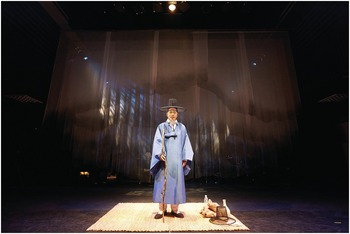
While the issue of finding a space to perform is undoubtedly important, the main issue that preoccupies sorikkun these days remains the need to connect with audiences. Kim Pongyŏng, a young ch’angjak p’ansori performer who has worked to bring traditional p’ansori story Shimch’ŏngga (The Song of Shim Ch’ŏng) closer to a contemporary audience (see Figure 1), describes the bind that p’ansori artists find themselves in an interview on 2 April 2015:
To be honest, the level of cultural appreciation in our country is quite low. …The trend is for the masses to only look for easy and entertaining things. That’s why there are a lot of celebrities in our country, and they have a lot of influence too. The fact that most kids today say they want to be celebrities when they grow up, the reason they have so much power is due to the effect of easy and entertaining television. You can go back and forth between lots of easy and entertaining programmes, plus it’s free. Why then would you want to go out, buy a ticket, spend money, go all the way there and watch something? …That’s why there’s a distance created with the arts, not just p’ansori but all arts in Korea.
Working within the logic of the Korean Wave narrative, many p’ansori artists, particularly of the younger generation, see the need to move closer to their audiences by including elements in their performance of the “easy and entertaining” culture their audiences are accustomed to. How, then, is this “easy and entertaining culture” integrated in p’ansori performance? What happens predominantly is a fusion (in the widest sense of the term) between different genres and media, for example when p’ansori singer Pak Aeri performs old pop songs with a p’ansori flavoured voice (and sometimes actual extracts of p’ansori) on the Korean Broadcasting System (KBS) music variety show Immortal Song 2 (Bulhu ŭi myŏnggok), alongside her husband, the hip-hop dancer Poppin’ Hyunjoon. Another example is the survival battle between master p’ansori singers (Kwangdaejŏn—Pansori Masters’ Battle) on MBC Jeonju, which completed its fourth season in 2015—here we find the more traditional format of competitions to designate new myŏngch’ang (master singers), such as the Jeonju Taesasŭp Nori, fused with the popular audition TV show format. A film about p’ansori (Dorihwaga—The Sound of a Flower, directed by Yi Chongp’il) released in 2015 featured the idol group Miss A member Suzy, attempting to use the popular appeal of the main actress to sell a more traditional story.Footnote 5
Kim Pongyŏng in his monodrama Nun mŏn saram (The blind man) on 14 February 2014 (photo provided by Kim Pongyŏng, reproduced with permission).

On an individual level, performers also come up with their own strategies for integrating more easily accessible content into their performances, most often grouped under the umbrella term “ch’angjak p’ansori.” Chi Kihak, artistic director at the Namwon National Gugak Centre and also isuja of p’ansori story Hŭngboga (The Song of Hŭngbo), has developed the concept of the “kugak ballad,”Footnote 6 which he explains as follows: in the past, p’ansori singers appropriated melodies, and even whole songs, from other genres in order to help create a certain atmosphere which held meaning for their audience; for example, using shijo (a form of classical singing) melodies when describing a member of the upper class, or using a farm work song when describing farmers. This strategy is described as sabipkayo (inserted songs) by Kim Kyung-hee (Reference Hill, Bithell, Hill and Bithell2008:63–67). Familiarity with these genres emerged from the interaction of p’ansori performers with people from various social classes in life, allowing them mastery in other folk traditions and in “‘popular Sino-Korean culture,’ those elements of Chinese culture which were known to the average Korean of some education” (Kim Tonguk 1980 cited in Walraven Reference Walraven1994:109).
Chi argues that in the way these musical connotations worked for an audience of the past, the music of today should be appropriated to create an atmosphere a contemporary audience can understand. I witnessed a performance of his piece Kwangdae ŭi norae (The Song of the Kwangdae, kwangdae being another term for a male p’ansori singer) that demonstrated these principles. Telling the story of an aged Shin Chaehyo (1812–1884, a petty government official credited with reforming p’ansori to the style it has today) missing his beloved female student, Chin Ch’aesŏn, Chi employed the musical codes of pop ballads to reflect the melancholy emotions of the lead character. The song “Torihwaga” (Peach Blossom Song) from this piece, the name of which refers to a tan’ga (short song sung by sorikkun to warm up the throat) written by Shin Chaehyo, reformats the text of the original song in a verse–chorus format, mixed with vocalisation retaining only a slight hint of the distinctive p’ansori huskiness, and accompanied by both Western and traditional instruments.Footnote 7
Kim Taeil, a member of the Namwon National Gugak Centre Changgeuk Company (Kungnip minsok kugakwŏn ch’anggŭkdan) and of performance group Mich’in Kwangdae (Crazy Kwangdae), often works together with Chi, and has also produced his own show based on the idea of a kugak ballad, titled Pyŏlsoril ta hane (lit. “You’re saying all kinds of things,” although the title is also a play on words, pointing to the character of the terrapin, pyŏlchubu in Korean). This show was, as the terrapin character indicates, a reinterpretation of p’ansori story Sugungga into the present day, recasting the terrapin as a member of an organ harvesting gang. Rather than turning to pop, Kim finds his musical inspiration in blues, arguing that there are certain emotions in that music that can resonate with a Korean public today. When I interviewed him on 6 December 2014, he argued that due to the similarity of experience of oppression between Korean people and black people in America, there is a potential for crossover between the different musical styles:
Looking at black music, black people can’t help but have a lot of han. Look at gospel for example, it’s music that was sung while they were slaves. …As I listened to black music I thought there was a certain similar feeling to our music, although it’s not the same, but there seemed to be some kind of sadness, and then the voice itself. …If you matched blues music with kuŭm [singing sounds without lyrics, a strategy predominantly employed in shamanistic genre shinawi], what kind of sound would be produced?Footnote 8
The question of mixing in different musical traditions with p’ansori remains a contentious one, as indeed do all issues of creating new material still within the frame of tradition (see, for example, Tsitsishvili Reference Tsitsishvili2009; Kartomi Reference Kartomi2013; and Witulski Reference Witulski2018). On the one hand, as Korean literature specialist Boudewijn Walraven puts it: “One should not be bound by antiquated folkloristic conceptions according to which folklore and folk beliefs are regarded as ‘survivals,’ which are pure in the measure in which they retain the forms of a distant, mythical past” (Reference Walraven1994:21). On the other hand, how far can one stretch the boundaries of a traditional genre in the name of revitalising it before it turns into something else? Indeed, as Mark Slobin argues in respect to American “ethnic” music: “It’s clear to many trained observers that even when people seem to be reviving things, that is, exhuming them and breathing life into them, what they get is something new” (Slobin Reference Slobin1983:37, cited in Hill and Bithell Reference Hill, Bithell, Hill and Bithell2014:5). In this sense, then, it is revealing that p’ansori-inspired theatrical pieces are often no longer described as p’ansori, the term ch’angjak kugakkŭk (newly created kugak theatre) having been coined to describe this trend instead.
Another form of ch’angjak p’ansori, often called fusion (or p’yujŏn in Korean pronunciation), shares with kugak ballads its attitude towards the incorporation of Western music. While this style is also built on the combination of p’ansori elements with popular music, it has a much stronger focus on regaining popularity for p’ansori. The logic behind this is simple: p’ansori in its current form is too difficult and no-one enjoys it,Footnote 9 pop music is popular, so p’ansori will become more popular if it is combined with pop music. Probably the most representative figure for this movement in today’s p’ansori world is Pak Aeri, isuja of p’ansori story Ch’unhyangga (The Song of Ch’unhyang), who explained her motivation for her current activities in an interview on 20 April 2015:
In the past, p’ansori was the big issue for people, the genre they wanted to see the most. If they heard that there was going to be a p’ansori performance somewhere, people would really follow it around to watch it, but now there are so many people, those who aren’t already mania fans, who aren’t even interested in where p’ansori performances are happening. However, if they experience it once or so, people are surprised and want to see more. …Since we can’t go chasing after people one by one, there must be a method to get people to come chasing after us. A method to make people walking on the street stop in their tracks, a story which is easy to listen to, eye-catching costumes, it could be something like that, so that’s why I started making ch’angjak p’ansori. Footnote 10
In fact, this nostalgia for a glorified past is common in discourse on p’ansori, particularly among those hoping to legitimise their popularisation efforts. Much discourse builds up an ideal of a pre-colonial golden age, prior to what is generally perceived as a continuous decline starting with attacks on Korean traditional culture by the colonial government. While this is a large topic which merits further discussion elsewhere, I wish to highlight here that perception of these “glory days” ties in very closely with the kind of adulation given to idol stars by their fans today. This image of broad popular appeal, both in the idealised past and the popular culture present, provides the model of success to which many contemporary sorikkun aspire.
Pak is best known among the general population for her appearance on KBS show Immortal Songs 2 (Pulhu ŭi myŏnggok II), together with her husband, contemporary dancer Poppin’ Hyunjoon. In this show, in which singers of the present revive classic pop songs from the past, Pak has seen success fusing her husband’s dance moves with her p’ansori-style vocalisation. In April 2015, for example, Pak won the first half of the show for her performance of O Sŭnggŭn’s “Issŭl ttae charhae” (Do Well While You Can), in which she combined her trot singing of the original with narration of scenes from several p’ansori stories in which the characters should have done better while they had the chance, all accompanied by her husband and his dance crew (and featuring a Michael Jackson tribute dance by Pak herself).Footnote 11 While, as she explained to me in the interview, there have been people criticising her for “selling out” and going too far along the popular route without paying enough attention to making a proper p’ansori voice, it is clear that her attempts have been successful in shifting p’ansori closer to mainstream awareness.
Pak is by no means the only sorikkun who is working on a crossover between pop and p’ansori. Ch’oe Hani is another who has been active in this field both as part of a team, kugak fusion group The Meari, and on her own. The Meari won the grand prize for their piece “Mearirang”Footnote 12 in the 2012 21C Korean Music Project competitionFootnote 13 held by the Gugak Broadcasting System. Rather than being straight p’ansori fusion, this piece is in fact based more on the folk song “Kanggangsullae,” with p’ansori influences apparent in Ch’oe’s use of aniri (p’ansori narration) to allow interaction with the audience. On The Meari’s 2014 album Mearirang (Me-Arirang) a more explicit p’ansori reference is found in their piece “Shigye t’okkirŭl ch’ajara” (Vision, Find the Hare), which uses the story of the terrapin trying to entice the hare to come back with him to the underwater palace in Sugungga, matching updated lyrics with a jazz-style accompaniment to Ch’oe’s p’ansori vocals, supplemented by further aniri sections and an upbeat chorus sung by the band’s pop vocal, Ch’oe Ŭnhye.
Based on the model of “Shigye t’okkirŭl ch’ajara,” Ch’oe Hani hopes to create pop song versions of all five core p’ansori pieces, limiting the time frame of each song to no more than five minutes, and building each in the standard pop song structure containing chord progressions, loops, hooks and catchy choruses. By employing this strategy, Ch’oe hopes to create pieces that contemporary audiences can listen to without finding them burdensome or difficult, as she explained in interview on 23 September 2014:
While preserving the essential elements of p’ansori like aniri and its theatrical aspect, at the same time creating something that can get stuck in people’s ears, with a familiar structure containing a hook and a chorus, and also containing the storytelling only p’ansori has, I started that kind of fusion or ch’angjak. In five minute sections. Not something where people look for p’ansori and listen to it online, but something where people hear it in passing, find it interesting and fun, and when they look into it more they find out it’s p’ansori, this is the kind of encounter I wanted to create.
The power of the “hook song” in pop is described in Kim Chang Nam (see also Fuhr Reference Fuhr2015:96–98), who calls it
a pattern of repetitive catchy melodies and refrains (or chorus) of a type designed to quickly attract the ears of listeners, particularly suitable for circumstances where the Internet and mobile devices have become crucial venues for listening to music. These hooks are essential for creating a deep impression of a song during the brief trial listening period allowed to customers as they browse music for the first time on online music pay sites (Kim Chang Nam Reference Kim2012:109).
One can see why this style might have appeal for p’ansori singers who often feel themselves sidelined by contemporary society.
However, as introduced above, not everyone is on board with this form of popularisation of p’ansori. Purists consider this style inferior in artistic value to the more traditional works, as can be seen from my interview on 6 March 2015 with Pae Ildong, isuja of p’ansori story Ch’unhyangga:Footnote 14
An outstanding artist is like spring water which flows without drying up or stopping, spreading out into thousands and tens of thousands of tributaries…. One-off skilful talents might make the people of the world dance like crazy, but they’re somewhat distant from true knowledge of the soul. …Ignoring the potential and vitality of the wellspring, dampening the Earth with rainwater like a one-off downpour, this cannot be seen as the correct attitude for an artist. Hence you can say that our traditional art is like ever-flowing spring water, and popular art lately is like the typhoons in May or June. Although people pay attention to the typhoon they aren’t all that interested in the tranquilly flowing spring water, because they trust that the water is there.
From Pae’s argument, we can see a perception of the existence of a “true path of art,” highlighting the need to claim some form of authenticity in the work one does. When this discourse of authenticity (or tradition) applies, those who stray too far can end up being accused of “selling out,” of oversimplifying the genre and so on; hence Pak Aeri, for example, told me that she was responding to people’s critiques by planning a wanch’ang (full rendition) performance to prove she was still capable of being traditional.Footnote 15 This need to prove oneself as authentic is obviously not compulsory: artists could cut themselves loose from the constraints of the genre and attempt to build something completely new. However, if they still want to claim legitimacy through associating with the tradition of p’ansori—as most ch’angjak performers I spoke to seemed to do—then the need to prove one’s authenticity remains. Many of those who have experience in working with popularised p’ansori hence tend to have rather ambivalent feelings towards it. I quote Yi Sŏnhŭi, a sorikkun who was a member of a kugak pop group called Shamony (a cross between the words shamanism and harmony) in the early 2000s. Having gone through her pop phase, she explained in interview on 20 May 2015 how she felt in hindsight that she had been unprepared, producing work she now felt rather regretful about:
It’s kind of like when men really want to drive a sports car, when they’re young they want to drive it but they have no money to buy it, and when they’re older they’ve entered the time when they could afford to drive a sports car, but they already feel too old. When people are young they want to work really hard at fusion music, but their musical basis isn’t fully established yet, but once they have the skills, they’re already too old and feel doing fusion isn’t appropriate any more.
Yi’s statement demonstrates some of the more ambivalent attitudes towards ch’angjak as a whole, in that while she has nothing against ch’angjak per se, she wished it would be done by people who have more experience and a better established musical skill set from which they are able to create higher quality pieces.
Making Ends Meet
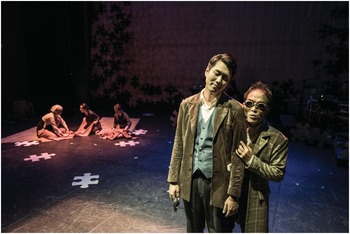
How do sorikkun make ends meet when not supported by the official preservation system? We saw above how becoming a member of a ch’anggŭk troupe can provide a stable income, but what of those who are unable or unwilling to join these troupes, who aspire towards broad popularity within the free-for-all economic system we saw described by Kang Inkyu above? Ch’oe Yongsŏk was the head of the ch’angjak p’ansori group Badaksori (P’ansori Kongjang Padaksori) during the course of my fieldwork in Korea, 2014–2015.Footnote 16 This group has made it its mission to create new p’ansori pieces that resonate with contemporary audiences (for example, creating a performance placing Sherlock the detective in colonial Korea, see Figure 2). While this team is among the more well-known ch’angjak p’ansori groups, this has not translated into financial success. As Ch’oe told me in an interview on 11 March 2015, making money from performances alone is almost impossible, as audiences are unwilling to pay a high price for tickets and a large portion of seats cannot be sold because they must be reserved as ch’odaekwŏn (invitation tickets, see beginning of article) for various associates. Indeed, most Badaksori members have other jobs on top of their activities in the team; after struggling to make ends meet through performance and teaching, Ch’oe himself opened a café to help support his family in November 2017.
A scene from Badaksori’s Taehan cheguk myŏngt’amjŏng Hong Sŏllok [The famous detective of the Korean empire, Hong Sŏllok], 19 August 2015 (photo provided by Badaksori, reproduced with permission).

In order to be able to create a performance, support must be obtained by other means. According to Ch’oe, most performances get funded through application to various regional arts foundations. In his case, he has been performing with the support of the Seoul Foundation for Arts and Culture (Sŏul munhwa chaedan) for many years now. Every year, the Foundation invites applications, and provides 15,000,000 KRW (around £10,000) in support for each project accepted. However, the application process is not without its problems: applications must usually be made a year in advance, and sometimes the timing can be rather awkward. If Ch’oe makes an application at the end of the year, the results for whether his application was successful or not come out in March the following year, but if he is aiming to do the performance in May, that leaves him only two months to prepare (preparing in advance without access to funds being rather difficult). An alternative option for receiving funds is to become a resident group in a public theatre; in Badaksori’s case, they were resident at the Kkum ŭi sup (Dream Forest) Art Centre until 2015. When a team becomes resident at an appropriate, recognised theatre, they sign a contract for two years, and receive 100,000,000 KRW (around £67,000), which they need to distribute themselves, by drawing up a monthly plan on how the money is to be used. This gives the advantage of being able to take more time in the planning stage.
While Ch’oe has so far been reasonably successful in obtaining funding for Badaksori’s projects, he complained that, despite his attempts, funding agencies usually had little money to spare for ch’angjak performances, favouring more traditional performance genres and programmes instead. Interestingly, during my interview with Kim Suji of the Korea Pansori Preservation Association on 23 April 2015, she argued that the exact opposite was the case. Howard (Reference Howard2016:464) supports this view, arguing that funding and sponsorship is increasingly targeted at kugak fusion rather than traditional kugak. Unfortunately there seems to be little numerical data to prove the case either way, as the funding agencies I approached stated that they did not keep records that differentiated exactly what kind of p’ansori performance they were supporting.
Ch’angjak p’ansori is indeed in a rather awkward position, often being neither mainstream enough to draw in large audiences, nor traditional enough to satisfy critics who say (often with good reason) that ch’angjak p’ansori cannot reach the level of the traditional corpus of p’ansori pieces (see for example Kim Kihyŏng Reference Kim2003:189). This predicament also occurs in the representation of p’ansori in the media: in a meeting on 12 March 2015 with Kim Sanhyo, formerly a writer for sorikkun Nam Sangil’s Sori Somun (Song Rumours) radio show on GugakFM radio, she told me of the very careful calculations presenters must make in the proportion of ch’angjak music they put in their shows, as they try to get enough ch’angjak in to try and draw a general audience without alienating the kwimyŏngch’ang (expert listener, lit. “ear master singer”), the more traditionally minded expert fans of kugak. This same issue was highlighted by Howard (Reference Howard and Kendall2010:212) in an interview with GugakFM’s then-chairman, Yun Miyong.
Riding on the Korean Wave
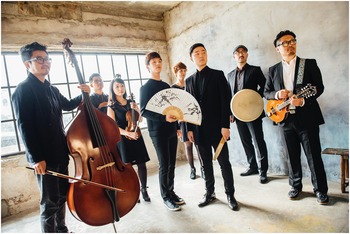
Given the awkward position that ch’angjak p’ansori occupies in the contemporary p’ansori scene, this raises the question of just how successful ch’angjak really is, with the additional question of how success should or can be measured. Does ch’angjak p’ansori bring in more money than traditional p’ansori? As we saw in the discussion of Ch’oe Yongsŏk, the jury is still out on which of the two genres is more economically viable. Much of the impulse behind its various types has come from a desire to make p’ansori more popular with a general audience, but has it really succeeded in this? Ch’angjak p’ansori performances do not necessarily draw larger audiences than traditional p’ansori performances, and usually draw significantly less of a crowd than ch’anggŭk performances. Apart from Pak Aeri, most ch’angjak p’ansori seems to have failed to make it into the public consciousness. One notable exception is the ethnic folk band Second Moon (Tubŏntche tal), which released an album, P’ansori Ch’unhyangga (P’ansori The Song of Ch’unhyang) of reimagined pieces from the original p’ansori story in collaboration with sorikkun Kim Chunsu and Ko Yŏngyŏl in 2016 (see Figure 3), and has become unexpectedly popular.
Second Moon’s profile picture, with band leader Kim Hyŏnbo on the far right, with sorikkun Ko Yŏngyŏl (right) and Kim Chunsu (left) holding fans in the centre (photo provided by Kim Hyŏnbo, reproduced with permission).

While the album contains various different strategies to make this work, I shall concentrate here on the track “Ibyŏlga” (The Song of Parting) from their album, which employs p’ansori lyrics and vocal production while retaining a hook song format. The title refers to the parting of Mongryong and Ch’unhyang, the main characters of the story, which is itself a famous scene in the original p’ansori piece. However, the lyrics instead combine excerpts from song lyrics of two other scenes, the songs “Kalkkabuda” (I Want to Go) and “Ssuktaemŏri” (Unkempt Hair), which sing about the sorrow of parting rather than the act of parting itself. In this piece, the lyrics “param to shwiŏ nŏmko, kurŭm to shwiŏ nŏmne” (Even the wind takes a rest, even the clouds take a break)Footnote 17 become the hook/chorus, interspersed with other excerpts from the two pieces mentioned above, and blended with a sampling of Second Moon’s track “Ŏrŭm yŏnmot” (Ice Pond) from the 2006 drama Kung (Princess Hours) original soundtrack. This emulates a crossover also seen in the more popular areas of the Korean Wave, as television dramas employ popular singers either for the soundtrack or as actors, creating a feedback loop as fans of the drama are encouraged to gain interest in the singer, and vice versa. Second Moon emulates this strategy by building on their experience providing the soundtrack for numerous popular dramas (Love in the Moonlight (2016), The Legend of the Blue Sea (2016) etc.) to draw in new listeners for their other projects. Using familiar audio material from a popular drama hence helps smooth over any potential unfamiliarity casual listeners might feel due to the subject matter and vocal style.
This strategy has proven successful, as Second Moon’s appearances together with Kim Chunsu and Ko Yŏngyŏl on various TV programmes (such as Mnet’s Nŏ ŭi moksori ka boyŏ (I Can See Your Voice) and P’ansŭt’illŏ (Scene Stealer), KBS’s Pulhu ŭi myŏnggok II (Immortal Song 2) and EBS’s Space Konggam (Space Empathy) would attest. They also set up a long-running concert series at the Daehak-no Dream Art Centre from 25 August to 4 September 2016, a very rare feat for performers that usually struggle to fill a concert hall even once (see the comparison with Harkness Reference Harkness2014). In this sense, they seem to have satisfied the aims for fusion described by Sutton:
to provide pleasant listening experiences, to earn money for its performers, but also to introduce Koreans to their own musical heritage (gently seducing them away from pop music to an appreciation of kugak), to promote Korea and Korea’s “culture” overseas, and more.
(Sutton Reference Sutton2011:16)While the popularity of the album is a hopeful sign for young p’ansori performers that they are able to make music with popular appeal, the variety of strategies attempting to blend p’ansori and Western folk music employed on the P’ansori Ch’unhyangga album, some successful and some less so, indicates that the creation of fusion music, particularly good fusion music, is by no means an easy task. It feels like Second Moon, Kim Chunsu and Ko Yŏngyŏl are themselves not sure which direction their music should take, as the album wanders between pop-style and p’ansori-style vocals, between pop and kugak rhythms, and between varying levels of faithfulness to the original text.
While the example of Second Moon would indicate that ch’angjak p’ansori or fusion can see success, it is difficult to establish any lasting impact this may have had on interest in p’ansori in general. Judging by reports from several sorikkun I interviewed, the film Sŏp’yŏnje (Western School, the name of one of the p’ansori singing styles), which was directed by Im Kwont’aek in 1993, had a much greater effect on p’ansori’s popularity than most ch’angjak p’ansori has ever done, at the time causing a rise in people who wanted to learn the traditional genre. Although I have heard this often, no data seems to exist to corroborate it. Perhaps, this indicates that media exposure has a much greater effect on p’ansori’s popularity, something many sorikkun would agree with. Kim Yulhŭi, an isuja of p’ansori story Ch’unhyangga, and also member of ch’angjak p’ansori group Badaksori and kugak band Baraji [Paraji], took part in a survival competition show for sorikkun called Sori ŭi shin (The God of the Voice),Footnote 18 which aired on Korean cable channel JTBC in autumn 2013. However, she argued in my interview with her on 1 May 2015 that part of the reason this show did not make a big impact was due to its very awkward broadcasting times:
I guess because [p’ansori] wasn’t very popular they had no choice but to do it like that. It was aired on Sunday mornings at eight, and then the time changed every week, sometimes it was at eight, sometimes at nine, sometimes at seven, it went back and forth like this. …The programme was clearly also lacking in various ways, but who is going to watch something at eight o’clock in the morning on a Sunday?
It should also be mentioned that this programme was not an initiative by JTBC itself, but rather came into being because the chief executive of Crown-Haitai confectionary, Yoon Young-dal, thought it would be fun to have a p’ansori audition show and provided the funding for it. In doing so, he unwittingly further demonstrated the lack of popularity and awareness of p’ansori in the media.
Kwon Hyun Seok (Reference Kwon2014:231) supports my discussion here, showing how kugak is hardly represented on mainstream radio broadcasts in Korea. There used to be three distinct kugak programmes per day on national public broadcaster KBS (Korean Broadcasting System) in the 1980s, but, with the creation in 2001 of GugakFM, a radio broadcasting station specialising exclusively in kugak, other broadcasters were relieved of the requirements to present kugak content, and coverage has declined, although KBS still has one regular kugak-related TV show, Kugak hanmadang (Korean traditional music gala concert), which airs on Saturdays at noon. Yi T’aehwa (Reference Yi2013:158–159) takes discussion about the lack of broadcasting outlets further, arguing that even in the cases where p’ansori is represented on mainstream media (he cites the example of Shin Yŏnghŭi, who appeared on a comedy programme on KBS, and the late Pak Tongjin, who appeared in an advert for traditional medicine), it is presented only in very short extracts, without reference to the context around these same extracts, and hence does not significantly contribute to audiences’ understanding of p’ansori. Clearly, there is much room for expansion in the representation of p’ansori and kugak in general in the media, particularly with the wide range of media that are being employed in the services of the Korean Wave.
Conclusion: A Future for Ch’angjak?
Young kugak artists are often perceived as elitist and unfamiliar with how to market themselves on the commercial music scene. However, from my observations young sorikkun are becoming more savvy, particularly with regard to the use of online resources and social networking tools as a means to become more visible. Many artists promote their concerts or radio appearances through live streams on Facebook, and on 2 March 2017 a p’ansori/dance crossover rendition of traditional piece Chŏkpyŏkka (The Song of the Red Cliff) performed at Jeongdong Theatre (Chŏngdong kŭkchang) was streamed live on Korea’s most popular search engine, Naver. Whether this strategy will translate into increased economic returns in the future is open to question, but with most sorikkun still advocating increased visibility of the genre, with the hope that this will help turn p’ansori into a commercially viable venture in the future, this development is still predominantly welcomed. With this focus on increased visibility of p’ansori, the appearance of bands such as Second Moon on mainstream media, appearing on various TV shows and now awarded with the 2017 Korean Music Awards Best Crossover Album title, is clearly a development to be watched in the future, to see how it affects the popularity of p’ansori as a whole.
In conclusion, then, while So Inhwa (Reference So2015:31–32) in her article on the popularisation of kugak describes a perception of young kugak performers as unwilling and unable to adapt to the demands of contemporary audiences used to popular culture, I would argue that the lack of space for development in the government-sponsored preservation system hierarchy, as well as their own familiarity with and desire to emulate successful Korean pop stars, prompts young p’ansori artists, and kugak artists in general, to attempt to emulate the pop music framework in order to gain access to the contemporary popular music scene. Much literature on traditional Korean music still seems to address it as if it existed in a vacuum of tradition, separated from contemporary trends, but young p’ansori artists also listen to K-pop, and inspired by the Korean Wave narrative they share many of the dreams of success with those of their generation who are not trained in traditional arts.
While the rise of interest in more popular p’ansori styles is a hopeful sign for those who feel that p’ansori has been overlooked for too long, others worry about the effects that an overly zealous application to popularisation might have for the future development of the genre (Finchum-Sung Reference Finchum-Sung2009:52; Park Reference Park2011:35). If these popularisation strategies are not to lead to a hollowing-out of the fundamental aspects of the genre, most people I spoke to agreed that the best way would be for new genres and pieces to be created by those with a strong foundation in p’ansori, the senior sorikkun or myŏngch’ang (master singers). This would hopefully allow for a skilful blend of creative tradition, or traditional creativity, due to their longer experience in engaging with the genre. While it is clear that interaction with contemporary popular culture will continue to be a contentious subject for not just p’ansori, but any traditional art form, the strategies employed by sorikkun today demonstrate that p’ansori artists today are as much members of contemporary Korea as non-traditional artists, and they interact with the same dominant Korean Wave narratives, as they attempt to prove the continued relevance of their music.
Glossary