INTRODUCTION
The silver pomfret, Pampus argenteus (Euphrasen, 1788) (Perciformes: Stromateidae) is an inshore species distributed broadly across the Indo-West Pacific, from the Persian Gulf in the west, to Indonesia in the east, and north to Hokkaido in Japan (Haedrich, Reference Haedrich, Hureau and Monod1984). Outside its native range the species has been reported from the Adriatic Sea (near Rijeka) in July 1896 (Dulčić et al., Reference Dulčić, Jardas, Pallaoro and Lipej2004), Hawaii (Honolulu—during G. Vanderbilt South Pacific Expedition) in June 1937 (Fowler, Reference Fowler1938), and the North Sea (18 miles east of Seahouses, Northumberland) in August 1983 (Davis & Wheeler, Reference Davis and Wheeler1985). European records of P. argenteus, a mesopelagic fish native to the Indian Ocean, South-East Asia and the East China Sea are reviewed, and the study specimen described.
MATERIALS AND METHODS
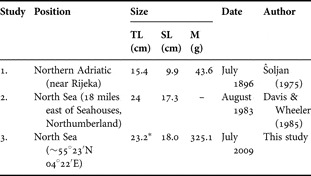
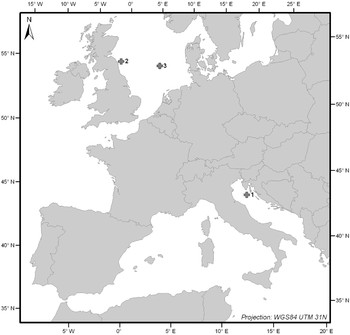
On 15 July 2009 a second North Sea specimen was caught by the fishing boat ‘Maggie M MBE’ near Dogger Bank (~55°23′N 04°22′E) (Figure 1; Table 1). In this part of the North Sea, water depths are ~24–30 m, and average sea surface temperatures were 17°C during July 2009 (UK Meteorology Office Hadley Centre HadISST data; Rayner et al., Reference Rayner, Parker, Horton, Folland, Alexander, Rowell, Kent and Kaplan2003). The fish was unfamiliar to the experienced skipper and his crew, who placed it on ice in the fish hold of the vessel until November 2009 when it was identified. The specimen has been deposited in the collection of the Natural History Museum, London (Accession number: 2010.1.15.1).
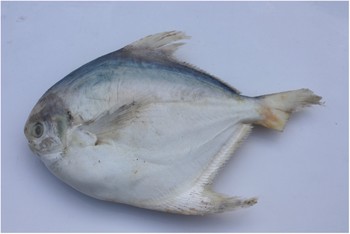
The specimen of Pampus argenteus caught in the North Sea (at ~55°23′N 04°22′E) on 15 July 2009.

Records of Pampus argenteus in European waters, giving total length (TL), standard length (SL) and mass (g).

*, caudal fin damaged.
RESULTS
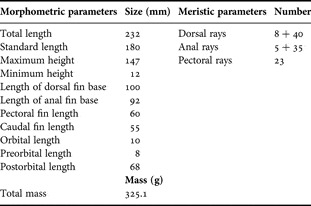
The studied specimen (Figure 2) has the morphometric and meristic data listed in Table 2. The body form of the specimen is typical of the family Stromateidae. The only member of the Stromateidae regularly encountered in European waters is Stromateus fiatola (Linnaeus, 1758), which occurs in the Mediterranean and tropical Atlantic and has been reported once from Arcachon in the southern Bay of Biscay (Amanieu & Cazaux, Reference Amanieu and Cazaux1963). Features that identify the specimen as Pampus argenteus rather than S. fiatola included: the very deep and compressed body; the absence of an operculum; the reduced gill opening so that it forms a vertical slit on the side of the body; the gill membrane being broadly united to isthmus and the dorsal and anal fins being single and falcate (Figure 1). Morphological and meristic characters are consistent with those presented by Haedrich (Reference Haedrich, Hureau and Monod1984), and confirm the specimen as the second recorded occurrence of the silver pomfret P. argenteus from the North Sea (Table 1).
Locations of recorded European captures of Pampus argenteus. Numbers refer to studies listed in Table 1.

Morphometric and meristic data of the Dogger Bank specimen.

DISCUSSION
Based on discussions with the crew there is no doubt the specimen was captured alive. The faded coloration and poor condition were the result of being stored for 143 days in the fish hold. Suggestions that the trawl had merely picked up a specimen discarded from the refrigerator of a passing vessel seem unlikely. There have been three other reports of Pampus argenteus found far from its centre of distribution; a specimen from the Adriatic (Ŝoljan, Reference Ŝoljan1948), two specimens from Honolulu during the George Vanderbilt South Pacific Expedition, June 1937 (Fowler, Reference Fowler1938) and Davis & Wheeler (Reference Davis and Wheeler1985) reported the only other occurrence of this species in the North Atlantic. Both Fowler (Reference Fowler1938) and Headrich (1967) considered that the reports of specimens caught beyond the Indo-Pacific region were ‘so far out of the established range of the genus that the records can only be based on specimens bought from elsewhere’. Ŝoljan (Reference Ŝoljan1975) refers to the possibility that the Adriatic specimen may have reached the Adriatic from the Red Sea by following a boat through the Suez Canal. The process of migrating through the Suez Canal is termed lessepsian migration, named after the chief engineer Ferdinand de Lesseps in charge of the construction of the canal which opened in 1869. Davis & Wheeler (Reference Davis and Wheeler1985) and Orsi-Rellini (Reference Orsi-Relini2001) accepted Ŝoljan's hypothesis and record. Dulčić et al. (Reference Dulčić, Jardas, Pallaoro and Lipej2004) confirmed the identity of the Adriatic specimen, and proposed to accept this specimen as the first reliable record (in 1896) of any lessepsian migrant in the Mediterranean Sea. Golani (Reference Golani, Golani and Appelbaum-Golani2010) noted that the Adriatic record should be considered as a vagrant rather than a lessepsian migrant since P. argenteus is not known to inhabit the Red Sea. Pampus argenteus is not recorded in the fish fauna of South Africa (Smith & Heemstra, Reference Smith and Heemstra1986) or of West Africa (Fowler, Reference Fowler1936); this negates the possibility that the fish could have reached northern waters via the Cape of South Africa (Davis & Wheeler, Reference Davis and Wheeler1985).
Stromateoid fish are well known for their habit of following pelagic medusae, floating wreckage, drifting seaweed and slow moving vessels (Davis & Wheeler, Reference Davis and Wheeler1985). This may facilitate, under favourable conditions, the dispersal of isolated individuals from the main distribution area. Considering the volume of marine traffic from the Arabian Gulf to north-western Europe, this behaviour may provide a mechanism for the specimen to reach the North Sea. The possibility of the study specimen entering the North Sea by ballast transport is hard to believe as it is very unlikely that young stages (eggs and larvae) could survive such a long trip. Dulčić et al. (Reference Dulčić, Jardas, Pallaoro and Lipej2004) dismissed the possibility that the Adriatic specimen could have been introduced this way, as ballast was organized in a different way (in 1896) to nowadays, thus supporting the hypothesis of the slow moving vessel. Whilst still difficult to comprehend in terms of distance travelled and environmental barriers crossed, the re-occurrence of P. argenteus in the North Sea appears to support the hypothesis of passage through the Suez Canal.
ACKNOWLEDGEMENTS
We thank the skipper and crew of the FV ‘Maggie M MBE’ for retaining the specimen, J.L. Weir for procuring the specimen for study, and D. McChesney for producing Figure 1. The Directors at Emu Ltd supported this study.