


Introduction
Competition among parties is a cornerstone of democracy. If a country's party system lacks a viable competitor to the ruling party, citizens are effectively deprived of their right to choose who governs them. A ruling party that is not challenged by a strong opposition party may lose incentives to be responsive to citizens' wishes and to stay popular.
In the past, there were a number of countries that had a dominant party that was not exposed to meaningful competition. Yet, many of them, including Mexico, India, and Malaysia, have later seen a development of a strong opposition party that made the countries' politics more competitive. In this study, I examine a country that still has a dominant party: Japan. Almost uninterruptedly since 1955, Japan's party system has been characterized by the presence of the dominant Liberal Democratic Party (LDP) and many other smaller parties. Although the LDP's strength has received much scholarly attention, far less effort has been dedicated to the question of why many opposition parties continue to exist, without converging into one main party.
When multiple opposition parties exist without forming a unified force to confront the ruling party, anti-incumbent votes are necessarily split, giving an advantage to the ruling party. An empirical study has demonstrated that the presence of a unified opposition party promotes anti-incumbent economic voting while many opposition parties dampen it (Maeda Reference Maeda2010). When voters want to punish the incumbent, they need a clearly identifiable alternative. The lack of an alternative makes an election uncompetitive, and it becomes easier for the incumbent to stay in power.
An anecdotal story from Japan underscores this point. Right before the 2017 general election, the cabinet approval rate was lower than the disapproval rate.Footnote 1 In most countries, this would mean a defeat for the incumbent. However, the LDP was able to secure 61 percent of the seats in that election, thanks mainly to the fact that the largest opposition party split into two shortly before the election, and neither of them was generally seen as a party capable of governing. If an unpopular ruling party cannot be unseated, a question arises if democracy is functioning in the country. Indeed, the voter turnout rate in the 2017 election, 53.7 percent, was the second lowest among Japan's post-World War II general elections.Footnote 2
Why has Japan's opposition been fragmented, without converging into one? In this study, I empirically evaluate the argument that there is a policy issue that is working as a wedge to divide Japan's opposition parties on the left-wing side. This argument implies that the LDP is benefitting from keeping the wedge issue in place. The findings from this study not only advance our understanding of Japan's party politics but have implications for future research on party competition dynamics.
An asymmetrical party system in Japan
Japan is quite unusual among the world's democracies in that one party has stayed in power for an exceptionally long time. The LDP was established in 1955 by a merger of two conservative parties, and it was the ruling party from the beginning. Since then, the LDP has been in power for all but four years. The LDP's long reign was helped by rapid economic growth and the absence of a strong opposition party (Rosenbluth and Thies Reference Rosenbluth and Thies2010).
The Socialist Party was the second largest party for a long time and the main rival to the LDP. Yet, other opposition parties such as the Communists and the Democratic Socialists existed. The Socialists did not even nominate enough candidates to win a majority of the seats in the lower house in most elections.Footnote 3 An asymmetrical party system with one ruling party on the right-wing side and multiple opposition parties on the left-wing side became an enduring feature of Japanese politics.
The LDP went into opposition for the first time in 1993 when a non-LDP coalition was formed after the 1993 general election. The coalition included two new parties formed by former LDP legislators. Even though the LDP lost power, it was still the largest party. The coalition fell apart in the following year, and the LDP returned to power by forming a coalition with two other smaller parties.
The second time the LDP lost power was in 2009, when the Democratic Party of Japan (DPJ) won a landslide victory. This time, the LDP's loss was so large that its seat share became less than half of that of the DPJ. Many thought the LDP's dominance had finally come to an end and Japan's party politics would become competitive. However, the DPJ was not able to retain its popularity after becoming the ruling party (Kushida and Lipscy Reference Kushida and Lipscy2013), and it suffered a major setback in the subsequent 2012 election. The LDP returned to power and has since won every national election.Footnote 4 The opposition camp has been fragmented into many parties and has not been able to pose a serious challenge to the LDP to this day. What is keeping Japan's opposition fragmented?
Opposition fragmentation and its determinants
Although there is an extensive literature on party system fragmentation (e.g., Lijphart Reference Lijphart1994), most of the studies analyze party systems as a whole, not distinguishing between ruling parties and opposition parties. Since opposition parties are a subset of political parties in a country, it is expected that the degree of opposition fragmentation is correlated with the degree of party system fragmentation. Yet, the correlation between the two is not as strong as one might think (r = 0.61 in the data from eighteen advanced democracies, as reported in Maeda Reference Maeda2015). The concept of opposition party systems has been understudied but warrants attention on its own.
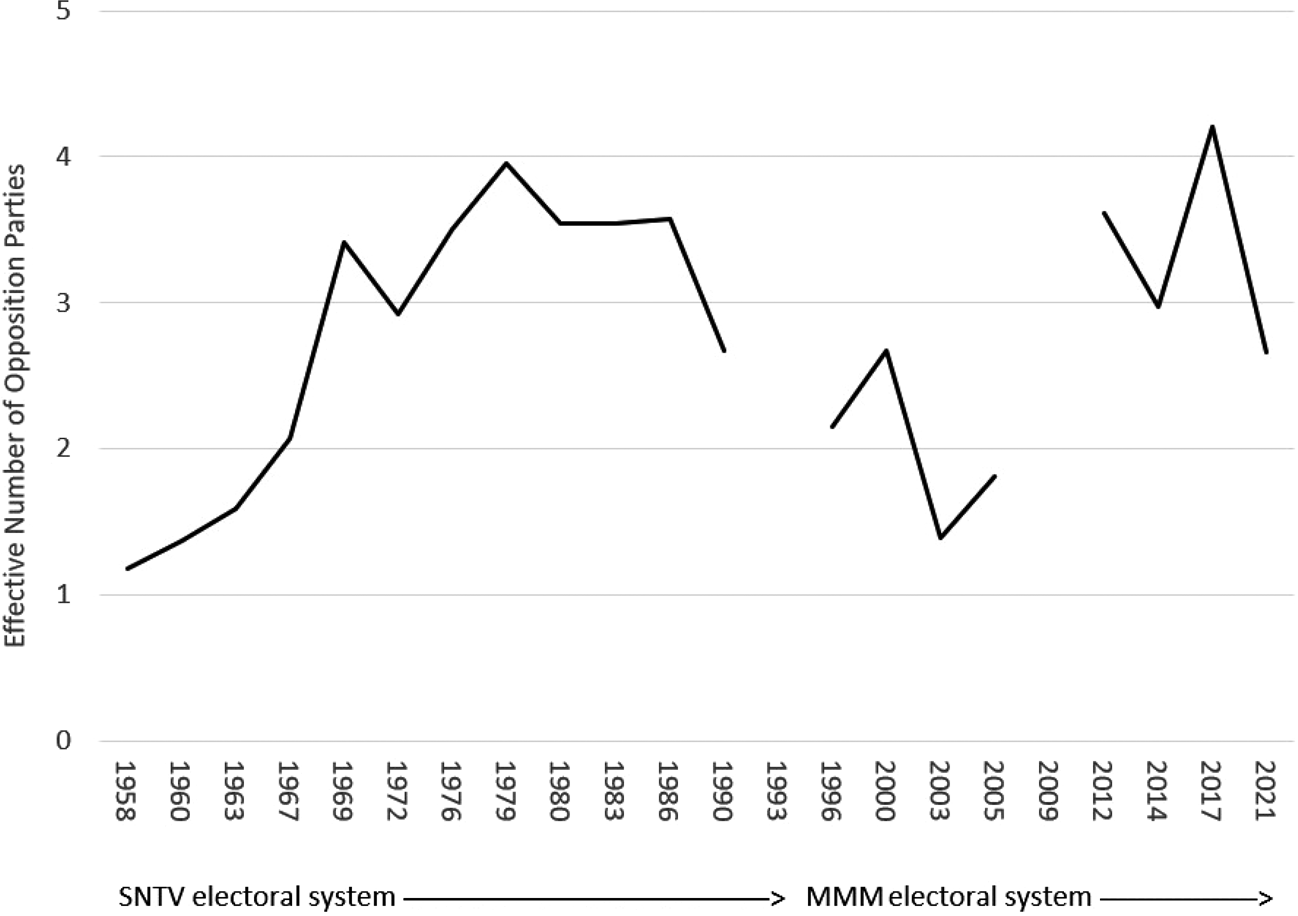
The effective number of opposition parties (ENOP) is a measurement of opposition fragmentation first introduced by Maeda (Reference Maeda2010) and is calculated by applying the formula of the effective number of parties to opposition parties. Figure 1 shows the trend of Japan's ENOP values since the foundation of the LDP, calculated after each general election (a higher value indicates a higher level of fragmentation). Considering that the average ENOP level in eighteen advanced democracies reported in Maeda (Reference Maeda2015) was 2.23, Japan's ENOP was relatively high for most of the period shown in the graph.
Effective number of opposition parties in Japan, 1958–2021.
Data from: Authors' calculation.
Note: Values are not shown for 1993 and 2009 since the LDP was in opposition after those elections. The following parties were in coalition with the LDP and thus were not in the calculation: the New Liberal Club in 1983; the Social Democratic Party and the New Party Sakigake in 1996; and Komeito since 2000.

What explains Japan's high degree of opposition fragmentation? It has been demonstrated that the number of parties in a country is positively correlated with the number of contentious political issues (Lijphart Reference Lijphart1984; Stoll Reference Stoll2011; Taagepera and Grofman Reference Taagepera and Grofman1985), and it may indeed be the case that the presence of contentious issues fragments Japan's opposition. This point will be elaborated upon in the next section.
What are electoral systems' impacts? A rare electoral system called the single non-transferable vote (SNTV) system was used until 1993, and scholars have argued that the SNTV system facilitated opposition fragmentation in Japan (e.g., Reed and Bolland Reference Reed, Bolland, Grofman, Lee, Winckler and Woodall1999). As Figure 1 shows, Japan's ENOP was initially low when the Socialists were effectively the only opposition party. But the level of ENOP went up as new opposition parties emerged in the 1960s and 1970s. Under the SNTV system, typically three to five members were elected in an electoral district, and thus it was relatively easy for a small party to win a seat, especially in four- or five-member districts. Further, this system was disadvantageous to the largest opposition, the Socialists, because incumbent Socialist legislators did not want their party to add an additional Socialist candidate in their own districts, which would jeopardize their re-election prospects (Maeda Reference Maeda2012). As a result, the Socialists' growth beyond a certain level was hindered, and smaller opposition parties were able to enjoy their share of representation. The SNTV system's unique characteristics offer a compelling explanation for Japan's high level of opposition fragmentation until the 1980s.
The 1994 electoral law reform replaced the SNTV system with a mixed-member majoritarian (MMM) system, which combines a single-member district (SMD) tier and a proportional representation (PR) tier. Currently, 289 members are elected from SMDs, and 176 seats are filled by party-list PR. Since a majority of the members are elected through the SMD portion, which is known to be disadvantageous to small parties (see, e.g., Duverger Reference Duverger1954), the new electoral system must be a tougher environment for minor opposition parties than the old SNTV system. In fact, the proponents of the electoral law reform argued that the new system would bring about rigorous competition between two major parties (Reed and Thies Reference Reed, Thies, Shugart and Wattenberg2001).
The new system indeed reduced the degree of opposition fragmentation after its introduction, as demonstrated in Figure 1. Small opposition parties' seat shares declined, and the DPJ became larger. In 2003, the DPJ incorporated the second largest opposition party and clearly became the main opposition party, which voters saw as the only viable alternative to the ruling LDP. As a result of the 2003 election, the ENOP value went down to 1.4. Although the subsequent 2005 election produced a slightly higher ENOP value, the DPJ was still clearly the main opposition party, possessing 113 lower house seats, while the second largest opposition, the Japanese Communist Party (JCP), had only nine seats. The DPJ then went on to defeat the LDP in 2009. The reduction in the level of opposition fragmentation and the emergence of a main opposition party after the electoral law reform were exactly what the proponents of the reform hoped to see as the new system's consequences.
However, the new electoral system did not completely end opposition fragmentation in Japan. First, the JCP, the leftmost party in the country, has survived to the present day. Second, as the DPJ's popularity plummeted while it was in power between 2009 and 2012, new parties emerged and fragmented the party system again. Third, after the breakup of the DPJ in 2017, its successor parties have not yet converged into one. As shown in Figure 1, the ENOP levels have been staying high since 2012. We can thus speculate that the new system's effect to reduce opposition fragmentation may not be as strong as previously thought or that there are other factors, aside from the electoral system, that are influencing the degree of opposition fragmentation.
Several factors can account for the current fragmentation of Japan's opposition. First, even though the disproportional SMD portion elects a majority of the seats of the lower house, there is also a PR portion that elects 38 percent of the seats, enabling small parties to win seats. For example, 96 percent of the lower house seats the JCP has won under the current system are from PR. However, it is also true that some small parties do win seats in SMDs, which suggests that the existence of the PR portion is not the whole story of why small parties are surviving in Japan.
Second, deliberative parliamentary rules that allow opposition parties to influence policies are associated with opposition fragmentation (Maeda Reference Maeda2015). There is a scholarly debate on whether Japan's parliament is a majoritarian or deliberative institution (see, e.g., Fukumoto Reference Fukumoto2000; Masuyama Reference Masuyama2000). If it is deliberative, that may partly explain the country's opposition fragmentation.
Third, even though the lower house of parliament is the more powerful chamber and the focus of this study, the upper house may be helping small parties' survival. The upper house has a more proportional electoral system—40 percent of its members are elected through a nationwide PR district, 34 percent from multi-member districts in relatively populous prefectures, and 26 percent from single-member districts in less populous prefectures. Under the current law, a party is eligible for public funding from the government if it has at least one seat in either chamber and wins at least two percent of votes in either chamber's election.Footnote 5 Thus, even though the upper house is the less powerful chamber, it can serve as a funding source for a small party that cannot win a seat in the more disproportional lower house.
Although these three factors should explain why Japan's opposition is fragmented to a certain extent, they may not fully explain it. In the rest of this article, I examine yet another factor that may be fragmenting Japan's opposition on the left-wing side: the polarizing issue of constitutional revision.
Constitutional revision as a wedge issue
A wedge issue is a political issue that divides voters who may otherwise support the same party. A well-known example is the Southern realignment in the United States in which the increased salience of the civil rights issue drove a wedge in the Democratic Party's support base. As a result, a large number of conservative white Southerners switched their party support from the Democratic Party to the Republican Party (see, e.g., Hillygus and Shields Reference Hillygus and Shields2008). Another example is the issue of immigration on which the pro-business wing and the social conservative wing of the Republican Party do not agree (Jeong et al. Reference Jeong, Miller, Schofield and Sened2011).
In the US two-party system, when a wedge is effective enough to separate a segment of voters from the party they previously supported, those voters are expected to come to support the other party. Yet, in countries with more than two parties, a new political issue may lead to the growth of a new party. It has been documented that the refugee issue in Germany caused a split within the Christian Democrats prior to the 2017 general election, and the national conservative wing switched its allegiance to the Alternative for Germany (Dostal Reference Dostal2017). Likewise, the British Conservative Party lost its supporters to the United Kingdom Independence Party due to the immigration issue (Evans and Mellon Reference Evans and Mellon2019).
The above examples suggest that an issue can extend a party's life. A party in decline may be able to survive if it can successfully appeal to its supporters with the policy issue it champions. This may be the mechanism that is keeping Japan's opposition fragmented. More specifically, the highly salient and contentious issue of a constitutional revision in Japan may be helping small opposition parties to survive and preventing the country's opposition camp from converging into one main party. While this argument has been made before (Maeda Reference Maeda and Alexander2018), it has not been empirically investigated yet.
Japan's current constitution, which came into effect in 1947, was created as part of the post-World War II reforms. The US-led occupation authority drafted it to demilitarize and democratize the country. Perhaps the most unique and controversial feature of the constitution is Article 9, which renounces war and prohibits the country from possessing “land, sea, and air forces, as well as other war potential.” Indeed, post-war Japan did not have military forces initially. Yet, when the US forces stationed in Japan were dispatched to fight in the Korean War in 1950, the occupation authority directed the Japanese government to rearm the country. The National Police Reserve was thus created in 1950, which since 1954 has been known as the Self-Defense Forces (SDF).
The government's position on the constitutionality of the SDF is that “Japan is permitted to possess the required minimum self-defense capability” (Ministry of Defense 2021, 206). Many lawsuits have been brought to the courts about the constitutionality of the SDF. There was a lower court ruling that declared the SDF unconstitutional, which was overturned by an upper-level court, and the Supreme Court has never directly ruled on the constitutionality of the SDF. Article 9 has been a contentious political issue (McElwain and Winkler Reference McElwain and Winkler2015). Generally, politicians and citizens on the right-wing end of the ideological spectrum argue that Article 9 should be revised to make it clear that the SDF is constitutional. Yet, opposition to a constitutional revision is strong among left-wing parties and people. For them, Article 9 is an extremely important clause that symbolizes the country's determination to sincerely seek peace in the world and never to invade a foreign country.
Citizens' and political parties' attitudes toward Article 9 are directly related to their opinions on the national defense policy. The right-wing, pro-revision side typically support higher defense spending and a stronger tie with the United States. For the left-wing, being too close with the United States puts Japan at a higher risk of getting involved in a military conflict, and they generally argue that the SDF and US bases in Japan should be shrunk.
Even though Article 9 and the related defense policy debate are a highly salient and contentious issue, it does not split the parties and citizens evenly. On the one hand, the LDP has always advocated a constitutional revision since its foundation even though individual politicians' views on the issue have varied. On the other hand, however, the opposition parties have been divided on this issue. While some opposition parties in the past, for example the Socialists, had a hardliner position in protecting Article 9, argued that the SDF was unconstitutional, and advocated a policy of “unarmed neutrality” (Stockwin Reference Stockwin1966), other opposition parties took a more moderate position, recognizing the SDF as constitutional and approving the security alliance with the United States.
As explained earlier, the old SNTV electoral system had a built-in tendency to allow multiple opposition parties to exist, which can explain why, for example, both the Socialists and the Communists existed separately. Yet, even under the new MMM electoral system, Japan's opposition stays fragmented, especially since 2012 (see Figure 1). While the LDP keeps winning in national elections, opposition parties have not been able to pose a serious challenge to it. Scheiner and Thies (Reference Scheiner, Thies, Pekkanen and Pekkanen2022) even referred to the post-2012 opposition with the phrase “opposition as irrelevance.”
Opposition supporters may all agree that they want to end the LDP government, and they may all realize that a fragmented opposition does not have much chance of achieving it. Yet, small opposition parties continue to exist, supported by a segment of voters who choose not to switch their support to the largest opposition party. Although many of those voters may understand that concentrating anti-LDP votes in one main opposition party is the optimal strategy to compete against the LDP, they vote for a small opposition party. In particular, the persistent existence of the JCP has continually been dividing the left-wing.
What is separating those who vote for a small opposition party and those who vote for the largest opposition party? Since Article 9 has been a highly salient issue, and opposition parties take different positions on it, it is plausible that this issue is working as a wedge that divides them. The DPJ—the largest opposition to the LDP until it fell apart in 2017—was internally divided on the issue of the constitution. It could not set forth a clear position on the constitution, and the only thing it was able to decide was to “discuss” it (Hagström Reference Hagström2010). The internal division plagued the party to the end. When the party split into two in 2017, the fault line was basically the issue of constitutional revision (Calder Reference Calder2018).Footnote 6 In contrast, smaller left-wing opposition parties such as the JCP and the Social Democratic Party (SDP) strongly argue that Article 9 should never be amended, and they are more internally cohesive on the issue than the DPJ.Footnote 7 The JCP and the SDP are known as the “staunch defenders” of the constitution, especially Article 9 (McElwain and Winkler Reference McElwain and Winkler2015, 267).
For pro-Article 9 people who passionately care about the issue, it may be difficult to vote for the DPJ—even if they realize that fragmenting the opposition will help the LDP. For them, an opposition party that is not committed to protecting Article 9 may be almost as despicable as the LDP. It is true that an electoral alliance of multiple opposition parties may have a chance to collectively defeat the LDP. Yet, having disagreements internally will not help such an alliance when it tries to appeal to the electorate as a potential ruling coalition.
Further, the presence of those voters who passionately care about a certain issue influences party leaders' strategies. A small party's leader faces a choice between trying to keep the party alive or merging the party with another party. When the leader considers that the party is terminally in decline, the leader may decide to have the party join another. Being a member of a large party comes with an advantage of being closer to power. Yet, depending on the situation, a small party's leader may conclude that it is better to try to keep the party alive on its own rather than to coalesce with another. Even though a small party has little chance of influencing policies and does not enjoy the electoral bonus large parties enjoy, if a politician is a party leader, she can get media exposure and raise her name recognition, which will help her own electability. If a politician decides that she would rather be a small party's leader than be a member of a large party, courting a small segment of enthusiastic and stable voters with an issue they care about may be an optimal strategy. Unlike swing voters, those passionate voters do not easily change their vote choice.
Thus, the survival of a small party that champions a certain issue is beneficial for both the party and its supporters. The supporters want to keep voting for a party that vocally argues for a cause they strongly believe in. For the party's politicians, especially its leader, having those stable supporters they can always count on means that their political careers are not at risk. There is always an element of uncertainty for the future when a party changes its position or joins a larger party. Instead, keeping the old flag high which predictably attracts the existing supporters may be a safe strategy as long as the party's politicians do not hope to be in government someday. In Japan, the voters who want to keep supporting a pro-Article 9 party and the party that wants to maintain its traditional supporters are in a stable relationship that benefits both. This may be one of the reasons why anti-LDP forces cannot be united under the main opposition party.
In the next section, I empirically test the following hypothesis:
Hypothesis: Citizens who are against a revision of Article 9 of the constitution are more likely than others to vote for a small left-wing opposition party over the largest opposition party—after controlling for voters' ideology.
Controlling for voters' ideology is necessary because, naturally, far-left voters oppose a constitutional revision and have a higher tendency to vote for a small left-wing party such as the Communists. I expect that the constitution issue separates voters who otherwise have the same general ideological scores.
Empirical analysis
In this empirical analysis, I employ survey data of Japanese voters and analyze what factors separate those who vote for the largest opposition party and those who vote for a smaller left-wing opposition party. I suspect that voters' opinions toward a constitutional revision are playing a role.
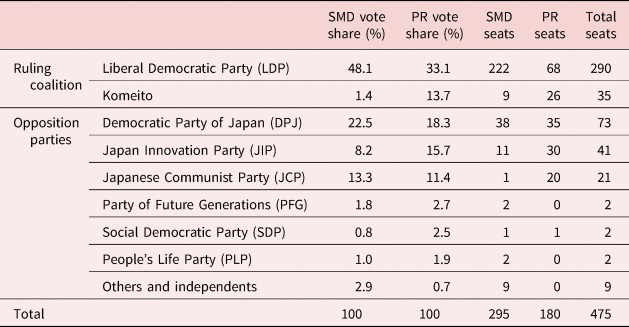
The survey data I used in this study is from the UTokyo-Asahi Survey (UTAS), a joint project of Masaki Taniguchi of the University of Tokyo and Asahi Shimbun, a national newspaper. Since I want to evaluate voters' opinions and behavior when there is a clearly identifiable main opposition party, I employed the survey conducted right after the 2014 general election.Footnote 8 The 2012 election is not an appropriate one for this study because the LDP was an opposition party going into the election. The 2017 and 2021 elections are not ideal because the largest opposition party, the DPJ, split into two right before the 2017 election, and thus the “main” opposition party has not been as clearly identifiable since then.Footnote 9 In contrast, the 2014 election took place when the political situation was more stable—the LDP being in power and the DPJ being the main opposition party. Table 1 shows the result of the 2014 election.
Results of the 2014 General Election

Data From: Ministry of Internal Affairs and Communications.
Since the focus of this study is on the factors that separate citizens on the left-wing side, the respondents who voted for ruling parties (the LDP and Komeito) and right-wing opposition parties were not included in the analysis. It is true that right-wing opposition parties (the Japan Innovation Party and the Party of Future Generations) also fragment the opposition camp, and why they receive support is a question that warrants more research, I will not address this question in this study.
The sample observations I analyzed were the respondents who voted for the DPJ, the JCP, the SDP, or the People's Life Party (PLP). Since each voter had two ballots for the two tiers of the election (SMD and PR), separate analyses were performed for each tier. The dependent variable takes the value of 1 if a respondent voted for the DPJ, the largest opposition (74 percent of the observations in the SMD tier voted for the DPJ, and 56 percent in the PR tier did so), and 0 otherwise. Among those who voted for a party other than the DPJ, a large majority voted for the JCP (92 percent in the SMD tier, and 79 percent in the PR tier).Footnote 10
The main independent variable is respondents' opinions toward a constitutional revision. Those who answered either “somewhat disagree” or “disagree” to the question “Do you agree or disagree with the statement ‘The Constitution should be amended’?” are coded as 1 in this “Anti-revision” variable, and 0 otherwise. The anti-revision people make up 29 percent of the total respondents. Among the opposition supporters that were used in this analysis, 60 percent are anti-revision.
Respondents' ideological positions need to be controlled because, naturally, Communist supporters are more left-wing than DPJ supporters. Since the survey does not include a simple left–right self-placement variable, I created two ideology variables—economic and social—and included them. The economic ideology variable is an additive index that combines the answers to the following two questions:
• “Smaller government that doesn't cost money is better, even if government services, such as social welfare, get worse.”
• “The corporate tax rate should be lowered.”
Respondents were asked to choose from five answers to each question. My index takes the value of 2 if a respondent answered either “somewhat disagree” or “disagree” to both questions. The index takes 1 if a respondent did so to either question, and 0 if neither. Thus, the higher the value of this variable is, the more left-wing economically the respondent is.
Similarly, the social ideology variable was created by combining the following two variables:
• “It is natural for privacy and individual rights to be restricted to protect public safety.”
• “The government should establish special programs to increase the number of women in higher positions and better jobs.”
Respondents who “somewhat disagree” or “disagree” with the former statement and those who “somewhat agree” or “agree” with the latter statement are considered socially left, and their answers are combined to create an index, which takes the value of 0, 1, and 2.
To control for demographic factors, a dummy variable of gender, two dummy variables of “Young” (39 or younger) and “Old” (60 or older), and a dummy variable of whether the respondent has a college degree are also included. Another demographic factor that should be controlled for is the degree of urbanization of respondents' residence. Unfortunately, it is not possible with the UTAS survey data to directly identify whether a respondent is an urban resident or a rural resident. As an alternative, I created and included a dummy variable that takes the value of 1 if the respondent resides in any of the prefectures of Tokyo, Osaka, and Kanagawa. These are the three most populous of Japan's 47 prefectures, and they also have the highest percentages of urban populations.Footnote 11
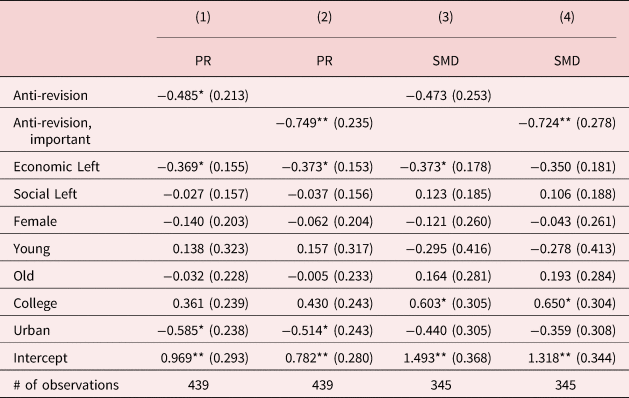
Table 2 shows the estimation results. Since the dependent variable is binary, the logit model was used. In Model (1), estimation results from the PR tier are shown. The main independent variable “Anti-revision” has a negative coefficient and is statistically significant, consistent with the expectation. In Model (2), the main independent variable is replaced by a variable called “Anti-revision, important.” This variable is similar to the “Anti-revision” variable, but this takes the value of 1 only if the respondents are anti-revision and also consider the issue of constitutional revision as important.Footnote 12 The result indicates that this variable is a stronger determinant of the respondents' vote choice than the “Anti-revision” variable in Model (1).
Logit estimation

Dependent variable: Respondent voted for the largest opposition or not.
Robust standard errors in parentheses.
** p < 0.01, * p < 0.05.
Models (3) and (4) are results from the SMD tier. Respondents who live in a district that did not have either a DPJ candidate or a JCP candidate were excluded from the sample as those districts are not comparable to the rest of the districts. While the “Anti-revision” variable in Model (3) is not statistically significant (p = 0.061), other results are quite similar to Models (1) and (2).
As for the two ideology variables I included to control for respondents' ideological leanings, the economic left variable consistently has a negative coefficient, as expected, and is significant in three of the four models. In contrast, the social left variable is not significant in any of the four models.
To evaluate the impact of the constitution variables substantively, I calculated predicted probabilities for the dependent variable while holding the control variables' values at their respective median levels (old, non-urban females with no college degree whose ideology scores are 1 for both). Based on Model (1), the chance of voting for the DPJ was 47.9 percent if that person is anti-revision and 59.9 percent if not, meaning that the opinions on the constitutional revision issue make a 12.0 percentage point difference in the probability of voting for the DPJ or not. In Models (2), (3), and (4), the estimated differences are 18.5, 9.0, and 15.1 percentage points, respectively. It is clear that the constitutional revision issue is a major factor that divides opposition supporters with respect to their vote choice.
Note that the aforementioned impacts of the constitutional revision issue on opposition fragmentation were estimated while controlling for voters' ideological positions. This means that, even while keeping their ideological leanings constant, the constitutional revision issue splits opposition supporters. As I discussed earlier, there are other suspected reasons for Japan's opposition fragmentation. Yet, my analysis demonstrates that a wedge issue is also a contributing factor that divides Japan's opposition.
Conclusion
The analysis presented in this article provides supportive evidence for the argument that citizens' varying opinions toward a constitutional revision are preventing Japan's opposition from converging into one main party. Opposition supporters may all agree that the LDP government should not stay in power. Yet, among them, those who strongly think that the constitution should not be revised have a tendency to vote for a minor opposition party such as the Communists. The constitutional revision issue has been a highly salient and contentious issue in post-World War II Japanese politics, and it is currently working as a wedge issue that fragments Japan's opposition.
Schattschneider (Reference Schattschneider1960, 67) observed that “the effort in all political struggles is to exploit cracks in the opposition while attempting to consolidate one's own side.” The dominant LDP has been electorally benefiting from the cracks in Japan's opposition camp. What is ironic is that the cracks may be sealed if the LDP can achieve its goal in the future. Since its foundation, the LDP has been advocating to revise Article 9 to make it explicit that the SDF is constitutional. Some small opposition parties like the Communists strongly oppose it, use this issue as a main campaign slogan, and win votes from anti-revision voters. Since more than 90 percent of Japanese citizens approve the existence of the SDF, if in the future the constitution is revised in the way that the SDF is clearly constitutional, there will unlikely be a major political movement to re-revise it to restore the original Article 9 (Maeda Reference Maeda and Alexander2018). Thus, a constitutional revision can end the debate on Article 9 or at least considerably reduce the issue's importance in politics. That would mean that the wedge in Japan's opposition may disappear, allowing a large, unified opposition party to emerge and diminishing the electoral advantage the LDP has long been enjoying. The LDP's quest to revise the constitution may be a self-destructive policy seeking.
Alternatively, could it be the case that the LDP intentionally mentions the constitution issue and raises its salience, trying to divide the opposition camp? Of course, there should be various opinions within the party. While many of its legislators must be genuinely advocating their true policy goals, some members may well realize that the cracks in the opposition are helping them, and the LDP is best served by maintaining the status quo. After all, a party whose signature policy fragments the opposition is in an advantageous position. It is rational for the party to try to preserve the advantage. For the LDP, arguing for a constitutional revision but not achieving it may be the best scenario electorally.
Academic research on the strategic use of wedge issues has been mostly focused on the US context and has only recently been extended to non-American settings (van de Wardt, De Vries, and Hobolt Reference Van de Wardt, De Vries and Hobolt2014). In the German and British cases mentioned earlier in this paper, it was the ruling parties that lost votes due to the immigration/refugee issue. In contrast, the case this paper illustrated is a situation where a ruling party's agenda is driving a wedge in opposition supporters and parties. There may be more instances in other democracies where a ruling party intentionally employs a wedge issue to cause opposition fragmentation. Further investigation on this topic will greatly advance our understanding of democratic party competition.
Funding details
Earlier versions of this study were presented at the 2022 Midwest Political Science Association and the 2022 American Political Science Association conferences. The author wishes to thank the panel participants for comments. This research received no specific grant from any funding agency in the public, commercial, or not-for-profit sectors.
Competing interests
The author declares none.