Introduction
In recent years, goosegrass [Eleusine indica (L.) Gaertn.] control in hybrid bermudagrass [Cynodon dactylon (L.) Pers. × Cynodon transvaalensis Burtt Davy] has become more difficult due to the decline in effective herbicide options caused by increases in herbicide-resistant populations (e.g., prodiamine and oxadiazon), loss of herbicides (e.g., diclofop), and increased use restrictions (e.g., monosodium acid methanearsonate) (Breeden et al. Reference Breeden, Brosnan, Breeden, Vargas, Eichberger, Tresch and Laforest2017; Keigwin Reference Keigwin2013; McCullough Reference McCullough2014; McCullough et al. Reference McCullough, Yu and Barreda2013; McElroy et al. Reference McElroy, Head, Wehtje and Spak2017). In response to reduced control options, turfgrass managers have begun to rely on more expensive herbicide options, such as foramsulfuron-containing products, or more injurious options, such as metribuzin and topramezone (Brewer et al. Reference Brewer, Willis, Rana and Askew2016; Busey Reference Busey2004; Cox et al. Reference Cox, Rana, Brewer and Askew2017; Elmore et al. Reference Elmore, Brosnan, Kopsell, Breeden and Mueller2011; Johnson Reference Johnson1980; McCullough et al. Reference McCullough, Barreda and Raymer2012). Foramsulfuron can effectively control less than 3-tiller E. indica when applied sequentially at or above 44 g ai ha−1, but control declines as E. indica matures (Busey Reference Busey2004; McCullough et al. Reference McCullough, Barreda and Raymer2012). Metribuzin can more economically control mature E. indica compared with foramsulfuron, but metribuzin rates must be greater than 210 g ai ha−1 (Busey Reference Busey2004; Johnson Reference Johnson1980; Kerr et al. Reference Kerr, McCarty, Cutulle, Bridges and Saski2019b). Researchers have observed that these rates of metribuzin injured bermudagrass unacceptably (Busey Reference Busey2004; Johnson Reference Johnson1980; Kerr et al. Reference Kerr, McCarty, Brown, Harris and McElroy2019a, Reference Kerr, McCarty, Cutulle, Bridges and Saski2019b).
Topramezone, a 4-hydroxyphenylpyruvate dioxygenase (HPPD) inhibitor, has recently been labeled for use in bermudagrass for E. indica control at rates between 12.3 and 18.4 g ae ha−1 (Anonymous 2018; Senseman Reference Senseman2007). These rates are two to three times lower than most cool-season turfgrass rates due to bermudagrass sensitivity to topramezone (Anonymous 2018; Brewer et al. Reference Brewer, Willis, Rana and Askew2016; Cox et al. Reference Cox, Rana, Brewer and Askew2017; Kerr et al. Reference Kerr, McCarty, Brown, Harris and McElroy2019a, Reference Kerr, McCarty, Cutulle, Bridges and Saski2019b). In fact, bermudagrass has been injured unacceptably from topramezone at rates as low as 6.1 g ae ha−1 (Cox et al. Reference Cox, Rana, Brewer and Askew2017). Multiple researchers have evaluated topramezone admixtures with fertility products and other herbicides to reduce the bleaching symptoms to an acceptable level. Cox et al. (Reference Cox, Rana, Brewer and Askew2017) observed that triclopyr effectively reduced the bleaching symptoms caused by topramezone, but increased bermudagrass necrosis, stunting, and injury duration in comparison to topramezone applied alone. Boyd et al. (Reference Boyd, McElroy, Han and Guertal2021a, Reference Boyd, McElroy, McCurdy and McCullough2021b) observed similar results with triclopyr and noted that chelated iron could also reduce the bermudagrass bleaching caused by topramezone. Additionally, carfentrazone + 2,4-D + mecoprop + dicamba (Speedzone®, PBI Gordon, 22701 W 68th Terrace, Shawnee, KS 66226, USA) has also been observed to significantly reduce topramezone-induced bermudagrass injury when applied as an admixture (Carroll et al. Reference Carroll, Brosnan and Breeden2021).
Immediate posttreatment irrigation is another strategy that has recently been employed to reduce bermudagrass injury from multiple herbicides, including metribuzin and topramezone. Kerr et al. (Reference Kerr, McCarty, Brown, Harris and McElroy2019a) observed that immediate posttreatment irrigation significantly reduced bermudagrass injury caused by metribuzin applied at 420 g ai ha−1 from 35% to 6% at 1 wk after treatment (WAT), but bermudagrass injury from topramezone was not reduced by irrigation in this study. In another study, topramezone applied at 12.3 g ha−1, metribuzin applied at 420 g ha−1, and the combination of topramezone plus metribuzin injured bermudagrass and controlled mature E. indica significantly less when immediate irrigation was applied (Kerr et al. Reference Kerr, McCarty, Cutulle, Bridges and Saski2019b). The concept of posttreatment irrigation has merit based on some examples of reduced bermudagrass discoloration and conserved control of seedling E. indica (Kerr et al. Reference Kerr, McCarty, Cutulle, Bridges and Saski2019b).
Previous research in Virginia refined the herbicide rates of topramezone plus metribuzin admixture to maximize safety while conserving mature E. indica control (Brewer et al. Reference Brewer, Askew and Askew2021). Performance of this combination was documented at 21 Virginia locations. Adding posttreatment irrigation could further reduce bermudagrass injury based on earlier reports. However, only immediate irrigation was previously tested (Kerr et al. Reference Kerr, McCarty, Brown, Harris and McElroy2019a, Reference Kerr, McCarty, Cutulle, Bridges and Saski2019b), and this method is not only impractical but impossible to implement using conventional turfgrass equipment and irrigation practices. According to the Golf Course Superintendents Association of America, the 18 fairways on an average golf course comprise 12 ha or 24% of the course (GCSAA 2017). By simply dividing total fairway hectarage by 18 holes per course, an average golf fairway of 0.7 ha is equivalent to that of the typical athletic field (STMA 2018). Assuming a 0.7-ha golf fairway or athletic field, a turfgrass sprayer with a 5.5-m-wide boom traveling at 6.5 km h−1 would require at least 12 min to treat without turnaround time. Thus, the earliest practical irrigation timing for most situations would be 15 min after treatment initiation or longer depending on size of the area treated. Elucidating how irrigation will affect plant response is further confounded by possible differences between topramezone and metribuzin regarding foliar versus root absorption. Neither herbicide has been evaluated for differential bermudagrass or E. indica response based on placement to soil versus foliage.
Because immediate irrigation following topramezone yielded varying results in previous trials (Kerr et al. Reference Kerr, McCarty, Brown, Harris and McElroy2019a, Reference Kerr, McCarty, Cutulle, Bridges and Saski2019b), we hypothesized that posttreatment irrigation 15 or 30 min after treatment would not reduce bermudagrass injury equivalent to immediate irrigation. Our objectives were (1) to determine how immediate posttreatment irrigation compares with more practical irrigation timings of 15 and 30 min after treatment or no posttreatment irrigation for bermudagrass and E. indica response; and (2) to elucidate possible mechanisms that govern posttreatment irrigation impacts on bermudagrass and E. indica response to either topramezone, metribuzin, or the combination of the two when treatments were applied to soil, foliage, or soil plus foliage.
Materials and Methods
Field Assessment of Posttreatment Irrigation Timings
Four field trials were conducted as duplicate sites of a randomized complete block experiment with four replications per trial to assess bermudagrass tolerance and E. indica control in response to herbicides followed by irrigation at varying intervals after treatment. The treatments were arranged in a factorial design with two herbicides and four irrigation timings (none, immediate, and 15 and 30 min after herbicide treatment). Herbicide treatments included topramezone (Pylex®, BASF, 26 Davis Drive, Research Triangle Park, NC 27709, USA) at 12.3 g ha−1 alone and topramezone at 6.1 g ha−1 plus metribuzin (Sencor®, Bayer Environmental Science, a Division of Bayer Crop Science, 5000 CentreGreen Way, Suite 400, Cary, NC 27513, USA) at 210 g ha−1, each applied with 0.5% v/v of methylated vegetable oil (MVO) (Dyne-Amic®, Helena Chemical, 225 Schilling Boulevard, Suite 300, Collierville, TN 38017, USA). A nontreated check was included for comparison. Herbicides were applied using a CO2-pressurized boom sprayer calibrated to deliver 374 L ha−1 at 289 kPa via four 11006 TTI nozzles (TeeJet®, Spraying Systems, Glendale Heights, IL 62703), which covered a 1.83-m swath. At all irrigation timings, plots received 0.25 cm of irrigation that occurred over a 2-min period from a circular syringing hose-end nozzle. During the first study, irrigation was applied in one direction (i.e., left to right), while in the second study, irrigation was applied in two directions (i.e., left to right and front to back).
The two bermudagrass tolerance trials were initiated at the Glade Road Research Facility (GRF) (37.23°N, 80.44°W) on the main campus of Virginia Tech in Blacksburg, VA, on August 16, 2018 (GRF-18), and August 26, 2019 (GRF-19), on a ‘Latitude 36’ bermudagrass research fairway, which was mowed at 1.8 cm. Additionally, nitrogen was supplied at 37 kg N ha−1 every 2 wk. One week before each trial, a fungicide containing fluxapyroxad plus pyraclostrobin (Lexicon®, BASF) was applied to help maintain turfgrass health and quality. Supplemental irrigation was supplied during all trials to maintain active turfgrass and weed growth. Soil was a Groseclose-Urban land complex loam (clayey, mixed, mesic Typic Hapludults) with a pH of 6.1 and 3.6% organic matter. The two E. indica control trials were initiated at the Turfgrass Research Center (TRC) (37.22°N, 80.41°W) in Blacksburg, VA, on August 16, 2018 (TRC-18), and August 28, 2019 (TRC-19), on a bermudagrass research fairway heavily infested with E. indica. Soil was a Groseclose-Urban land complex loam (clayey, mixed, mesic Typic Hapludults) with a pH of 6.1 and 2.9% organic matter. Both trials were maintained at 3.8 cm. The E. indica was between the 15- to 25-tiller growth stage at initiation of both trials. Plot sizes for the field sites were 1.83 m by 1.8 m in 2018 and 1.8 m by 3.6 m in 2019.
Data were assessed at 0, 5, 7, 14, 21, 28, 42, and 56 d after treatment (DAT). Normalized difference vegetation index (NDVI) data were collected using a multispectral analyzer (Crop Circle™ model ACS-210, Holland Scientific, 6001 South 58th Street, Lincoln, NE 68516, USA) that scanned the center 0.45 m by 1.8 to 3.6 m of each plot and collected 40 ± 2 readings m−2. Plot images were digitally assessed for green turfgrass cover at 5, 7, and 14 DAT using Field Analyzer (Turf Analyzer, 2958 S Country Club Dr, Fayetteville, AR 72701, USA) with selected settings of low hue from 75 to 85, high hue at 360, low saturation from 25 to 29, high saturation at 100, low brightness at 0, and high brightness from 65 to 71. Before green cover was assessed, a grid was selected with an X-offset of 20 and Y-offset of 20 to reduce any variable edge effect. Eleusine indica plant counts were made at 56 DAT by counting the total number of plants per plot and converting to plants per square meter. Bermudagrass injury, bermudagrass white discoloration, and E. indica control were visually assessed on a 0% to 100% scale (Frans et al. Reference Frans, Talbert, Marx and Crowley1986) at all rating dates. To account for repeated measures over time, bermudagrass injury data were expressed as the maximum observed injury and white discoloration at any evaluation date and the number of days over an injury threshold of 30% (DOT30). These injury DOT30 values were calculated assuming linear trends in changes to bermudagrass injury between assessment dates. Bermudagrass white discoloration days over a threshold of 10% (DOT10) were also calculated. Days over threshold values, having been reported in other studies (Cox et al. Reference Cox, Rana, Brewer and Askew2017), reflect temporal trends in objectionable turfgrass injury that are an important component to managing turfgrass aesthetics over time. The minimum value for turfgrass NDVI and green cover were also recorded for each experimental unit as the minimum observed value at any assessment date.
These responses were subjected to ANOVA with sums of squares partitioned to reflect replicate, trial, herbicide treatment, irrigation timing, herbicide by irrigation timing, and all interactions of these effects or interactions with trial. Trial was considered a random variable in the combined analysis and mean squares of fixed effects or interactions were tested by the mean square of each effect’s interaction with trial (McIntosh Reference McIntosh1983). Appropriate means were separated with Fisher’s protected LSD test at P ≤ 0.05. If trial interactions were significant, data were presented separately by trial; otherwise, data were pooled. In the case of NDVI and turfgrass green cover, data from the nontreated check were compared with each level of significant effects or interactions via single degree of freedom tests.
Influence of Herbicide Placement on Bermudagrass and Eleusine indica Response
A greenhouse experiment was initiated on October 19, 2020 (GH-1), and October 23, 2020 (GH-2), in a Quonset-style greenhouse at GRF. Both trials were established as a randomized complete block design (RCBD) with four replications and a two by four by three factorial treatment design, which includes two plant species (bermudagrass and E. indica), four herbicide treatments, and three application placements. The herbicide treatments include a nontreated check, topramezone applied at 6.1 g ha−1, metribuzin applied at 210 g ha−1, and topramezone plus metribuzin. All treatments were applied with MVO at 0.5% v/v. Both trials were sprayed using a CO2-pressurized spray chamber calibrated to deliver 374 L ha−1 at 289 kPa and fit with a single TeeJet® 8002 even flat-fan nozzle.
All herbicide treatments were applied to foliage only, soil only, and soil plus foliage. Foliage-only treatments were administered by inserting cotton balls to completely cover exposed soil around plants in each pot. These cotton balls were removed and discarded approximately 1 h after treatment. After 2 d, foliage only–treated pots were turned on their sides, and the foliage was rinsed with a garden hose–fitted spray wand for 5 s to remove any unabsorbed herbicide from leaves without allowing exposure to underlying soil. Soil-only treatments were administered by carefully wrapping all foliage with aluminum foil and constricting the foil to minimize surface area before pots were sprayed. Soil plus foliage treatments were sprayed over the top of pots with no modifications.
The two greenhouse trials were established by removing sod from a ‘PremierPRO’ brand bermudagrass research fairway. All soil from the root system of the harvested sod was removed, and then 2 to 3 cm plugs were planted into 10.2-cm pots in a soil and sand mix (2:1 by weight). The soil used was a Groseclose-Urban land complex loam (clayey, mixed, mesic Typic Hapludults) with a pH of 6.0 and 3.1% organic matter. Eleusine indica seed were sown into a flat containing straight sand. When seedlings reached the 2- to 3-leaf stage, they were transplanted into the same pots and soil plus sand mix as described for bermudagrass. These plants were allowed to mature to the 4- to 7-tiller stage before herbicides were applied. Nitrogen was supplied once per week at 25 kg N ha−1 to maintain proper plant growth. Automated irrigation was supplied twice per day (approximately 0.6 cm d−1) to maintain active bermudagrass and E. indica growth. The greenhouse had supplemental lighting that was set at a 14-h daylength. The first study used sodium halide lights with 650 µmol m−2 s−1 output of photosynthetically active radiation while the second study used mercury vapor lamps with 430 µmol m−2 s−1 output of photosynthetically active radiation. The greenhouse was maintained at 26/24 C day/night temperature.
Data were collected at 0, 3, 5, 7, 10, 14, and 21 DAT and included visually assessed bermudagrass injury/bleaching and E. indica control/bleaching, E. indica tiller counts, and NDVI. All visual data were assessed as in the field trials. NDVI was assessed regularly as a measure of plant health using a Spectral Evolution PSR-1100 hyperspectral radiometer (Spectral Evolution, 26 Parkridge Road, Suite 104, Haverhill, MA 01835, USA) with leaf-clip attachment. Bermudagrass and E. indica were mowed every 3 d with clippings collected to evaluate differences in cumulative clipping yield. Final foliar biomass for both species was also collected at the conclusion of each study. The clippings and final biomass were dried at 50 C for 72 h in a chromatography oven and weighed. Data were subjected to ANOVA with sums of squares partitioned to reflect the two by four by three factorial treatment design and trial effects previously described. Mean separation procedures were the same as in the field study.
Results and Discussion
Field Assessment of Posttreatment Irrigation Timings
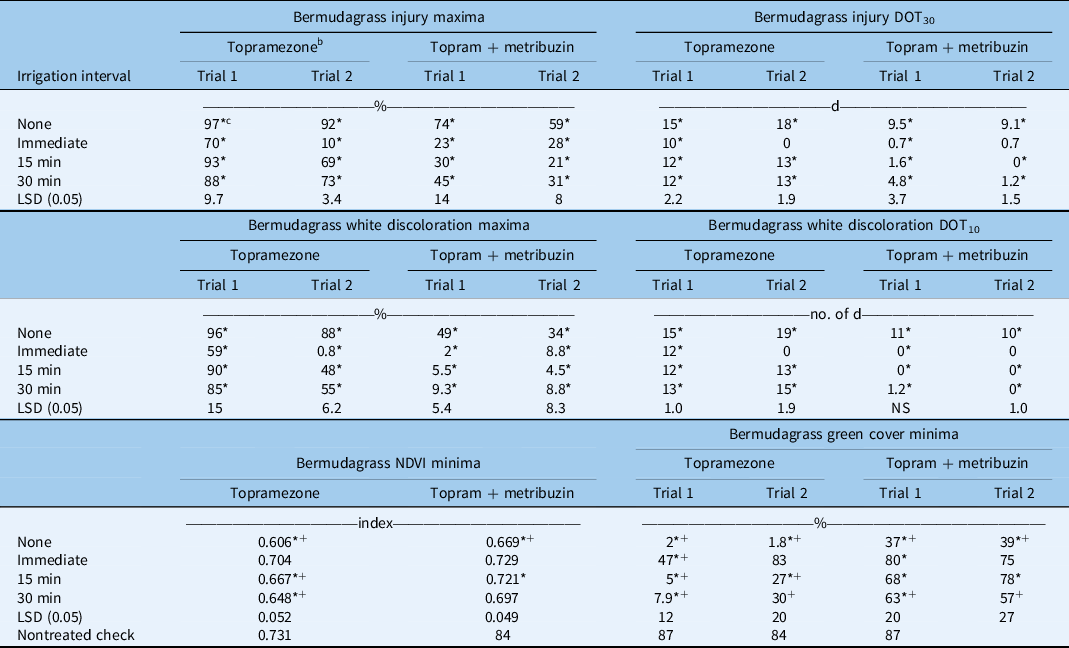
The trial by irrigation by herbicide interaction was significant (P ≤ 0.0138) for bermudagrass injury maxima, bermudagrass injury DOT30, white discoloration maxima, white discoloration DOT10, and bermudagrass green cover minima (Table 1). This interaction was mainly caused by variable response of bermudagrass to topramezone alone at the immediate and 15-min after treatment irrigation timings. In the first trial, irrigation had generally less effect on bermudagrass response to topramezone than in the second trial. We feel that inconsistencies in watering techniques between the two trials may be responsible for these differences. In the first trial, patterns of white discoloration were apparent and indicative of nonuniform irrigation distribution. In the second trial, the hose wand was waved side to side and front to back compared with a unidirectional pattern in the first trial. There have only been two studies that evaluated immediate posttreatment irrigation following topramezone application to bermudagrass. Immediate posttreatment irrigation did not influence bermudagrass injury in one study (Kerr et al. Reference Kerr, McCarty, Brown, Harris and McElroy2019a) and reduced bermudagrass injury from 53% without irrigation to 11% with irrigation in another study (Kerr et al. Reference Kerr, McCarty, Cutulle, Bridges and Saski2019b). The inconsistencies between previous reports and in the current study between trials brings reliability of posttreatment irrigation for improving bermudagrass tolerance to topramezone into question. Despite the inconsistencies between trials for immediate and 15-min posttreatment irrigation, other irrigation treatments and trends in bermudagrass response between topramezone alone and topramezone plus metribuzin were consistent (Table 1).
Influence of herbicide treatments and irrigation intervals on bermudagrass injury and white discoloration maxima, days over a 30% bermudagrass injury threshold (DOT30), and days over a 10% bermudagrass white discoloration threshold (DOT10), minimum turfgrass normalized difference vegetation index (NDVI), and bermudagrass green cover minima. a

a Abbreviation: Topram, topramezone.
b Topramezone alone applied at 12.3 g ae ha−1; topramezone + metribuzin applied at 6.13 g ha−1 + 210 g ai ha−1.
c Indicates difference between the two herbicide treatments; + Indicates difference from nontreated check.
Maximum bermudagrass injury following low-dose topramezone plus metribuzin was always less than that of high-dose topramezone alone, except for topramezone followed by immediate irrigation in Trial 2 (Table 1). At this time, only one peer-reviewed article has evaluated topramezone at the low dose of 6.1 g ha−1 plus metribuzin at 210 g ha−1, but the researchers did not evaluate posttreatment irrigation. During that study, bermudagrass was injured 74% and similar to the results in the present study (Brewer et al. Reference Brewer, Askew and Askew2021). Lindsey et al. (Reference Lindsey, DeFrank and Cheng2019, Reference Lindsey, DeFrank and Cheng2020) observed that topramezone applied at 10 g ha−1 plus metribuzin applied at 90 or 100 g ha−1 injured bermudagrass 84% and 79%, respectively, which is more than the maximum injury by topramezone plus metribuzin with no irrigation in our study. Kerr et al. (Reference Kerr, McCarty, Cutulle, Bridges and Saski2019b) and Cox et al. (Reference Cox, Rana, Brewer and Askew2017) observed substantial injury to bermudagrass following treatment of topramezone at 12.3 g ha−1 without posttreatment irrigation, similar to the current study.
The 15-min and 30-min irrigation intervals for topramezone did not reduce maximum injury in Trial 1 and slightly reduced maximum injury in Trial 2 (Table 1). These later irrigation timings did not reduce bermudagrass injury nearly as much as immediate irrigation, thus supporting our hypothesis. However, we did not expect that the more practical 15- and 30-min posttreatment irrigation timings would reduce maximum bermudagrass injury by the low-dose topramezone plus metribuzin treatment (Table 1). For the low-dose topramezone plus metribuzin treatment, the immediate, 15-min, and 30-min irrigation intervals reduced bermudagrass injury near or below the 30% acceptable threshold in all but one case in Trial 1 (Table1).
Bermudagrass injury DOT30 was reduced much more by low-dose topramezone plus metribuzin than by any posttreatment irrigation practice with topramezone alone, except that of immediate irrigation in Trial 2 (Table 1). Topramezone at 12.3 g ha−1 alone caused above-threshold injury levels for at least 10 d regardless of irrigation program, except for immediate irrigation in Trial 2. Similar to the current studies, Cox et al. (Reference Cox, Rana, Brewer and Askew2017) observed that topramezone applied once at 6.1 or 12.3 g ha−1 caused 11 to 16 d of injury over a 30% injury threshold. In contrast to high-dose topramezone alone, low-dose topramezone plus metribuzin combined with any posttreatment irrigation timing reduced bermudagrass DOT30 to 4.8 d or less. The reduced DOT30 when posttreatment irrigation was added following topramezone plus metribuzin is encouraging, assuming these programs will still control E. indica.
The white discoloration maxima followed trends similar to bermudagrass injury maxima, albeit with greater reductions caused by adding metribuzin to low-dose topramezone (Table 1). Posttreatment irrigation only reduced bermudagrass white discoloration below 10% in one of six cases for high-dose topramezone alone and five of six cases for low-dose topramezone plus metribuzin. These white discoloration maxima values trend well with white discoloration DOT10. The more practical irrigation times of 15 and 30 min after high-dose topramezone treatment still caused bermudagrass white discoloration above 10% for 12 to 15 d compared with 0 to 1.2 d when these later irrigation timings were applied following low-dose topramezone plus metribuzin. The white discoloration DOT10 caused by high-dose topramezone in these trials is similar to observations made by Cox et al. (Reference Cox, Rana, Brewer and Askew2017).
The interaction of irrigation timing and herbicide was significant (P = 0.0439) for bermudagrass NDVI minima and not dependent on trial (P > 0.05). Thus, data were pooled over the two trial sites for presentation in Table 1. The nontreated turfgrass had a minimum NDVI of 0.731, which was equivalent to high-dose topramezone followed by immediate irrigation and low-dose topramezone plus metribuzin followed by any timing of irrigation. Non-irrigated turfgrass following any herbicide and 15- or 30-min posttreatment irrigation following high-dose topramezone had significantly lower NDVI compared with the nontreated check (Table 1). These trends in NDVI align well with other bermudagrass response variables, albeit with smaller magnitude differences between treatment effects. This smaller magnitude change compared with visual ratings suggests that the multispectral analyzer either detects green turfgrass that may reside underneath white foliage or detects higher infrared reflection, which is normalized in the equation. Otherwise, it is hard to reconcile such high levels of visual phytotoxicity yielding such small differences in NDVI. Research evaluating aerial versus ground-based NDVI assessments compared with visually estimated turfgrass chlorosis revealed examples where turfgrass chlorosis was similar between herbicides of different modes of action, leading to widely variable NDVI values, suggesting that NDVI may not correctly estimate turfgrass health equivalently across all types of stress (Zhang et al. Reference Zhang, Simerjeet, Porter, Kenworthy, Sullivan and Schwartz2019).
Digitally assessed bermudagrass green cover minima mirrored trends in bermudagrass injury maxima (Table 1). These data speak to the accuracy of visually estimated data in these studies, as both injury maxima and green cover minima are based on multiple assessments made over 8 wk and represent a near-perfect negative correlation based on regression of means in Table 1. Green cover was conserved compared with nontreated turfgrass in only one instance when immediate irrigation followed high-dose topramezone in Trial 2 and in all instances when immediate or 15-min posttreatment irrigation followed low-dose topramezone plus metribuzin.
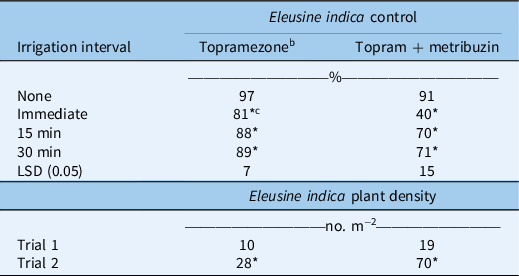
The interaction of irrigation timing by herbicide was significant for E. indica control at 56 DAT (P = 0.0404) and not dependent on trial (P > 0.05). When posttreatment irrigation was not applied, high-dose topramezone and low-dose topramezone plus metribuzin controlled E. indica greater than 90% and equivalently (Table 2). In previous studies, similar results were observed for E. indica control when topramezone at 12.3 g ha−1 or topramezone (Cox et al. Reference Cox, Rana, Brewer and Askew2017) at 6.1 g ha−1 plus metribuzin at 210 g ha−1 (Brewer et al. Reference Brewer, Askew and Askew2021) were applied twice at 3-wk intervals, but Kerr et al. (Reference Kerr, McCarty, Cutulle, Bridges and Saski2019b) only observed 66% E. indica control when topramezone was applied once at 12.3 g ha−1. Unfortunately, a substantial decrease in E. indica control resulted from all posttreatment irrigation timings (Table 2), and this effect worsened with irrigation timings that were more effective at reducing bermudagrass injury responses (Table 1). For example, E. indica control was reduced by 51% and 16% when immediate posttreatment irrigation was applied following low-dose topramezone plus metribuzin or high-dose topramezone, respectively. Kerr et al. (Reference Kerr, McCarty, Cutulle, Bridges and Saski2019b) observed that the addition of posttreatment irrigation to topramezone at 12.3 g ha−1 reduced E. indica control by 46%, which is 30% more than in our study. The interaction of trial by herbicide was significant (P = 0.0222) for final E. indica plant counts. When averaged over all irrigation levels, the herbicides resulted in equivalent E. indica plant densities in Trial 1 and lower plant densities in response to high-dose topramezone applied alone in Trial 2 (Table 2).
Influence of herbicide, irrigation, and trial on Eleusine indica control and plant count per square meter at 56 d after treatment. a

a Abbreviation: Topram, topramezone.
b Topramezone alone applied at 12.3 g ae ha−1; topramezone + metribuzin applied at 6.13 g ha−1.
c *Indicates difference between the two herbicide treatments.
Influence of Herbicide Placement on Bermudagrass and Eleusine indica Response
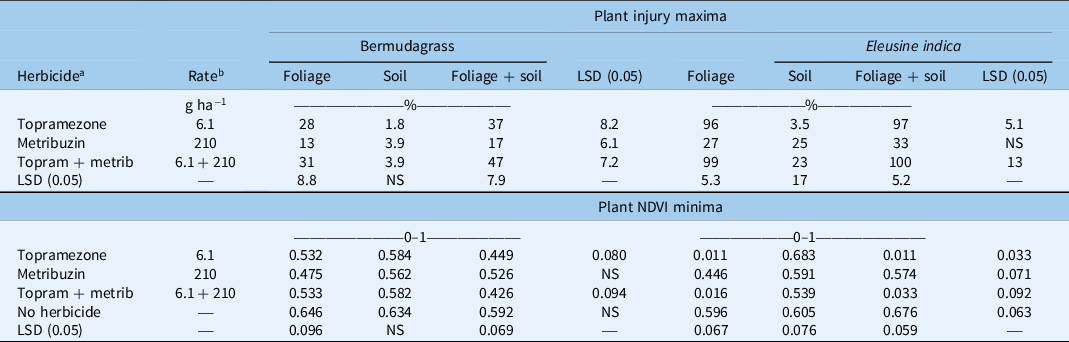
The interaction of plant species by herbicide by placement was significant (P ≤ 0.05) for plant injury maxima and plant NDVI minima, and no effect was dependent on trial (P > 0.05). Bermudagrass was injured 37% to 47% and more than other treatments when either high-dose topramezone or low-dose topramezone plus metribuzin were applied to soil plus foliage (Table 3). Foliar-only application of these two herbicides was considerably more injurious than soil application, but 10% less injurious than soil plus foliar applications. Metribuzin did not injure bermudagrass more than 17%, and soil-only applications of any herbicide did not injure bermudagrass more than 3.9%. Similar trends were noted for E. indica injury, in that foliar-only or soil plus foliar applications injured E. indica 96% to 100%. Soil-only applications of topramezone injured E. indica no more than 3.5%, with injury rising to 23% with the addition of metribuzin (Table 3). These data suggest that topramezone is responsible for most of the plant response from the topramezone plus metribuzin combination and that topramezone is highly dependent on foliar absorption. Previous research had similar trends, with topramezone being readily absorbed by shoots, but also by roots when grown through hydroponics (Grossman and Ehrhardt Reference Grossman and Ehrhardt2007). Research has shown that when applied directly to soil, topramezone may only be confined to the top layer, reducing the amount of potential root absorption (Shaner 2014), thus the low topramezone rate present in the soil after application may have limited effect on bermudagrass and E. indica (Begitschke et al. Reference Begitschke, McCurdy, Philley, Baldwin, Stewart, Richard and Kalmowitz2017; Brewer et al. Reference Brewer, Askew and Askew2021). However, the soil-only contribution of metribuzin is not insubstantial. Plant NDVI minima support plant injury data, as foliar and soil plus foliar applications to either plant species significantly reduced NDVI compared with nontreated plants, while soil-only applications to bermudagrass did not influence NDVI (Table 3). Eleusine indica NDVI values were also similar to E. indica injury trends.
Influence of herbicide and placement on bermudagrass and Eleusine indica injury maxima and normalized difference vegetation index (NDVI) minima.

a Abbreviations: Topram, topramezone; metrib, metribuzin.
b Rates given as acid equivalency for topramezone and active ingredient for metribuzin.
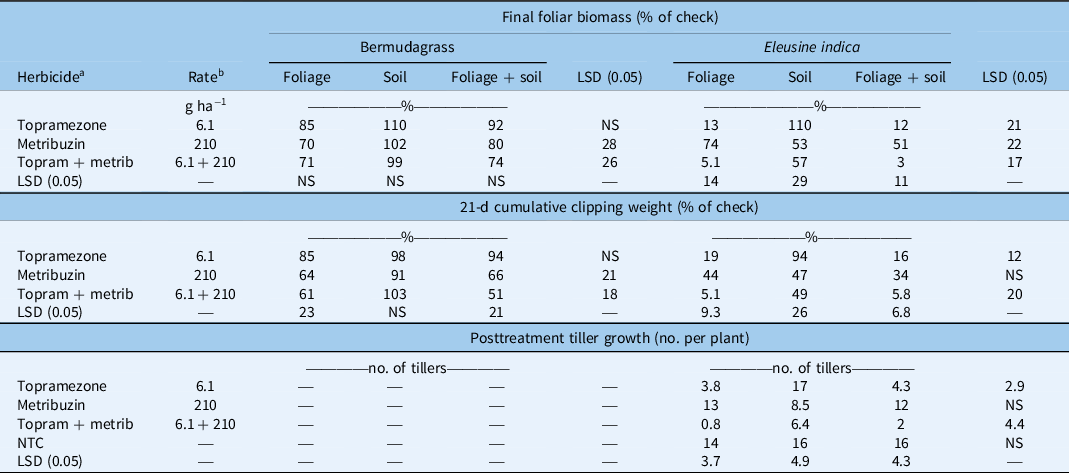
The interaction of plant species by herbicide by placement was significant (P < 0.05) for percentage of nontreated plant biomass, percentage of nontreated 21-d cumulative clipping dry weight, and posttreatment E. indica tiller growth, and these effects were not dependent on trial. Final foliar biomass was equivalent for all herbicides within each application placement (Table 4). Eleusine indica biomass was reduced to no more than 13% of the nontreated plants when topramezone-containing treatments were applied to foliage or foliage plus soil. Soil application of metribuzin reduced E. indica biomass about 50%. These data suggest that the topramezone plus metribuzin combination affects E. indica control through alternate routes of uptake depending on herbicide. Topramezone appears more dependent on foliar uptake, while metribuzin is more active via uptake from the soil. During previous research, topramezone was found to be phloem-mobile and more readily absorbed by roots and shoots but may lack substantial root absorption when applied to soil (Begitschke et al. Reference Begitschke, McCurdy, Philley, Baldwin, Stewart, Richard and Kalmowitz2017; Grossman and Ehrhardt Reference Grossman and Ehrhardt2007), while metribuzin was found to be xylem-mobile and more readily absorbed by roots than shoots (Gawronski et al. Reference Gawronski, Haderlie and Stark1986; Shaner 2014).
Influence of herbicide and placement on bermudagrass and Eleusine indica final foliar biomass, cumulative clipping weight, and posttreatment tiller growth.

a Abbreviations: Topram, topramezone; metrib, metribuzin; NTC, nontreated check.
b Rates given as acid equivalency for topramezone and active ingredient for metribuzin.
Bermudagrass cumulative clipping dry weight was 85% of that produced by nontreated plants when treated with topramezone foliar only and 61 to 64% of the nontreated when treated with metribuzin (Table 4). A similar trend was evident when these herbicides were applied to soil plus foliage. This observation may partially explain how metribuzin reduces white discoloration when included as an admixture with topramezone. Goddard et al. (Reference Goddard, Willis and Askew2010) showed that white-discolored leaves of tall fescue [Schedonorus arundinaceus (Schreb.) Dumort.] and several weeds were limited to new leaves that were produced after mesotrione, a related HPPD-inhibiting herbicide, was applied. If metribuzin causes a transient reduction in leaf growth, as the 21-d cumulative clipping weight suggests (Table 4), then white discoloration would be reduced, because new leaves are not growing. The trends in 21-d cumulative clipping weight of E. indica are similar to those of foliar biomass with respect to herbicide and placement (Table 4).
During the 21 d following treatment, nontreated plants added 14 to 16 additional tillers, equivalent to plants in the topramezone applied only to soil treatment. The addition of metribuzin reduces tiller count when added to topramezone (Table 4), and this trend further supports the reductions in cumulative clipping weight caused by metribuzin (Table 4). Following topramezone treatment, E. indica continues to grow for the first few weeks, while adding metribuzin helps reduce this growth. The impact of metribuzin may partially contribute to E. indica control in field settings through competitive exclusion of E. indica by actively growing bermudagrass.
Results of these studies suggest that posttreatment irrigation likely reduces bermudagrass response by rinsing topramezone from plant leaves and effectively reducing the herbicide rate. Inconsistencies in E. indica control may occur if irrigation occurs rapidly enough to prevent a lethal dose from being absorbed into the foliage. Topramezone absorbs more rapidly into E. indica than bermudagrass, and metribuzin decreases absorption rate by both species (Brewer et al. Reference Brewer, Askew and Askew2021). The reduced absorption caused by metribuzin admixture (Brewer et al. Reference Brewer, Askew and Askew2021) and dependence on foliar uptake by topramezone to reduce E. indica biomass (Table 4) explain why E. indica control was more severely reduced when posttreatment irrigation followed the mixture (Table 2). Metribuzin reduces leaf and tiller production of affected species in the first 21 DAT, which likely contributes to the substantial decrease in white foliar discoloration when admixtures of metribuzin are added to topramezone compared with topramezone alone.
The dramatic improvement in bermudagrass safety when 15-min posttreatment irrigation followed low-dose topramezone plus metribuzin and concomitant 70% mature E. indica control from this treatment is encouraging. The irrigation reduced E. indica control from 91% to 70%, but this limitation could possibly be overcome by including a sequential treatment of the program at a 3-wk interval. Other studies have shown that sequential topramezone treatments can improve weed control compared with single treatments (Cox et al. Reference Cox, Rana, Brewer and Askew2017; Elmore et al. Reference Elmore, Brosnan, Kopsell, Breeden and Mueller2011; Kerr et al. Reference Kerr, McCarty, Cutulle, Bridges and Saski2019b). Immediate irrigation may be too impactful on E. indica control and is impossible to implement using current sprayer and irrigation technology in the turfgrass industry. One limitation to both the present and past studies (Kerr et al. Reference Kerr, McCarty, Brown, Harris and McElroy2019a, Reference Kerr, McCarty, Cutulle, Bridges and Saski2019b) is that irrigation applied to small plots with a hose-end wand mimics syringing rather than turfgrass irrigation system applications. Future work should evaluate topramezone plus metribuzin programs on in-use turfgrass facilities to determine whether practical posttreatment irrigation regimes will respond similarly to the current study and whether such treatment plus irrigation programs can effectively control mature E. indica with sequential treatments.
Acknowledgments
The authors would like to thank Caitlin Swecker, Natalie Stone, Connor Waters, Heather Titanich, and Jon Dickerson for aiding in trial establishment, data collection, and site maintenance. This research received no specific grant from any funding agency or the commercial or not-for-profit sectors. No conflicts of interest have been declared.