Coronary artery bypass is increasingly used as a revascularisation procedure to treat paediatric coronary artery problems. In patients with transposition of great arteries, coronary hypoperfusion may occur after the arterial switch operation, especially when coronary anatomy is complicated.Reference Wernovsky, Mayer and Jonas1, Reference Rheuban, Kron and Bulatovic2
We report the use of the left internal mammary artery in a minimally invasive off-pump technique in a 9-year-old boy with coronary hypoperfusion 9 years after the arterial switch operation for transposition of great arteries with left main coronary artery stenosis was performed, in order to maintain a dual coronary perfusion.
Translocation of coronary arteries is one of the critical steps in the arterial switch operation. Coronary hypoperfusion may occur, which accounts for much of the morbidity and mortality associated with the procedure. The risk of the complication is high when the coronary anatomy is complicated. We report the case of a 9-year-old boy in whom an internal mammary graft was used in an off-pump technique for coronary hypoperfusion after an arterial switch operation for transposition of the great arteries, with the resultant occlusion of the left main artery.
The primary procedure was uneventful, with no signs of enzyme elevation or signs of ischaemia in electrocardiogram. The post-operative course after the initial procedure was uneventful.
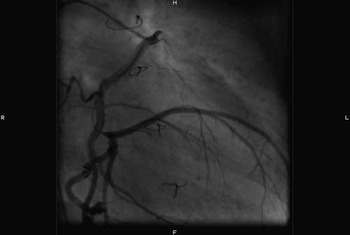
The problem with the left main coronary artery was noted at the annual follow-up 9 years after the operation in routine echocardiography without any clinical manifestation. The echocardiography demonstrated normal function in both ventricles, with trace aortic valve insufficiency without any signs of hypocontractility or ischaemia. The left main coronary artery was occluded. In magnetic resonance tomography, there was a sign of ischaemia and late enhancement in the region of the left descending artery and circumflex artery. Cardiac angiography confirmed the occlusion of the left main artery with very good retrograde perfusion of the left main artery through the right coronary artery (Fig 1).
Pre-operative coronary angiogram showing retrograde perfusion of the left anterior descending coronary artery from right coronary artery with filling of the circumflex artery.

We decided to establish a dual coronary circulation, with coronary artery bypass grafting using off-pump techniques.
The coronary artery bypass grafting procedure was performed through a median re-sternotomy. Myocardial function was not depressed and the heart was enlarged. The left internal mammary artery with an internal diameter of less than 2 millimetres was harvested as a pedicle. After heparinization (100 International Units), the proximal left anterior descending coronary artery was exposed to perform the anastomosis to provide an antegrade distribution in both left anterior descending and circumflex artery territories.
An Octopus Evolution (Medtronic Inc., Minneapolis, Minnesota, United States of America) stabiliser was applied with direct pressure and suction. In addition, we used a 2.0 coronary shunt avoiding myocardial hypoperfusion during the anastomosis. Anastomosis was performed using running sutures of 8-0 Prolene. There was no perioperative complication. Primary chest closure was performed.
The post-operative course was uneventful. Low-dose aspirin was prescribed for anti-platelet therapy. Post-operative echocardiography showed normal ventricular function. The patient was discharged on the 10th day after the operation.
Discussion
In the arterial switch operation, coronary translocation is one of the most critical steps. The complexities of coronary anatomy can therefore influence the late outcome of the procedure.
The use of arterial conduits for coronary problems in infants and children is now well accepted, with excellent long-term patency and growth in children with Kawasaki disease, post-arterial switch, and other congenital coronary lesions.Reference Mavroudis, Backer, Ouffy, Pahl and Wax4 Differences in adaptation to growth of children have been shown between arterial and venous grafts, with thoracic artery growing in proportion to somatic growth, whereas saphenous vein grafts tend to course in a more linear way, with no increase in length or diameter.Reference Legendre, Chantepie and Belli3, Reference Mavroudis, Backer, Ouffy, Pahl and Wax4 Surgical coronary angioplasty of the left main artery has also been shown to be effective in the mid-term and is useful in avoiding venous and arterial conduits and preserving these for later reoperations.Reference Legendre, Chantepie and Belli3, Reference Mavroudis, Backer, Ouffy, Pahl and Wax4 The concept of the establishment of a dual coronary perfusion is more physiological and may influence the incidence of congestive cardiac failure in this patient group. In such a situation, grafting of the internal mammary artery to the responsible coronary artery may be an excellent solution.