


Introduction
Religious freedom, or the right to adopt any religion or belief and express it through worship and practice, is a core principle of Western European societies (Council of Europe, 2021). Accordingly, this right is entrenched in the constitutions of most liberal democracies in Western Europe (Schnabel et al., Reference Schnabel, Behrens and Grötsch2017). Moreover, this right enjoys widespread support among European populations, as studies have shown that people in Western Europe generally consider it very important that “people can practice their religion freely” (Wike and Simmons, Reference Wike and Simmons2015). Consequently, some scholars have argued that support for religious freedom is “overwhelming” (Verkuyten et al., Reference Verkuyten, Yogeeswaran and Adelman2023). Despite this widespread support, the concrete accommodation of religious expressions remains a site of intense debate, especially when it concerns the expressions of religious minorities (Adam-Troian et al., Reference Adam-Troian, Arciszewski and Apostolidis2019; Saroglou et al., Reference Saroglou, Lamkaddem, Van Pachterbeke and Buxant2009). One prominent example of this is the discussion surrounding religious symbols worn by government employees, such as public school teachers or civil servants, which still elicit significant opposition among substantial parts of the population (Van der Noll, Reference van der Noll2010; Van der Noll and Saroglou, Reference van der Noll and Saroglou2015).
A range of scholars have tried to study what causes people to disapprove of religious symbols of government employees, despite valuing religious freedom highly. On the one hand, it could originate from the belief that religion should remain a private matter and, therefore, has no place in a neutral public context, particularly in contexts where individuals interact with people outside of their own religious group (Van der Noll and Saroglou, Reference van der Noll and Saroglou2015; Velthuis et al., Reference Velthuis, Van der Noll and Verkuyten2022). This should lead to an opposition to any religious expression by government employees, as it is interpreted as an imposition of one’s religious beliefs in a context that should be exempt from any religious references (Maclure and Taylor, Reference Maclure and Taylor2011). On the other hand, feelings of prejudice are important for shaping disapproval of specific religious symbols as well (Adam-Troian et al., Reference Adam-Troian, Arciszewski and Apostolidis2019; Saroglou et al., Reference Saroglou, Lamkaddem, Van Pachterbeke and Buxant2009). As specific religious symbols are necessarily tied to “a defining set of values and beliefs and a community of practitioners” (Verkuyten et al., Reference Verkuyten, Yogeeswaran and Adelman2020, 241), the associated group and values of specific religious symbols might be interpreted as threatening among those harboring negative opinions about these groups (Adam-Troian et al., Reference Adam-Troian, Arciszewski and Apostolidis2019). As a result, it can be questioned to what extent a general aversion toward religious expressions in public contexts plays a role when shaping attitudes toward concrete religious symbols for government employees, or whether negative sentiments and prejudice take the upper hand. This brings us to the guiding research questions of the study: 1) To what extent do Belgians approve or disapprove of government employees wearing different religious symbols, namely a Christian cross, a Muslim headscarf or a Jewish yarmulke? 2) Is the disapproval of government employees wearing different religious symbols foremost linked to a general disapproval of religious expression in public settings, or to prejudices toward specific outgroups?
Few empirical studies have experimentally assessed whether people are equally disapproving of accommodating both majority and minority religious symbols by government employees (Ivarsflaten and Sniderman, Reference Ivarsflaten and Sniderman2022; Verkuyten et al., Reference Verkuyten, Yogeeswaran and Adelman2023). To fill this gap, we test these competing mechanisms through a split-ballot experiment in which respondents are randomly assigned to one of three groups, each asked about their opinion on government employees wearing a specific religious symbol: a Christian Cross, a Muslim headscarf, or a Jewish yarmulke. If a resistance against religious expressions in public contexts is the dominant explanation, we expect people to be equally disapproving of government employees wearing any of the religious symbols. But when prejudice is dominant, we expect people to be especially opposed to religious symbols of minority groups—in Western-European contexts, notably the Muslim headscarf and Jewish yarmulke—as these reflect religious views, practices, and values that might deviate strongly from the dominant majority culture and are therefore perceived to be more “deviant” compared to ingroup religious symbols, like the Christian cross (Saroglou et al., Reference Saroglou, Lamkaddem, Van Pachterbeke and Buxant2009).
Belgium is relevant as a case study for several reasons. Traditionally, the Catholic church had a strong influence on state policy and public education (Billiet, Reference Billiet1995). More recently, other religious institutions, such as the Muslim and the Jewish communities, have been recognized and are funded by the state (Torrekens, Reference Torrekens, Burchardt and Michalowski2014). For this reason, religious expressions in the public sphere are more common in the daily life of Belgians, which is different from a country like France, where neutrality in terms of religious and political expressions is strived for in public places (Adam-Troian et al., Reference Adam-Troian, Arciszewski and Apostolidis2019). Yet, church attendance in Belgium has declined strongly over the last 50 years (Van Ingen and Moor Reference van Ingen and Moor2015), and an increasing number of people identify as atheist or agnostic (Sahgal et al., Reference Sahgal, Cooperman and Schiller2018). At the same time, the institutionalization of religious minorities is a politicized topic, and the accommodation of headscarves for students, teachers, and government employees remains a topic of contestation (Brems et al., Reference Brems, Heri, Chaib and Verdonck2017; Torrekens, Reference Torrekens, Burchardt and Michalowski2014; Van de Graaf et al., Reference Van de Graaf, Saïla Ouald Chaib, Schoentjes, Van Baelen, Bribosia and Inghilterra2021).
Theoretical framework
Religious symbols by government employees
The normative foundation of liberal democracy is based on moral pluralism, which asserts that a diversity of beliefs, ideologies, and convictions holds intrinsic value, enriching societies and individuals within them (Maclure and Taylor, Reference Maclure and Taylor2011; Sartori, Reference Sartori1997). One of the fundamental responsibilities of liberal democracy is therefore to facilitate societal pluralism by safeguarding constitutional liberties, which establish neutral legal boundaries that enable individuals to pursue their chosen lifestyles (Habermas, Reference Habermas2004; Rawls, Reference Rawls1997). Freedom of religion is one of these constitutional rights, guaranteeing the right to adopt any religion or belief without undue interference and express it in teaching, symbols and practice (Council of Europe, 2021). Religious freedom has been adopted as a core principle of virtually all Western European constitutions (Schnabel et al., Reference Schnabel, Behrens and Grötsch2017) and enjoys widespread support among Western European populations (Wike and Simmons, Reference Wike and Simmons2015).
As an extension to this, religious freedom also implies that everyone should have equal rights and opportunities as citizens, including equal access to resources, jobs, and public services, regardless of their religion or its expression (Maclure and Taylor, Reference Maclure and Taylor2011). Yet, an increasing number of countries have implemented some form of policy that bans religious expressions for people in a public function, such as in public schools (Baubérot, Reference Baubérot2009; Brems et al., Reference Brems, Heri, Chaib and Verdonck2017) and for government employees (Saharso and Lettinga, Reference Saharso and Lettinga2008). These policies are also supported by a substantial portion of the population in Western European countries (Aarøe, Reference Aarøe2012; Van der Noll, Reference van der Noll2010), indicating that the endorsement of religious freedom is not unlimited. The question that remains is why, despite the near-universal support for religious freedom, there is much more disagreement on the appropriateness of religious expressions by government employees. The following section will discuss two prominent explanations for this phenomenon.
The public and private context
To maintain a society where different beliefs and worldviews can coexist alongside each other, states must also ensure that people with different religions are treated equally when engaging with each other in shared civic spaces, such as schools, workplaces, or government institutions (Maclure and Taylor, Reference Maclure and Taylor2011). To facilitate this, social groups with different beliefs are expected to neutrally engage with each other in these contexts, ensuring that these interactions are based on shared moral values that apply regardless of background or beliefs (Joppke, Reference Joppke2004; Sartori, Reference Sartori1997). Publicly expressing one’s religion in this context can then be seen as suspect, as it can be perceived as imposing personal morals over these universally shared values (Adam-Troian et al., Reference Adam-Troian, Arciszewski and Apostolidis2019). This same concept extends to the religious expressions of government employees. As their job requires them to interact with other citizens, visible displays of religious affiliation may be perceived as compromising the neutrality that is necessary for these engagements (Aarøe, Reference Aarøe2012; Adam-Troian et al., Reference Adam-Troian, Arciszewski and Apostolidis2019).
In practice, the aim to maintain neutrality in the public context can conflict with citizens’ right to religious expression. Specifically, it has been questioned whether the aim of public neutrality is truly neutral, or whether it disproportionately affects religious groups for which the visible expression is a more central aspect of their religious experience, by impeding their access to public sector employment opportunities (Baubérot, Reference Baubérot2009; Gunn, Reference Gunn2004). This issue also has a significant gender dimension, as many religious expressions are gender specific. A clear example is the demand for Muslim women to remove their headscarves in public roles, which critics argue particularly excludes women from full participation in society (Abdelgadir and Fouka, Reference Abdelgadir and Fouka2020; Van de Graaf et al., Reference Van de Graaf, Saïla Ouald Chaib, Schoentjes, Van Baelen, Bribosia and Inghilterra2021). Balancing the right of religious expression with the principle of public neutrality presents a significant challenge. Reflecting this, there is also disagreement among European citizens on whether public expressions of religion by government employees are appropriate (Velthuis et al., Reference Velthuis, Van der Noll and Verkuyten2022). Disagreement on the matter is partly shaped by different expectations of the role of religion in public contexts. Those who argue that religion should be a private matter interpret religious symbols in public as an inappropriate imposition of personal beliefs in a public context and, consequently, may advocate for more stringent regulations on the display of religious symbols for government employees (Helbling, Reference Helbling2014; Van der Noll and Saroglou, Reference van der Noll and Saroglou2015). However, others interpret public religious expression as a fundamental part of religious freedom, arguing that the expression of one’s religion, in terms of symbols, customs and practices, is an essential part of the religious experience (Ivarsflaten and Sniderman, Reference Ivarsflaten and Sniderman2022). As a result, these people are more likely to accept the presence of religious symbols for government employees, perceiving them as a fundamental right and a form of personal and communal identity (Habermas, Reference Habermas2004). This leads to the following hypothesis:
Hypothesis 1: The endorsement of the right of public expression of religion is positively related to the support for government employees wearing a Christian cross, a Muslim headscarf, or a Jewish yarmulke.
The role of prejudice: religious expressions in an intergroup context
The abovementioned conflict between religious freedom versus public neutrality should, in theory, apply to any religious symbols for government employees equally (Ivarsflaten and Sniderman, Reference Ivarsflaten and Sniderman2022). In practice, however, public opinion research shows that people are generally less approving of minority religious symbols in public settings compared to majority religious symbols (Dangubić et al., Reference Dangubić, Yogeeswaran, Verkuyten and Sibley2023). We argue that this phenomenon occurs because these judgments are not made in a vacuum but remain rooted in an intergroup context (Gibson and Gouws, Reference Gibson and Gouws2001). In Western Europe, discussions surrounding religious expressions have increasingly aligned around questions of multiculturalism, thereby politicizing and polarizing attitudes toward religious minority groups (Van der Noll, Reference van der Noll2014). Specifically, Islamic and Jewish religious groups in Western Europe often face hostility due to perceptions that they conflict with the region’s “Christian roots” and threaten Enlightenment values (Brubaker, Reference Brubaker2017; O’Brien, Reference O’Brien2016). Such perceptions can trigger prejudice, which, in turn, serves as a guiding principle for judging specific civil liberties (Sniderman and Hagendoorn, Reference Sniderman and Hagendoorn2009, 4).
While people might be generally inclined to hold prejudices toward any minority group, which outgroup becomes the primary target of prejudice may depend on socially offered justifications for such prejudices (Zick et al., Reference Zick, Küpper and Hövermann2011). Prejudice toward Muslims is expressed through Islamophobia or indiscriminate negative attitudes or emotions toward Muslims as a religious community (Bleich, Reference Bleich2011). Commonly, Islam is stereotyped as being inherently hostile toward the West (O’Brien, Reference O’Brien2016), while Muslims are perceived to endorse values that are incompatible with those in the West (Cesari, Reference Cesari2013; Sniderman and Hagendoorn, Reference Sniderman and Hagendoorn2009). People who endorse these views are therefore more likely to disapprove of the Muslim headscarf for government employees, as it symbolizes a visible marker of religious identity that they dislike (Saroglou et al., Reference Saroglou, Lamkaddem, Van Pachterbeke and Buxant2009; Sniderman and Hagendoorn, Reference Sniderman and Hagendoorn2009).
Although Jewish individuals are also a religious minority, their position in Western Europe is more ambivalent. On the one hand, Jews have historically served as the cultural “other” that Western societies have defined themselves against (Quinley and Glock, Reference Quinley and Glock1979). Accordingly, they constitute a visibly distinct cultural outgroup as well and are still interpreted as a threat to Western Values among certain parts of the Western European population (Dencik and Marosi, Reference Dencik and Marosi2016; Schiffer and Wagner, Reference Schiffer and Wagner2011). Consequently, individuals who believe that Jews pose a threat to society are expected to be more likely to reject government employees wearing a Jewish yarmulke for similar reasons as mentioned before. On the other hand, the Jewish yarmulke plays a less central role in debates about the accommodation of religious diversity, which are mainly concerned with Muslim symbols and practices (Abdelgadir and Fouka, Reference Abdelgadir and Fouka2020; Brems et al., Reference Brems, Heri, Chaib and Verdonck2017; Van de Graaf et al., Reference Van de Graaf, Saïla Ouald Chaib, Schoentjes, Van Baelen, Bribosia and Inghilterra2021). As a result, we expect Antisemitic prejudice to be less salient in debates about the accommodation of religious symbols for government employees. Nevertheless, we still expect Antisemitism to be a significant predictor of opposition to the Jewish yarmulke for government employees. We therefore formulate the following hypotheses:
Hypothesis 2a: Islamophobia is positively related to opposition against government employees wearing a Muslim headscarf, beyond one’s endorsement of religious expression in public.
Hypothesis 2b: Antisemitism is positively related to opposition against government employees wearing a Jewish yarmulke, beyond one’s endorsement of religious expression in public.
Alternative explanations for opposition against concrete religious symbols
Researchers have emphasized that differences in opposition against religious symbols in public settings do not always stem from prejudice but can also originate from other sources (Ivarsflaten and Sniderman, Reference Ivarsflaten and Sniderman2022; Verkuyten et al., Reference Verkuyten, Yogeeswaran and Adelman2023). First, research indicates that attitudes toward religious expressions in general are also rooted in general value orientations (Van der Noll, Reference van der Noll2014). Individuals who endorse group-based equality are generally more concerned with ensuring the equal standing of others (Rokeach, Reference Rokeach1973) and are therefore less likely to perceive minority religious symbols of government employees as a threat (Davidov et al., Reference Davidov, Meuleman, Billiet and Schmidt2008). Similarly, attitudes toward religious minorities have strongly aligned with ideological divisions, with those on the left expressing more support for the accommodation of minority religious expressions compared to those on the right (Adam-Troian et al., Reference Adam-Troian, Arciszewski and Apostolidis2019). Lastly, due to the gendered nature of the Muslim headscarf, research has shown that attitudes toward the headscarf are shaped by one’s endorsement of gender equality, although the relationship is complicated (Helbling, Reference Helbling2014; Sniderman and Hagendoorn, Reference Sniderman and Hagendoorn2009). On the one hand, the Muslim headscarf is often framed as a symbol of female oppression, as it conflicts with modern ideals of female autonomy (Cesari, Reference Cesari2013; Sniderman and Hagendoorn, Reference Sniderman and Hagendoorn2009). As a result, an endorsement of gender equality might lead to a willingness to restrict the Muslim headscarf to safeguard female rights (Ivarsflaten and Sniderman, Reference Ivarsflaten and Sniderman2022; Moss et al., Reference Moss, Blodorn, Van Camp and O’Brien2019). However, other studies have shown that the endorsement of gender equality is correlated with a general solidarity toward other minorities and disadvantaged groups (Zick et al., Reference Zick, Küpper and Hövermann2011). Consequently, the endorsement of gender equality can also lead to more support for the right of minorities to express their identity, thereby fostering positive attitudes toward the Muslim headscarf (Sarrasin, Reference Sarrasin2016). We will control for these alternative explanations in our model.
Research context: public neutrality and intergroup relations in Belgium
Attitudes toward religious expressions are significantly influenced by how the state manages religious diversity (Helbling, Reference Helbling2014), making it important to understand the historical legacy of state–church relations in Belgium. As the Catholic Church historically had a strong influence on policy and public education in Belgium (Billiet, Reference Billiet1995), expressions of religion in public contexts are not uncommon. In contrast to a country like France, which emphasizes strict neutrality in public spaces (Baubérot, Reference Baubérot2009; Gunn, Reference Gunn2004), we expect lower baseline disapproval of religious symbols worn by government employees. Yet, church attendance in Belgium has declined substantially (Van Ingen and Moor, Reference van Ingen and Moor2015), and most citizens believe that religion should be kept separate from government policy (Sahgal et al., Reference Sahgal, Cooperman and Schiller2018). This is reflected in official policy as well, as every Belgian municipality has the right to implement a restriction on religious clothing for its employees to uphold public neutrality (Van de Graaf et al., Reference Van de Graaf, Saïla Ouald Chaib, Schoentjes, Van Baelen, Bribosia and Inghilterra2021). Consequently, there is a wide variety in the extent to which religious symbols by government employees are allowed between municipalities. For instance, whereas government employees are permitted to wear a headscarf in Ghent, those in Antwerp are prohibited from doing so (Van Puymbroeck et al., Reference Van Puymbroeck, Blondeel and Vandevoordt2014). There are also differences in the interpretation of public neutrality between the two communities, with the French-speaking community (Brussels and Wallonia) adopting more of a republic-secularist model like their French neighbors and the Dutch-speaking community (Flanders) adopting a multiculturalist-pluralist model from the Netherlands (Torrekens, Reference Torrekens, Burchardt and Michalowski2014; Williame, Reference Williame, Giuseppe and Pace2014). Therefore, we expect slightly stronger disapproval of government employees wearing religious symbols in the French-speaking community compared to Flanders.
Moreover, it is essential to consider the structural position of religious minority groups that shapes intergroup relations and, in turn, shapes attitudes toward public expression of different religious groups (Meuleman et al. Reference Meuleman, Abts, Slootmaeckers and Meeusen2019). In the Belgian context, there is a substantial Muslim community that primarily has its origin in post-war labor migration from Turkey and Morocco (Dorn and Zweimüller, Reference Dorn and Zweimüller2021). While exact numbers of Belgians who identify as Muslim are not recorded, they are estimated to make up roughly 7.5% of the Belgian population (Statbel, 2025). The increasing visibility of this religious minority group has been interpreted as a threat by parts of the Belgian majority population (Meeusen and Jacobs, Reference Meeusen and Jacobs2017; Meuleman et al., Reference Meuleman, Abts, Slootmaeckers and Meeusen2019). Consequently, the accommodation of Muslim religious expressions has been especially faced with contestation. Indeed, while demands for religious neutrality in Belgian municipalities are officially applied to all religions, in practice, the headscarf is most likely to be the target of legal cases and concrete restrictions (Van de Graaf et al., Reference Van de Graaf, Saïla Ouald Chaib, Schoentjes, Van Baelen, Bribosia and Inghilterra2021).
While the Jewish community also forms a visible cultural minority group in Belgium, it is considerably smaller. Again, while exact numbers are not recorded, in 2018, it was estimated that roughly 30,000 people in Belgium identified as Jewish (0.25% of the total population), primarily residing in Antwerp and Brussels (Staetsky and DellaPergola, Reference Staetsky and DellaPergola2022). In absolute numbers, then, the Jewish community is less visible compared to the Muslim one. Nevertheless, they are still the target of prejudice in Belgium (Meuleman et al., Reference Meuleman, Abts, Slootmaeckers and Meeusen2019). The “prototypical Jews” in the Belgian context are the Ultra-Orthodox Haredi Jews, who form the majority (roughly 60%) of Jews in the Antwerp region (Staetsky and DellaPergola, Reference Staetsky and DellaPergola2022). With their religious practices and traditional clothes, they form a small but highly visible cultural outgroup that has a symbolic value in how Jews are perceived in Belgian society (Schiffer and Wagner, Reference Schiffer and Wagner2011). Yet despite this, Jews are generally less likely to be described negatively by politicians or in the media (Meeusen and Jacobs, Reference Meeusen and Jacobs2017), and feelings toward Jews in Belgium are generally more positive compared to feelings toward Muslims (Meuleman et al., Reference Meuleman, Abts, Slootmaeckers and Meeusen2019). Moreover, Jewish religious symbols play a less central role in the public debate on religious expressions by government employees (Brems et al., Reference Brems, Heri, Chaib and Verdonck2017). As a result, we still expect there to be substantial disapproval of government employees wearing a Jewish yarmulke, but not as much compared to the Muslim headscarf.
Research design
Data
To test our hypotheses, we make use of the 2020 wave of the Belgian National Election Study, which is a two-stage random probability survey conducted after the 2019 elections (Meuleman et al., Reference Meuleman, Swyngedouw, Abts, Meeusen, Stefanelli, Wopereis, Van Den Abbeele, Yzerbert, Klein and Phalet2021). Data were largely gathered between 2019 and 2020 through computer-assisted face-to-face interviews.Footnote 1 From the initial sample (n = 1659, 32.81% response rate), we only make use of the respondents who completed an additional pen-and-paper questionnaire (n = 1150). As we focus on the majority perspective, the sample was also reduced to respondents whose parents were both born in Belgium, leaving us with a final sample of 954 respondents. Post-stratification weights based on gender, age, and education have been applied to account for unit nonresponse.
Measurements
Disapproval of religious symbols by government employees
This study uses a split-ballot experiment to gauge opinions on religious symbols worn by government employees. Respondents were randomly assigned to one of three conditions and asked to rate their agreement, on a 5-point scale (1 = totally disagree, 5 = totally agree), with a statement regarding whether government employees who interact with the public should be prohibited from wearing one specific religious symbol: a Christian cross (n = 338), a Muslim headscarf (n = 306), or a Jewish yarmulke (n = 310). We have chosen these religious symbols as they could most realistically be worn by government employees in daily life. First, the Muslim headscarf is a highly visible religious expression of Muslim women, which is usually worn at all times when in a public context, also when working for the government (Cesari, Reference Cesari2013). Consequently, the Muslim headscarf can be seen as the prototypical religious symbol when it comes to the debate of accommodating religious expressions by government employees. The Jewish yarmulke is a symbol that is similar in visibility and, therefore, in principle, subject to the same rules. In practice, however, scholars have highlighted that a yarmulke worn by government employees generally leads to less resistance (Brems et al., Reference Brems, Heri, Chaib and Verdonck2017; Van de Graaf et al., Reference Van de Graaf, Saïla Ouald Chaib, Schoentjes, Van Baelen, Bribosia and Inghilterra2021). Of the Christian religious symbols, a necklace with the Christian cross is chosen as it’s the most well-known Christian symbol that is usually worn (Aarøe, Reference Aarøe2012). However, the Christian cross is not entirely equivalent in visibility, which may lead to an overestimation of the preferential treatment it receives as a majority religious symbol. Moreover, two of the three religious symbols have a clear gendered character, as the headscarf is only worn by women and the yarmulke only by men. As a result, differential patterns between the religious symbols could not only reflect differences in prejudice regarding the religious groups but also differences in gender stereotypes or visibility (Aarøe, Reference Aarøe2012). Despite this, we argue that these are the most realistic symbols in this context. Rather than constraining the realism of the experiment for the sake of making the religious symbols more comparable, we have chosen to compare attitudes toward religious symbols that are salient in the contemporary debate surrounding religious symbols of government employees, increasing the external validity of the experiment. Moreover, constraining the visibility of the different religious symbols to be similar misses the point that some religions are just inherently more “visible” compared to others. For example, devout Muslim women may view the headscarf as a religious obligation, not a discretionary symbol. Some Jewish men wear a yarmulke for similar reasons (Brems et al., Reference Brems, Heri, Chaib and Verdonck2017). From this perspective, it can be argued that the demands of neutrality for government employees place a bigger constraint on those for whom visibility is an integral part of their religious practice (Abdelgadir and Fouka, Reference Abdelgadir and Fouka2020). With our setup, we hope to more accurately reflect the real-life consequences that religious groups cope with when working as government employees.
Endorsement of the abstract value of religious expression in public
The endorsement of religious expression in abstract terms is measured by asking respondents to what extent they agree (on a 5-point scale) with the statement “Every person has the right to express his/her religion in public.” This question most directly taps into the free-exercise interpretation of religious expression, which limits itself only to the right to express one’s religion without (government) interference (Habermas, Reference Habermas2004). Moreover, by specifically addressing the “public” aspect of religious expression, it not only measures whether people feel that it is important that people can believe what they want but also whether they should be allowed to express it in public. Compared to other studies that ask if religious freedom is important for the country (e.g., Wike and Simmons, Reference Wike and Simmons2015), this item more effectively captures where the tension regarding religious rights really occurs (Maclure and Taylor, Reference Maclure and Taylor2011).
Islamophobia and antisemitism
Both Islamophobia and Antisemitism were measured using a range of items on a 5-point scale (1 = totally disagree, 5 = totally agree). Islamophobia was measured using six items that gauged people’s endorsement of negative stereotypes of Muslims. The first three items concerned generalized negative stereotypes, asking respondents about the morality, trustworthiness, and perceived power of Muslims. Specifically, the statements are formulated as follows: “Most Muslims think they’re better than others,” “Muslims are generally to be trusted,” and “Muslims have too much influence in our country.” Additionally, we added three items that tapped into target-specific negative stereotypes that are generally used against Muslims in particular. The first two items concern Islam as a geopolitical threat (Brubaker, Reference Brubaker2017; O’Brien, Reference O’Brien2016), by asking respondents whether they consider Islam to be a threat to the safety of the country (Kathawalla et al., Reference Kathawalla, Gulamhussein, Chan, Riegelman and Syed2024). Specifically, we asked them whether they agreed with the following statements: “Islamic countries turn against Europe,” “Islamic culture and history are more violent than other cultures.” The last item asks whether they believe that Muslim values are compatible with Western values, by asking their agreement to the statement “Islamic values are not compatible with European values.” For the Antisemitism scale, we also measured the general negative stereotypes toward Jews by asking whether respondents agree with the statements: “Most Jews think they’re better than others,” “Jews are generally to be trusted” and “Jews have too much influence in our country.” Additionally, we also asked whether respondents believed Jews were money-oriented, by asking whether they agree with the statement: “Most Jews are only after money.” This question is added since it is a notorious stereotype that was used historically to marginalize Jews in Europe (Quinley and Glock, Reference Quinley and Glock1979). In the Belgian context specifically, the prototypical image of Jews is often that of the Orthodox Haredi community in Antwerp, historically associated with the diamond industry, which renders stereotypes of greed particularly salient (Meuleman et al., Reference Meuleman, Abts, Slootmaeckers and Meeusen2019). See Appendix 1.2 for a more elaborate discussion surrounding the theoretical and methodological underpinning of our Islamophobia and Antisemitism scale.
The Islamophobia and Antisemitism scales, alongside all other latent variables, were validated using confirmatory factor analysis (CFA) (for more detail on factor loadings and full wording of the items, see Appendix 2.1). The model fit of the CFA model is satisfactory, indicating that the measurement model fits the data well (χ 2 = 124.224; df = 84; RMSEA = 0.028; CFI = 0.986; TLI = 0.983). Moreover, the factor loadings of the items that measure Islamophobia all load high on their respective scale (all above 0.58), indicating that they collectively contribute meaningfully to the measurement of a common scale. Similarly, all items that measure Antisemitism also load high on their respective scale (all above 0.59). Lastly, the correlation between Islamophobia and Antisemitism remains at 0.427, meaning that the concepts are positively related but also distinct from each other. As a result, we can convincingly interpret the results of the measurement model to infer the validity and reliability of our measurements.
Control variables
We also control for a range of other variables that could confound the hypothesized relationships. Support for group-based equality was measured using two items asking about the extent to which respondents strive toward equality between groups. Additionally, support for gender equality was measured using three items asking respondents to what extent women and men should be treated as equals in the household and leadership positions.
Again, all these variables were measured on a 5-point scale. Looking at our measurement model, both items measuring the endorsement of group-based equality load sufficiently high on a common latent scale (both higher than 0.56). Similarly, the items measuring the endorsement of gender equality load high on their respective latent scale as well (all above 0.53). Lastly, the left–right position of respondents was measured by asking them to place themselves on an 11-point scale, ranging from 0 (“Very left-wing”) to 10 (“Very right-wing”).
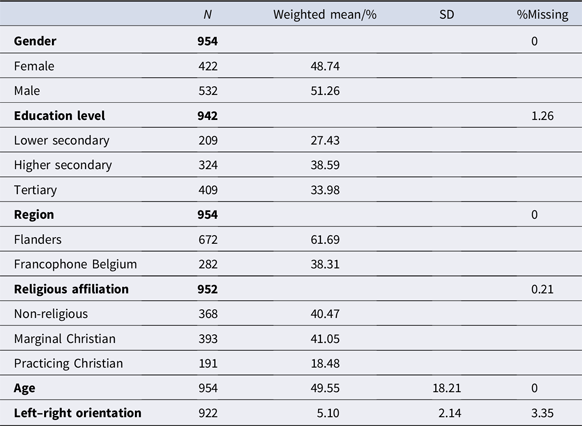
Since attitudes toward religious symbols in general may be affected by individual characteristics as well, we also control for a range of sociodemographic factors. To control for religious affiliation, we distinguish between Christians who attend religious services (“Practicing Christians”), people who consider themselves Christian but only attend religious services for special occasions such as family events or holidays (“Marginal Christians”) and atheists and non-believers (“Non-religious”) (Billiet, Reference Billiet1995). As our sample contained very few respondents affiliated with religions other than Christianity after removing those whose parents were not born in Belgium (0.21%), these values were coded as missing. Lastly, we included gender (0 = male, 1 = female), education level (highest attained education level; 1 = lower secondary, 2 = upper secondary, 3 = tertiary), age (in years), and region (0 = Flanders, 1 = Francophone Belgium). Descriptive statistics—weighted for gender, age, and education—of all observed variables are provided in Table 1.
Descriptive statistics of manifest indicators

Table 1. Long description
A table with descriptive statistics of sociodemographic factors. The table has 954 rows and 6 columns. Column headers are N, Weighted mean/%, SD, and %Missing. Row labels include Gender, Education level, Region, Religious affiliation, Age, and Left-right orientation. Row 1: Gender, 954, Female, 422, 48.74, Male, 532, 51.26. Row 2: Education level, 942, 1.26, Lower secondary, 209, 27.43, Higher secondary, 324, 38.59, Tertiary, 409, 33.98. Row 3: Region, 954, Flanders, 672, 61.69, Francophone Belgium, 282, 38.31. Row 4: Religious affiliation, 952, 0.21, Non-religious, 368, 40.47, Marginal Christian, 393, 41.05, Practicing Christian, 191, 18.48. Row 5: Age, 954, 49.55, 18.21, 0. Row 6: Left-right orientation, 922, 5.10, 2.14, 3.35.
Note: Means and percentages are weighted for age, gender, and education.
Analytical strategy
We conducted a split-ballot experiment in which respondents were randomly assigned to evaluate one of three religious symbols: either a Christian cross, a Muslim headscarf, or a Jewish yarmulke. The advantage of this is that respondents only judge one religious symbol at a time, ensuring that the other symbols do not prime respondents to respond in a consistent manner (Podsakoff et al., Reference Podsakoff, MacKenzie, Lee and Podsakoff2003). This method reduces the risk of overestimating consistency in responses and minimizes social desirability bias.
We start by addressing the descriptive patterns in the endorsement of the right to publicly express one’s religion. Then, we test if there are differences in the disapproval of government employees wearing the three religious symbols using an analysis of variance (ANOVA). Subsequently, we analyze what factors predict the disapproval of these religious symbols through a multigroup structural equation Modeling approach, focusing on the support for public expression of religion in abstract terms compared to prejudice. This method is preferred over traditional linear regression because it allows us to measure our independent variables as latent scales measured through CFA. Rather than relying on an additive index of items, which assumes that all items contribute equally to the underlying latent construct, CFA models weigh the contribution of the individual items based on the estimated factor loading (e.g., the strength of its relationship with the latent construct), thereby explicitly modeling measurement error and providing more reliable estimates of these concepts (Brown, Reference Brown2006). This is particularly relevant for measures of prejudice, which are often measured using multiple items assessing negative stereotypes about the group (Meuleman et al., Reference Meuleman, Abts, Slootmaeckers and Meeusen2019). These negative stereotypes might not all be equally salient, and the CFA model accounts for this measurement error by allowing the more informative stereotypes to contribute more to the underlying scale (Zick et al., Reference Zick, Küpper and Hövermann2011).
To test hypothesis 1, Model 1 assesses the effect of the endorsement of the public expression of religion on the disapproval of the religious symbol of the government employees, controlling for the sociodemographics and value orientations. To test hypotheses 2a and 2b, Model 2 includes Islamophobia and Antisemitism. All models will include control variables for the alternative explanations provided and sociodemographics. The models will be estimated using a robust maximum likelihood estimator to take into account the ordinal nature of the data. We use the full information maximum likelihood estimator that deals efficiently with item non-response. All parameters for the continuous variables in the model are standardized, while those for dummy variables are semi-standardized. Lastly, post-stratification weights for gender, age, and education were applied to all subsequent analyses in this paper.
Results
Descriptive results
Looking at the endorsement of public religious expression in abstract terms, we see that the average score on this item is equal to 3.530 (SD = 0.943) on a 5-point scale, indicating a relatively strong endorsement of the general principle that “Every person has the right to express his/her religion in public.” This is confirmed when we look at the distribution of responses on this item in Figure 1, where we see that 62.95% of the respondents (completely) agree with the statement. Conversely, 18.51% of the respondents disagree or strongly disagree with the statement, while 18.47% take a middle position. Although the questions are not directly comparable due to the different answer options, it is noteworthy to see substantially lower levels of endorsement for religious rights compared to the question of Wike and Simmons (Reference Wike and Simmons2015), who found that a large majority of respondents (roughly 80%) in Western European countries argue that it’s important that “people can practice their religion freely” (Wike and Simmons, Reference Wike and Simmons2015). By mentioning the public dimension of religious expression in our item, it suggests that it already implicitly makes the social implications of religious expressions more concrete, leading to higher disapproval.
Weighted distribution of the endorsement of religious expression in abstract terms.

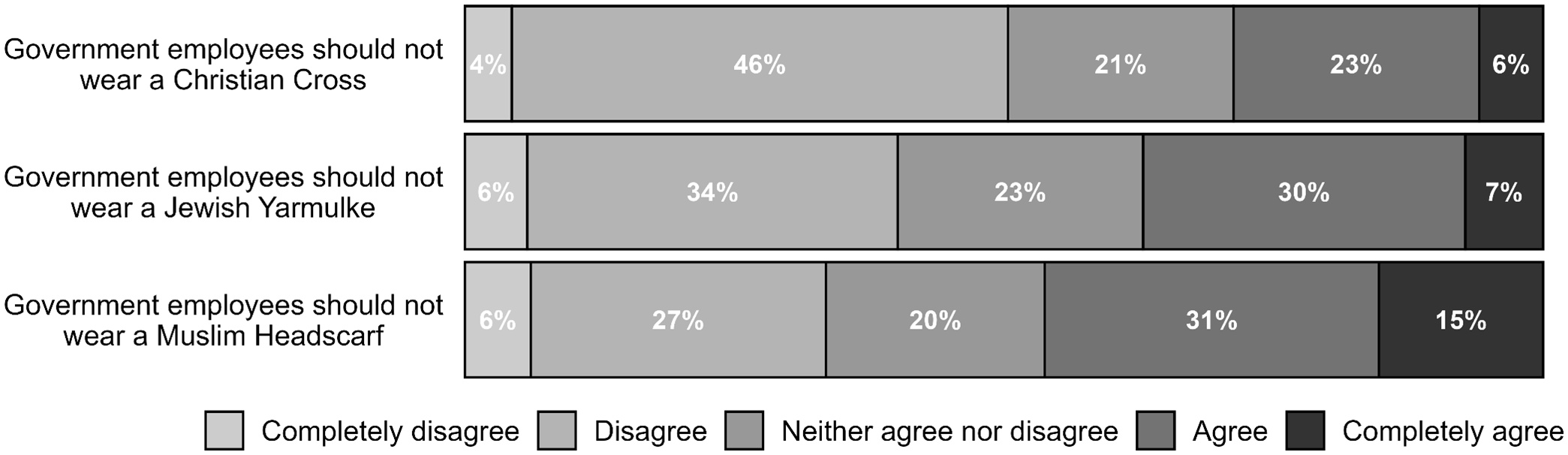
To test how these patterns translate into (dis)approval of concrete religious symbols, we now measure the extent to which respondents believe that government employees should not be allowed to wear a Christian cross, a Muslim headscarf, and a Jewish yarmulke. Figure 2 provides the distribution of the responses within each experimental category. We see a diverging pattern between the three religious symbols: roughly half of the respondents (completely) disagree with the statement that government employees should not be allowed to wear a Christian cross (50.37%), compared to 40.15% for the Jewish yarmulke and 33.48% for the Muslim headscarf. Conversely, almost half of the respondents (completely) agree with the statement that government employees should not be able to wear a Muslim headscarf (46.23%), compared to 28.72% for the Christian cross and 37.11% for the Jewish yarmulke. An ANOVA showed that there were significant differences among the groups (F = 11.68, p < 0.001), although the overall effect size of the experimental condition was small (η 2 = 0.02). A post hoc Tukey test indicated that respondents rated government employees wearing a Muslim headscarf significantly more negatively compared to those wearing a Christian cross (p < 0.001) and a Jewish yarmulke (p = 0.021). The difference between the rejection of the Christian cross and the Jewish yarmulke, however, fails to reach statistical significance (p = 0.082). The full ANOVA results are provided in Appendix 2.3.
Weighted distribution of the disapproval of religious symbols of government employees.

Explanation models: public neutrality and prejudice
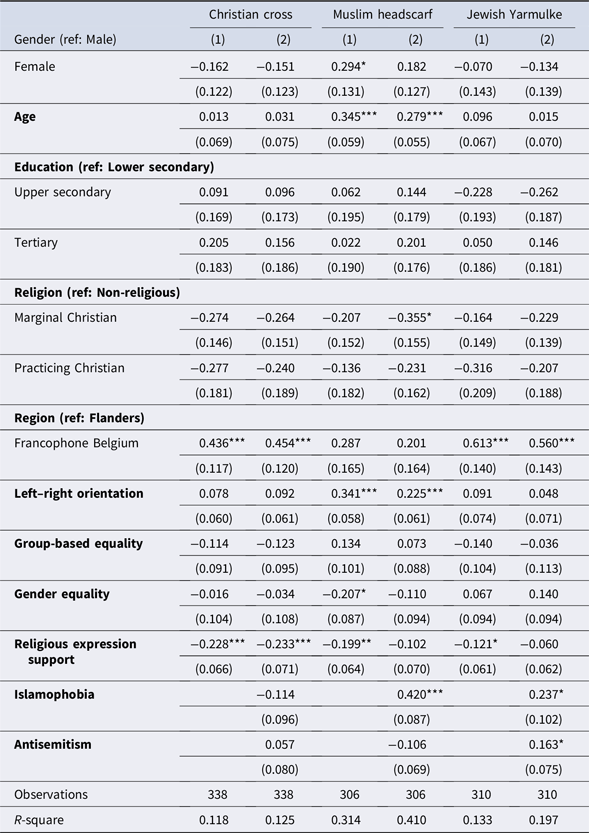
In the next step, we test how well our two mechanisms explain the patterns of (dis)approval that we find for government employees wearing the different religious symbols through a Multigroup Structural Equation Model (see Table 2). Supporting hypothesis 1, Model 1 shows that the disapproval of all religious symbols by government employees generally becomes weaker as the endorsement of the right to publicly express one’s religion increases. Importantly, the multi-group SEM shows that the strength of this relationship is similar across the three symbols. Specifically, the standardized regression effects for the Christian cross (β = −0.228, p = 0.000) and the Muslim headscarf (β = −0.199, p = 0.002) are almost similar in effect size, while the effect size for the Jewish yarmulke (β = −0.121, p = 0.045) is a bit smaller. Still, this indicates that the endorsement of public religious expression is not just a principle that people pay lip service to, but that it plays a role in shaping the approval of religious symbols for government employees.
Standardized regression effects on the rejection of different religious symbols

Table 2. Long description
A table with 12 rows and 10 columns comparing standardized regression effects on the rejection of different religious symbols. The columns are labeled Christian cross, Muslim headscarf, and Jewish Yarmulke, each with two sub-columns. The rows are labeled Gender, Age, Education, Religion, Region, Left-right orientation, Group-based equality, Gender equality, Religious expression support, Islamophobia, and Antisemitism. Each cell contains regression values and standard errors. Notable trends include significant effects for Francophone Belgium and Religious expression support across all symbols.
Note: Coefficients are fully standardized for continuous predictors and semi-standardized for binary and ordinal predictors. Estimated using robust maximum likelihood (MLR) *p < 0.05; **p < 0.01; ***p < 0.00. Fit statistics for all three models were satisfactory and are provided in Appendix 2.4.
Additionally, Model 2 provides strong support for hypothesis 2a, as Islamophobia is significantly related to the rejection of government employees wearing the Muslim headscarf. The results also provide some support for hypothesis 2b, although the rejection of government employees wearing the Jewish yarmulke mostly seems to reflect Islamophobia rather than specific feelings of threat toward Jewish minorities, as the standardized effect size of Islamophobia (β = 0.237, p = 0.023) is bigger than the one for Antisemitism (β = 0.163, p = 0.031). The prejudices do not affect the rejection of government employees wearing the Christian cross, indicating that those with negative views on Islam are more accepting of Christian religious symbols compared to Muslim or Jewish ones. The importance of target-specific prejudices is highlighted by the explained variance, as the addition of the target-specific prejudice variables increases the explained variance for rejection of the Muslim headscarf (R-squared = 41.0%), while also increasing the explained variance for the rejection of the Jewish yarmulke (R-squared = 19.7%). Importantly, these effects remain strong and significant while controlling for the alternative explanations, increasing the confidence in our findings. The effects of prejudice also put the results of Model 1 into perspective by highlighting that the explanatory power of the endorsement of public religious expression should not be overstated. Including Islamophobia and Antisemitism in Model 2 eliminates the negative effect of endorsing religious expression on disapproval of government employees wearing the Muslim headscarf or Jewish yarmulke. This suggests that prejudice confounds the link between abstract support for religious expression and disapproval of minority religious symbols, reflecting underlying attitudes toward specific groups (Abdelgadir and Fouka, Reference Abdelgadir and Fouka2020; Brems et al., Reference Brems, Heri, Chaib and Verdonck2017).
Among the alternative explanations, neither attitudes toward gender equality nor support for group-based equality, are related to disapproval of government employees wearing any of the religious symbols. However, the model does show that older respondents and right-wing respondents tend to reject government employees wearing the Muslim headscarf more. Lastly, the rejection of government employees wearing the Christian cross and the Jewish yarmulke is significantly higher in Francophone Belgium compared to Flanders. In Flanders, conversely, the rejection of religious symbols for government employees is more specifically focused on the expressions of Muslims.
Discussion and conclusion
While religious freedom as a civil right is considered a core value of Western European liberal democracies, there is still a substantial amount of resistance against religious expressions by government employees (Abdelgadir and Fouka, Reference Abdelgadir and Fouka2020; Brems et al., Reference Brems, Heri, Chaib and Verdonck2017). In this study, we tested how the endorsement of the right to publicly express one’s religion and prejudices, specifically Islamophobia and Antisemitism, influences how people judge government employees wearing different religious symbols. Our explanatory model initially rejected the notion that religious expression as a civil right is an empty concept that people discard when it does not suit them. Indeed, the endorsement of the right to publicly express one’s religion consistently increased positive attitudes toward government employees wearing the Christian cross, the Muslim headscarf, and the Jewish yarmulke in their function. Yet, prejudices, in general, and Islamophobia, in particular, generally overruled this effect when it concerned the judgment of government employees wearing the Muslim headscarf and the Jewish yarmulke, confirming the expectation that the debate surrounding religious expression is largely dominated by debates on multiculturalism and Islam (Petersen et al., Reference Petersen, Slothuus, Stubager and Togeby2011).
While these findings align with other studies that find that religious expressions of minority groups generally face more resistance compared to majority religious expressions (Dangubić et al., Reference Dangubić, Yogeeswaran, Verkuyten and Sibley2023; Saroglou et al., Reference Saroglou, Lamkaddem, Van Pachterbeke and Buxant2009), it should be noted that there is also a range of studies that find that people tend to respond similarly toward majority and minority religious groups engaging in the same practices (Hirsch et al., Reference Hirsch, Verkuyten and Yogeeswaran2019; Sleijpen et al., Reference Sleijpen, Verkuyten and Adelman2019). Yet, these experiments explicitly made sure that the visibility of the religious symbols was similar between the religious groups, for instance by comparing tolerance toward wearing a Christian or Islamic necklace. Consequently, our diverging findings can partly be attributed to differences in visibility between our experimental conditions (Aarøe, Reference Aarøe2012). At the same time, by constraining the religious symbols to be equal in visibility in the experimental setup, one risks overlooking the fact that Muslim symbols are inherently more publicly visible than most Christian symbols (Brems et al., Reference Brems, Heri, Chaib and Verdonck2017). Our results highlight that, even when Muslims and Christians are treated symmetrically in a controlled experimental setting (Hirsch et al., Reference Hirsch, Verkuyten and Yogeeswaran2019; Sleijpen et al., Reference Sleijpen, Verkuyten and Adelman2019), this does not imply that they enjoy equal opportunities to express their religion as they wish in practice.
Additionally, while studies explain the resistance against the headscarf by the salience of the negative image of Muslims in the public debate (Petersen et al., Reference Petersen, Slothuus, Stubager and Togeby2011; Saroglou et al., Reference Saroglou, Lamkaddem, Van Pachterbeke and Buxant2009; Sarrasin, Reference Sarrasin2016), we show that Islamophobia is also related to more negative views of the Jewish yarmulke, even when controlling for Antisemitism. This aligns with studies that argue that Islamophobia and Antisemitism share a certain cultural logic, with both being embedded in frames about cultural threat (Schiffer and Wagner, Reference Schiffer and Wagner2011). Indeed, despite efforts of populist radical right politicians to juxtapose “Judeo-Christian values” against Islam (Brubaker, Reference Brubaker2017; O’Brien, Reference O’Brien2016), our findings highlight that Jewish expressions are also negatively perceived among those with negative views of Islam in particular. Even though Muslims are the primary targets within current debates on religious diversity, our study suggests that other religious outgroups might be similarly affected by negative attitudes toward their religious expressions.
Our findings also differ from studies on political tolerance, which tend to show that people are generally quite willing to extend the freedom of expression and the right to protest to political opponents they dislike, as long as they are perceived to adhere to shared social norms (Harell, Reference Harell2010; Sullivan and Transue, Reference Sullivan and Transue1999). However, it does align with the findings of Petersen et al. (Reference Petersen, Slothuus, Stubager and Togeby2011), who find that those with Islamophobic attitudes don’t differentiate in their tolerance assessments between ordinary Muslims and Islamic fundamentalists, as they consider social practices of even ordinary Muslims to be intolerable. It remains a question why people who dislike the radical right or the radical left generally still support the right of these groups to express their opinion, but those who dislike Islam generally don’t support the right of Muslims to express their religion. One possible explanation is that the right to religious expression, contrary to other liberal values, such as freedom of speech or the right to protest, is a civil right that is more clearly tied to (religious) minority groups (Brems et al., Reference Brems, Heri, Chaib and Verdonck2017; Verkuyten et al., Reference Verkuyten, Yogeeswaran and Adelman2023), leading majority members to interpret the right to religious expression as a value not particularly related to their own interests. Consequently, there might be less perceived collective benefits for the majority population in upholding the freedom to express one’s religion compared to freedom of speech or the right to protest.
The strength of our study lies in its experimental setup, as it allows us to analyze the determinants for acceptance of different religious symbols in isolation. However, this setup also comes with some limitations. As mentioned before, the difference in visibility between the three religious symbols could confound the variation found between the rejection of these symbols (Aarøe, Reference Aarøe2012). It also overlooks gender differences in religious symbols, as acceptance may be influenced not only by the symbols but also by the gendered stereotypes associated with their wearers (Moss et al., Reference Moss, Blodorn, Van Camp and O’Brien2019; Sarrasin, Reference Sarrasin2016). Future research would do well to test how concerns over public neutrality or prejudice shape attitudes toward alternative religious expressions that are more equal in visibility, such as comparing Churches, Mosques and Synagogues.
Additionally, we did not test whether concerns over state neutrality played a role in shaping public attitudes toward government employees wearing religious symbols. This is important, as a state setting, where government employees work, is indeed more specific compared to a general public context: they act as representatives of the state, which is constitutionally mandated to maintain a neutral stance on religious matters (Gunn, Reference Gunn2004; Maclure and Taylor, Reference Maclure and Taylor2011). Regrettably, our survey did not include a question regarding the separation of state and church (Adam-Troian et al., Reference Adam-Troian, Arciszewski and Apostolidis2019; Baubérot, Reference Baubérot2009). As a result, we cannot directly test if a strong preference for a separation between state and church informs attitudes toward religious expressions of government employees beyond general attitudes toward the appropriateness of religious expressions in the public sphere. Preliminary research, however, does show that people do not differentiate between Muslim women wearing a headscarf in a civil servant position or a general public context, such as a shopping street (Velthuis et al., Reference Velthuis, Van der Noll and Verkuyten2022), indicating that this might not be as much of a concern in our case. Nevertheless, future studies should use more elaborate measures to test whether religious expressions of different religious groups are judged differently in a state context, such as for government employees, compared to a general public context, such as walking in a public street.
Supplementary material
The supplementary material for this article can be found at https://doi.org/10.1017/S1755048326100546.
Data
The data of the Belgian National Election Studies of 2019 are currently under embargo. Access to the data will be available upon request after the embargo period ends. For further information or to request access to the data, please contact Guido Priem at Guido.Priem@kuleuven.be.
Acknowledgments
We wish to thank the audience of a seminar organized by the Institute for Social and Political Opinion Research (KU Leuven) for their insights during the early phases of this project. Moreover, we wish to thank the audience of the “Affective Polarization” seminar of the Politicologenetmaal in Leuven and the audience of a seminar organized by the European Research Centre on Migration and Ethnic Relations (Utrecht University) for their constructive feedback on the final version of this manuscript. Lastly, we would like to thank two anonymous reviewers for their thoughtful feedback that substantially improved the quality of the paper.
Financial support
We thank the National Lottery and the KU Leuven Research Council for the generous financial support that made the project possible (C1l-19-00569).
Competing interests
The authors declare none.
Guido Priem is a PhD candidate at the Centre of Sociological Research at KU Leuven. His research interests include intergroup relations between majority members and Muslim minority members in Belgium and the determinants of intergroup tolerance.
Cecil Meeusen is a Professor at the Centre for Sociological Research at KU Leuven. Her research focuses on the structure of generalized prejudice, investigating how different types of prejudice are associated and how these associations are related to societal factors.
Bart Meuleman is Professor at the Centre for Sociological Research at KU Leuven. His research focuses on cross-national comparisons of value and attitude patterns, such as ethnic prejudice, egalitarianism, and support for the welfare state. He has a special interest in the application of multilevel modeling and structural equation modeling on comparative survey data. His research was published in, among others, Annual Review of Sociology, Social Science Research, European Sociological Review, Public Opinion Quarterly, Journal of Cross-cultural Psychology, and Journal of European Social Policy.
Koen Abts is Research Manager at the Centre for Sociological Research (CeSO) at KU Leuven (Belgium) and responsible for the building of the Belgian Online Probability Panel—an infrastructure by a consortium of all Belgian universities. His research focuses on the effect of resentment and cultural, economic, and political attitudes as well as on populism and the populist radical right.



 Open access

