Congenital coronary arterial fistulas are rare malformations, said to occur with an incidence of 0.002%, and being found in up to 0.08 to 0.30% of patients during coronary arteriography.1 Most of the patients are asymptomatic during childhood but, in older patients, late symptoms and complications, such as congestive heart failure, bacterial endocarditis, coronary ischaemia or rupture, have been reported.2 While surgical ligation of such fistulas, reported initially in 1947 by Björck and Crafoord,3 was the treatment of choice for many years, transcatheter closure was introduced as a less invasive alternative to surgery in the 1980s and early 1990s, albeit using various different devices.4, 5 Nowadays, closure with coils is the most commonly used technique.6, 7 Even though the results of transcatheter closure are comparable with those obtained surgically, the procedure may be difficult and time-consuming in patients with large and unrestricted fistulas, when multiple coils are needed to occlude the malformation. In this report, we describe our initial experience using the Amplatzer® vascular plug, originally designed for non-cardiac malformations, to close moderate to large sized coronary arterial fistulas in 3 children.
Materials and methods
Patients
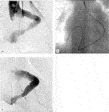
We treated 3 patients, aged 3, 13, and 14 years, who presented with coronary arterial fistulas. While two of them were without any symptoms, one patient showed breathlessness during exertion, and was on medication for congestive heart failure. At initial echocardiography, all showed a dilated left ventricle and, depending on the origin of the fistulas, a dilated proximal right or left coronary artery was seen. At catheterization, the ratio of pulmonary-to-systemic flows of 1.5 to 3 confirmed the echocardiographic impression of shunt-related left ventricular enlargement, while the anatomical details of the fistulas were investigated by angiography. This revealed 2 fistulas arising from the proximal right and left coronary arteries, with maximal diameters of 9 and 10 millimetres, and with their narrowest diameters of 6 millimetres proximal to the entrance into the right atrium via a saccular aneurysm (Fig. 1a). In the third patient, the fistula, with a maximal diameter of 16 millimetres, had its origin from the circumflex coronary artery, and entered the right atrium with nearly unrestricted flow, its narrowest diameter being 8 millimetres (Fig. 2a).

Figure 1. Angiography (a) in this male patient, aged 3 years, shows a coronary arterial fistula with a diameter from 6 to 10 millimetres originating from the proximal right coronary artery and draining into the right atrium via a saccular aneurysm After occlusion with the plug (b), further angiography confirms complete occlusion. The plug was 12 millimetres in diameter.

Figure 2. In this female patient, aged 13 years, digital subtraction angiography (a) shows a large coronary artery fistula, with a diameter from 8 to 16 millimetres, originating from the circumflex coronary artery and draining into the right atrium. The fistula was closed (b) having made an arteriovenous wire loop with an 8 French guide catheter, which was advanced from the femoral vein to the ascending aorta. A residual shunt was seen (c) soon after placement of the plug, which ad a diameter of 16 millimetres, and was placed at the narrowest segment of the fistula. Arrows show the slight compression of the plug, indicating correct placement at the narrowest segment of the fistula. The plug is still connected to the delivery cable.
Method
The device
Originally designed for arterial or venous embolizations in the peripheral vasculature, the Amplatzer vascular plug (AGA Medical Corp., Golden Valley, Minnesota, USA) is a self-expanding, cylindrical device made from 144 Nitinol mesh wires secured on both ends with platinum marker bands. Unlike other devices manufactured by this company, no fabric has been sown within the plug. The plug comes pre-loaded, attached to a stainless steel delivery cable 135 centimetres in length. The plugs range in diameter from 4 to 16 millimetres in 2-millimetre increments, and are 7 to 8 millimetres in length. For delivery, we could have used a 5 to 8 French standard coronary guide catheter, the recommended internal diameter being from 0.056 to 0.088 inches. As with other devices manufactured by the company, the plug can be repositioned or removed should placement not be satisfactory. The manufacturers recommend selection of a plug that is from one-third to half larger than the diameter of the target vessel.
The procedure
At the cardiac catheterization laboratory, the procedures were performed under sedation with Propofol, and additional visualisation of the anatomy by transoesophageal or transthoracic echocardiography. A standard catheterization was performed to evaluate the haemodynamic situation, and angiograms, including selective coronary arteriograms, showed the anatomy of the fistulas, this being important for measurement of the exact diameter of the malformations. For interventional closure, we chose plugs with twice the diameter of the narrowest segment of the fistula, specifically of 12 millimetres for 2 patients, and 16 millimetres for the third. In all cases, an arteriovenous wire loop was established through the fistula by snaring an exchange guide wire (Fig. 2b), which had been advanced from the arterial side into the right atrium via a standard 4 or 5 French multipurpose catheter. This allowed the exact placement of the plug via a 7 or 8 French guide catheter of internal diameter of 0.078 and 0.088 inches. This was then advanced from the femoral vein, while additional injections of contrast in the aortic root or the coronary arteries confirmed the correct position of the plug prior to, and after, releasing it from the delivery cable. After the procedure, which consumed 20 to 38 minutes screening time, and took from 100 to 120 minutes, we gave aspirin at 2 to 3 milligrams per kilogram per day for six months in order to prevent thromboembolic events.
Results
Under fluoroscopic guidance, all plugs were placed at the narrowest segment of the fistula, which produced a slight compression at the middle part of the device. Directly after placement of the device, we confirmed complete closure of 2 fistulas by angiography (Fig. 1b), and by transoesophageal or transthoracic echocardiography. When the device was still connected with the delivery cable, the third patient, with a fistula of the circumflex coronary artery, who received a plug of 16 millimetres, clearly showed a residual shunt on angiography (Fig. 2c). Turbulent flow through the wire mesh of the plug was also seen on transoesophageal echocardiography. One hour later, angiography and colour flow Doppler clearly showed diminished blood flow through the plug. At that time, discrete changes in the ST segment of the electrocardiogram were observed, but angiography confirmed that no major side branches of the circumflex artery were compromised by the plug. In addition, echocardiography showed no regional mechanical dysfunction of the ventricles. The decision was made to leave the device in place and it was released from its delivery cable. The patient received heparin, at 400 International Units per kilogram per day, until the electrocardiogram returned to normal 24 hours later. On follow-up examinations up to 9 months after placement of the plug, this patient still had a small residual shunt, but had complete relief of symptoms, with no need to continue anticongestive medication. At 12 months follow-up examination, complete occlusion of the residual shunt was demonstrated by colour flow Doppler. All patients showed normalization of left ventricular size on transthoracic echocardiography after follow-up of from 1 to 2 years.
Discussion
The new Amplatzer® vascular plug has been used for transcatheter closure in a variety of different malformations,8–11 but there are, up to now, only two reports concerning its use for closure of coronary artery fistulas in not more than 3 patients worldwide.8, 12 Our experience demonstrates an alternative to the use of coils or surgery to close such malformations. Like other devices made by the company, the plug is easy to use and retrievable, and has the potential to become the tool of first choice for closure of moderate to large sized coronary arterial fistulas. In comparison, occlusion using coils sometimes requires complex manipulation of catheters, as well as selection of various catheters and wires. In patients with complex anatomy, or large fistulas, multiple coils may be needed to occlude the malformation, which might lead to prolonged procedural and screening times. In these cases, the Amplatzer plug offers the advantage of using a single device for effective closure.
A potential limitation of the technique, especially in children, is the necessity to use relatively large guiding catheters. Because of this, it seemed essential to establish an arteriovenous wire loop through the coronary arterial fistulas. In our patients, this permitted us to use 7 and 8 French guide catheters, and to insert the device from the femoral vein. It might, however, be difficult or impossible to establish an arteriovenous wire loop in patients with a very tortuous root of the fistula. Because it is nearly impossible to enter the fistulas from the venous side, the only alternative approach could be the placement of the plug via the arterial route. But especially in children, this arterial approach, with the usage of large guiding catheters, could be inadequate. If this is the case, then occlusion with coils inserted through small 4 or 5 French catheters is the only option when an arteriovenous wire loop cannot be established.
Sometimes the anatomy of the fistula could be a limitation of any interventional technique, whether using a plug or coils. In cases with a very short and unrestricted route, for instance a fistula arising from the left coronary artery with drainage into a left heart chamber, attempted closure with a device courts the high risk of migration of the device to the systemic circuit, or even the coronary arterial circulation. This risk could be a strong argument against any attempt at transcatheter closure, and a surgical approach could be the safer option.13
In our patients, we chose to insert plugs of at least twice diameter of the fistula at its narrowest segment in order to prevent dislodgement. This choice exceeds the recommendation of the manufacturer to select a plug that is from one-third to half larger than the diameter of the target vessel. But the fluoroscopic pictures showed only a slight compression of the middle part of the implanted devices, which proved that the chosen devices were not too big, and indicated precise and secure placement at the narrowest segment of the fistula (Fig. 2c).
It could be speculated that the delayed spontaneous closure of the residual shunt is possibly due to the fact that the plug has no polyester fabrics sewn into it, as do the other devices manufactured by the company. In malformations producing high flows, this fact maybe relevant in combination with the usage of a large plug with a relatively larger pore size in the 144 Nitinol mesh wires. This was also the conclusion of a recently published multicentric study from the United States of America, where Hill et al.8 reported a significant residual shunt after an arterial duct had been occluded with a large plug of 14 millimetres diameter.
An important recommendation for transcatheter occlusion is to assure that there is no compromise of vital branches distal to the site of placement of the device. This can be done with test occlusion of the fistula, and selective injections of contrast using a wedge catheter. Test occlusion also offers the additional advantage to observe any changes in the electrocardiogram.14 In our patient who developed transient changes in the ST segment of the electrocardiogram, a comparison of angiographies before and after placement of the plug confirmed that no major side branches had been compromised, and the plug was left in place.
In conclusion, the Amplatzer plug is easy to use, even in children with moderate to large sized coronary arterial fistulas, and offers an attractive alternative to surgery or occlusion with coils. Caution is needed when using large plugs due to the observation of long lasting or persistent residual shunts, which might be related to the design of the device.