

The poor mental health of the construction industry is well established (Bryson & Duncan, Reference Bryson and Duncan2018; Chan, Nwaogu, & Naslund, Reference Chan, Nwaogu and Naslund2020; Milner, Niven, & LaMontagne, Reference Milner, Niven and LaMontagne2015; Milner, Spittal, Pirkis, & LaMontagne, Reference Milner, Spittal, Pirkis and LaMontagne2013; Roberts, Jaremin, & Lloyd, Reference Roberts, Jaremin and Lloyd2013; Suicide Mortality Review Committee, 2016). Construction workers have greater rates of mental distress than the general male population (Bowers, Lo, Miller, & Mawren, Reference Bowers, Lo, Miller and Mawren2018; Jacobsen et al., Reference Jacobsen, Caban-Martinez, Onyebeke, Sorensen, Dennerlein and Endresen Reme2013), and the construction industry has one of the highest suicide rates (Turner, Mills, Lkeiner, & Lingard, Reference Turner, Mills, Lkeiner and Lingard2017). In New Zealand, construction workers aged 20–24 years had the highest rates of suicide at 32.94 per 100,000 based on suicide data collected between 2007 and 2019 (Jenkin & Atkinson, Reference Jenkin and Atkinson2021). Similarly, every year, 190 Australian construction workers take their own lives, which equates to one death by suicide every second day (Mates in Construction, 2020), and young Australian construction workers are at greater risk of suicide relative to older workers (Heller, Hawgood, & De Leo, Reference Heller, Hawgood and De Leo2007). Several factors underlie the mental health issues of the construction industry, including the boom-bust cycle, the lack of work/life balance, drug and alcohol use, and the difficulties that stem from an intergenerational and ethnically diverse workforce (Bryson & Duncan, Reference Bryson and Duncan2018). Additionally, the toxic masculine culture contributes to the high rates of bullying behaviours that seem to be particularly apparent among young construction apprentices. In a large study of 1,483 Australian construction apprentices, Ross, Mathieu, Wardhani, Gullestrup, & Kõlves (Reference Ross, Mathieu, Wardhani, Gullestrup and Kõlves2021) found that 30% reported some experience of bullying, with 20% reporting being a victim of severe workplace of bullying. Common factors associated with bullying were working for a large employer, working for a group training organisation, not currently having an employer, not currently being in an apprenticeship, identifying as LGBTI+, and being aged 18–25.
Compared to other sectors across New Zealand, the construction industry employs younger workers on average, possibly due to the fact that it provides employment opportunities to those who may have come straight out of school, with minimal or no experience (Rice & Forgan, Reference Rice and Forgan2016). These young people are able to enter the industry and receive training through a construction apprenticeship. In an effort to rebuild the economy and stabilise employment levels in the wake of Covid-19, the government set up the Targeted Training and Apprenticeship Fund (TTAF) and the Apprenticeship Boost Programme to help employers keep and take on new apprentices through providing free or subsidised education and training (Tertiary Education Commission (TEC), n.d.). As a result of these initiatives, there has been a massive influx of apprentices into the construction industry (Beehive, 2020, 2021). With so many apprentices now entering the industry, more research is needed to explore factors, which may affect the mental health of New Zealand construction apprentices. In this way, the industry can gain a better understanding of how best to support their well-being.
Across both Australia and New Zealand, Mates in Construction (MATES) is the main organisation for addressing the mental health of the construction industry. Most of MATES's interventions stem from a deficit-based approach, whereby risk factors are targeted and reduced to prevent the incidence of poor mental health and suicide (Bryson & Duncan, Reference Bryson and Duncan2018). However, factors associated with fostering positive mental health equally play a role in preventing the incidence of poor mental health and buffer the effects of risk factors through increasing competency and resiliency (World Health Organisation [WHO], 2004). Indeed, positive mental health is defined as the presence of optimal well-being in addition to an absence of mental distress and/or psychopathology (WHO, 2004). These components do not function as exact opposites but rather operate on two separate continuums that are only moderately associated (Huppert & Whittington, Reference Huppert and Whittington2003; Keyes, Reference Keyes2005; Lamers, Westerhof, Bohlmeijer, ten Klooster, & Keyes, Reference Lamers, Westerhof, Bohlmeijer, ten Klooster and Keyes2011; Weich et al., Reference Weich, Brugha, King, McManus, Bebbington, Jenkins and Stewart-Brown2011; Westerhof & Keyes, Reference Westerhof and Keyes2010). Therefore, this dual-factor model of mental health supports examining factors associated with both optimal well-being and mental distress (Trompetter, de Kleine, & Bohlmeijer, Reference Trompetter, de Kleine and Bohlmeijer2017). However, little research within the construction industry has focused exclusively on factors contributing to the optimal well-being of young construction apprentices.
In the field of psychology, there are two approaches to conceptualising well-being derived from two philosophical stances, namely hedonism, where the focus is on being happy, and eudaimonism, where the focus is on living life in a full and deeply satisfying way (Chen, Jing, Hayes, & Lee, Reference Chen, Jing, Hayes and Lee2012; Deci & Ryan, Reference Deci and Ryan2008; Ryff, Reference Ryff1989). Based on hedonism, subjective well-being refers to a highly satisfying and emotionally pleasant life, with frequent positive emotions and infrequent negative emotions (Diener, Reference Diener1984). In contrast to subjective well-being, psychological well-being focuses on fulfilment of human potential and a meaningful life (Keyes, Shmotkin, & Ryff, Reference Keyes, Shmotkin and Ryff2002; Ryff, Reference Ryff1989, Reference Ryff2018). Taking this stance, Ryff (Reference Ryff1989) developed a comprehensive model of psychological well-being, which comprises six dimensions of positive functioning: self-acceptance (positive evaluations of oneself and one's life), personal growth (a sense of continued growth and development as a person), purpose in life (the belief that one's life has meaning and purpose), positive relationships with others (the experience of quality relationships with others), environmental mastery (the capacity to effectively manage one's life), and autonomy (a sense of self-determination). Ryff's psychological well-being model appears to be particularly useful to examine among construction apprentices. From a theoretical point of view, construction apprentices are embarking on a new career in the construction industry, and thus, they are more likely to be seeking to fulfil their human potential as opposed to the more basic subjective well-being goal of maximising feelings of happiness. Arguably, if they were seeking to achieve subjective well-being goals, they may not have signed up for a construction apprenticeship, which is notoriously hard work and could induce more negative emotions than positive ones. Given that psychological well-being has been described as perceived thriving in the face of life's challenges, Ryff's model appears to be the more suitable framework to explore among construction apprentices, who appear to be up against numerous adversities.
Self-compassion has recently gained attention as one construct that is shown to have a strong link with mental health (see Ferrari et al. (Reference Ferrari, Hunt, Harrysunker, Abbott, Beath and Einstein2019) for a review), yet Eastern philosophies have long understood its significance (Brach, Reference Brach2003; Harris, Reference Harris1997; Kabat-Zinn, Reference Kabat-Zinn2009). Self-compassion can be viewed as compassion directed inward towards the self (Neff, Reference Neff2003a), characterised in part by the ability to treat oneself with the same compassion and kindness as one would treat others in a similar circumstance (Biber & Ellis, Reference Biber and Ellis2017; Neff, Reference Neff2003b). There are various definitions and models of self-compassion, emphasising different aspects of the conceptualisation (Gilbert, Reference Gilbert2014, Reference Gilbert2018; Neff, Reference Neff2003b; Strauss et al., Reference Strauss, Lever Taylor, Gu, Kuyken, Baer, Jones and Cavanagh2016).
Gilbert (Reference Gilbert2014, Reference Gilbert2018) conceptualises compassion as a prosocial motivating system, comprising three evolved emotion systems, threat, drive, and soothing, that interact and regulate one another. According to this model, self-compassion is part of the soothing system, designed to regulate negative affect by being aware of suffering in self, and commitment to alleviate it by fostering feelings of warmth and safety.
Neff (Reference Neff2003a, Reference Neff2003b, Reference Neff2016) defines self-compassion as an attitude of kindness and understanding towards the self when experiencing personal disappointments and struggles and suggests that self-compassion is a tripartite construct that includes self- kindness, common humanity, and mindfulness. Self-kindness is the capacity to be supportive and empathic towards oneself during periods of suffering and failure, rather than being self-judgemental. Common humanity is the ability to understand that one's failures, imperfections and suffering are part of the shared human experience, rather than viewing one's suffering in isolation. Mindfulness is the capacity to pay attention to painful thoughts and feelings in a non-judgmental way, rather than allowing the self to over-identify with them. Additionally, self-compassion is described as having both ‘yin’ or female qualities that involve soothing, comforting, and validating suffering; and ‘yang’, or male qualities that stem from protecting, providing, and motivating action to relieve suffering (Neff & Germer, Reference Neff and Germer2018). Thus, self-compassion cannot be said to be ‘masculine’ or ‘feminine’ but instead surpasses this duality in its focus on the alleviation of suffering (Neff & Germer, Reference Neff and Germer2018; Yarnell, Neff, Davidson, & Mullarkey, Reference Yarnell, Neff, Davidson and Mullarkey2019). What appears most critical to compassion is to understand how compassion may give rise to both communal and agentic behaviours, depending on what can best serve one's goal to alleviate suffering (Gilbert & Mascaro, Reference Gilbert, Mascaro, Seppälä, Simon-Thomas, Brown, Worline, Cameron and Doty2017; Neff, Reference Neff2021; Quaglia, Reference Quaglia2022). Such a conceptualisation of self-compassion provides a more complete consideration of the wide range of possible compassionate behaviours.
Robust evidence supports the beneficial role of self-compassion on mental health (MacBeth & Gumley, Reference MacBeth and Gumley2012; Muris & Petrocchi, Reference Muris and Petrocchi2017). Self-compassionate people tend to report lower rates of psychological distress, such as anxiety, depression, and stress (Leary, Tate, Adams, Allen, & Hancock, Reference Leary, Tate, Adams, Allen and Hancock2007; MacBeth & Gumley, Reference MacBeth and Gumley2012; Neff, Kirkpatrick, & Rude, Reference Neff, Kirkpatrick and Rude2007a; Neff & Vonk, Reference Neff and Vonk2009). They also report higher rates of positive psychological outcomes, such as life satisfaction, happiness, social connectedness, perceived competence, and intrinsic motivation (Neff, Reference Neff2003b; Neff, Hsieh, & Dejitterat, Reference Neff, Hsieh and Dejitterat2005; Neff, Pisitsungkagarn, & Hsieh, Reference Neff, Pisitsungkagarn and Hsieh2008; Neff, Rude, & Kirkpatrick, Reference Neff, Rude and Kirkpatrick2007b). Within male-dominated, high-stress and physically demanding industries, a few studies have examined the role of self-compassion on mental health. Kotera, Green, and Sheffield (Reference Kotera, Green and Sheffield2019) explored the relationships among mental health shame, mental health problems, masculinity, motivation, and self-compassion among 155 UK construction workers. Findings indicated that self-compassion was negatively related to mental health problems and partially mediated the relationship between mental health shame and mental health problems. The authors concluded that compassion training to build self-compassion may be beneficial to construction workers’ mental health (Gilbert & Procter, Reference Gilbert and Procter2006; Kelly, Zuroff, & Shapira, Reference Kelly, Zuroff and Shapira2009). In a study of trauma-exposed fire-fighters, self-compassion was shown to buffer the association between self-criticism and depression (Kaurin, Schönfelde, & Wessa, Reference Kaurin, Schönfelde and Wessa2018). Additionally, research on policemen has shown the effective role of self-compassion in protecting against burnout, depression and anxiety (Kaplan, Bergman, Green, Dapolonia, & Christopher, Reference Kaplan, Bergman, Green, Dapolonia and Christopher2020; Trombka et al., Reference Trombka, Demarzo, Campos, Antonio, Cicuto, Walcher and Rocha2021). Finally, a review of self-compassion research in veteran samples has shown that self-compassion has an impact upon trauma-related disorders (e.g., post-traumatic stress disorder), resulting in reductions in anger, shame, distress, deliberate self-harm, and suicidal behaviour (Steen, Di Lemma, Finnegan, Wepa, & McGhee, Reference Steen, Di Lemma, Finnegan, Wepa and McGhee2021).
One study has unveiled interesting results on the relationship between self-compassion, workplace bullying and emotional exhaustion. As a target of workplace bullying, being subjected to incivility (berating or belittling by others) and ostracism (shunning and exclusion at work) are seen to increase employees’ experience of emotional exhaustion. Anjum, Liang, Durrani, and Parvez (Reference Anjum, Liang, Durrani and Parvez2020) examined if self-compassion moderated the effect of workplace incivility on emotional exhaustion and the effect of workplace ostracism on emotional exhaustion in 310 Pakistan service-sector employees. Findings indicated that self-compassion moderated both the workplace incivility–emotional exhaustion and workplace ostracism–emotional exhaustion relationships. In this way, following exposure to ostracism and incivility, people high in self-compassion felt less emotionally exhausted. These results demonstrate that self-compassion may also play an important role in buffering the effects of workplace bullying within the construction industry. However, more research is required to clarify self-compassion's role in moderating the effects of workplace bullying.
Despite the promising results on the protective role of self-compassion against psychopathology, to our knowledge, no research studies to date have focused exclusively on the role of self-compassion in fostering psychological well-being in construction workers. A few studies have explored the associations between self-compassion and psychological well-being as conceptualised by Ryff (Reference Ryff1989) among other populations. Results indicated that self-compassion was positively linked to all six dimensions of psychological well-being among women athletes (Ferguson, Kowalski, Mack, & Sabiston, Reference Ferguson, Kowalski, Mack and Sabiston2014); men athletes (Reis, Kowalski, Mosewich, & Ferguson, Reference Reis, Kowalski, Mosewich and Ferguson2019); and adolescents (Sun, Chan, & Chan, Reference Sun, Chan and Chan2016). Additionally, self-compassion uniquely predicted psychological well-being in older adults (Homan, Reference Homan2016).
This study sought to expand the literature by investigating the relationships among self-compassion, psychological well-being, psychological distress and bullying among New Zealand construction apprentices. On the basis of past research, we hypothesised that self-compassion would be positively associated with psychological well-being and negatively associated with psychological distress and bullying. We also hypothesised that self-compassion would uniquely predict each of the six dimensions of psychological well-being. Finally, we hypothesised that self-compassion would moderate the relationship between bullying and psychological distress.
Method
Participants
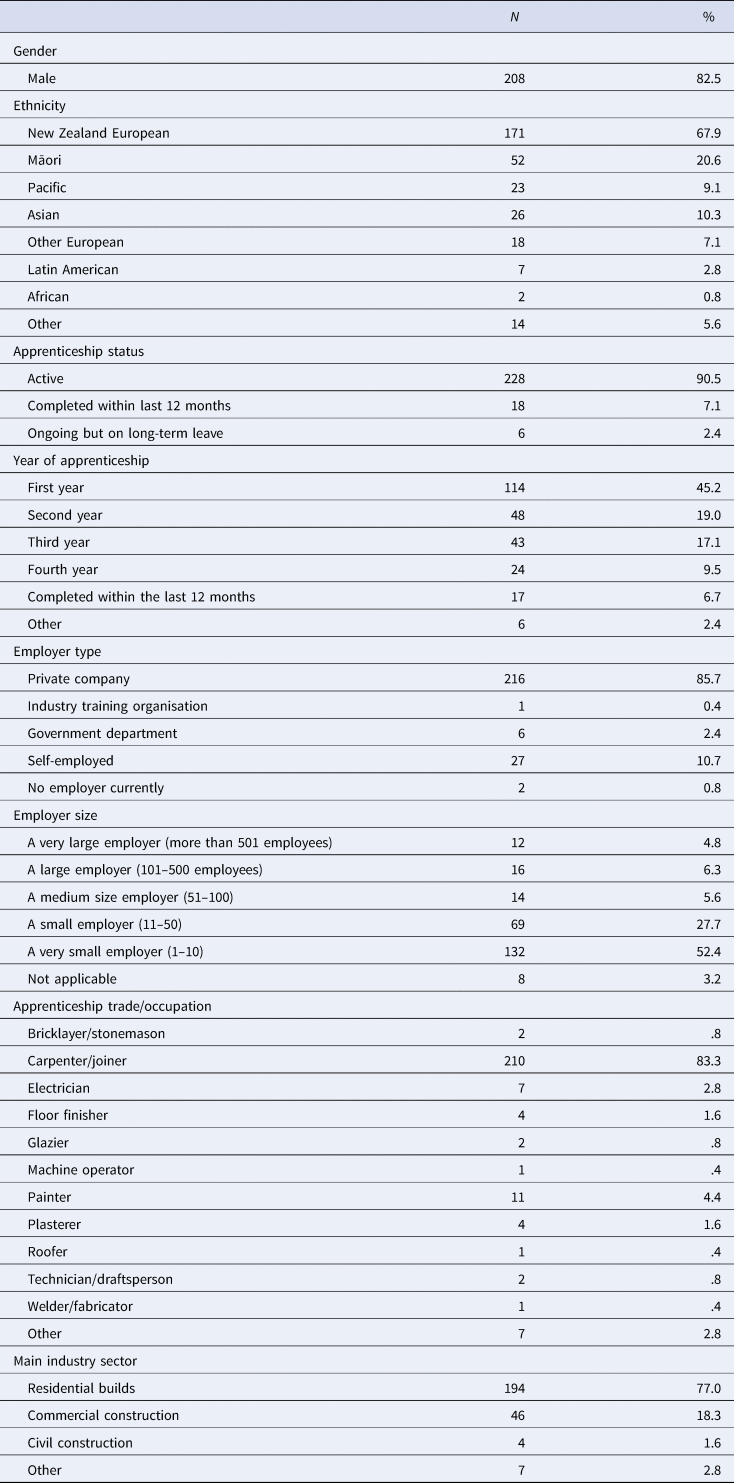
Of the 252 construction apprentices included in this report, 82.5% were male, which is representative of the gender distributions among construction workers in New Zealand (e.g., 82% male in 2021; Construction Sector Accord, 2021). Participants’ age ranged from 17 to 63 years, with an average age of 30.77 years (SD = 10.03). Participants predominantly identified as New Zealand European (67.9%), followed by Māori (20.6%), 10% Pacific, and 10% Asian peoples, consistent with ethnicity percentages reported at the whole-industry level in 2021 (e.g., MBIE, 2021). Ninety percent of participants had an active apprenticeship status; 45% were in the first year of their apprenticeship; 86% worked for a private company; and more than half of participants worked for an employer with 1–10 employees. Of the 12 different apprenticeship trade options, the majority (83.3%) selected that of carpenter/joiner. Detailed information of the participant characteristics and apprenticeship background are presented in Table 1.
Participant Characteristics and Apprenticeship Background (N = 252)

Note. Sum of columns for ethnicity exceeds 100% because of the option to select as many as applied.
Procedure
Ethics approval was obtained from the Human Ethics Committee of Massey University (Ethics Approval: SOA 21/19). Participants were recruited via non-random convenience sampling. Four construction-related organisations (e.g., trades-training institutions and companies that focus on construction workers site safety or mental health) agreed to help with the recruitment of participants. Interested participants were sent an invitation email containing a link to study information and the survey. Inclusion required that the participants were (i) currently enrolled in and/or completing an apprenticeship within the New Zealand Construction Industry; or having completed an apprenticeship within the last 12 months; (ii) fluent in English; and (iii) 16 years or over. Response rates are difficult to determine as the anonymous nature of recruitment precluded our tracking the number of apprentices who received email invites. Participants followed links to Qualtrics to complete a 20-min survey, which included questions about demographics, and standardised scales on self-compassion, psychological well-being, psychological distress, and bullying. Participation in the study was voluntary and anonymous, and the completion of the questionnaire was taken to imply consent. Participants who completed the questionnaire were invited to enter a draw to win one of ten $40 vouchers.
Measures
Background characteristics
The first section of the survey on background characteristics was informed by the survey questions used in a previous research study among Australian construction apprentices (Ross et al., Reference Ross, Mathieu, Wardhani, Gullestrup and Kõlves2021). Participants answered questions on age, English language fluency, gender, and ethnicity. They also answered questions related to the apprenticeship background, including status (e.g., active), stage of completion (in years), type of trade training, company type, company size, and industry sector.
Self-compassion
The 12-item Self-Compassion Scale — Short Form (SCS-SF; Raes, Pommier, Neff, & Van Gucht, Reference Raes, Pommier, Neff and Van Gucht2011) was used to measure self-compassion, namely the ability or tendency to which participants respond to oneself with kindness and understanding in times of failure or distress. Participants rate items using a five-point Likert scale, ranging from 1 (almost never) to 5 (almost always). The short form correlates almost perfectly with the original, longer version of the scale (Neff, Reference Neff2003b). The SCS-SF has robust psychometric properties, possessing high internal reliability, and high face, content, convergent, and divergent validity (Neff, Reference Neff2016; Raes et al., Reference Raes, Pommier, Neff and Van Gucht2011). Item responses were reversed where necessary and averaged to create a single self-compassion score with higher scores indicating greater self-compassion. For the current study, Cronbach's alpha coefficient was .81.
Psychological well-being
Psychological well-being was evaluated using the 42-item version of the Scales of Psychological Well-Being (PWB; Ryff & Keyes, Reference Ryff and Keyes1995). Accounting for each of the six dimensions of psychological well-being, the scale consists of six subscales: self-acceptance (e.g., ‘In general, I feel confident and positive about myself’), positive relationships with others (e.g., ‘Most people see me as loving and affectionate’), personal growth (e.g., ‘I think it is important to have new experiences that challenge how I think about myself and the world’), purpose in life (e.g., ‘I have a sense of direction and purpose in life’), environmental mastery (e.g., ‘In general, I feel I am in charge of the situation in which I live’), and autonomy (e.g., ‘I am not afraid to voice my opinions, even when they are in opposition to the opinions of most people’). Participants indicate agreement with each item using a six-point scale (1 = strongly disagree to 6 = strongly agree). Items were reversed when necessary, and items comprising each subscale were averaged. For this study, Cronbach's alpha coefficients for each subscale were as follows: .84 for self-acceptance; .74 for positive relations with others; .72 for personal growth; .74 for purpose in life; .77 for environmental mastery; and .71 for autonomy.
Psychological distress
Psychological distress was measured with the 6-item Kessler Psychological Distress scale (K6; Kessler et al., Reference Kessler, Green, Gruber, Sampson, Bromet, Cuitan and Zaslavsky2010). Participants rate how often in the past 30 days they felt ‘nervous’, ‘hopeless’, ‘restless or fidgety’, ‘so depressed that nothing could cheer you up’, ‘that everything was an effort’, and ‘worthless’ (Kessler et al., Reference Kessler, Green, Gruber, Sampson, Bromet, Cuitan and Zaslavsky2010). Response categories for these items are on a five-point scale, ranging from 0 (all of the time) to 4 (none of the time). Item responses were summed to create a single psychological distress score with higher scores indicating greater psychological distress. K6 sum scores were also trichotomized into three categories: ‘low’ (scores between 0–7), ‘moderate’ (scores between 8–12), and ‘high’ (scores 13 and above) (Krynen, Osborne, Duck, Houkamau, & Sibley, Reference Krynen, Osborne, Duck, Houkamau and Sibley2013). Cronbach's alpha coefficient for this study was .86.
Bullying
Bullying was assessed using the Negative Acts Questionnaire—Revised (NAQ-R; Einarsen, Hoel, & Notelaers, Reference Einarsen, Hoel and Notelaers2009). The 22-item NAQ-R scale is designed to measure workplace bullying or persistent negative acts, which have the effect of making an employee feel humiliated, intimidated, frightened, or punished. Items are rated on a 5-point rating scale from 1 (never) to 5 (daily), with three subscales — person-related, work-related, and physical intimidation forms of bullying as well as a single factor measure. For the purposes of the current report, items were summed to create a single bullying score with higher scores indicating greater bullying (Notelaers & Einarsen, Reference Notelaers and Einarsen2013). Furthermore, the summated scores were explained using a categorical approach, namely participants with a score lower than 33 were considered not bullied, participants with a score between 33 and 45 were considered as being bullied occasionally, and those who scored above 45 were considered to be victims of workplace bullying (Notelaers & Einarsen, Reference Notelaers and Einarsen2013). The scale has robust psychometric properties, particularly in terms of construct validity, criterion validity, and internal stability (Einarsen et al., Reference Einarsen, Hoel and Notelaers2009). The NAQ-R has also good sensitivity and can accurately distinguish between groups of employees with different levels of exposure to bullying, ranging from infrequent exposure to severe workplace bullying. Cronbach's alpha coefficient for this study was .94 for the total score.
Results
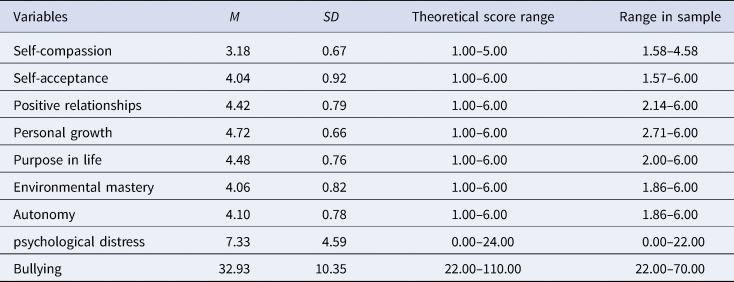
Participants 16 years of age or older who gave consent to participate and completed the entire questionnaire were included in the study. A total of 259 participants responded to the Qualtrics questionnaire. One score in the personal growth subscale of the PWB scale and six scores in the NAQ-R scale were identified as outliers with z scores above 3.29 or less than −3.29. After this initial cleaning process, a total of 252 participants were left for data analysis. Preliminary data analyses demonstrated that these data were suitable for regression analysis, given that all variables were normally and linearly distributed after removal of outliers (Tabachnick & Fidell, Reference Tabachnick and Fidell2013). Skewness values (−0.54 to 1.29), and kurtosis values (−0.56 to 1.40) were of no concern (i.e., less than 3.0 for skew and less than 10.0 for kurtosis; Kline, Reference Kline2010). Internal consistencies for all of the scales and subscales were high (α ≥ .71). Means, standard deviations, theoretical score range, and range in sample for the major study variables are presented in Table 2. The mean score of self-compassion (3.18 of 1–5) was almost identical to 155 construction workers in the UK (Kotera et al., Reference Kotera, Green and Sheffield2019). The mean score of psychological distress (7.33) was below the serious mental illness clinical range of 13–24 (Kessler et al., Reference Kessler, Barker, Colpe, Epstein, Gfroerer, Hiripi and Zaslavsky2003), yet close to the moderate level (8; Krynen et al., Reference Krynen, Osborne, Duck, Houkamau and Sibley2013).
Means, Standard Deviations, Theoretical Score Range, and Range in Sample for the Major Study Variables (N = 252)

Further analyses, where we converted K6 sum scores into ‘low’ (0–7), ‘moderate’ (8–12), and ‘high’ (13 and above) (Krynen et al., Reference Krynen, Osborne, Duck, Houkamau and Sibley2013) indicated that 73 (29%) apprentices were experiencing moderate psychological distress, and 38 (15%) were experiencing serious psychological distress. Lastly, the mean score of bullying (32.93) was in the normal range, yet close to the 33–45 score range, interpreted as being bullied occasionally (Notelaers & Einarsen, Reference Notelaers and Einarsen2013). When using the categorical levels (see Notelaers & Einarsen, Reference Notelaers and Einarsen2013), findings indicated that 66 (26%) apprentices reported being bullied occasionally, and 29 (11.5%) reported being victims of workplace bullying. More than half of the apprentices (157; 62%) reported not being bullied.
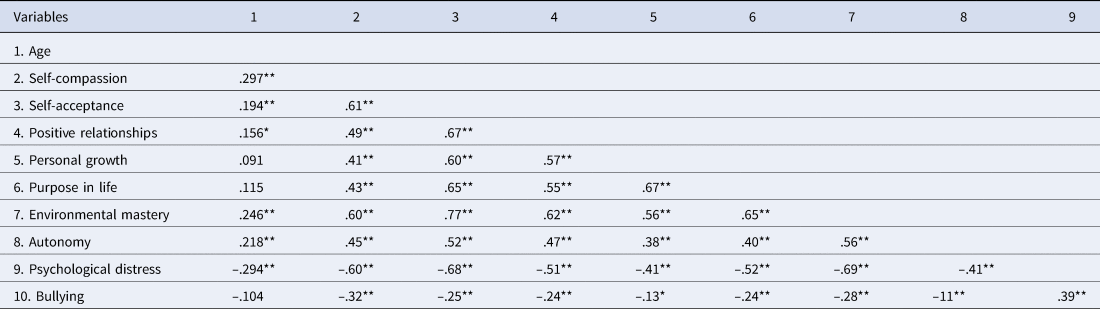
Self-compassion was positively correlated with all psychological well-being dimensions and in the expected directions. Furthermore, self-compassion was negatively correlated with psychological distress consistent with previous work, where higher levels of self-compassion were associated with lower levels of psychological distress (e.g., see Kotera et al., Reference Kotera, Green and Sheffield2019). As expected, bullying was positively correlated with psychological distress. In line with prior research findings (Neff & Vonk, Reference Neff and Vonk2009), age had a significant positive association with self-compassion and a significant negative association with psychological distress, indicating that greater age was associated with greater self-compassion and less psychological distress (refer to Table 3 for specific correlation values).
Correlations among Age, Self-Compassion, Psychological Well-Being Subscales, Psychological Distress and Bullying (N = 252)

*p < .05 level (two-tailed); **p < .01 level (two-tailed).
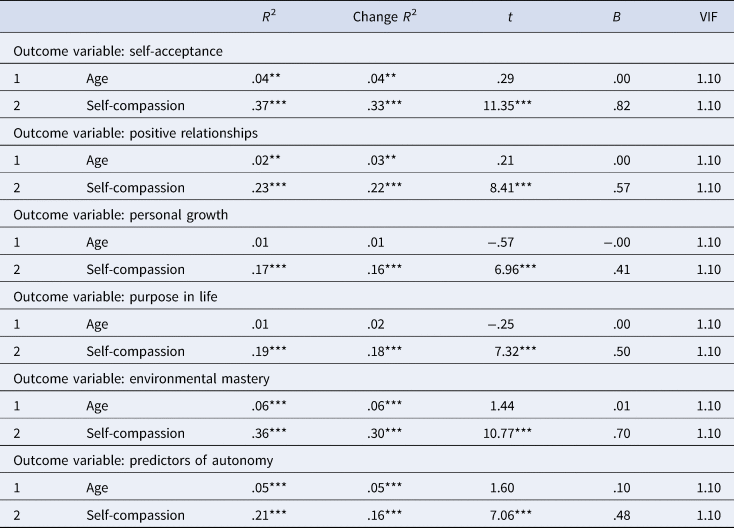
In order to test the unique contribution of self-compassion to psychological well-being, six hierarchical regression analyses were performed. In each analysis, one of the six psychological well-being dimensions was regressed on age to control for its effect, because it correlated positively with some aspects of psychological well-being. In Step 2, self-compassion was entered. Results are presented in Table 4. For every psychological well-being dimension, self-compassion explained unique variance, above and beyond the effect of age, indicating that as self-compassion increases, these dimensions of psychological well-being also increase. Effect sizes were moderate, ranging from R 2 = .17 for the total model involving personal growth as the criterion variable to R 2 = .37 for the total model for self-acceptance.
Summary of Hierarchical Regression Analyses for Self-Compassion Predicting Dimensions of Psychological Well-Being (N = 252)

**p < .01 level (two-tailed); ***p < .001 (two-tailed).
To test the moderating effect of self-compassion on bullying and psychological distress, a hierarchical regression analysis was conducted with psychological distress as the dependent variable. Self-compassion and bullying were mean centred. At Step 1, psychological distress was regressed on age to control for its effect. At Step 2, self-compassion and bullying were entered. At Step 3, an interaction term, formed by multiplying these two predictor variables, was entered (Frazier, Tix, & Barron, Reference Frazier, Tix and Barron2004). The effect of self-compassion on psychological distress was negative and significant (B = −3.36, t = −9.07, p < .001). The effect of bulling on psychological distress was positive and significant (B = .9, t = 3.70, p < .001). However, the interaction between self-compassion and bulling was not statistically significant [B = −.02, t = −.58, p = .560), contrary to the hypothesis that self-compassion moderates the effect of bullying on psychological distress.
Discussion
The present study examined the relationships between self-compassion, psychological well-being, psychological distress, and bullying in construction apprentices. We found that (1) self-compassion was positively related to psychological well-being (and each of its six dimensions) and negatively associated with psychological distress and bullying; (2) self-compassion uniquely predicted six dimensions of psychological well-being; and (3) contrary to our hypothesis, self-compassion did not moderate the relationship between bullying and psychological distress.
In accordance with several of the dominant construction industry characteristics, the prevalent features of participants in the current study were that they were male, training to be a carpenter/joiner and working for small, private companies in the residential sector (MBIE, 2021; Stats NZ, 2020). Relative to 2018/2019 New Zealand statistics, construction apprentices in our study reported significantly higher levels of psychological distress possibly due to risk factors that are prevalent in the construction apprentice environment, such as bullying (Ross et al., Reference Ross, Mathieu, Wardhani, Gullestrup and Kõlves2021). Another possible explanation for this difference is that our study comprised a much smaller and fairly homogenous sample of males from low-educational and low-socioeconomic backgrounds; factors that are generally associated with higher rates of psychological distress (Macintyre, Ferris, Gonçalves, & Quinn, Reference Macintyre, Ferris, Gonçalves and Quinn2018). Furthermore, the prevalence of psychological distress in the New Zealand population consistently rises each year and, hence, it is possible the prevalence of psychological distress to have increased over this time period, especially given the occurrence of Covid-19 (Anderson, Dominick, Langley, Painuthara, & Palmer, Reference Anderson, Dominick, Langley, Painuthara and Palmer2020; Wilson & Nicolson, Reference Wilson and Nicolson2020). With regard to bullying, 26% apprentices reported being occasionally bullied and 11.5% reported being victims of workplace bullying. These findings are somewhat similar to Ross et al.'s (Reference Ross, Mathieu, Wardhani, Gullestrup and Kõlves2021) findings, which showed that 21.4% of respondents scored above the cut-off of being bullied occasionally, though a larger percentage (20%) scored above the cut-off for being a victim of severe workplace bullying. It is possible that this finding reflects a genuine difference in the level of exposure to bullying in construction apprentices in New Zealand versus Australia. However, as noted previously, our sample of construction apprentices was smaller and did not represent all of the industry diversity in apprenticeship backgrounds. For instance, the current study lacked participants who worked for a large employer, a group training organisation, trained for other trades, or who were not employed or active in their apprenticeship, factors which have been found to increase an apprentices’ exposure to bullying (Cherry et al., Reference Cherry, Arrandale, Beach, Galarneau, Mannette and Rodgers2018; Ross et al., Reference Ross, Mathieu, Wardhani, Gullestrup and Kõlves2021). Given this, perhaps the levels of bullying recorded in this study do not accurately reflect the overall levels of bullying experienced by New Zealand apprentices in the wider construction industry.
In our correlational analysis (Table 3), self-compassion was positively correlated with all psychological well-being dimensions and in the expected directions. This echoed previous findings (Ferguson et al., Reference Ferguson, Kowalski, Mack and Sabiston2014; Homan, Reference Homan2016; Reis et al., Reference Reis, Kowalski, Mosewich and Ferguson2019), suggesting that self-compassion is related to all facets of psychological well-being. Consistent with previous findings (Kotera et al., Reference Kotera, Green and Sheffield2019), self-compassion was negatively correlated with psychological distress, suggesting that there were many construction apprentices who had low self-compassion and high psychological distress, or vice versa. As expected, bullying was positively correlated with psychological distress. While we found no age-related differences in exposure to workplace bullying, there were age-related differences in the levels of self-compassion and psychological distress. Specifically, findings indicated that older construction apprentices reported significantly more self-compassion compared to younger apprentices, consistent with previous research, which showed that self-compassion increases with age (Neff & Vonk, Reference Neff and Vonk2009; Tóth-Király & Neff, Reference Tóth-Király and Neff2021). It is possible that an individual's life experience eventually leads them to a more compassionate perspective to life as they get older (Homan, Reference Homan2016). With regard to psychological distress, younger apprentices appeared to be significantly more distressed than older ones, consistent with findings on mental distress for the New Zealand population as a whole, where a greater proportion of 15–24-year-old experience high levels of anxiety, depression, or mental distress than that of older age groups (Wilson & Nicolson, Reference Wilson and Nicolson2020). As age increases, the proportion of people reporting high levels of anxiety, depression, or mental distress decreases, which could be partly explained by older people being more self-compassionate.
Self-compassion predicted each psychological well-being dimension above the effect of age, providing evidence for the main hypothesis and supporting the notion that self-compassion may be a valuable mechanism to tackle the poor mental health of construction workers. Consistent with previous findings (Ferguson et al., Reference Ferguson, Kowalski, Mack and Sabiston2014; Homan, Reference Homan2016; Reis et al., Reference Reis, Kowalski, Mosewich and Ferguson2019), the relationship between self-compassion and self-acceptance was the strongest. This robust relationship is not difficult to understand given that one of the core elements of self-compassion is self-kindness and, by definition, self-kindness involves recognising and accepting one's weaknesses and strengths (Homan, Reference Homan2016). The link between self-compassion and positive relations with others is also unsurprising. It makes sense and has been demonstrated, in several studies, that self-compassionate behaviours flow into one's interactions with others, resulting in more positive personal relations (Neff & Beretvas, Reference Neff and Beretvas2013; Yarnell & Neff, Reference Yarnell and Neff2013; Zhang, Chen, & Tomova Shakur, Reference Zhang, Chen and Tomova Shakur2020). Finally, the associations between self-compassion, environmental mastery, and personal growth are perhaps best understood from a motivational perspective (Homan, Reference Homan2016). Self-compassion is associated with realistic self-appraisal, which is seen to increase the desire to learn and improve oneself or seek out challenges that would enhance growth as a person. Subsequently, the awareness that one can grow to better adapt to the external environment is understood to increase one's experience of environmental mastery (Homan, Reference Homan2016).
Finally, as expected, the effect of bulling on psychological distress was positive and significant, suggesting that as bullying increases, so too does psychological distress (Anjum et al., Reference Anjum, Liang, Durrani and Parvez2020; Doran, Rebar, Waters, & Meredith, Reference Doran, Rebar, Waters and Meredith2020; National Academies of Sciences, Engineering, & Medicine, 2016; Pidd, Duraisingam, Roche, & Trifonoff, Reference Pidd, Duraisingam, Roche and Trifonoff2017; Ross et al., Reference Ross, Mathieu, Wardhani, Gullestrup and Kõlves2021). Equally consistent with previous findings (Kotera et al., Reference Kotera, Green and Sheffield2019; Luo et al., Reference Luo, Meng, Li, Liu, Cao and Ge2019; MacBeth & Gumley, Reference MacBeth and Gumley2012; Muris & Petrocchi, Reference Muris and Petrocchi2017; Reis et al., Reference Reis, Kowalski, Mosewich and Ferguson2019), the effect of self-compassion on psychological distress was negative and significant, indicating that as self-compassion increases, psychological distress decreases. However, contrary to previous findings (Anjum et al., Reference Anjum, Liang, Durrani and Parvez2020) and our hypothesis, self-compassion did not moderate the effect of workplace bullying on psychological distress. A possible explanation may be that, while emotional exhaustion and psychological distress are strongly linked with each other, they are indeed separate constructs and the contradictory findings likely reflect the different constructs measured. On the other hand, it could be that self-compassion did not moderate the relationship between bullying and psychological distress because the effects of bullying were so severe, and the pathways through which these effects occurred were so engrained that self-compassion had no effect.
It is important to interpret this study in light of its limitations. Firstly, the correlational cross-sectional design reveals the direction and strength of relationships between one point in time, but it does not allow conclusions about causality. Furthermore, as with cross-sectional mediation (Maxwell & Cole, Reference Maxwell and Cole2007), cross-sectional analyses of processes involving moderation cannot always be trusted to yield accurate estimates of true underlying longitudinal processes. Longitudinal research, which could test whether hypothesised causal variables temporally precede outcomes, and experimental work, which could definitively demonstrate causal effects, are both needed. Secondly, the study sample was fairly homogenous and did not accurately represent all of the diversity in apprenticeship backgrounds that characterises the wider industry, limiting the generalizability of the findings. Researchers may wish to replicate in more diverse larger samples. Finally, the study relied upon self-report measures, which are susceptible to participant error and social desirability. Future research, which may include a qualitative component to acquire greater knowledge of how self-compassion exerts its effects on psychological well-being and psychological distress in the construction apprentice population, is needed.
These limitations notwithstanding, findings from the current study highlight the role of self-compassion as a promising mechanism through which to improve the psychological well-being of construction apprentices. Up until now, research and interventions within the construction industry have mostly focussed on identifying and targeting risk factors to reduce the poor mental health of workers in the construction industry. Given the alarming levels of psychological distress and bullying reported in this study, as well as the fact that these are associated with apprenticeship non-completion, absenteeism, presenteeism, avoidance coping, and alcocol and other drug use, it is urgent to also focus on protective factors, such as self-compassion, that may inform the development of strength-based interventions within the New Zealand construction industry. A future step in the field of construction workers’ mental well-being might be to adapt and evaluate the efficacy of a self-compassion intervention specifically tailored to construction apprentices and workers, similar to what has been successfully accomplished with a population of veterans (Serpa, Bourey, Adjaoute, & Pieczynski, Reference Serpa, Bourey, Adjaoute and Pieczynski2021). Given the Covid-19 pandemic still generating uncertainty (Gluckman & Bardsley, Reference Gluckman and Bardsley2020), the isolated locations of many construction sites, and the appeal of minimal training, such an intervention should be a brief (see Haukaas, Gjerde, Varting, Hallan, & Solem, Reference Haukaas, Gjerde, Varting, Hallan and Solem2018; Smeets, Alberts, Peters, & Neff, Reference Smeets, Alberts, Peters and Neff2014) and potentially web-based adaptation of the Mindful Self-Compassion programme (Eriksson, Germundsjö, Åström, & Rönnlund, Reference Eriksson, Germundsjö, Åström and Rönnlund2018).
Acknowledgements
We would like to extend a heartfelt thank you to the participants for their generosity in contributing to this study.
Ethical standards
The authors assert that all procedures contributing to this work comply with the ethical standards of the Massey University Human Ethics Committee and with the Helsinki Declaration of 1975, as revised in 2008 (Ethics approval: SOB 21/19).