INTRODUCTION
The life cycles of ommastrephid squids have evolved within the contexts of the oceanographic regimes where they occur (Anderson & Rodhouse, Reference Anderson and Rodhouse2001). The general patterns of the ecology of widely-ranging species are best identified by examining large-scale physical factors such as ocean climate and major currents. However the biology, distribution and population structure of some squid have been clarified by considering local hydrographic regimes (Coelho, Reference Coelho1985).
According to several authors, most ommastrephids take advantage of productive areas for feeding, mating and spawning (Haimovici et al., Reference Haimovici, Brunetti, Rodhouse, Csirke, Leta, Rodhouse, Dawe and O'Dor1998; Murata & Nakamura, Reference Murata, Nakamura and Okutani1998; Kiyofuji & Saitoh, Reference Kiyofugi and Saitoh2004; Gilly et al., Reference Gilly, Elliger, Salinas, Camarillo-Coop, Bazzino and Beman2006). Because paralarvae are useful indicators of spawning/hatching grounds and their abundance can be used to assess the stock–recruitment relationship, interest in the study of the early life stages of squid has increased in the last decade. However, many studies have focused on worldwide taxonomic identification (e.g. Harman & Young, Reference Harman and Young1985; Young & Hirota, Reference Young and Hirota1990; Sweeney et al., Reference Sweeney, Roper, Mangold, Clarke and Boletzky1992; Ramos-Castillejos et al., Reference Ramos-Castillejos, Salinas-Zavala, Camarillo-Coop and Enriquez-Paredes2010), paralarval distribution and abundance patterns (Bower et al., Reference Bower, Nakamura, Mori, Yamamoto, Isoda and Sakurai1999; Vecchione, Reference Vecchione1999; Yatsu, Reference Yatsu1999; Goto, Reference Goto2002; Camarillo-Coop, Reference Camarillo-Coop2006; Yamamoto et al., Reference Yamamoto, Shimura, Uji, Masuda, Watanabe and Sakurai2007) and the relationship between squid and their environment (Sakurai et al., Reference Sakurai, Kiyofuji, Saitoh, Goto and Hiyama2000; Anderson & Rodhouse, Reference Anderson and Rodhouse2001; Waluda et al., Reference Waluda, Rodhouse, Podestá, Trathan and Pierce2001; Ichii et al., Reference Ichii, Mahapatra, Sakai and Okada2009). Until now, the early life history dynamics of squid have remained poorly understood.
The jumbo squid Dosidicus gigas (d'Orbigny, 1835) is endemic to the eastern tropical Pacific, ranging from southern California, USA (37°N) to Tierra de Fuego, Chile (47°S) (Nesis, Reference Nesis and Boyle1983). However, adult squid have been caught in Oregon, British Columbia (Canada) and Alaska in recent years, and the reasons for their presence in such northern latitudes remain unknown (Zeidberg & Robison, Reference Zeidberg and Robison2007).
Dosidicus gigas is the only ommastrephid in Mexican commercial catches. The fishery is focused mainly in the central area of the Gulf of California (hereafter GC). The reproductive biology of this species has been studied during several fishing periods in the GC (Ehrhardt et al., Reference Ehrhardt, Jacquemin, García, González, López, Ortíz, Solís and Caddy1983, Reference Ehrhardt, Solís, Jacquemin, Ortíz, Ulloa, González and García1986; Ramírez & Klett, Reference Ramírez and Klett1985; Hernández-Herrera et al., Reference Hernández-Herrera, Morales-Bojórquez, Cisneros-Mata, Nevárez-Martínez and Rivera-Parra1998; Markaida & Sosa-Nishizaki, Reference Markaida and Sosa-Nishizaki2001; Díaz-Uribe et al., Reference Díaz-Uribe, Hernández-Herrera, Morales-Bojórquez, Martínez-Aguilar, Suárez-Higuera and Hernández-López2006; Nigmatullin & Markaida, Reference Nigmatullin and Markaida2009). The first records of spawning peaks suggested during the 1980s should be taken with caution because sexual maturity stages were assigned from personal observations without an appropriate maturity scale. Ehrhardt et al. (Reference Ehrhardt, Jacquemin, García, González, López, Ortíz, Solís and Caddy1983) suggested three spawning peaks according to percentages of mature females, nevertheless some of these percentages were too low to be considered as indicator of spawning peak (31.1%, 30%), moreover the stage that they assigned as stage V is difficult to see because the squids die and sink.
Since the 1990s the reproductive studies in GC have considered several maturity scales and the most used for this species has been from Lipinski & Underhill (Reference Lipinski and Underhill1995). Markaida & Sosa-Nishizaki (Reference Markaida and Sosa-Nishizaki2001) found that a small proportion of mature females were present in almost all months (from November 1995 to June 1997, with the exception of December 1996). These findings suggest that the reproductive cycle of D. gigas occurs throughout the year.
Unfortunately, few studies have focused on the early life stages of this species in comparison with studies on their reproductive biology in the GC and other locations of their distribution area. To date, our knowledge of early life stages comes from only a few reports. Gilly et al. (Reference Gilly, Elliger, Salinas, Camarillo-Coop, Bazzino and Beman2006) found paralarvae and juvenile of D. gigas in the area of the San Pedro Mártir basin. More recently, Staff et al. (2008) described the first natural egg mass and hatchlings collected in the Guaymas basin. These findings confirm that central GC is a spawning area; they represent the background for the present study.
The GC is the only evaporative marginal sea of the eastern subtropical Pacific Ocean (Roden, Reference Roden1958). Winds are seasonal and are north-westerly in the winter and south-easterly in the summer (Roden, Reference Roden1958; Badan-Dangon et al., Reference Badan-Dangon, Koblinsky and Baumgartner1985). Seasonal coastal upwelling occurs both on the western side (during the summer) and the eastern side (during the winter) of the GC. As a result of upwelling, wind mixing and winter convection, some areas are characterized by high levels of biological productivity. The principal water masses in the central gulf are Pacific Intermediate Water (PIW) and Pacific Deep Water (PDW) both below about 600 m. Overlying PIW between 150 and 500 m is found Subtropical Subsurface Water (StSsW) and, because of its high temperature in the upper layers Central Gulf Water (CGW) is always found (Bray, Reference Bray1988; Lavín & Marinone, Reference Lavín, Marinone, Velasco Fuentes, Sheinbaum and Ochoa2003).
This paper examines the presence of D. gigas paralarvae in the central GC in relation to the local oceanographic features. The data were collected during four research cruises across all seasons of 2008. The aims of this study were to: (i) investigate whether D. gigas paralarvae are present year round as suggested by previous reproductive biology studies; and (ii) describe the horizontal and vertical physical oceanographic conditions where D. gigas paralarvae are found.
MATERIALS AND METHODS
Sampling and laboratory analysis
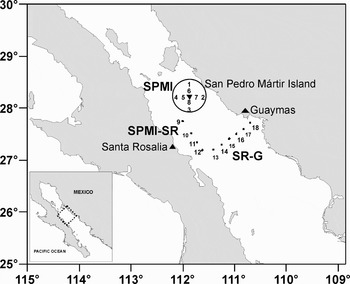
Four surveys were conducted in the central GC in 2008 to collect Dosidicus gigas paralarvae. Plankton samples were collected in February, April, June and September on-board RV ‘BIP XII’ del Centro de Investigaciones Biológicas del Noroeste. Sampling stations were located in three defined areas: (i) around San Pedro Mártir Island (SPMI) with 8 concentric stations, 4 of these stations were located 5 km from the island and 4 stations were 10 km from the island; (ii) a transect from San Pedro Mártir Island to Santa Rosalia (SPMI-SR), with 4 stations sampling; and (iii) a transect from Santa Rosalia to Guaymas (SR-G) with 6 stations (Figure 1). Samples were collected using a 0.50 m diameter dual bongo net with 0.5 mm mesh. A 10 minute oblique tow was conducted at each station. Considering the vertical distribution known for other ommastrephid paralarvae (Harman & Young, Reference Harman and Young1985; Young & Hirota, Reference Young and Hirota1990), samples were collected between the surface and approximately 150 m depth. When the bottom depth was less than 150 m, the net was kept at 10 m from the seafloor. The ship's towing speed was approximately 1 knot during sample collection. On-board, plankton samples from one net were fixed in 75% ethanol. Samples from another net were fixed in a 4% buffered formaldehyde–seawater solution. In the laboratory, all cephalopod paralarvae were removed from the samples.
Location of sampling stations in the central Gulf of California. Samples were taken during February, April, June and September 2008: (i) around San Pedro Mártir Island (SPMI); (ii) transect from San Pedro Mártir Island to Santa Rosalia (SPMI-SR); (iii) transect from Santa Rosalia, BCS to Guaymas, Son (SR-G).

Paralarvae from the family Ommastrephidae were sorted based on the distinctive rhynchoteuthion form (Nesis, Reference Nesis1979; Wormuth et al., Reference Wormuth, O'Dor, Balch, Dunning, Forch, Harman, Rowell, Sweeney, Roper, Mangold, Clarke and Boletzky1992). As no other ommastrephid has been caught in the GC, the rhynchoteuthion form was assumed to correspond to D. gigas. However, the species were identified according to criteria proposed by Yatsu (Reference Yatsu1999), Camarillo-Coop (Reference Camarillo-Coop2006) and Ramos-Castillejos et al. (Reference Ramos-Castillejos, Salinas-Zavala, Camarillo-Coop and Enriquez-Paredes2010). Dorsal mantle lengths (MLs) of all D. gigas paralarvae (0.9 to ~10 mm) were measured to the nearest 0.1 mm with an ocular micrometer using a Stemi DV4 Zeiss stereomicroscope. MLs from deformed paralarvae were not measured. A t-test for independent samples (Statistica 7.0) was used to compare the measurements of ML between June and September surveys and a 2 × 2 contingency table was used for determining statistical significance in the abundance by hour of sampling to the same months (Zar, Reference Zar1999). The hour of sampling was divided in to day and night criteria. The daytime and nighttime were defined according to the NOAA ESRL Sunrise/Sunset Calculator web page (http://www.srrb.noaa.gov/highlights/sunrise/sunrise.html) for both months. The total abundance for each criteria-month was used in the 2 × 2 contingency table.
Hydrographic data
Conductivity–temperature–depth casts were conducted at each sampling station using a SeaBird CTD to a maximum depth of 500 m. Temperature–salinity plots from the sea surface to 150 m were used to identify water masses. The definition of water masses is that used by Bray (Reference Bray1988) and Lavín & Marinone (Reference Lavín, Marinone, Velasco Fuentes, Sheinbaum and Ochoa2003). Additionally, temperature and salinity averages profiles were used to analyse the water column structure at each station. Profiles were obtained averaging the data per every 1 m of depth using a pivot table in an Excel worksheet. These data were used also in obtaining the average profile for each survey. Frontal zones were identified using biweekly satellite images (1 km resolution) of chlorophyll-a (chl-a sensor MODIS-Aqua) and applying the algorithm for front detection proposed by Cayula & Cornillon (Reference Cayula and Cornillon1992). The identification of frontal zones was implemented in the WIM software (http://www.wimsoft.com). A window size of 32 × 32 pixels was used. Once chl-a fronts were detected the image was superposed on maps of the distribution of paralarvae. The main front was defined as those nearer to the station. The distance from stations to the main front was estimated using the WIM software.
Hatching localities
Yatsu et al. (Reference Yatsu, Tafur and Maravi1999) obtained paralarvae of Dosidicus gigas via artificial fertilization in Peruvian waters. Their hatching size ranged from 0.9 to 1.3 mm ML and Staaf et al. (Reference Staaf, Camarillo-Coop, Haddock, Nyack, Payne, Salinas-Zavala, Seibel, Trueblood, Widmer and Gilly2008) reported sizes of 1.02 ± 0.08 mm ML from wild egg masses. Therefore, in this study paralarvae ≤1.1 mm ML were considered to correspond to a recent spawning event and were used to identify possible hatching localities.
RESULTS
Distribution of Dosidicus paralarvae
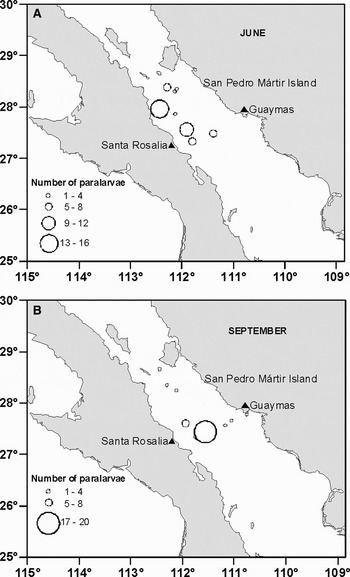
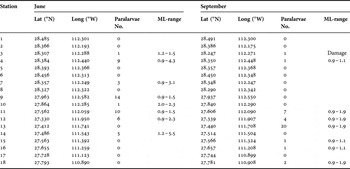
Dosidicus gigas paralarvae were only found during the June and September surveys (Figure 2; Table 1). No paralarvae were found in February or April. During June, they were distributed in a few stations around SPMI, in all the SPMI-SR transect and in only one station of the SR-G transect (Figure 2A). The greater number of paralarvae was found at Station 9 with 14 paralarvae (Table 1). During September paralarvae were collected in two stations around SPMI, two stations from the SPMI-SR transect and in almost all the SR-G transect (Figure 2B). At Station 13 were found 20 paralarvae (Table 1). With respect to the abundance by hour of sampling, the 2 × 2 contingency table showed a probability of 99% of association between month and hour of sampling (χ2 = 7.98; P < 0.01).
Distribution and abundance of Dosidicus gigas paralarvae in the central Gulf of California in 2008: (A) June; (B) September.

Summary data of paralarvae captured in the central Gulf of California in 2008. The number of paralarvae (No.) and the mantle length (ML)-range (mm) are indicated per station.

Paralarval size
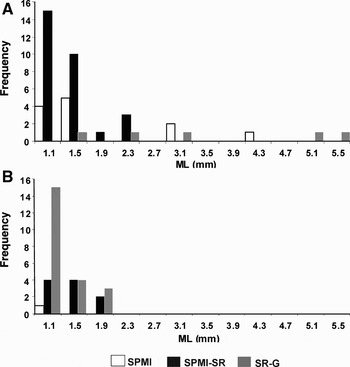
A total of 79 paralarvae were measured. The smallest and biggest paralarvae were 0.9 mm and 5.3 mm ML. In June most paralarvae measured 0.9 to 1.5 mm ML while the rest were distributed in larger ML ranges. Paralarvae from September were mostly small with ML from 0.9 to 1.9 mm. The t distribution test showed statistical significance between June and September ML data (t = 2.4122; P = 0.018; df = 77).
The ML ranges by transect by survey are shown in Figure 3. During June most of the paralarvae were collected at the SPMI-SR transect with ML from 0.9–2.3 mm, followed by SPMI with ML between 0.9 and 1.5 mm and few paralarvae ranged from 2.8–3.1 mm and 4.0–4.3 mm. The SR-G transect showed a different ML range as well as low number of paralarvae (Figure 3A; Table 1). In contrast, paralarvae from September were restricted to small ML (0.9–1.9 mm) at the SPMI-SR and SR-G transects (Figure 3B; Table 1).
Mantle length (ML) of Dosidicus gigas paralarvae by sampling location collected in the central Gulf of California in 2008: (A) June; (B) September.

Hatching localities
During June, hatching localities were mainly identified in the SPMI-SR transect with 15 hatchlings, followed by SPMI with 4 hatchlings (Figure 3A). In September paralarvae with ML ≤ 1.1 mm were found in the SR-G and SPMI-SR transects with 15 and 4 hatchlings respectively (Figure 3B).
Hydrographic data
WATER MASSES
Three water masses were identified from all of the surveys in 2008. Temperature–salinity plots showed a salinity range of ≥35 psu with a temperature >12°C, corresponding to CGW. It was found at all stations and seasons (not shown) in the upper layer. Below CGW less saline and colder water known as StSsW was found (34.5–34.9 psu and 9–18°C). The StSsW was present in all seasons although not at all stations. The lower depth limits at which it was located between seasons was different (February 88 m; April 78 m; June 50 m and September 140 m). The third water mass found was PIW (34.5–34.8 psu; 4–9°C). Its presence was restricted to depth beyond 384 m.
OCEANOGRAPHIC PROFILES
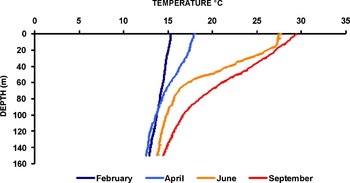
The average temperature profiles from the surveys are shown in Figure 4. In February the average sea surface temperature (SST) was 15.3°C and 12.9°C at 150 m; the water column was homogeneous. The average SST increased in April to 18.1°C and the water column began stratification below 80 m. The average temperature at 150 m was 12.5°C. During June, the SST increased notably and reached a mean of 27.7°C. A thermocline was evident at approximately 55 m, indicating stratification in the water column. The average temperature at 150 m was 13.8°C. The water column remained stratified during September, although the thermocline was less pronounced in this month. The average SST in September was 29.4°C and the average temperature at 150 m depth was 14.4°C.
Average sea temperature profiles for February, April, June and September 2008 in the central Gulf of California.

Fronts
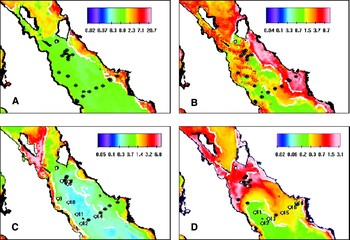
The analysis of ocean colour imagery showed chl-a fronts in all surveys. A high productivity area was delimited by a chl-a front located along the eastern coast in February (Figure 5A). During this month, the highest chl-a values (2.3–7.1 mg m−3) were recorded along the eastern coast. Lower values (~0.8 mg m−3) over the remaining central GC suggest a homogeneous surface condition. Mean chl-a value increased in April in most of the study area (Figure 5B). Highest values (>8.7 mg m−3) were located again in a wide zone along the eastern coast. Biological productivity was higher in March. The chl-a distribution was similar to, but wider than that observed in February, and new edges were observed in the central GC. High productivity was observed on the western side by June with a number of fronts in the central GC, whereas lower mean values of chl-a (1.4 mg m−3) prevailed on the eastern side (Figure 5C). The rest of the area had low values (0.3–0.7 mg m−3), lower than those previously observed. September had a higher chl-a value on both sides of the GC, mainly in the northern area (1.5–3.1 mg m−3). Chl-a fronts defined the boundary of this highly productive area (Figure 5D). Paralarvae were present in most of the stations near to fronts, mainly on the western side in June (Figure 5C) and central GC during September. The greatest abundance of D. gigas paralarvae was observed within 2.23–3.48 km (June and September) of the main front.
Frontal zones (white lines) in the central Gulf of California from chlorophyll-a satellite imagery: (A) February; (B) April; (C) June; (D) September. Stations with paralarvae are shown by white circles in C and D.

DISCUSSION
The presence of jumbo squid Dosidicus gigas paralarvae has previously been reported from San Pedro Mártir and Guaymas basins. Gilly et al. (Reference Gilly, Elliger, Salinas, Camarillo-Coop, Bazzino and Beman2006) employed molecular genetic methods to identify ommastrephid paralarvae and juveniles collected in San Pedro Mártir basin. All the specimens analysed were identified as D. gigas and the smallest size corresponded with that expected at hatching. Staaf et al. (Reference Staaf, Camarillo-Coop, Haddock, Nyack, Payne, Salinas-Zavala, Seibel, Trueblood, Widmer and Gilly2008) described the first wild egg mass of D. gigas found in the Guaymas basin as well as the hatchling behaviours that included proboscis extension, chromatophore activity and swimming speeds. Molecular analysis from embryos confirmed these specimens as D. gigas. However, the research cruises conducted for the present study were the first cruises to focus specifically on D. gigas paralarvae in the GC. Paralarvae were found along the western coast in June and from Santa Rosalia to Guaymas in September. The distribution of paralarvae seems to be related to the adult distribution as the fishing grounds in the GC are located off Santa Rosalia (from May–October) and Guaymas (from November–May) (Markaida & Sosa-Nishizaki, Reference Markaida and Sosa-Nishizaki2001). During September or early October, adult D. gigas start to migrate from the western coast to the eastern coast. The migration between both shores was demonstrated by Markaida et al. (Reference Markaida, Rosenthal and Gilly2005). Markaida & Sosa-Nishizaki (Reference Markaida and Sosa-Nishizaki2001) suggest that this migration coincides with the alternating wind-driven upwelling system along both coasts. The upwelling seems to provide the food supply for D. gigas maturation because the reproductive season appears to occur throughout the year (Markaida & Sosa-Nishizaki, Reference Markaida and Sosa-Nishizaki2001).
Paralarvae were restricted to the summer season in the central GC. Unfortunately no sampling from Guaymas to San Pedro Mártir Island was performed in this study which would have been useful to corroborate that D. gigas spawn in the winter on the north-eastern coast near Guaymas as was suggested by Ehrhardt et al. (Reference Ehrhardt, Solís, Jacquemin, Ortíz, Ulloa, González and García1986). However, they also assumed that most of the population would spawn in the Pacific waters off Baja California Peninsula. The low abundance of paralarvae found is in contrast with the potential fecundity of this species, which is the largest recorded fecundity for cephalopods (Nigmatullin & Markaida, Reference Nigmatullin and Markaida2009). Some considerations should be addressed. Ehrhardt et al. (Reference Ehrhardt, Solís, Jacquemin, Ortíz, Ulloa, González and García1986) stated that the reproductive cycle of D. gigas is not seasonally fixed and changes with oceanographic conditions in the GC although these authors never explained such changes. However, the interannual variability of the spawning peaks in the GC might be related to El Niño-Southern Oscillation (ENSO) events that alter coastal food webs and consequently influence the life cycles of many organisms. It is probable that jumbo squid move to other areas inside or outside the GC following food organisms that had to migrate as a consequence of high temperatures in the GC. Another reason for the low abundance could be the size of the bongo net used. Gilly et al. (Reference Gilly, Elliger, Salinas, Camarillo-Coop, Bazzino and Beman2006) found only 12 D. gigas paralarvae in seven tows around San Pedro Mártir basin with the same bongo net size as was used in our study (0.50 m diameter and 2 m long), while other cruises used the standard size (0.70 m diameter and 4 m long). According to Saito (Reference Saito1994) who compared Ommastrephes bartramii paralarvae catches obtained using bongo nets (70 cm mouth diameter), larval nets (130 cm mouth diameter) and large larval nets (200 cm mouth diameter), the most efficient and effective method for catching are oblique tows using bongo nets. However, high numbers of ommastrephid paralarvae have been reported with other types of nets, such as a neuston net or stepwise superficial horizontal towing. For example, Vecchione (Reference Vecchione1999) found 1780 rhynchoteuthion in the Costa Rica Dome using a surface Manta net and more recently Palomares-García et al. (Reference Palomares-García, De Silva-Dávila and Avendaño-Ibarra2007) collected 819 rhynchoteuthion using a neuston net for 30 minutes off Jalisco, Mexico. These studies suggest that D. gigas paralarvae catches depend on the type of gear, time of towing and depth of sampling, which depends on the diel migration of the species. The vertical distribution of D. gigas paralarvae is unknown in contrast to other ommastrephid species such as Ommastrephes bartramii (0–40 m; Young & Hirota, Reference Young and Hirota1990), Todarodes pacificus (25–50 m; Young & Hirota, Reference Young and Hirota1990), Sthenoteuthis oualaniensis (0–70 m; Harman & Young, Reference Harman and Young1985) and Hyaloteuthis pelagica (50–130 m; Harman & Young, Reference Harman and Young1985). O'Dor & Balch (Reference O'Dor and Balch1985) proposed that pelagic egg masses like that of Illex illecebrosus are located near the picnocline. The only wild egg mass of D. gigas described was found at 16 m depth, above the picnocline (Staaf et al., Reference Staaf, Camarillo-Coop, Haddock, Nyack, Payne, Salinas-Zavala, Seibel, Trueblood, Widmer and Gilly2008). If the new hatchlings swim to the surface (O'Dor & Balch, Reference O'Dor and Balch1985) superficial tows would be more efficient to collect them. We have to consider also that the abundance of paralarvae will depend on the spawning success and the mortality of the early life stages, which until now are not well known.
Knowledge of paralarval distribution and abundance patterns is useful for determining when and where adults spawn. Paralarvae were present only in the summer season. The main difference between seasons was the structure of the water column and the SST. In February the water column was homogeneous and no thermocline was observed; the SST was 15.3°C. In June paralarvae were present when SST increased to 27.7°C and chl-a fronts on the western side of the GC suggested that zooplankton prey might be abundant due to the high productivity conditions. These conditions persisted until September when the SST reached 29.4°C. This SST is similar (29–29.5°C) to that of the Costa Rica Dome, where the greatest numbers of rhynchoteuthion paralarvae were collected (Vecchione, Reference Vecchione1999).
The stages subject to the highest natural mortality in squid could be the embryonic and paralarval phases. With sufficient food, paralarvae enter a rapid growth phase, which makes this stage very short. Better feeding conditions along frontal zones could be a reason for spawning near these zones. Bower et al. (Reference Bower, Nakamura, Mori, Yamamoto, Isoda and Sakurai1999) reported paralarvae within 20 km of the Kuroshio Front; local upwelling promotes the proliferation of phytoplankton and zooplankton near the coast, providing enhanced feeding areas for the paralarvae. As the growth rate in paralarval and juvenile ommastrephids is exponential (Arkhipkin, Reference Arkhipkin1989; Balch et al., Reference Balch, Sirois and Hurley1988; Bower, Reference Bower1996) rich feeding areas are needed. The GC is a highly productive zone due to the seasonal wind-driven upwelling system. This study confirmed that D. gigas spawn and hatch in the GC, as was previously proposed by Gilly et al. (Reference Gilly, Elliger, Salinas, Camarillo-Coop, Bazzino and Beman2006) and Staaf et al. (Reference Staaf, Camarillo-Coop, Haddock, Nyack, Payne, Salinas-Zavala, Seibel, Trueblood, Widmer and Gilly2008). We found that hatching occurred during the summer on the western coast of the Guaymas basin. Despite that we only sampled in June and September we assume that paralarvae were present also in July and August. Most of the stock is concentrated in this area, taking advantage of high SSTs near areas with high biological productivity and food availability. Females of D. gigas probably spawn during winter in other areas of the GC as, for example, on the north-eastern coast near Guaymas and in southern areas close to the mouth where permanent oceanic fronts occur and the SST is higher than in the central and northern areas (21°C in February) (Castro et al., Reference Castro, Mascarenhas, Durazo and Collins2000) or even outside the gulf as proposed by Ehrhardt et al. (Reference Ehrhardt, Jacquemin, García, González, López, Ortíz, Solís and Caddy1983). In our study paralarvae presence was related to high SST and chl-a fronts in the western Guaymas basin as well as in the central area where the availability of food and high temperatures could be a major factor for the rapid growth that results in a short paralarval phase and lowers mortality.
ACKNOWLEDGEMENTS
We thank the captain and crew of RV ‘BIP XII’ for their support on all cruises and the students who participated with enthusiasm. We are grateful to M. Kahru for making available the 1 km satellite-derived dataset. This work was supported by the Consejo Nacional de Ciencia y Tecnologia (CONACyT) (grant number 165-C).