A large literature has examined predictors of relapse v. desistance among criminal offenders (Gendreau et al. Reference Gendreau, Little and Goggin1996; Warr, Reference Warr1998; Laub & Sampson, Reference Laub, Sampson and Tonry2001; Blokland & Nieuwbeerta, Reference Blokland and Nieuwbeerta2005; Brown et al. Reference Brown, St Amand and Zamble2009; Monsbakken et al. Reference Monsbakken, Lyngstad and Skardhamar2013; Zoutewelle-Terovan et al. Reference Zoutewelle-Terovan, van der Geest, Bijleveld and Liefbroer2014). According to Laub & Sampson (Reference Laub, Sampson and Tonry2001), a limited number of factors are ‘sturdy correlates’ of desistance. Prominent among these is marriage. A recent review of the literature concludes as follows:
“Our review of the empirical literature investigating the relationship between marriage and crime in contemporary criminological research indicates an overall protective effect of marriage on subsequent criminal desistance.” (Craig et al. Reference Craig, Diamond, Piquero, Humphrey and Cordella2014, p. 34)
Four important issues about this association merit further consideration. First, with other investigations of criminal behaviour (CB), most prior studies of the impact of marriage on desistance have been in males. Would the protective effect of marriage on criminal offending be similar in women (Andrews et al. Reference Andrews, Guzzo, Raynor, Rowe, Rettinger, Brews and Wormith2012)? To date, studies have disagreed, reporting a stronger protective effect of marital relationships on recurrent CB in women (Cobbina et al. Reference Cobbina, Huebner and Berg2012) or in men (King et al. Reference King, Massoglia and MacMillan2007). A recent review notes greater consistency in the protective marital effect on rates of criminal activity in men than in women (Craig et al. Reference Craig, Diamond, Piquero, Humphrey and Cordella2014).
Second, given the robust evidence that deviance in peer networks strongly predicts criminal recidivism (Andrews & Bonta, Reference Andrews and Bonta2010), would marriage to a deviant spouse (e.g., with CB) still have a protective effect on recidivism? Zoutewelle-Terovan et al. report a substantial association for CB in married couples (Zoutewelle-Terovan et al. Reference Zoutewelle-Terovan, van der Geest, Bijleveld and Liefbroer2014), but Farrington and West reported an equal rate of offending in men who married women, who did v. did not have a history of CB (Farrington & West, Reference Farrington, West, Blau and Hagan1995).
Third, relatively little attention has been given in the prior literature to those characteristics of individuals, such as personality or genetic risk, which would render them more or less sensitive to the protective effects of marriage on criminal recidivism.
Finally, the most critical question is the causal nature of the marriage–recidivism relationship. It is plausible both that of marriage actively protects against recidivism (for example, through a reduction in time spent with deviant peers (Warr, Reference Warr1998)), and that less deviant individuals with a lower propensity towards CB are more like to marry. This question has been previously addressed using a counterfactual life-course approach (Sampson et al. Reference Sampson, Laub and Wimer2006), propensity score matching (King et al. Reference King, Massoglia and MacMillan2007; Jaffee et al. Reference Jaffee, Lombardi and Coley2013) and co-twin and co-relative designs (Burt et al. Reference Burt, Donnellan, Humbad, Hicks, McGue and Iacono2010; Barnes & Beaver, Reference Barnes and Beaver2012; Jaffee et al. Reference Jaffee, Lombardi and Coley2013) with results generally favouring a causal explanation of the marriage–desistance association.
In this study, we seek to expand on the prior literature on marriage and criminal desistance. We use a Swedish national sample, which is both considerably larger and more representative than those previously examined. We can examine the association separately in males and females, and classify the spouses on their own history of CB. We also explore whether the spousal effect on desistance is influenced by a history of violent CB or a familial propensity to crime. Finally, we examine the marriage–desistence association in a co-relative design by comparing the risk for criminal relapse among siblings and cousins concordant for prior CB but discordant for marriage. Because these analyses control for familial confounders that might explain the CB–marriage association, they can provide further insight into the potential causal nature of the marriage–criminal recidivism relationship.
While CB is not itself a psychiatric disorder, it is highly comorbid with a range of externalising psychiatric disorders, including antisocial personality and substance use disorders (Fazel & Danesh, Reference Fazel and Danesh2002; Fazel et al. Reference Fazel, Bains and Doll2006). Indeed, we showed in a recent multivariate twin study that in Sweden, genetic and environmental risk factors for CB were substantially shared with those for drug abuse and alcohol use disorder (Kendler et al. Reference Kendler, Lönn, Maes, Lichtenstein, Sundquist and Sundquist2016a ). Therefore, the lessons that we learn here about prediction of course of CB is likely to be also applicable to more traditional psychiatric externalising psychopathology as we have recently shown for alcohol use disorder (Kendler et al. Reference Kendler, Lönn, Salvatore, Sundquist and Sundquist2016b ).
Materials and methods
We linked nationwide Swedish registers via the unique ten-digit identification number assigned at birth or immigration to all Swedish residents. The identification number was replaced by a serial number to ensure anonymity. The following sources were used to create an analysis dataset: the Total Population Register, containing data such as year of birth, sex and annual data on place of residences; the Swedish National Census; the Swedish Mortality Register, containing dates of death; the Multi-generation register (linking children born after 1932 to their parents); and the Crime Register, containing all convictions in lower court from 1973 to 2011. In all of our analyses here presented, we define ‘married’ as a member of a couple who are either officially married and cohabiting, or are cohabiting with a biological child of both members.
Sample
We included individuals born between 1958 and 1986, and convicted for a criminal offence (according to our definition below) between ages 15 and 20, but had not been married before or at age 20. In this cohort, the oldest subject is 15 when the crime Register starts and the youngest 26 when the follow-up ends. We chose this period to identify criminal offenses occurring in the years immediately preceding those when the subjects had a high probability of marriage. For the co-relative analyses, we identified full-siblings and cousins from the Swedish Multi-Generation Register born within 3 years of each other. We secured ethical approval for this study from the Regional Ethical Review Board of Lund University.
Measures
For marriage, we required that both individuals in the pair were above 18 years old and the age difference was less than 20 years. Before 1990, we only had access to household information every 5 years, while after 1990 the same information was provided yearly.
We assessed CB based on convictions in lower courts on the following criminal types: (i) violent crimes: (aggravated) assault, illegal threats, intimidation and illegal coercion, threats or violence against a police officer, (aggravated) robbery, murder, manslaughter or filicide, kidnapping, arson, sexual crimes (excluding prostitution and the buying of sexual services but including child pornography); (ii) white collar crimes: fraud, forgery and embezzlement; and (iii) property crimes: theft, vandalism, vandalism causing danger to the public and trespassing. The exact law chapters and paragraphs have been reported elsewhere (Kendler et al. Reference Kendler, Larsson Lönn, Morris, Sundquist, Långström and Sundquist2014). The analyses in this paper are based on date of the crime and when this is missing we used date of conviction instead. Deviant status in the spouse is defined as any CB over the lifetime. As a measure of socioeconomic status, we used highest educational level of the two parents categorised as low (compulsory school only or missing information), mid (high school) or high (university).
A familial risk score for CB was derived as follows: Using Weinberg's abridged age correction method (Slater & Cowie, Reference Slater and Cowie1971), we divided the population into three groups based on individual's age at end of follow-up and the age distribution of first CB registration: individuals in the first quartile (15–17 years) were weighted 0; the second and third quartile (17–37 years) were weighted 0.5; and the last quartile (over 37 years) were weighted 1. These weights are assigned to each individual's closest relatives (MZ twin, DZ twin, full-siblings, half-siblings, mother, father and cousins) and if more than one (sibling or cousin) a weighted average is derived. Thereafter, we model CB as a function of CB in their relatives and the weights utilising logistic regression and the Swedish population born 1958–1986 (n = 3 248 168). From this model, which shows that risk for CB in the proband individual is predicted as expected by genetic theory (most strongly from MZ twins, then relatively similarly from DZ twins, siblings and parents, then less strongly from half-siblings, and least strongly from cousins), we obtain a predicted probability for CB ranging between 9.6 and 96.3% (mean: 18.1, s.d.: 11.4), which we included in the analysis as a familial risk score. While not a conventional measure of familial risk, this risk score – made possible by our access to extensive genealogical information for the Swedish population – is considerably more informative than those based on more restricted sets of relatives (e.g., parents only or siblings only), which are often dichotomised into family history positive or negative.
Statistical methods
We utilised Cox proportional hazard methods to estimate the risk of relapse into crime (after age 20) as a function of marital status. Relapse is formally defined as the occurrence of a criminal registration after age 20 given at least one prior conviction before age 20. As marital status can change during follow-up, it was included in the model as a time-dependent covariate. We censored at death, end of marriage, age 28, or end of follow-up (year 2011) whichever came first. We adjusted for age at first criminal act (both linear and quadratic term), year of first criminal act and parental education. To account for severity of CB, we included life time violent CB in the model as supported by our prior analyses (Kendler et al. Reference Kendler, Larsson Lönn, Morris, Sundquist, Långström and Sundquist2014, Reference Kendler, Lonn, Lichtenstein, Sundquist and Sundquist2015). Finally, we investigated whether deviant behaviour in the spouse, lifetime violent CB and familial risk modified the association with marital status by including the corresponding interaction terms in the model. For ease of interpretation, we included the familial risk score on a modified scale, so that the hazard ratio (HR) represents an increase in one s.d. To test for gender differences, we constructed a joint model including both sexes, allowing all covariates to differ by gender.
In a next step, we used a co-relative design based on same-sex full-sibling and cousin pairs. The co-relative design allows us to contrast criminal recurrence in relatives with differing marital status. We identified unique combinations of pairs and utilised conditional Cox regression where each pair was treated as a stratum. Consequently, the effects of the covariates are estimated within each pair and thereby controlling for unmeasured genetic and environmental factors shared within the pair. Twin pairs were excluded from consideration due to small sample size. Each member of the pair had to be convicted for at least one crime before age 20 and as marriage was included as a time dependent covariate, either one met our criteria for ‘marriage’ over the follow-up period and one did not or they were married at different ages. Unfortunately, the female sample was underpowered for co-relative analysis. We here report results for all marriages (deviant and non-deviant).
Results
Our sample consisted of Swedish men and women, born between 1958 and 1986, who were convicted of at least one crime before age 20 and were not married prior to age 20. We then followed them up using the Swedish Criminal Registry from age 20 until their next criminal registration, death, age 28, or the end of follow-up in 2011. Marital status is included in the model as a time-dependent covariate and changes when the individual is married for the first time.
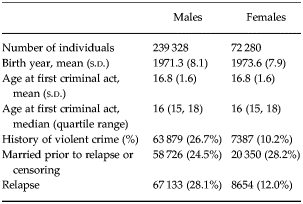
Table 1 contains key descriptive results. Our sample size of males was nearly four times larger than females. Males were much more likely to commit a violent crime and had higher recidivism rate than females. For both males and females, around one-quarter of them married prior to relapse or censoring.
Samples sizes and relevant characteristics of our sample of individuals with criminal behaviour

Males
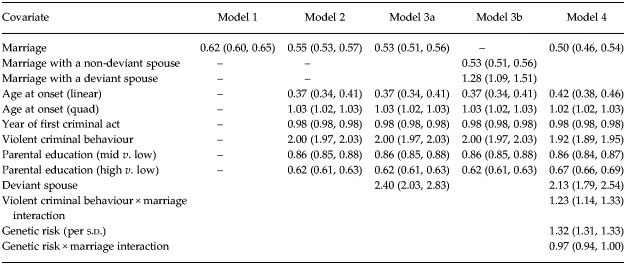
Table 2 presents the key results of our individual-level analyses in males. With no covariates in the model (model 1), marriage was associated with a HR for criminal recurrence of 0.62 (95% CIs, 0.60–0.65). We then added, in model 2, covariates for both a linear and quadratic effect for age at first CB, a cohort effect (year at first CB), lifetime violent CB, and parental education as a proxy for socioeconomic status of rearing. While these covariates all significantly predicted relapse in the expected direction, in their presence, the association of marriage with risk for recidivism modestly strengthened (that is, the HR became lower) (HR = 0.55, 0.53–0.57). Then in model 3a, we added deviance in the spouse which strongly predicted criminal relapse (HR = 2.40, 2.03–2.83). In model 3b, we re-parameterised these results to show that marriage with a non-deviant spouse was slightly more protective against recurrence than any marriage (HR = 0.53, 0.51–0.56), while marriage to a deviant spouse significantly increased the risk for criminal relapse (HR = 1.28, 1.09–1.51). Finally, in model 4, we added (i) an interaction between marital status and violent CB; (ii) a main effect of familial risk for CB; and (iii) an interaction between marital status and familial risk. The interaction between marital status and violent CB was positive and highly significant so that individuals with a history of violent criminality had a reduced sensitivity to the protective effect of marriage on criminal relapse. By contrast, the interaction between familial risk and violent CB was negative and marginally significant. Individuals with high familial risk for CB were more sensitive to the protective effect of marriage on criminal relapse.
Hazard models predicting in males the risk of criminal relapse as a function of marriage and associated covariates

Females
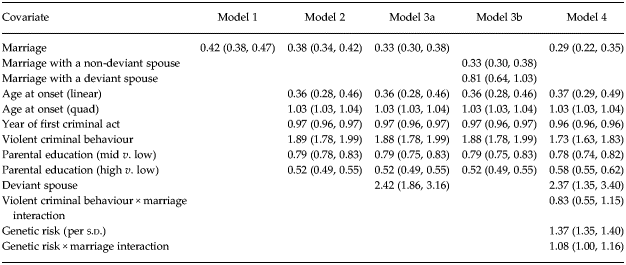
Table 3 presents similar results for our individual-level analyses in females. With no covariates in the model (model 1), marriage was associated in women with a HR for criminal recurrence of 0.42 (0.38–0.47). Model 2 included the same covariates utilised in our analysis of males and the protective effect of marriage increased further in strength (HR = 0.38, 0.34–0.42). In model 3a, we added deviance in the spouse, and the protective effect of marriage on recidivism further strengthened (0.33, 0.30–0.38). In model 3b, we reparameterised these results and showed that marriage with a non-deviant spouse was equally protective against recurrence while marriage with a deviant spouse was also protective but with a smaller effect size (HR = 0.81, 0.81–1.03) In model 4 in females, the interaction between violent CB and marital status is not significant, while the interaction between familial risk and marital status is barely significant and positive, so that those with high familial risk were less sensitive to the protective effects of marriage. This is in the opposite direction from that seen in males.
Hazard models predicting in females risk of criminal relapse as a function of marriage and associated covariates

Males and females
We also fitted models jointly to the males and female samples (results not shown). Both without and with covariates, we found a significant sex × marriage interaction (p < 0.0001) indicating that the protective effect of marriage in females was significantly greater than that seen in males. The interaction between violent CB and marital status in the prediction of relapse also differed significant across the sexes, being stronger in males than females (p = 0.02). The interaction between familial risk and marital status also differed significantly across the sexes (p = 0.01).
Co-relative analyses in males
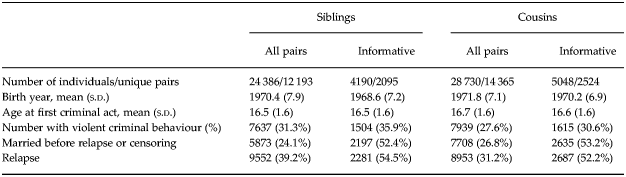
Table 4 presents key descriptive results for our co-relative analyses. We identified 2095 male–male full-sibling and 2524 male–male first cousin pairs who were concordant for criminal registration prior to age 20, but discordant for marriage at some point over the specified time period. Furthermore, at least one member of the pair had a criminal relapse over the time period.
Descriptive statistics for co-relative analyses in males

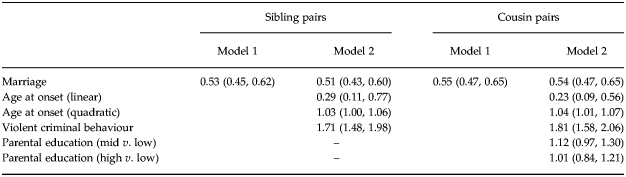
Results from our co-sibling and co-cousin analyses are presented in Table 5. With no covariates in the model, marriage was associated with a HR for criminal recurrence of 0.53 (0.45–0.62) in the discordant full-sibling and 0.55 (0.47–0.65) in cousin pairs. Model 2 included as covariates both a linear and quadratic effect for age at first CB and a history of violent CB and the cousins’ parental education. All these covariates significantly predicted risk for criminal relapse in both the sibling and cousin pairs. With the addition of these covariates, the impact of marriage became slightly stronger in both the sibling (HR = 0.51, 0.43–0.60) and cousin pairs (HR = 0.54, 0.47–0.65). Compared with the individual level results in males in the parallel model 2 (HR = 0.55, 0.53–0.57), no attenuation of the association between marital status and risk for criminal relapse was seen in the full-sibling or cousin pairs concordant for CB prior to age 20 but discordant for marriage.
Co-relative analyses in sibling and cousin male–male pairs concordant for a history of criminal behaviour before age 20 and discordant for marriage and criminal recidivism

Discussion
We sought in this paper to further clarify the association, among criminal offenders, between marriage and subsequent risk for a relapse of CB. We review our important results in turn.
First, congruent with a large prior literature, recently reviewed by Craig et al. who covered 85 studies (Craig et al. Reference Craig, Diamond, Piquero, Humphrey and Cordella2014), we found that a first marriage was strongly associated with a reduction in risk for criminal recidivism in males. Controlling for a range of relevant covariates, including measures of the severity of the CB (age at first registration and violent crimes), parental socioeconomic status, year of first conviction and deviance of the spouse, produced little change in this relationship. In males when including these covariates, marriage was associated with a 47% reduction in recidivism. This is higher than the 35% reduction estimated by Laub and co-workers in high-risk males (Sampson et al. Reference Sampson, Laub and Wimer2006) and lower than the 66% increase in desistance reported by Warr (Reference Warr1998).
Second, using identical analytic methods, we found an even stronger effect of marriage on rates of recidivism in females. Controlling for the same set of covariates, marriage was associated with a 67% reduction in criminal recidivism. This is consistent with prior evidence of the greater centrality of familial relationships in the prediction of recidivism in women compared with men (Cobbina et al. Reference Cobbina, Huebner and Berg2012). Our results are less consistent with findings from the extensive Craig et al. review, which reported a significant association between marital status and criminal activity in women in only 55% of prior reports (Craig et al. Reference Craig, Diamond, Piquero, Humphrey and Cordella2014).
Third, CB in the spouse strongly increased rates of criminal relapse with virtually identical effects in males and females (HRs of ~2.4). This is a potentially important process given evidence that CB in both members of a marital pair occur at rates much higher than would be expected by chance (Krueger et al. Reference Krueger, Moffitt, Caspi, Bleske and Silva1998; Rhule-Louie & McMahon, Reference Rhule-Louie and McMahon2007). Finding a strong role of deviant spouses on predictors of future CB is consistent with a large body of literature showing ‘antisocial associates’ to be among the strongest predictors of recidivism (Andrews & Bonta, Reference Andrews and Bonta2010). However, our findings contradict those of Farrington and West who reported equal rates of offending in men who married women who did v. did not have a criminal history (Farrington & West, Reference Farrington, West, Blau and Hagan1995), but are consistent with findings from Zoutewelle-Terovan et al. that CB is substantially correlated among married couples (Zoutewelle-Terovan et al. Reference Zoutewelle-Terovan, van der Geest, Bijleveld and Liefbroer2014), and of van Schellen et al. that the marriage reduction of CB in men only occurs when ‘the marriage is to a non-convicted spouse.’ (van Schellen et al. Reference van Schellen, Apel and Nieuwbeerta2012, p. 701). The impact of deviance in the spouse would be congruent with current theories that a major mechanism through which marriage protects against criminal recidivism is through a reduction in contact with deviant friends (Warr, Reference Warr1998). As War writes:
“… marriage has two important consequences for criminal trajectories. First, marriage substantially reduces the amount of time available for friends, marking a shift from a peer-oriented to a family-oriented life-style. At the same time, marriage alters the kinds of friends with whom individuals associate; it reduces exposure to deviant friends and increases exposure to conventional others.” (Warr, Reference Warr1998, p. 195–196)
Spouses with a history of CB are likely to facilitate rather than inhibit contact with deviant friends. An intriguing sex difference was seen in the impact of marriage to a deviant spouse. In males, this is associated with an increased risk of recidivism, while in females it is associated with a modest reduction in risk compared with being unmarried.
Fourth, we examined whether the protective effect of marriage on criminal relapse in males was moderated by two risk factors: a history of violent crime and a high familial risk. Marriage was significantly less effective in preventing recidivism in males with than without a history of violent crime. Preliminary analyses suggested that this effect did not result from violent criminals more frequently marrying deviant spouses. Perhaps motivations for CB in individuals with a history of violent crime are more internal and less sensitive to the social influences that occur with marriage. By contrast, males at high familial risk for CB were more sensitive to the protective effect of marriage. This would be consistent with prior evidence for several psychiatric disorders, including depression and conduct disorder, where those at high familial risk are more sensitive to the predisposing effects of adversity (Kendler et al. Reference Kendler, Neale, Kessler, Heath and Eaves1992; Kim-Cohen et al. Reference Kim-Cohen, Caspi, Taylor, Williams, Newcombe, Craig and Moffitt2006). However, the opposite effect was seen at marginal levels of significance in females.
Finally, the central issue in the large literature on the association of marital status and criminal relapse is the causal nature of the relationship. While it is plausible that marriage directly reduces the rate of subsequent CB, the relationship might be due to a range of non-casual (or confounding) factors. The power of co-relative designs is their ability to control for any confounders which themselves are familial – that includes the large proportion of relevant human traits (Polderman et al. Reference Polderman, Benyamin, de Leeuw, Sullivan, van, Visscher and Posthuma2015). If an observed association between an exposure (here marriage) and an outcome (here recidivism) arises in part due to familial confounds, then the association observed in closely related relative pairs discordant for the exposure should be attenuated compared with that seen in more distantly related pairs, which should in turn be attenuated from that seen in the general population. In our analyses, this would predict that the protective effect of marriage should be strongest in our general population analyses, weaker in our co-cousin analyses and weaker still in our co-sibling analyses. However, we observed no such trend. The comparable HRs in the general population, and discordant cousin and sibling pairs were, respectively, 0.53 (0.51, 0.56), 0.54 (0.47, 0.65) and 0.51 (0.43, 0.60). Our results are consistent with a range of prior studies. For example, Laub and co-workers applied a counterfactual life course approach to a sample of 500 high-risk boys followed prospectively from adolescence to age 32 (Sampson et al. Reference Sampson, Laub and Wimer2006). They estimated that being married was causally associated with a substantial reduction in the odds of a future crime. King et al. used propensity score matching finding protective effects in males, and somewhat less so in females (King et al. Reference King, Massoglia and MacMillan2007). In 289 twin pairs, Burt et al. used a co-twin control approach in MZ and DZ twins, and found results consistent with a causal effect of marital status on male antisocial behaviour (Burt et al. Reference Burt, Donnellan, Humbad, Hicks, McGue and Iacono2010). Theobald and Farrington carried out a propensity score matching in 411 males from the Cambridge Study in Delinquent Development, and found medium effect sizes in the reduction in recidivism for those married in their late teens and early twenties, with smaller effect sizes for later ages at marriage (Theobald & Farrington, Reference Theobald and Farrington2009). Jaffee et al. look at marital effects on CB in the National Longitudinal Study of Adolescent health using four methods (standard multiple regression, propensity score matching, within person longitudinal analyses and co-sibling designs) all of which support the conclusion that ‘married men engaged in significantly less antisocial behaviour than unmarried men.’ (Jaffee et al. Reference Jaffee, Lombardi and Coley2013, p. 65).
The co-relative design is far from perfect, and cannot prove that the observed association is causal as it could arise from environmental experiences unique to one relative that alters both risk of the exposure (marriage) and the outcome (recurrence). However, combining the present results with the prior literature suggests that at least a substantial proportion of the effect of marriage on relapse risk for CB is likely to arise from causal effects. These findings are therefore of obvious importance in planning for prevention and treatment of CB, i.e. those individuals that do not marry may be in need of more substantial social efforts. These results suggest that further research is required to determine whether marriage is also protective against more classical externalising syndromes such as alcohol and drug use disorders and antisocial personality.
Limitations
These results should be interpreted in the context of four potential methodological limitations. First, the Swedish Crime Register contains only data on criminal convictions. As seen in most other countries, in Sweden a majority of most crimes are not officially reported or do not result in a conviction. In the 2008, National Swedish Crime Victim Survey, the proportion of crimes reported to the police ranged from 14% for sexual offenses to 55% for serious assaults (Swedish National Council for Crime Prevention, 2008). Bias might arise if the probability that a committed crime is reported, or that a reported crime leads to a conviction, differs across social strata or between unmarried and married individuals.
Second, incarceration was not formally accounted for in our analyses. However, the rates are very low in Sweden involving only 0.5% of male and 0.03% of females in our sample with CB. Rates of incarceration over 1 year in our sample (occurring in 0.1% of males and 0.01% of females) are too low to impact appreciably on our analyses.
Third, our definition of marriage was somewhat unconventional in including couples who were cohabiting and had biological children together. This was done because such an arrangement was both broadly socially acceptable in Sweden at this time and quite common. We therefore repeated all of our main analyses restricting our sample to only those who were officially married. Although our sample size and statistical power declined, the results were quite similar in men. The main effect of marriage on risk for criminal relapse in models 1 and 3a (Table 2) were 0.62 (0.60, 0.65) and 0.53 (0.51, 0.56) with our broad definition of marriage, and 0.62 (0.58, 0.67) and 0.51 (0.47, 0.56) using the more restrictive definition. In women, the parallel results were 0.42 (0.38, 0.47) and 0.33 (0.30, 0.38) (Table 3) with our broad definition of marriage, and 0.65 (0.57, 0.75) and 0.45 (0.37, 0.55) with our narrower definition. That is, unexpectedly, the protective effect of marriage was weaker in women when we utilised the narrow definition of marriage. These results suggest that in women our broad definition of marriage resulted in stronger rather than weaker effects on criminal relapse.
Finally, some inaccuracies undoubtedly entered into our analyses because household data were only available in 5-year increments before 1990.
Financial Support
This project was supported by the Ellison Medical Foundation, the Swedish Research Council (K2012-70X-15428-08-3), the Swedish Research Council for Health, Working Life and Welfare (In Swedish: Forte; Reg. no.: 2013-1836), the Swedish Research Council (2012-2378; 2014-10134) and FORTE (2014-0804) as well as ALF funding from Region Skåne awarded.
Conflicts of Interest
None.
Ethical Standards
The authors assert that all procedures contributing to this work comply with the ethical standards of the relevant national and institutional committees on human experimentation and with the Helsinki Declaration of 1975, as revised in 2008.
Availability of Data and Materials
Data used in these analyses are not publically available due to confidentiality concerns of the Swedish authorities.