INTRODUCTION
The high rate of psychological and physical health problems is a major public health issue. People with co-morbid depression and physical health problems have increased functional impairment (Lee et al. Reference Lee, Yu, Wing, Chen, Lee, Lee, Chen, Lin and Weiss2000), absenteeism (Broadhead et al. Reference Broadhead, Blazer, George and Tse1990), hospital stays (Fulop et al. Reference Fulop, Strain, Fahs, Hammer and Lyons1988), and suicidal ideation (Druss & Pincus, Reference Druss and Pincus2000). The physical and psychological suffering of individuals with co-morbid depression and other physical health problems is synergistically greater than that of either problem alone.
There is mounting evidence that a higher prevalence of co-morbid psychological problems, such as depression, exists among persons with heart disease (Anda et al. Reference Anda, Williamson, Jones, Macera, Eaker, Glassman and Marks1993; Musselman et al. Reference Musselman, Evans and Nemeroff1998; Cox et al. Reference Cox, Lewis, Stuart and Murphy2002; van Melle et al. Reference van Melle, de Jonge, Spijkerman, Tijssen, Ormel, van Veldhuisen, van den Brink and van den Berg2004; Glassman et al. Reference Glassman, Bigger, Gaffney, Shapiro and Swenson2006) and respiratory problems (Wells et al. Reference Wells, Golding and Burnam1988; Hurwiz & Morgenstern, Reference Hurwiz and Morgenstern1999; Vila et al. Reference Vila, Nollet-Clemencon, de Blic, Mouren-Simeoni and Scheinmann2000; Wamboldt et al. Reference Wamboldt, Hewitt, Schmitz, Wamboldt, Rasanen, Koskenvuo, Romanav, Varjonen and Kaprio2000; Gillaspy et al. Reference Gillaspy, Hoff, Mullins, van Pelt and Chaney2002; Goodwin et al. Reference Goodwin, Fergusson and Horwood2004; Ortega et al. Reference Ortega, McQuaid, Canino, Goodwin and Fritz2004). However, it is still unclear whether the co-morbidity is caused by one or other illness, or whether even a third factor might underlie the association (Kramer et al. Reference Kramer, Warner, Olfson, Banks, Chaput and Weissman1998).
One such third factor might be perinatal risk, such as low birthweight (LBW) and prematurity (Allen et al. Reference Allen, Lewinshon and Seeley1998; Wadhwa et al. Reference Wadhwa, Sandman and Garite2001). A review of studies on perinatal risk and later health problems suggested that exposure to stress in utero and/or early in life may increase vulnerability to subsequent normative stress and impair functions of the central nervous system (CNS) and hypothalamic–pituitary–adrenal (HPA) axis (Sanchez et al. Reference Sanchez, Ladd and Plotsky2001). These changes are hypothesized to elevate the risk for both emotion regulation and physical health problems, particularly related to respiratory function (Wamboldt et al. Reference Wamboldt, Hewitt, Schmitz, Wamboldt, Rasanen, Koskenvuo, Romanav, Varjonen and Kaprio2000) and cardiovascular reactivity (Sanchez et al. Reference Sanchez, Ladd and Plotsky2001). Animal studies show that chronic perinatal stress increases the risk for subsequent problems in physical health, affect and behavior (Ward, Reference Ward1991). Several aversive experiences in utero and in the neonatal period result in a sensitization of emotional and HPA-axis responses to subsequent stress (Chuckley, Reference Chuckley1996; Meaney, Reference Meaney2001). Human studies similarly suggest that stressful prenatal experiences, such as maternal smoking, preterm birth or LBW, may contribute to abnormalities in the endocrine system (Wadhwa et al. Reference Wadhwa, Porto, Garite, Chicz-DeMet and Sandman1998; Heim & Nemeroff, Reference Heim and Nemeroff2001). This pathway may be mediated by increased exposure to corticotropin-releasing hormone (CRH), because CRH is involved in the organization of the CNS during this sensitive period (Sandman et al. Reference Sandman, Wadhwa, Chicz-DeMet, Porto and Garite1998).
Despite its potential importance, this third risk factor remains largely unexplored. Studies examining psychological and physical health problems are generally conducted separately and not integrated into a broader, potentially more constructive, perspective. Furthermore, many studies of perinatal risk factors measure markers of perinatal problem, such as LBW, preterm birth, small head size and low Apgar scores, but their underlying causes and their long-term consequences could be different. For example, LBW primarily caused by preterm birth has been associated with an elevated risk for cardiovascular illness (Leon et al. Reference Leon, Litchell and Vegero1998; Barker et al. Reference Barker, Eriksson, Forsen and Osmond2002; Huxley et al. Reference Huxley, Neil and Collins2002; Davies et al. Reference Davies, Davey-Smith, May and Ben-Shlomo2006), while being born small for gestational age (SGA) has been associated with an increased risk for diabetes (Hales et al. Reference Hales, Barker, Clark, Cox, Fall, Osmond and Winter1991; Veening et al. Reference Veening, Van Weissenbruch and Delemarre-Van De Waal2002; Vaag et al. Reference Vaag, Jensen, Poulsen, Brons, Pilgaard, Grunnet, Vielwerth and Alibegovic2006).
To test this third factor hypothesis, we have analyzed data from the Johns Hopkins Collaborative Perinatal Study (JHCPS). Using the same data, Fan & Eaton (Reference Fan and Eaton2001) reported a three- to fourfold increased risk for general mental distress and nervous conditions in adulthood among those with perinatal risk, such as LBW and preterm birth, and this risk was accentuated in the low income group. However, they did not examine whether the same perinatal problems increased the risk for physical health problems alone or in conjunction with psychological problems. It would be fruitful if we could not only estimate the risk for adult health problems by perinatal indicators singly but also distinguish different underlying etiological processes, taking advantage of the available perinatal indicators (LBW, preterm birth, small head circumference and low Apgar scores).
In the study reported here, we examined whether four perinatal risk indicators singly increase the risk for psychological problems (e.g. depression; Hulshoff et al. Reference Hulshoff Pol, Hoek, Susser, Brown, Dingemans, Schnack, van Haren, Pereira Ramos, Gispen-de Wied and Kahn2000; Thompson et al. Reference Thompson, Syddall, Rodin, Osmond and Barker2001; Patton et al. Reference Patton, Coffey, Carlin, Olsson and Morley2004; Nomura et al. in press) and physical health problems (e.g. respiratory and cardiovascular problems; Barker & Lackland, Reference Barker and Lackland2003; Eriksson et al. Reference Eriksson, Forsen, Tuomilehto, Osmond and Barker2001). We also examined the magnitude of the co-morbidity between the two. Finally, we attempted to elucidate the different underlying perinatal etiological processes and their effects on adult health. Given our underlying assumption that general perinatal problems may lead to biophysiological changes, associated with both psychological problems (related to emotional regulation) and physical health problems (related to cardiovascular and respiratory functions), we focused primarily on depression and suicidal ideation as our psychological outcomes and hypertension and asthma as our physical health outcomes. We hypothesized that (1) perinatal problems are associated with an increased risk for psychological and physical health problems; (2) there would be an elevated risk for depression or suicidal ideation if hypertension or asthma was also present; (3) perinatal problems are associated with an increased risk for co-morbid psychological and physical problems; and (4) different underlying etiological processes may exist and the risks may differ depending on the process.
METHOD
Data source and participants
The JHCPS, part of the National Collaborative Perinatal Project (NCPP), consists of prospective data collected from a random sample of pregnant women who received prenatal care, and delivered their babies in hospital during 1960–1964. The NCPP entailed a single study design across all sites and involved the systematic data collection from pregnancy to the first 8 years to identify perinatal and early childhood factors that adversely affect subsequent child development (Fan & Eaton, Reference Fan and Eaton2001). Reports from the NCPP have been summarized elsewhere (Nichols & Chen, Reference Nichols and Chen1981; Hardy, Reference Hardy2003).
In 1992–1994, the Pathways to Adulthood Study at Johns Hopkins University (principal investigators: J. Hardy & S. Shapiro) bridged the period from age 7–8 to 27–33 years of age. Of the 2694 offspring eligible for the Pathways to Adulthood Study, 2220 (82%) were located and 1758 completed interviews (71·4% response rate of known outcome and 65·3% of full interview). Those who were located but did not complete full interviews had mothers with characteristics generally similar to those who were interviewed. The study design, interview procedure, potential biases and attrition of the sample are described in detail elsewhere (Hardy et al. Reference Hardy, Shapiro, Mellits, Skinner, Astone, Ensminger, Laveist, Baumgardner and Starfield1997). Of the 1758 offspring who completed interviews, 1525 provided information on perinatal factors and psychological and physical health problems in adulthood. This subset provided the data used in this paper. Analyses of demographic and perinatal differences between the 1525 included and 1069 excluded offspring revealed no difference in race (African American: 81·9% v. 81·3%), birthweight (3036 v. 3009 g), gestational age (38·9 v. 38·6 weeks), head circumference (33·54 v. 33·46 cm) and 5-min Apgar scores (8·83 v. 8·79). However, the included offspring were more likely to be female than the excluded (54·4% v. 43·4%, p<0·001). This study was ruled exempt by the Institutional Review Board Committee at Mount Sinai School of Medicine because it involved secondary data analysis of de-identified data.
Measures
Perinatal problems
Independent variables included four perinatal problems. Birthweight, 5-min Apgar scores and head circumference were recorded by a research nurse in the delivery room. Gestational age was determined by a combination of the mother's self-report of their last menstrual period and sonogram. We used both continuous and dichotomous measures of perinatal indicators. For dichotomous variables, we used the traditional cut-off points to create risk indicators for LBW (<2500 g), low 5-min Apgar score (<7), small head circumference (<32 cm), and preterm birth (<37 weeks' gestational age).
Adult psychopathology and illness
Depression was measured with the General Health Questionnaire-28 (GHQ-28; Goldberg, Reference Goldberg1978). It was assessed by responses to seven questions, with response options ranging from 1 (better than usual) to 4 (much worse). Using the scoring method, a choice of 1 or 2 was recoded as ‘0’ and 3 or 4 as ‘1’. Four or more ‘1’ responses were used to indicate the presence of depression. The internal consistency of the GHQ is high (Goldberg, Reference Goldberg1972). Compared to the three most commonly used instruments for identifying psychiatric illness (the Center for Epidemiological Studies Depression Scale, the Beck Depression Inventory, and the Hospital Anxiety and Depression Scale), the GHQ had higher sensitivity (92%) and specificity (90%) for identifying psychiatric illness (Clarke et al. Reference Clarke, Smith and Herrman1993; Katz et al. Reference Katz, Stephen, Shaw, Matthew, Newman and Rosenbluth1995). Suicidal ideation was scored as positive if participants endorsed any of the following three items: ‘felt life was not worth living’, ‘recurring thoughts of suicide’ and ‘wishing yourself were dead’. Physical health status was based on self-report using the RAND-36 Health Status Inventory (Adams & Benson, Reference Adams and Benson1990; Hays, Reference Hays1998), which has good reliability (Boyle et al. Reference Boyle, Furlong, Feeny, Torrance and Hatcher1995; Feeny et al. Reference Feeny, Furlong, Torrance and Barr2002; Thoma et al. Reference Thoma, Sprague, Veltr, Duku and Furlong2005) and validity (Feeny, Reference Feeny2002; Thoma et al. Reference Thoma, Sprague, Veltr, Duku and Furlong2005). This measure specifically asked about current or past problems with physical health (hypertension and asthma). The prevalence percentage rates for current/life-time hypertension and asthma were 5·5/10·1 and 7·3/14·1 respectively.
Potential confounders and missing values
Confounders included mother's age, parity, income, education and marital status, poverty level at delivery and child's sex, race, age at last interview and poverty level at age 7. Poverty level (Hardy et al. Reference Hardy, Astone, Brooks-Gunn, Shapiro and Miller1998) represents the ratio of the mother's annualized income to the poverty level based on the Annual Statistical Supplement to the Social Security Bulletin (US DHHS, 1993). All confounders, except the age of the child, were based on the mother's self-report. The child's age was calculated from birth dates. The frequency of missing data in this sample was negligible (less than 0·1%) for all control variables except for the mother's income and education attainment (2·2% missing).
Data analysis
First, each dichotomous perinatal factor was examined in separate maximum likelihood logistic regressions predicting each of the psychological and physical health outcomes. Second, to evaluate the magnitude of the association between co-morbid psychological and physical health problems, odds ratios (ORs) were obtained, using logistic regression without covariates and then with adjustment for potential confounders. Third, four dichotomized perinatal risk factors that the offspring had were examined as to whether they would predict their future co-morbidity of psychological and physical health problems status. Polytomous logistic regression analyses were conducted, using the Statistical Analysis System Categorical Model (CATMOD; SAS Institute, Cary, NC, USA), with four groups according to their co-morbid status: one with neither psychological nor physical health problems, one with physical health problems only, one with psychological health problems only, and one with co-morbidity. Finally, to explore whether different etiological processes exist during pregnancy, cluster analysis was used to examine whether these four perinatal indicators revealed natural clusters within a data-set that would otherwise not be apparent. Empirical internal testing indicates that the procedure is fairly robust to violations of the assumptions of independence and the normal distribution (Norusis, Reference Norusis2004), but when the skewness or kurtosis were more than 1·96, we normalized the distribution using a logarithmic transformation. Cluster analysis began with the construction of a cluster features (CF) tree, which provides a capsule summary of the data file. The leaf nodes of the CF tree were then grouped using an agglomerative clustering algorithm. To determine which number of clusters was ‘best’, each of these cluster solutions was compared using Schwarz's Bayesian Criterion (BIC) as the clustering criterion. When clusters were extracted, we first evaluated the mean (s.d.) of the four perinatal characteristics in each cluster and then examined the overall difference in the risk for health problems among the cluster groups. The pairwise comparisons of the rates of each problem were further examined.
RESULTS
Descriptions of demographics and the four perinatal problems
The subjects were predominately black (82%), and approximately half (53%) were female. During the initial interviews between 1960 and 1964, mothers reported average ages of 24·9 (s.d.=7·1) years and three (s.d.=2·3) children. During the delivery interview, 86·2% of mothers reported completing primary school education, 22% high school, and less than 1% college. At the last interview (1992–1994), the mean age (s.d.) was 29 (2·5) years. Family income (s.d.) was US$33682 (US$24675). More than 60% of offspring had completed high school.
With the exception of the Apgar scores, perinatal factors were moderately to highly correlated. Birthweight was correlated with gestational length, head circumference and Apgar scores at 0·46, 0·79 and 0·17 respectively. Gestational length was correlated with head circumference and Apgar scores at 0·44 and 0·10 respectively. Apgar scores and head circumference were correlated at 0·11. Furthermore, tetrachoric correlations for dichotomous indices of perinatal risks were evaluated. LBW was correlated with preterm birth, small head circumference and low Apgar scores at 0·66, 0·89 and 0·33 respectively. Gestational length was correlated with head circumference and Apgar scores at 0·70 and 0·24 respectively. Apgar scores and head circumference were correlated at 0·39.
Risk of psychological and physical health problems by perinatal problems
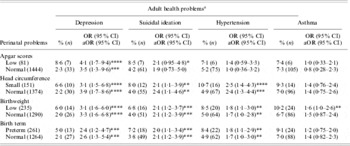
The relationships between the different perinatal problems singly and adult health problems are shown in Table 1. Offspring with small head circumference had an almost fourfold increased risk for depression (p=0·003) and more than a twofold increased risk for suicidal ideation (p=0·02) and hypertension (p=0·01). Those with a low Apgar score had a more than threefold increased risk for depression (p=0·01). Those with LBW had a threefold increased risk for depression (p<0·001) and a twofold increased risk for suicidal ideation (p=0·012) and hypertension (p=0·08). Preterm birth was associated with an approximately twofold increased risk for depression (p=0·01), suicidal ideation (p=0·01) and hypertension (p=0·05). None of the four risk factors elevated the risk for asthma after controlling for potential confounders. Nearly all relationships remained equivalent or grew stronger when confounders were controlled for.Footnote †
Rates (n) and crude and adjusted risk of psychological and physical health problems in offspring by four perinatal risk factors (n=1525)

OR, Odds ratio; aOR, adjusted odds ratio (mother's age, education, parity, marital status and poverty level at delivery and child's sex, age at last interview, race at poverty level at age 7 were adjusted); CI, confidence interval.
Perinatal problem scales (Apgar scores, preterm birth, birthweight, and head circumference) were created according to the traditional cut-off points: Apgar scores (low <7 and normal ⩾7); preterm birth (preterm <37 completed weeks and normal ⩾37 completed weeks); birthweight (low <2500 g and normal ⩾2500 g); and head circumference (small <32 cm and normal ⩾32 cm).
a The General Health Questionnaire-28 (Goldberg, Reference Goldberg1978) was used for depression and suicidal ideation and the RAND-36 Health Status Inventory (Adams & Benson, Reference Adams and Benson1990) was used for current history of asthma and hypertension, with 1 representing the presence and 0 the absence of the illness.
* 0·10<p<0·05, ** 0·05<p<0·01, *** 0·01<p<0.001, **** 0·001<p<0·0001.
Risk of co-morbid psychological and physical health problems
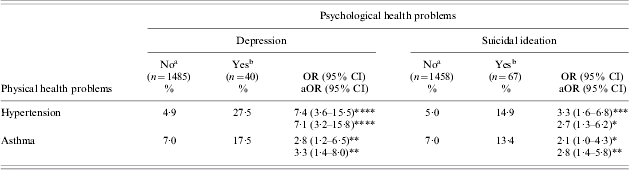
Table 2 shows the magnitude of co-morbid psychological and physical health problems after controlling for confounders. Offspring with depression had an elevated risk for co-morbid hypertension [OR 7·1, 95% confidence interval (CI) 3·2–15·8] and asthma (OR 3·3, 95% CI 1·4–8·0). Those with suicidal ideation also had an elevated risk for co-morbid hypertension (OR 2·7, 95% CI 1·3–6·2) and asthma (OR 2·5, 95% CI 1·2–5·3).
Risk of co-occurring psychological problems among those with hypertension and asthma in young adulthood (n=1525)
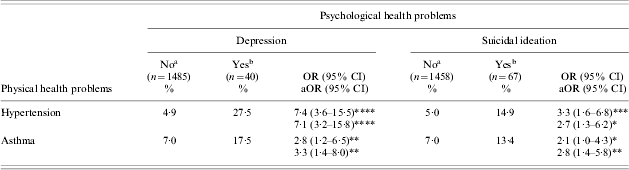
OR, Odds ratio; CI, confidence interval; aOR, adjusted odds ratio (mother's age, education, parity, marital status and poverty level at delivery and child's sex, age at last interview, race at poverty level at age 7 were adjusted).
a ‘No’ for depression denotes the absence of a clinically significant condition, and ‘No’ for suicidal ideation denotes the absence of suicidal thoughts and ideas.
b ‘Yes’ for depression denotes a clinically significant condition, and ‘Yes’ for suicidal ideation denotes the presence of suicidal thoughts and ideas.
* 0·05⩾p>0·01, ** 0·01⩾p>0·001, *** 0·001⩾p>0·0001, **** 0·0001 ⩾p.
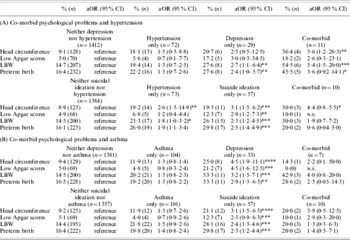
Table 3 shows whether perinatal risk factors might be associated with an increased risk for future health problems (psychological health problems only, physical health problems only, and co-morbidity). The offspring with LBW were at sevenfold, those with small head circumference at fivefold, and those with preterm birth at nearly fourfold increased risk for being in the co-morbid depression and hypertension group than in neither health problem group. However, only small head circumference was associated with a marginal increased risk for co-morbid hypertension and suicidal ideation (OR 4·4, p=0·08). There was an approximately two- to threefold increased risk for offspring with a perinatal risk factor being in the psychological health problem (depression and suicidal ideation) only group. There was no evidence that perinatal risk factors increase the risk for co-morbid psychological problems and asthma.
Rates (n) and the risk for co-morbid physical (hypertension and asthma) and psychological (depression and suicidal ideation) health problems by perinatal problems

aOR, Adjusted odds ratio; CI, confidence interval; LBW, low birthweight; n.e., not estimable.
Apgar scores (low <7 and normal ⩾7); preterm birth (pre-term <37 completed weeks and normal ⩾37 completed weeks); birthweight (low <2500 g and normal ⩾2500 g); and head circumference (small <32 cm and normal ⩾32 cm). Polytomous logistic regression with potential confounders was used for statistical analysis.
* 0·10 >p>0·05, ** 0·05 ⩾p>0·01, *** 0·01 ⩾p>0·001, **** 0·001 ⩾p>0·0001.
Clusters of perinatal conditions in our sample and the risk for future psychological and physical health problems, and co-morbidity
Prior to running the cluster analysis, we tested whether each continuous perinatal indicator was normally distributed. Except for the Apgar scores, skewness and kurtosis were less than 1·96, meeting requirement for normal distribution. Apgar scores were normalized as they were negatively skewed (–2·84, s.d.=0·063) and had a high kurtosis (11·2, s.d.=0·13).
Cluster analysis identified four clusters. Cluster 1 consisted of offspring with preterm LBW, represented by low birthweight (mean 1869 g, range 1794–1945), preterm birth (mean 32·3 weeks, range 31·6–33·0), small head size (mean 29·9 cm, range 29·5–30·2) and a lower Agpar score (mean 7·67, range 7·34–8·0). Cluster 2 appears to consist of offspring with small gestational age (SGA), represented by lower birthweight (mean 2799 g, range 2774–2823 g), smaller head circumference (mean 32·8 cm, range 32·7–32·9) for gestational age (mean 38·1 weeks, range 37·9–38·3), and a normal Apgar score (mean 9·1, range 9·1–9·2). Cluster 3 appears to consist of offspring with fetal distress alone represented by normal birthweight (mean 3116 g, range 3025–3208), normal gestational age (mean 40·5 weeks, range 39·9–41·0), normal head circumference (mean 34·2 cm, range 33·9–34·5), but a very low Agpar score (mean 5·32, range 5·93–5·71). Finally, Cluster 4 appears to consist of offspring with optimal perinatal outcomes, normal birthweight (mean 3424 g, range 3399–3449), full-term gestational age (mean 40·4 weeks, range 40·3–40·6), normal head circumference (mean 34·7 cm, range 34·6–34·8) and a normal Agpar score (mean 9·13, range 9·09–9·18).
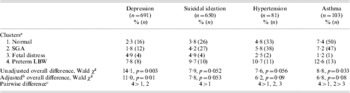
Table 4 shows the rates of depression, suicidal ideation, hypertension and asthma and the overall and pairwise differences in these rates among the cluster groups. Depression, suicidal ideation and asthma showed a significant overall group difference, with the preterm LBW group having the highest rate (7·8, 9·7 and 12·6% respectively), but the overall difference was only marginally significant for asthma (p=0·08) and hypertension (p=0·09) after adjusting for confounders. The last row shows the results from the pairwise comparisons. The preterm LBW group constantly showed poorer health outcomes. Moreover, the offspring with preterm LBW had a substantial increased risk for being in the co-morbid depression and hypertension group (OR 6·3, 95% CI 1·2–24·0), the co-morbid depression and asthma group (OR 10·2, 95% CI 1·8–58·7), the co-morbid suicidal ideation and hypertension group (OR 2·1, 95% CI 1·0–4·5), and the co-morbid suicidal ideation and asthma group (OR 2·0, 95% CI 1·0–3·8) than being in neither health problem group (table available upon request).
Rates of depression, suicidal ideation, hypertension and asthma among the four cluster groups and overall unadjusted and adjusted difference in rates of these problems among the four cluster groups

SGA, Small for gestation age; LBW, low birthweight.
a The four cluster groups were based on cluster analysis by four perinatal risk factors (birthweight, gestational age at delivery, 5-min Apgar scores, and head circumference at birth). The overall difference among the four groups was based on logistic regression.
b Adjusted for mother's age, education, parity, marital status and poverty level at delivery and child's sex, age at the last interview, race, and poverty level at age 7.
c The number represents the cluster group. Only significant (p<0·05) difference between the two cluster groups on the rate of each health problem is listed.
DISCUSSION
Our data are consistent with and expand results from prior studies, and provide four main findings. First, perinatal problems, namely LBW, preterm birth and small head circumference, were associated with a significantly increased risk for both psychological and physical health problems in adulthood. Second, there was a significantly increased risk of co-occurring depression and physical problems in adult offspring. Third, single perinatal risk factors, namely LBW, preterm birth and small head circumference, appear to be associated with an increased risk for co-morbid psychological problems and hypertension, but not co-morbid psychological problems and asthma. Fourth, there was initial evidence for differential etiological processes for preterm LBW, SGA and fetal distress, with preterm LBW having substantial adverse influence over adult health and co-morbidity.
We have demonstrated that perinatal problems have long-term effects on both psychological and physical health problems in adulthood, even after controlling for a wide range of confounders. Although the fetal origin hypothesis (Barker, Reference Barker1995) suggested a link between malnutrition during pregnancy and later physical health conditions, especially heart disease (Leon et al. Reference Leon, Litchell and Vegero1998; Eriksson et al. Reference Eriksson, Forsen, Tuomilehto, Osmond and Barker2001; Barker & Lackland, Reference Barker and Lackland2003), only recently have studies begun to examine the possibility that perinatal problems influence the development of adult psychopathology, such as depression (Thompson et al. Reference Thompson, Syddall, Rodin, Osmond and Barker2001, Gale & Martyn, Reference Gale and Martyn2004; Wiles et al. Reference Wiles, Peters, Leon and Lewis2005; Nomura et al. in press) and schizophrenia (Hulshoff et al. Reference Hulshoff Pol, Hoek, Susser, Brown, Dingemans, Schnack, van Haren, Pereira Ramos, Gispen-de Wied and Kahn2000). However, to our knowledge no studies have examined psychological and physical health problems simultaneously. Our findings extend prior studies by showing that linkages between perinatal problems and adult illness are not limited to physical or psychological health problems.
The level of co-morbidity we found between psychological and physical health problems was striking. If offspring had depression, the risk of co-morbid hypertension increased more than sevenfold and asthma increased threefold. Similarly, if offspring had suicidal ideation, the risk for co-morbid hypertension and asthma increased more than twofold. Both psychological and physical health conditions were based on current problems. We therefore do not know if one problem proceeded to the other. It should be noted, however, that the rates of current hypertension (5·5%) and asthma (7·3%) were low in this relatively young adult population (mean age 29). As rates of depression (2·6%) and suicidal ideation (4·4%) were also low, the number of offspring with co-morbid conditions was small. Thus, the results need to be interpreted with great caution. The risk for co-morbid depression and hypertension by perinatal problems was evident but we found no evidence for co-morbid psychological problems and asthma by perinatal problems. Because significant co-morbidity between asthma and depression (OR 3·3, p=0·007) and between asthma and suicidal ideation (OR 2·8, p=0·005) were documented, this indicates that there may be different pathogenesis for the co-morbid asthma and psychological problems. Postnatal environment is one strong possibility for the increased risk. However, investigating this is beyond the scope of the current study. Future studies could consider adverse postnatal psychosocial environment such as exposure to smoking and poverty (Rimington et al. Reference Rimington, Davies, Lowe, Pearson, Russo, Andrew and Coffey2001; Bender, Reference Bender2006) as potential factors for the co-morbid psychosocial problems and asthma. We should remind readers that because low Apgar scores were only associated with an increased risk for psychological but not for physical health problems, the rate of low Apgar scores among the co-morbid group was very low. This prevented us from estimating the risk for co-morbid problems by low Apgar scores. However, it appears that Apgar scores, among the four perinatal measures that we examined, may influence adult health outcomes differently. This is consistent with the result based on cluster analysis; one cluster group that comprised offspring with optimal perinatal indicators except for low Apgar scores (the fetal distress group) had low rates of hypertension (1%) and asthma (2·5%) but relatively high rates of depression (5%) and suicidal ideation (5%). Tetrachoric correlation based on dichotomous Apgar scores (low v. normal) and any other perinatal risk indices were relatively low. This also suggests that a low Apgar score might have different etiological implications for the future illness, and including information on Apgar scores in an examination of fetal origin of adult illness and separating different processes might prove fruitful in future studies.
Note also that female offspring were more likely to be followed up through their adulthood (p<0·001). It is well known that the risk for depression is generally higher among females and the risk for hypertension is higher among males. It is possible that our sample had an artificially higher rate of depression and lower rate of hypertension. Although there were no gender differences in rates of depression (2·8% for females v. 2·4% for males, p=0·69) and hypertension (5·9% for females v. 5·2% for males, p=0·54) in our sample, we do not know how the differential attrition by gender may have influenced our results, especially in the co-morbidity analysis.
There is considerable speculation about the mechanism for CNS alterations following fetal exposure to stress during the critical period of development. Some studies have uncovered evidence of brain injury among those with preterm birth (Lemons et al. Reference Lemons, Schreiner and Grashum1981; Garcia-Alix et al. Reference Garcia-Alix, Saenz-de Pipaon, Martine, Salas-Hernandez and Quero2004). Although preliminary, we attempted to elucidate different etiological processes based on the four perinatal scores (birthweight, gestational age, head circumference, and Apgar scores). As stated earlier, those with fetal distress, characterized by significantly low Apgar scores but otherwise normal perinatal scores, for example, had few problems with physical health but relatively high rates of psychological problems, while SGA appeared to have few psychological problems but moderately high rates of asthma (6%) and hypertension (7%). One cluster group (referred to as preterm LBW) that consisted of offspring with preterm birth and LBW together with small head circumference and low Apgar scores appeared to have the worst outcomes of all. We attempted to see whether this condition discriminated offspring with increased risk for co-morbid psychological and physical health problems and found a substantially increased risk for co-morbid depression and hypertension (OR 6·3, p=0·02), co-morbid depression and asthma (OR 10·2, p=0·01), co-morbid suicidal ideation and hypertension (OR 2·1, p=0·045), and co-morbid suicidal ideation and asthma (OR 2·0, p=0·045). Despite this significant co-morbidity between psychological problems and asthma, perinatal problems singly did not predict an increased risk for asthma and, consequently, there was no evidence for co-morbidity between psychological problems and asthma due to perinatal problems. Examining the underlying processes and mechanisms rather than single risk factors may prove more relevant to refining our understanding of perinatal health. One drawback in this approach, however, is that setting up the criteria we found based on cluster analysis could be arbitrary and therefore hinder systematic replication. Nevertheless, to our knowledge this is the first study to combine perinatal information and attempt to delineate underlying problems to evaluate the risk for co-morbid psychological and physical health problems. The influence of perinatal problems singly on increased risk for adult health status demonstrated that perinatal problems in general have a lingering consequence on poor health even in adulthood, whereas cluster analysis, delineating possible underlying etiological processes, helped us to understand who are at highest risk for co-morbid psychological and physical health problems in adulthood. Future studies should consider examining the actual biological mechanism during pregnancy that leads the offspring to have an adverse condition such as preterm LBW.
Our study has several methodological strengths. The second-generation cohort was prospectively and systematically followed from birth and studied longitudinally for almost 30 years. The subjects were randomly selected regional (inner-city Baltimore, USA) representatives who sought prenatal care at Johns Hopkins Hospital rather than a clinical sample with either serious psychopathology or medical illness. Thus, co-morbid conditions reported here had less chance of being artificially inflated and have higher external validity. Three of the four perinatal problems (birthweight, Apgar scores, and head circumference) were recorded by a research nurse at the time of delivery rather than based on mother's retrospective report.
This study also has limitations. First, as stated earlier, we had no direct measure of HPA-axis functioning, although we speculate that this is the mechanism through which perinatal problems increase the risk for co-morbid conditions. However, our preterm LBW group, extracted by cluster analysis, could be viewed as the one with the most adverse influence on the HPA axis. We still recognize that this approach does not directly reveal HPA-axis function. Second, both psychological and physical health problems in adulthood were based on self-report checklist inventories, not clinical diagnostic assessments. Although the validity of the instruments is widely supported, there were no external measures to validate the reliability of the self-report. Self-report on physical health conditions often leads to under-reporting. For example, we considered diabetes as another physical health problem, but this was not possible because of its low prevalence (n=14, 0·9%). In the general population, the prevalence in this age group ranges from 3·0% to 4·0% (Connolly, Reference Connolly2006) and even two to six times higher among the disadvantaged (Liao et al. Reference Liao, Tucker, Okoro, Giles, Mokdad and Harris2004; Mainous et al. Reference Mainous, King, Garr and Pearson2004; Mensah et al. Reference Mensah, Mokdad, Ford, Greenlund and Croft2005; Russo et al. Reference Russo, Andrews and Coffey2006), which describes our sample. Moreover, it is possible that individuals with psychological problems may have systematically over-reported asthma and hypertension, while those without these problems may have under-reported them. This would artificially inflate/deflate the increased risk for co-morbid psychological and physical health problems. Third, there is some evidence that parental depression increases the risk for offspring's affective and anxiety disorders and cardiovascular illness (Weissman et al. Reference Weissman, Wickramaratne, Nomura, Warner, Pilowsky and Vedeli2006; Nomura et al. in press). Although this may or may not be through a different pathway, it is an important factor to consider when we examine the risk for co-morbid psychological and physical problems. Unfortunately, our data do not include the mother's psychological status and therefore we were not able to control for this effect. Fourth, the number of offspring with co-morbid psychological and physical health problems ranged from 7 to 11 (Table 3). Although the magnitude of associations was significant, the small cell sizes contributed to wide confidence intervals. Thus, the results should be interpreted with caution. Future studies using samples with greater rates of physical health problems would allow us to re-examine the risk for co-morbidity between psychological and physical conditions by perinatal problems. These findings warrant replication and extension to include investigation of the perinatal precursors to compromised psychological and physical health across the life cycle.
ACKNOWLEDGMENTS
This study was supported by R03MH067761 (Y.N.) from the NIMH and the Young Investigator Award (Y.N.) from the National Alliance for Research on Schizophrenia and Depression (NARSAD). We thank Janet Hardy and Sam Shapiro, principal investigators of the Pathways to Adulthood Study, for allowing us to use their data and we are grateful to the mothers and their children who participated in the study. We also thank Priya J. Wickramaratne for her constructive advice on an early version of the manuscript. Finally, we thank Claude M. Chemtob and Jeffery H. Newcorn for their support of this project.
DECLARATION OF INTEREST
None.