In parliamentary and semi-presidential democracies, governments must enjoy the support of a legislative majority in order to enter office and remain in power. Since single parties rarely control a legislative majority, coalition governments are the norm. The share of ministerial portfolios allocated to each coalition party is an important signal of a new government's policy agenda. Gamson's Law states that cabinet portfolios will be distributed among government parties in rough proportion to the number of seats that each party contributes to the government's legislative total.Footnote 1 Although Gamson's Law lacks a clear theoretical foundation, it has developed a reputation as one of the strongest empirical laws in all of political science.Footnote 2 The positive relationship between the percentage of seats that a party contributes to the government's legislative majority and its share of ministerial portfolios is not perfect, though. In fact, there is a tendency, both on average across European countries and within each individual country, for large parties to be undercompensated and for small parties to be overcompensated.Footnote 3
Most bargaining models of government formation do not predict portfolios to be allocated proportionally.Footnote 4 Indeed, many have the potential to produce quite a high degree of disproportionality, depending on characteristics such as party discount factors.Footnote 5 Standard bargaining models predict that the formateur, who oversees the government formation process, will enjoy an advantage during coalition negotiations due to his or her proposal-making powers. The formateur is expected to provide just enough government posts to other parties to get them to join his or her proposed coalition, and keep the rest for his or her own party. In effect, the formateur party, which is usually one of the largest legislative parties, is expected to ‘cheat’ smaller parties out of their fair (proportional) share of portfolios. These theoretical predictions are contradicted, though, by decades of empirical evidence showing that small (not large) parties receive a ‘bonus’ when it comes to portfolio allocation.
What explains this conflict between theory and empirics, and how can it be resolved? Standard bargaining models implicitly assume that government parties instantly receive office and policy benefits at the successful conclusion of coalition negotiations. In reality, government parties receive a stream of benefits during the government's time in power, and can only continue to receive these benefits as long as the government does not collapse. As a result, the division of ministerial portfolios is driven not only by what it takes to form a government, but also by considerations of what it takes to maintain a government. Maintaining a coalition over the long run is likely to require the formateur to offer a different (and more generous) allocation of office benefits than would be required simply to form a government.Footnote 6
This concern about maintaining government coalitions is due to the existence of the ‘vote of no confidence’ in parliamentary and semi-presidential democracies. Unlike executives in presidential regimes, who have fixed terms, the cabinets in parliamentary and semi-presidential regimes must maintain the support of a legislative majority to stay in office. If a government loses a vote of no confidence, it must resign and give up its access to the stream of benefits associated with being in power. During coalition negotiations, therefore, large formateur parties must worry that their smaller coalition partners might leave the government at some future point in time, leaving them vulnerable to a no confidence vote. In effect, the threat of the vote of no confidence creates incentives for formateur parties to give more portfolios to their smaller coalition partners than is strictly necessary to bring them on board initially, so that these smaller parties are less likely to feel ‘aggrieved’ and bring the government down at a later date. In the absence of a vote of no confidence, formateur parties need only worry about government formation, not government survival. This is essentially the scenario captured by standard government formation models: there is no need for large formateur parties to give smaller coalition partners more portfolios than is necessary to get them to join the government.
By definition, the vote of no confidence exists in all parliamentary and semi-presidential democracies at the national level. However this is not always the case at the sub-national level. France, for example, has a vote of no confidence for its national governments, but not its regional ones. In this article, we test our theory linking portfolio allocation to the vote of no confidence by exploiting variations in the presence of the vote of no confidence across the different levels of government in France. In line with our expectations, we find that formateur parties, and larger parties more generally, receive a larger share of portfolios if the vote of no confidence is absent (the sub-national level) than if it is present (the national level).
National-Level Portfolio Allocation: Empirical Evidence
In his famous article, Gamson argues that ministerial portfolios are distributed among government parties in strict proportion to the number of seats (resources) that each party contributes to the government's legislative total.Footnote 7 According to his argument, regressing a party's share of ministerial portfolios on the share of seats that it contributes to the government's legislative majority should produce an intercept of zero and a slope of one. In Figure 1, we plot the share of cabinet portfolios controlled by a government party against its share of the government's legislative seats in fourteen West European countries from 1945 to 2000.Footnote 8 The strong positive relationship shown in Figure 1 is often taken as evidence in favour of Gamson's argument, and is what the literature refers to as Gamson's Law.Footnote 9
Portfolio allocation in Western Europe
Notes: The gray circles indicate a government party's share of cabinet portfolios and its share of the government's legislative seats. Data are for fourteen West European countries from 1945 to 2000.8 The dashed line represents the predicted values from a model in which we regressed a party's share of cabinet portfolios against its share of the government's legislative seats. We report the intercept and slope coefficients; standard errors are given in parentheses. The solid line represents the predicted values that we would obtain if portfolios were allocated in a perfectly proportional manner.

Note, though, that portfolios are not allocated in a perfectly proportional manner. The solid black line in Figure 1 indicates the 1:1 relationship that would exist if portfolios were allocated proportionally. The gray circles tend to be above this line when a government party is small, but below it when a government party is large. This trend is confirmed by the dashed line in Figure 1, which represents the predicted values from a model in which we regressed a party's share of cabinet portfolios against its share of the government's legislative seats. The slope of this dashed regression line (0.79) is significantly less than one and the intercept (0.07) is significantly greater than zero, indicating that smaller parties are overcompensated when it comes to portfolio allocation while larger parties are undercompensated.Footnote 10 Significantly, country-specific regression models indicate that this pattern occurs not only on average across these fourteen countries but also within each country. But why does this empirical regularity exist?
Bargaining Models and No Confidence Votes
Theoretical accounts of the government formation process are typically based on the canonical (closed-rule) Baron-Ferejohn model, in which three parties bargain over forming a new government by making alternating offers.Footnote 11 In this type of model, a proposer (formateur) is chosen in order of party size, either going in order from the largest to the smallest party, or probabilistically, where the likelihood of being selected is proportional to size.Footnote 12 The formateur then makes a proposal, typically involving a distribution of ministerial portfolios and a government policy position, to the other parties. All parties then vote on the formateur's proposal. If the proposal receives majority support, then a new government takes office. Otherwise the exogenous selection mechanism is called upon again to designate a new proposer and the process begins once more. Prior to a new government proposal being accepted, all parties receive identical payoffs, which are often normalized to zero.
In this model, the formateur uses policy concessions and ministerial portfolios to build a legislative majority. The formateur gives out just enough portfolios to his or her proposed coalition partner to make it willing to join the government rather than continue with another round of bargaining. Bargaining itself is costly: the longer it takes to form a government, the less time cabinet parties have to enjoy the benefits of being in power. Because potential coalition partners are aware that delaying the government formation process shrinks the size of the overall pie, the formateur need only offer them the equivalent of the discounted goods that would be available in later bargaining rounds to get them to agree to his or her proposal immediately. This leaves ‘extra’ portfolios on the table that the formateur can keep. Because formateurs are likely to be large parties (due to the exogenous selection mechanisms used to choose proposers), larger parties will, on average, receive more than their fair share of portfolios, and smaller parties will receive less.
As the empirical evidence in the previous section indicates, though, it is smaller parties that receive a ‘bonus’ in portfolio allocation. One explanation for this gap between theory and empirics can be traced to the fact that almost all government formation models end once a cabinet is formed. These models implicitly assume that cabinet parties receive all of the benefits associated with being in power as soon as the bargaining is successfully concluded. In reality, though, entering office does not result in an immediate one-time payoff; instead, it results in a stream of benefits that continues as long as the government stays in power.
Importantly, the fact that a government is able to form does not mean that it will last. Conditions can, and do, change. Coalition partners who were satisfied with their share of portfolios and policy compromises when the government first formed might recalculate how large a share they are due if conditions change during the life of the government.Footnote 13 The likelihood that exogenous shocks will cause one or more cabinet parties to become dissatisfied with the status quo and bring the government down is greater if smaller parties have only been allocated just enough portfolios to make them indifferent between joining the government and continuing with another round of bargaining, as most government formation models predict. If smaller parties are not pushed down to this reservation value during the bargaining process, though, it will take a larger shock to break the coalition deal, and the government will last longer.
In this context, it is important to consider how formateur parties discount the future. Is it preferable to enjoy a smaller piece of the pie for a longer period of time, or a larger piece for a shorter period of time? Penn and Indriðason present models in which actors prefer to have a smaller piece of the pie but for a longer period of time.Footnote 14 From the point of view of the formateur party, the desire to enhance the government's survival prospects and thereby enjoy the benefits of office longer provides a rationale for allocating portfolios more generously than standard bargaining models predict. According to Penn,Footnote 15
While the existence of stable coalitions is undeniably central to political life, such coalitions can be difficult to understand from a theoretical perspective … In the theory presented here, individuals consider the trade-off between the immediate value of a policy and the long-run stability of the coalition implementing that policy. Ultimately, this consideration leads to the recognition that policies that fairly divide benefits between members of a winning coalition leave individual players best off in the long run. The cooperation that emerges in this model does not rely on any threat of punishment other than the fact that current policies can be replaced by new alternatives.
The concern about government survival is due to the existence of the vote of no confidence. Governments in parliamentary and semi-presidential democracies can fall at any time if they lose their legislative majority. The possibility that coalition partners might turn against the government if they become dissatisfied with the status quo and participate in (or threaten to participate in) a vote of no confidence drives the higher-than-predicted share of portfolios allocated to smaller cabinet parties.Footnote 16 Without a vote of no confidence, formateur parties need only worry about government formation and not government survival. In effect, formateur parties would not have an incentive to provide smaller parties with more portfolios than is strictly necessary to get them to support the government proposalFootnote 17 – which is the scenario captured by bargaining models in the Baron-Ferejohn tradition. This line of reasoning generates the following hypothesis about the formateur party:
FORMATEUR HYPOTHESIS: Controlling for their legislative size, formateur parties receive a smaller share of portfolios if there is a recourse to a vote of no confidence.
Given the nature of the exogenous formateur selection rules that favour larger parties in government formation models, the Formateur Hypothesis can be restated in terms of party size:
PARTY SIZE HYPOTHESIS: Portfolios are positively related to legislative size. This positive relationship is smaller if there is a recourse to a vote of no confidence.
Note that these hypotheses predict only that formateur status and party size will be associated with a lower share of portfolios in the presence of a vote of no confidence. They do not predict the extent to which this will be the case, since that ultimately depends on how much parties discount the future.
Research Design
One way to test these hypotheses would be to compare portfolio allocation in presidential democracies (vote of no confidence absent) and parliamentary/semi-presidential democracies (vote of no confidence present). The few analyses of portfolio allocation that have been conducted in presidential democracies suggest that portfolios are generally allocated in a way that benefits formateur parties.Footnote 18 Although this is consistent with our hypotheses, it is possible that the observed differences in portfolio allocation across these regime types might be attributed to factors other than the presence or absence of the vote of no confidence. Presidential and parliamentary/semi-presidential democracies can differ in numerous ways (culture, party systems, political history, bargaining norms, etc.), many of which are unobservable, or at least difficult to measure in a reliable and systematic manner. An alternative research design would be to hold these types of things constant.
Although all parliamentary and semi-presidential democracies have the vote of no confidence at the national level, this is not necessarily the case at the sub-national level. For instance, France has a vote of no confidence for its national governments, but not its regional ones. France is unusual in this respect. The regional governments in the United Kingdom (Scotland Act 1998, Articles 45, 47), Italy (Constitution, Article 126), Germany,Footnote 19 Spain (Constitution, Article 152) and all of the other European countries that we are aware of face the vote of no confidence just like their national-level counterparts. France's institutional variation offers us the opportunity to test our theory linking portfolio allocation to the vote of no confidence across different levels of government in the same country. A benefit of this research design is that we can more plausibly claim to hold constant a variety of contextual factors that might vary in important but unobserved ways across both regime types and countries, better isolating the effect of the vote of no confidence.Footnote 20
At the national level, France is a semi-presidential democracy, meaning that the government is responsible to the legislature and there is an independently elected president.Footnote 21 Although the president officially appoints the prime minister, it is important to note that, due to the vote of no confidence, the government (the prime minister and other cabinet members) can only be appointed with the support of a legislative majority. The government formation process and the structure of government at the regional level is basically the same as at the national level, though the names associated with the various offices are different. Following elections, the members of the regional assemblies bargain over who should be the ‘president’, the equivalent of the prime minister at the national level, and who should be the ‘vice presidents’, the equivalent of cabinet ministers at the national level. The government types observed at both the national and regional levels typically include minimal winning coalitions, surplus majority coalitions and minority coalitions.Footnote 22
The key difference between the national and regional governments in France is that regional governments do not face the vote of no confidence. Although regional governments must be formally approved by the regional assembly through an investiture vote before taking office, this vote is final and the regional cabinet – the regional president and vice-presidents – remains in office until the next set of regional elections.Footnote 23 Thus, in the French context, we can restate our earlier hypotheses in the following way:
FORMATEUR HYPOTHESIS (FRANCE): Controlling for their legislative size, formateur parties receive a smaller share of portfolios at the national level than at the regional level.
PARTY SIZE HYPOTHESIS (FRANCE): Portfolios are positively related to legislative size. This positive relationship is smaller at the national level than at the regional level.
In some respects, France represents a difficult case for us. Country-specific models in which we regressed a party's share of portfolios against its share of the government's legislative seats at the national level indicate that France has the highest point estimate (0.94) for the slope coefficient among the fourteen countries examined in Figure 1.Footnote 24 Moreover, France is the only country with a positive and statistically significant formateur bonus at the national level. In other words, larger parties and formateur parties already do considerably better at the national level in France when it comes to portfolio allocation than their counterparts in other West European countries. Our theoretical predictions require that these parties do even better at the regional level.
Empirical Analysis
Few studies address government formation at the regional level in France. Scholars of French sub-national politics have focused on elections, public opinion and voter behaviour.Footnote 25 Thus we created a new dataset containing information on the assemblies and governments that emerged in twenty-one regions following the 2004 and 2010 regional elections.Footnote 26 Data on the number of seats won by the parties in each assembly were collected from the France Politique website and cross-checked against data from the Election Politique website.Footnote 27 The remaining data came from the official websites of each region and regional media accounts of the various government formation processes. In sum, we collected data on forty-two governments and 129 government parties at the regional level in France. We then merged these data with the Warwick and Druckman dataset, which includes information on twenty-two governments and fifty-eight government parties at the national level in France from 1945 to 2000.Footnote 28
We created several measures to test our hypotheses. Our dependent variable, Portfolioshare, is the share of ministerial portfolios controlled by party i. Our independent variables include Seatshare (the share of legislative seats that party i contributes to the total number of seats controlled by the government), Formateur (a dichotomous variable that equals 1 if party i is the formateur party and 0 otherwise)Footnote 29 and Regional (a dichotomous variable that equals 1 when government formation occurs at the regional level and 0 when it occurs at the national level). We also created two interaction terms, Formateur × Regional and Seatshare × Regional, to test the conditional claims in our hypotheses that the effect of formateur status and party size depends on whether the government formed at the national or sub-national level.
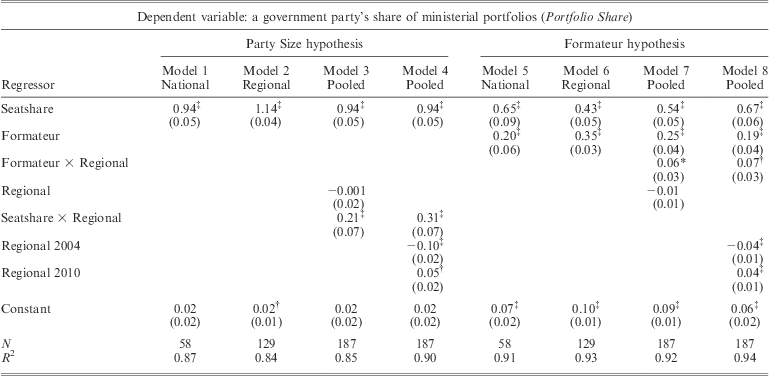
We use ordinary least squares to test our hypotheses. Robust standard errors (clustered by government) deal with potential heteroskedasticity and allow us to account for the fact that observations within governments are unlikely to be independent. We also employ fixed effects to deal with various sources of unobserved heterogeneity – while Regional allows us to account for unobserved differences across the two levels of government, Regional 2004 and Regional 2010 let us deal with unobserved differences between the two regional elections themselves. The results from eight slightly different models are shown in Table 1. Models 1–4 relate to the Party Size Hypothesis, and Models 5–8 relate to the Formateur Hypothesis.
The Effect of Party Size and Formateur Status on Portfolio Allocation at the National and Regional Levels in France
*p < 0.10; †p < 0.05; ‡p < 0.01 (two-tailed).
Note: Coefficients are shown with robust standard errors clustered by government in parentheses. ‘National’ includes data on all government parties for the twenty-two government formations that took place at the national level in France between 1945 and 2000. ‘Regional’ includes data on all government parties in the twenty-one mainland regions of France following the 2004 and 2010 regional elections. ‘Pooled’ combines the data from ‘National’ and ‘Regional’.
Consider first the Party Size Hypothesis. Models 1 and 2 indicate that the share of seats that a party contributes to a government's legislative majority is positively related to its share of portfolios at both the national (Model 1) and regional (Model 2) levels in France. As predicted, the positive effect of Seatshare on Portfolioshare is larger (1.14) at the regional level than it is at the national level (0.94). The positive and statistically significant coefficient on Seatshare × Regional in Models 3 and 4 confirm that this difference in the effect of party size across the national and regional levels is statistically significant.Footnote 30
It is interesting to note the magnitude of the coefficient on Seatshare at the regional level in Model 2 (1.14). As mentioned earlier, country-specific regressions indicated that larger parties receive less than their ‘fair’ share of cabinet portfolios at the national level in all fourteen countries in our sample. Of course, national-level governments all face the vote of no confidence. If one looks at the regional governments in France, which do not face the vote of no confidence, we see that larger parties receive considerably more than their ‘fair’ share of portfolios; tests confirm that the coefficient on Seatshare in Model 2 is statistically larger than one (p < 0.001).
We now turn to the Formateur Hypothesis. The positive and statistically significant coefficient on Formateur in Models 5 and 6 indicates that, controlling for legislative size, there is a formateur bonus when it comes to portfolio allocation at both the national (Model 5) and regional (Model 6) levels in France. As predicted, though, the formateur bonus is larger at the regional level (0.35) than at the national level (0.20). The positive and statistically significant coefficient on Formateur × Regional in Models 7 and 8 confirms that the difference in the size of the formateur bonus is statistically significant across both levels.Footnote 31 In sum, the evidence suggests that, controlling for their size, formateur parties obtain a greater share of portfolios when there is no vote of no confidence.
Conclusion
Empirical scholars have criticized formal bargaining models for generating predictions about portfolio allocation that are inconsistent with the empirical regularity of Gamson's Law. For example, Laver, de Marchi and Mutlu write that, ‘the profession's canonical theory of bargaining in legislatures is contradicted by one of the profession's strongest and most robust empirical laws [Gamson's Law]’.Footnote 32 Yet the disproportionality predicted by formal models of government formation is not what we observe in the real world. Whereas formal models typically predict that larger parties – and formateur parties in particular – will be advantaged in the government formation process, the empirical evidence suggests that smaller parties do relatively better.
One reason for this gap between theory and empirics can be explained by the way in which bargaining models treat government formation as the end of the game rather than the beginning. These models fail to recognize that the benefits of being in power are tied not only to the formation of the government but also to its survival. The existence of the vote of no confidence in parliamentary and semi-presidential democracies means that governments must have the support of a legislative majority every day of their existence, not just the day on which the government forms. If a government party comes to believe that it is no longer adequately compensated by its share of portfolios and that it could negotiate a better deal with parties outside the government, then it may pull out of the coalition and join a no confidence vote against the government. Recognizing this, formateurs have an incentive to offer a more generous share of the pie to their smaller coalition partners than is strictly necessary to form the government. By offering a larger share of portfolios, formateurs make it more costly for opposition parties to buy off their coalition partners, thereby extending the life of the cabinet – and with it, their access to the perquisites of power.Footnote 33
The key implication of this line of reasoning is that larger parties and formateur parties should receive a larger share of portfolios when the vote of no confidence is absent than when it is present. This is exactly what we found when we compared portfolio allocation across the national and regional levels in France. Larger parties and formateur parties fare significantly better when it comes to portfolio allocation at the regional level (where the vote of no confidence is absent) than at the national level (where the vote of no confidence is present).
Our analysis suggests that the vote of no confidence, and its implications for government survival, may be the root cause of the tension between the predictions of most formal bargaining models and real-world data on portfolio allocation. Our analysis also suggests the potential value of assessing government formation at the sub-national level. To date, most theories of government formation have only been tested at the national level. Sub-national government formation effectively represents a new arena in which scholars can test these theories.Footnote 34 Moreover, it is an arena that potentially offers more variation when it comes to the key causal variables found in government formation theories.