Significant outcomes
• The excessive activation of the NR2B–GSK-3β loop would be associated with elevated GSK-3β expression in the hippocampi of patients with MDD.
• The calretinin-immunoreactive neurons in the dentate gyrus of the hippocampus seem to be the main target of the neuronal cell death triggered by excessive activation of the NR2B–GSK-3β loop.
Limitations
• The sample size used to collect the original data was small.
• Considering various postmortem confounding variables and their effects on the neuropathological markers, we could not examine the effects of lifetime antidepressant treatment history in the process of data analysis.
• A significant correlation between neuropathological markers does not mean that one variable necessarily influences the other. A causal relationship between two variables should be cautiously interpreted.
Introduction
Two previous studies have suggested that the expression of glycogen synthase kinase-3β (GSK-3β) is elevated in the hippocampi of patients with major depressive disorder (MDD) and in an animal model related to depression. Thus, in a chronic mild stress model, the depression-related responses seen in behavioural tests were paralleled by hypercortisolemia and increased hippocampal GSK-3β mRNA levels (Reference Silva, Mesquita and Bessa1). Also a recent study using a web-based integrative database reported increased GSK-3β expression in the hippocampi of patients with MDD (Reference Oh, Park and Kim2). However, the cause of the elevated expression and its function in the hippocampi of patients with MDD remain unknown.
Several groups have examined the interaction between GSK-3β and the N-methyl-d-aspartate (NMDA) receptor. GSK-3β inhibitors (SB-216763 and SB-415286) protected cultured rat cerebellar granule neurons and hippocampal neurons against excitotoxicity mediated by NMDA receptors (Reference Facci, Stevens and Skaper3) and stimulation of NR2B-containing NMDA receptors caused protein phosphatase 1 (PP1)-mediated GSK-3β activation in cultured hippocampal neurons and in the adult mouse brain. Thus, excessive activation of a positive feedback loop between GSK-3β and PP1 may contribute to the deficit of cAMP response element binding protein-dependent neuronal plasticity (Reference Szatmari, Habas, Yang, Zheng, Hagg and Hetman4). An in vitro study using neuronal cell cultures also suggested that GSK-3β inhibition leads to suppression of the function of the NMDA receptor subunit NR2B by increasing NMDA receptor internalisation, which is mediated by Rab5 and regulated by post-synaptic density protein 95 (PSD-95) (Reference Chen, Gu, Liu and Yan5). NMDA receptor stimulation activates GSK-3β and NMDA receptor inhibition increases levels of serine-phosphorylated GSK-3β (the inactive form) in mouse brains (Reference De Sarno, Bijur, Zmijewska, Li and Jope6). These findings point to the existence of an NR2B–GSK-3β loop that may explain the elevated GSK-3β expression in the hippocampi of patients with MDD and its function.
We hypothesized that the existence of an NR2B–GSK-3β loop and its excessive activation in the hippocampi of patients with MDD are associated with the increased hippocampal GSK-3β expression in these patients. For this reason, we examined the hippocampal expression of NR2B and also attempted to identify markers, such as GSK-3β, whose expression was correlated with NR2B levels, using the Stanley Neuropathology Consortium Integrative Database (SNCID, http://sncid.stanleyresearch.org/), a web-based tool used to integrate Stanley Medical Research Institute (SMRI) data sets. The great advantage of data mining using the SNCID in psychiatric studies is the ability to rapidly integrate and analyse diverse experimental findings in human postmortem tissues, which reduces the problems posed by limited sample availability.
Materials and methods
Postmortem brain tissues
The SNC is a subset of 60 specimens from the collection, consisting of four well-matched groups of 15 specimens each from patients with diagnoses of schizophrenia, bipolar disorder, MDD without psychotic symptoms and normal controls. Diagnoses were made independently by two senior psychiatrists according to the Diagnostic and Statistical Manual of Mental Disorders, Fourth Edition. The four groups were matched for age, sex, race, postmortem interval (PMI), brain pH, side of brain and mRNA quality. Specimens were collected with the permission of the families in a standardised manner, with half of each specimen being frozen and half-fixed in formalin. More than 75 000 sections and blocks from the Consortium were sent to over 50 research groups worldwide to perform a wide variety of assessments. The details of sample collection have been reported previously (Reference Torrey, Webster, Knable, Johnston and Yolken7).
The Stanley Neuropathology Consortium Integrative Database
The SNCID currently includes a total of 1749 neuropathology markers measured in 12 different brain regions of the SNC. We classified the markers into four categories: RNA (n = 719), protein (n = 315), cell (which includes cytoarchitectural studies; n = 332) and other (n = 383). The SNCID has been generated with multiple data sets from research groups located all over the world. Research is still being conducted with SNC tissue and the SMRI continues to receive additional data sets. Therefore, the SNCID will continue to be updated. It is freely available to all users, but for commercial use, agreement and permission should be obtained from the SMRI (Reference Kim and Webster8).
Statistical analysis
The effect of the disorders on neuropathology markers (such as NMDA NR2B) was initially tested by analysis of variance. The non-parametric Kruskal–Wallis test was used because the traits are not all normally distributed. If there was a significant effect of the disorders on a trait (p < 0.05), a post hoc Mann–Whitney U-test was used to identify group differences between the disorder groups and unaffected controls (R-packages, http://www.r-project.org/). To identify the markers that correlate with NMDA NR2B in the hippocampus, Spearman's rank correlation test was performed (Reference Kim and Webster9).
To examine whether neuropathology markers were affected by age, brain pH, duration of illness, lifetime exposure to antipsychotics and PMI, we assessed their inter-relationships using Spearman's correlation analysis. The effect of categorical variables (such as sex, smoking, suicide, psychotic feature, alcohol and drug abuse) on the neuropathology markers were also tested by the Mann–Whitney U-test. p-Values less than 0.05 were considered significant. The effects of the neuropathology markers were estimated after controlling for the effects of confounding variables by analysis of covariance (ANCOVA) or partial correlation analysis.
We also downloaded raw data from the SNCID website (repository database) to confirm the online statistical results. Further statistical analysis was performed using SPSS 17.0 software (SPSS Inc., Chicago, IL, USA).
Results
Increased numbers of NMDA receptor complexes in the hippocampi of patients with MDD
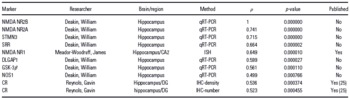
In the SNCID, we found two studies that investigated NMDA receptor subunit NR2B expression in the hippocampus (Table 1). Analysis of variance confirmed that the results from William Deakin's study were statistically significant. In that study, the level of NR2B subunit mRNA expression in the hippocampus was greater in the MDD group (n = 8, 0.3341 ± 0.1681) than in the controls (n = 12, 0.1965 ± 0.0480) (p = 0.047) (Fig. 1). However, we did not find a significant difference in NR2B subunit levels between the two groups in Meador-Woodruff's study (Reference Beneyto, Kristiansen, Oni-Orisan, McCullumsmith and Meador-Woodruff10) (p > 0.05) (Fig. 2).
Sources of data on NMDA receptor NR2B subunit expression in the hippocampus in the SNCID

* ISH, in situ hybridisation; qRT-PCR, quantitative reverse transcriptase polymerase chain reaction.
* Hippocampal tissue section which was investigated by Deakin et al., including all subfields of the hippocampus; CA1 through CA4 and the dentate gyrus.
† Only samples with an RIN > 5.6 were used for qRT-PCR.
Comparison of NMDA receptor NR2B subunit mRNA expression in the major depressive disorder group and the control group. The level of NR2B subunit mRNA expression in the hippocampus was significantly higher in the MDD group (n = 8) than in controls (n = 12) (p = 0.047) (data normalised to the geometric mean of succinate dehydrogenase complex subunit A and beta actin). *p < 0.05.

Laminar distribution of NMDA receptor NR2B subunit mRNA expression in the major depressive disorder group and the control group. Bar graphs illustrating similar distributions of NR2B subunit expression in hippocampal structures in patients with MDD (black bar; n = 15) and controls (gray bars; n = 15).
In the study by Deakin et al., the mean values of NR1 and NR2C subunit mRNA expression in the hippocampus were higher in the MDD group (n = 8) than in the controls (n = 12). However, the differences were not statistically significant (NR1: p = 0.098; NR2C: p = 0.181), whereas the levels of NR2A and NR2D subunit mRNA expression in the hippocampus were significantly higher in the MDD group (n = 8) than in the controls (n = 12) (NR2A, p = 0.016; NR2D, p = 0.010) (Fig. 3).
Comparisons of the expression levels of NMDA receptor subunits NR1, NR2A, NR2C and NR2D in the major depressive disorder group and the control group. (a) The level of NR1 subunit mRNA expression in the hippocampus was slightly higher in the MDD group (n = 8, 0.5824 ± 0.1480) than in controls (n = 12, 0.4748 ± 0.1085) (p = 0.098). (b) The level of NR2A subunit mRNA expression in the hippocampus was significantly higher in the MDD group (n = 8, 0.4845 ± 0.1738) than in controls (n = 12, 0.3234 ± 0.0826) (p = 0.016). (c) The level of NR2C subunit mRNA expression in the hippocampus was slightly higher in the MDD group (n = 8, 0.0217 ± 0.0072) than in controls (n = 12, 0.0197 ± 0.0062) (p = 0.181). (d) The level of NR2D subunit mRNA expression in the hippocampus was significantly higher in the MDD group (n = 8, 0.0072 ± 0.0020) than in controls (n = 12, 0.0049 ± 0.0014) (p = 0.010) (data normalised to the geometric mean of succinate dehydrogenase complex subunit A and beta actin). *p < 0.05.
Excessive activation of the NR2B–GSK-3β loop in the hippocampi of patients with MDD
Spearman's rank correlation test revealed that NR2B subunit mRNA levels in the hippocampus were significantly correlated (p < 0.001) with the expression levels of GSK-3β and eight other neuropathological markers in the hippocampi of all subjects in the SNC (Table 2). In particular, NR2B subunit expression in the hippocampus was significantly correlated with the expression of NR1 subunits (ρ = 0.649, p = 0.000002), discs, large homolog-associated protein 1 (DLGAP1, which interacts with PSD-95) (ρ = 0.599, p = 0.0001027), GSK-3β (ρ = 0.561, p = 0.000110) and nitric oxide synthase 1 (NOS1) (ρ = 0.599, p = 0.000766). The number of calretinin-immunoreactive (CR-IR) neurons in the dentate gyrus and their density were significantly correlated with the expression of the NR2B subunit in the hippocampus (total number: ρ = 0.523, p = 0.000455; density: ρ = 0.536, p = 0.000374). In addition, expression of discs, large homolog 4 (DLG4) was significantly correlated with NR2B subunit expression in the hippocampus (ρ = 0.384, p = 0.00120).
Results of correlation analyses

CA, cornu ammonis area; DG, dentate gyrus; IHC, immunohistochemistry; ISH, in situ hybridisation; qRT-PCR, quantitative reverse transcriptase polymerase chain reaction.
We also found that the level of DLGAP1 mRNA in the hippocampus was higher in the MDD group (n = 8, 0.4884 ± 0.1436) than in the controls (n = 12, 0.3359 ± 0.0899) (p = 0.016). The mean mRNA level of DLG4 (also known as PSD-95) was also higher in the MDD group (n = 8, 0.2506 ± 0.0699) than in the controls (n = 12, 0.2069 ± 0.0398). However, the difference was not statistically significant (p = 0.098) (Fig. 4).
Comparisons of DLG4 and DLGAP1 mRNA expression in the major depressive disorder group and the control group. (a) The mean mRNA level of DLG4 (known as PSD-95) was slightly, but not significantly, higher in the MDD group (n = 8) than in controls (n = 12) (p = 0.098). However, (b) the level of DLGAP1 (which interacts with PSD-95) mRNA expression in the hippocampus was significantly higher in the MDD group (n = 8) than in controls (n = 12) (p = 0.016) (data normalised to the geometric mean of succinate dehydrogenase complex subunit A and beta actin). *p < 0.05.
Effects of confounding variables
We examined whether there was any significant association among all subjects in the SNC between hippocampal NR1, NR2A, NR2B, DLG4 or DLGAP1 mRNA expression (from Deakin's study) and confounding variables (the 11 descriptive variables mentioned in ‘Methods' section) (p > 0.05). We observed a trend towards a correlation between NR2B subunit mRNA level in the hippocampus and brain pH (ρ = 0.30, p = 0.0539). In ANCOVA with adjustment for brain pH, a more marked statistical difference in hippocampal NR2B subunit mRNA expression emerged between the MDD group and the control group (p = 0.006).
We also found a significant correlation between the number and density of CR-IR neurons in the dentate gyrus of the hippocampus (from the study by Gavin Reynols) and brain pH (number: ρ = 0.32, p = 0.0130; density: ρ = 0.28, p = 0.0293). To control for the general effects of brain pH, we performed a partial correlation analysis, which yielded a significant correlation between NR2B and the number of CR-IR neurons (p = 0.016) (Table 3).
Correlations between the level of NR2B subunit mRNAFootnote * and the number and density of CR-IR neurons in the dentate gyrus of the hippocampus

* Data normalised to geometric mean of succinate dehydrogenase complex subunit A and beta actin.
There was a significant association between DLGAP1 mRNA expression levels and antipsychotics (ρ = −0.427, p = 0.0048) in all subjects in the SNC (n = 42). However, since none of the subjects in the MDD group or the control group were taking antipsychotics, the group comparisons were not adjusted for this variable. The level of NOS1 mRNA in the hippocampus was significantly elevated in the suicide group (n = 14, 0.0180 ± 0.0072) compared to the non-suicide group (n = 26, 0.0139 ± 0.0081).
Discussion
Our data mining shows the following: (a) the expression of NR2B and DLGAP1 is significantly higher in the hippocampi of patients with MDD than in those of the controls and (b) the NR2B changes are significantly and positively correlated with changes in NR2A, NR1, GSK-3β, DLGAP1, NOS1, DLG4 and CR-IR neurons in the hippocampi of all SNC subjects. Given the results of previous studies showing the existence of an NR2B–GSK-3β loop and the present study showing up-regulation of the NMDA NR2B subunit, DLGAP1 and GSK-3β, as well as significant correlations between them in the hippocampi of patients with MDD, we propose that excessive activation of the NR2B–GSK-3β loop causes elevated GSK-3β expression in the hippocampi of patients with MDD.
In our study, not only did we find that the expression of NR2A, NR2B and DLGAP1 was significantly elevated in the hippocampi of patients with MDD patients, but also that all the NMDA receptor subunits (including NR2B) were expressed in a similar pattern in hippocampal structures in the control and MDD groups (Reference Beneyto, Kristiansen, Oni-Orisan, McCullumsmith and Meador-Woodruff10). However, the reasons that we gave precedence to the data from Deakin's study over the results of Meador-Woodruff's study in the process of data mining were as follows: (a) the Meador-Woodruff study is limited in that their receptor subunit transcript expression data and receptor binding data are not mutually consistent (Reference Beneyto, Kristiansen, Oni-Orisan, McCullumsmith and Meador-Woodruff10) and (b) the quantitative reverse transcriptase polymerase chain reaction (qRT-PCR, used in Deakin's study) is known to be more sensitive than in situ hybridization (used in Meador-Woodruff's study). In addition, previous studies using postmortem human brain tissue have given various results with regard to NMDA receptor expression in patients with MDD (Reference Karolewicz, Stockmeier and Ordway11–Reference Karolewicz, Szebeni, Gilmore, Maciag, Stockmeier and Ordway15) Differences in specific brain regions and experimental techniques are important factors that may be related to the discrepancies between postmortem studies. Mean values of NR1 and PSD-95 immunoreactivity in the dentate gyrus were slightly, but not significantly, elevated in the MDD group relative to controls (Reference Toro and Deakin12). The levels of NR2C subunit immunoreactivity were significantly higher in the locus coeruleus of depressed subjects compared with those of matched controls (Reference Karolewicz, Stockmeier and Ordway11). NR1 and NR2C expressions were significantly decreased in the prefrontal cortices of patients with MDD (Reference Beneyto and Meador-Woodruff13). There was reduced expression of NR2A, NR2B and PSD-95 in the anterior prefrontal cortices (Brodmann area 10) of patients with MDD compared to those of the controls (Reference Feyissa, Chandran, Stockmeier and Karolewicz14). NR2A and PSD-95 levels were significantly elevated in the lateral amygdalae of depressed patients compared to those of the controls (Reference Karolewicz, Szebeni, Gilmore, Maciag, Stockmeier and Ordway15).
Excessive activation of the NR2B–GSK-3β loop is expected to be associated with the oxidative stress-induced neuronal cell death pathway in the hippocampus. Previously, we have reported that GSK-3β expression levels were correlated with NOS1 expression (ρ = 0.70, p < 0.0001) in the hippocampus (Reference Oh, Park and Kim2). Now, we have shown that NR2B subunit expression levels are also significantly correlated with NOS1. NOS1 is known to bind to PSD-95, which may participate in downstream signaling by NMDA receptors (Reference Sheng16). Suppressing the expression of PDS-95 or NOS1 reduce the vulnerability of neurons to excitotoxic NMDA challenge. This result confirms that the NMDAR–PSD-95–NOS1 complex is important in mediating excitotoxic damage (Reference Cui, Hayashi and Sun17). A recent study found that hippocampal NOS1 overexpression associated with neuronal apoptosis (Reference Khovryakov, Podrezova and Kruglyakov18) or with impaired neurogenesis (Reference Zhou, Hu and Hua19) was observed in rodents exposed to chronic stress resulting in behavioural changes typical of depression. Hippocampal NOS1 expression was also increased in the CA1 region of patients with major depression. This was significantly more marked in samples from the right hemisphere (Reference Oliveira, Guimaraes and Deakin20).
Interestingly, we also found that the number and density of CR-IR neurons in the dentate gyrus were correlated with hippocampal expression of NR2B subunit. CR, a calcium-binding protein, is expressed differentially in neuronal subpopulations and its expression has been used to selectively target specific cell types (Reference Camp and Wijesinghe21). It is a marker of specific non-pyramidal γ-aminobutyric acid-ergic neurons (Reference Fonseca and Soriano22), as well as a neuronal marker expressed transiently in maturing granule cells during adult hippocampal neurogenesis (Reference Brandt, Jessberger and Steiner23). In the human hippocampus, calretinin-immunoreactivity is present exclusively in non-granule cells of the dentate gyrus and in non-pyramidal cells of Ammon's horn (Reference Nitsch and Ohm24). Our results suggest that the CR-IR neurons in the dentate gyrus of the hippocampus represent the main site of the neuronal cell death triggered by excessive activation of the NR2B–GSK-3β loop.
Although this study yielded some interesting results, it had several limitations. First, the sample size used to collect the original data was small and relied mainly on the unpublished work of Deakin et al. In particular, in the Deakin's study, RNA samples with an RNA integrity number (RIN) greater than 5.6 were only used for qRT-PCR, so the sample size was further decreased because of missing data. Second, as there are no antidepressant drug histories in the SNCID, we unfortunately could not examine the effects of antidepressant treatments on the various neuropathological markers. Finally, although we found a significant correlation between the expression levels of NR2B and other neuropathological markers, this does not mean that one variable necessarily influences the other. Well-designed experiments using human postmortem brain tissues will be required to establish causal relationships.
Despite these limitations, this is the first study to show the possible involvement of excessive activation of the NR2B–GSK-3β loop in the hippocampi of patients with MDD through data mining, which facilitated the analysis of patients' postmortem brains. Our findings suggest a model of the pathway linking GSK-3β and NMDA receptor function in the hippocampal CR-positive neurons of patients with MDD. According to this model, excessive activation of the NR2B–GSK-3β loop induces overexpression of GSK-3β in the hippocampus and GSK-3β-mediated neuronal cell death or suppressed neurogenesis in hippocampal CR-IR neurons could play a significant role in the pathophysiology of MDD (Fig. 5).
A hypothetical model of the biological pathway linking GSK-3β and NMDA receptor function in the hippocampal CR-IR neurons of patients with MDD.
Acknowledgements
We would like to thank the SMRI collaborators who allow SNCID to be freely available to all users and also all investigators generating original data in the SMRIDB. This research was supported by a grant from the Korea Health 21 R & D project, Ministry of Health and Welfare, Republic of Korea (A050047).