Implications
In Europe, a common practice is to inseminate dairy cows with semen from beef cattle if the calves will not be used for milk production. However, few studies have compared breeding pure Holstein and several crossbreed with respect to calving traits. This investigation studied the effects on calving difficulty, gestation length and stillbirths of the use of crossbreeding with beef bulls of the breeds most often used for crossbreeding in dairy cattle from the north-west region of Spain. Although more studies are required, data provide a decision support aid for selecting breed when crossbreeding Holstein dams.
Introduction
Trends in milk pricing, coupled with increasing concerns about health, fertility and calving performance, have led to a greater interest in crossbreeding among commercial dairy producers (Maltecca et al., Reference Maltecca, Khatib, Schutzcalfkus, Hoffman and Weigel2006). A common European practice in dairy production is to inseminate dairy cows with semen derived from beef cattle if the calves will not be used for milk production on the dairy farm (Sørensen et al., Reference Sørensen, Norberg, Pedersen and Christensen2008; Dal Zotto et al., Reference Dal Zotto, Penasa, De Marchi, Cassandro, Lopez-Villalobos and Bittante2009). Wolfova et al. (Reference Wolfova, Wolf, Kvapilik and Kica2007) have established a superior financial value from the meat of dairy and beef crossbreeds when compared with pure dairy cattle.
The use of beef bulls in dairy farms has arisen because of the following factors: (i) Low milk prices in certain periods and areas of Europe have led farmers to look for alternative income sources, such as selling calves for meat production. (ii) Certain health problems, such as paratuberculosis or neosporosis, have caused farmers to redirect the infected cows from calf rearing. Paratuberculosis is becoming a generalised infectious problem in cattle in developed countries (Maning and Collins, Reference Maning and Collins2001), and a high neosporosis seroprevalence has been also observed in the European cattle population (Bartels et al., Reference Bartels, Arnaiz-Seco, Ruiz-Santa-Quiteria, Björkman, Frössling, von Blumröeder, Conraths, Scahres, van Maanen, Wouda and Ortega-Mora2006). (iii) It is believed that beef sires are more fertile than dairy cattle, and beef cattle sperm is more frequently used in cows that do not become pregnant. Therefore, in Galicia (northwestern Spain) 20.2% of Holstein cows are crossed with beef breeds in the first insemination, and 28.5% of cows do not become pregnant (Fouz, Reference Fouz2007). In this area, Belgian Blue, Limousine and Galician Blonde (an autochthonous breed from this area) are the breeds most often used for crossbreeding (Fouz, Reference Fouz2007).
The availability of beef cattle semen is not currently a limiting factor for its use. Therefore, the decision to opt for a breed when crossbreeding dairy cattle depends not only on the growth of the calf, the conversion index and the yield of the carcass but also on the other aspects affecting the dairy production, such as gestation length, calving difficulty or occurrence of stillbirth.
Calving is a stressful time in a cow's life, and the amount of stress is affected by high birth weights, dystocia and stillbirth. Calving difficulty can result in the loss of a calf, lower milk production and diminished health of the cows (Olson et al., Reference Olson, Cassell, McAllister and Washburn2009). Several studies have shown benefits in calving in a crossbreeding system with various breeds in dairy cattle in the United States (Heins et al., Reference Heins, Hansen and Seykora2006; Maltecca et al., Reference Maltecca, Khatib, Schutzcalfkus, Hoffman and Weigel2006), but the European dairy literature is sparse (McGuirk et al., Reference McGuirk, Forsyth and Dobson2007; Blöttner et al., Reference Blöttner, Heins, Wensch-Dorendorf, Hansen and Swalve2011). Gestation length may be one of fertility traits with the potential to reduce calving problems, which would increase the lifetime reproductive efficiency of dairy cows (Nadarajah et al., Reference Nadarajah, Burnside and Schaeffer1989; Olson et al., Reference Olson, Cassell, McAllister and Washburn2009).
The aims for this study were (i) to analyse the evolution in the practices of beef bull semen for dairy cattle insemination and (ii) to assess the calving difficulty, gestation length and proportion of stillbirths after breeding pure Holsteins (H × H), or crossbreeding with Belgian Blues (H × BB), Limousines (H × LM) and Galician Blondes (H × GB) sires.
Material and methods
Area description
Galicia (in northwestern Spain) is the major cattle-farming region of Spain. Galicia accounts for 35% of the milk produced in Spain and constitutes ∼1.7% of the milk produced in the European Union. Thus, dairy cattle farming is one of this region's most important economic activities. In Galicia, 35% of the herds are enroled in the Official Milk Recording, which represents 82% of the milk produced in this region.
Data collection and animals surveyed
Information for the study was recorded from the Official Milk Recording system of Galicia. Data were collected during 2004 to 2011 for 552 535 Holstein calvings (457 070 H × H, 43 348 H × LM, 32 174 H × BB, 19 943 H × GB). In addition, the annual percentage of cows registered in neosporosis and paratuberculosis control programmes were recorded. These voluntary programmes are implemented through farming associations to control cattle health (Attachment Disorder Support Group (ADSG) in Spain); this programme works together with control programmes against bovine viral diarrhoea virus and bovine herpesvirus type 1, which cause bovine infectious rhinotracheitis.
For each calving, the difficulty was measured using the following classifications:
1. Quick, easy birth with no assistance
2. Slight problem but required no assistance
3. Required assistance
4. Difficult birth with veterinary assistance
5. Extreme difficulty/caesarean.
The gestation length was recorded in days (period from the date of insemination leading to pregnancy to calving). Other variables regarding the ease and duration of calving were the age of the dam at calving, sex of the calf and number of calves and type of mating (natural mounting, artificial insemination or embryonic transfer). Besides, calves found dead at birth or within 24 h of birth were recorded as stillbirths.
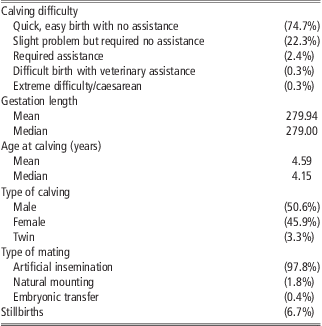
The frequency and descriptive data are shown in Table 1.
Frequencies and descriptive data for the variables used in the study

Statistical analysis
All data were collected and processed by SPSS 15.0. By using the Pearson correlation coefficient (r), we tested for the changes in the percentage of inseminations with beef bull semen in relation to the percentage of animals registered in health programmes through ADSG.
To evaluate the breed selection influence at crossbreeding on calving difficulty, a χ 2 test was used. The other variables previously mentioned were evaluated through a univariate analysis using k × 5 tables to study their possible associations with this trait. Those with moderate statistical significance (P < 0.15) were introduced, along with the breed of the sire used for mating, into an ordinal logistical regression model. The parallel line test was used to test the hypothesis of proportionality.
To evaluate the influence of breed on gestation length, ANOVA was used. As in the previous case, the remaining variables were also tested to measure their influence on this parameter. A multivariate analysis using a linear regression was later performed using the same criteria.
To assess the effect of the breed on the proportion of stillbirths, a new χ 2 test was performed. The observed effect was corrected for the variable ‘calving difficulty’.
Results
The sire breed most frequently used for crossbreeding with Holstein cows was Limousine (7.8% of all breedings performed), followed by Belgian Blue (5.8%) and Galician Blonde (3.6%). No significant variations were seen in the 2004 to 2011 period with regard to the proportions of different breeds. A significant linear decrease existed in the use of crossbreeding as the number of animals registered in ADSG increased (r = −0.832, P = 0.010).
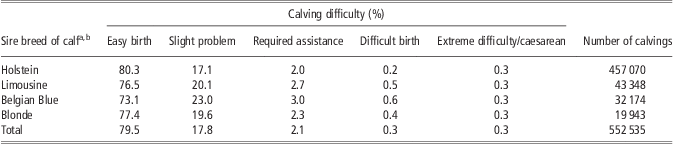
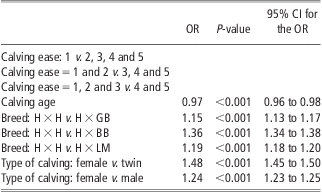
Out of all calvings, 80.3% of the calvings for the H × H calves were classified as easy. For other calves, the percentage of easy calvings was lower, and a higher percentage was classified as slight or difficult (including caesarean) compared with Holstein (P < 0.001). The H × GB calves were the closest to the H × H for the percentage of easy calvings (77.4%), followed by H × LM (76.5%) and H × BB (73.1%). There was also a tendency for easier calvings for the H × GB and H × LM calves when compared with H × BB (P < 0.001; Table 2). The multivariate analysis indicates that the calving difficulty decreased as the age of the dam advanced, and the difficulty was not related to the type of mating. The probability of a more difficult calving was 1.15 times higher for the H × GB calves, 1.36 for H × BB, 1.19 for H × LM compared with H × H. The most difficult calvings were observed most frequently in twin calvings, followed by the calvings of male calves and female calves (Table 3). The parallel line test was not significant.
Calving difficulty in Holstein dairy cows as a function of the breed used for insemination
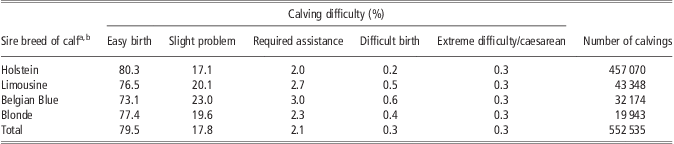
aDistribution of calving difficulty statistically differed when comparing Holstein with Limousine, Belgian Blue and Blonde (P < 0.001 for the three comparisons).
bDistribution of calving difficulty statistically differed when comparing Limousine and Blonde with Belgian Blue (P < 0.001 for the two comparisons).
Multivariate ordinal regression for evaluating factors associated with calving difficulty in Holstein dairy cows
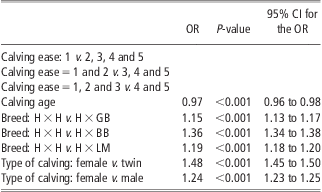
OR = odds ratio, CI = confidence interval.
Calving ease: 1: easy birth, 2: slight problem, 3: required assistance, 4: difficult birth, 5: extreme difficulty/caesarean.
Breed: H × H: cross of Holstein with male Holstein (reference category), H × GB: cross of Holstein with male Galician Blonde, H × BB: cross of Holstein male Belgian Blue, H × LM: cross of Holstein with male Limousine.
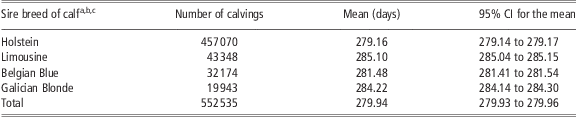
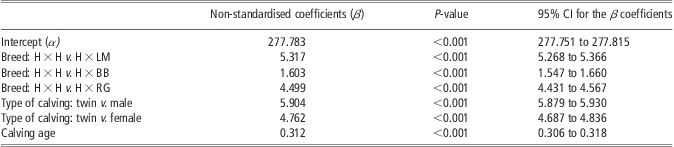
The H × LM and H × GB calves had significantly longer gestation lengths than H × H and H × BB. Between the latter two, H × H has the shortest gestation length (Table 4). The multivariate analysis led to similar conclusions in terms of the breed used for mating. The gestations leading to the birth of females or males were, on average, 4.76 and 5.90 days longer than those leading to twin births, respectively. The length of the gestation was significantly lower when the dam was older (Table 5).
Mean gestation length (in days) of Holstein dairy cows as a function of breed used for insemination
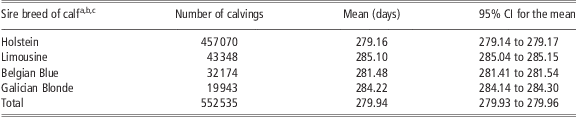
CI = confidence interval.
aMeans statistically differed when comparing Holstein with Limousine and Blonde (P < 0.001 for the two comparisons).
bMeans statistically differed when comparing Belgian Blue with Limousine and Blonde (P < 0.001 for the two comparisons).
cMeans statistically differed when comparing Holstein with Belgian Blue (P = 0.003).
Multivariate linear regression to evaluate factors associated with gestation length in Holstein dairy cows
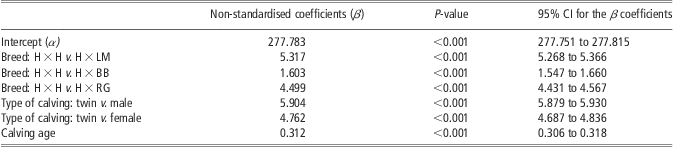
CI = confidence interval.
Breed: H × H: cross of Holstein with male Holstein (reference category), H × BB: cross of Holstein with male Belgian Blue, H × GB: cross of Holstein with male Belgian Blue, H × LM: cross of Holstein with male Limousine.
The proportion of stillbirths was 6.7% (6.7%, 6.8%, 7.0% and 6.7% for H × H, H × LM, H × BB and H × GB calves, respectively). Difference was significant (P < 0.001) when comparing H × BB with the other calves. However, stratified analysis indicated that this association was confounded by ‘calving difficulty’.
Discussion
A change in the farm production would make the farmer less vulnerable to drops in milk prices because the sale of calves from crossbreeding to feedlots has a higher value in the market than Holstein calves. Crosses have better meat yield when beef sires are used with Holstein dams (Morris et al., Reference Morris, Parker, Purchas and McCutcheon1992). US data indicated that beef derived from Holstein steers is a significant source of the beef supply (National Agricultural Statistics Service (NASS), 2005).
In the study population, the average number of lactations for milking animals has been constant in recent years (3.7 mean lactation number in 2004 and 2010; Asociación Provincial para o Control de Rendementos (AFRICOR), 2010). However, this population needs to increase because of constantly expanding herds, which is why dedicating dairy cows for crossbreeding further limits this population. This practice explains the progressive decrease in the use of crossbreeding as an alternative income to milk sales. On the other hand, the increase in the population registered in ADSG since 2004 allows an increasing number of farmers to identify dams that could be carriers of pathogens that could be potentially passed to their descendants. This also limits the number of reproductive cows available for calf-raising, but it is mitigated by the ADSG's encouragement of calf-raising as one of the most effective measures for increasing herd biosecurity, which is less dependent on the incorporation of animals from other origins. The percentage of internal rearing in the study population increased from 39.4% in 2004 to 52.3% in 2009 (AFRICOR, 2010). This finding could explain the negative correlation observed between the percentage of animals belonging to ADSG and the use of crossbreeding.
Calving male calves was more difficult than female calves, which agrees results obtained in other studies although using other sire breeds for mating Holstein dams (Brown Swiss, Montbeliarde, Normande and Scandinavian Red; Heins et al., Reference Heins, Hansen and Seykora2006; Blöttner et al., Reference Blöttner, Heins, Wensch-Dorendorf, Hansen and Swalve2011). Olson et al. (Reference Olson, Cassell, McAllister and Washburn2009) reported that gestation length had an unfavourable genetic correlation with both stillbirth and dystocia, as longer gestation intervals produced more dystocia and more stillbirths. The calving difficulty was affected by multiple factors, such as the breed of the sire of calf, age of the dam, sex of the calf and twin calvings and were similar to those reported by McGuirk et al. (Reference McGuirk, Forsyth and Dobson2007).
Calving difficulty is an important parameter in dairy cows because it is related to the production and fertility during the subsequent lactation. McGuirk et al. (Reference McGuirk, Forsyth and Dobson2007) estimated that the average increase in days open was 9.2 and 21.5 days after moderate and difficult calvings, respectively, in comparison to the easy calvings. There was also a marked decrease in the kilograms of fat and protein produced in lactations after difficult calvings.
Dematawewa and Berger (Reference Dematawewa and Berger1997) have pointed to average losses of 703.6 kg in lactations after extremely difficult calvings. The cost of labour and veterinary assistance should be added to this loss. Calf mortality also rises with more difficult calvings, ranging between 2.6% in uneventful calvings and 51.8% in the most difficult calvings (McGuirk et al., Reference McGuirk, Forsyth and Dobson2007). Parity of the dam was a significant source of variation for calving difficulty and was lower when the age was higher. Difficult calvings in dairy cows, especially in primiparous cows, have an important effect on a cow's longevity and therefore on the investment costs of the herd (de Maturana et al., Reference de Maturana, Ugarte and González-Recio2007).
Contrary to what was observed in the present study, Nadarajah et al. (Reference Nadarajah, Burnside and Schaeffer1989) showed an increase in the gestation length as the number of calvings increased. The importance of gestation length is linked to birth calf weight and the ease of calving (de Maturana et al., Reference de Maturana, Wu, Gianola, Weigel and Rosa2009). However, according to the data collected in the present study, longer gestation lengths (observed in H × LM and H × GB calves), did not imply a more difficult calving (as observed in H × BB). Therefore, the choice of a sire breed for crossbreeding, in terms of gestation length, does not seem to be affected by the calving difficulty. The H × LM and H × GB crossbreeds demonstrated a similar gestation length, although the latter group had more uneventful calvings.
Stillbirths have a severe impact on dairy profitability (Bicalho et al., Reference Bicalho, Galvão, Cheong, Gilbert, Warnick and Guard2007). According to previous studies, the cause of stillbirth is likely to be multifactorial, although calving difficulty and stillbirth are highly correlated. Difficult calving may explain about half of the stillbirths (Berglund et al., Reference Berglund, Steinbock and Elvander2003; Steinbock et al., Reference Steinbock, Näsholm, Berglund, Johansson and Philipsson2003). In this line, several risk factors for stillbirths not considered in this study should be estimated. Causes of stillbirth not related to dystocia include infections (e.g. bovine viral diarrhea), insufficient placenta development, metabolic disorders of the dam, genetic factors and congenital malformations of the calf (Szücs et al., Reference Szücs, Gulyas, Cziszter and Demirkan2009).
The fertility of the dams, resulting from different crosses, complements the data examined when choosing a breed for crossbreeding. A prior study reviewed fertility data in regard to the return rate after 56 days post-insemination. The non-return rates from inseminations performed using semen from the following breeds in nulliparous heifers/milking cows were 0.71/0.58 for Limousine, 0.75/0.52 for Belgian Blue and 0.81/0.61 for Galician Bond (Fouz et al., Reference Fouz, Gandoy, Sanjuán, Yus and Diéguez2011). The use of repeated beef breed insemination is not justified in reproducing cows to improve fertility. There is a wide margin for the use of Holstein bull semen without using beef breeds. Among the Holstein breeds commonly used in the study population, there are more than 37 points of difference in the non-return rate, which justifies the use for highly fertile Holsteins before beef bulls in cows who have not become pregnant (Fouz et al., Reference Fouz, Gandoy, Sanjuán, Yus and Diéguez2011).
Through examining these parameters, more elements should be considered when selecting a beef breed for the insemination of milk-producing cows. If genetic advances in the most economically important factors do not accompany crossbreeding practices, the practices will only achieve limited success (Sørensen et al., Reference Sørensen, Norberg, Pedersen and Christensen2008). Results from the present study would allow producers to make informed decisions to minimise the impact that the studied traits (specially calving difficulty) have on herd cost. However, unlike previous studies, shorter gestations did not lead to the lowest calving difficulty.
Acknowledgement
The authors thank AFRICOR Lugo for its invaluable help for performing the study