INTRODUCTION
Intractable problems in environmental science and management abound. The world's fisheries are endangered (FAO [Food and Agriculture Organization of the United Nations] 2003), global forest cover is subject to continued and apparently intransigent depletion practices (Capistrano & Kiker Reference Capistrano and Kiker1995), wetlands are seen as waste ground and mangroves as a barrier to development (Blasco et al. Reference Blasco, Aizpuru and Gers2001). Many more examples could be cited, and it may seem that resource management globally is notable more for its spectacular failures than for its rare successes (Brundtland Reference Brundtland1987; Albo & Roberts Reference Albo, Roberts, Jackson and Sanger1998; Martin & Schumann Reference Martin and Schumann1998; Ommer Reference Ommer and Hawken2004). Humans have not excelled in protecting the planet, and the age of climate change is now forcing humankind to come to grips with the basic principles that underlie resource management at a range of scales from the local to the supra-national (IPCC [Intergovernmental Panel on Climate Change] Reference Parry, Canziani, Palutikof, van der Linden and Hanson2007).
The restructuring that is associated with globalization has been generally recognized to have created rapid and profound social, economic and political change both in and beyond industrial countries, and the growing literatures on globalization, the dismantling of the welfare state, industrial change and neo-liberalism all speak of the advent of a ‘new industrial divide’ (Piore & Sable Reference Piore and Sabel1986; Petras & Veltmeyer Reference Petras and Veltmeyer2003; Harvey Reference Harvey2005). Much of the literature has concentrated on regulatory and industrial restructuring through an examination of globalization, technological change and new industrial divisions and practices, and points out that social restructuring has both global and local dimensions (Tiessen et al. Reference Tiessen, Brklacich, Breulmann and Menezes2007). Globally, ‘freeing’ the operation of economic activity has predominated (Beneria & Lind Reference Beneria and Lind1995). The effects of this can be seen, for example, in shifts in the location of production, as well as in changes in the nature of work and employment (Mackenzie & Norcliffe Reference Mackenzie and Norcliffe1997). Nationally and locally, restructuring has also been associated with the erosion of social safety nets and changes in health and education systems.
It has been less well recognized that restructuring has had impacts on the natural world, through the organizing of natural resources for economic requirements, national and global. The literature does talk about restructuring as referring to periods of relatively rapid, substantive change: that which, in the biophysical sciences is referred to as ‘regime shift’. However, research on such environmental restructuring has usually focused either narrowly on regime shifts within ecosystems (Harris & Steele Reference Harris and Steele2004) or more broadly on ecosystem stressors and their potentially devastating consequences for environmental and human health. ‘Healthy ecosystems’ are usually defined as ecosystems which are stable and sustainable, resilient to stressors, and capable of maintaining organization and autonomy over time (Dolan et al. Reference Dolan, Taylor, Neis, Eyles, Ommer, Schneider and Montevecchi2005). Natural disturbances, it is argued, often provide the basis for the revitalization of local ecosystems, while anthropogenic stressors are seen as often resulting in degradation that reduces the capacity of ecosystems to recover, thus permanently affecting their health (Rapport et al. Reference Rapport, Costanza and McMichael1998). Degradation can worsen under conditions of uncertainty in the biophysical sciences (if lack of knowledge results in lack of good management practice), and/or when politico-economic pressure for continued resource exploitation results in a cycle of resource overexploitation characterized by the so-called ‘ratchet effect’ (Clapp Reference Clapp1998; Ludwig et al. Reference Ludwig, Hilborn and Walters1993). Throughout the various literatures of the biophysical, social and health sciences, that is, there has been disagreement on the manner in which restructuring affected people, their communities and the environment. Moreover, all such writing has reflected an incomplete understanding of the dynamics of environments or the links between ecology, economy and health.
That humanity needs to manage its resources better is undisputed. But, scholars also need to understand the social context of such work, and the impact that different management regimes are likely to have, not just upon the natural resources themselves, but also on the human communities that are interdependent with (not just dependent on) those resources (Coward et al. Reference Coward, Ommer and Pitcher2000; Sumaila et al. Reference Sumaila, Boyer, Skogan and Steinshamn2004; Ommer and Team Reference Ommer and Team2007). Hence scholars must marry (biophysical) scientific understanding of the environment with the realities of life lived by ordinary people.
Social-ecological literature is not to be confused with the school of social or human ecology, started in the 1920s in Chicago by urban sociologists to integrate social and environmental studies in an interdisciplinary way. Such work was fundamentally focused on people and society, and included physical and biological facts only as independent (not interdependent) variables influencing social structure. Contemporary research in social ecology, in Europe as in North America, goes far beyond the biological and economic foundations of human ecology to provide a broader cross-disciplinary perspective on the ways in which human-environment relations are jointly influenced by physical environmental, political, legal, psychological, cultural and societal forces. However, only the Resilience Alliance (URL http://www.resalliance.org/) has sought to integrate the social and the ecological, by thinking of them as interdependent subsystems. That joint social-ecological perspective, pioneered by Carl Folke and Fikret Berkes, will enable better management of the environment, and especially of natural resources (Berkes et al. Reference Berkes, Folke and Colding2000; Ommer and Team Reference Ommer and Team2007; Ommer et al. Reference Ommer, Perry, Cochrane and Cury2010; Chapin et al. Reference Chapin, Trainor, Huningdon, Lovecraft, Zavaleta, Natcher, McGuire, Nelson, Ray, Calef, Fresco, Huntington, Rupp, DeWilde and Naylor2008). This urgent need for social-ecological understanding in the management of the environment by definition requires work conducted in an integrated interdisciplinary manner.
The challenge, however, is to create the kind of team research that will be capable of addressing social-ecological problems in such a manner. As someone who has worked for twenty years with applied team research of various kinds, I have come to understand that the most appropriate approach is that which, quite simply, the research question demands. Thus, in an investigation of the ethics of Canadian marine fisheries, the approach that was adopted was one of bringing scholars together to discuss how to reconsider research already done within the context of an ethical perspective that was agreed upon by the whole team; this is what Coward calls a ‘common mind’ (Coward et al. Reference Coward, Ommer and Pitcher2000), and I speak of as ‘shared vision’. However, in the wake of the commercial collapse of the groundfish fisheries of the north-west Atlantic and the establishment of the ensuing moratoria on fishing that threw 40 000 people out of work overnight, new archival, documentary and field research was required that would bring together the biophysical and human realms in which that social-ecological crisis had erupted. This was the only way to establish what had happened, and why, and what could be done to remedy the situation (Ommer Reference Ommer2002): that was the shared vision of that research. These two examples of rather different approaches to applied interdisciplinary work show that the whole issue of discipline, methodology and theory needs to be sufficiently open and flexible to permit the real potential for new theory and methods to be developed. Interdisciplinary research will, therefore, require scholars to ‘learn by doing’, since it will be constantly undergoing development. Interdisciplinary teams, moreover, will have to use an appropriate array of different levels of interweaving of methodologies, some of which will be close to a mono-discipline approach, while other parts may be truly transdisciplinary. That said, in environmental science and resource management, discipline-based science (social and natural) is fundamental, and thus will be useful, and necessary. It will, however, always be insufficient because, in a world fraught with complex problems, the combined wisdom of many disciplines, in partnership with participants in resource sectors (for example fishers, managers and policy-makers) is becoming an important way to reach necessary goals. The management of natural resources is fraught with complexities of scale, knowledge, power, purpose and application (Sinclair & Ommer Reference Sinclair and Ommer2006) and so those disciplines that can analyse such underlying forces are needed as part of the effort to solve the intransigent problems of the twenty-first century.
The disciplines involved should be those that are needed, neither more nor less, to provide a holistic answer to the problem at hand. That is why it is important to have social scientists in several disciplines (not just economics and law) working in an interdisciplinary manner directly with natural scientists and policy-makers, not separately in a multi-disciplinary (many disciplines working on their own on a shared problem and then coordinating outcomes) mode as is the current practice (for example, Operational Evaluation Tools for Fisheries Management Options [EFIMAS], L'Institut Francais de Recherche pour l'Exploitation de la Mer [IFREMER], Sweden's Sustainable Coastal Zone Management [SUCOZOMA] projects) in Europe. A good example is the EFIMAS book (Motos & Wilson Reference Motos and Wilson2006) in which different experts from different disciplines write different chapters; these insights are then collated by scientists so that science can then advise management. This is a vast improvement on previous practice, but it is still not enough. It still does not provide the kind of multi-faceted integrated template that is essential to understanding what happens at the many different scales in fisheries. If science and social science cannot be integrated, then major insights and new ways of coming together to solve problems are lost.
This struggle with interdisciplinarity (as opposed to multidisciplinarity) is also evident in the marginally interdisciplinary (often biologists with economists only) but otherwise multidisciplinary networks created under the International Geosphere-Biosphere Programme (IGBP) and the International Human Dimensions Programme (IHDP), both of which come under the United Nations Educational, Cultural and Scientific Organization (UNESCO) with the Scientific Committee on Ocean Research banner (SCOR), which supports programmes such as the Land-ocean Interactions in the Coastal Zone (LOICZ) or the new Integrated Marine Biogeochemistry and Ecosystem Research (IMBER) programme. This is because of the manner in which funding is dispensed in these networks, with funds dedicated to meetings, networking activities, focus groups and the like, not to integrated research initiatives and teams. National participants are expected to find their own funding for specific interdisciplinary projects and, since so many national academic funding councils are divided into separate funders for humanities and social sciences, natural sciences and engineering, and health (for example Canada's Social Sciences and Humanities Research Council [SSHRC], Natural Sciences and Engineering Research Council [NSERC] and Canadian Institutes of Health Research [CIHR]), these international networks cannot put together large interdisciplinary teams, although they can sponsor international programmes and work with the projects that arise out of them.
Such was the partnership between Global Oceans Ecosystem Dynamics (GLOBEC) and, the focus of this paper, the Canadian Coasts Under Stress (CUS) research project. The PD (project director) of CUS was on the International Scientific Steering Committee ISSC of GLOBEC and co-chaired its working group on human dimensions (Focus 4). Some of the researchers of CUS became part of that group, whose meetings were funded by GLOBEC. In the process, the research theory and results from the CUS research project were disseminated more widely, and used by GLOBEC, in a mutually reinforcing partnership, although the actual research was done by CUS, with Cdn$ 6.2 million research funds awarded in their annual research competition funded through an entirely new and experimental joint award by SSHRC and NSERC totalling Cdn$ 6.2 million for research, that was increased by a further Cdn$ 1 million contribution from the project teams’ two ‘home’ universities (Memorial University of Newfoundland and the University of Victoria, Canada).
I use the CUS project here as a model that demonstrates how to conduct interdisciplinary team research in such a way as to achieve real integration of research that examines urgent, complex and highly interdependent social-ecological concerns. Other projects that are comparable in scale include the Swedish SUCOZOMA project on coastal zone management and the Mangrove Dynamics and Management (MADAM) (Germany and Brazil) project on tropical coastal zone issues; the latter funds interdisciplinary projects, but they are restricted in the number of disciplines that make up the team and in integration of the various separate component projects. The IHDP/IGBP programmes (particularly LOICZ) partner with separate stand-alone nationally funded projects to focus on issues concerning coastal zone management and thus are structurally unable to achieve complete integration into one overarching research project. Thus, none of these initiatives can claim to have achieved integration of the social (which is more than economy and policy) with the biological. Their work is important, but it is incomplete, because, while their combinations of disciplines tell us ‘what’ and suggest ‘how’, they do not explain why managing fisheries is so intransigent a problem: they do not get to the motivations of the people involved. CUS, in an integrated study, looked at all natural resource development aspects of two of the coasts of one nation (although separated by thousands of miles), examining resource sectors (usually considered separately) as an integrated resource base supporting local communities as well as industry, and as contributing to the interdependent ecological and social health of each coast over time: both renewable (forestry) and non-renewable (oil and gas, minerals) resources. Other than the CUS project research, I am only aware of one other comparable discussion of how to achieve similar integration of truly interdisciplinary teams: the theoretical and methodological paper by Starfield and Jarre (Reference Starfield, Jarre, Ommer, Perry, Cury and Cochrane2010), which discussed integrated research from a modelling perspective, with conclusions entirely in keeping with CUS's work.
The context of the case study: Coasts Under Stress
CUS identified a range of interconnected social, economic and environmental impacts of restructuring on the social-ecological health of human, marine and terrestrial populations on the east and west coasts of Canada, from the perspective of people in resource-dependent communities whose lives are embedded in the environment in which they live and on which they depend (Ommer and Team Reference Ommer and Team2007). CUS is unique in the field of interdisciplinary team research in that, over seven years, the CUS study employed more than 60 natural and social scientists, humanists, and education and health experts, along with 167 trainees (undergraduate to postdoctoral fellow) from many disciplines, ranging from oceanography and marine biogeochemistry, through education and human community health, to philosophy and sociology.
To my knowledge, no comparable team research exists (in terms of both scope and scale), the closest being the earlier interdisciplinary team of 30 scholars that examined the collapse of the north-west Atlantic groundfish fishery. Thus, the experience gained by the CUS team was both broader and more integrated than any other previous initiative, involving many researchers and disciplines while operating at distance across a continent. The method that was created in and for CUS built on lessons learned in earlier work. I review it here, in order to provide a detailed analysis of a successful, relatively ‘mature’ template for interdisciplinary team research that can be transferred to other teams and other research problems.
Using a methodology of complementary community-level case studies on the two coasts to identify and examine the long- and short-term effects of social-ecological (see Berkes et al. Reference Berkes, Folke and Colding2000) restructuring, CUS uncovered the linkages (‘pathways’) between the main drivers of social-ecological health in both human and environmental communities. Data were drawn from historical records, archaeological digs, censuses, field work (both social and biogeophysical), interviews, mapping and modelling (economic, biological and physical). The research identified the manner in which decreasing occupational flexibility stemmed from social and industrial policies that, over time, privileged the formal business sector over rural occupational pluralism on both coasts. This undermined the capacity of local communities to respond to the interdependent human and ecological crises that afflicted the coasts through the collapse of their marine (groundfish and salmon) and terrestrial (forestry and mining) resource bases, due to overfishing, changing water temperatures and the vagaries of the global marketplace. It thus also outlined possible pathways by which government policy could reverse such trends and return social and ecological wellbeing to the coasts. The details of individual methodologies and findings in the subcomponents of the study are to be found in a range of publications in both scholarly journals and a series of books (see also Ommer and Team Reference Ommer and Team2007). This paper discusses the innovative and flexible methodology for achieving the interdisciplinary integration that led to the suite of integrated findings that is the legacy of this work.
THE COASTS UNDER STRESS APPROACH
Building a framework
Academically speaking, interdisciplinary excellence is best measured by the degree of success that team research achieves in integration of the work, namely the way in which the research and training work of a project comes together, to what degree it shares goals and achieves them, and how much it trains students to work with a range of disciplines. CUS, for example, positioned itself to be successful by taking several preliminary steps: as PD, I built on a foundation of team members from earlier projects who had worked successfully together before, and worked with them to find compatible people to fill the disciplinary gaps that existed in the original core group and thus complete the team; I used four bi-coastal co-chairs with whom I had worked, two of whom led research centres where CUS could find a home, and who had previous experience in team research; and developed a truly interdisciplinary overarching question that came out of a series of workshops, first on each coast and then between them (using audio-visual equipment to ensure real team-building), that led to the shared vision of the team. The overarching question the team set out to answer was: ‘What has been the impact of environmental and social restructuring on the social-ecological health of the east and west coasts of Canada?’ To answer it, the whole team (including senior students and postdoctoral fellows [pdfs]) had to agree on a research strategy that would bring together and integrate the work of all team members.
CUS was created in the context of the coastal social-ecological stress that framed the work. The natural resource-based industries (fishing, forestry and minerals) that had been the economic mainstays of both coasts were in crisis or had already collapsed when the work started. In both fishing and forestry, local ecosystems were stressed, while mining in the past had left a legacy of polluted and damaged landscapes. Examining the stressed ecosystems that had sustained resource-based coastal communities on the east and west coasts of Canada, required the whole team to examine, in a variety of ways, the impact of ‘restructuring’ defined as: structural change in both the environment and the human communities which depend on the natural resources that flowed from the environment.
The coasts the team examined are geographically very different and also culturally diverse, with descendants of settlers and indigenous peoples present on both coasts. Many of the communities are not well off, some are really poor and some are in a state of collapse. The team wanted to understand why this had happened, given the rich renewable resources that made up the economies of those communities, and also what could be done, in terms of restoring the environment and sustaining the coastal human communities. A range of sometimes conflicting hypotheses were offered in the planning stages of the work. Some team members hypothesized that the globalizing economy and neoliberal economics had rendered these places hugely vulnerable, while shrinking or collapsed resources bases (fish, timber and minerals) had thrown their economies into crisis. But others, both social and natural scientists, saw that explanation as ideologically-based, and counter-hypothesized that these places were just not able to deal with the difficulties and realities of a modernizing world.
This potential conflict was minimized during the early workshops, when researchers agreed that, although they could not start with a single agreed hypothesis, they shared a strong concern for the stressed state of both the people and the environment; it was that shared concern (expressed as a research vision) that formed team spirit. All the members of the team working with me then constructed an interdisciplinary approach to the problem. I minimized personality clashes by establishing at the beginning of every meeting that egos should be left in an imaginary box outside the door, and one-on-one conversations with individuals were held when necessary. Scale (analytical, geographical, temporal and institutional) was an ongoing challenge, since the two coasts, drawing on their particular experiences, had not always been in step. To minimize the difficulties, the team first examined the history of the remote communities of the east and west coasts of Canada, their resource bases, their economies over time, and the way in which the lives of people are embedded in the environments to which they belong, and on which they depend. This required working with different temporal and geographical scales in order to capture both the dramatic, and the more subtle, forms of restructuring, and their impacts on social-ecological health. Building this history required historians, sociologists, anthropologists and marine biologists who used computer modelling techniques to recreate past marine ecosystems.
Secondly, the team explored how the current state of the environment (requiring input from biologists, geologists and oceanographers) and society (with input from sociologists, economists, geographers, an ethno-ecologist, educators and community health experts) was related to coastal social-ecological health (or ill-health).
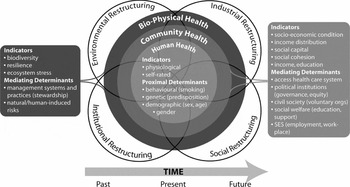
Third, the team created a comprehensive new way to understand restructuring and its impact on social-ecological health. Fourth, as PD, I regularly discussed linkages between various parts of the research with team members, thus keeping integration always in the forefront of team thinking. A refinement of earlier less-rigorous thinking was constructed halfway through the project (Fig. 1; see Dolan et al. Reference Dolan, Taylor, Neis, Eyles, Ommer, Schneider and Montevecchi2005), demonstrating the temporal dynamic in the ways in which human health is nested inside community health, which in turn is nested inside environmental health, and identifying the different social and economic forces at work over time with respect to environmental and human health and well-being. Four kinds of restructuring (environmental, industrial, institutional and social) have impacted on the total coastal social-ecological system (Fig. 1), and this diagram allowed the team to systematize research and locate it in its wider context, thus also reminding team members how their work fitted into the overall conception of the study.
The team social-ecological framework of restructuring and health for situating individual parts of the research.

Fifth, the team developed a range of policy reflections (with input from political scientists, sociologists, geographers, educators, health experts and economists) which they judged would alleviate, or might even reverse, many of the negative impacts of restructuring, as well as encourage positive impacts (Ommer Reference Ommer2006).
Organizing the team
While it is unfortunate that most funding councils, and many academics, do not realize the complexity and hard work that team leadership entails, the satisfaction of leading a successful project pays many hidden personal dividends. To organize such a large team and so many sets of expertise is a full-time job, requiring patience, the willingness to relinquish ego and personal research (for the duration of the project) and an abiding intellectual curiosity about other disciplines, which needs to be amply demonstrated through questions, developing a shared knowledge base of key literature from a range of disciplines, attending seminars, visiting laboratories, holding conversations about puzzling aspects of an individual's research and always being available for discussion. In other words, a PD needs to transcend individual discipline(s), but does not need to have total expertise in all disciplines represented in the team. Since a synthetic volume is one vital outcome of a project, its PD also needs to be able to fully understand the research outcomes of all subcomponents, to see how these come together, and then compile the results in such a way that the whole team's individual contributions are acknowledged. For example, in the overview volume of CUS, I acknowledged individual contributions as a percentage contribution at the beginning of each chapter (see section on dissemination). This is the kind of ‘out of the box’ thinking that is required in being a PD; the job therefore requires a range of skills, along with considerable energy, commitment and an enduring engagement with the problem that the team is seeking to address, as well as a capacity for intellectual synthesis and an ability to manage and administrate.
Above all, being a PD means having respect for, and trust in, all team members (including students), their disciplines and their dedication to the research. Team members also need to enjoy team work and be engaged and committed. In CUS, that commitment was reinforced from the very beginning of planning the research. A series of plenary discussions and breakout sessions at the first team meeting enabled the team to self-organize into the seastar that became the Project trademark. The team recognized five main subcomponents to the Project, ultimately interdependent, but initially somewhat distinct, research ‘arms’(sections), hence the seastar metaphor. These arms each focused on one sub-set of the major research question. The ‘centre’ contained both administrative and research areas, the research being that which pertained to the whole. Each arm had two leaders, one on each coast, a social scientist/humanist with a natural scientist/health scientist, depending on which interdisciplinary groupings were involved. Arm One asked: how do different forms of knowledge (scientific, technical and local community) contribute to the understanding of ecosystems and the development of local policy, with respect to environmental (and hence human) health? Arm Two asked: how can local ecological and scientific knowledge help us to understand changes in environmental, community and individual health and to identify strategies for future ecological recovery? Arm Three, which looked at renewable resources, asked: what are the consequences on both coasts of traditional and new strategies in the forestry and fisheries sectors for environmental, community and human health? Arm Four looked at non-renewable resources, and asked: what are the risks and benefits to environmental, community and human health of the development, and exploitation of hydrocarbon and mineral resources? Arm Five asked: how has social and political change (or lack thereof) affected the health of individuals, families and their communities? The centre of the seastar concept incorporated, beyond its administrative functions, three case studies. The task of the first was to synthesize of the work of the project. The second examined the ethics of some of the policy recommendations, focusing specifically on the thorny issue of aquaculture. The third investigated the perceptions of the team on the success or failure of the team's ability to produce interdisciplinary work. In this way, all aspects of the crisis on the coasts were covered, and all subcomponents were precisely situated and linked within a potential integration framework (the seastar).
To foster eventual integration from the very beginning, the Arms agreed to report every six months to the whole team, with presentations that followed an agreed format and were circulated to the whole team, so that everyone knew what everyone else was doing. Budgets (a potential area of conflict and competition) were the responsibility of the PD and the Executive, issued to each subcomponent annually and reviewed every six months by the PD in consultation with the Arm leaders. Extraordinary budgetary matters were dealt with by Arm leaders (if a small amount) and the Executive (if large). To satisfy the requirement that the research was being conducted in a timely and effective manner, team members had to
• summarize the research they had completed since the previous report,
• identify the milestones met (and, if not met, what was being done to remedy that),
• report expenditures, results and anticipated linkages, and
• report on outcomes of the work in terms of policy guidelines, presentations, publications community workshops, videos and so on.
Thus far, the management was similar to other large projects from Canada, the USA and Europe but, because the Project covered both coasts, it was necessary to make considerable additional investment in communication across the large distances. Listservs were instigated for each Arm, for students and later on for Project partners at their request; Arm teleconferences were very productive. These communication and budgetary strategies, along with team meetings, became the backbone of integrative initiatives. The team meeting updates continued until the last eighteen months of the Project, at which point contributions to the seven team-written volumes that the team produced replaced them.
Disciplines, and degrees of interdisciplinarity
The team did not think in terms of what changes disciplinary theories and methodologies must undergo to achieve goals, but more in terms of how much wisdom each discipline could bring to the problem and what its limitations were with respect to answering the problem that confronted the Project. As a result, all team members became aware of working at an intellectual interface. The team recognized that disciplines were designed to go into a particular facet of social-ecological wellbeing in depth, and interdisciplinarity would enable the team to use the knowledge from such in-depth investigation in an integrated and thus more widely applicable manner.
In some respects, the various methodologies adopted by CUS researchers were no different from those that would have been employed outside CUS except, perhaps, that the range of methods employed was somewhat greater (owing to the large size of the team) than might have been possible otherwise. Different members of the team employed surveys (both natural and social), participant observation, snowball interview techniques, systems modelling (natural and socioeconomic), archival research, archaeological excavations, sampling techniques in the marine and geological sciences and fieldwork in the places where they worked, namely schools, the sea, shoreline and islands. The team worked at the broad scale of analysis that deals with global economies’ impacts on resource-based economies and with ocean endangered preferred habitats for species-at-risk known as ‘hot spots’. Topics for examination included regional and national health frameworks, diet and nutrition in the twentieth century and plant life and First Peoples (Canadian aboriginal peoples; see URL http://www.afn.ca/) culture in one small settlement on the northern British Columbian coast. Researchers interviewed fishers on and off the water, in kitchens and in schoolrooms, used small plane surveys to identify old fishing and First Nation aquaculture sites, and scanned the ocean floor in research vessels for such things as fossils that could provide information about oil and gas, or the accumulated debris from log booms over the span of a century. In effect, team researchers worked with theory and concept at a variety of scales. More important in this kind of work was the coherence of the framework employed for thinking as a team about the research problem and for overall operational guidance. This concept of social-ecological health facilitated thinking in terms of interdependence in ecology and society, including the capacity to create and/or withstand stress. Since environment and society are multi-layered, the team was constantly aware of scale and the problems of scaling up or down, be that from policy at the national level to the ability to obtain good nutrition in remote areas, or changes in ecosystem structure and the capacity of a species (such as Homo sapiens or Gadus morhua) to survive and be healthy.
The strength of this approach is that it not only acknowledges the wisdom inherent in individual disciplines, but recognizes that no good interdisciplinary work can occur without strong disciplines as a base. It also follows that discipline-based theories and methodologies may then apply, to some degree, but their application will have to be contextualized for the research involved, being appropriate where they further explain the topic involved (for example insights from ecology), but flexibly adapted as results demand (for example social-ecological thinking, with its requirement that the team think of ecology and society as interdependent). This is standard practice for evolving theory and methodology, of course, and it is also the case that, where theory and/or method is inappropriate for the work involved, it should not be used (social ecology was inappropriate thinking for the CUS Project, as explained earlier); forcing research results into a theoretical or methodological straightjacket does not help. In my view, applied interdisciplinary research does not start with theories, but with a complex problem which requires several sets of skills to clarify it and then search for solutions. Theory will be illuminated by results rather than the reverse in this situation, unless there is an overarching theory that all parties agree is pertinent and can form a universal framework for the work; this will, in all likelihood, be rare.
Integrating the various parts of the work
Methodologically speaking, the main challenge in interdisciplinary teamwork is that of achieving integration of all the subcomponents in a complex array of related research, so that a shared coherent set of analyses will result, which meshes in such a way as to provide an interdisciplinary intellectual synthesis. There are two kinds of methodology needed. The first is that by which team interdisciplinary research is constructed and integrated. The second is the methods used within subcomponents. Both need to be handled in tandem. In CUS, meetings were crucial; these were face-to-face interactions that made subsequent email and teleconference work easier. National-level advisors came to all CUS meetings, and were joined, in the coastal meetings, by local advisors.
Research integration had to reflect the complexity of the coasts, and needed different kinds of ongoing exchanges between team members, often on particular points. It then becomes possible to accommodate many different ways of thinking about the problem without losing coherence. Naturally, perspectives varied according to discipline, interest and even ideology, but (as a result of the rigorous visioning and coordination process) team members were all aware of where they fitted into the rest of the work, where the interfaces were and the overlaps between themselves, their disciplines and others, and what all parties needed in order to be full participants in the examination of interfaces between sectors, places and people, and between scales ranging from the local to the national. Team members were also in total agreement that it was impossible to conduct the work that was needed on a single-discipline basis; social scientists needed to understand what was happening to the ocean and the fish, and natural scientists needed to understand why people dumped logs on the seabed, created pollution in the coastal zone and kept fishing when stocks were vulnerable. Collaboration was required to approach the real answers.
To maintain focus, team members created schematic Arm diagrams that would let each subcomponent identify itself within the whole project. This was a key exercise because, in discussing the implications of lines, curves, linkages and connections, the predilections, assumptions and perspectives of the various scholars, their disciplines and even their personal ideologies rapidly became apparent. Diagrams were also a language that was readily comprehended by all, and the ‘artwork’ that was produced was, on occasion, a trigger for laughter and the good-natured bonding of team members that accompanies that.
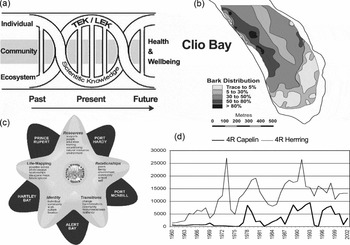
Disciplinary preferences were interesting: natural scientists, on the whole, along with some quantitative social scientists, preferred flow charts; scholars with long experience in community-based research preferred spirals (to convey feedback loops); geographers liked things to be organized spatially and historians by time period; political scientists and those with a policy concern thought in terms of spheres of influence and institutions (Fig. 2). Because of the complexity of different styles and approaches, the organizational framework that the team constructed (Fig. 1) was of vital importance. Without it, the analytical location of any one part of the work would not always have been apparent, and the integration of research results would have been much harder to achieve, since many important cross-coastal linkages would not have been identified and several highly productive cross-coastal research partnerships would not have been realized.
Examples of different disciplinary metrics: (a) feedback loops, (b) map, (c) organizational diagram and (d) graph.

In short, the knowledge of different working methods, and their acceptance, was fostered and facilitated by working together in a range of ways and by holding seminars in which team members from different disciplines met and learnt about the work that each would do on the team project, in the process identifying potential overlaps and partnerships within the team. With that kind of structure in place, it is impossible for any one part of an interdisciplinary team research enterprise to operate in a vacuum. Integration will take time and can be fostered, but cannot be forced too quickly.
Taking the time it takes to get it right
In the early stages of the CUS project, the team had a range of ways of investigating ecosystem health (such as species at risk, abundance, biodiversity, biomarker analysis of lipids), social health (such as community economic health, social well-being, determinants of health and cultural energy/creativity liveliness), the future health of communities (for example youth, education and infrastructure) and individual health (such as sickness and risk danger). Team researchers also employed various ways of assessing the manner in which social-ecological health was protected and promoted (through academic and government research, stewardship, marine protected areas, federal/provincial regulations and their history and application, and traditional or local ecological knowledge [TEK or LEK] evaluation), and the team assigned a historical component to all this work, since, just as vulnerability can be exacerbated over the long term, so resilience is also a long-term concept and can only be demonstrated over an extended period of time.It took time for all the relationships and the linkages in the research to become first apparent and then compatible in terms of joining together into a seamless whole. At start-up, the link between, for example, stewardship of eastern wetlands and oil and gas exploration in the Hecate Strait, could only be described as tenuous at best; there is an intellectual linkage, but that is a different matter from a research project linkage. Integration does not happen all at once, nor will it happen with every subcomponent simultaneously. After a year, the potential for integration in CUS was still nascent rather than real, but relationships between researchers had been established and links between different parts of the work were beginning to emerge. By the end of year two, it was possible to produce a working paper that drew all the research together into a narrative text, in which the linkages and relationships between subcomponents were clearly articulated. At this time also it became clear that Arms 1 and 2 were close to integration, and they were thus combined. Thirty months after the commencement of the CUS Project, building on that narrative, each Arm presented to a mid-term review committee set up by the funding councils, and explicitly addressed their parts of the research in terms of integration, clearly stating the linkages between Arms. On the advice of the mid-term review committee, the team created an internal position paper on ‘pathways to social-ecological health’, which explicitly laid out a way to achieve integration of all subcomponents through shared analytical thinking. Tighter integrative formulations then began to appear. This was made possible because national academic funding councils funded CUS, and the councils expected that adjustments would be needed as time went on: the purpose of the mid-term review, incorporating a site visit that explored all the work that the team were doing, was to make recommendations for improvements and adjustments. Hence the councils’ encouragement to explore the pathways involved in social-ecological health in greater detail and to discuss as a team how the interdependencies would manifest themselves in the research. At the end of the five-year funding period, the PD continued to work with team members to ensure that the major team overview volume achieved overall integration and synthesis of the work (Ommer & Team Reference Ommer and Team2007), as is discussed in more detail below.
Dissemination: both/and, not either/or
There are a range of different publishing opportunities and challenges for work like this. Integrated research requires integrated dissemination, but not necessarily exclusively so; there may also be disciplinary results that belong in scholarly journals. In CUS, the team did both, selecting the dissemination vehicle according to the requirements of the research reported. By 2007, the CUS project team had produced 10 books (six team-written) and 92 book chapters, 129 journal articles, 56 conference papers, 328 conference presentations and individual journal articles, as well as two videos. Journal articles were sometimes discipline-based and sometimes interdisciplinary, sometimes written by sub-groups of the whole team, sometimes by single authors (although the last was rare). The major overview volume (Ommer & Team Reference Ommer and Team2007) was written by the whole team; team discussions devised a way to do this, dealing in advance with many of the possible ego problems that might arise from joint authorship. After extensive discussion, and with team members expressing concern that young scholars and students had to be able to claim authorship in a manner that would work for their curricula vitae, it was agreed that researchers would, individually or in groups, submit overviews of their part of the research to me as PD; I would then organize and rewrite that material to produce a smooth text, which would then be vetted by the individual contributors. Contribution would be individually estimated on a percentage basis chapter by chapter, with the PD negotiating any disagreements; in the event there was only one disagreement and it was fixed through the generosity of one team member. The PD was then to credit all contributors accordingly in the first footnote of every chapter, thus allowing team members to be able to cite their individual contributions to the book accurately and precisely. This format was useful, because it made the precise contribution of each team member explicit, and additional footnotes took care of informants’ and communities’ contributions, as is standard. I wrote the first and concluding chapters myself, but received feedback from a small editorial committee that was representative of the team and that reviewed the whole overview volume (Ommer & Team Reference Ommer and Team2007). The process took 18 months, but we were rewarded with a truly interdisciplinary book with which all the team could identify.
Training: both the team and its students
An interdisciplinary team project like CUS also has enormous creative training potential in terms of research attitudes and understanding of the work of other scholars from different disciplines. In CUS, the team broke down some significant solitudes. This is illustrated by the following comment from a marine biologist: ‘My research is based on the theory of fisheries ecology. As a [biophysical] scientist, I practise the ‘scientific method’ in conducting research. Before my involvement in CUS, I used ‘anecdotal information’ from fishers in planning my field studies. Through my collaboration with sociologists and humanists in CUS, I learned that this ‘anecdotal information’ is actually another knowledge base relevant to my research. . . .. I have always valued FEK (fishers’ ecological knowledge), but since becoming part of CUS, I have learned that LEK is intellectual property, and must be respected and protected. Through my collaboration with sociologists and humanists in CUS, I became aware of the ethical issues involved in participatory research with fishers. . . I now obtain ethical clearance from the MUN committee before interviewing fishers. Although I was aware of the economic risks, I was oblivious to the sociological risks fishers face in granting interviews with researchers. My research in CUS has involved disseminating new [biophysical] scientific knowledge to coastal communities, empowering them with [biological] scientifically validated LEK. I am more aware of the implications of fisheries research, i.e. the power of new knowledge. I have also become involved with co-management of local marine resources. My research has broadened beyond [natural] science into management policy.’
A social scientist said: ‘The sharing of interview guides with other social scientists and scientists, and the input from scientists in terms of the conceptualization of the areas of inquiry, helped to integrate questions/ideas that explored changes in the physical and natural environment and how they impacted youth through various mechanisms. For example, the collapse of the cod fishery has led the community to develop and expand new relationships with the natural environment including an expansion of tourism based on attracting tourists to the physical beauty and historical character of community. The ‘selling’ of the physical or natural setting (i.e. tourism) has interacted with social factors (e.g. resources placed into tourist development), which have also affected youth's relationship to the physical or natural environment and the nature of their leisure activities and lifestyle (e.g. improved outdoor recreational facilities allow for easier access to and use of the natural environment for leisure activities, and alcohol is a key part of the leisure lifestyle).’
The CUS project students were also excited by working in an interdisciplinary project. Indeed, they were a motivating force for interdisciplinarity. Their written joint response to my request to document their experience was that, ‘interdisciplinarity is a philosophy, an art form – it is a synchronicity of questions, of viewpoints, and methods, focused on a problem of common concern. It is more than sharing views or coordinating methods [among the team members].’ The team encouraged and facilitated this perspective, holding seminars in which various team members explained their disciplines’ approaches and methodologies to the problems with which we were concerned in accessible language, for a group that often comprised other faculty as well as students. For students who were open to participating fully in the project and enthusiastic about the distinctive opportunity provided for academic growth, the intellectual benefits of team research were considerable.
DISCUSSION AND CONCLUSIONS: LESSONS LEARNED
If there is no need to cross a disciplinary boundary, there is no need for interdisciplinarity; strong disciplines are important in and of themselves, and they also lay the basis for good interdisciplinarity when that is required. Moreover, not everyone is of an interdisciplinary orientation, and it lies with those scholars who are not interested in interdisciplinary work to keep disciplines strong and healthy. It follows, then, that interdisciplinarity is successful when it is carefully and appropriately applied, and not forced. It should be promoted pragmatically; if seen as a useful applied tool where complex problems exist, it avoids the perils of reductionism. Intellectually speaking, everyone benefits. Previously neglected or unknown linkages are identified, new metaphors are found that lead to new questions, and reappraisals are encouraged. Finally, there is everything to gain and nothing to lose in fostering such work, provided interdisciplinarity does not become the new research rubric or fashion; it should remain one tool among many, to be used as appropriate.
The fundamental added value of interdisciplinary work, as exemplified through the example of CUS methodology for team research, is that it can tackle complex problems that cross beyond one discipline's expertise, and do so in a nuanced manner, without having to be reductionist. Some problems are simply too big, and too interconnected to be dealt with from the perspective of individual disciplines. Such was the stress facing coastal communities and ecosystems in Canada that the CUS team examined, and their methodology permitted them to move beyond simplistic formulaic analyses (such as the reductionist explanation of overfishing as simply ‘too many people chasing too few fish’) to an understanding of why resource management strategies had been failing, what policies to date had failed to solve the problem, what unintended impacts specific aspects of various policies had had on coastal communities, and hence what could be done to alleviate the situation. It also facilitated identification of the latent strengths in the study communities and enriched discussions with local people about what they needed in order to improve their situations. It became clear that local strengths had too often been ignored, and that the fundamental social cohesion of communities not only still held, but was protecting community and personal health to some degree. The team also came to understand that many coastal problems could be meaningfully addressed by generating policies which are sensitive to complexity and thus are able to take the local perspective into account, thereby increasing the probability of the community embracing the implementation of such policies. Most importantly, just as CUS methodology pointed to the importance of seeing from beyond one disciplinary perspective, so the research results showed that governance needs to move beyond the confines of the single government department, and use cross-discipline and cross-department wisdom. Key to the success of any interdisciplinary research is the shared vision or concern, which captures the synergies that are the huge reward in research of this kind and holds researchers together. In short, the methodological approach developed by CUS could fruitfully be applied in resource management and other aspects of governance more widely.
This is the other major important achievement of interdisciplinarity; it can generate new forms of knowledge that point to strategies that facilitate the building of the kind of partnerships, vision and leadership essential for good governance under the complex social-ecological changes that have happened and those that await the world. In this age of political, economic, biogenic, environmental and climatological uncertainty, scientists (social, natural and health), in their role as servants of society, need to try new things, including those experiments in group research and administration that may then be adaptable to resource management, assisting it in reconciling top-down and bottom-up governance approaches in a way that facilitates insightful policy recommendations, enhances the potential for local acceptance and thus improves social-ecological health outcomes.
The legacy of the CUS project is that it crafted, tested and carried out an interdisciplinary team methodology that can address the kinds of issues that affect coastal zones and other natural resource locations; CUS examined not only fish and fisheries, but also forests, mining, and oil and gas, the overlapping resource complexes of the two study coasts, and thus investigated the social-ecological health of all the natural resources of both study coasts.
A growing number of studies concern themselves with natural resource issues, and these and future work need to be able to generate the kind of policy implications that will address such complex, interdependent and multi-scale problems, which will not be adequately solved from within single disciplines or departments. The CUS model works, and demonstrates that: (1) adequate time (at least 5 years, plus another two for dissemination) is required; (2) significant joint social and natural science funding is crucial; (3) a dedicated PD willing to devote the time out of a personal career is needed; (4) team members need to be able to work in an interdisciplinary environment, which means being able to leave personal egos aside; (5) appropriate team and research structures are vitally important; (6) integration needs constant ongoing attention; and (7) the project will fail if there is not a shared research vision and mutual trust and respect among team members. These take time to achieve to the satisfaction of all players, but they are essential to successful interdisciplinary team research.
ACKNOWLEDGEMENTS
I thank McGill-Queen's University Press for permission to use some text from Ommer and Team (2007, pp. 9–10) in this paper. I thank the Social Sciences and Humanities Research Council of Canada and the Natural Sciences and Engineering Council of Canada for funding with which to conduct the Coasts Under Stress research project. Finally, I thank Nicholas Polunin and Annette Breckwoldt for detailed guidance during the writing of this paper, and gratefully acknowledge the work of the two reviewers, whose thoughtful and detailed comments have added greatly to the paper's value; my thanks also to Gillian Wilson, copy editor, whose attention to detail was greatly appreciated.